California Natives · Season Two · No. 15
Yarrow: Nobody Quite Agrees What You're Buying
A field guide to Achillea millefolium, the flat-topped white perennial in every native plant sale and every European meadow. Why the world's major plant authorities can't agree what the name covers, and why the most native-sounding label on the bench is the name of the introduced plant.
On this page
16 sections
- About the Plant
- What You're Looking At
- Three Authorities, Three Different Plants
- The Common Name Does Two Jobs
- The Experiment in the Sierra
- So Can You Tell by Looking?
- What the Choice Costs You in Bees
- The Nursery Bench
- Water: What's Measured and What Isn't
- It Spreads
- Planting It This Autumn
- Handling It
- Sourcing
- A Footnote for the Curious
- The Takeaway
- Quick Reference
About the Plant
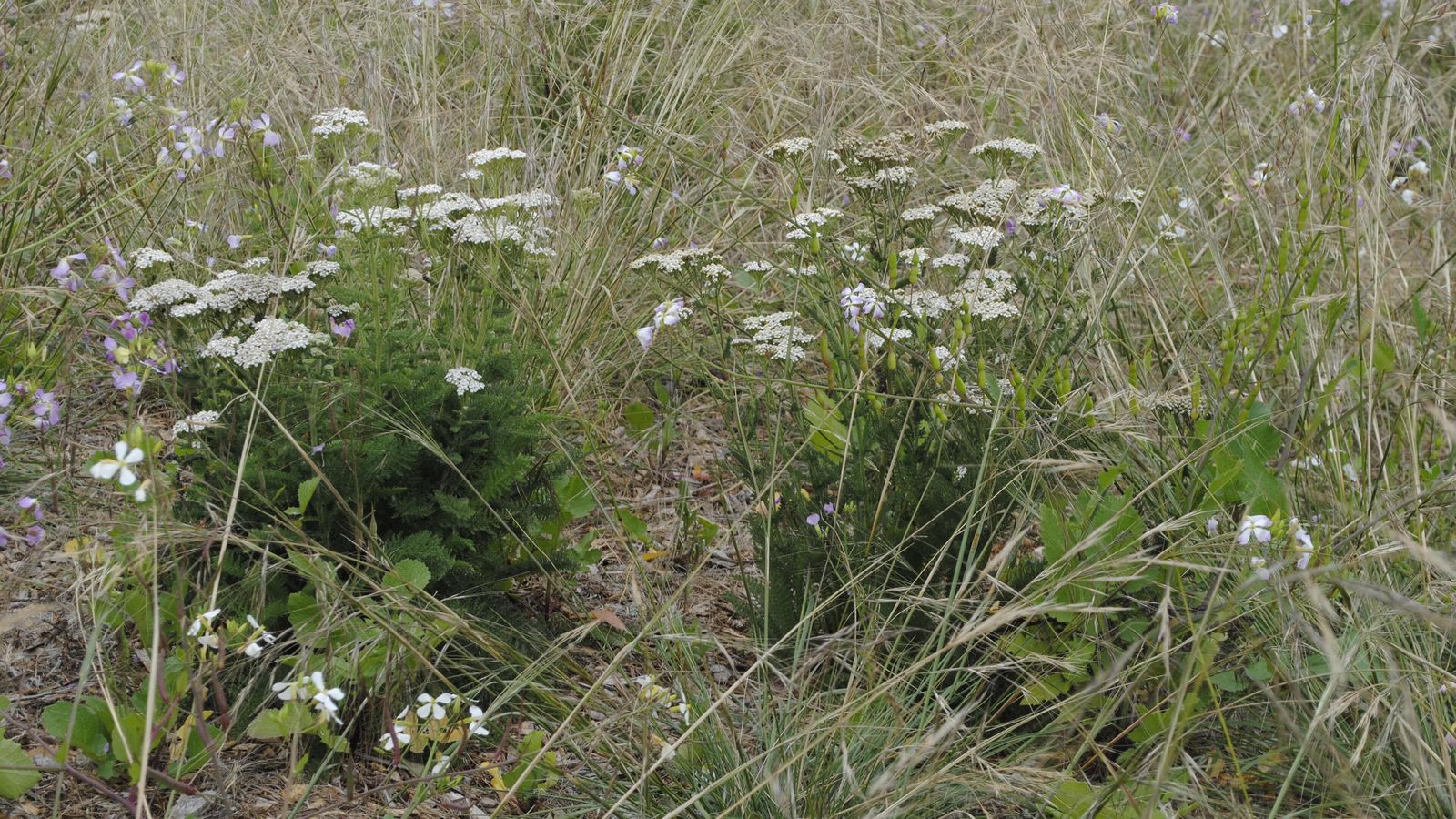
Yarrow is the plant everybody recommends to beginners, and it deserves it. Flat white flower heads on knee-high stems, foliage so finely cut it reads as a haze from ten feet away, no interest in being fussed over, and a flowering season long enough that you stop noticing when it started.
It's also the hardest plant in the native aisle to buy knowing what you've got. That isn't a complaint about nurseries; it goes back further than the nursery. The major plant authorities attach the name Achillea millefolium to different circumscriptions, and the most native-sounding common name in the trade is used by at least one federal document for the European plant.
What You're Looking At
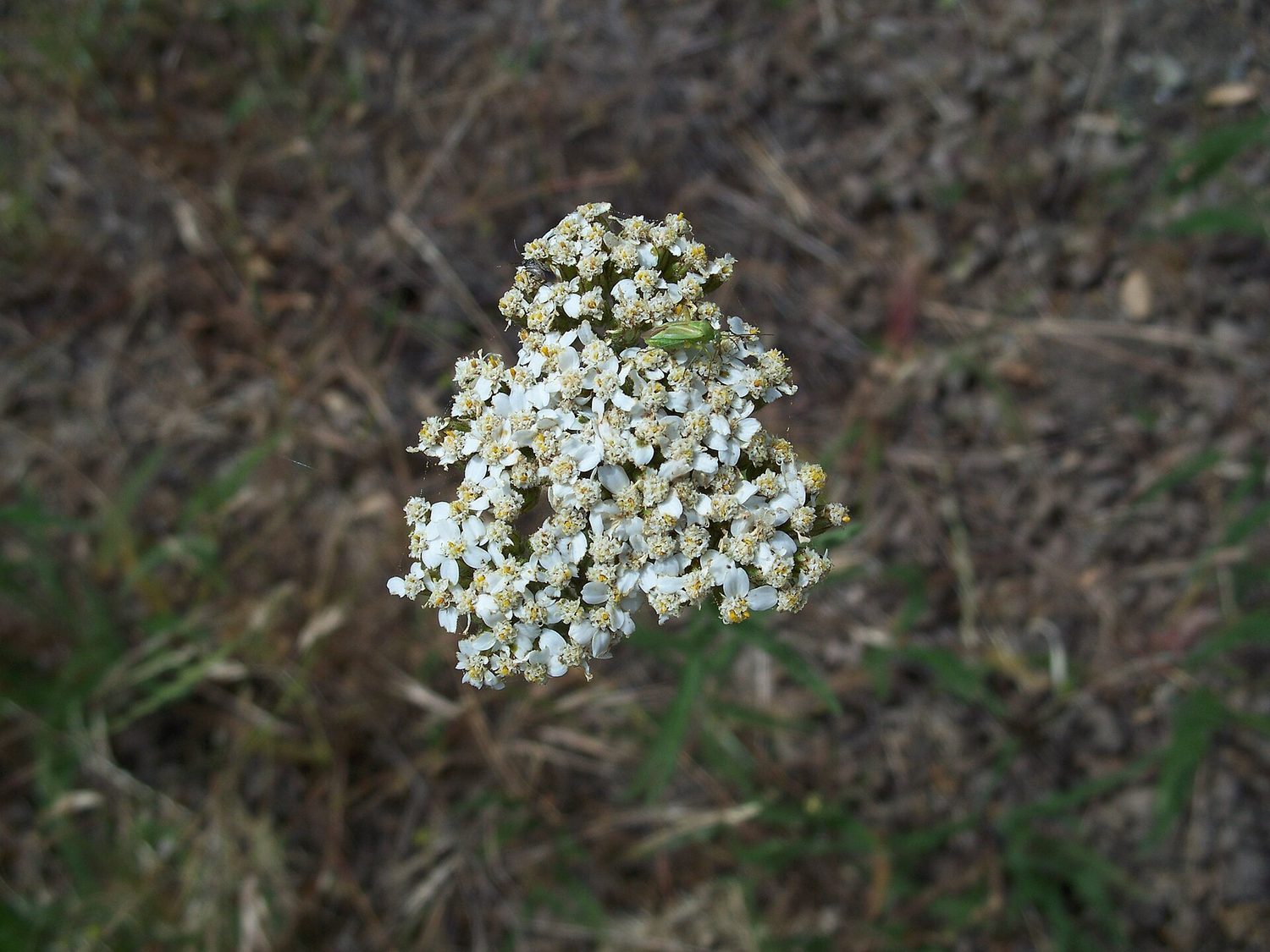
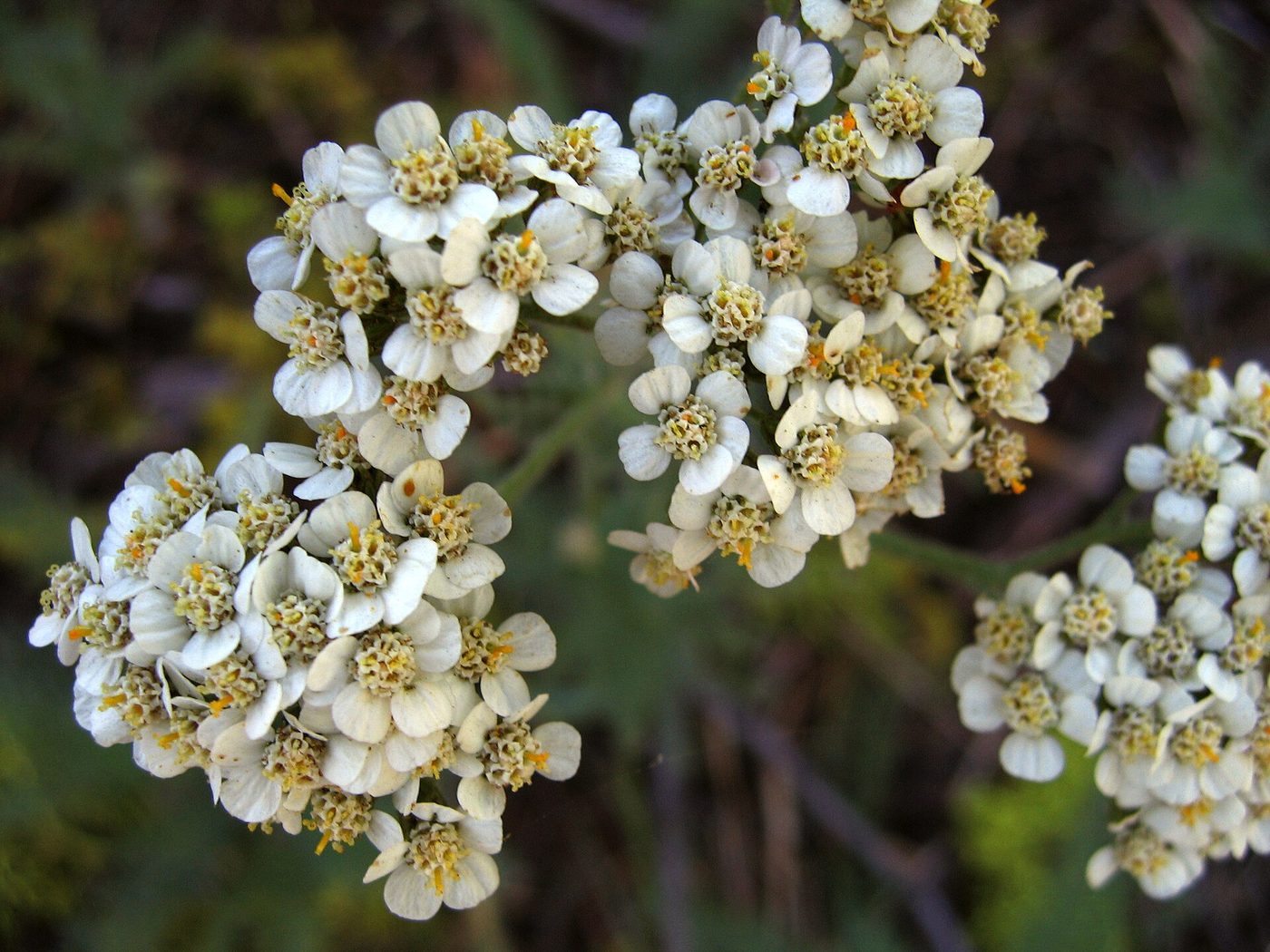
Flora of North America's description opens: perennials, 6 to 65+ cm, usually rhizomatous, sometimes stoloniferous (Flora of North America Editorial Committee, 2006). Rhizomatous means it travels by underground stems; stoloniferous means it sometimes runs along the surface too. The leaves are the giveaway, divided and redivided until each one looks like a small fern frond. The flower heads are crowded into flat or slightly domed clusters, usually white, sometimes pink in wild populations. If you want that flat top taken apart under a hand lens, the Flower Library entry on the corymb is built on this plant.
Height is where the sources part company, and you want to know that before you plan a bed. Those 6 to 65+ cm work out to about 2.5 to 26 inches. It runs 12 to 39 inches (30 to 100 cm) in the Forest Service's account, which calls it a perennial forb, meaning a non-woody flowering plant, with extensive rhizomes (Aleksoff, 1999). Extension services offer figures that fit neither. Plan on something knee-high in flower and treat any single published number with suspicion.
Habitat tolerance is the easy part. Flora of North America's list runs from pasture and meadow to roadside, streamside and woodland, takes in waste ground, and covers soils dry and sandy at one end, damp, heavy with clay or salty at the other, at any elevation from sea level to 3,600 m, about 11,800 feet (Flora of North America Editorial Committee, 2006). There isn't much it refuses.
Three Authorities, Three Different Plants
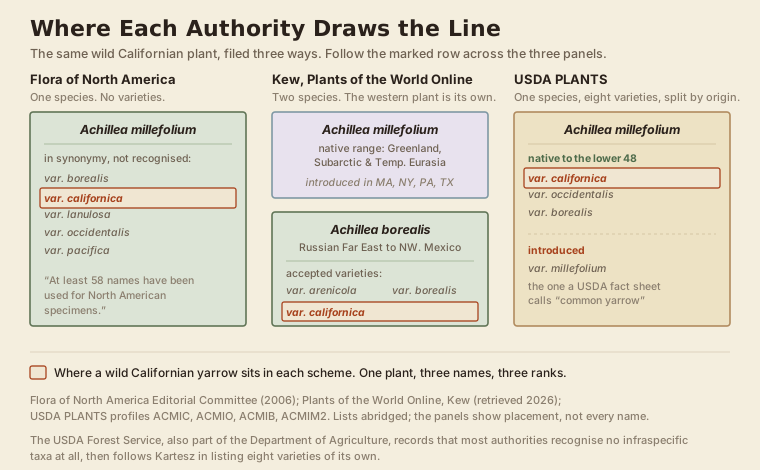
Flora of North America treats Achillea millefolium as one species and files the western names as synonyms of it, names it treats as duplicates rather than as plants in their own right, among them var. borealis, var. californica, var. lanulosa, var. occidentalis and var. pacifica. Its discussion is candid about why this is hard. The plant's form varies widely. Botanists have met that either by keeping one species and dividing it into varieties or by cutting it into separate species outright, and North American specimens have carried at least fifty-eight names between them (Flora of North America Editorial Committee, 2006). Fifty-eight names, for a plant that may or may not be one plant.
Kew's Plants of the World Online answers differently. It treats Achillea borealis Bong. as an accepted species whose native range it gives as "Russian Far East to NW. Mexico", and lists among its accepted varieties Achillea borealis var. californica (Plants of the World Online, 2026a). For Achillea millefolium it gives a native range of "Greenland, Subarctic & Temp. Eurasia", and records the plant as introduced into a long list of places including Massachusetts, New York, Pennsylvania and Texas (Plants of the World Online, 2026b). So the Californian plant that USDA files as a variety of millefolium, Kew files as a variety of a different species.
Both of those range lines are Kew's own wording, printed in its abbreviated house style. NW. is northwest and Temp. is temperate, and the Eurasian label covers Greenland plus the subarctic and temperate belt of Europe and Asia: the cold and cool-temperate north of the Old World, with no part of the Americas in it but Greenland. Bong. is doing a different job. It's the naming authority: August Gustav Heinrich von Bongard, who published Achillea borealis in 1832 (International Plant Names Index, 2026), in the way the L. after Achillea millefolium stands for Linnaeus.
USDA PLANTS, the Department of Agriculture's own database, keeps one species with eight accepted varieties and splits native from introduced between them. Its records give var. californica, var. occidentalis and var. borealis as native to the lower 48 states, and var. millefolium as introduced there.
The Forest Service, also part of the Department of Agriculture, complicates its own house position. Its species review states that most authorities recognise no ranks at all below the species here, then adds "however, Kartesz recognizes the following varieties" and lists eight of them, which it uses throughout (Aleksoff, 1999).
So the two great floras disagree with each other, and one federal agency disagrees with itself twice over. None of this is sloppiness. It's what a hard group looks like when careful people work on it. The Forest Service, citing Cronquist and colleagues, puts the failure on the record: the variation within the species "has frustrated all efforts to organize an intraspecific taxonomy on a circumboreal or even a strictly North American basis" (Aleksoff, 1999). In plainer words, the plant differs in its shape, in where it grows and in what it grows in, all at once, and nobody has turned that into a workable set of names below the rank of species, either around the northern hemisphere or within North America on its own.
The Common Name Does Two Jobs
The USDA Natural Resources Conservation Service publishes a plant fact sheet on western yarrow, the native western North American plant. Under the heading Weediness it tells the reader not to confuse western yarrow with "the introduced, invasive plant, common yarrow (Achillea millefolium var. millefolium)". It puts that plant's origins in Eurasia, continental Europe and the islands of Scandinavia, and separates it from the western native on four counts: it stands taller, grows more aggressively, behaves more weedily, and comes into flower and ripens its seed later in the season (U.S. Department of Agriculture, Natural Resources Conservation Service, n.d.).
In that document, the name common yarrow belongs to the European variety. It's also the friendliest, most native-sounding phrase on any plant tag in the aisle.
The Forest Service species review cited throughout this entry is itself titled Achillea millefolium, common yarrow, and uses the phrase for the whole species, native phases included (Aleksoff, 1999). One arm of the Department of Agriculture uses common yarrow for a single introduced variety; another uses it for everything. The name is doing two jobs at two different ranks inside one agency. So a label reading common yarrow tells you less than it appears to.
The Experiment in the Sierra
The reason origin matters to a garden was settled eighty years ago, on a transect that runs right past us. A transect is a line of study sites laid out across changing conditions; this one climbs from the bay to the Sierra crest.
Clausen, Keck and Hiesey, of the Carnegie Institution's Division of Plant Biology, worked with fourteen wild yarrow populations. The plants themselves were raised at Stanford from seed collected in the wild, and the thirty individuals of each population used in the transplant were selected from a random sample of sixty such seedlings. In 1942, as they put it, "approximately 30 individuals of each of fourteen populations were divided into three parts and planted in the gardens at Stanford, Mather, and Timberline" (Clausen, Keck, & Hiesey, 1948). Stanford sat at 30 m, barely above the bay. Mather was on the Sierra Nevada's western slope at 1,400 m, about 4,600 feet. Timberline was over the crest in Slate Creek Valley at 3,050 m, roughly 10,000 feet, and close to the altitude where trees give out. Same genetic individual, three addresses.
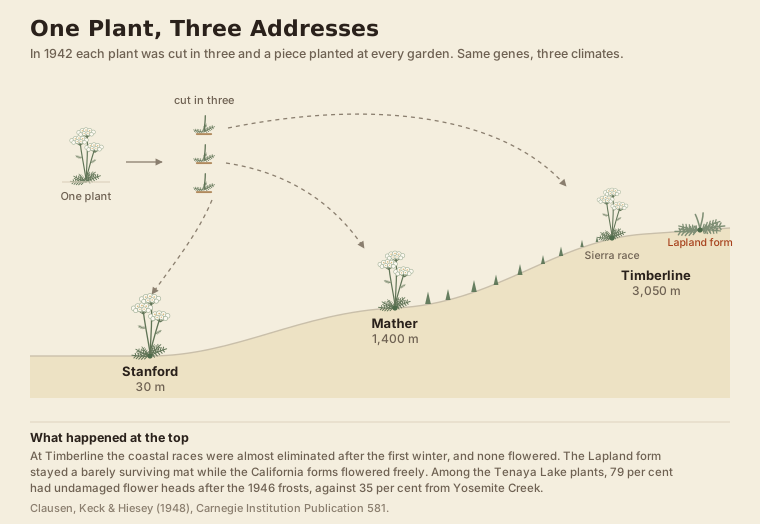
The results aren't subtle. Under the extreme conditions at Timberline, they wrote, "the coastal races were almost eliminated after the first winter, and none flowered." Set against that, a long frosty spell in 1946 handed them a test of the mountain races. Of the plants raised from Tenaya Lake seed, high in the Sierra, 79 per cent came through it with their flower heads undamaged, against 35 per cent of the plants from Yosemite Creek, and the Tenaya Lake plants ripen seed at Timberline in most years (Clausen, Keck, & Hiesey, 1948).
Their own summary of the design is the line worth keeping: the three stations "serve as a climatic sieve by which the populations may be sorted into distinguishable ecological units" (Clausen, Keck, & Hiesey, 1948). The logic behind it, in their words: "When climatic races from many diverse environments are brought into one garden, we see their genetic differences expressed under one set of conditions." A climatic race is a population shaped by the climate it grew up in, distinct enough to behave differently once it is moved. The sieve is the three gardens together: each one passes only the races that can live at that altitude.
In the taxonomy those authors used, the Californian plants on that transect were not Achillea millefolium. Summarising their own earlier treatment, they wrote that "A. millefolium L. is considered to be native only in the Old World" (Clausen, Keck, & Hiesey, 1948), which left the European populations as the only true millefolium in the experiment. And at Timberline, they recorded, "the California forms develop vigorously with abundant flowering, and the Lapland form remains a low, barely surviving vegetative mat" (Clausen, Keck, & Hiesey, 1948).
The European yarrow was the one that couldn't do a Sierra winter.
Three honest corrections, because this study gets repeated loosely. Clausen, Keck and Hiesey did not invent the ecotype, the idea that a widespread species breaks into locally adapted races, and they say so in their own first paragraph: these races "were first studied experimentally by Turesson (1922), who named them ecotypes, a term and concept universally accepted" (Clausen, Keck, & Hiesey, 1948). Their term for the design is transplant stations, which is the phrase this entry uses; the modern labels came later. And the differences did not simply hold steady from garden to garden, since the volume records reversals where a population flowers later than another at Stanford and earlier at Mather. What held is their own formulation: "although the individuals and populations vary, the races are statistically and reactionally distinct" (Clausen, Keck, & Hiesey, 1948).
One citation note for anyone following this up. The yarrow work is Volume III of the series, issued as Carnegie Institution of Washington Publication 581, whose copyright page records a first printing in 1948. Publication 520 of 1940 is Volume I of the same series and a different book, and it is the one most often reached for by mistake.
So Can You Tell by Looking?
Mostly not, and we'd rather give you that flat than dress it up.
North America carries both native and introduced forms of the plant, the Forest Service records, and the two interbreed freely where they meet. The same review adds, on the authority of the sources it cites, that what mainly separates them is the number of chromosomes they hold rather than anything a person could see (Aleksoff, 1999). Chromosome number isn't a garden observation, and hybridizing phases mean a correct answer today may not stay correct in a population over time.
Two things stop us from making that any stronger. The same document, in a different section, draws a contrast: the typical European plant is hexaploid, carrying six sets of chromosomes, and holds its leaves flat, while the native forms are mostly tetraploid, with four sets, and set their narrow leaf segments on several planes at once, so the leaf reads as a three-dimensional thing rather than a flat one (Aleksoff, 1999). Half of that contrast is countable and half is visible. And Flora of North America lists the physical features botanists have reached for when trying to split these populations up: how much felty hair a plant carries and how long it keeps it; the colour of the margins of the phyllaries, the small bracts sitting under each flower head; the shape of the flower clusters; and how finely the leaves are cut. It then attributes variation in several of them to latitude, elevation and habitat, and closes that these are only trends (Flora of North America Editorial Committee, 2006).
A difference that is real, that leaves visible traces, that varies with where the plant grew as much as with what it is, and that no source we found has turned into a key a gardener could use. If someone tells you they can spot European yarrow across a nursery bench, they're telling you about their confidence, not about the plant.
What the Choice Costs You in Bees
If you can't reliably tell native from introduced, it's fair to ask whether any of this changes what you do on a Saturday. For provenance itself, we found no study that priced it for a garden. For the cultivar question, somebody has run the experiment.
Hayes and colleagues established a garden experiment in Corvallis, Oregon, to examine pollinator visitation and utilization of Pacific Northwest native plant species and cultivars. Over three years they collected and observed bees, butterflies and syrphid flies, which are hoverflies (Hayes et al., 2025). Yarrow was in it, with wild-type Achillea millefolium set against 'Moonshine' and 'Salmon Beauty'. Their Table 2 gives observed species richness of 21 on the wild type, 15 on 'Moonshine' and 14 on 'Salmon Beauty', and in the bee column alone, 16 species on the wild type against 8 on each cultivar. Across the whole trial, they report, the native plant drew a wider range of species than any cultivar in every insect group but one.
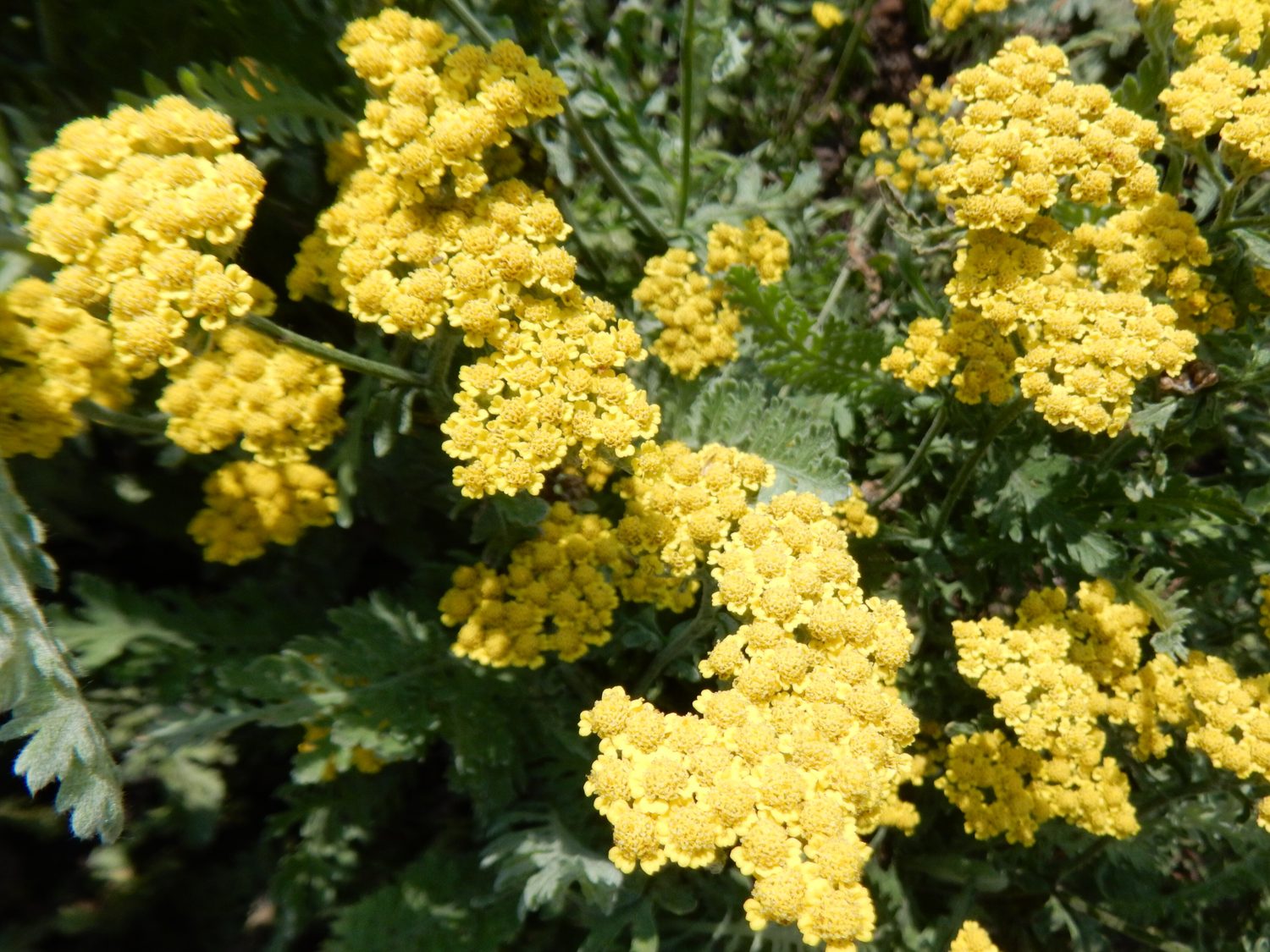
Three limits, and the first is the one that matters. Table 2 also carries Chao1 estimates beside the observed counts, and those run 41 for the wild type, 20 for 'Moonshine' and 41 for 'Salmon Beauty'. Chao1 estimates how many species were really there, including the ones nobody happened to catch, by looking at how many turned up only once or twice: a lot of single sightings implies more went unseen. On the estimate rather than the count, 'Salmon Beauty' is level with the wild plant. The bee comparison, 16 against 8 and 8, is observed richness and is not affected. Second, the study sampled bees, butterflies and hoverflies only, so 21 is not a count of everything that visited. Third, Corvallis has summer rain where Santa Clara County does not.
So: one garden, well run, in the wrong climate, with an estimator that complicates the headline and leaves the bee result standing. It is the only measured answer we found to the question this entry is about, and on bees it says the plain plant carries twice the species the improved ones do.
The Nursery Bench
In September 2026 we searched Crossref, the register where publishers file a record of nearly every scholarly article, on the cultivar names together with Achillea. Alongside it we searched the International Cultivar Registration Authority list, the United States plant patent record, and the plant databases of Kew, the Royal Horticultural Society, Missouri Botanical Garden and Chicago Botanic Garden. None of them turned up a study of Achillea cultivar parentage. What the trade knows about these plants' ancestry appears to have been copied between catalogues rather than established.
'Moonshine' shows the shape of the problem. Cambridge University Botanic Garden and Missouri Botanical Garden both state its parentage as A. clypeolata crossed with A. 'Taygetea', each as a bare assertion on a plant page. The Royal Horticultural Society's entry for the same plant lists family, habit and name status and stops there. The one breeder-generated document we found, a United States plant patent for a related introduction, describes its pollen parent as Achillea millefolium 'Moonshine', which places the plant somewhere else again. And the putative parent "taygetea" appears at three different taxonomic ranks across three institutions: as a hybrid at Chicago Botanic Garden, as a species at Ohio State, and as a cultivar at Cambridge and Missouri. For a question about what you're actually buying, that disagreement among the institutions is a harder fact than any of the parentage claims individually.
Summer Pastels is the one clean record. All-America Selections lists it as Variety Name Summer Pastels F2, Genus Achillea, Species millefolium, Year 1990, Winner Type National, Type Flowers from Seed, Breeder K. Sahin, Zaden B.V. One awarded variety from a Dutch seed house, raised from seed, filed under the European species.
None of this makes the cultivars bad plants. 'Moonshine' is a good garden plant and we won't pretend otherwise. It does mean that "yarrow" on a label and "native yarrow" on a label are not claims anyone has audited, and the bee numbers above are the strongest reason to walk past them.
Water: What's Measured and What Isn't
Yarrow's drought tolerance is asserted almost everywhere, and the measurement behind it is thinner than the confidence.
The standard California reference for landscape water use rates yarrow as low-water in the Bay Area region. Its Method section is candid about what it is: the ratings are "subjective evaluations" made to a standard format, resting on the experience and observations of the people taking part alongside whatever research was to hand. Further on, under Making Water Needs Assignments, it records that each species landed in a single water category "as determined by consensus of each regional committee". The numeric bands behind those categories were extrapolated from figures worked out for related farm crops, citrus, walnuts and cherries among them, and for some landscape species (Costello & Jones, 1994). An expert panel's judgment, calibrated partly against orchard trees. A reasonable basis for a planting decision, and not a measurement of yarrow.
We searched Crossref and the horticultural literature in September 2026 for deficit-irrigation and landscape-perennial water-use trials, then read the plant lists of the three nearest published trials of ornamental perennials. We found none that included Achillea. The measured drought work that does exist is greenhouse pot work on a horticultural cultivar in New Mexico and on unspecified material in Iran, in soilless substrate, and what it measures is the plant under stress.
Drought tolerance differs from one local race to the next, according to the Forest Service's California profile, which also has the plant turning up mostly in damp hollows and meadows in the southern California lowlands (Montalvo et al., 2010). Which is this entry's theme again. Whether your yarrow shrugs off August may depend on where its ancestors came from, and the tag won't tell you.
Practically: water it through its first dry season, then taper and watch. It'll almost certainly be fine. Just don't let anyone tell you that's a measured fact.
It Spreads
Usually rhizomatous, sometimes stoloniferous: that is the first line of the description in Flora of North America (Flora of North America Editorial Committee, 2006). The Forest Service records extensive rhizomes (Aleksoff, 1999), and its California profile warns that it can take over a garden if you place it carelessly (Montalvo et al., 2010).
The best illustration is an accident in the record. The Chicago Botanic Garden ran a four-year evaluation of 42 kinds of yarrow and found the spreading ones grew fast enough that it couldn't get a usable width out of them after the first season. Plants had gone in 46 to 61 cm apart, 18 to 24 inches, and by the second season there was no gap left between them. The report's own summary of the problem: "widths were not routinely recorded due to the vigorous spreading nature of the plants" (Hawke, 1994).
A botanic garden with a four-year budget and a measuring tape stopped measuring the spread. Take that as your planting guidance. Site it where a slow traveller is welcome, not in a tight mixed border you've planned to the inch. That trial ran in Illinois on irrigated and fertilised beds, so the pace in an unirrigated Bay Area garden will be gentler. The direction is the same.
Every spread figure we traced runs back through the Forest Service accounts to a handful of 1980s papers behind publisher paywalls, so this entry gives no rate rather than repeating one at second hand.
Planting It This Autumn
Same argument as the rest of the pillar, and yarrow makes it easily. Put a container plant in the ground in October or November and the winter rains do the establishment for you. Full sun: the Forest Service records that across its range the plant sits mostly on dry, open ground, in habitats of many kinds, and that it won't take deep shade (Aleksoff, 1999).
On seed set, the Forest Service's California profile calls it generally an obligate outcrossing species and self-incompatible, and notes that apomixis has been found in species within the Achillea millefolium complex in Europe with the extent not known (Montalvo et al., 2010). Plant several, and more than one clone if the nursery can manage it. And because it travels, give it an edge it can meet: a path or a strip of gravel does more for a tidy bed than any amount of later editing.
Buy plants rather than sowing seed for a first planting, because the germination guidance conflicts. The Natural Resources Conservation Service's Montana plant guide says seed wants a month of cold stratification, a spell of cold and damp that breaks its dormancy, plus direct sunlight before it will germinate. Two answers come back at once from the Forest Service's California profile: USDA fact sheets saying western North American seed germinates with no pre-treatment at all, and Stevens and colleagues reporting that seed from some sources wants as much as two weeks of cool, damp conditions first (Montalvo et al., 2010). One month, two weeks, or none, and which applies depends on where your seed came from.
Handling It
Yarrow is a recognised contact sensitiser and belongs to the family dermatology clinics patch-test for. It's also at the mild end of that family.
Salapovic and colleagues quantified the allergenic sesquiterpene lactones, the compounds behind contact allergy in the daisy family, across several plant extracts. The pattern ran the way you'd expect. The two extracts richest in those compounds, feverfew and tansy, produced the most patch-test reactions; the two poorest in them, German chamomile and yarrow, produced significantly fewer. Their measured figures put tansy at 11 per cent allergenic sesquiterpene lactones, arnica at 3 per cent and yarrow at 2 per cent (Salapovic et al., 2013). Practically: if you already know you react to daisies, chrysanthemums or feverfew, wear gloves when you cut a lot of yarrow back. If you don't, this is not a plant to worry about.
Yarrow is also widely described as causing photosensitivity, and we went looking for the clinical source. I searched and found nothing: no case report, no case series, no dermatological study documenting a phototoxic or photoallergic reaction to this plant, across nine search routes through PubMed and Europe PMC in September 2026, including queries pairing Achillea with phototoxic, photoallergic, photosensitivity and photodermatitis. What does exist points the other way. The European Medicines Agency's draft assessment report relays a 2001 source which found that alcoholic extracts made from the plant's dried leaves and stalks produced no phototoxic response under clinical testing (European Medicines Agency, 2010). That is a relay of an unnamed compilation rather than a study anyone can go and read, and the same paragraph records that in provocation testing, patients reacted to a Compositae mix that contained yarrow, as well as to yarrow itself. So the contact-allergy finding above stands, and the light claim has one negative test behind it and no positive one.
The genuine relationship between yarrow and light is more interesting than the warning it became. Chronic actinic dermatitis, a light-sensitive condition, appears as a complication in some patients who have contact allergy to the daisy family. That's a property of certain patients rather than of the plant. This entry is not medical advice and gives none; it reports that the widely repeated garden warning did not turn up a clinical source.
Sourcing
Buy it from a California Native Plant Society (CNPS) chapter nursery, and ask two questions:
- Is this wild-type, or a named selection?
- Do you know where the seed came from?
The provenance question isn't fussiness, and it isn't answerable from the plant. The Forest Service's California profile puts it plainly: farm-grown seed is on sale from the major seed companies, but "information about the source of the seeds is often obscure" (Montalvo et al., 2010). Certified source-identified native seed does exist, and the fact that such releases have to be separately named and certified tells you what ordinary trade seed is not.
The CNPS Santa Clara Valley chapter runs its nursery at Hidden Villa in Los Altos Hills with event-based sales, including an autumn one, which is the right season for this plant anyway. Chapter nurseries are also the sellers most likely to give you a straight answer about provenance, because tracking it is the point of the operation.
If a nursery can't tell you, that isn't a scandal. It's the ordinary condition of this plant in the trade, and now you know why.
A Footnote for the Curious
The chromosome story underneath all of this is strange.
The chromosome line for Achillea millefolium in Flora of North America lists counts of 18, 27, 36, 45, 54, 63 and 72, European material included (Flora of North America Editorial Committee, 2006). Nine is the base number, so that is every multiple from two sets through eight, including the odd ones at three, five and seven where different ploidy levels have crossed. That's not one species. It's a swarm.
The people who work on this group are direct about where it leaves them. Guo and colleagues open the discussion of their study of the group's family tree by restating the problem they set out to address: "at the polyploid level, species are difficult to define either by morphology or by molecular data" (Guo et al., 2012). The same paper describes the northern-hemisphere Achillea millefolium group as varying widely in both form and genetics, and as living across a broad range of conditions.
Which is the formal version of what Clausen, Keck and Hiesey showed with a knife and three gardens. Yarrow isn't one thing, and the label was never going to manage it.
Quick Reference
- Sun: Full sun. It sits mostly on dry, open ground across its range, on the Forest Service's account, and will not take deep shade.
- Water: Low, with an honest caveat: the standard low-water rating is expert consensus rather than measurement, and the searches described in this entry turned up no landscape irrigation trial that included this plant. Water a first-year plant through its first dry season, then taper.
- Soil: Almost anything. In Flora of North America it turns up on soils running from dry and sandy to damp, heavy with clay or salty, at any elevation from sea level to about 11,800 ft (3,600 m). Drainage matters more than fertility.
- Hardiness: Not a consideration in any Bay Area garden. Extension sources put the cold end somewhere between zone 3 and zone 4, and disagree.
- Bloom: Late April to early July in the south of its range, according to Flora of North America; in the Forest Service's California profile the variety californica runs March through June. Deadheading extends it.
- Size: The sources disagree: about 2.5 to 26 in (6 to 65+ cm) in Flora of North America, 12 to 39 in (30 to 100 cm) from the Forest Service. Plan on knee-high in flower, and wider every year.
- Habit: Usually rhizomatous, spreading by underground stems, and sometimes stoloniferous, running along the surface, in the Flora of North America description. Feathery finely divided leaves in a low mat, flat-topped flower clusters on upright stems.
- Pollination: Insect, generalist, and described as generally self-incompatible, so plant more than one.
- Plant in: Autumn, with the rest of the pillar. Its roots do their work in the wet months.
- Source from: California Native Plant Society (CNPS) chapter sales, and ask for wild-type plants of known local provenance instead of a named cultivar.
- What to avoid: Assuming the label tells you the provenance; buying a named cultivar if pollinators are the point; planting it where a slow traveller would be a problem; trusting any single published height.
The Takeaway
Yarrow is worth growing and almost impossible to buy precisely. Three major authorities attach the name to three different circumscriptions, the most native-sounding common name is used by one USDA document for the European variety, and squinting at the foliage will not settle it, because the Forest Service reports the difference is mainly one of chromosome number. Choose well anyway: buy wild-type plants from a chapter nursery that knows where its seed came from, skip the named cultivars if you're planting for bees, put it in full sun in autumn, and accept that it will be somewhere slightly different every year. Next in the series, blue elderberry, and the single 1983 poisoning case that quietly underwrites every warning you have ever read about it.
Sources
Aleksoff, K. (1999). Achillea millefolium, common yarrow. In Fire Effects Information System. U.S. Department of Agriculture, Forest Service, Rocky Mountain Research Station, Fire Sciences Laboratory. https://doi.org/10.2737/feis-species-review-achmil
Clausen, J., Keck, D. D., & Hiesey, W. M. (1948). Experimental studies on the nature of species. III. Environmental responses of climatic races of Achillea (Carnegie Institution of Washington Publication 581). Carnegie Institution of Washington. https://archive.org/details/experimentals58131972clau
Costello, L. R., & Jones, K. S. (1994). WUCOLS: Water use classification of landscape species. University of California Cooperative Extension and California Department of Water Resources. https://ucanr.edu/sites/oc/files/132534.pdf
European Medicines Agency, Committee on Herbal Medicinal Products. (2010). Assessment report on Achillea millefolium L., flos (EMA/HMPC/149343/2010). https://www.ema.europa.eu/en/documents/herbal-report/draft-assessment-report-achillea-millefolium-l-flos_en.pdf
Flora of North America Editorial Committee (Eds.). (2006). Achillea millefolium Linnaeus. In Flora of North America north of Mexico (Vol. 19, pp. 491-493). Oxford University Press. http://www.efloras.org/florataxon.aspx?flora_id=1&taxon_id=200023010
Guo, Y.-P., Wang, S.-Z., Vogl, C., & Ehrendorfer, F. (2012). Nuclear and plastid haplotypes suggest rapid diploid and polyploid speciation in the N Hemisphere Achillea millefolium complex (Asteraceae). BMC Evolutionary Biology, 12, Article 2. https://doi.org/10.1186/1471-2148-12-2
Hawke, R. G. (1994). A performance report of cultivated yarrows (Achillea) (Plant Evaluation Notes No. 5). Chicago Botanic Garden. https://www.chicagobotanic.org/downloads/planteval_notes/no5_yarrow.pdf
Hayes, J. J.-M., Bell, N. C., Best, L. R., Bruslind, S. R., Johnson, D. O., Mead, M. E., Spofford, T. S., & Langellotto, G. A. (2025). Pacific Northwest native plants and native cultivars, part I: Pollinator visitation. Environmental Entomology, 54(1), 199-214. https://doi.org/10.1093/ee/nvae126
International Plant Names Index. (2026). Achillea borealis Bong. (name record 2286-2). Royal Botanic Gardens Kew, Harvard University Herbaria & Libraries, and Australian National Herbarium. Retrieved September 20, 2026, from https://www.ipni.org/n/2286-2
Montalvo, A. M., Goode, L. K., & Beyers, J. L. (2010). Plant profile for Achillea millefolium. Native Plant Recommendations for Southern California Ecoregions. Riverside-Corona Resource Conservation District and U.S. Department of Agriculture, Forest Service, Pacific Southwest Research Station. https://www.fs.usda.gov/psw/publications/beyers/psw_2010_beyers(montalvo)_NativePlantRecomm.A.millefolium.pdf
Plants of the World Online. (2026a). Achillea borealis Bong. Royal Botanic Gardens, Kew. Retrieved September 19, 2026, from https://powo.science.kew.org/taxon/urn:lsid:ipni.org:names:2286-2
Plants of the World Online. (2026b). Achillea millefolium L. Royal Botanic Gardens, Kew. Retrieved September 19, 2026, from https://powo.science.kew.org/taxon/urn:lsid:ipni.org:names:2294-2
Salapovic, H., Geier, J., & Reznicek, G. (2013). Quantification of sesquiterpene lactones in Asteraceae plant extracts: Evaluation of their allergenic potential. Scientia Pharmaceutica, 81(3), 807-818. https://doi.org/10.3797/scipharm.1306-17
U.S. Department of Agriculture, Natural Resources Conservation Service. (n.d.). Plant fact sheet: Western yarrow, Achillea millefolium L. var. occidentalis DC. Bridger Plant Materials Center. https://plants.sc.egov.usda.gov/DocumentLibrary/factsheet/pdf/fs_acmio.pdf
U.S. Department of Agriculture, Natural Resources Conservation Service. (n.d.). Plant guide: Common yarrow, Achillea millefolium L. Montana Plant Materials Center. https://www.nrcs.usda.gov/plantmaterials/mtpmcpg13974.pdf
U.S. Department of Agriculture, Natural Resources Conservation Service. (n.d.). PLANTS database profiles for Achillea millefolium varieties (symbols ACMIM2, ACMIC, ACMIO, ACMIB). https://plantsservices.sc.egov.usda.gov/api/PlantProfile?symbol=ACMIM2
Image (hero): Achillea millefolium with Stipa pulchra and nonnative Raphanus sativus, by oliveoligarchy, California. Wikimedia Commons, CC BY 2.0. Cropped from the original. https://commons.wikimedia.org/wiki/File:Achillea_millefolium_(yarrow),_Stipa_pulchra_(purple_needle_grass),_and_nonnative_Raphanus_sativus_(wild_radish)_(7184137526).jpg
,_Stipa_pulchra_(purple_needle_grass),_and_nonnative_Raphanus_sativus_(wild_radish)_(7184137526).jpg)
Image (hub card): Yarrow (Achillea millefolium), by blmcalifornia, Bureau of Land Management California. Wikimedia Commons, public domain. Cropped from the original. https://commons.wikimedia.org/wiki/File:Yarrow_(Achillea_millefolium)_(53043870618).jpg
_(53043870618).jpg)
Image (flower head): Achillea millefolium at Almaden Quicksilver County Park, San José, California, by Eugene Zelenko. Wikimedia Commons, CC BY-SA 4.0. Scaled, not cropped. https://commons.wikimedia.org/wiki/File:Achillea_millefolium_02.jpg

Image (Yosemite): Yarrow, Achillea millefolium, Taft Point trail, Yosemite, by Dawn Endico. Wikimedia Commons, CC BY-SA 2.0. Scaled, not cropped. https://commons.wikimedia.org/wiki/File:Yarrow,_Achillea_millefolium,_Yosemite.jpg

Image ('Moonshine'): Achillea × 'Moonshine', Morris Arboretum, by Shuvaev. Wikimedia Commons, CC BY 4.0. https://commons.wikimedia.org/wiki/File:Achillea_%C3%97_%27Moonshine%27,_Morris_Arboretum_01.jpg

Graphics (transect, circumscriptions): The Planters' Guild. (2026). Drawn from the sources cited above. The elevation profile is schematic; the station altitudes are those given by Clausen, Keck and Hiesey.
Note on the source ladder: WUCOLS is a University of California product and is flagged here accordingly. It appears in this entry only as evidence of how its own ratings were arrived at, in the document's own words, and carries no horticultural claim.