California Natives · The Finale · No. 12
Currant & Gooseberry: The Natives That Flower in Winter
A field guide to Ribes, the genus that runs the California garden year backwards. The currants and gooseberries leaf out in the rain, flower in the cold, feed the hummingbirds that nest in December, and then rest through the summer while everything else is putting on its show. What the genus actually is, why the bare summer plant is doing exactly what it should, and the strange federal campaign that once made it a crime to grow one.
On this page
16 sections
- About the Plant
- What You're Looking At
- One Genus, Two Names
- Where It Comes From
- The Mistake Most People Make
- Sun: Shade Is a Feature
- Water: On the Winter Schedule
- Soil
- Hardiness
- The War on Ribes
- One Honest Caveat: The Rust Is Real, the Ban Is Not
- The Winter Table
- Sourcing
- The Takeaway
- The Takeaway
- Quick Reference
About the Plant
Here is a good place to end a series about California natives, because the currant is the plant that refuses to keep the schedule.
Everything else in this pillar runs on a version of the same year. It wakes in spring, peaks in the warm months, and slows down as the rains return. The currants and gooseberries do the reverse. They leaf out when the first storms come in, flower through the cold from around December into spring, and then, as the days lengthen and the soil dries, most of them drop their leaves and go quiet for the summer. They do their real work in the months the rest of the garden skips.
That one habit is the reason to grow them, and the reason people misread them. A winter-flowering shrub is worth a great deal in a garden that otherwise goes grey from November to March. But a shrub that looks bare and finished in July, right when you're outside admiring everything else, is a shrub people pull out by mistake.
"Currant" and "gooseberry" are two common names for one genus, Ribes, which runs to roughly 160 species worldwide, 53 of them in North America and a good share of those Californian (Morin, 2009). The genus gives us the currants and gooseberries of the produce aisle and a range of native shrubs that belong in a low-water garden. This guide is about the natives.
What You're Looking At
A Ribes is usually a rounded, arching shrub, most of them 3 to 6 feet (0.9 to 1.8 meters) tall and about as wide. The leaves are palmately lobed, shaped a little like a small maple leaf, and they're often faintly sticky or aromatic when you rub them. On older stems the bark shreds and splits, showing a different color underneath.
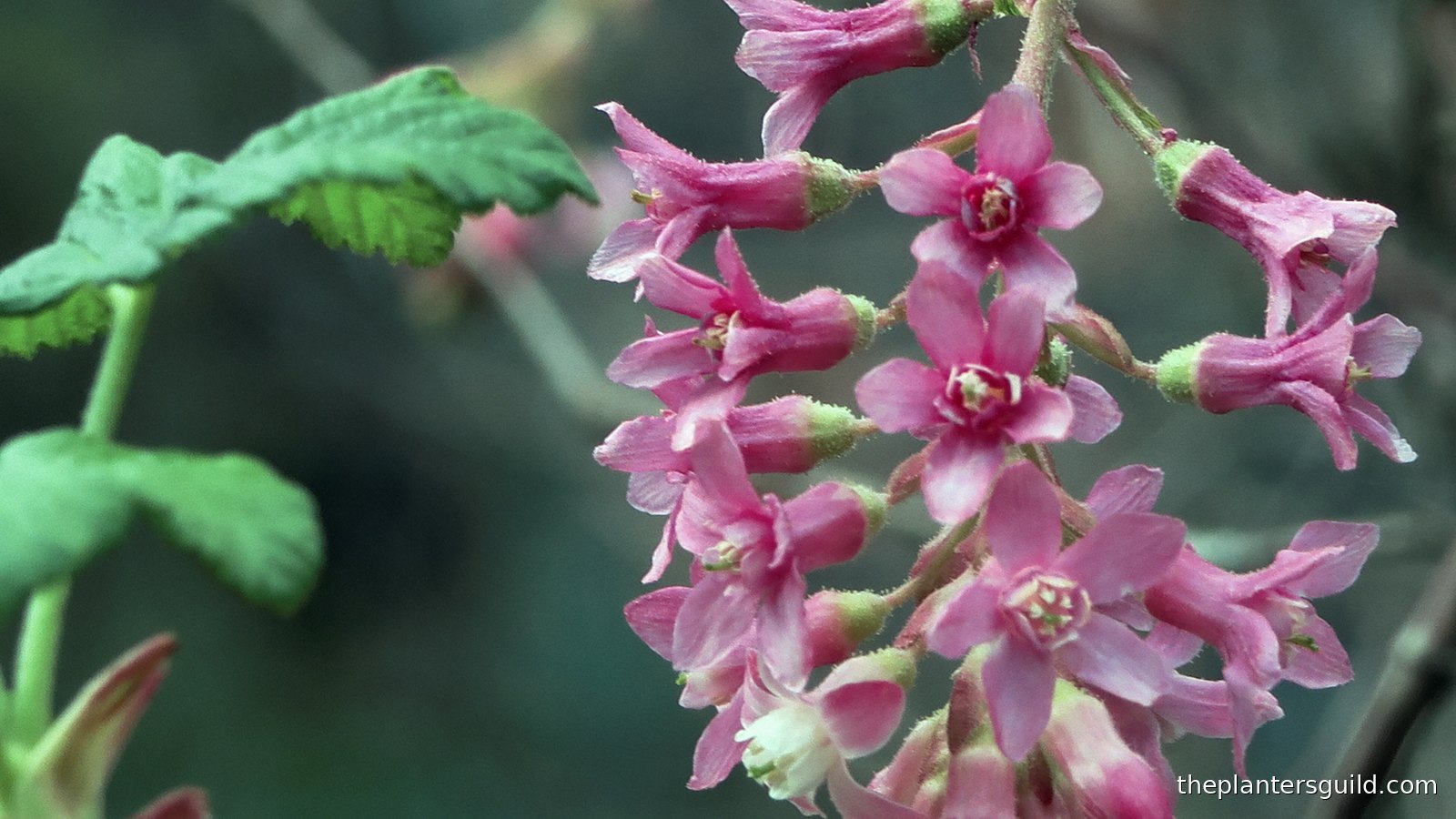
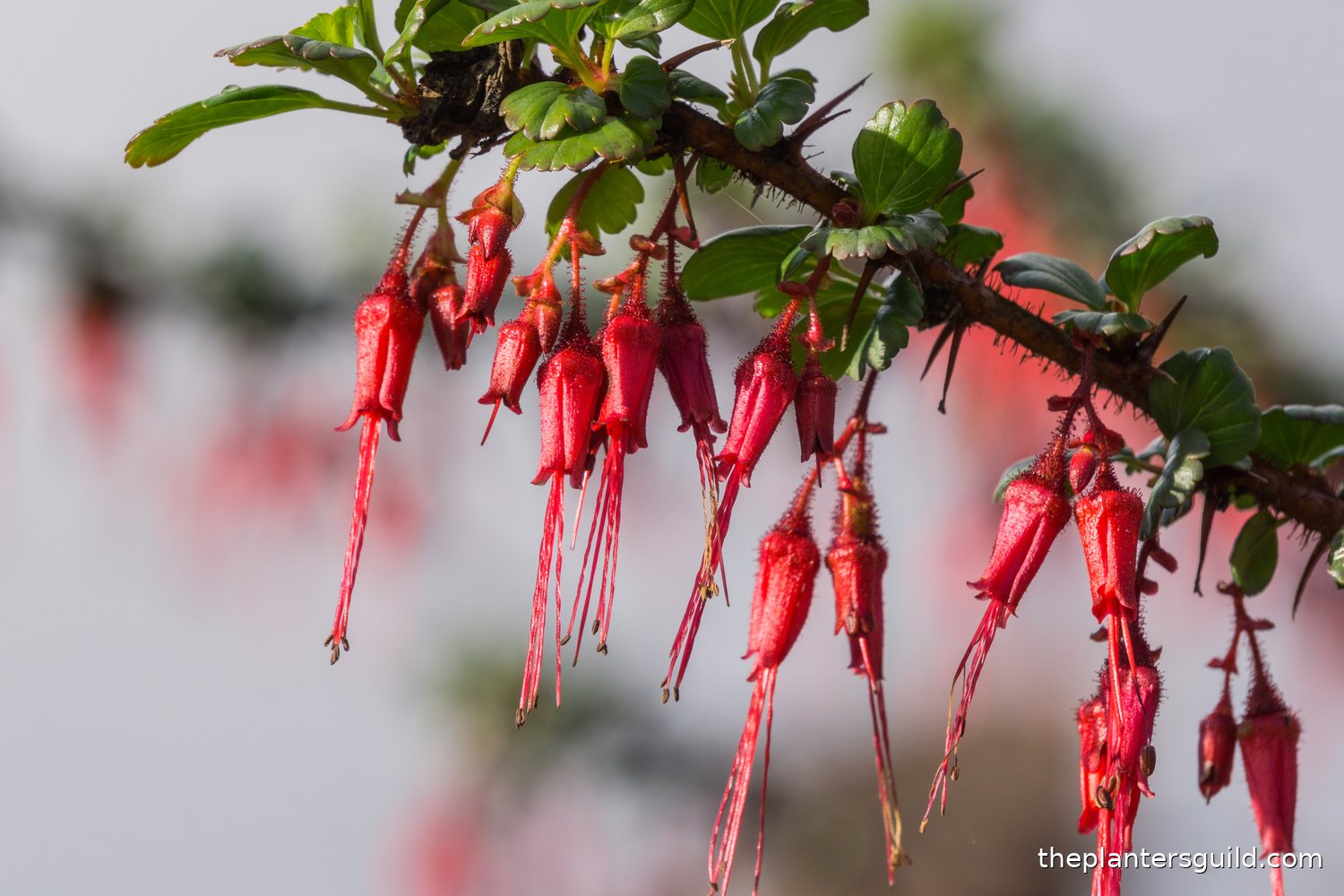
The flowers are the event. They hang or stand in small clusters called racemes, and depending on the species they read very differently. Pink-flowering currant drips pendant strings of pink to rose flowers along its bare late-winter stems. Fuchsia-flowered gooseberry hangs individual tubular red flowers that look, fairly, like small fuchsias. Golden currant holds its bright yellow flowers more upright and adds a clove-like scent. After bloom come round berries, sometimes smooth, sometimes covered in fine glands or bristles.
One Genus, Two Names
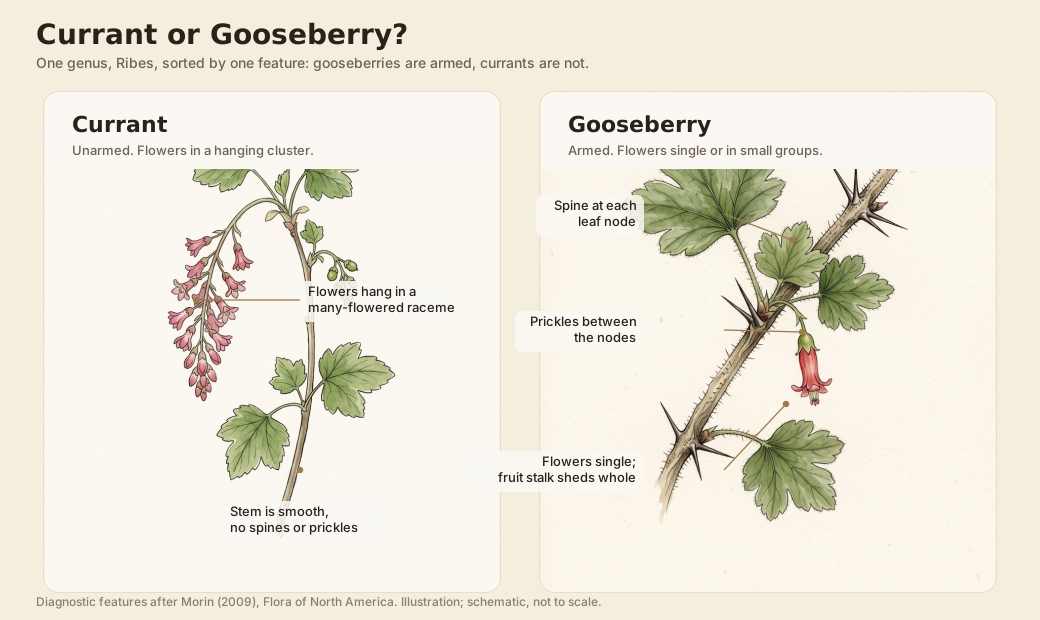
The split between currant and gooseberry is old, older than modern botany, and it comes down mostly to armament. Gooseberries carry spines at the leaf nodes and often small prickles on the stem between them. Currants are unarmed. There's a second, closer tell if you want it: a currant's fruit stalk has a small joint where it meets the branch and leaves a stub behind when the fruit drops, while a gooseberry sheds the whole stalk (Morin, 2009).
For a long time botanists split the two into separate genera, keeping Ribes for the currants and Grossularia for the gooseberries. Molecular work hasn't supported that division. The gooseberries do form a natural group, but it sits nested inside the currants rather than standing apart from them, so the modern treatment folds everything back into one genus, Ribes (Morin, 2009). For a gardener, the practical news is simple: currant and gooseberry are close enough that the care is broadly the same. You just want gloves for the gooseberries.
Where It Comes From
The currants and gooseberries in this guide grow in chaparral, coastal sage scrub, and the dappled edges of oak woodland, and that origin is the whole explanation for their strange calendar.
California has a Mediterranean climate: the rain arrives in the cool months and the summers are long and dry. A plant living in that pattern has a choice about when to do its growing, and the currants made the opposite choice from most of the pillar. Instead of pushing through the summer drought, they run their entire working year on the wet season. They leaf out when the water arrives, flower and set fruit while it lasts, and then shut down before the drought can reach them. The summer dormancy is the plant sitting the dry season out rather than trying to power through it.

The Mistake Most People Make
The classic failure with a currant happens in July, and it happens because the plant looks finished when it's only asleep.
You plant a currant in fall, it settles in over winter, and it flowers well in late winter or spring. Then the weather warms, the rain stops, and the leaves start to yellow and fall. By midsummer the shrub is a set of bare stems in a garden where everything around it is green and blooming. It looks wrong. So you reach for one of two rescues, and both of them are the actual mistake.
The first is to pull it out, on the reasonable-seeming logic that it's gone. The second is worse: you turn on the hose. A chaparral currant that has gone summer-dormant does not want water. Its roots are resting in warm soil, and steady summer irrigation in that state is a standing invitation to root rot, which is far more likely to harm the plant than the drought ever was.
The bare July shrub only wants to be left alone. Read those empty stems the way you'd read a sleeping animal rather than a sick one, and keep the hose off them. The green comes back with the rain.
Sun: Shade Is a Feature
Most currants and gooseberries want less sun than the rest of this pillar, and that turns out to be one of the most useful things about them. The pink-flowering currant and both gooseberries are woodland-edge and understory plants, and they take, or prefer, part shade. Fuchsia-flowered gooseberry in particular is happy in the dry shade under oaks and larger shrubs, one of the hardest spots in any garden to fill. The evergreen currant, covered below, does genuine deep dry shade. The exceptions run the other way: golden currant wants more sun and takes full sun in most of California. What none of the shade-lovers want is unbroken afternoon sun in a hot inland yard, which scorches them. Read your own light before you choose the species.
Water: On the Winter Schedule
The single hardest habit to unlearn with these plants is when to water them, because it inverts what a summer garden teaches.
Their growing season is the wet season. Water is welcome from fall through spring, and in most years the rain simply supplies it. Through the dry summer you taper off and, for the chaparral species, stop. The coastal pink-flowering currant is the most forgiving and will take a little summer water in a hot inland spot to hold a few more of its leaves. The chaparral currants and the gooseberries are less forgiving and would rather be left dry once they've gone dormant. If you water this plant the way you water the rest of your beds in August, you are working against it.
Soil
Soil is the part these plants are relaxed about. They're adaptable across sand, loam, and clay, and they don't ask for richness. The one real requirement is that the ground not stay waterlogged in summer, which loops back to the watering: give them reasonable drainage, keep the hose off them in the dry months, and the soil takes care of itself. Slightly acidic ground is fine and common in their native range.
Hardiness
Cold is not the limiting factor for this genus, and for one species it's barely a factor at all. Golden currant is hardy to somewhere around −30 °F (−34 °C), USDA (United States Department of Agriculture) zone 3, which is far more cold than any California garden will ever hand it (U.S. Department of Agriculture, Forest Service, n.d.). The coastal currants and gooseberries are milder-climate plants, but every one of them is comfortable through a Bay Area winter, and the winter bloom shrugs off the light frosts that come with it.
The War on Ribes
Every plant in this series carries some history. This one carries a war, and it's worth telling as the series closes, because for half a century it was a federal crime to grow the shrub in your yard.
Around 1900, a fungus called white pine blister rust (Cronartium ribicola) arrived in North America on infected pine nursery stock shipped from Europe. The fungus has an unusual requirement: to complete its life cycle it needs two entirely different hosts, moving between a five-needle white pine and a Ribes. It can't get from pine to pine directly. It has to pass through a currant or a gooseberry in between (Geils et al., 2010).
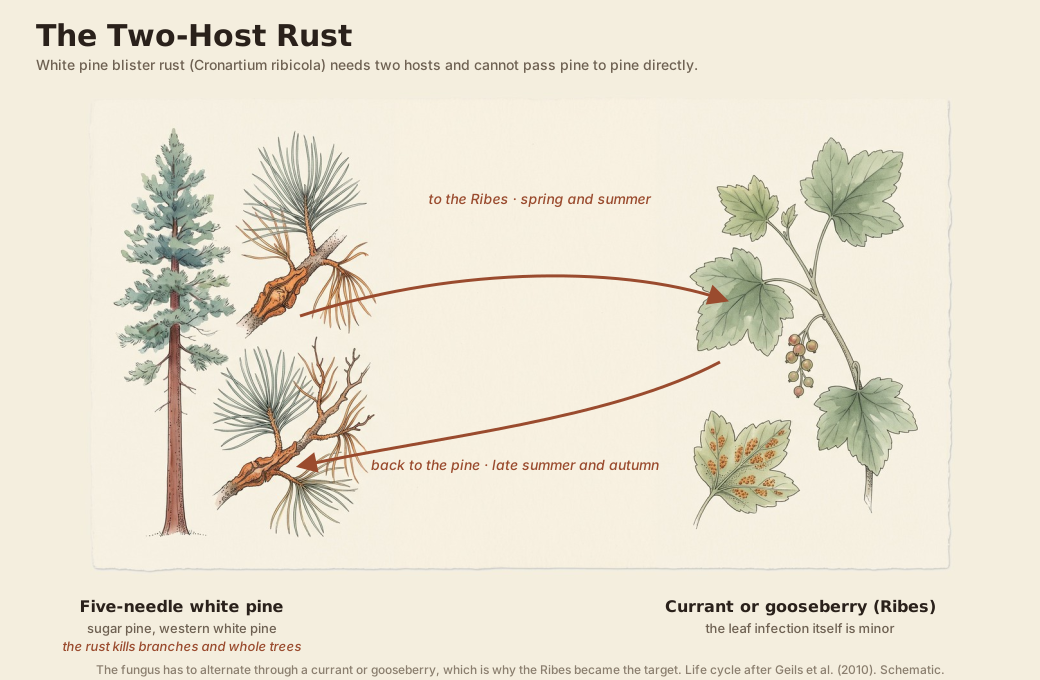
The disease is lethal to the pines, and among the pines at risk are two California giants, sugar pine and western white pine. Because the pines were hard to protect and the currants were easy to find, the country went after the currants. Starting in 1912, federal and state rules restricted growing Ribes, and a vast eradication program set out to strip the shrub from whole landscapes (Morin, 2009). Crews pulled bushes by hand across millions of acres. Between 1949 and 1966, the program sprayed roughly 41,000 acres of stream bank and forest with about 13.3 million gallons of herbicide in the effort to knock the genus back (Geils et al., 2010). It never fully worked. The federal ban was rescinded in 1966, and the campaign is now mostly remembered as one of the largest and least successful eradication efforts in American forestry (Hummer & Dale, 2010).
One Honest Caveat: The Rust Is Real, the Ban Is Not
The history has a live edge, and it's worth being straight about where it does and doesn't touch a home gardener.
California places no restriction on planting Ribes today. Every currant and gooseberry named in this guide is legal here and sold openly in the native-plant trade, and a currant in a lowland Bay Area garden, miles and thousands of feet of elevation away from any sugar pine, is a negligible link in that disease chain. The plant you buy at a California Native Plant Society (CNPS) sale is not a threat to a forest it will never meet.
Where the caveat bites is at elevation and with the wrong species. If you garden in or near high-country five-needle pine forest, the disease is a genuine concern, and the worst offender by a wide margin is not a California native at all but the European black currant (Ribes nigrum), the species several eastern states still restrict. The native currants and gooseberries are lower-risk hosts, and some resistant fruiting varieties exist, but if your garden sits in sugar-pine country, it's worth knowing what's downhill of you and choosing accordingly. The other honest note is smaller and closer to hand: the gooseberries are genuinely thorny, so site them where you won't reach blindly into them, and wear gloves when you prune.
The Winter Table
There's a nice symmetry to how this plant feeds a garden, because it does its most important work when the rest of the garden has nothing open.
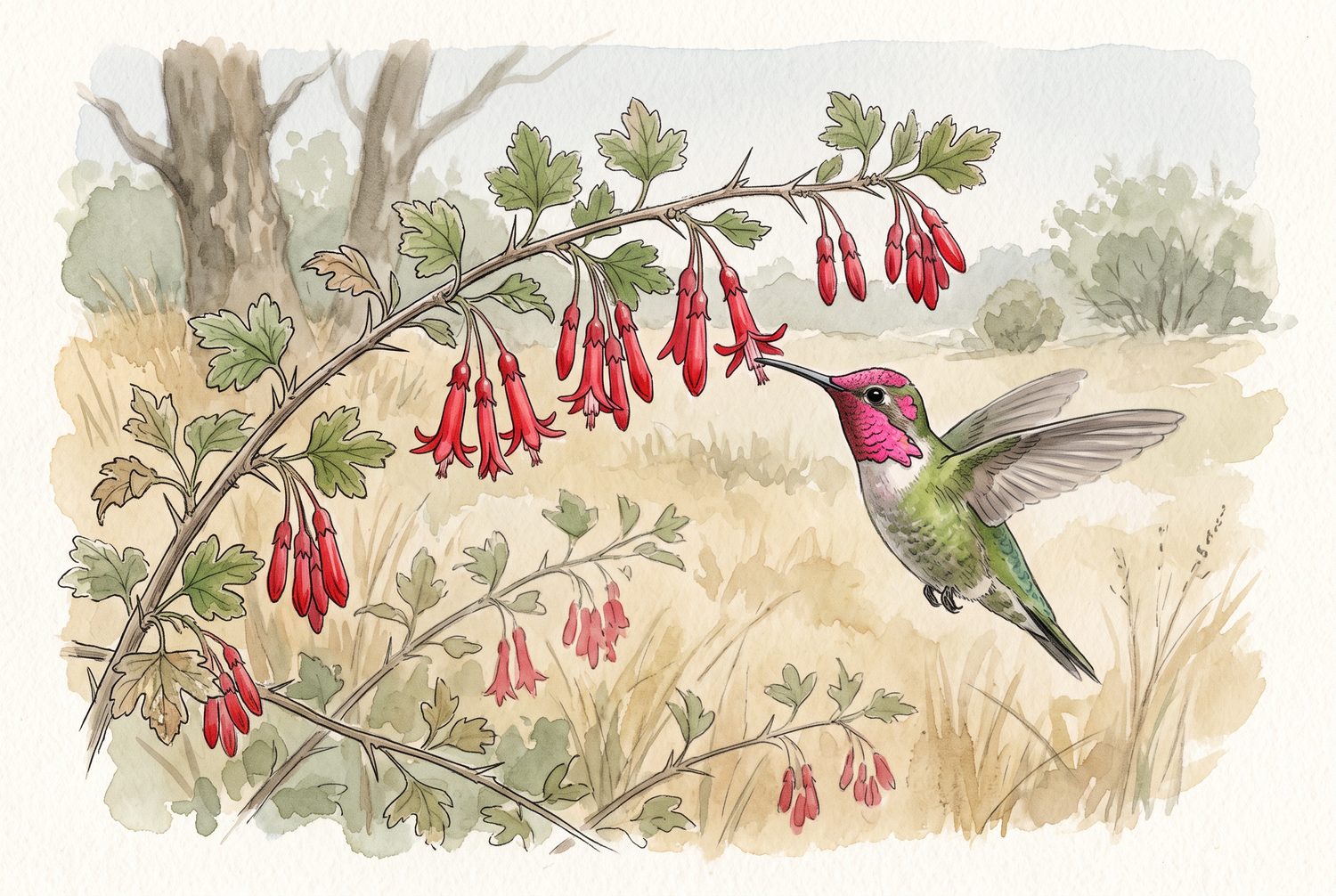
The headline guest is the hummingbird, covered in the note above: Anna's Hummingbird nests in the California winter and runs on these flowers when little else is open (Clark & Russell, 2020). But the currants also settle a question this series raised back at the coffeeberry, which was a plant you were told, flatly, not to eat. The currants are the counterexample. Several are edible, and one is good: golden currant produces amber-to-black fruit that has long gone into pies and preserves and is worth eating straight off the shrub (U.S. Department of Agriculture, Forest Service, n.d.). Pink-flowering currant makes a dark berry that is edible but flat and insipid, which is a polite way of saying the birds are welcome to it (California Native Plant Society, n.d.). Between the winter nectar and the early-summer fruit, a Ribes is working the two ends of the year that most of the garden skips.
Sourcing
The most important thing to get right when you buy a currant is which currant you're buying, because a single tag reading "native currant" could be any of several plants that want different things. Choose by the job:
For a winter flower show in part shade, pink-flowering currant (Ribes sanguineum var. glutinosum, where "var." means a naturally occurring variety within the species) is the classic, with named selections bred for heavier or deeper-colored bloom. For hummingbirds and for filling dry shade under an oak, fuchsia-flowered gooseberry (Ribes speciosum) is the standout, thorns and all. For edible fruit, cold tolerance, and a clove scent, golden currant (Ribes aureum) is the one. And for a spreading evergreen groundcover in dry shade, the odd one out is the evergreen currant or Catalina perfume (Ribes viburnifolium), the single species here that keeps its leaves all year and skips the summer-bare act entirely.
Buy from CNPS chapter sales and native nurseries, ask by the Latin name and the variety, and put the plant in the ground in fall or early winter so it roots in ahead of its first flowering season.
The Takeaway
The currants and gooseberries flower when California is asleep, and that single fact is the whole care sheet turned into a habit.
Grow them on the opposite clock from everything you already know how to grow. Water them with the winter rain and keep the hose off them in the summer heat. When the leaves drop in July, don't read it as failure and don't try to fix it, because the plant is resting, and the green returns with the storms. Pick the species for the work you want done, whether that's a February flush of pink in a shady corner, a winter feeder for the hummingbird nesting outside your window, a handful of good fruit, or a tough green carpet under an oak.
This is the last entry in the series, and it lands on the plant that starts its year in December, about when this pillar started counting its own back in the spring. Watch for it: when the currants come into bloom this winter, they'll be among the first things in the garden to wake up.
Quick Reference
- Sun: Part shade for most, including the pink-flowering currant and the two gooseberries; full sun for golden currant; genuine dry shade for evergreen currant. Full afternoon sun inland scorches the shade-lovers.
- Water: On the winter schedule. Growth and bloom run on the rainy season, which rain usually supplies. Taper off through the dry summer; established chaparral species want to be dry then and resent irrigation.
- Soil: Adaptable. Wants reasonable drainage; tolerates clay if it isn't waterlogged in summer. Slightly acidic is fine. No richness required.
- Hardiness: Varies by species. Golden currant is extraordinarily cold-hardy, to roughly −30 °F (−34 °C), USDA zone 3. The coastal currants and gooseberries are milder-climate plants, comfortable through every Bay Area winter.
- Bloom: Winter into spring, roughly December through April depending on species and the year's rain. Pendant pink racemes (pink-flowering currant), hanging tubular red flowers (fuchsia-flowered gooseberry), upright golden clusters (golden currant).
- Fruit: Round berries, often glandular or bristly, ripening late spring into summer. Edibility runs from genuinely good (golden currant) to edible-but-dull (pink-flowering currant, better left for birds).
- Size: Most 3–6 ft (0.9–1.8 m) tall and about as wide; pink-flowering currant can reach 10 ft (3 m). Evergreen currant is a low spreader, 2–3 ft (0.6–0.9 m) tall and wider than tall.
- Habit: Deciduous shrubs, mostly summer-deciduous, with arching stems and shredding older bark. Evergreen currant is the exception and holds its leaves year-round.
- Bloom season: The off-season. These flower when the rest of the garden, and most of the rest of this pillar, is dormant or waiting for spring.
- Plant in: Fall through winter, ahead of the rains, the same window as the rest of the pillar.
- Source from: California Native Plant Society (CNPS) chapter sales and native nurseries. Ask by Latin name and variety, since a 'currant' could be any of several very different plants.
- What to avoid: Reading the bare summer plant as finished; summer-watering a dormant chaparral currant; buying an unnamed 'currant' and hoping; planting the highly susceptible European black currant near high-elevation white-pine forest.
The Takeaway
The currants and gooseberries are the plants that flower when California is asleep. They leaf out in the first cold rains, hang the winter with pink and red, carry a nesting hummingbird through the months when nothing else has nectar, and then let their leaves go and rest while the summer garden takes its turn. So you grow them on the opposite clock from everything you already know. Water them with the rain, leave them be in the heat, and don't panic in July. Pick the species for the work you want done. And when the last of them settles into its summer rest, watch the calendar: the show starts again in December, right about when this series began its own year.
Sources
Bornstein, C., Fross, D., & O'Brien, B. (2005). California native plants for the garden. Cachuma Press.
California Native Plant Society. (n.d.). Pink-flowering currant (Ribes sanguineum var. glutinosum). Calscape. Retrieved July 31, 2026, from https://calscape.org/Ribes-sanguineum-var.-glutinosum-(Pink-flowering-Currant)
California Native Plant Society. (n.d.). Fuchsiaflower gooseberry (Ribes speciosum). Calscape. Retrieved July 31, 2026, from https://calscape.org/Ribes-speciosum-(Fuchsiaflower-Gooseberry)
Clark, C. J., & Russell, S. M. (2020). Anna's Hummingbird (Calypte anna), version 1.0. In A. F. Poole (Ed.), Birds of the World. Cornell Lab of Ornithology. https://doi.org/10.2173/bow.annhum.01
Geils, B. W., Hummer, K. E., & Hunt, R. S. (2010). White pines, Ribes, and blister rust: A review and synthesis. Forest Pathology, 40(3–4), 147–185. https://doi.org/10.1111/j.1439-0329.2010.00654.x
Hummer, K. E., & Dale, A. (2010). Horticulture of Ribes. Forest Pathology, 40(3–4), 251–263. https://doi.org/10.1111/j.1439-0329.2010.00657.x
Morin, N. R. (2009). Ribes. In Flora of North America Editorial Committee (Eds.), Flora of North America north of Mexico (Vol. 8, pp. 8–44). Oxford University Press. http://floranorthamerica.org/Ribes
U.S. Department of Agriculture, Forest Service. (n.d.). Golden currant (Ribes aureum). Celebrating Wildflowers. Retrieved July 31, 2026, from https://www.fs.usda.gov/wildflowers/plant-of-the-week/ribes_aureum.shtml
Image (hero and hub card): Rusk, J. (2016). Ribes sanguineum var. glutinosum, Regional Parks Botanic Garden, Berkeley [Photograph]. Wikimedia Commons. Cropped from the original. Licensed under CC BY 2.0. https://commons.wikimedia.org/wiki/File:J20160218-0033%E2%80%94Ribes_sanguineum_var_glutinosum%E2%80%94RPBG%E2%80%94DxO_(32154725344).jpg ; license deed: https://creativecommons.org/licenses/by/2.0/
.jpg)
Image (fuchsia-flowered gooseberry, Ribes speciosum): Sundry Photography / Adobe Stock (asset 242346254), Standard license.
Illustration (winter feeding scene): The Planters' Guild. (2026). Anna's hummingbird at fuchsia-flowered gooseberry in midwinter [AI-generated illustration]. Generated with Artlist. Illustrative of the winter currant–hummingbird relationship generally; not a photograph and not a documentary record of a specific bird or place.
Graphics (currant-and-gooseberry key, the inverted year, blister-rust cycle): The Planters' Guild. (2026). Drawn from the sources cited above.