California Natives · The State Flower · No. 08
California Poppy: The State Flower You Don't Plant, You Sow
A field guide to Eschscholzia californica, the flower on every California postcard. Why it's a plant you sow rather than one you set out in pots, how to start it so it reseeds itself for years, and why the summer brown-out is the plant working, not failing.
On this page
12 sections
- About the Plant
- What You're Looking At
- Where It Comes From
- The Mistake Most People Make
- Sun: Full Sun, and It Means It
- Water: Ride the Rain, Then Stop
- Soil: Poor Is a Feature
- Hardiness: Milder Than It Looks
- One Honest Caveat: It Seeds Where It Wants, and It Travels
- Sowing and Sourcing
- The Takeaway
- Quick Reference
About the Plant
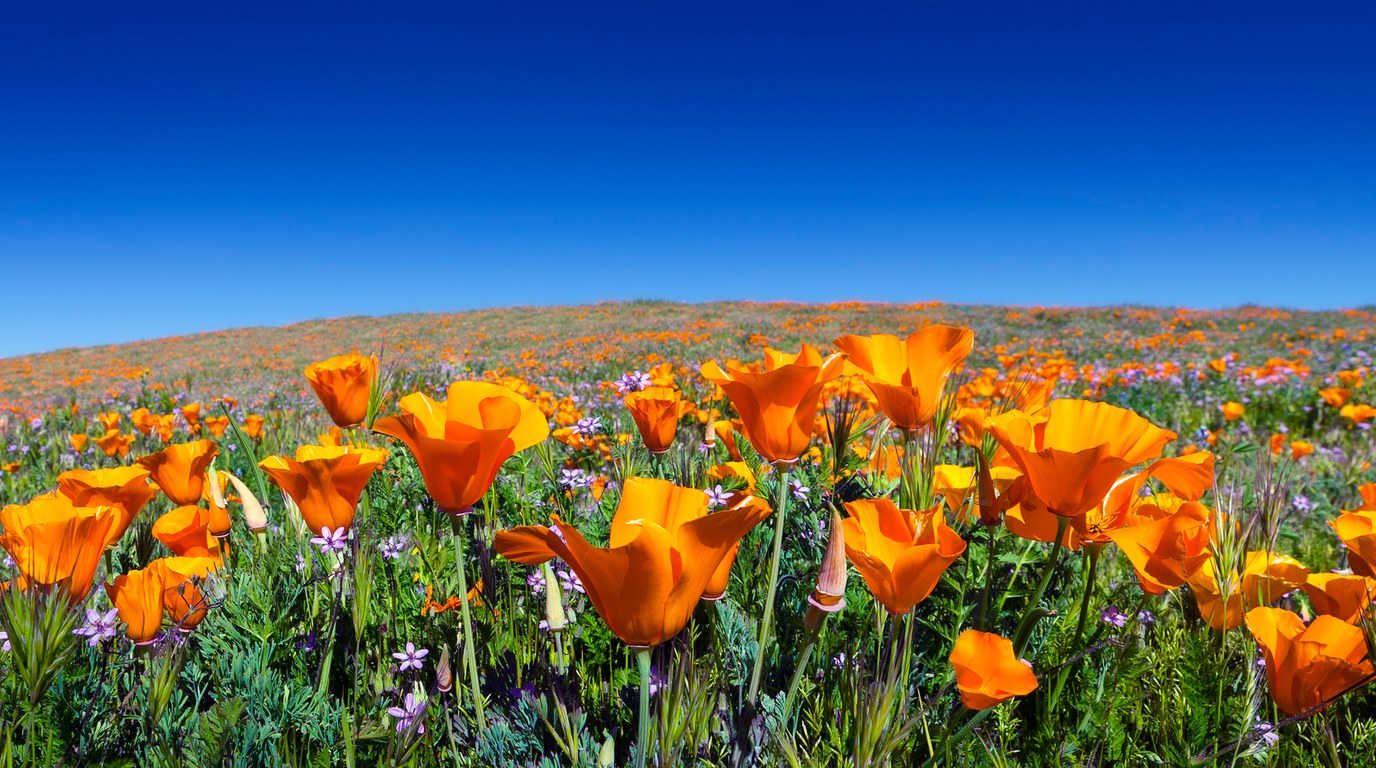
The California Poppy is the flower you already picture when someone says "California." It's on the highway signs, the tourist brochures, the springtime hillsides that turn solid orange and pull people out of their cars. It's been the official state flower since 1903. And it's one of the easiest natives to grow badly, because almost everyone approaches it the wrong way.
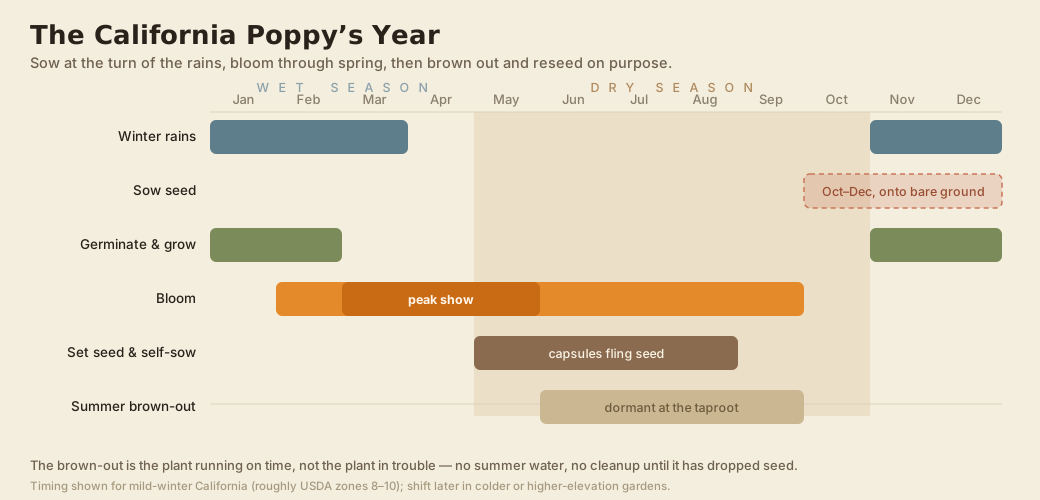
So here's the fix. Eschscholzia californica is not a plant you buy in a pot and set into a bed. It's a plant you sow from seed and then let take care of itself. It grows fast, flowers hard, drops seed, and goes quiet, and if you give it room to do that, it reseeds and returns on its own for years. Treat it like a tidy container perennial and you'll fight it the whole way. Treat it like the self-sowing wildflower it is and it's close to no work.
It belongs to Papaveraceae, the poppy family, though it's a different animal from the opium poppy people associate with that name. It carries its own set of mild alkaloids (the plant-made compounds behind its long folk use as a gentle sedative), not the ones that make opium poppies notable, and the two aren't interchangeable (Becker et al., 2023).
What You're Looking At
A California Poppy grows as a low mound of foliage, usually 8 to 24 inches (20 to 60 cm) tall and about as wide, from a single fleshy taproot. The leaves are the first tell: finely divided, almost ferny, and a waxy blue-green (botanists call that waxy coating glaucous, and it's part of how the plant handles dry heat and glare).
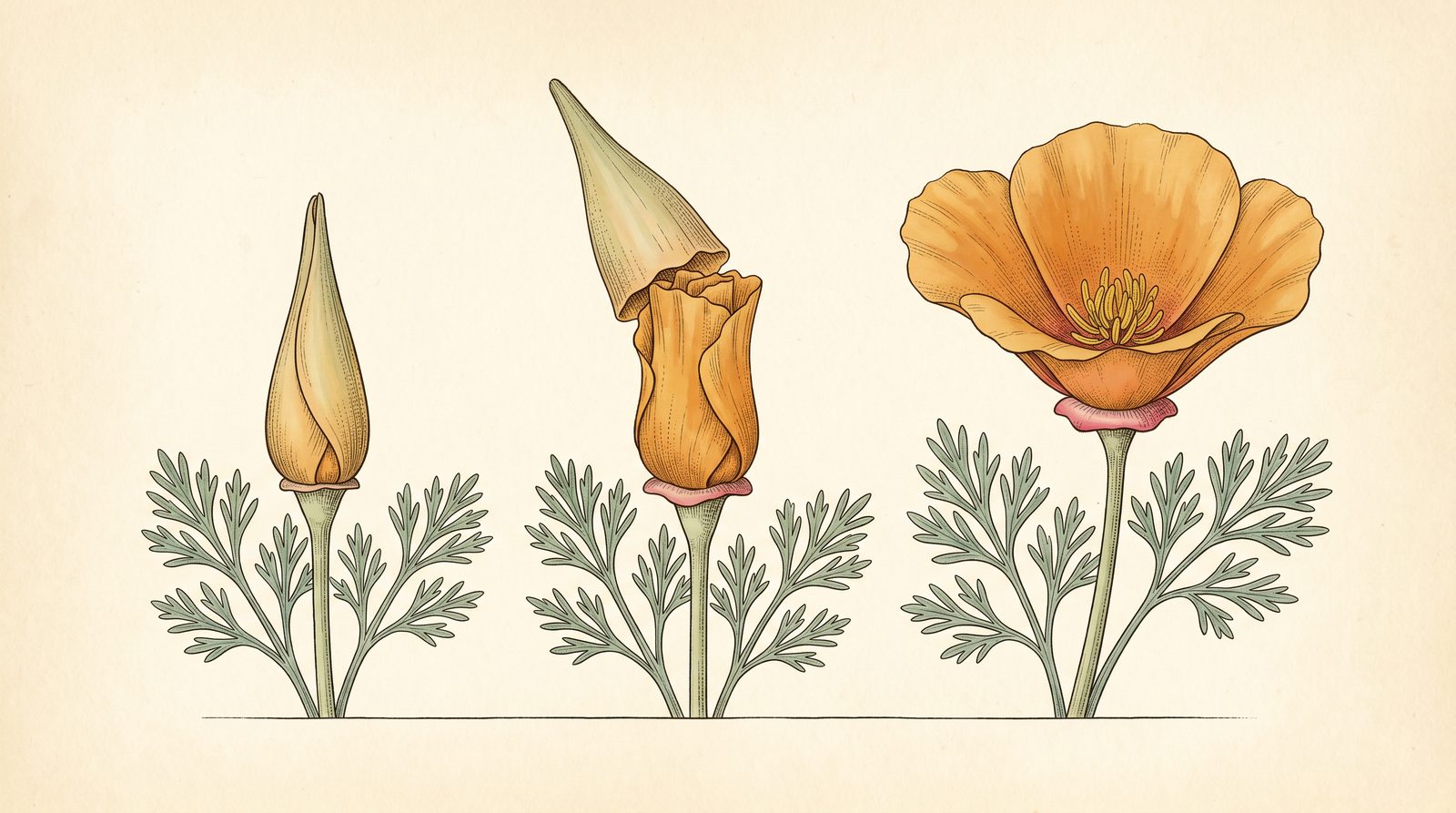
The flowers are the reason anyone grows it. Each one is a shallow cup of four satiny petals, most often a deep orange, sometimes clear yellow, an inch to nearly three inches across (2.5 to 7 cm). Coastal wild forms often carry an orange center fading to yellow at the edge; inland forms tend toward solid orange. There are two small diagnostic details worth knowing. First, the bud is capped by a fused, pointed sheath that the opening flower pushes off from the bottom like a snuffer lifted off a candle, which is unmistakable once you've watched it happen. Second, at the base of the flower sits a slightly flared pink rim, a feature that separates this species from its relatives.
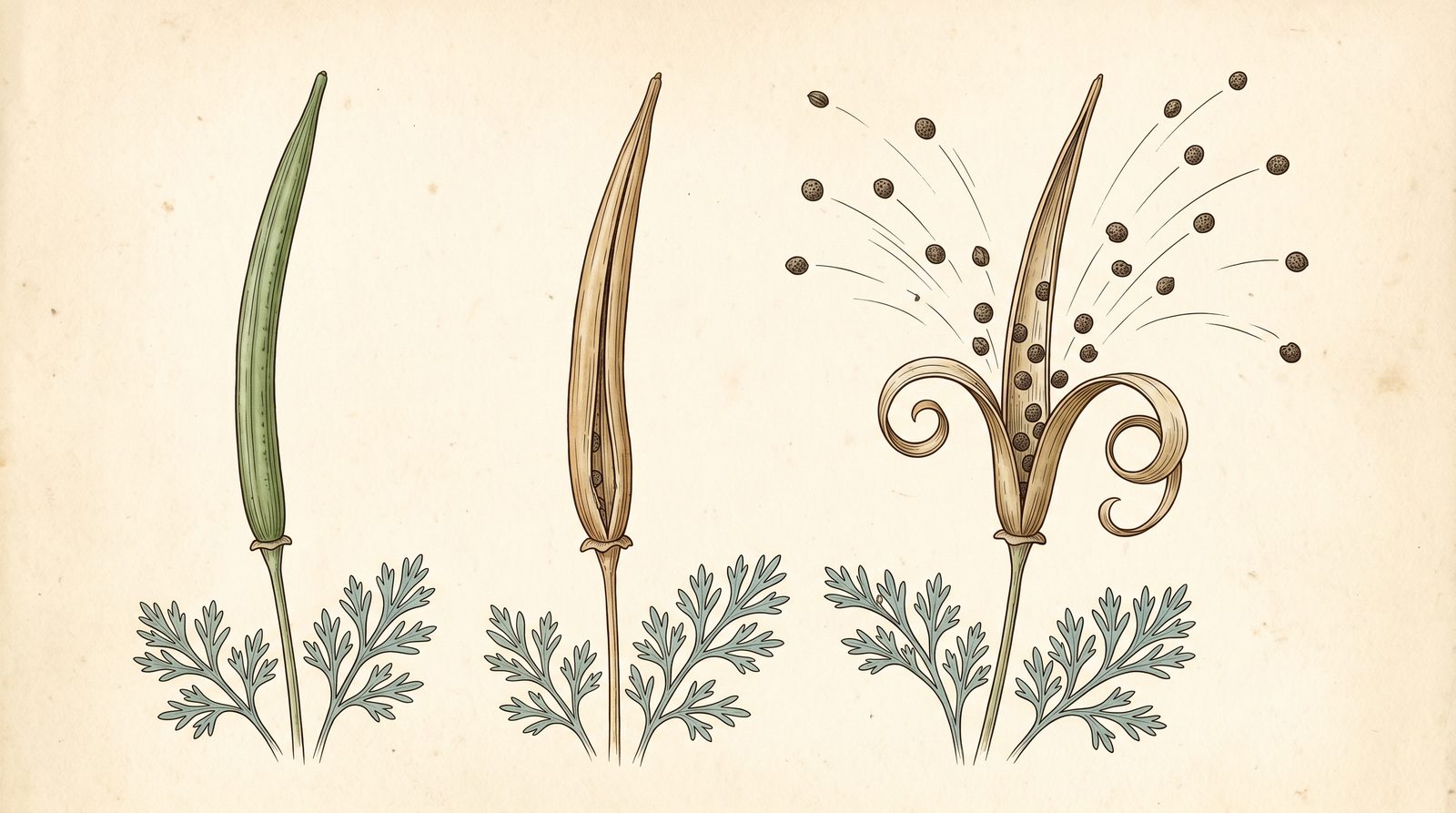
Then there's the seed. After bloom, the plant sends up slender capsules two to three inches long (5 to 8 cm). As they dry, they build tension and split open explosively, flinging seed several feet from the parent. That mechanism is the whole reason a single poppy becomes a patch, and it's why next year's plants show up a stride or two from where you sowed.
Where It Comes From
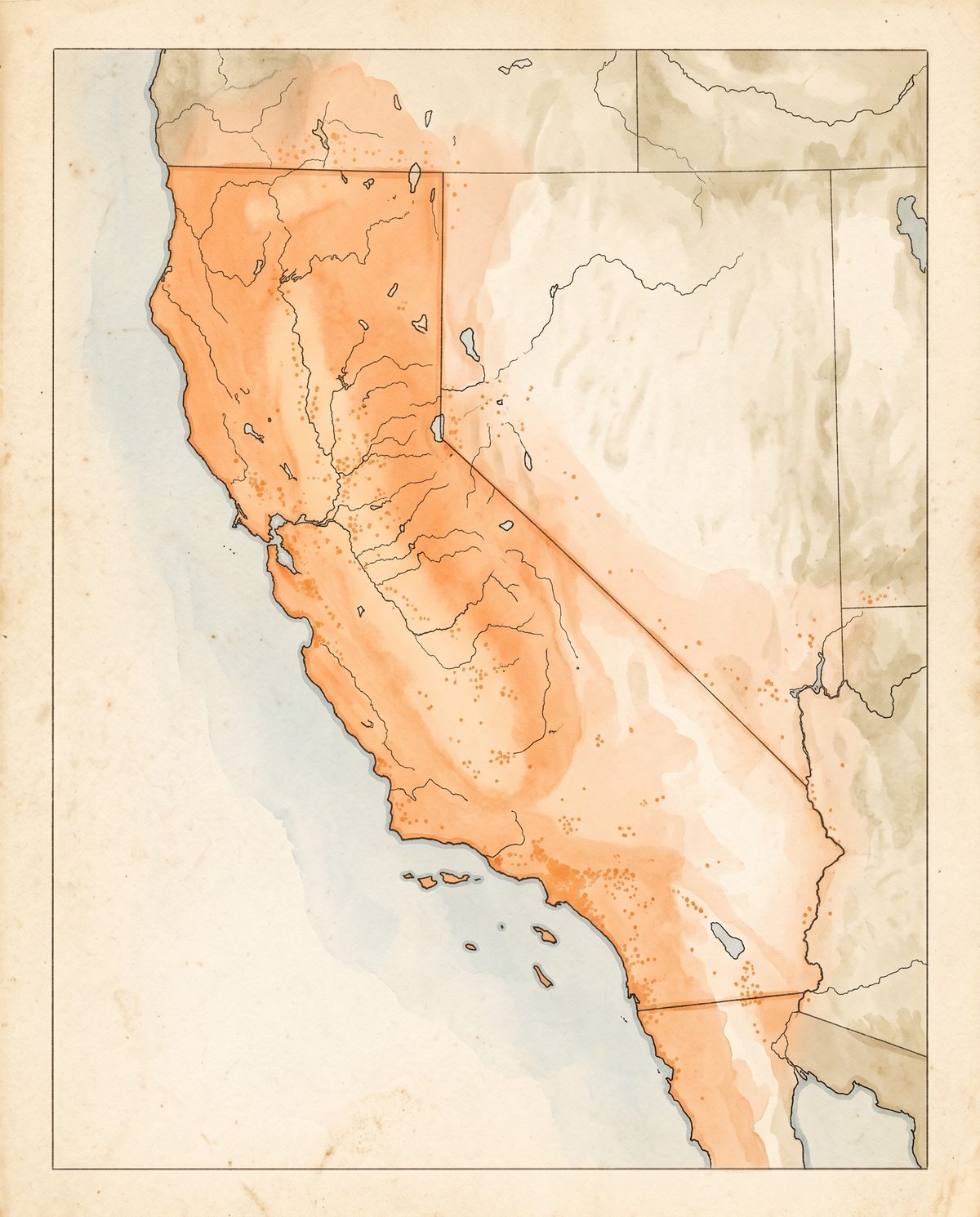
The California Poppy is native across most of California and up into southern Oregon, with related forms reaching into Baja California and the desert Southwest (Clark, 1997). Its home ground is open and sunny and, tellingly, often disturbed: grassy slopes, road cuts, the edges of fields, the raw ground left after a fire or a grading job. This is a coloniser. It moves into bare, poor, sunny openings and holds them.
That origin is the instruction manual. Full sun, lean soil, sharp drainage, wet winters, bone-dry summers. It expects the whole California pattern, and it's built to sprint through the wet season and then shut down for the drought rather than fight it.
The plant is genuinely woven into the state's identity. It was named in the 1810s by the botanist Adelbert von Chamisso, sailing on a Russian expedition to the California coast, who named the genus for his shipmate, the naturalist Johann Friedrich von Eschscholtz (Becker et al., 2023). Nearly a century later the legislature made it the state flower. And it's still the plant behind the famous spring "superblooms," where a wet winter on undisturbed ground can turn whole hillsides orange.
The Mistake Most People Make
Most people meet the California Poppy as a four-inch pot at the nursery in spring, take it home, plant it in a nice watered bed, and expect a well-behaved perennial. What they get is a plant that sulks, roots poorly, and is often gone by its second summer, and the state flower gets written off as difficult.
Two things are going wrong there. The first is the taproot. The poppy drives a deep root early and does not like having it disturbed, so nursery transplants establish worse than direct-sown seed almost every time. The second is timing and habit: a spring-planted poppy in a rich, irrigated bed has missed the season it's built for and landed in conditions it doesn't want.
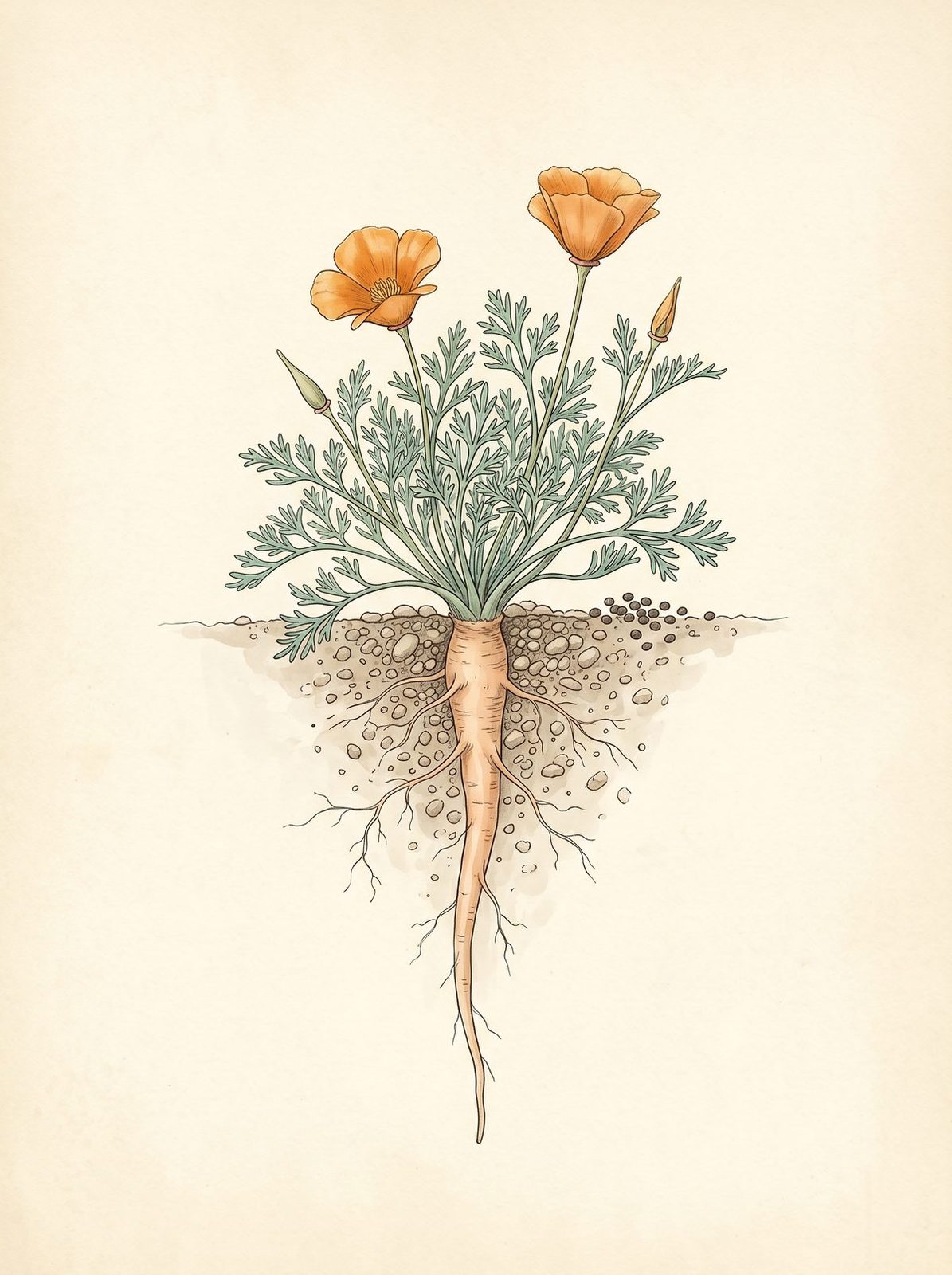
So sow it instead. Scatter seed in fall, October through December, onto cleared, weed-free ground, and let the coming rains germinate it. Press the seed lightly into the surface rather than burying it, because it needs to sit shallow to sprout. A patch you start this way, from seed, on the schedule the plant evolved for, will outperform any six-pack of transplants and cost a fraction as much. If you only ever change one thing about how you grow poppies, change this: start them from seed, in fall, and never from a pot in spring.
Sun: Full Sun, and It Means It
Six hours of direct sun is the floor. The California Poppy is a sun-tracking plant whose flowers physically close at night and stay shut on overcast days, so shade doesn't just slow it down, it keeps the flowers from opening at all. In too little light you get plenty of that pretty ferny foliage and almost no open bloom. If your poppies are all leaves and few flowers, the answer is nearly always more sun, not more anything else. Give it the most open, unshaded ground you have.
Water: Ride the Rain, Then Stop
The California Poppy is a rain-grown plant, and the simplest way to grow it is to let the seasons do the watering. Fall-sown seed germinates on the first rains and grows through the wet winter and spring on rainfall alone. In a dry autumn you may need to water a new sowing in to get it started, but once it's up and the rains have arrived, it needs nothing from the hose.
The thing to resist is summer irrigation. As the heat comes on, the plant browns off, drops seed, and pulls back to its taproot. Watering to keep it green past that point works against its biology and tends to rot the root, cutting short a plant that would otherwise have gone dormant and returned. Let it dry down. The brown is the point.
Soil: Poor Is a Feature
Give the California Poppy the worst soil you've got. It's adapted to lean, sandy, gravelly, disturbed ground, and it colonises exactly the poor, fast-draining sites most garden plants refuse. Rich, amended, regularly fed beds produce lush foliage and fewer flowers, and they encourage the plant to grow soft and short-lived. So skip the compost, skip the fertilizer, and don't work the ground into a fluffy bed. Firm, open, unimproved soil with good drainage is what it wants. On heavy Bay Area clay, the poppy will still take a sunny, unwatered spot that drains, but it's happiest on the gravelly, neglected edges: the base of a path, a dry slope, the strip along a driveway.
Hardiness: Milder Than It Looks
How the California Poppy behaves depends on your winters. In mild-winter California, roughly USDA (United States Department of Agriculture) Plant Hardiness Zones 8 through 10, it often lives as a short-lived perennial, retreating to its taproot through the dry summer and pushing new growth again with the fall rains. In colder climates it's grown as an annual, but the seed itself is very cold-hardy, which is why the plant reseeds and persists far outside the range where the roots would survive a hard freeze. For a Bay Area garden, the practical version is simple: expect it to go dormant in summer, and expect a well-established stand to come back on its own, whether the individual roots make it through or the seed does.
One Honest Caveat: It Seeds Where It Wants, and It Travels
Two things are worth being honest about. The first is small and local: the California Poppy reseeds on its own terms. Those explosive capsules put next year's plants a few feet from this year's, so a stand drifts around the garden over time and won't stay in the tidy patch you first sowed. In a naturalistic planting that's the whole appeal. In a formal bed it can read as untidy, and you'll be thinning and steering it by pulling seedlings where you don't want them.
The second is bigger and worth taking seriously. This is a vigorous self-sower, and outside its home range it has become a genuine invasive, crowding out native flora in places like Chile, where introduced California poppies grow even larger and more aggressively than they do at home (Leger & Rice, 2003). Inside California it's where it belongs, but two cautions still apply. Don't sow the bred garden color strains, the creams, pinks, and doubles, right next to wild poppy populations, because they can cross with and muddy the local genetics. And if your garden backs onto open space, favor straight-species seed of local origin. Being the state flower doesn't exempt it from good manners near wildland.
Sowing and Sourcing
Because you're growing this from seed, sourcing is about seed, not pots. The right window is fall, October through December, timed so the seed is on the ground when the rains arrive. Clear a patch of competing weeds first, since poppy seedlings lose to established grass and weeds. Scatter the seed, press or rake it lightly into the surface so it makes contact without being buried, and let the weather take over.
For seed that's the true species and of regional origin, your best sources are local California Native Plant Society (CNPS) chapter seed sales and native seed suppliers that list provenance. In the Bay Area that means the Santa Clara Valley, East Bay, and Yerba Buena CNPS chapters, whose sales are stocked with regionally appropriate material and staffed by people who can point you to local-origin seed. The generic "California poppy" seed in a big-box rack is often a garden color mix rather than the wild orange species, so read the packet if you're aiming for the real thing.
And don't dig poppies from the roadside or from public land. Beyond being illegal in most places, a wild plant's taproot almost never survives the move, and collecting from wild stands does real harm for a plant that's so easy to start from a few cents of seed.
Quick Reference
- Sun: Full sun, six hours minimum. The flowers won't open in shade or on overcast days, so more sun means more open bloom.
- Water: Rain-grown. Fall sowing rides the winter rains; after that it wants no summer water. Irrigating to keep it green shortens its life and rots the taproot.
- Soil: Lean, sandy, gravelly, or otherwise poor and fast-draining. It colonises disturbed roadsides and open slopes. Don't amend with compost or feed it.
- Hardiness: In mild-winter California (roughly USDA zones 8–10) it behaves as a short-lived perennial, pulling back to a taproot each summer. Grown as a self-sowing annual well beyond that; the seed is very cold-hardy.
- Bloom: Satiny orange (sometimes yellow) four-petaled flowers, February through September, with the heaviest show in spring.
- Habit: Low mounds of ferny blue-green foliage, 8 to 24 inches (20 to 60 cm) tall and wide, from a fleshy taproot.
- Sow in: October through December, onto cleared, weed-free ground, so seed germinates on the first rains.
- Reseeding: Explosive seed capsules self-sow the patch each year. Leave spent plants to dry and drop seed if you want it to return.
- Source from: Local California Native Plant Society (CNPS) chapter seed sales; regional native seed suppliers. Buy straight-species local seed, not garden color strains, if you're near wildland.
- What to avoid: Transplanting established plants; summer irrigation; burying the seed; rich or amended soil; sowing garden color strains next to wild populations.
The Takeaway
Growing the California Poppy comes down to one shift: stop thinking of it as a plant you buy and place, and start thinking of it as a population you start. You don't set out poppies in pots and keep them alive. You scatter seed on bare, sunny ground in the fall, let the winter rain wake it, and let the stand look after itself from there. It flowers hard in spring, then browns out and pulls back to its taproot for the summer, and that's the plant running on time, not the plant in trouble. If you leave the spent flowers to dry, the capsules fling next year's seed for you, and the poppies come back, a little to the left of where you meant them. So give it the poorest, sunniest corner you have and then mostly stay out of its way: no summer hose, no cleanup until it's done seeding. Do that and the flower every California postcard borrowed will keep showing up in your garden on its own, year after year, for the price of a packet of seed and the patience to let it self-sow.
Sources
Becker, A., Yamada, Y., & Sato, F. (2023). California poppy (Eschscholzia californica), the Papaveraceae golden girl model organism for evodevo and specialized metabolism. Frontiers in Plant Science, 14, 1084358. https://doi.org/10.3389/fpls.2023.1084358
Bornstein, C., Fross, D., & O'Brien, B. (2005). California native plants for the garden. Cachuma Press.
California Native Plant Society. (n.d.). Eschscholzia californica subsp. californica (California Poppy). Calscape. Retrieved July 4, 2026, from https://calscape.org/Eschscholzia-californica-ssp.-californica-(California-Poppy)
Clark, C. (1997). Eschscholzia. In Flora of North America Editorial Committee (Eds.), Flora of North America north of Mexico (Vol. 3, pp. 308–312). Oxford University Press.
Leger, E. A., & Rice, K. J. (2003). Invasive California poppies (Eschscholzia californica Cham.) grow larger than native individuals under reduced competition. Ecology Letters, 6(3), 257–264. https://doi.org/10.1046/j.1461-0248.2003.00423.x