California Natives · The Misnamed One · No. 11
Coffeeberry: The Shrub That Was Never Coffee
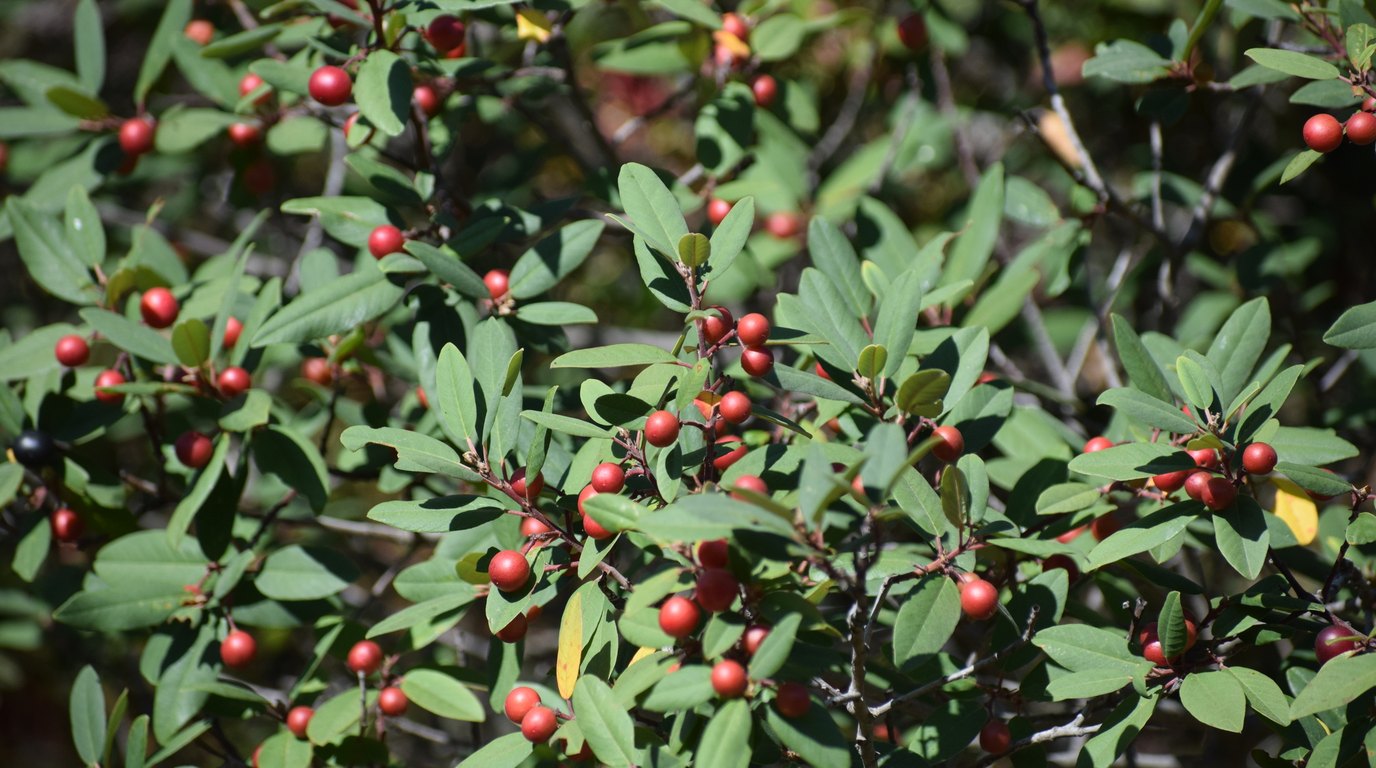
A field guide to Frangula californica, an evergreen native shrub that takes sun or light shade, dry summers or some irrigation, and a wide range of soils, under a common name that promises coffee and delivers none. What it is, what it wants from you, and why the berries are better left to the birds.
On this page
15 sections
- About the Plant
- What You're Looking At
- The Name Doesn't Survive Contact with the Plant
- Thin Cascara Bark
- Where It Comes From
- The Mistake to Avoid
- Sun: Full Sun to Moderate Shade
- Water: Some Summer Water Is Fine
- Soil: Wide Tolerance, One Serpentine Specialist
- What Happens After a Fire
- The Berries, and Who They're For
- A Caveat: Don't Eat It
- Sourcing
- The Takeaway
- Quick Reference
Corrected September 2026: we've revised parts of this guide. See the correction note at the end.
About the Plant
Coffeeberry is evergreen or semi-deciduous (Tutka, 2015). Flora of North America says its leaves usually persist and are only rarely shed (Sawyer & Nesom, 2016), so as a rule it holds the bed through winter. The Forest Service's species review cites an estimated lifespan of 100 to 200 years (McMurray, 1990). Established plants take full sun to moderate shade (McMurray, 1990), and the U.S. Department of Agriculture's Natural Resources Conservation Service (NRCS) plant guide says it handles sand and clay and puts up with occasional seasonal flooding (Tutka, 2015).
It's widely grown: the Forest Service review says it's frequently cultivated as an ornamental (McMurray, 1990). A 2010 California Native Plant Society (CNPS) article still called it an attractive plant that is often overlooked as a garden subject (Mazur, 2010). The flowers don't help its case in a nursery, being small and greenish.
The name doesn't help either. The seeds look like coffee beans (McMurray, 1990), but the plant is a buckthorn (Tutka, 2015). Botanists once classed it as a variety of another buckthorn, cascara (Sawyer & Nesom, 2016), which has been used in Western medicine as a laxative since the 19th century (National Institute of Diabetes and Digestive and Kidney Diseases [NIDDK], 2017).
The name is misleading, but that's no reason to skip the plant. What's underneath is a long-lived shrub whose fruit feeds birds in fall and which, once established, needs little from you.
What You're Looking At
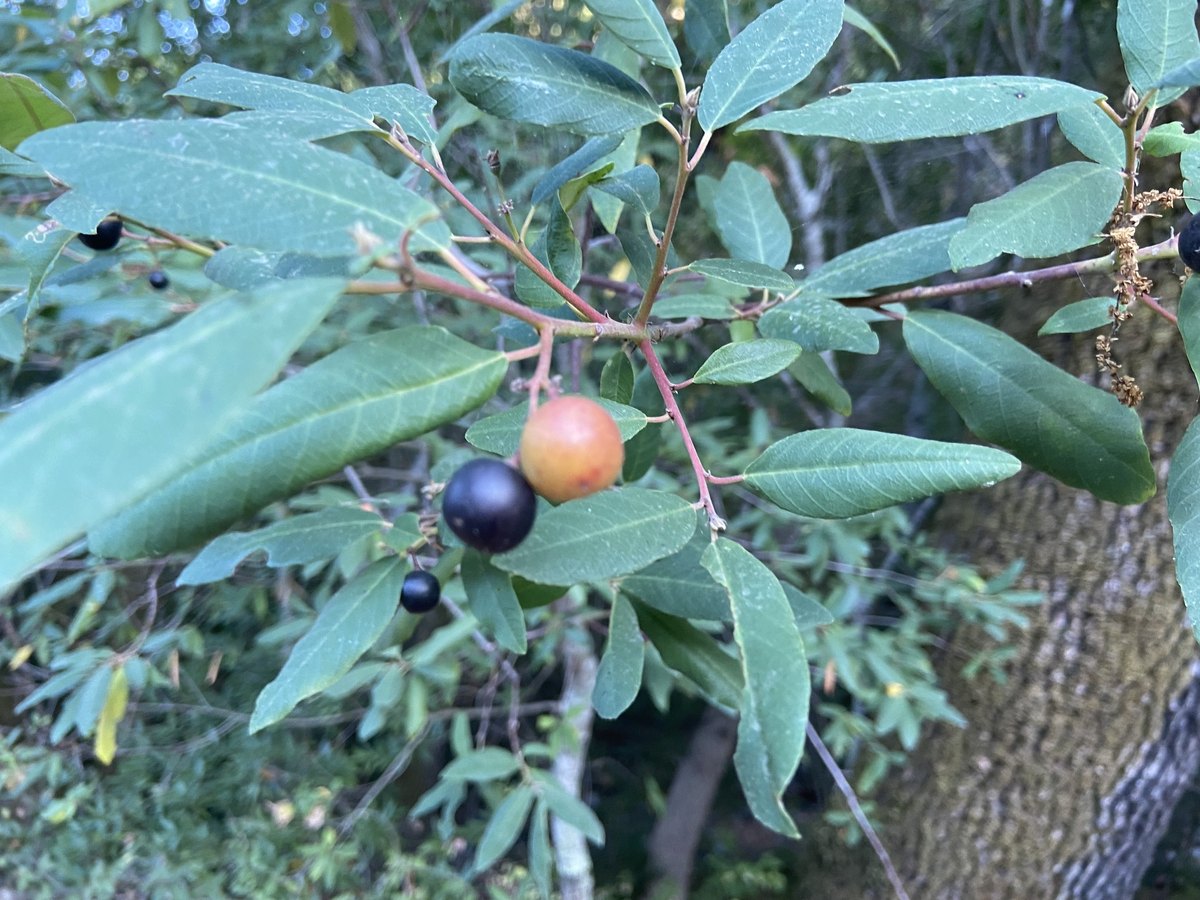
Start with the leaf, because that's what you'll see most of the year. Flora of North America gives leaf blades of about 3/4 inch to 4 inches (2 to 10 cm), elliptic, ovate or oblong-elliptic, and distinctly leathery (Sawyer & Nesom, 2016). Young twigs usually have reddish bark; older branches go gray, brown or reddish (McMurray, 1990).
The leaf undersides vary with the subspecies, from bright green or yellow in some to white with star-shaped hairs in others (Sawyer & Nesom, 2016). The margins are typically inrolled, meaning the edges curl under toward the underside (McMurray, 1990), and the Golden Gate National Parks Conservancy says the edges roll under in dry summers, which by its account conserves moisture (Golden Gate National Parks Conservancy, n.d.). On dry sites the leaves tend to be small and thick, and in moist situations relatively large and thin (McMurray, 1990), so two plants in the same neighborhood can look like different shrubs.
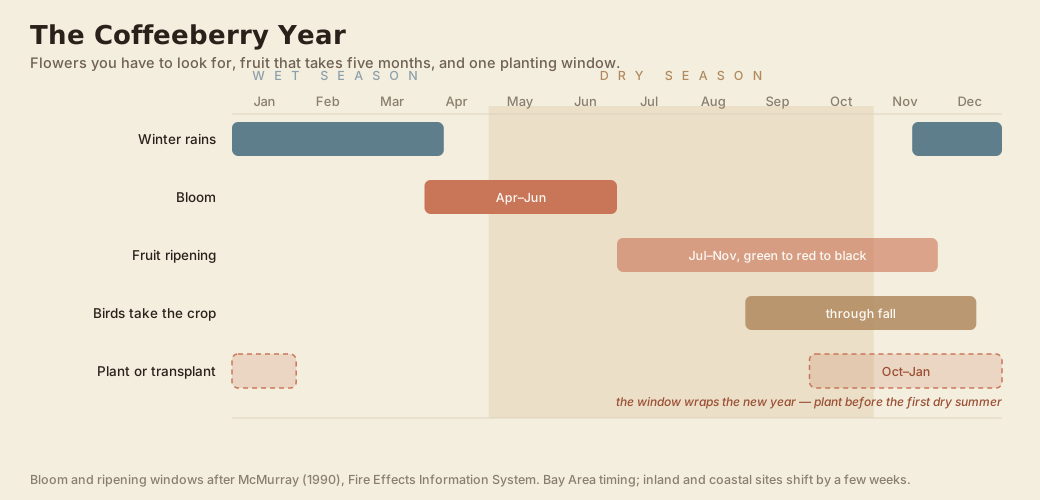
The flowers come typically April to June (McMurray, 1990), and you have to look for them. The NRCS plant guide describes many small, clustered, yellow-green flowers with five petals each (Tutka, 2015), and the Forest Service review calls them inconspicuous (McMurray, 1990). They do get visitors. A hover fly, Sphecomyia hoguei, has been collected visiting the flowers in southern California's mountains (Moran & Skevington, 2019), and a study of monarch butterflies in Mountain View lists coffeeberry among the plants they took nectar from (James et al., 2021). The shrub is also a caterpillar host for the pale swallowtail (Butterflies and Moths of North America, n.d.).
The fruit is the part worth a closer look. It's a juicy drupe, a fleshy fruit built around a stony pit. The Forest Service review gives it as about 1/4 inch (7 to 9 mm) across (McMurray, 1990), and Flora of North America as about 3/8 to 5/8 inch (10 to 15 mm) (Sawyer & Nesom, 2016). Ripening commonly runs from July through November, green to red or reddish-black, with dispersal in fall (McMurray, 1990), which is why a shrub in September can carry every color at once.
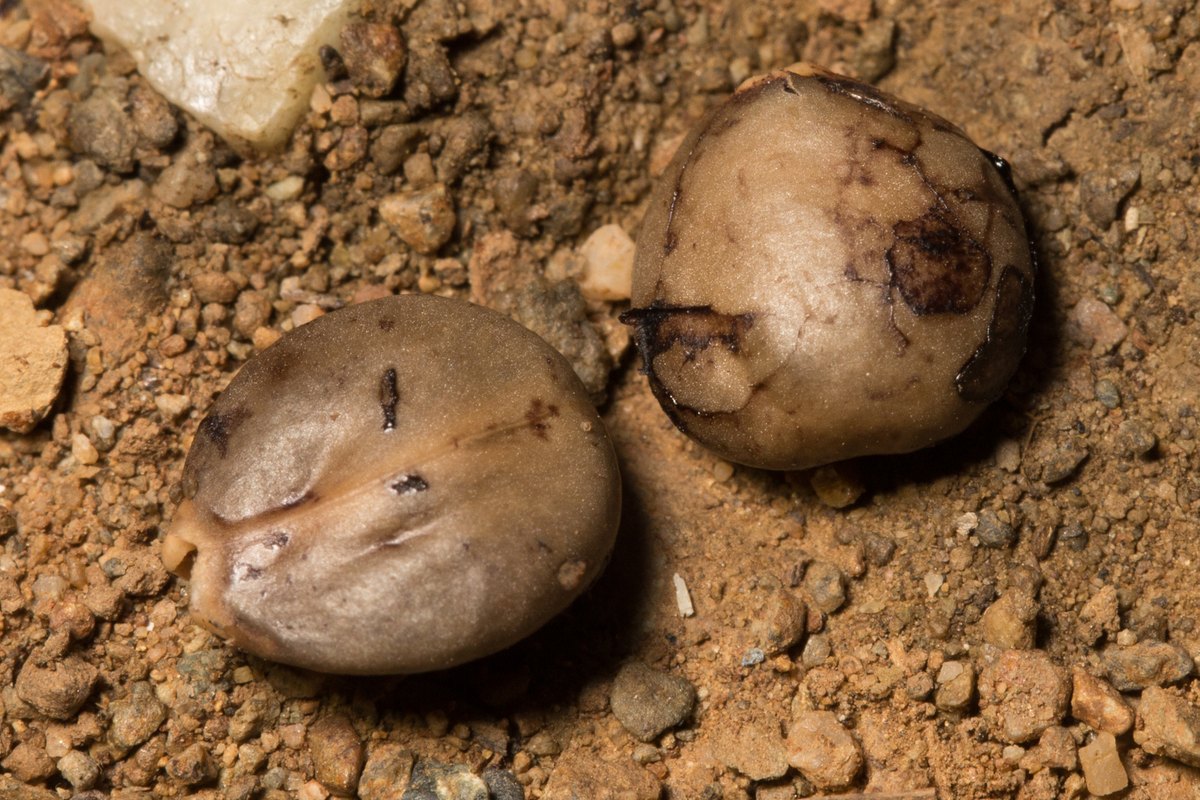
Each fruit holds two or three stones, depending on the subspecies (Sawyer & Nesom, 2016). Split one open. That's the "coffee."
The Name Doesn't Survive Contact with the Plant
The name "coffeeberry" falls short in three ways, and they get worse as you go.
The first is small. It's a resemblance, and the sources don't agree on which part is doing the resembling. The Forest Service review says the berries contain two smooth, nutlike seeds that "closely resemble the commercial coffee bean" (McMurray, 1990). The CNPS article credits the name to the look of the ripe berries, not their edibility (Mazur, 2010). Split a fruit in fall and judge for yourself.
The second is that people tried. People did try coffeeberry as a coffee substitute, the Forest Service review says, without success, and it says nothing more (McMurray, 1990). The San Marcos Growers plant page reports that roasted seeds have been noted as a caffeine-free stand-in for coffee, and in the same passage says the plant is considered poisonous (San Marcos Growers, n.d.-d).
The third is chemistry. A 2025 genome study of yerba mate names coffee, tea, cacao, citrus, guarana and yerba mate among the caffeine-making plants and says caffeine has evolved independently no less than six times across flowering plants (Vignale et al., 2025). The buckthorn family isn't among the lineages that study names, and coffeeberry is a buckthorn, in the family Rhamnaceae (Tutka, 2015).
The plant's own name has moved too. Flora of North America gives its original name as Rhamnus californica, published in 1826, and its accepted name as Frangula californica, a combination published in 1849 (Sawyer & Nesom, 2016). It reports that molecular studies show Frangula and Rhamnus as sister groups, and some treatments fold Frangula back into Rhamnus; Flora of North America keeps them apart on their physical differences (Sawyer & Nesom, 2016). The CNPS article, written in 2010, said nurseries were more likely to know the plant as Rhamnus californica (Mazur, 2010). Either name gets you the same plant.
Thin Cascara Bark
The family history matters more than the name.
Coffeeberry was at one time classified as a variety of cascara, Rhamnus purshiana var. californica, a synonym Flora of North America still lists (Sawyer & Nesom, 2016). LiverTox, a federal database on drug-induced liver injury, describes cascara as usually made from the aged, dried bark of Rhamnus purshiana, and translates cascara sagrada as sacred bark (NIDDK, 2017). Its active laxative components are anthraquinone derivatives (a class of plant compounds) and their glucosides, the cascarosides, which appear to irritate the colon locally and so speed the movement of stool (NIDDK, 2017).
King's American Dispensatory says cascara was discovered by an Eclectic physician, J. H. Bundy, and that its virtues were first praised in print in New Preparations, Detroit, in 1877 (Felter & Lloyd, 1898). The trade got big. The Forest Service review of cascara says five million pounds of dried Pacific Northwest cascara bark went to laxative makers in one year, though it doesn't say which year (Habeck, 1992).
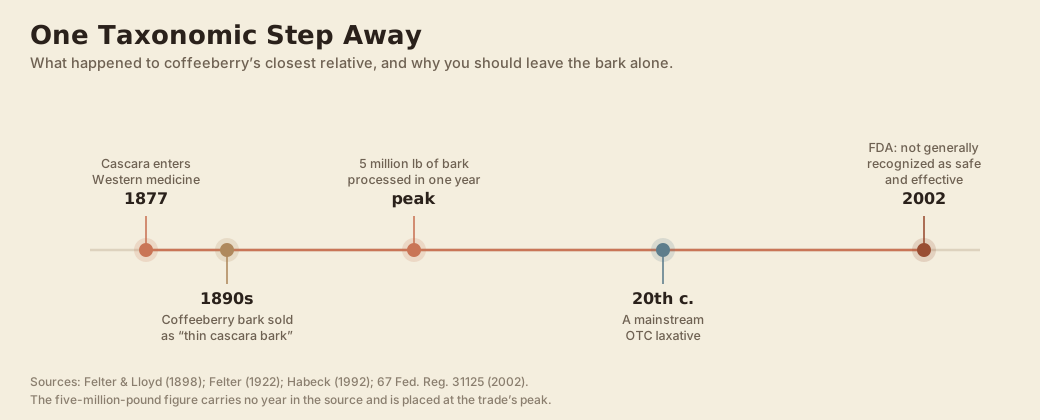
A trade that size leaves room for substitution. King's American Dispensatory (1898), quoting a writer from the 1890s, says coffeeberry bark had been used at home as a substitute for cascara, that it had doubtless been common practice to adulterate cascara with it, and that the two barks look very alike except that coffeeberry's is thinner (Felter & Lloyd, 1898). The same quotation says California wholesale druggists called it thin cascara bark, and King's adds that some commercial lots of cascara contained coffeeberry bark (Felter & Lloyd, 1898).
A generation later, Felter's Eclectic Materia Medica gave coffeeberry its own entry and repeated that it was sometimes gathered with cascara, adding that coast dealers knew it as thin cascara bark (Felter, 1922).
Cascara had been a category I, or monograph, over-the-counter laxative ingredient until the Food and Drug Administration (FDA) moved it to category III, more data needed (FDA, 2002). The FDA had asked for mutagenicity, genotoxicity and carcinogenicity data on cascara, and no data were submitted (FDA, 2002). In a final rule published in May 2002, the FDA stated that cascara sagrada, as a stimulant laxative ingredient in over-the-counter drug products, is not generally recognized as safe and effective (FDA, 2002). The rule took effect that November (FDA, 2002).
That didn't take cascara off the shelf. Memorial Sloan Kettering Cancer Center says cascara bark is marketed as a dietary supplement (Memorial Sloan Kettering Cancer Center, n.d.).
Where It Comes From
Coffeeberry ranges from the far southwest of Oregon down the coast and the Coast Ranges into southwestern California, according to the Forest Service review (McMurray, 1990). Across that range it grows on sites from dry flats and rocky ridges to moist slopes and ravines, usually below 5,500 ft (1,677 m) (McMurray, 1990). The NRCS plant guide adds chaparral, coastal sage scrub, coastal strand, central oak woodland, and mixed-evergreen and redwood forest to the list of habitats (Tutka, 2015).
Flora of North America recognizes six subspecies (abbreviated subsp.) and, citing a 1938 study, describes them as "more or less separated geographically," with intermediates among all of them except ursina (Sawyer & Nesom, 2016). Three reach past California: ursina into Arizona, Nevada, New Mexico and Sonora, Mexico; tomentella into Baja California; and occidentalis into Oregon (Sawyer & Nesom, 2016).
The one you're most likely to meet near the coast is subsp. californica, which Flora of North America calls the most coastal of the six. It runs from the western Klamath Mountains to Agua Tibia Mountain in southern California, native to California only and introduced in Hawaii, at elevations from sea level to about 9,200 ft (2,800 m) (Sawyer & Nesom, 2016). The NRCS plant guide, citing Sawyer (2016), gives the same subspecies a range from southern Oregon to Orange County (Tutka, 2015), so the sources don't quite agree on its ends.
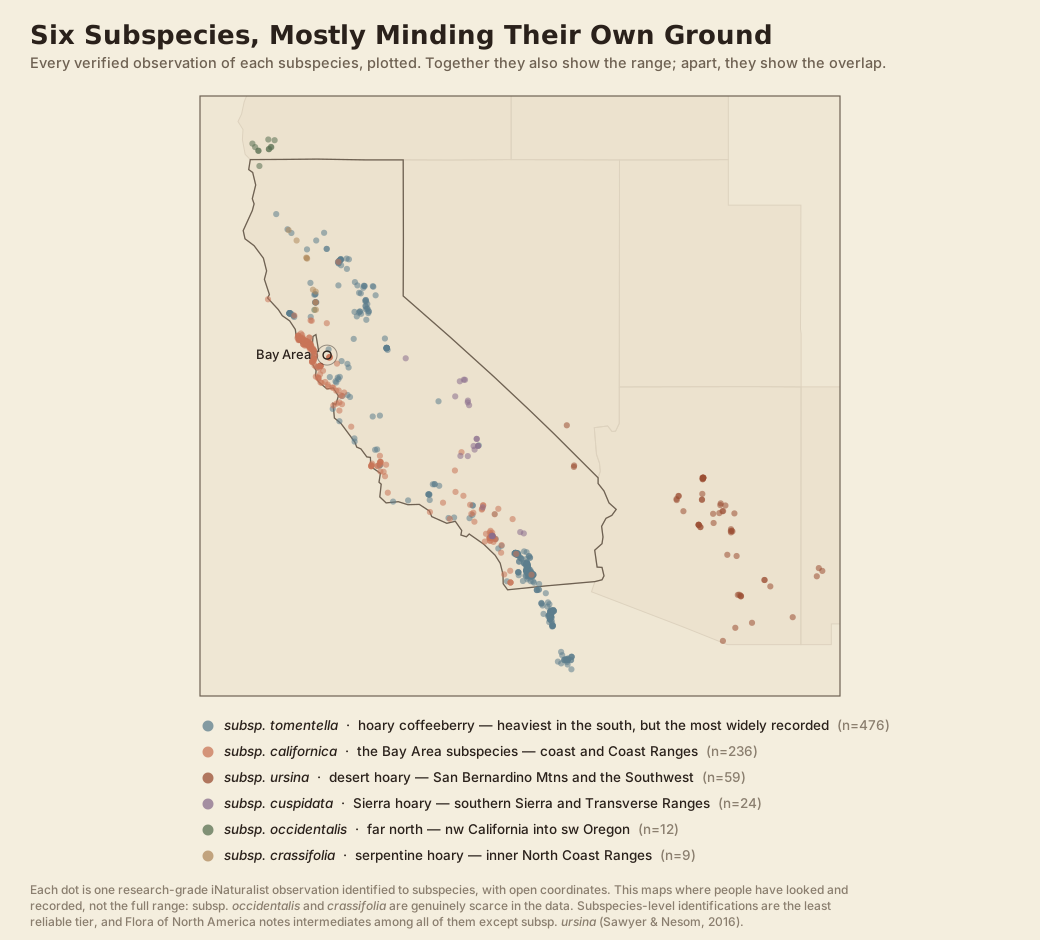
For the garden, the useful part is how much the mature size varies.
The Mistake to Avoid
Buying a coffeeberry with no selection name on the tag and putting it in a narrow gap between a path and a fence.
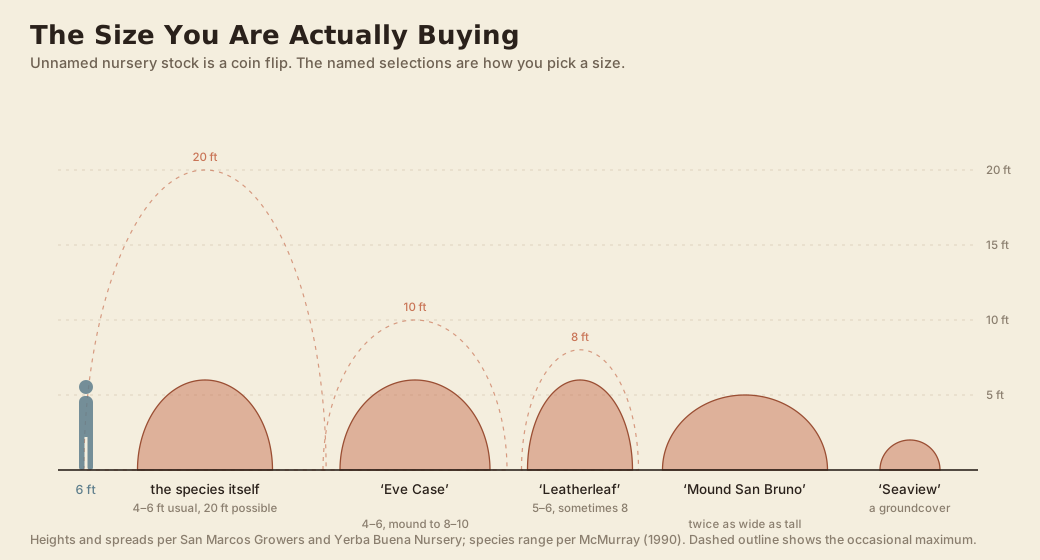
The Forest Service review says coffeeberry more often grows as a 4 to 6 ft (1.2 to 1.8 m) shrub, and on favorable sites along the coast occasionally becomes a small tree of about 20 ft (6 m) (McMurray, 1990). Given a suitable site, transplants may reach 8 to 12 ft (2.4 to 3.7 m), and about as wide, in roughly 20 years (McMurray, 1990). Published figures for the species spread wide: Oregon State University gives usually 4 to 8 ft, up to 20 (Oregon State University Department of Horticulture, n.d.), and San Marcos Growers 6 to 12 ft tall and as wide (San Marcos Growers, n.d.-d).
Named selections narrow that down, and there's history behind them. Pacific Horticulture says the Saratoga Horticultural Research Foundation began offering new California native plant selections in the early 1950s, at a time when, it says, "California natives were considered weeds and few were available in nurseries" (Coate & Coate, n.d.). Here are four you'll find:
- 'Eve Case' was introduced by the Saratoga Horticultural Foundation in 1975, from a seedling selection that used 'Seaview' as a parent (San Marcos Growers, n.d.-a). San Marcos Growers describes it as most commonly 4 to 6 ft tall but capable of a mound 8 to 10 ft tall and as wide, with showy berries (San Marcos Growers, n.d.-a). California Flora Nursery gives it as 6 ft tall and wide, reaching 8 ft or more under ideal circumstances (California Flora Nursery, n.d.-a).
- 'Mound San Bruno' is Roger Raiche's selection from plants on San Bruno Mountain (San Marcos Growers, n.d.-c). San Marcos Growers gives it as typically 4 to 6 ft tall and twice as wide as tall, with leaves about half the size of the species (San Marcos Growers, n.d.-c); California Flora Nursery gives 6 ft tall and wide (California Flora Nursery, n.d.-b).
- 'Seaview' was a 1957 Saratoga Horticultural Foundation introduction (San Marcos Growers, n.d.-a). Yerba Buena Nursery calls it the smallest coffeeberry available, growing to 2 ft high and 4 ft wide, and useful as an edging plant (Yerba Buena Nursery, n.d.); California Flora Nursery gives 2 to 3 ft high and as much as 6 ft across (California Flora Nursery, n.d.-c).
- 'Leatherleaf' came from the UC Berkeley Botanic Garden, which introduced it from a selection Roger Raiche made on Montara Mountain, near San Mateo (San Marcos Growers, n.d.-b). Its leaves are darker green than other cultivars (named selections), with margins rolled under for a leathery look more like a rhododendron, and it is more often 5 to 6 ft, though it can reach a mound 8 ft tall and wide (San Marcos Growers, n.d.-b).
Buy by name. Even the nurseries don't agree on exact sizes, but a named selection tells you roughly what you're getting, and an unnamed one doesn't.
If you garden near wild stands, meaning naturally occurring populations rather than planted ones, you might ask whether a selection could cross with them. I searched and found no study of gene flow, pollen from one population fertilizing another, between coffeeberry cultivars and wild plants. The general concern comes from other species: University of Maryland Extension, describing a creeping bentgrass study, says the cultivars' pollen "traveled up to 20 km" (about 12 miles) and fertilized planted cultivars and wild relatives of the same species (Tangren, 2019). That study followed a wind-pollinated grass (Watrud et al., 2004), while coffeeberry's flowers attract pollinating insects (Mazur, 2010), so we wouldn't carry the distance over. In a developed neighborhood, plant the selection and enjoy it. If you're doing restoration work next to intact chaparral, University of Maryland Extension's general advice applies: ask for locally adapted, genetically diverse plants (Tangren, 2019).
Sun: Full Sun to Moderate Shade
The Forest Service review says established plants handle anything from full sun to moderate shade, and calls coffeeberry a moderately shade-tolerant shrub (McMurray, 1990). The plant changes shape with the light. The CNPS article says it grows to 15 ft or more in shade, open in habit with glossy dark leaves, and stays more compact in sun, with lighter grey-green leaves (Mazur, 2010).
Location matters too. The Theodore Payne Foundation lists it for sun or part sun on the coast and part sun or shade inland (Theodore Payne Foundation for Wild Flowers and Native Plants [TPF], n.d.-a). In practice, a bed with open sky above it is fine; a spot in deep, all-day shade is past what the Forest Service describes. For a dark corner, the Douglas iris entry is a better place to start.
Water: Some Summer Water Is Fine
Established coffeeberry needs limited or no irrigation (Oregon State University Department of Horticulture, n.d.). New plants are different: the NRCS plant guide says that although coffeeberry is drought tolerant, limited summer water in the first year or two after planting improves survival (Tutka, 2015).
It's also forgiving of water. The NRCS plant guide says it tolerates even occasional seasonal flooding (Tutka, 2015). The Forest Service review reports large numbers of volunteer seedlings on sites receiving additional irrigation (McMurray, 1990). Yerba Buena Nursery advises regular to occasional summer water for 'Seaview' (Yerba Buena Nursery, n.d.).
There's a limit. Las Pilitas Nursery, recommending coffeeberry for fire breaks, says it will put up with "wash off" water every two weeks, but advises no deep summer soaks after the third year (Wilson, 2014). So an established plant can share a bed with light irrigation. Don't plan on soaking it all summer.
Soil: Wide Tolerance, One Serpentine Specialist
The Forest Service review says the soils where it grows are typically dry and well drained (McMurray, 1990). The range it will take is wider: the NRCS plant guide says it tolerates sand and clay (Tutka, 2015), Oregon State says it isn't particular about soil (Oregon State University Department of Horticulture, n.d.), and the Theodore Payne Foundation lists its soil type as any (TPF, n.d.-a). San Marcos Growers says 'Leatherleaf' grows in most soils, does best in sand, and gets harder to grow in heavy soil and farther from the coast (San Marcos Growers, n.d.-b).
Serpentine is the exception worth knowing. Serpentine soils are low in calcium, high in magnesium, relatively high in nickel, chromium and other heavy metals, and low in nitrogen, and they house only plants that can tolerate those conditions (U.S. Department of Agriculture, Forest Service, n.d.). Flora of North America says one subspecies, occidentalis, is typical of mafic and ultramafic ground in northwest California, and lists serpentine among its habitats in California and Oregon (Sawyer & Nesom, 2016). That's a trait of one subspecies, not of coffeeberry in general, so don't count on it from nursery stock.
In ordinary garden soil, we'd plant it without amending: dig the hole, backfill with what came out, and water it in.
What Happens After a Fire
After fire or cutting, coffeeberry resprouts from its root crown. The Forest Service review says that after fires that burn off the stems, it sprouts vigorously from dormant buds on the root crown, which supplies buds and stored carbohydrates and lets the plant rapidly reoccupy the burned site (McMurray, 1990). It calls coffeeberry quite resistant to fire mortality and says most plants survive fire even when the aboveground parts are lost (McMurray, 1990).
The root crown may enlarge with repeated postfire sprouting, but it is not a lignotuber (McMurray, 1990), the large woody burl at the stem base that Eastwood's manzanita forms in all but one of its subspecies (Fryer, 2020).
Seedlings are less predictable. The review says limited information leaves the pattern of seedling establishment after fire unclear. In southern California chaparral, coffeeberry apparently behaves as an obligate sprouter, meaning it comes back by resprouting, rarely establishing seedlings right after fire. On northern California chaparral sites, one study found 4,400 seedlings per acre on one-year-old burns (McMurray, 1990). The seeds are apparently quite short-lived: dried at room temperature, they stay viable for no longer than 9 months (McMurray, 1990). Coffeeberry is among the chaparral resprouters that look resilient to fire in the short term but whose populations may be threatened by repeated burning (Keeley, 1991).
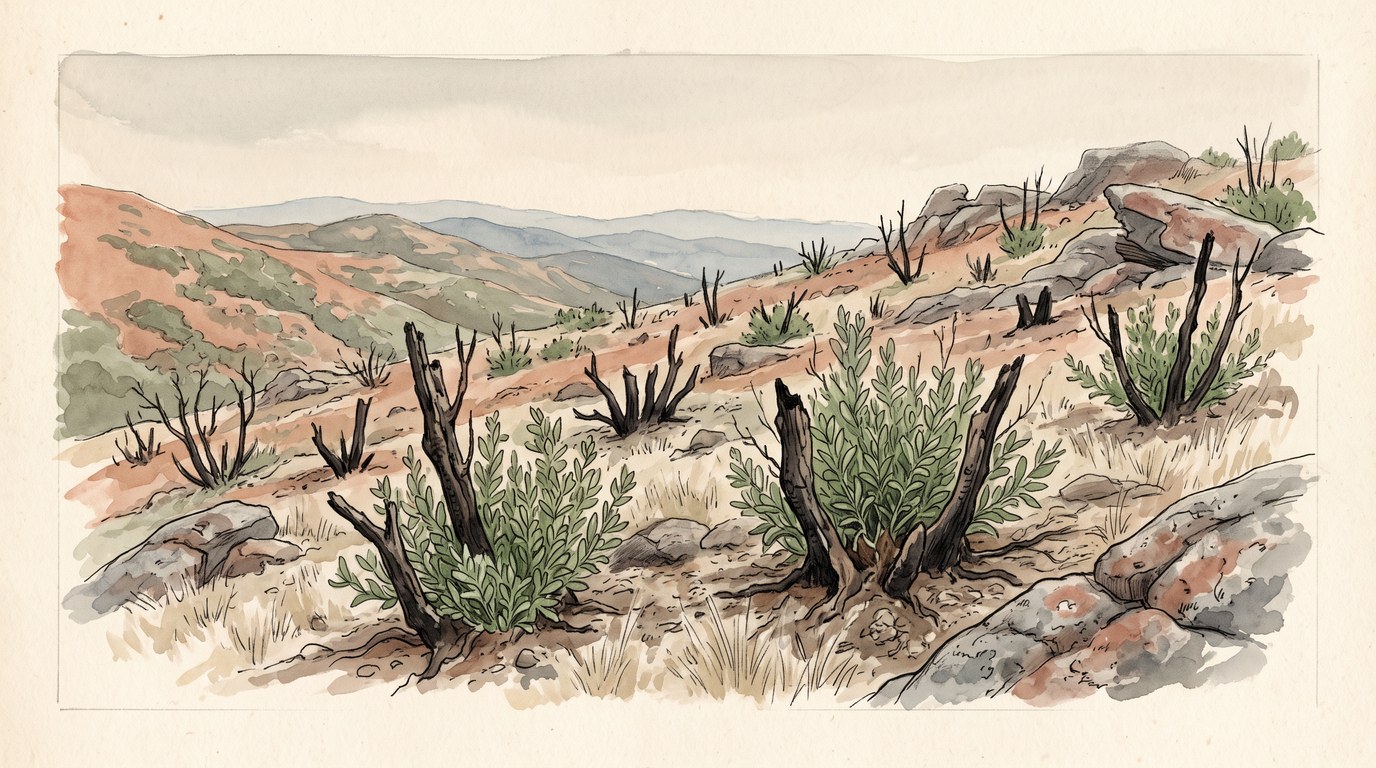
In the garden, that means you can cut it back. The NRCS plant guide says it tolerates pruning well and can be used as an informal hedge (Tutka, 2015), a use the CNPS article endorses too, calling it a fine one (Mazur, 2010).
The Berries, and Who They're For
The Forest Service review says the fruit is extensively used by wildlife, particularly birds, and, citing notes from the Hastings Natural History Reservation, that "in many areas, the berries are often the only abundant 'juicy' fruit available in the fall" (McMurray, 1990). Black bears, black-tailed deer and band-tailed pigeons all readily eat the berries, and woodrats take limited quantities of the seeds (McMurray, 1990). Woodrats eat the plant as well: at a woodrat hybrid zone in California's Kelso Valley, Bryant's woodrat ate more coffeeberry than any other single plant (Nielsen & Matocq, 2021).
Birds often strip the crop so thoroughly that relatively few seeds land under the parent plant (McMurray, 1990). Shrubs with bird-dispersed seed, coffeeberry among them, have apparently become more common on remnant oak savanna in central California, the review adds (McMurray, 1990).
A Caveat: Don't Eat It
The sources disagree on the berries. The Forest Service review, citing an earlier Forest Service guide, calls them "sweet and edible" and says West Coast tribes gathered them for food as well as medicine (McMurray, 1990), and the Golden Gate National Parks Conservancy repeats that (Golden Gate National Parks Conservancy, n.d.). The Theodore Payne Foundation describes them as not edible (TPF, n.d.-a). San Marcos Growers says the plant is not very poisonous compared with much more toxic plants, but enough so that it should be considered a poisonous plant, and that eating enough of the berries, or being particularly sensitive, could make a person sick (San Marcos Growers, n.d.-d).
The chemistry points one way. A 2021 woodrat-diet study, citing earlier toxicology, says coffeeberry carries anthraquinones, compounds it says can severely damage the gut lining of mammals and harm the liver (Nielsen & Matocq, 2021). The NRCS plant guide, citing Chestnut (1902), says that, like other buckthorns, coffeeberry produces a purgative effect, which native Californians used to treat constipation (Tutka, 2015), and, citing earlier ethnographic work, records that the Chumash and Costanoan dried and ground the inner bark to make a laxative tea (Tutka, 2015). Costanoan is an older name for the Ohlone. A report prepared for the National Park Service, titled Ohlone/Costanoan, says Costanoan was the accepted term among linguists and anthropologists from 1891 until the 1970s (Milliken et al., 2009).
So we'd leave it at this. The berries are for birds. Don't make anything out of the bark. The seeds aren't coffee, and the Forest Service's verdict on trying them is that it didn't work.
Plant it and look at it. The birds get the rest.
Sourcing
Buy coffeeberry from a native-plant nursery, and ask for it by two names: the Latin binomial and the selection.
Some nurseries still list it as Rhamnus californica; San Marcos Growers says it held off relisting the plant under the new name until the new name was more widely recognized, to avoid confusing its customers (San Marcos Growers, n.d.-d). It's the same plant. Then ask which selection it is. If nobody can tell you, treat it as the species and give it room for 8 to 12 ft, the size the Forest Service review says transplants may reach in about 20 years (McMurray, 1990).
Check where the plant came from. The U.S. Department of Agriculture's Animal and Plant Health Inspection Service (APHIS) lists coffeeberry among the proven hosts of Phytophthora ramorum (U.S. Department of Agriculture, Animal and Plant Health Inspection Service, 2022), the cause of sudden oak death (Swiecki et al., 2021). A paper in the proceedings of the Sixth Sudden Oak Death Science Symposium reports coffeeberry plants at a California native-plant nursery infected with Phytophthora tentaculata, which the paper says had been ranked among the five introduced Phytophthora species of greatest concern in the United States (Rooney-Latham et al., 2017). In a pilot accreditation program for northern California restoration nurseries, no Phytophthora was detected in more than 20,000 plants grown under its clean-production practices, while tests of stock from nurseries that followed few or none of the practices found it 71% of the time (Swiecki et al., 2021). A nursery that can tell you how it keeps its stock clean is worth the drive.
Plant in fall or winter. The Theodore Payne Foundation calls those the ideal times to plant California natives, because the cool, short days ease transplant stress and the seasonal rains cut down on watering (TPF, n.d.-b). Give it limited summer water for the first year or two (Tutka, 2015). After that the plant is on its own schedule, for what the Forest Service review cites as an estimated 100 to 200 years (McMurray, 1990).
We review our guides against the research and extension guidance available at the time, and we correct them when a source doesn't say what we took it to say or when we can't find support for a point. In this review we corrected our account of the 2002 federal rule on cascara and where coffeeberry suits serpentine soil, and updated what we said about eating the berries and about summer watering. We also removed claims we couldn't source.
Quick Reference
- Sun: Full sun to moderate shade once established. More compact with lighter grey-green leaves in sun; taller, more open and darker-leaved in shade.
- Water: Limited summer water for the first year or two. After that, little or none; one nursery advises against deep summer soaks after the third year.
- Soil: Sand, clay or most garden soils. Serpentine ground (low in calcium, high in magnesium) suits one subspecies, occidentalis, so don't assume it of nursery stock.
- Hardiness: Rated to U.S. Department of Agriculture (USDA) hardiness zone 7. One nursery reports losing a full-sized plant after a fourth night below 10 °F (−12 °C) and one night near 0 °F (−18 °C).
- Bloom: Typically April to June. Small, yellow-green, five petals, in clusters in the leaf axils (the crooks where leaf meets stem).
- Fruit: Juicy drupes (fleshy fruits built around a stony pit) that ripen commonly July through November, green to red to black. Two or three seeds each, and the seeds are the coffee-bean lookalikes.
- Size: Usually a 4–6 ft (1.2–1.8 m) shrub; on favorable coastal sites, occasionally a small tree to about 20 ft (6 m). Named selections run from about 2 ft ('Seaview') to 8–10 ft ('Eve Case' at its largest).
- Habit: Evergreen shrub, often in rounded clumps. Resprouts from the root crown after fire or cutting, and tolerates pruning well.
- Longevity: Estimated at 100 to 200 years.
- Plant in: Fall or winter, the times the Theodore Payne Foundation recommends for planting California natives.
- Source from: Native-plant nurseries. Ask by Latin name and by selection name.
- Watch for: Coffeeberry is a listed host of Phytophthora ramorum, the cause of sudden oak death, and nursery stock has carried another introduced Phytophthora. Buy from a nursery you trust.
The Takeaway
Coffeeberry suits a lot of Bay Area gardens: sun or light shade, sand or clay, little water once it's settled, and leaves through winter. Buy a named selection so you know roughly what size you're getting. Plant it in fall or winter, water it through the first summer or two, then mostly leave it be. The berries are for the birds, which often strip the crop (McMurray, 1990). That's what you're planting it for.
Sources
Butterflies and Moths of North America. (n.d.). Pale swallowtail (Papilio eurymedon Lucas, 1852). Retrieved September 25, 2026, from https://www.butterfliesandmoths.org/species/Papilio-eurymedon
California Flora Nursery. (n.d.-a). Frangula (Rhamnus) californica 'Eve Case'. Retrieved September 25, 2026, from https://www.calfloranursery.com/plants/frangula-rhamnus-californica-eve-case/
California Flora Nursery. (n.d.-b). Frangula (Rhamnus) californica 'Mound San Bruno'. Retrieved September 25, 2026, from https://www.calfloranursery.com/plants/frangula-rhamnus-californica-mound-san-bruno/
California Flora Nursery. (n.d.-c). Frangula (Rhamnus) californica 'Seaview'. Retrieved September 25, 2026, from https://www.calfloranursery.com/plants/frangula-rhamnus-californica-seaview/
Coate, C., & Coate, B. (n.d.). The legacy of the Saratoga Horticultural Research Foundation. Pacific Horticulture. Retrieved September 25, 2026, from https://pacifichorticulture.org/articles/the-legacy-of-the-saratoga-horticultural-research-foundation/
Felter, H. W. (1922). Rhamnus californica. In The eclectic materia medica, pharmacology and therapeutics. John K. Scudder. https://www.henriettes-herb.com/eclectic/felter/rhamnus-cali.html
Felter, H. W., & Lloyd, J. U. (1898). Rhamnus purshiana (U.S.P.), cascara sagrada. In King's American dispensatory (18th ed., 3rd rev.). Ohio Valley Company. https://www.henriettes-herb.com/eclectic/kings/rhamnus-purs.html
Food and Drug Administration. (2002). Status of certain additional over-the-counter drug category II and III active ingredients: Final rule (67 Fed. Reg. 31125, May 9, 2002; to be codified at 21 C.F.R. pt. 310). https://www.govinfo.gov/content/pkg/FR-2002-05-09/html/02-11510.htm
Fryer, J. L. (2020). Arctostaphylos glandulosa, Eastwood's manzanita. In Fire Effects Information System. U.S. Department of Agriculture, Forest Service, Rocky Mountain Research Station, Missoula Fire Sciences Laboratory. https://www.fs.usda.gov/database/feis/plants/shrub/arcgla/all.html
Golden Gate National Parks Conservancy. (n.d.). California coffeeberry. Retrieved September 25, 2026, from https://www.parksconservancy.org/conservation/california-coffeeberry
Habeck, R. J. (1992). Frangula purshiana. In Fire Effects Information System. U.S. Department of Agriculture, Forest Service, Rocky Mountain Research Station, Fire Sciences Laboratory. https://www.fs.usda.gov/database/feis/plants/shrub/frapur/all.html
James, D. G., Schaefer, M. C., Krimmer Easton, K., & Carl, A. (2021). First population study on winter breeding monarch butterflies, Danaus plexippus (Lepidoptera: Nymphalidae) in the urban South Bay of San Francisco, California. Insects, 12(10), 946. https://doi.org/10.3390/insects12100946
Keeley, J. E. (1991). Resilience to fire does not imply adaptation to fire: An example from the California chaparral. Proceedings of the Tall Timbers Fire Ecology Conference, 17, 113–120. https://talltimbers.org/wp-content/uploads/2014/03/Keeley1991_op.pdf
Lady Bird Johnson Wildflower Center. (n.d.). Frangula californica. Native Plant Database. Retrieved September 25, 2026, from https://www.wildflower.org/plants/result.php?id_plant=FRCA12
Mazur, V. (2010, September 28). California coffeeberry. California Native Plant Society. https://www.cnps.org/life-with-plants/california-coffeeberry-3025
McMurray, N. E. (1990). Frangula californica. In Fire Effects Information System. U.S. Department of Agriculture, Forest Service, Rocky Mountain Research Station, Fire Sciences Laboratory. https://www.fs.usda.gov/database/feis/plants/shrub/fracal/all.html
Memorial Sloan Kettering Cancer Center. (n.d.). Cascara. About Herbs. Retrieved September 25, 2026, from https://www.mskcc.org/cancer-care/integrative-medicine/herbs/cascara
Milliken, R., Shoup, L. H., & Ortiz, B. R. (2009). Ohlone/Costanoan Indians of the San Francisco Peninsula and their neighbors, yesterday and today. Report prepared for the National Park Service, Golden Gate National Recreation Area.
Moran, K. M., & Skevington, J. H. (2019). Revision of world Sphecomyia Latreille (Diptera, Syrphidae). ZooKeys, 836, 15–79. https://doi.org/10.3897/zookeys.836.30326
National Institute of Diabetes and Digestive and Kidney Diseases. (2017, January 23). Cascara. In LiverTox: Clinical and research information on drug-induced liver injury. National Library of Medicine. https://www.ncbi.nlm.nih.gov/books/NBK548113/
Nielsen, D. P., & Matocq, M. D. (2021). Differences in dietary composition and preference maintained despite gene flow across a woodrat hybrid zone. Ecology and Evolution, 11(9), 4909–4919. https://doi.org/10.1002/ece3.7399
Oregon State University Department of Horticulture. (n.d.). Frangula californica. Landscape Plants. Retrieved September 25, 2026, from https://landscapeplants.oregonstate.edu/plants/frangula-californica
Rooney-Latham, S., Blomquist, C. L., Soriano, M. C., Guo, Y. Y., Woods, P., Kosta, K. L., Weber, K., Swiecki, T. J., Bernhardt, E. A., Suslow, K., & Frankel, S. J. (2017). An update on Phytophthora species in California native plant nurseries and restoration areas. In Proceedings of the Sudden Oak Death Sixth Science Symposium (Gen. Tech. Rep. PSW-GTR-255). U.S. Department of Agriculture, Forest Service, Pacific Southwest Research Station. https://www.fs.usda.gov/psw/publications/documents/psw_gtr255/psw_gtr255_051.pdf
San Marcos Growers. (n.d.-a). Frangula californica 'Eve Case'. Retrieved September 25, 2026, from https://www.smgrowers.com/products/plants/plantdisplay.asp?plant_id=1347
San Marcos Growers. (n.d.-b). Frangula californica 'Leatherleaf'. Retrieved September 25, 2026, from https://www.smgrowers.com/products/plants/plantdisplay.asp?plant_id=3552
San Marcos Growers. (n.d.-c). Frangula californica 'Mound San Bruno'. Retrieved September 25, 2026, from https://www.smgrowers.com/products/plants/plantdisplay.asp?plant_id=1850
San Marcos Growers. (n.d.-d). Frangula californica. Retrieved September 25, 2026, from https://www.smgrowers.com/products/plants/plantdisplay.asp?plant_id=1346
Sawyer, J. O., & Nesom, G. L. (2016). Frangula californica. In Flora of North America Editorial Committee (Eds.), Flora of North America north of Mexico (Vol. 12). Oxford University Press. http://www.efloras.org/florataxon.aspx?flora_id=1&taxon_id=250101344
Swiecki, T. J., Bernhardt, E. A., Frankel, S. J., Benner, D., & Hillman, J. (2021). An accreditation program to produce native plant nursery stock free of Phytophthora for use in habitat restoration. Plant Health Progress, 22, 348–354. https://doi.org/10.1094/PHP-02-21-0025-FI
Tangren, S. (2019, May). Cultivars of native plants. University of Maryland Extension. https://extension.umd.edu/resource/cultivars-native-plants
Theodore Payne Foundation for Wild Flowers and Native Plants. (n.d.-a). Frangula californica, California coffeeberry. Retrieved September 25, 2026, from https://store.theodorepayne.org/products/theodore-payne-foundation-frangula-rhamnus-califor
Theodore Payne Foundation for Wild Flowers and Native Plants. (n.d.-b). Planting guide. Retrieved September 25, 2026, from https://theodorepayne.org/wp-content/uploads/2013/11/PLANTING-GUIDE_FINAL.pdf
Tutka, M. (2015). Plant guide for California coffeeberry (Frangula californica). U.S. Department of Agriculture, Natural Resources Conservation Service, Lockeford Plant Materials Center. https://plants.sc.egov.usda.gov/DocumentLibrary/plantguide/pdf/pg_frca12.pdf
U.S. Department of Agriculture, Animal and Plant Health Inspection Service. (2022). APHIS lists of proven hosts of and plants associated with Phytophthora ramorum. https://www.cdfa.ca.gov/plant/docs/2026/host_list_being_incorporated_by_reference.pdf
U.S. Department of Agriculture, Forest Service. (n.d.). Serpentine adaptations. Celebrating Wildflowers. Retrieved September 25, 2026, from https://www.fs.usda.gov/wildflowers/beauty/serpentines/adaptations.shtml
Vignale, F. A., Hernandez Garcia, A., Modenutti, C. P., Sosa, E. J., Defelipe, L. A., Oliveira, R., Nunes, G. L., Acevedo, R. M., Burguener, G. F., Rossi, S. M., Zapata, P. D., Marti, D. A., Sansberro, P., Oliveira, G., Catania, E. M., Smith, M. N., Dubs, N. M., Nair, S., Barkman, T. J., & Turjanski, A. G. (2025). Yerba mate (Ilex paraguariensis) genome provides new insights into convergent evolution of caffeine biosynthesis. eLife, 14, e104759. https://doi.org/10.7554/eLife.104759
Watrud, L. S., Lee, E. H., Fairbrother, A., Burdick, C., Reichman, J. R., Bollman, M., Storm, M., King, G., & Van de Water, P. K. (2004). Evidence for landscape-level, pollen-mediated gene flow from genetically modified creeping bentgrass with CP4 EPSPS as a marker. Proceedings of the National Academy of Sciences, 101(40), 14533–14538. https://doi.org/10.1073/pnas.0405154101
Wilson, B. (2014, January 3). Rhamnus californica, coffeeberry. Las Pilitas Nursery. https://www.laspilitas.com/nature-of-california/plants/rhamnus-californica
Yerba Buena Nursery. (n.d.). Rhamnus californica 'Seaview' (dwarf coffeeberry). Retrieved September 25, 2026, from https://www.nativeplants.com/online_album/0523.htm
Image (hero): Parsons, A. (2022, August 3). Frangula californica, Sierra Azul Open Space Preserve, Santa Clara County, California [Photograph]. iNaturalist observation 129346344. Dedicated to the public domain (CC0 1.0). https://www.inaturalist.org/observations/129346344
Image (fruit ripening): Herz, A. (2023, September 17). Frangula californica, Rancho Cañada del Oro Open Space Preserve, San Jose, California [Photograph]. iNaturalist observation 183805153. Licensed CC BY. https://www.inaturalist.org/observations/183805153
Image (seeds): Ueda, K. (2019, September 23). Frangula californica seeds, Del Valle Regional Park, Alameda County, California [Photograph]. iNaturalist observation 34342520. Licensed CC BY. https://www.inaturalist.org/observations/34342520
Image (chaparral after fire): The Planters' Guild. (2026). Chaparral resprouting in the second spring after fire [AI-generated illustration]. Generated with Artlist. Illustrative of root-crown resprouting generally; not a photograph and not a documentary record of a specific site.
Graphics (subspecies map, cultivar sizes, phenology and cascara timelines): The Planters' Guild. (2026). Drawn from the sources cited above. Subspecies occurrence points from iNaturalist research-grade observations; state boundaries from US Census public-domain data.