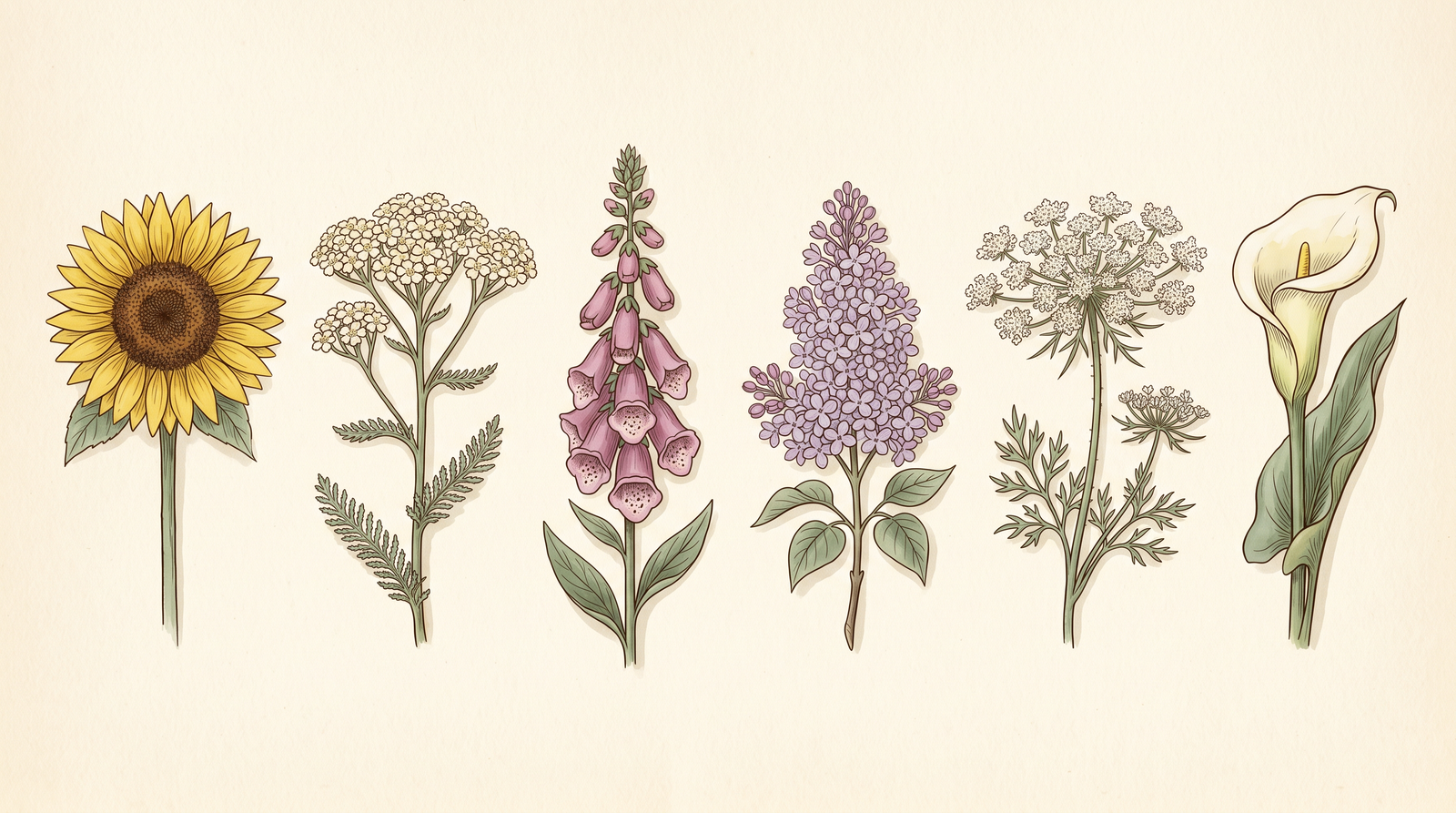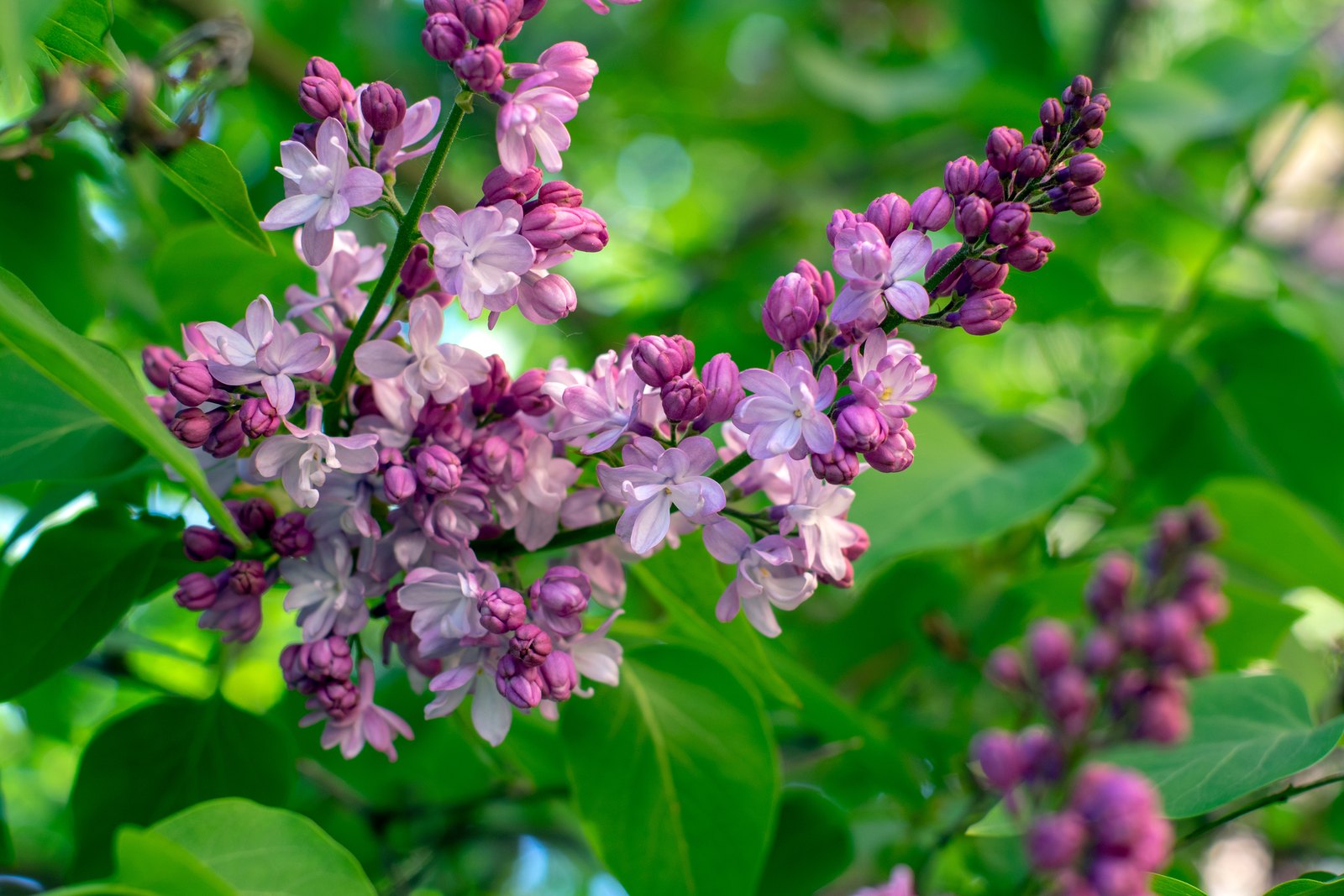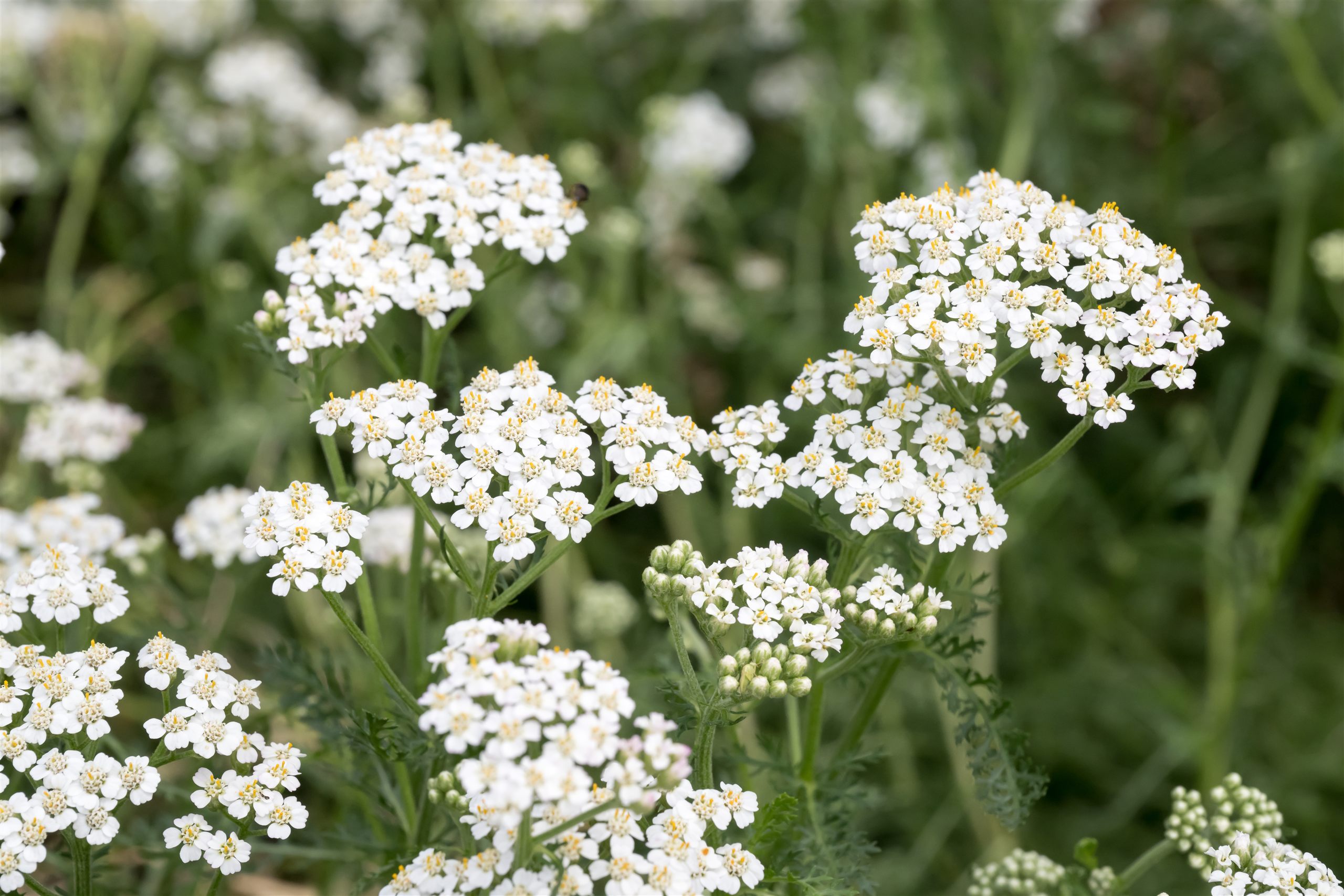
A corymb is a raceme that flattened itself. The stalks still leave the main stem at different heights, but the lower ones grow longer than the upper ones, and every flower arrives at the same level. What that buys the plant is a platform: a surface an insect can land on once and then walk. Hawthorn carries the textbook version across every hedgerow in May. Yarrow is the one worth the hand lens, because the flat top you're admiring isn't made of flowers at all.
§ 01What actually counts as a corymb
A corymb is a raceme that flattened itself. The parts are the ones you already know from foxglove: a main axis, flowers held out on individual stalks, a growing tip that never caps itself with a final flower. The change is in the stalks. In a raceme they're all about the same length, so the flowers climb the axis like rungs. In a corymb they're graded: the lowest, outermost pedicels (the individual flower stalks) grow the longest, the upper ones stay short, and every flower arrives at roughly the same height (Weberling, 1989; Merriam-Webster, n.d.). The silhouette stops being a spire and becomes a table.
The field test lives in the stalks. Plenty of clusters look flat from across a garden. Get to the side of one and trace the stalks down: if they leave the main axis at different heights and still finish level, you're holding a corymb. Hawthorn is the example the reference books reach for first (Encyclopaedia Britannica, n.d.), and it earns the spot. In May a hawthorn hedge is one continuous shelf of white, and W. J. Bean, the great chronicler of British trees, wrote that when in blossom "no object of our waysides has greater beauty" (Bean, n.d.-a).
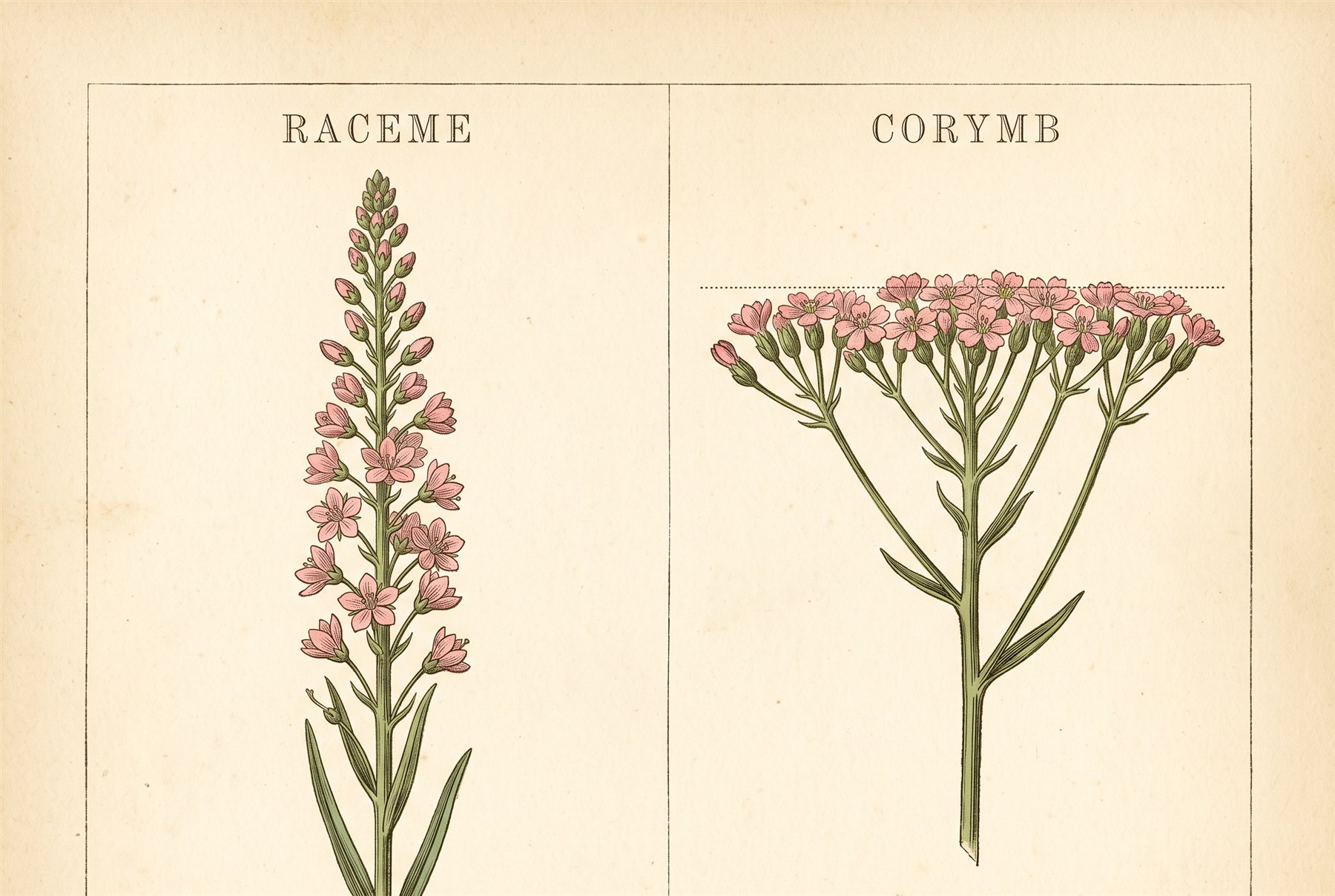
The word itself came through Latin corymbus from the Greek korymbos, a cluster of fruit or flowers (Merriam-Webster, n.d.). No hidden gods this time, no millet. Just a cluster.
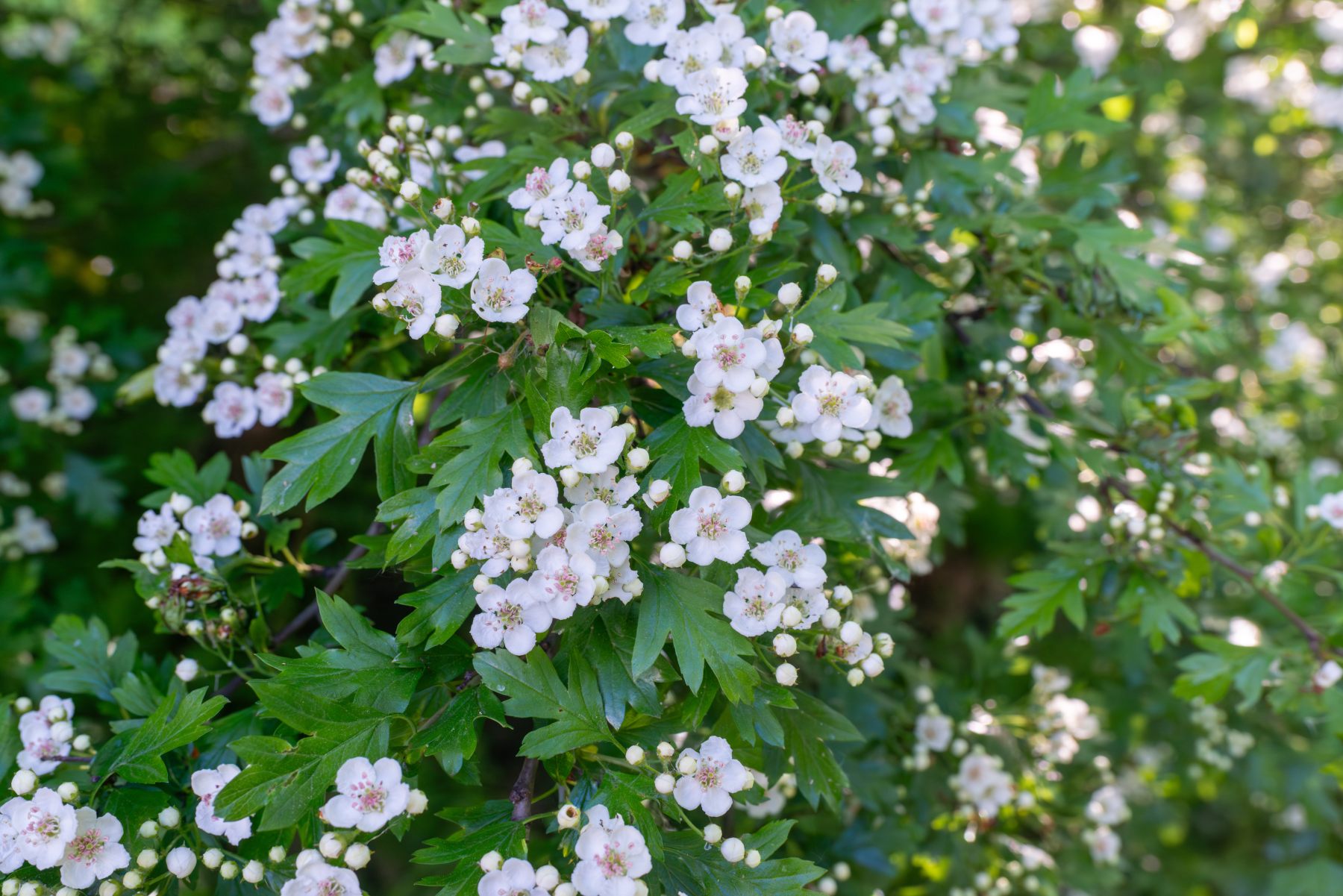
Because the corymb is still racemose, still indeterminate, the bloom order gives it away even before you check the stalks. The outer, lower flowers open first and the display fills toward the center (Encyclopaedia Britannica, n.d.). A corymb in mid-bloom reads as a ring of open flowers around a middle of tight buds, and you can spot that from a distance once you know to look for it. Models of inflorescence architecture treat these open, indeterminate forms as points on one continuum, the same machinery with different settings for how tips and stalks behave (Prusinkiewicz et al., 2007). The corymb's setting happens to produce a floor.
§ 02The yarrow, and the deeper trick
Common yarrow, Achillea millefolium , is the plant this entry hands you, and it looks like the perfect specimen. A flowering stem carries 50 to 100 small white heads packed into a flat or slightly domed cluster up to about 6 inches (15 cm) across (Botanical Society of Britain & Ireland [BSBI], n.d.). The genus is named for Achilles, who according to the old retellings learned the plant's wound-staunching properties from the centaur Chiron and, in the Iliad's telling, first used it to heal the wounds of Telephus (BSBI, n.d.). Flat top, graded stalks, blooms at the rim first. Everything checks out.
Then you put a hand lens on a single "flower" and the entry changes underneath you. Each one is a capitulum , a composite flower head: what look like five white petals are five individual ray florets, each a complete miniature flower, arranged around ten to twenty tubular disc florets in the center (Flora of North America [FNA], 2006; BSBI, n.d.). The daisy family builds false flowers this way as a matter of course (Simpson, 2010), and yarrow's flat top is made of dozens of them. So the structure isn't a corymb of flowers. It's a corymb of heads, each head itself pretending to be a flower. Yarrow is running the flat-top trick and the false-flower trick at the same time, in the same 6 inches.
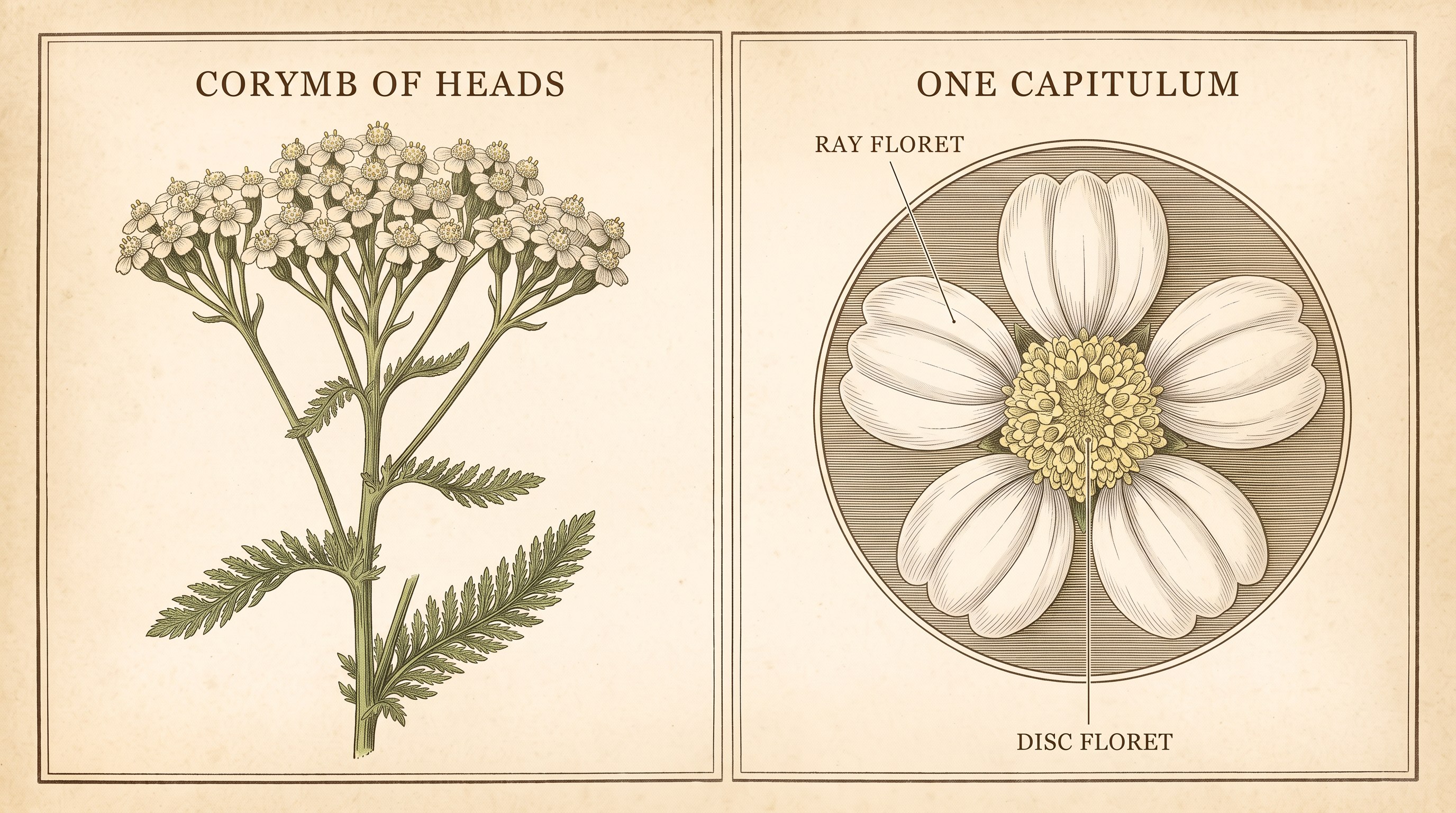
Watch how the reference floras handle this and you can see them hedging in real time. Flora of North America describes yarrow's heads as held "in simple or compound, corymbiform arrays" (FNA, 2006). Corymbiform: shaped like a corymb, without committing to being one. The BSBI's Fermanagh account goes the other way and calls it a "corymbose panicle" (BSBI, n.d.). Two authoritative sources circling the same flat top, and neither one quite willing to land on it. Lilac showed us last entry that "panicle" works as a bucket. "Corymb" turns out to be one too, and when a structure sits between definitions, the honest move is an adjective. Entry No. 08 will take the lens to the capitulum itself.
One more complication, since yarrow collects them. Whether the yarrow in a California garden counts as native depends on whose species concept you adopt. Kew's world checklist draws the native range at Greenland plus subarctic and temperate Eurasia (POWO, 2026). Flora of North America instead treats the whole thing as one circumboreal polyploid complex, native and introduced populations hybridizing freely into a single, hugely variable species that spans the continent (FNA, 2006), a complex whose chromosome counts run from diploid clear up to octoploid (Warwick & Black, 1982). Both positions are defensible. If you buy a locally grown yarrow from a native plant sale, you're planting the North American lineage either way; the argument is about where the species boundary sits, not where your plant came from.
§ 03The corymb in your own garden
Now the question the whole pillar keeps asking: what does the shape buy? For the corymb the answer is a floor. A foxglove asks its bee to fly, hover, land, crawl in, back out, and repeat, flower after flower up the spire. A corymb asks for one landing. After that the visitor walks, and walking is cheap.
Yarrow needs those visitors more than most, because it's self-incompatible: it cannot set seed with its own pollen, so every fruit depends on an insect arriving from a different plant (BSBI, n.d.). And the clientele the flat top serves is exactly the crowd that appreciates a floor. Hoverflies, the bee-mimicking flies you'll find hanging motionless over any summer garden, feed mostly at open, bowl-shaped flowers where nothing is hidden down a tube (Branquart & Hemptinne, 2000, as cited in Klečka et al., 2018). They don't have the long tongues or the crawl-inside ambitions of bees. They want a surface, and yarrow is a plate of food several inches wide.
The visitation data backs the intuition. In a community-wide study of a Central European grassland, the drone-fly subfamily of hoverflies showed the strongest preference for white flowers of any group, smaller hoverfly species concentrated their visits on plants with larger inflorescences, and females of one abundant species, Eristalis nemorum, directed most of their visits to just two plants, one of which was yarrow (Klečka et al., 2018). White, wide, and flat is a deliberate storefront, and the flies read the sign.
Size itself pays measurably. In common ragwort, a roadside composite that presents its heads in the same flat-topped corymbs, an experiment stripped most of the heads from some stems and left others intact: the intact corymbs set a higher proportion of fruit per flower (Andersson, 1996). The display works as a unit. Trim the platform and the whole enterprise books fewer visits.
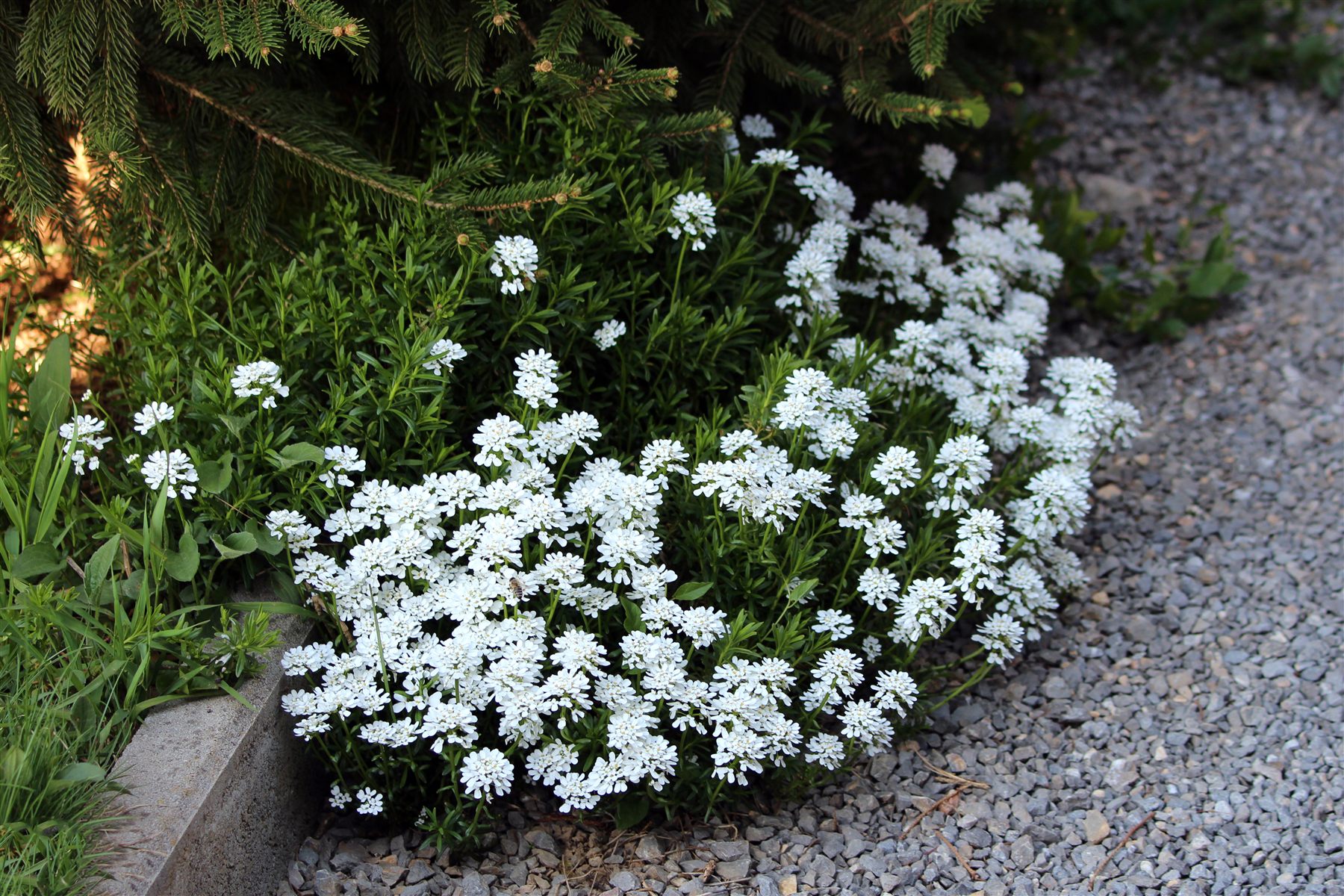
For a corymb you can grow at ankle height, plant evergreen candytuft, Iberis sempervirens , a southern European edging perennial that covers itself in dense, flattened white clusters from early to late spring (Missouri Botanical Garden, n.d.). It rewards the hand lens twice. First, each individual flower is lopsided by design: one pair of petals runs 5 to 13 mm long while the other pair stays at 3 to 6 mm, so the outward-facing side of every flower is enlarged (FNA, 2010), which amplifies the rim of the cluster the same way the corymb amplifies the whole plant. Second, candytuft confesses what a corymb really is if you wait. As the flowers finish and fruits form, the racemes elongate slightly (FNA, 2010), and the flat top loosens back toward a visible axis with stalks spaced along it. A corymb, it turns out, is a raceme holding a pose, and in fruit it relaxes.
Hawthorn closes the loop at tree scale. The common hawthorn of hedgerows opens from mid-May into early June, and an identification detail worth keeping: its flowers carry one style and its fruits one stone (Bean, n.d.-a), where its close relative Crataegus laevigata carries two or three of each (Bean, n.d.-b). If you find a flat white shelf of bloom on a thorny tree in late spring, count styles and you've keyed it to species without stepping back from the corymb.
§ 04The bottom line
A corymb is an indeterminate inflorescence with graded stalks: pedicels leaving the main axis at different heights, lower ones longer, all delivering their flowers to one plane, outer flowers opening first. Find the flat top, then confirm it in the stalks. That second step matters because the umbel, next in the arc, builds an almost identical shelf from a single attachment point, and the two are told apart at the axis, never from above.
Next form: the umbel, where every stalk springs from one point at the tip of the stem, and the flat top becomes a firework caught mid-burst.
Photo credits: the hero (common yarrow), the hawthorn figure, and the candytuft figure are licensed from Adobe Stock, cropped from the originals. The two comparison figures are original illustrations by The Planters' Guild.
Andersson, S. (1996). Floral display and pollination success in Senecio jacobaea (Asteraceae): Interactive effects of head and corymb size. American Journal of Botany, 83(1), 71–75. https://doi.org/10.1002/j.1537-2197.1996.tb13876.x
Bean, W. J. (n.d.-a). Crataegus monogyna. Trees and Shrubs Online. Retrieved August 26, 2026, from https://www.treesandshrubsonline.org/articles/crataegus/crataegus-monogyna/
Bean, W. J. (n.d.-b). Crataegus laevigata. Trees and Shrubs Online. Retrieved August 26, 2026, from https://www.treesandshrubsonline.org/articles/crataegus/crataegus-laevigata/
Botanical Society of Britain & Ireland. (n.d.). Achillea millefolium L., Yarrow. Fermanagh Species Accounts. Retrieved August 26, 2026, from https://fermanagh.bsbi.org/achillea-millefolium-l
Encyclopaedia Britannica. (n.d.). Inflorescences. In Angiosperm. Retrieved August 26, 2026, from https://www.britannica.com/plant/angiosperm/Inflorescences
Flora of North America Editorial Committee. (2006). Achillea millefolium. In Flora of North America North of Mexico (Vol. 19). Retrieved August 26, 2026, from http://www.efloras.org/florataxon.aspx?flora_id=1&taxon_id=200023010
Flora of North America Editorial Committee. (2010). Iberis sempervirens. In Flora of North America North of Mexico (Vol. 7). Retrieved August 26, 2026, from http://www.efloras.org/florataxon.aspx?flora_id=1&taxon_id=250095044
Klečka, J., Hadrava, J., Biella, P., & Akter, A. (2018). Flower visitation by hoverflies (Diptera: Syrphidae) in a temperate plant-pollinator network. PeerJ, 6, e6025. https://doi.org/10.7717/peerj.6025
Merriam-Webster. (n.d.). Corymb. In Merriam-Webster.com dictionary. Retrieved August 26, 2026, from https://www.merriam-webster.com/dictionary/corymb
Missouri Botanical Garden. (n.d.). Iberis sempervirens. Plant Finder. Retrieved August 26, 2026, from https://plantfinder.mobot.org/PlantFinderDetails.aspx?kempercode=k620
POWO. (2026). Achillea millefolium L. Plants of the World Online. Royal Botanic Gardens, Kew. Retrieved August 26, 2026, from https://powo.science.kew.org/taxon/urn:lsid:ipni.org:names:2294-2
Prusinkiewicz, P., Erasmus, Y., Lane, B., Harder, L. D., & Coen, E. (2007). Evolution and development of inflorescence architectures. Science, 316(5830), 1452–1456. https://doi.org/10.1126/science.1140429
Simpson, M. G. (2010). Plant systematics (2nd ed.). Academic Press.
Warwick, S. I., & Black, L. (1982). The biology of Canadian weeds. 52. Achillea millefolium L. s.l. Canadian Journal of Plant Science, 62(1), 163–182. https://doi.org/10.4141/cjps82-024
Weberling, F. (1989). Morphology of flowers and inflorescences (R. J. Pankhurst, Trans.). Cambridge University Press.