California Natives · Season Two · No. 14
Coyote Brush: The Shrub You've Walked Past Ten Thousand Times
A field guide to Baccharis pilularis, the shrub that lines every trail and fire road in the Bay Area and almost never gets planted on purpose. Why the groundcover and the head-high shrub are different plants, why the one you choose changes the insects you get, and why this is the rare native to plant knowing it won't be there forever.
On this page
14 sections
- About the Plant
- What You're Looking At
- Two Plants Under One Name
- Half the Plants Are Male, and Yours Almost Certainly Is
- The Mistake Most People Make
- Sun, Soil, and Water
- Planting It This Autumn
- Pruning Is a Cycle, Not a Rescue
- What It's Doing Out There, and How It Ends
- Fire, and a Claim Worth Correcting
- Sourcing
- A Footnote for the Curious
- The Takeaway
- Quick Reference
About the Plant
Every hillside photograph you have ever seen of the Bay Area has this plant in it. Nobody points at it.
Coyote brush is the grey-green shrub along the fire road and the mound at the edge of the parking lot. It fills the gap between the grassland and the oaks. It's one of the most ordinary plants in Northern California and one of the least often planted on purpose, for the usual reason: the flowers are small and dull, and on a nursery bench it loses to anything with color on it.
It also blooms in October, holds its leaves all year, carries an enormous insect load, and is genuinely strange once you look closely. Baccharis pilularis, pronounced BAK-uh-ris pil-yoo-LAIR-iss, sits in the sunflower family alongside the daisies and the sagebrushes, and almost every plant in its genus carries male and female flowers on separate plants rather than both on one (Sundberg & Bogler, 2006). That single fact drives most of what is interesting about buying one.
What You're Looking At
An evergreen shrub, densely branched, with small toothed leaves dotted with resin glands and slightly sticky to the touch. The whole plant reads as one texture, which is part of why it stays anonymous.
Size is where the description forks, and it forks completely. The mat-forming type spreads 3 to 12 ft (1 to 4 m) across and stays 4 to 10 in (10 to 25 cm) tall (Smither-Kopperl, 2016; Steinberg, 2002a). The upright type is a rounded shrub, most often 4 to 6 ft (1.2 to 1.8 m) and capable of 12 ft (4 m) (Smither-Kopperl, 2016). There is very little in between.
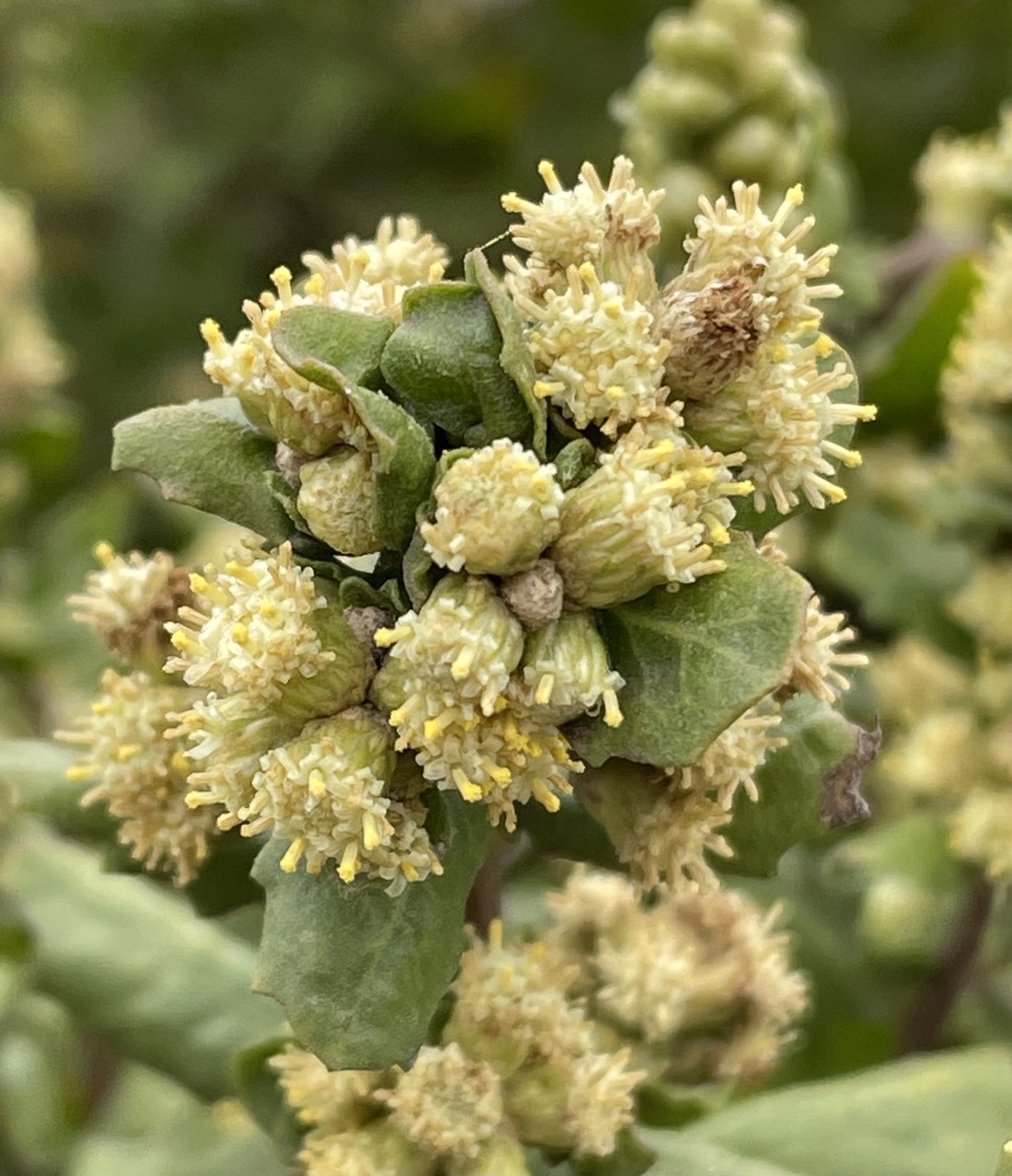
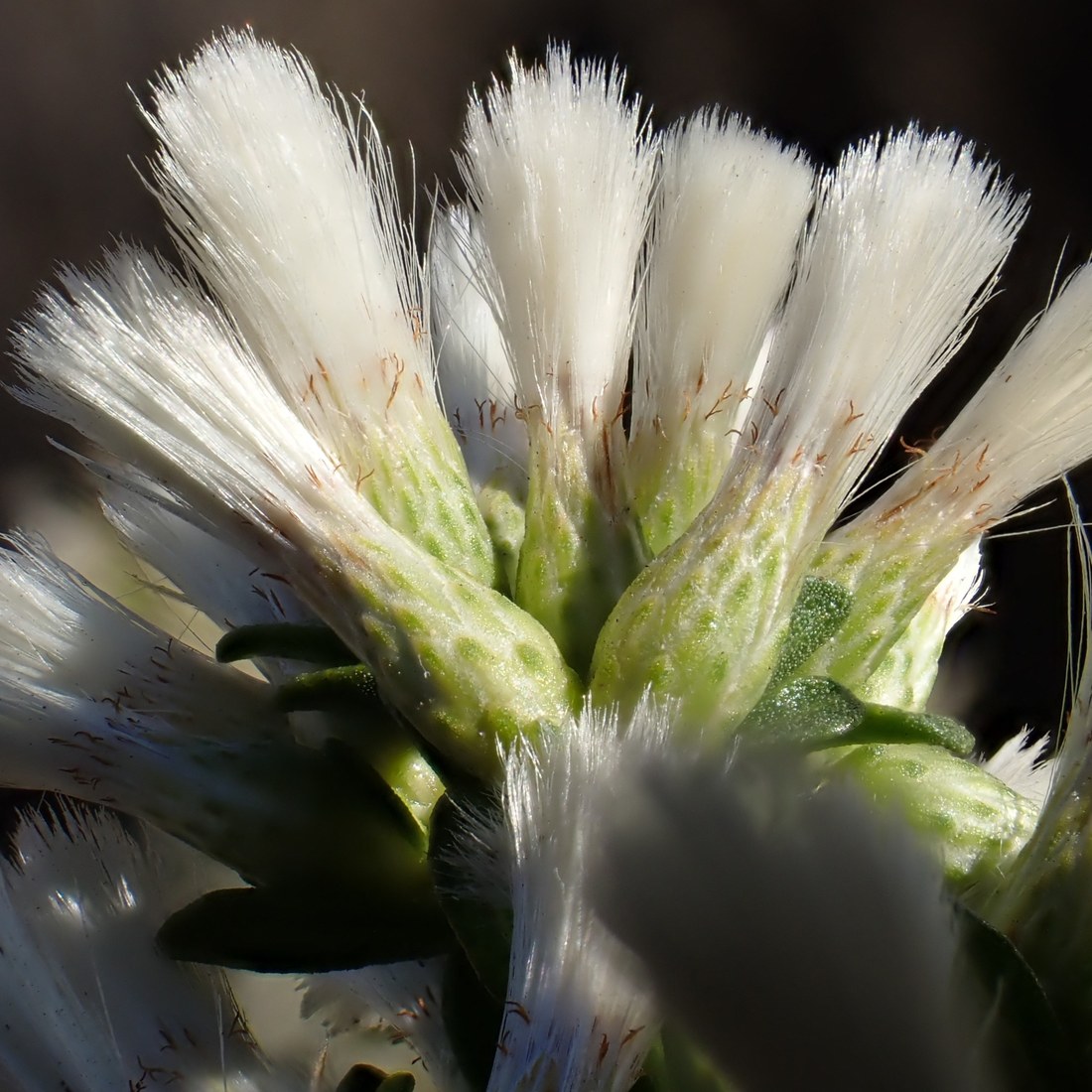
The flower heads are 0.16 to 0.25 in (4 to 6 mm) long, clustered at the branch tips, and bloom runs July into December (Smither-Kopperl, 2016; Sundberg & Bogler, 2006). Female plants finish by going white and fluffy. Each seed carries a pappus, the little parachute of fine hairs that lets it ride the wind, and the seed itself weighs about a ten-thousandth of a gram (Sundberg & Bogler, 2006; Steinberg, 2002a).
Two Plants Under One Name
Grow the low mat and the upright shrub side by side and they stay different. One study raised plants from a coastal population at Bodega Bay and an inland one near Irvine and grew them together. Leaf size shifted with conditions, but the shape of the plant traveled with the plant, which is what an inherited difference looks like (Miller & Weis, 1999, as summarized in Montalvo et al., 2010).
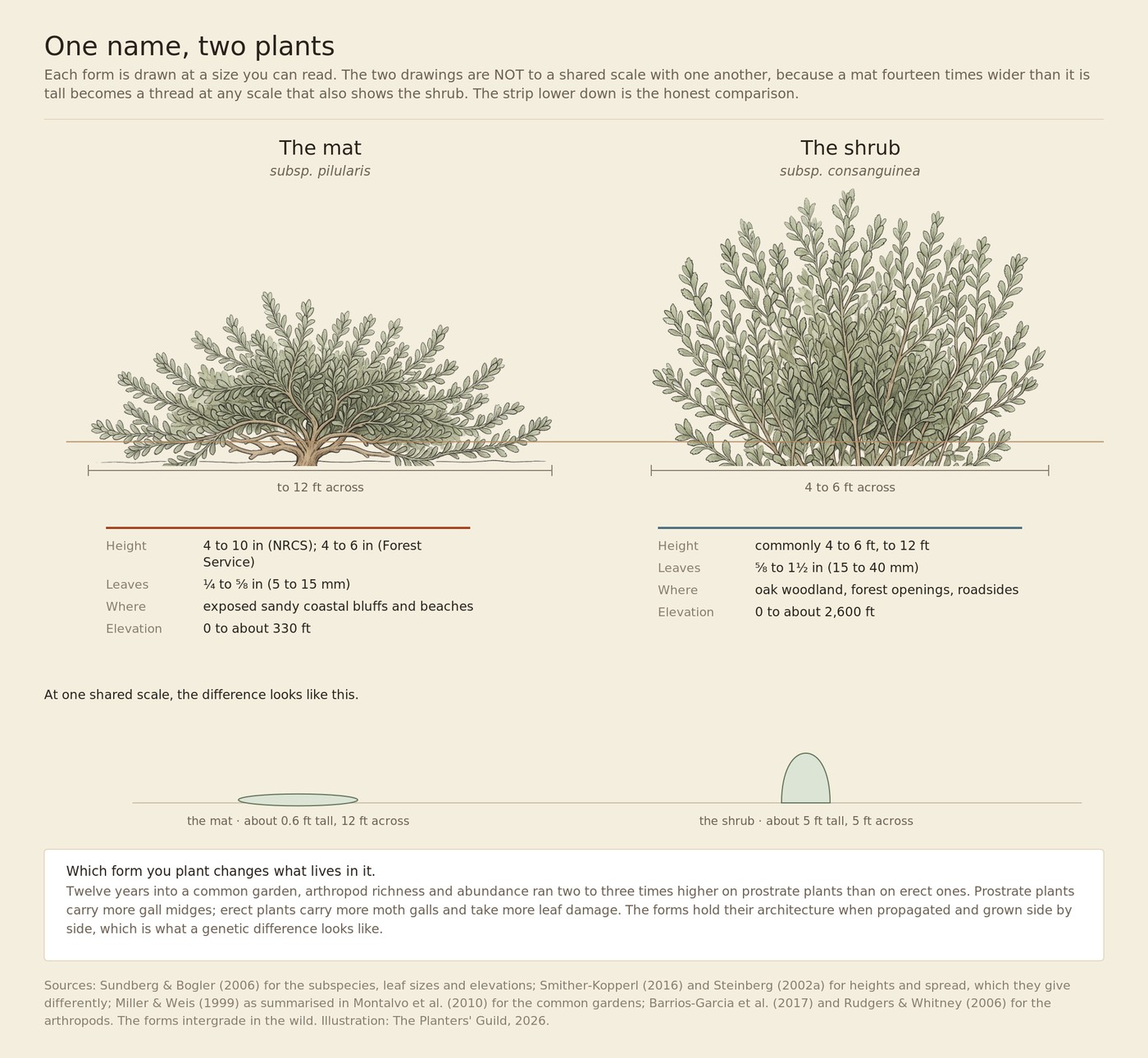
The two have names. Flora of North America calls the low one subspecies pilularis, a plant of sandy coastal bluffs and beaches below about 330 ft (100 m), and the upright one subspecies consanguinea, pronounced kon-san-GWIN-ee-uh, which runs through oak woodland, forest openings and roadsides up to about 2,600 ft (800 m) (Sundberg & Bogler, 2006). They blend into each other where they meet, so treat them as local forms with a real inherited difference and a blurry border rather than two clean species (Steinberg, 2002a; Montalvo et al., 2010).
Which one you plant changes what lives in it. Insect life varies strongly with the plant's shape: low plants carry more of one gall midge, upright plants more of a gall moth and more leaf damage (Rudgers & Whitney, 2006). And the wider effect is bigger than the galls. Twelve years into one side-by-side trial, insect numbers and variety ran two to three times higher on the low plants (Barrios-Garcia et al., 2017), with the difference carrying down through the leaf litter into the soil bacteria (Crutsinger et al., 2014).
So the low sprawling one is the better wildlife plant by a wide margin. Which runs straight into the problem with what the nurseries sell.
Half the Plants Are Male, and Yours Almost Certainly Is
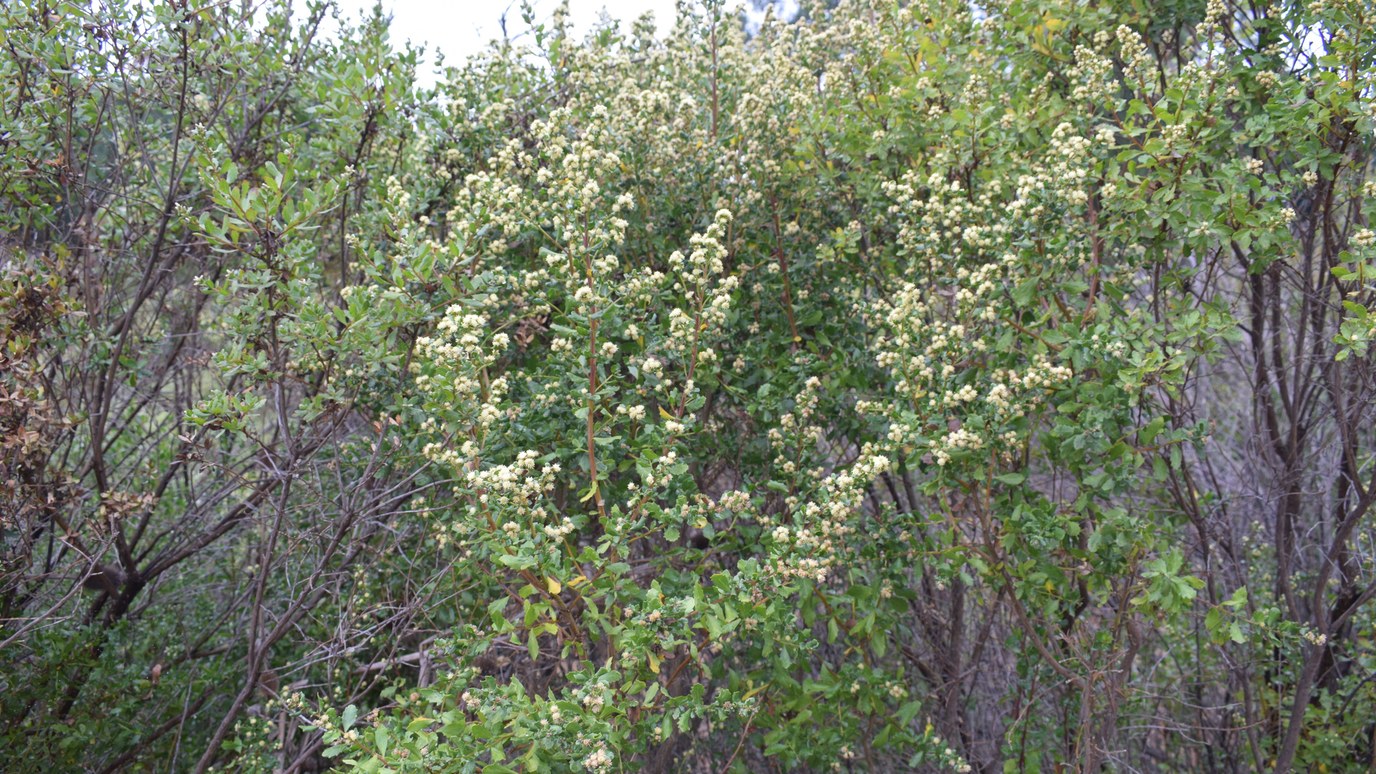
Male and female flowers are on separate plants here, and a plant can't fertilize itself; it needs one of the other sex nearby (Steinberg, 2002a; Montalvo et al., 2010). Male plants make pollen. Female plants make the white seed fluff, and that fluff is why the nursery trade looks the way it does.
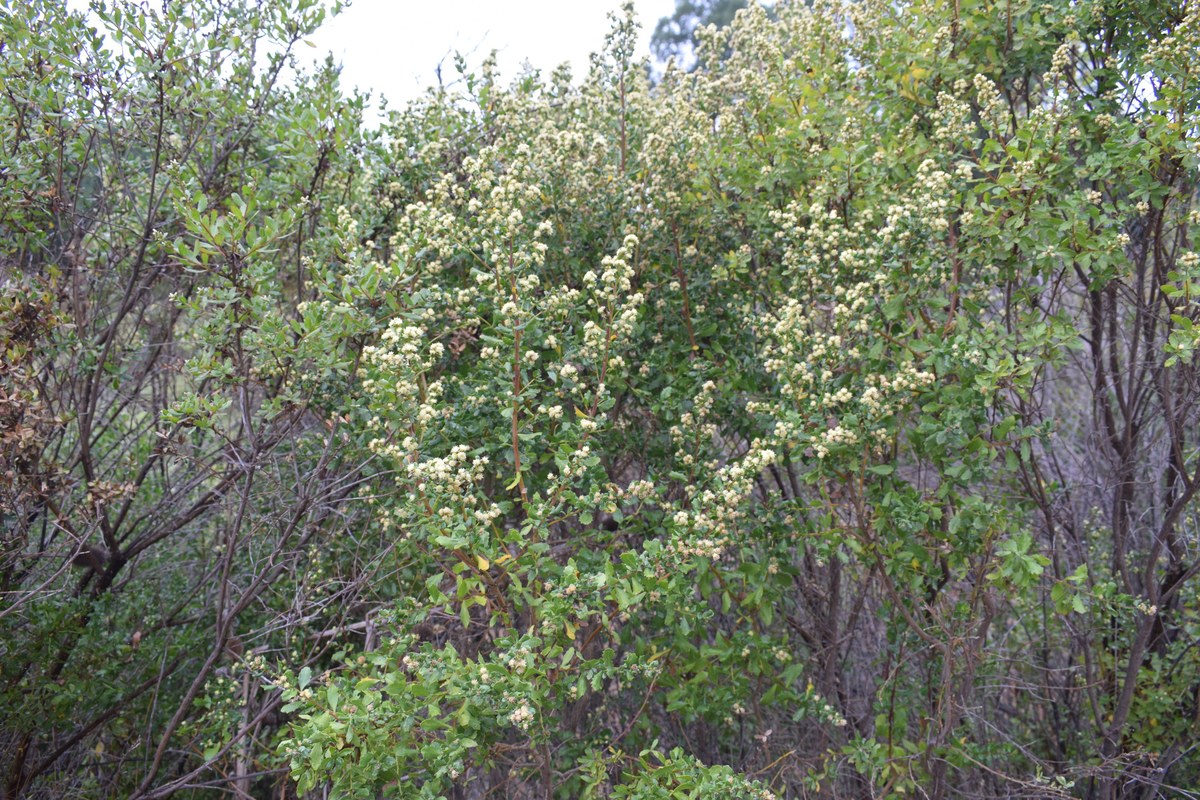
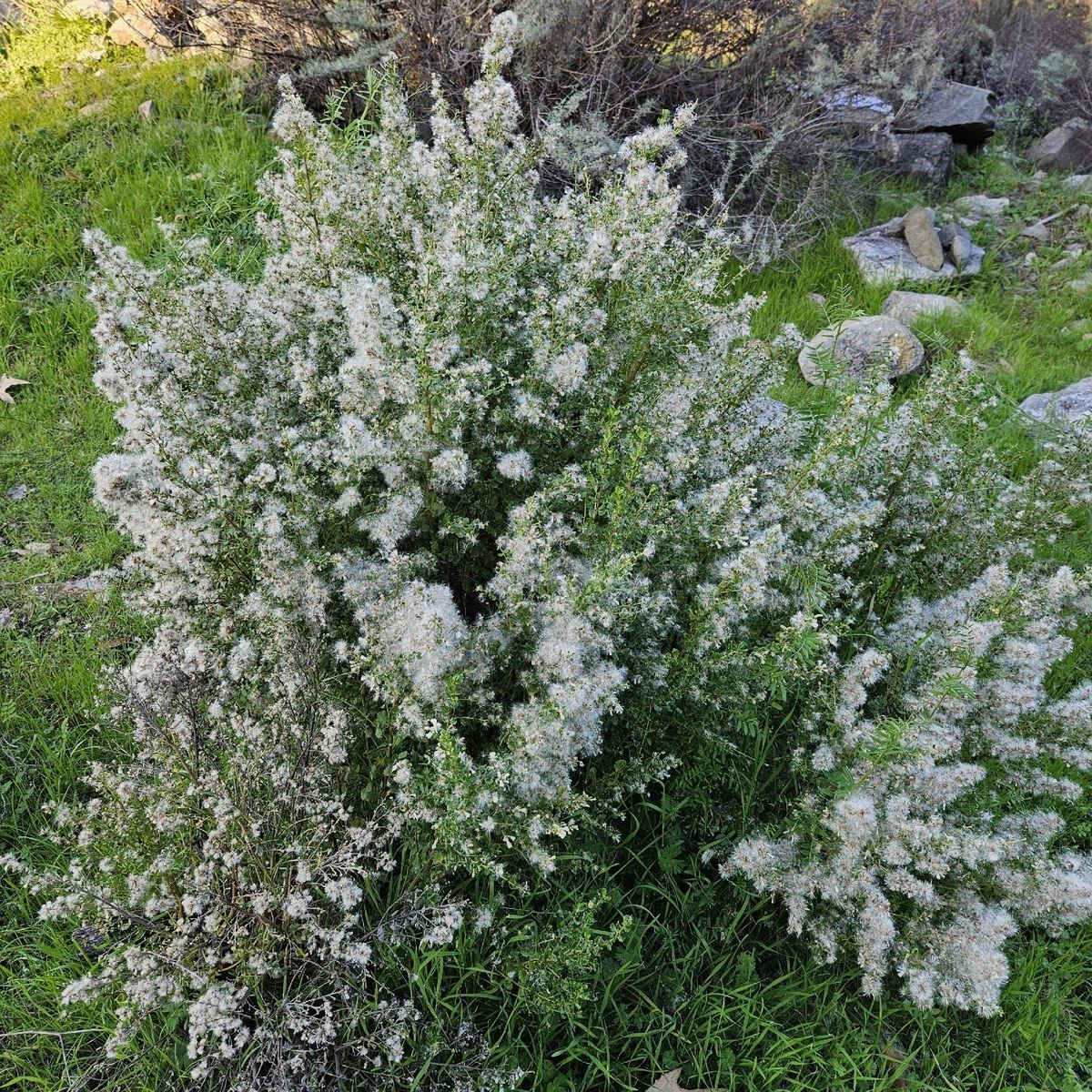
The NRCS states it flatly: in the horticultural trade, the selections are all male (Smither-Kopperl, 2016). Males get chosen because females seed so heavily (Montalvo et al., 2010).
'Pigeon Point' is the one you're most likely to meet. It's male, so it never fluffs up, and it was selected on the San Mateo County coast and has been in the trade since 1975 (California Flora Nursery, n.d.-b; San Marcos Growers, n.d.). 'Twin Peaks', found in San Francisco, is also male (California Flora Nursery, n.d.-c).
What you give up is concrete: no seed for seed-eating birds and no volunteer seedlings. Restoration plantings go the other way deliberately, at roughly one male to five females (Steinberg, 2002a; Smither-Kopperl, 2016). A garden is not a restoration site, and there's a real case for a plant that won't seed itself around a small yard. Just make it on purpose rather than by default.
The Mistake Most People Make
Buying the groundcover and expecting the hillside shrub.
The wild plant you admire on the ridge above your house is almost certainly the upright inland subspecies, living on winter rain and nothing else. The low spreading plant on the nursery bench is a clone taken from the coastal mat form (Montalvo et al., 2010).
Those are not interchangeable. The Forest Service puts it directly: inland upright forms may be more drought tolerant, and coastal forms tend to need summer water when planted away from the coast (Montalvo et al., 2010). So the plant sold as the tough, drought-proof native groundcover is the less drought-adapted of the two, and buying it for a hot Morgan Hill or Livermore garden on the strength of what you've seen growing wild is a category error.
This runs opposite to the lesson of the last entry in this series. California sagebrush punishes summer water. A coastal coyote brush clone planted inland may well need some. Same planting season, opposite watering advice.
If you want the wild plant's toughness, buy the upright subspecies, or a seed-grown low plant rather than a named clone.
Sun, Soil, and Water
Full sun. It's shade intolerant, seedlings do poorly in shade, and it won't regenerate under a closed canopy, including its own (Steinberg, 2002a; Smither-Kopperl, 2016).
Soil is the easy part. It colonizes grassland on ordinary soils, and bare mineral soil is what gives it the edge over established perennial grasses (Steinberg, 2002a). Clay, loam, sand, thin ground: it takes them.
Water divides by form and by geography. Established plants of the wild upright type are extremely drought tolerant. New plantings of anything want weekly water until established, then monthly through the first summer (Smither-Kopperl, 2016). After that, it's the coastal clones planted inland that keep asking.
Planting It This Autumn
The fall-planting case here is just a description of what the seed does. It needs no chilling and no special treatment, sprouts on bare mineral soil within 15 to 30 days, and blows around from October to January so that it comes up with the first rains (Steinberg, 2002a; Smither-Kopperl, 2016; Montalvo et al., 2010).
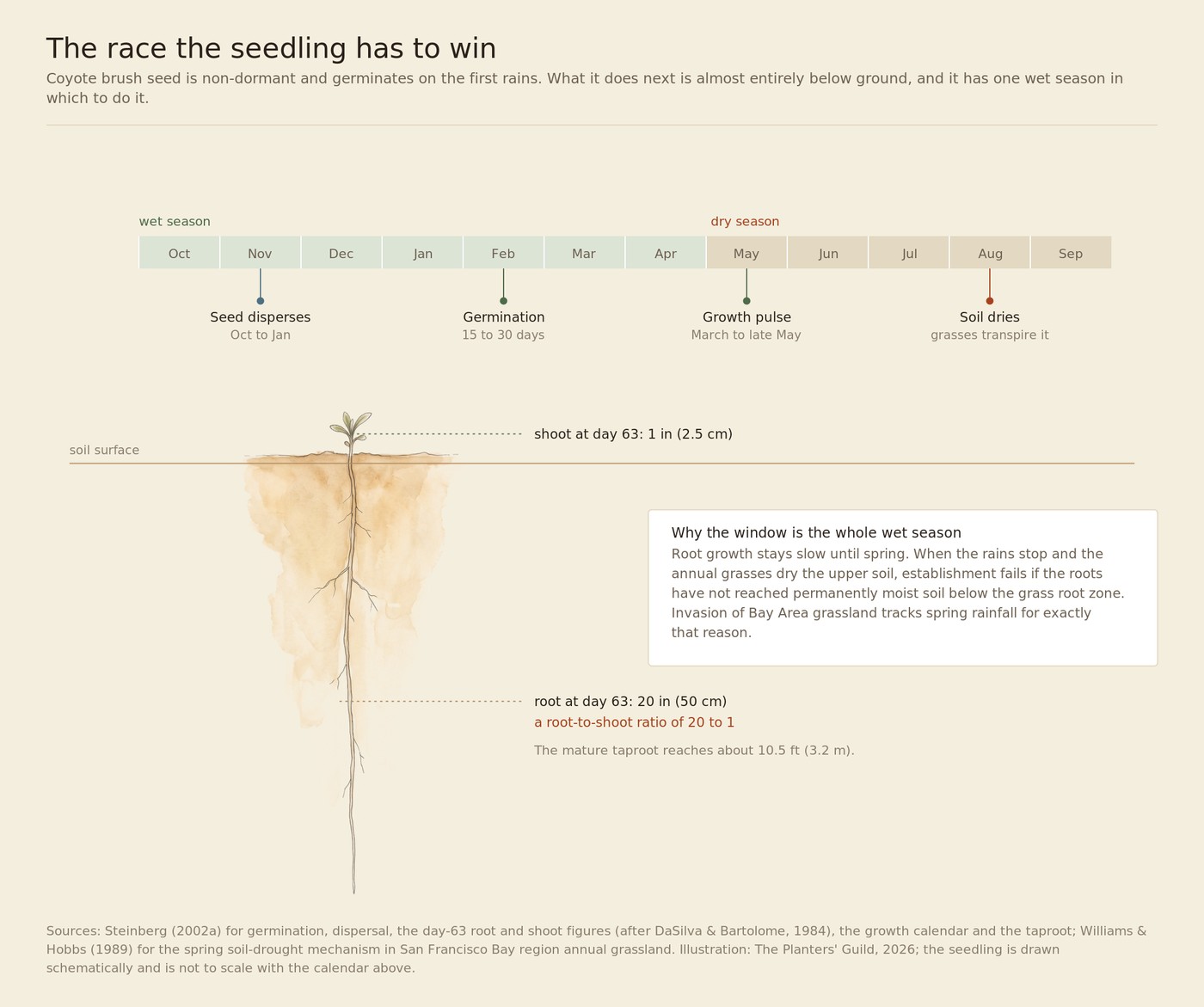
What the seedling then does is the argument. Nearly all of the first nine weeks happens below ground: by day 63 the root averaged 20 in (50 cm) against 1 in (2.5 cm) of shoot (DaSilva & Bartolome, 1984, as cited in Steinberg, 2002a). The mature taproot reaches about 10.5 ft (3.2 m).
And the whole thing is a race. Root growth stays slow until spring, and when the rains stop and the annual grasses pull the upper soil dry, the seedling fails, because its roots haven't reached permanently moist soil in time (Williams & Hobbs, 1989).
Two things follow for a container plant going in this autumn. Plant early enough to hand it the whole wet season, because that's the only window it gets. And clear the grass around it and keep clearing it, because competition for spring soil moisture is the documented failure mode, more than anything you do with a hose.
Pruning Is a Cycle, Not a Rescue
The garden advice and the research disagree here. The NRCS says coyote brush can be pruned to shape, or cut right back to 6 in (15 cm), and will sprout again from the base (Smither-Kopperl, 2016). True, with a condition attached that garden writing almost never carries.
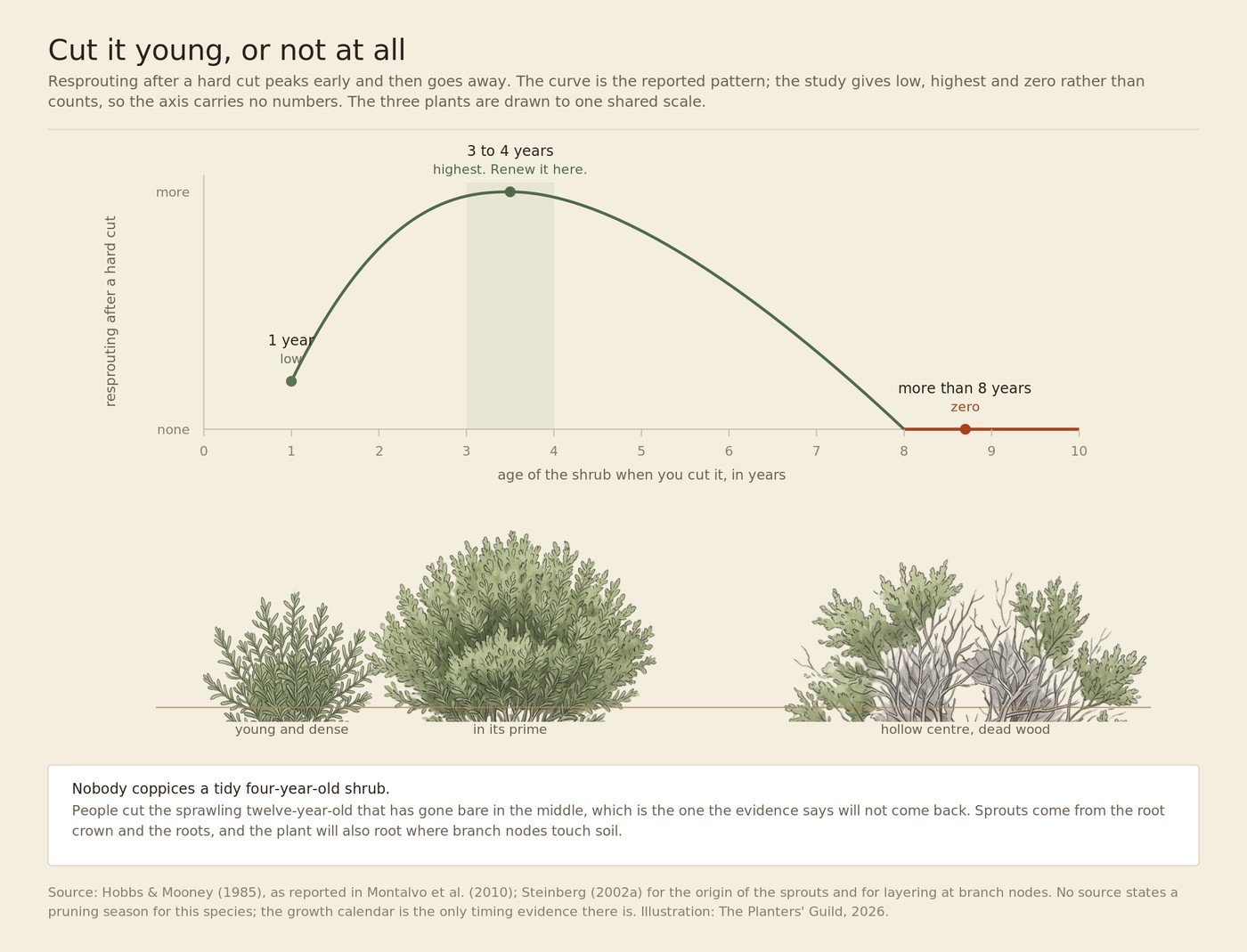
Cut back shrubs of a range of ages and the regrowth follows an arc: weak at one year, strongest at three to four, and zero past eight, because the buds that make the new shoots sit inside the old wood (Hobbs & Mooney, 1985, as reported in Montalvo et al., 2010).
Read that against the plant you're actually tempted to cut. Nobody takes shears to a tidy four-year-old. People cut the sprawling twelve-year-old gone bare in the middle, which is precisely the plant that won't come back. Renew it on a cycle while it's young enough to answer, rather than saving the hard cut for when it looks like it needs one.
No source we opened names a pruning season. Growth is slow until March, runs hard through late May, and flushes again after the September rains (Steinberg, 2002a), so the quiet spell after that flush is an inference rather than a recommendation.
What It's Doing Out There, and How It Ends
Coyote brush is a colonizer. In California grassland it moves in where fire and grazing are absent, and once established it changes what else can arrive: its cover shelters other coastal scrub plants and brings in rabbits and small mammals that graze down the grass and clear the way for more (Steinberg, 2002a).
Then it grows a forest on top of itself. A mature plant acts as a nurse shrub for coast live oak, sheltering the seedlings that become the canopy. In one central California study, shrubs covered 30 percent of the ground but held 80 percent of the oak seedlings, with two-year survival of zero in the open against 31 percent under shrubs. Another found shelter made no difference while deer cages did, so the nurse story is real but not the whole of it (Callaway & D'Antonio, 1991, as reported in Steinberg, 2002b).
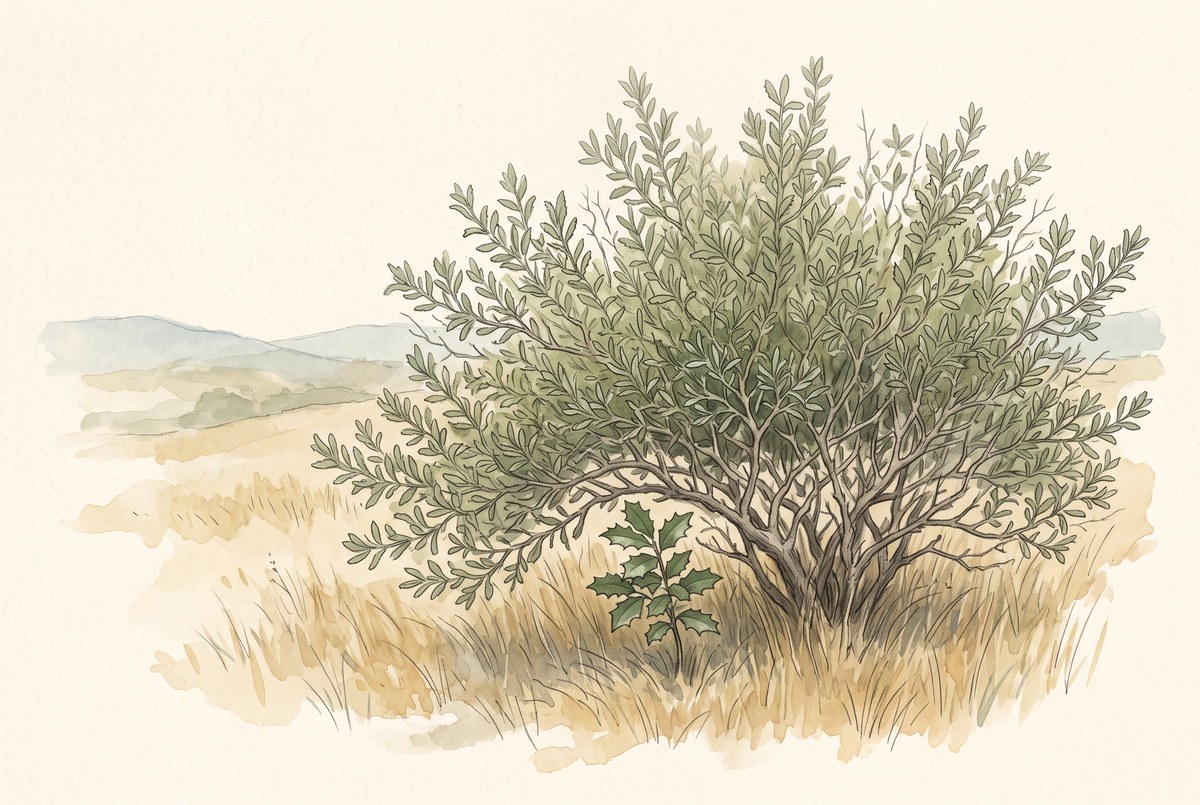
And the shade is what ends it. The oak it sheltered grows up and shades it out, and coyote brush scrub gives way to mixed evergreen forest over roughly fifty years where fire and grazing stay out (Steinberg, 2002a).
Which is why this one probably isn't a plant-it-once shrub. The Forest Service gives individuals 10 to 15 years, extended by sprouting from the base and by layering, where a low branch resting on the ground grows roots of its own (Steinberg, 2002a). Stack that against the regrowth collapse past year eight and what you have is a plant doing one stage of the hillside's work in your garden. It fills open ground, holds a slope, and feeds insects through autumn. What it won't do is anchor a bed for thirty years; toyon and manzanita are the plants for that. Budget for replacing it, and decide now what goes in after.
Fire, and a Claim Worth Correcting
The previous entry flagged California sagebrush as flammable and said it shouldn't be the last such flag. Here is the next one, with a correction attached.
Coyote brush appears on plenty of fire-safe native plant lists. The record doesn't support that. FIRESafe MARIN is direct: after two to five years most coyote brush builds up dead woody material that may be highly combustible, and it does not recommend the plant within 30 ft (9 m) of any structure. If it's kept, space it as single plants, cut it back regularly, and keep it clear of dead twigs (FIRESafe MARIN, n.d.). That 30 ft covers CAL FIRE's Zones 0 and 1, the first 30 ft around a building (CAL FIRE, n.d.).
The fire-resistant reputation traces to a claim with two qualifiers that get dropped in transit. The Forest Service wording is that the dwarf form is fire-resistant when watered (Steinberg, 2002a). Dwarf form, and watered. Applied to an unirrigated 12 ft shrub with eight years of dead wood inside it, neither holds. Its own fire behavior is mixed: all eleven plants in one simulated crown fire sprouted from the base within five weeks, while of eleven in a simulated grass fire, eight were lost (McBride & Heady, 1968, as reported in Steinberg, 2002a).
Where you live decides how much of this applies. On an interior San Jose lot with no wildland edge, this is a shrub like any other. Near the wildland-urban interface, where houses meet unmanaged wildland, take the 30 ft rule seriously and follow your local fire agency ahead of any garden writer, including this one. The annual cut does double duty there: the dead wood inside an unpruned plant is the hazard.
Sourcing
It's easy to buy; the question is which form. Prices and stock move, so treat this as a September 2026 snapshot and call ahead.
The Watershed Nursery in Richmond lists the straight species in both forms, from restoration plugs up, and notes plainly that each bush is either male or female (The Watershed Nursery, n.d.-a, n.d.-b). No online orders, so it's a phone call or a visit. California Flora Nursery in Fulton carries the straight species alongside 'Pigeon Point' and 'Twin Peaks', and describes its seed-grown crop as a mix of males and females that can't be told apart until they bloom (California Flora Nursery, n.d.-a). That's the sentence to look for on a label if you want a female plant.
Native Here Nursery in Berkeley, run with the CNPS East Bay chapter, sells the upright subspecies, pickup on Saturdays, and its sales area covers Santa Clara County (Native Here Nursery, n.d.). The CNPS Santa Clara Valley chapter sells at Hidden Villa in Los Altos Hills at events, with no online inventory (CNPS Santa Clara Valley Chapter, n.d.). What's on the bench is what there is.
Seed-grown, mixed-sex plants are genuinely available here. The low groundcover niche is the one dominated by male clones.
A Footnote for the Curious
Coastal plants look better in September than inland ones, and cooler air isn't the whole of it. One study measured the water held in living leaves and twigs across coastal California shrublands and found clear evidence of fog being taken up by only one of the species tested. It was coyote brush (Emery et al., 2018).
So a plant in the fog belt is drinking through the dry season by a route a plant twenty miles inland doesn't have. The coastal clone was selected where summer moisture arrives out of the air. Plant it where the fog doesn't reach and you've taken away part of how it makes its living, which is the least mystical explanation available for why it wants the hose.
Quick Reference
- Sun: Full sun. It is shade intolerant, and it does not regenerate under a closed canopy, including its own.
- Water: Low once established, with one real exception. Coastal low-growing forms planted inland tend to want summer water, so the groundcover in a Livermore garden is thirstier than the wild shrub on the hill behind it.
- Soil: Undemanding. It colonizes grassland on ordinary soils and takes clay, loam and sand. Bare mineral soil is what its seedlings actually want.
- Hardiness: No Bay Area winter troubles it. Flora of North America records the widespread upright subspecies from sea level to about 2,600 ft (800 m) across California and into Oregon.
- Bloom: July through December in the Flora of North America account, August through December in the NRCS one, peaking in autumn either way. Small, dull, and the most useful flowering in the garden at that time of year.
- Size: Depends entirely on which form you buy. The mat-forming coastal type runs 4 to 10 in (10 to 25 cm) tall and 3 to 12 ft (1 to 4 m) wide. The upright type is commonly 4 to 6 ft (1.2 to 1.8 m) and can reach 12 ft (4 m).
- Habit: Evergreen, densely branched, small resin-dotted leaves. Either a wide flat mat or a rounded shrub, with little middle ground.
- Pollination: Male and female flowers are on separate plants, and a plant cannot fertilize itself. Flowers are heavily insect-visited.
- Plant in: Autumn. Its seed sprouts on the first rains and its roots do their real work through the wet season.
- Source from: California Native Plant Society (CNPS) chapter nurseries and native growers. Ask for seed-grown plants if you want both sexes; the named groundcover varieties are all clones of one male plant.
- What to avoid: Planting it within 30 ft (9 m) of the house if you are near wildland; cutting an old woody plant to the ground and expecting regrowth; assuming the nursery groundcover is as tough as the wild shrub.
The Takeaway
Coyote brush is the plant you already know by sight and have probably never bought. It's worth buying, with your eyes open on two counts. The low groundcover on the nursery bench is a male clone selected off the coast, so it will never set seed, and away from the fog it will want more water than the wild shrub does. And whichever form you plant, you are planting a stage rather than a fixture. It fills open ground, shelters an oak seedling, and gets shaded out by the tree it sheltered. Plant it this autumn, clear the grass around it, cut it back while it's still young enough to answer, and keep it away from the house if you live where the wildland starts. Next in the series, blue elderberry, and the single 1983 poisoning case that quietly underwrites every warning you have ever read about it.
Sources
Barrios-Garcia, M. N., Rodriguez-Cabal, M. A., Rudgers, J. A., & Crutsinger, G. M. (2017). Soil fertilization does not alter plant architectural effects on arthropod communities. Journal of Plant Ecology, 10(5), 800–807. https://doi.org/10.1093/jpe/rtw087
Sundberg, S. D., & Bogler, D. J. (2006). Baccharis pilularis. In Flora of North America Editorial Committee (Eds.), Flora of North America north of Mexico (Vol. 20). Oxford University Press. http://www.efloras.org/florataxon.aspx?flora_id=1&taxon_id=250066185
CAL FIRE. (n.d.). Defensible space. Ready for Wildfire. Retrieved September 8, 2026, from https://www.readyforwildfire.org/prepare-for-wildfire/defensible-space/
California Flora Nursery. (n.d.-a). Baccharis pilularis. Retrieved September 8, 2026, from https://www.calfloranursery.com/plants/baccharis-pilularis/
California Flora Nursery. (n.d.-b). Baccharis pilularis 'Pigeon Point'. Retrieved September 8, 2026, from https://www.calfloranursery.com/plants/baccharis-pilularis-pigeon-point/
California Flora Nursery. (n.d.-c). Baccharis pilularis 'Twin Peaks'. Retrieved September 8, 2026, from https://www.calfloranursery.com/plants/baccharis-pilularis-twin-peaks/
CNPS Santa Clara Valley Chapter. (n.d.). CNPS nursery. Retrieved September 8, 2026, from https://www.cnps-scv.org/index.php/gardening/cnps-nursery
Crutsinger, G. M., Rodriguez-Cabal, M. A., Roddy, A. B., Peay, K. G., Bastow, J. L., Kidder, A. G., Dawson, T. E., Fine, P. V. A., & Rudgers, J. A. (2014). Genetic variation within a dominant shrub structures green and brown community assemblages. Ecology, 95(2), 387–398. https://doi.org/10.1890/13-0316.1
Emery, N. C., D'Antonio, C. M., & Still, C. J. (2018). Fog and live fuel moisture in coastal California shrublands. Ecosphere, 9(4), Article e02167. https://doi.org/10.1002/ecs2.2167
FIRESafe MARIN. (n.d.). Coyote brush. Retrieved September 8, 2026, from https://firesafemarin.org/plant/coyote-brush/
Hobbs, R. J., & Mooney, H. A. (1985). Vegetative regrowth following cutting in the shrub Baccharis pilularis ssp. consanguinea (DC) C. B. Wolf. American Journal of Botany, 72(4), 514–519. https://doi.org/10.1002/j.1537-2197.1985.tb08304.x
Miller, W. B., & Weis, A. E. (1999). Adaptation of coyote brush to the abiotic environment and its effects on susceptibility to a gall-making midge. Oikos, 84(2), 199–208. https://doi.org/10.2307/3546714
Montalvo, A. M., Goode, L. K., & Beyers, J. L. (2010). Plant profile for Baccharis pilularis. Native plant recommendations for southern California ecoregions. Riverside-Corona Resource Conservation District & U.S. Department of Agriculture, Forest Service, Pacific Southwest Research Station. https://www.fs.usda.gov/psw/publications/beyers/psw_2010_beyers019(montalvo)baccharispilularis.pdf
Native Here Nursery. (n.d.). Shop. Retrieved September 8, 2026, from https://nativeherenursery.org/shop/
Rudgers, J. A., & Whitney, K. D. (2006). Interactions between insect herbivores and a plant architectural dimorphism. Journal of Ecology, 94(6), 1249–1260. https://doi.org/10.1111/j.1365-2745.2006.01161.x
San Marcos Growers. (n.d.). Baccharis pilularis 'Pigeon Point'. Retrieved September 8, 2026, from https://www.smgrowers.com/products/plants/plantdisplay.asp?plant_id=4109
Smither-Kopperl, M. (2016). Plant guide for coyotebrush (Baccharis pilularis). U.S. Department of Agriculture, Natural Resources Conservation Service, Lockeford Plant Materials Center. https://www.nrcs.usda.gov/plantmaterials/capmcpg12900.pdf
Steinberg, P. D. (2002a). Baccharis pilularis. In Fire Effects Information System. U.S. Department of Agriculture, Forest Service, Rocky Mountain Research Station, Fire Sciences Laboratory. https://www.fs.usda.gov/database/feis/plants/shrub/bacpil/all.html
Steinberg, P. D. (2002b). Quercus agrifolia. In Fire Effects Information System. U.S. Department of Agriculture, Forest Service, Rocky Mountain Research Station, Fire Sciences Laboratory. https://www.fs.usda.gov/database/feis/plants/tree/queagr/all.html
The Watershed Nursery. (n.d.-a). Baccharis pilularis. Retrieved September 8, 2026, from https://www.watershednursery.com/nursery/plant-finder/baccharis-pilularis/
The Watershed Nursery. (n.d.-b). Baccharis pilularis (prostrate). Retrieved September 8, 2026, from https://www.watershednursery.com/nursery/plant-finder/baccharis-pilularis-prostrate/
Williams, K., & Hobbs, R. J. (1989). Control of shrub establishment by springtime soil water availability in an annual grassland. Oecologia, 81(1), 62–66. https://doi.org/10.1007/BF00377011
Photograph (hero and hub card): Anne Parsons. Baccharis pilularis, observation 188669065, photo 330284807, iNaturalist, 22 October 2023, Joseph D. Grant County Park, Santa Clara County, California. Dedicated to the public domain under CC0 1.0, https://creativecommons.org/publicdomain/zero/1.0/. Cropped and resized for this page. https://www.inaturalist.org/observations/188669065
Photograph (male plant in flower, whole shrub): Anne Parsons. Baccharis pilularis, observation 188669065, iNaturalist, 22 October 2023, Joseph D. Grant County Park, Santa Clara County, California. Dedicated to the public domain under CC0 1.0, https://creativecommons.org/publicdomain/zero/1.0/. Cropped and resized for this page. https://www.inaturalist.org/observations/188669065
Photograph (female plant in seed, whole shrub): Tser. Baccharis pilularis, observation 335448422, iNaturalist, 19 January 2026, San Jose Country Club, Santa Clara County, California. Licensed under CC BY 4.0, https://creativecommons.org/licenses/by/4.0/. Cropped and resized for this page. https://www.inaturalist.org/observations/335448422
Photograph (male flower heads): Irene. Baccharis pilularis, observation 92299481, iNaturalist, 23 August 2021, Fort Ord National Monument, Salinas, Monterey County, California. Dedicated to the public domain under CC0 1.0, https://creativecommons.org/publicdomain/zero/1.0/. Cropped and resized for this page. https://www.inaturalist.org/observations/92299481
Photograph (female heads in seed): John Cowles. Baccharis pilularis, observation 252671916, iNaturalist, 22 November 2024, Newport Beach, Orange County, California. Dedicated to the public domain under CC0 1.0, https://creativecommons.org/publicdomain/zero/1.0/. Cropped and resized for this page. https://www.inaturalist.org/observations/252671916
Diagrams (the two forms, the seedling's first year, resprouting by age) and illustration (the nurse shrub): The Planters' Guild. (2026). Botanical drawing generated with Nano Banana 2 and composited by the Guild; all labeling, measurement and scale drawn from the sources cited above. The plant drawings are schematic and are not identification references.