California Natives · No. 07
Manzanita: The Genus Behind That Red Bark, and Why You Have to Buy the Right One
A field guide to the genus Californians know by its mahogany bark: nearly a hundred kinds of manzanita, almost all of them native here, spanning a groundcover to a small tree under one name. Why choosing the right species matters more than anything you'll do after, and how to keep one alive once it's in the ground.
On this page
13 sections
About the Plant
You've seen the bark before you knew the name. A trunk so smooth it looks polished, the color of a fresh chestnut or old mahogany, twisting up out of dry ground in a way that reads more like sculpture than shrub. That's manzanita, and once it registers you start noticing it everywhere: on coastal bluffs, along mountain trails, holding down road cuts in the foothills, sometimes pruned up into a small tree in someone's front yard.
Manzanita is the common name for Arctostaphylos, a genus in the heath family (Ericaceae, the same family as blueberries, rhododendrons, and heather). What most people never get told is that it isn't one plant. The genus runs to roughly 60 species, and close to 100 distinct kinds once you count subspecies, with the overwhelming majority native to California and many found in one county and nowhere else on Earth (Parker, Vasey, & Keeley, n.d.). The name Arctostaphylos is Greek for "bear grape." Manzanita is Spanish for "little apple," after the small reddish fruit. Both names describe the berry, which tells you something about how long people and animals have been paying attention to this plant.
So this guide is built differently from a single-species profile. The decision that matters most happens in the nursery, before you plant anything, when you choose which manzanita you're taking home. Get that right and the plant is famously tough. Get it wrong and no amount of good care will save you. We'll come back to that, because it's the whole point.
What You're Looking At
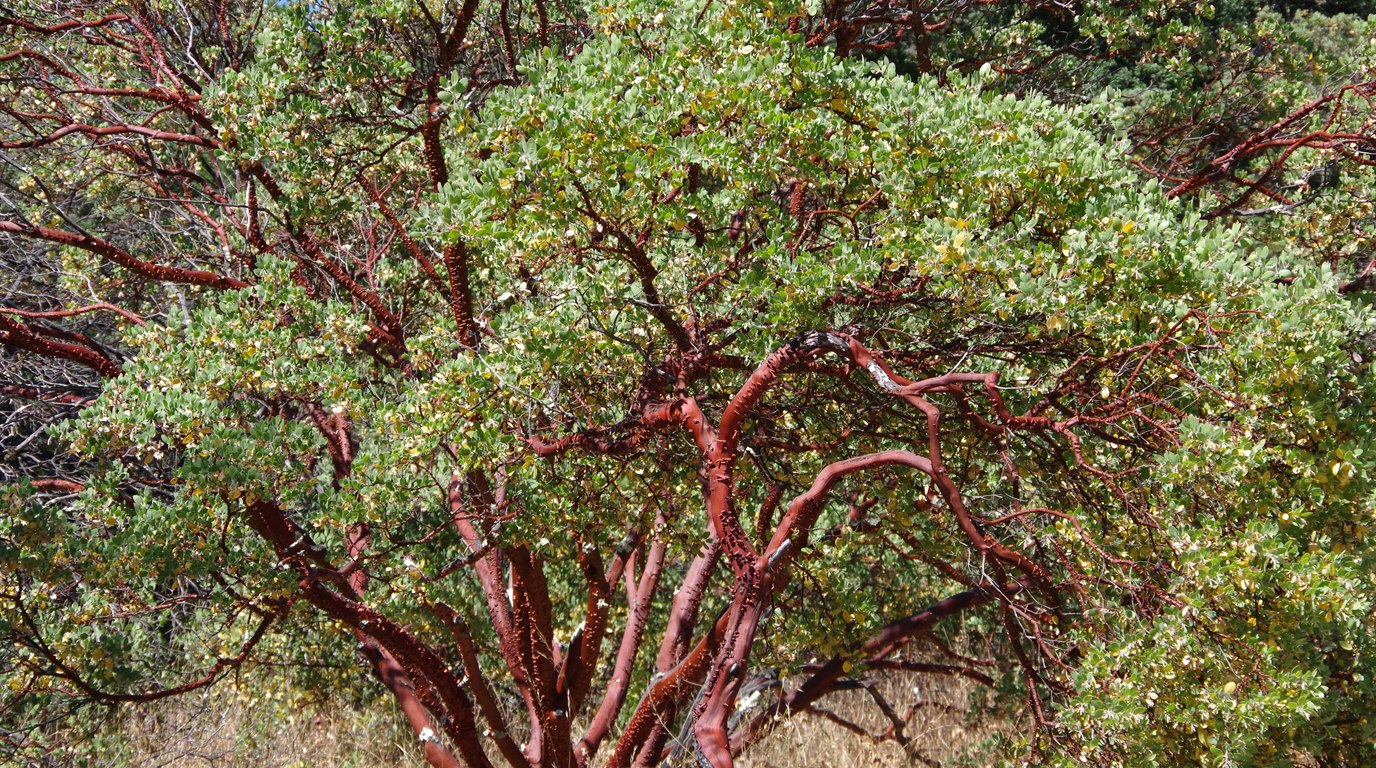
The bark is the signature. On the larger species and cultivars it's smooth and a deep red-brown, and it peels in late summer, sloughing thin curls to reveal fresh, cool-toned wood underneath. The branches are crooked and muscular, often holding their leaves at the very tips so the architecture of the wood shows through. That structure is why manzanita earns its keep year-round: even with no flowers and no fruit, the plant is doing something for the eye.
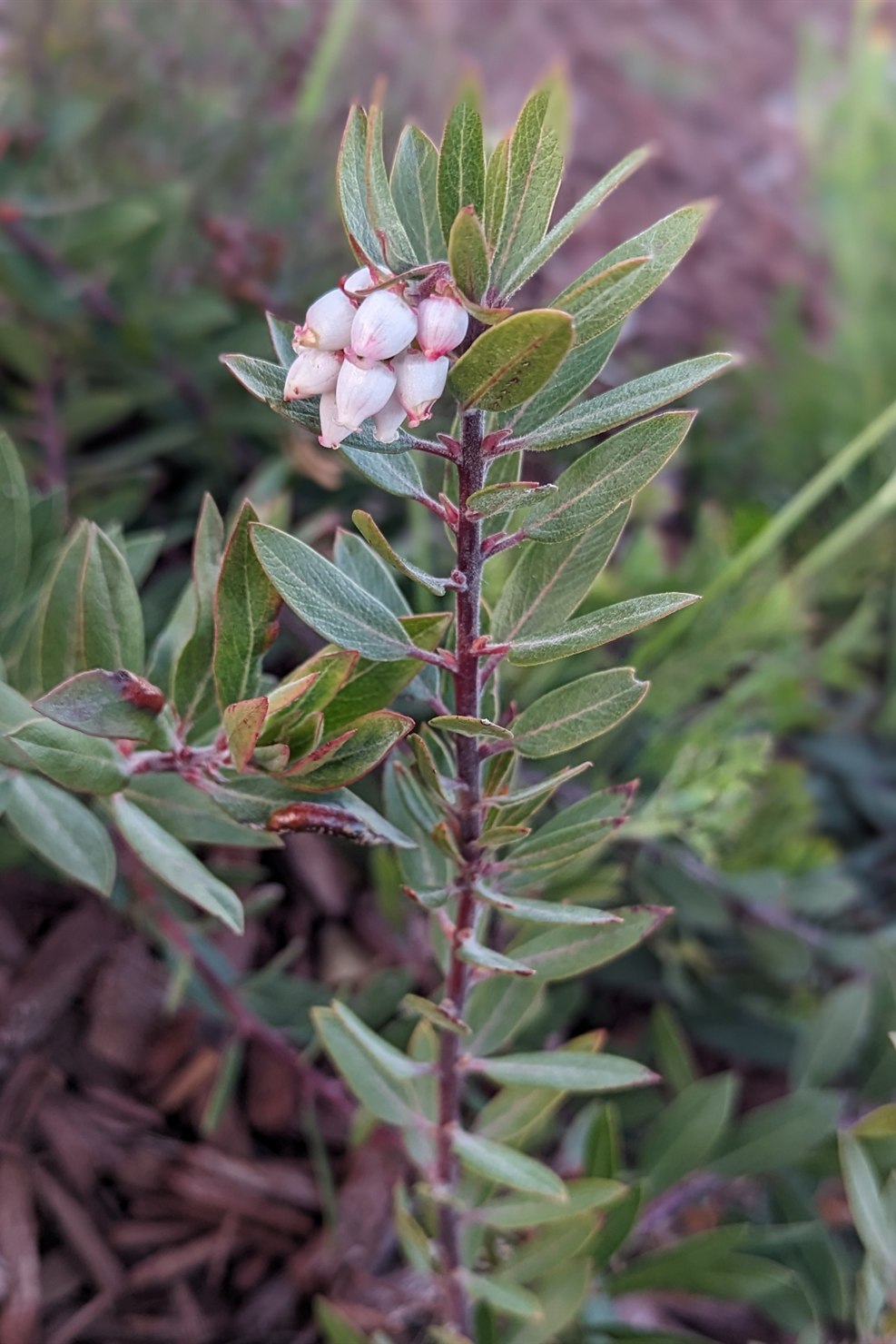
The leaves are small, leathery, and usually held more or less vertically, a dull sage-green to grey-green, often with a waxy or hairy surface. Holding the leaf edge-on to the midday sun and coating it in wax are both water-saving moves, the foliage of a plant built for a dry summer. In the dead of winter, sometimes as early as December, manzanita opens clusters of small flowers shaped like tiny urns or lanterns, white to soft pink, hanging downward. Those become the "little apples," reddish-brown berries that feed birds, coyotes, and a long list of other animals, and that Indigenous Californians have used for food and drink for thousands of years.
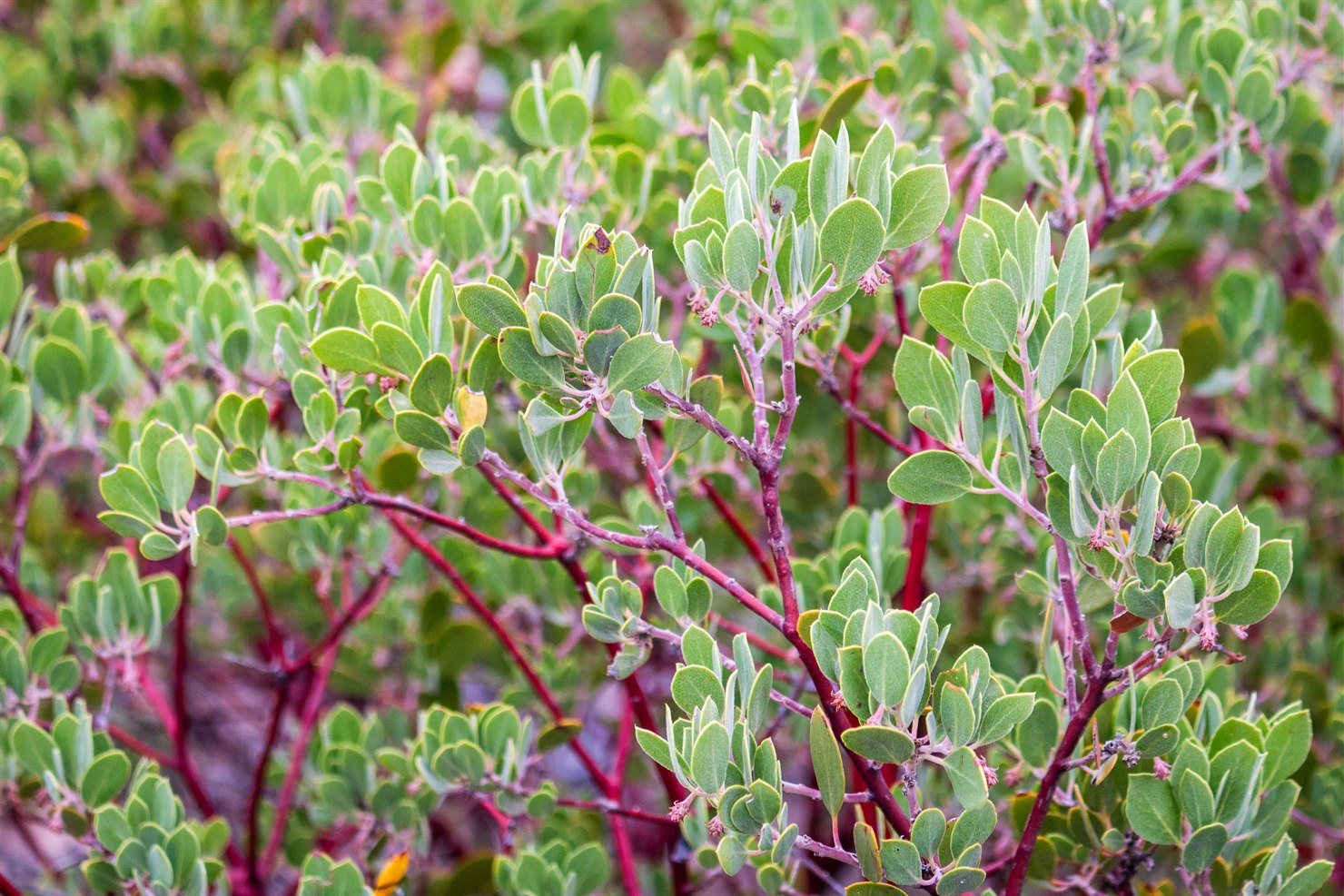
The catch is that almost none of those traits tells you how big the plant in front of you will get. Some manzanitas are flat groundcovers that never top your ankle. Others are dense rounded shrubs at eye level. A few are genuine small trees you can walk under. They share the bark, the leaves, the winter urns, and the berry, and they share almost nothing about scale. Which is exactly why the name on the sign isn't enough.
Where It Comes From
Manzanita is one of the defining plants of the California Floristic Province, the botanical region running down the West Coast that holds one of the highest concentrations of plants found nowhere else on Earth. The genus has radiated here into an extraordinary number of narrow specialists, many of them adapted to one particular hard situation: serpentine soils, deep sand, coastal fog, exposed rock, the nutrient-poor ground where less specialized plants give up (Parker, Vasey, & Keeley, n.d.). That's the deep reason there are so many manzanitas, and the practical reason they vary so much: each one is tuned to a specific place.
A lot of what manzanita does only makes sense in the context of fire. Here the genus splits cleanly in two, and it's worth learning to read. Some manzanitas grow a burl, a swollen woody mass at the base of the plant packed with dormant buds; after a fire burns the top, these species resprout from the burl and carry on. Most manzanitas have no burl at all. When fire comes through, the parent plant dies outright, and the species starts over entirely from seed, banked in the soil and waiting (Parker, Vasey, & Keeley, n.d.). Those seeds are deeply dormant and don't germinate on a normal schedule; they wait for the specific cues of a fire, the heat and the chemistry of smoke and charred wood, before they'll break dormancy and sprout into a bare, sunlit, ash-fertilized hillside (Keeley & Fotheringham, 1998). It's a high-stakes strategy: the whole next generation rides on the seed bank surviving until the next burn.
There's a quieter partnership underground, too. Like other members of the heath family, manzanitas associate with ericoid mycorrhizal fungi, root symbionts that help the plant pull nutrients from soil too poor for most plants to bother with. That partnership is part of how a manzanita thrives on a rocky slope with almost nothing in the ground, and it's the reason that feeding one is not just unnecessary but actively wrong. More on that next.
Where People Go Wrong
The classic manzanita failure looks like this. Someone falls for the bark, buys a plant, brings it home to a yard with heavy clay soil, tucks it into a bed that gets watered all summer, and waters the new plant generously on top of that to help it settle in. The manzanita looks fine for a season, maybe two. Then one hot stretch it wilts, drops leaves, blackens at the branch tips, and dies fast, often with the soil still damp. The owner concludes manzanita is delicate.
It isn't. What killed it was warm, wet soil. Manzanita roots are adapted to a dry summer dormancy, and summer irrigation, especially in soil that drains poorly, creates exactly the conditions that soil-borne water molds like Phytophthora need to attack the roots. The plant essentially drowns and rots from below while looking, until the end, like it just needs more water (University of California Statewide Integrated Pest Management Program, n.d.). Pile fertilizer on top, and you push soft, fast growth on a plant evolved for lean ground, which is weaker and more disease-prone, not healthier.
None of those mistakes is hard to avoid, but every one of them happens after the plant is already in the cart. The bigger error came earlier: buying a manzanita without knowing which manzanita it is, and whether it suits your soil and your summers. A species native to fast-draining coastal sand is a poor bet in hot inland clay no matter how carefully you water it. The first real decision isn't made in the garden at all. It's made standing in front of the bench, picking the plant that matches the conditions you actually have.
Sun
Most manzanitas want full sun, and they reward it with denser growth, better form, and more flowers. In the hottest inland gardens, a few species appreciate light afternoon shade, but as a rule, the more sun a manzanita gets, the better it looks. Deep shade produces thin, leggy, sparse plants. If you're growing manzanita for the structure and the bark, give it the light to build them.
Water
This is where manzanitas are won and lost. For the first year after planting, water deeply but infrequently, a thorough soak every two to three weeks through the dry season, to drive roots down and out. After that, taper off hard. An established manzanita in most of California wants little to no summer water, and many established plants want none at all beyond natural rainfall.
When you do water, keep it away from the trunk and crown. Water at the drip line, the outer edge of the canopy, not against the base of the plant, and skip overhead sprinklers that soak the foliage and the trunk. Wet bark and a wet crown are an invitation to rot. With manzanita, the sprinkler does more damage than the drought ever will, and that's the one thing worth remembering if you remember nothing else.
Soil
Of everything you can give a manzanita, sharp drainage matters most. Lean, rocky, sandy, or decomposed-granite soils are ideal, and the plant is perfectly happy in ground too poor to grow much else. What it cannot tolerate is water sitting around its roots.
That puts heavy clay gardeners at a fork. You have two honest options. Plant a cultivar specifically known to tolerate clay, such as 'Howard McMinn' or 'Dr. Hurd', or build the drainage yourself by planting high, setting the plant on a raised mound or berm of native soil so water drains away from the crown rather than pooling at it. What you should not do is amend a planting hole with rich compost in the middle of clay, which just creates a bathtub that holds water against the roots. Manzanita doesn't want a richer hole. It wants water to leave.
Hardiness
Cold-hardiness depends entirely on which manzanita you've chosen, same as everything else here. The common garden species and cultivars are generally comfortable in roughly USDA (United States Department of Agriculture) zones 7 through 10. Manzanitas from high elevations in the Sierra and the mountains are considerably tougher, and the low groundcover types from cool coastal habitats have their own range. Check the hardiness of the specific plant you're buying rather than trusting "manzanita" as a category, because the category spans mountains and coastline both.
One Honest Caveat
The honest caveat with manzanita isn't about the plant. It's about the gap between the picture in your head and the plant on the bench. People fall for a photograph of a mature specimen, that sculptural red trunk you can walk under, and then buy a one-gallon shrub of a completely different species that will never look like the photo, because it's a groundcover, or a dense ten-foot thicket, or a plant that wants a mountainside your yard can't offer. The disappointment that follows gets blamed on the plant.
You skip all of that by treating the common name as a question rather than an answer. Before you buy, get the full botanical name (species and cultivar), then look up that exact plant's mature size, soil preference, and hardiness and decide honestly whether it fits your yard. Ten minutes of homework is all it takes, and it's the whole reason some people end up with the manzanita they pictured and others end up nursing a slow letdown wearing the same name.
Sourcing It
Buy manzanita by its exact name. Not "manzanita," and not even just the species, but the species and cultivar together, because that's the level at which size and toughness are actually decided.
If you're new to the genus or your soil is difficult, start with a cultivar bred for forgiveness. Arctostaphylos 'Howard McMinn' is the standard recommendation for good reason: selected back in the 1950s, it takes both sand and clay, tolerates a range of garden conditions, and is genuinely hard to kill, while still giving you the bark, the form, and the winter flowers (Bornstein, Fross, & O'Brien, 2005). 'Dr. Hurd' is a tall, tree-form selection with especially fine red bark for gardeners who want the small-tree look. At the other end of the scale, low-growing forms of bearberry (Arctostaphylos uva-ursi) and similar groundcover selections cover slopes and spill over walls and never get tall at all (California Native Plant Society, n.d.). Same genus, completely different job.
Source from a local California Native Plant Society chapter plant sale or a nursery that specializes in California natives, where the plants are labeled honestly by species and cultivar and the staff can tell you what each one actually does. Plant in fall or early winter so the roots establish on natural rainfall ahead of the first dry summer. That single timing choice does more for establishment than anything you can buy.
A Note on Pollinators
Manzanita earns a place in the garden partly on timing. It blooms in the dead of winter, December into March, when very little else is open, which makes it one of the most valuable early nectar sources in the California garden. Those small urn-shaped flowers are built for a specific kind of pollinator visit: bumblebees grab on and vibrate their flight muscles to shake the pollen loose, a technique called buzz pollination, and the flowers also feed hummingbirds and the first emerging native bees of the year. A manzanita in January is a refueling station in a season that has almost none. The bark and the structure are what sell the plant. The winter flowers are what make it worth a spot in the ground for anything that has to get through a California January on nectar.
Quick Reference
- Sun: Full sun in most of California; light afternoon shade is fine in the hottest inland gardens. More sun means denser growth and more bloom.
- Water: Year 1, a deep soak every 2–3 weeks through the dry season to set the roots. Established plants want little to no summer water. Overwatering kills more manzanitas than anything else.
- Soil: Fast drainage is the whole ballgame. Lean, rocky, sandy, or decomposed-granite soil is ideal. Most species rot in wet clay; pick a clay-tolerant cultivar ('Howard McMinn', 'Dr. Hurd') or plant high on a mound.
- Hardiness: Varies by species. Common garden manzanitas run roughly USDA zones 7–10; high-elevation and groundcover species are hardier.
- Bloom: Clusters of small, urn-shaped white-to-pink flowers in the dead of winter, December through March, when little else is open.
- Size: Anywhere from a 6-inch prostrate groundcover to a 20-foot tree, depending entirely on the species and cultivar.
- Lifespan: Long-lived for a chaparral shrub when sited well; many garden plants run decades. Poor drainage, not old age, is what usually ends them.
- Mycorrhizae: Partners with ericoid mycorrhizal fungi to feed from poor soil. Never fertilize.
- Plant in: Fall through early winter, so roots establish on natural rainfall before the first dry summer.
- Source from: Local California Native Plant Society chapter sales; California-native specialty nurseries. Buy by exact species or cultivar name, matched to your soil and climate.
- What to avoid: Summer irrigation on established plants; wetting the crown and trunk; rich soil or fertilizer; heavy wet clay without a tolerant cultivar or a mound; buying on the strength of the bark alone.
The Takeaway
People fall for manzanita because of the bark and lose it because of the name. 'Manzanita' isn't a plant. It's almost a hundred of them, and a six-inch groundcover and a twenty-foot tree have nothing in common but the family resemblance. So most of the work happens before you ever dig a hole: find out what your soil does with water in August and how hot your yard gets in the worst of summer, then buy the exact species or cultivar that fits that, not the best-looking plant on the bench. Once the right one is in the ground, the job is mostly knowing when to do nothing. Plant in fall, water it through a single dry season to drive the roots down, and after that keep the hose away from it. Don't feed it, since it feeds itself. Keep water off the crown. If your soil holds water, plant high on a mound or choose a clay-forgiving cultivar like 'Howard McMinn'. None of that makes manzanita fussy. It buys you a plant that holds its shape for fifty weeks a year, opens flowers in the dead of winter when the bees have nothing else, and carries that bark for decades.
Sources
Bornstein, C., Fross, D., & O'Brien, B. (2005). California native plants for the garden. Cachuma Press.
California Native Plant Society. (n.d.). Manzanita (Arctostaphylos). Calscape. Retrieved June 23, 2026, from https://calscape.org/search/?plant=Arctostaphylos+(Genus)
Keeley, J. E., & Fotheringham, C. J. (1998). Smoke-induced seed germination in California chaparral. Ecology, 79(7), 2320–2336. https://doi.org/10.1890/0012-9658(1998)079[2320:SISGIC]2.0.CO;2
Parker, V. T., Vasey, M. C., & Keeley, J. E. (n.d.). Arctostaphylos. In Jepson Flora Project (Eds.), Jepson eFlora. Retrieved June 23, 2026, from https://ucjeps.berkeley.edu/eflora/eflora_display.php?tid=9173
University of California Statewide Integrated Pest Management Program. (n.d.). Manzanita. UC IPM. Retrieved June 23, 2026, from https://ipm.ucanr.edu/PMG/GARDEN/PLANTS/manzanita.html