California Natives · Season Two · No. 13
California Sagebrush: The Bare Ground Around It Was Never What We Thought
A field guide to Artemisia californica, the pungently aromatic shrub of the coastal scrub. What it actually is, why it wakes with the first storms and sleeps through August, what the famous ring of bare dirt around it turned out to be about, and why we'd rather you forgot to water it in summer than remembered.
On this page
15 sections
- About the Plant
- What You're Looking At
- The Plant Runs on Rain, Not on Months
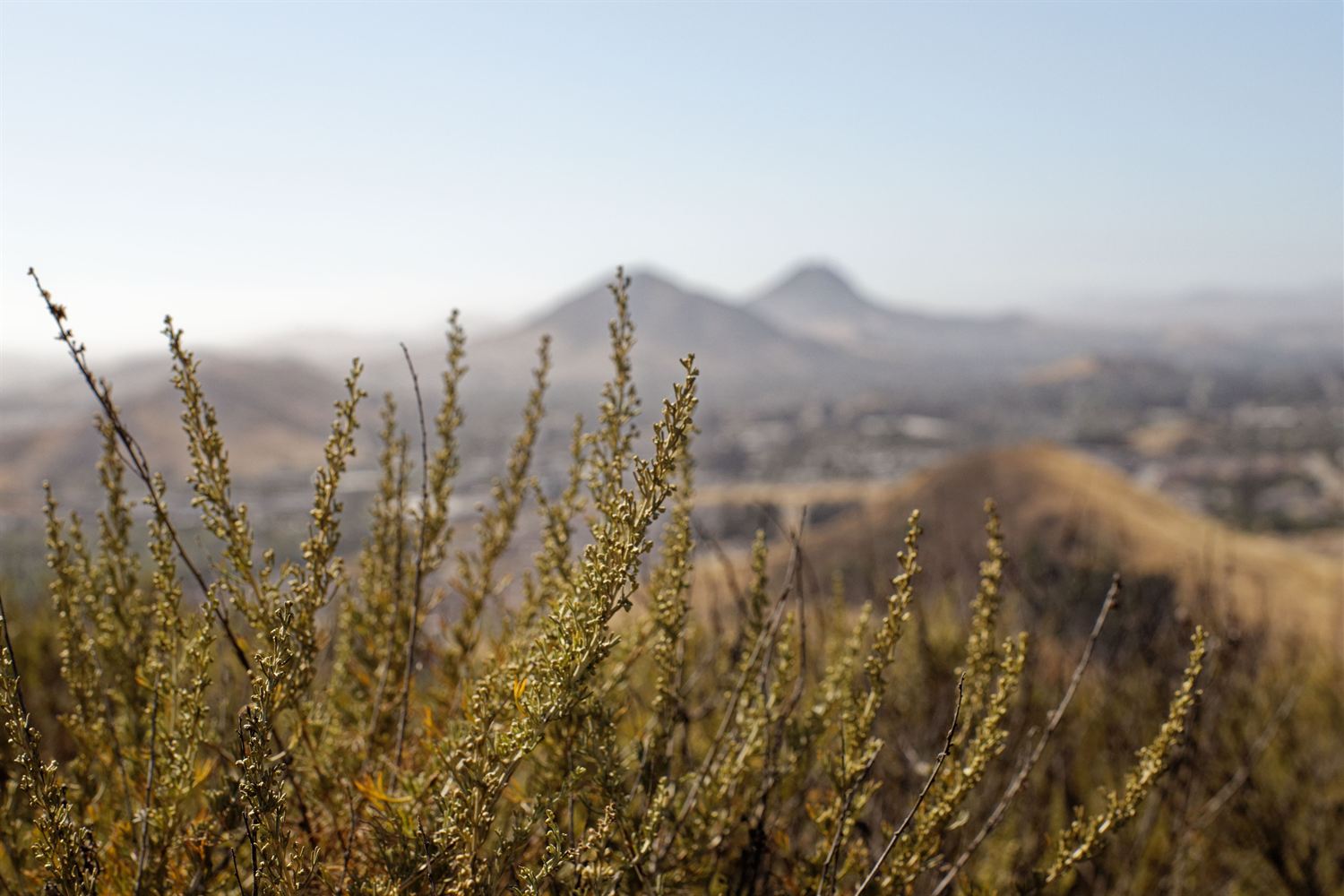
- Why It Looks Half-Finished in August
- The Bare Ground Around It
- Where It Comes From
- The Mistake Most People Make
- Sun, Soil, and the Things It Doesn't Care About
- Planting It This Autumn
- Pruning, and the Cut That Doesn't Grow Back
- One Honest Caveat: This Plant Burns
- Sourcing
- A Footnote for the Curious
- The Takeaway
- Quick Reference
Corrected October 2026: we've revised parts of this guide. See the correction note at the end.
About the Plant
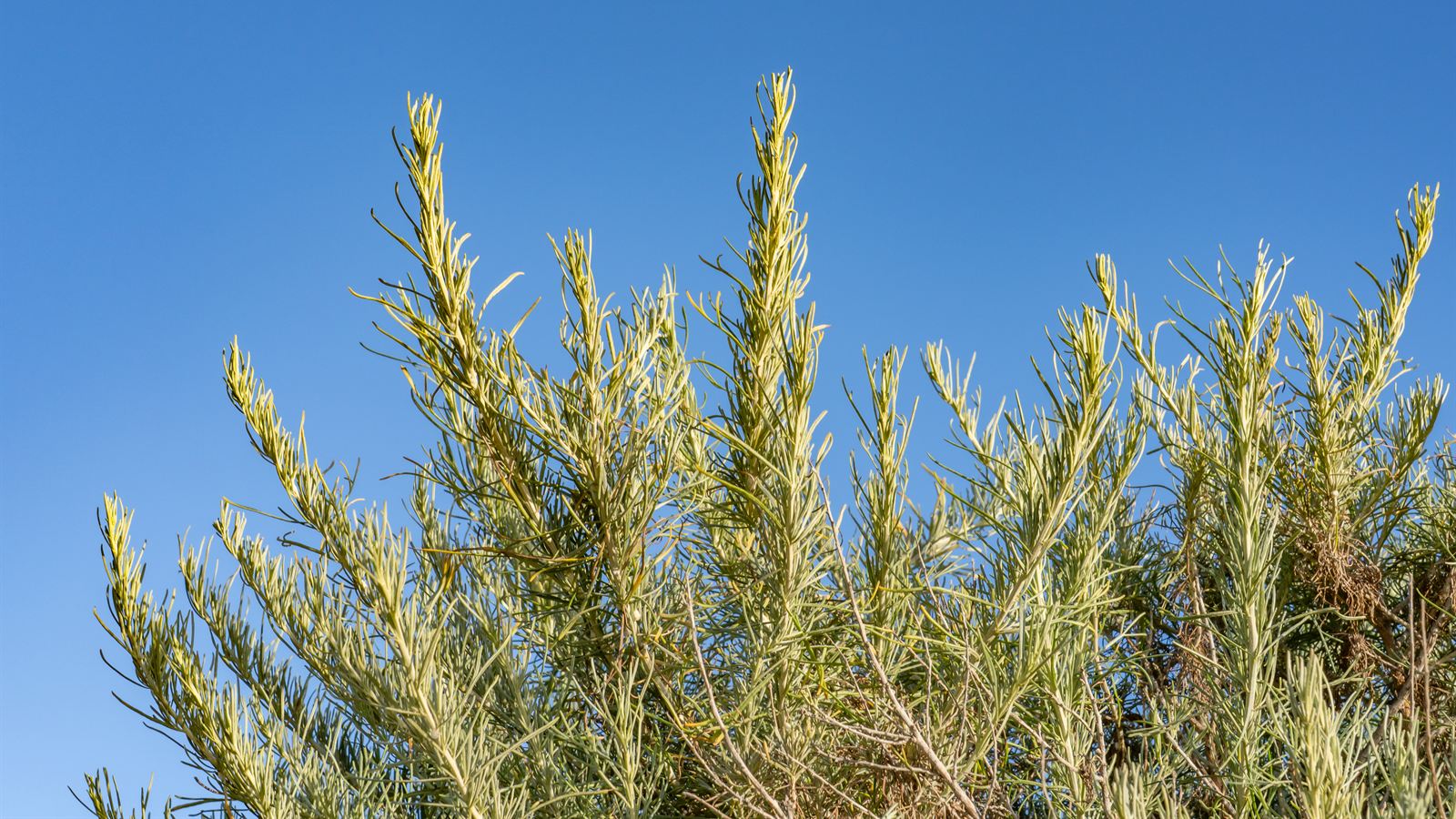
If you've walked a California hillside after rain and thought that's what this place smells like, there's a good chance you were smelling this plant.
The Forest Service calls California sagebrush "the most important and widely distributed plant in the coastal sage scrub" (Hauser, 2006), and it is not the plant most of us go to the nursery for. It has no flowers worth the name, and it goes scruffy and gray in exactly the months people are outside looking at their gardens. At the nursery it loses to something with color on it. It is also the tallest shrub in coastal sage scrub and an important cover plant for small birds, mammals and arthropods (Hauser, 2006), and, as anyone who has crushed a leaf knows, pungently aromatic (Shultz, 2006).
And it isn't a sage. Artemisia californica sits in the Asteraceae, the sunflower family. The true sages are Salvia, in the Lamiaceae, the mint family. They're not close relatives. The resemblance is in the nose. Flora of North America makes the point without hedging: "The odor of A. californica is markedly like that of the culinary mints known as common sage (Salvia species)" (Shultz, 2006). Two unrelated lineages arrived at a similar smell, we named them both sage, and the confusion has been in the common names ever since. Real Salvia shrubs do grow in coastal sage scrub, so the community name isn't wrong. This particular plant just isn't one of them.
What You're Looking At
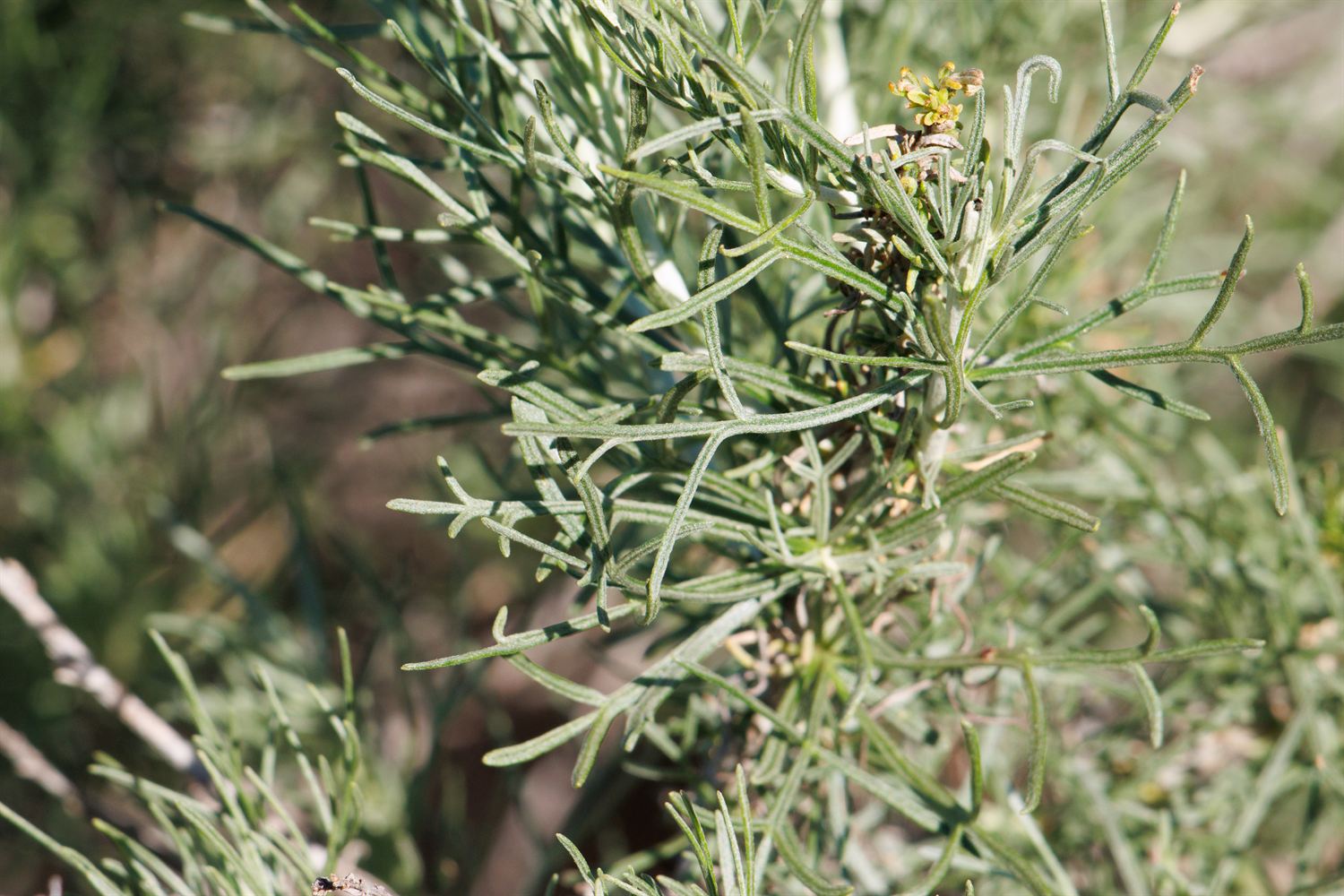
A rounded shrub with many slender, flexible stems rising from a woody root crown, and foliage so finely divided it reads as texture rather than as leaves. Individual leaves run about three quarters of an inch to two inches long (2 to 5 cm) (Hauser, 2006), thread-thin, sometimes with a few narrow lobes, light green to gray (Shultz, 2006).
Size is where the sources stop agreeing, and you want to know that before you buy one. The Forest Service puts it at 2 to 5 feet (0.5 to 1.5 m) and calls it the tallest shrub in coastal sage scrub (Hauser, 2006). Flora of North America gives (20–)150–250 cm, which is up to about 8 feet (Shultz, 2006), and the NRCS agrees it can reach 5 to 8 feet (Young-Mathews, 2010). Nursery listings scatter across the whole range. Plan for something around 3 to 5 feet (0.9 to 1.5 m) in both directions, and understand that pruning is what actually settles the question in a garden.
The flowers are the anticlimax. Pale yellow corollas, 0.8 to 1.2 mm long, carried in narrow branched sprays (Shultz, 2006). Flora of North America puts flowering in early to late summer (Shultz, 2006); the NRCS plant guide says later summer into autumn or winter depending on where you are (Young-Mathews, 2010). Either way, most people never register that it has bloomed.
The Plant Runs on Rain, Not on Months
California sagebrush runs on a different calendar from the one you were taught.
Its growth is keyed to the wet season. New leaf growth starts with the first significant rainfall, and flowering, branch elongation and fruit set follow months later (Hauser, 2006). Roughly 90 percent of the precipitation in its range falls between November and April, and the plant shows no measurable aboveground growth during the two to four driest months (Hauser, 2006). Its roots are fibrous, fragile and shallow, which sounds like a liability and isn't: a shallow root system absorbs soil moisture fast at the beginning of the rainy season, when speed is what matters (Hauser, 2006).
So the shrub you meet in September, thin and gray and apparently half gone, is not struggling. It's between shifts.
Why It Looks Half-Finished in August
The mechanism behind that has a name, and knowing it will stop you doing something unhelpful with a hose.
California sagebrush is drought-deciduous (it sheds leaves in response to dryness rather than to cold), but not in the simple way the term suggests. Westman (1982) describes the pattern across coastal sage scrub. The commonest adaptation to summer drought, in his words, "is not total deciduousness, but the production of smaller leaves on side shoots developing from the axils of larger, main-shoot leaves" (the axil is the angle where a leaf joins the stem). The main-shoot leaves fall as the summer drought develops, while the smaller side-shoot leaves persist "to varying extents" into the next rainy season (Westman, 1982). He adds that very few shrub species in this community lose all of their leaves in the dry season.
Westman also names this species specifically for something more unusual. He describes poikilohydric behavior, "the ability of leaves to wilt for long periods, and rehydrate within hours of a rainfall," and names Artemisia californica as a shrub that exhibits it (Westman, 1982). He calls it a strategy occasionally found in sage scrub. This shrub treats a long stretch of visible wilt as a holding pattern and comes back within hours of a storm.
One wrinkle. The Forest Service review says both things: in one place that the large leaves produced in the rainy season are dropped from summer until the winter rains, and in another that most of the big leaves stay on through the dry season, wilted but attached (Hauser, 2006). The two-cohort pattern is well established. Exactly how much of the large-leaf set is shed appears to vary, and I'd rather tell you the sources disagree than pick the tidier version.
The Bare Ground Around It
This is the story ecologists know it for.
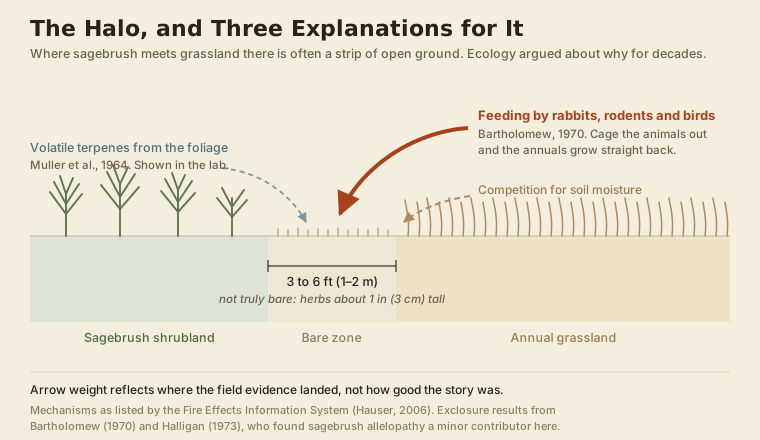
Walk up on a stand of California sagebrush pushing into grassland and you'll often find a halo of open ground between the shrubs and the grass, often 3 to 6 feet wide (1 to 2 m) (Hauser, 2006). It's striking, and it looks deliberate. For a while it was the textbook example of plants doing chemical warfare.
In 1964, Muller, Muller and Haines published a three-page paper in Science reporting that volatile materials from the leaves of three shrubs, Artemisia californica and two sages, Salvia leucophylla and S. apiana, inhibited root growth in cucumber and oat seedlings (Muller et al., 1964). As Hierro and Callaway (2021) summarize it, the inhibition was shown in the laboratory, and the field mechanism, toxins carried in dew condensing on seedlings, was proposed rather than demonstrated. That distinction matters and it got lost almost immediately. The idea was elegant, and allelopathy, the suppression of one plant by another's chemistry, "emerged on the ecological map" through this work, in Hierro and Callaway's phrase (2021).
Then Bartholomew went out and built wire-mesh exclosures, cages that keep animals out, in the bare ground (Bartholomew, 1970). His finding, published in Science, was that feeding activity by rodents, rabbits and birds is concentrated in that zone, and that when the cages exclude them, annuals grow in the bare ground. His conclusion is carefully worded: "animal activity is sufficient to produce the bare zone." Not necessary, and not proven to be the cause. He had shown the pattern could arise from animal feeding alone.
Halligan (1973) then did the work on this species directly, fencing an area spanning grassland, bare zone and shrubland (we know his study through the Forest Service's summary of it, as the paper itself is behind a paywall). After a year of protection the grassland had pushed roughly 20 inches (40 cm) into the border, while in unprotected ground the grassland retreated and the bare zone widened by about 30 inches (70 cm). Brush rabbit droppings were abundant in the new border, and short animal trails were noticeable. He concluded that allelopathy was a minor contributor here (Halligan, 1973, as cited in Hauser, 2006).
The detail I like best is that Halligan was no partisan. He ran the chemistry himself on the terpenes, the volatile compounds behind that smell, and found real toxins: five terpenoids in major amounts, with camphor the most toxic, followed by 1,8-cineole (Halligan, 1975). The compounds are there and they do inhibit seedlings (Muller et al., 1964). They were just not what was mostly making the bare ground. Halligan's own tests split by species, too. Volatiles significantly suppressed coast tarweed and smooth catsear, while ripgut brome and rattail fescue, which are precisely the annual grasses the bare zone is supposed to explain, were not significantly affected (Halligan, 1973, as cited in Hauser, 2006).
It landed somewhere messier. Hierro and Callaway describe the sequence plainly (Hierro & Callaway, 2021): Bartholomew's exclosures demonstrated apparent competition (one plant suppressing another indirectly, through the animals it shelters), and allelopathy "as a general mechanism for vegetation patterns in the field was largely rejected," though that rejection did not stop four decades of subsequent work on allelopathy's consequences, and they count a substantial body of later work as supporting a role for it in where plants grow in shrublands. The specific bare-zone claim lost. The broader field carried on regardless.
The Forest Service, for its part, still lists all three candidate mechanisms side by side, chemistry, animals and soil moisture, and adds a detail that undercuts the whole premise: the bare zone is not actually bare. It carries short herbs roughly an inch tall (3 cm), and the effect shows up around large dense shrub stands rather than around scattered individuals (Hauser, 2006).
That's a better story than the one in the textbooks, and it's the reason this plant opens the season. The chemical explanation was tidy; the one the field tests support involves rabbits, rodents and birds.
Where It Comes From
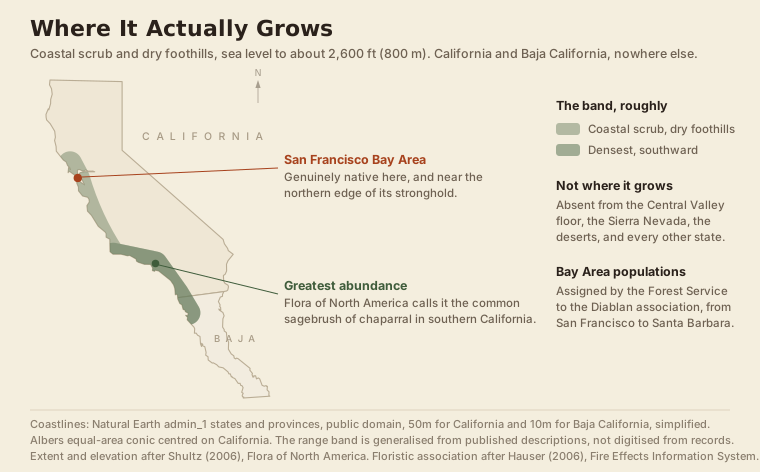
Artemisia californica is native to California and Baja California, from sea level to about 2,600 feet (800 m), in coastal scrub and dry foothills (Shultz, 2006; POWO, 2026), and the Forest Service calls it endemic to the two (Hauser, 2006). One USDA plant guide extends the range north to southwestern coastal Oregon (Young-Mathews, 2010); the occurrence databases we checked, GBIF and iNaturalist, hold no Oregon records, so we've drawn the map to the state line and noted the exception. The Forest Service assigns Bay Area populations to the Diablan floristic association, a regional grouping of coastal scrub that runs from around San Francisco down to northern Santa Barbara County (Hauser, 2006).
It's native here, not borrowed from the south.
A note on emphasis. Flora of North America calls it "the common sagebrush of chaparral in southern California" (Shultz, 2006), and the Diablan group is the northernmost of the Forest Service's four (Hauser, 2006). It belongs in a Bay Area garden. It's also closer to the northern end of its range than to the middle of it.
The Mistake Most People Make
Watering it in summer.
This is the failure mode, and it's a familiar one with chaparral natives. The plant looks rough in July. The gardener reads rough as thirsty. The hose comes out. Artemisia californica is a documented host of Phytophthora tentaculata, a root-rot organism that the California Department of Food and Agriculture has recorded in native plant nurseries in seven California counties, Santa Clara and San Mateo among them, and in outplanted nursery stock at restoration sites in three counties, Alameda, Monterey and Santa Clara (California Department of Food and Agriculture, 2016).
I want to be precise here, because it would be easy to overclaim. We looked for an irrigation trial on established California sagebrush and found none; the closest thing, a common-garden study, grew cuttings under high and low precipitation treatments to measure leaf chemistry, not survival (Pratt et al., 2014). The NRCS plant guide, for its part, lists no pests or diseases of concern (Young-Mathews, 2010). So what exists is a nursery-pathogen host record and consistent low-water advice: Calscape puts the ceiling at a maximum of one summer irrigation per month once established and calls summer water optional (California Native Plant Society, n.d.).
There's also a simpler cost that has nothing to do with pathogens. Leaf shedding is how the shrub avoids long-term water stress (Hauser, 2006). Water it enough to keep it lush and you've overridden the mechanism it uses to survive the season. A greener July plant isn't a healthier one.
Sun, Soil, and the Things It Doesn't Care About
Full sun. The Forest Service records it as shade intolerant (Hauser, 2006).
Soil is the easy part. The Forest Service records it on virtually all soil types except serpentine, and notes that no other dominant plant in coastal sage scrub is as indifferent to substrate (Hauser, 2006). Loam, clay loam, sandy loam, gravelly, thin and undeveloped, it takes them. What it wants is drainage. The NRCS says it grows best on shallow, well-drained soils (Young-Mathews, 2010), and Calscape's picks are dry, sunny, sloped sites (California Native Plant Society, n.d.). In practice that means a slope if you have one.
Cold is a non-issue in any Bay Area garden. Calscape puts its cold tolerance at 20 °F (−7 °C) (California Native Plant Society, n.d.).
Planting It This Autumn
The fall-planting argument is this plant's own biology.
Seedlings come up in the rains, November through April, and have done most of their growing by May, when the dry season sets in (Hauser, 2006). Put a container plant in the ground in October and you've handed it the entire window it's built to use. May planting asks it to establish during the months it's designed to sit out.
The other half of the argument is competition, and it's more important than watering. The Forest Service, summarizing one study, says that where annual grasses have moved in they beat sagebrush seedlings to soil moisture, and first-year survival is, in the review's word, "very" low (Hauser, 2006). A post-fire study in southern sage scrub paints a more specific picture. Early seedling survival in its largest cohort was 70 to 94 percent whether or not non-native grasses and forbs were removed; the non-natives showed their cost later, in seedlings dropping leaves by the start of summer drought, and higher spring rainfall both helped seedlings directly and made the removals pay off more (Thomson et al., 2021). By 2020 the removal plots carried nearly four times the sagebrush canopy area of the controls (Thomson et al., 2021). Wet springs helped both adults and seedlings.
Translated into a Saturday afternoon: clear the grass around your new plant and keep clearing it. That will do more for a young sagebrush than anything you do with water.
Seedling establishment also gets poor as a stand matures and the canopy closes, and seedlings are significantly associated with gaps in mature vegetation (Hauser, 2006). If you're planting into an existing native bed, give it an actual opening rather than tucking it under something.
Pruning, and the Cut That Doesn't Grow Back
Prune it annually, and don't improvise.
The reason to prune is that it gets woody and rangy on its own, and an annual cut is what keeps it dense. The NRCS advises a yearly pruning or pinching back to hold the shape of ornamental plants (Young-Mathews, 2010). Timing is autumn, as the first rains bring it into leaf, which is also when you can see exactly what's alive.
The rule that matters is where you stop. The Chino Basin Water Conservation District states it as clearly as anyone: "Cut back in the Fall as hard as needed to prevent plant from getting too 'woody' over time," but "plants cut back into old wood (no leaves or buds along the wood) may not grow back out, but as long as you cut above the lowest leaves or buds, plants should grow back strong" (Chino Basin Water Conservation District, n.d.).
That's the whole rule, and it's the difference between a shrub you keep for fifteen years and one you replace next spring. Never cut a stem below its lowest live leaf or bud. If a plant is already all bare wood, cutting it back is a gamble rather than a plan, for the reasons below.
Cutting to the ground is a different proposition and the evidence is mixed. Fifty mature shrubs in the Santa Monica Mountains, cut right to the ground, had sprouted on 80 percent of plants two years later (Malanson & Westman, 1985, as cited in Hauser, 2006). Against that, Thomson and colleagues, summarizing earlier studies, put post-fire resprouting at 13 to 25 percent, and note that older plants likely lose the capacity (Thomson et al., 2021). A clean autumn cut on a healthy young plant is a reasonable gamble, not a technique to rely on.
One Honest Caveat: This Plant Burns
I'd rather you hear this from us than from a defensible-space inspection.
California sagebrush is highly flammable, and the agency language isn't subtle. The Forest Service records a high ratio of dead to live material and an ether extract level (a laboratory flammability measure) of 15.6 percent, against the 8 percent level above which the review considers shrubs highly flammable, and relays the species' characterization as "explosively flammable" (Hauser, 2006). The NRCS notes the foliage contains substantial oil, making it highly flammable during summer (Young-Mathews, 2010). FIRESafe MARIN's 2018 fire-prone plant list marks it "Avoid," a category the document defines as plants that "should not be planted, should be removed if possible, and require greater maintenance and care if allowed to remain in the Defensible Space Zone" (FIRESafe MARIN, 2018). The list is written for the wildland-urban interface, where houses meet unmanaged wildland. Fire Safe San Mateo County lists it among pyrophytic plants, which it describes as plants that ignite easily and burn intensely (Fire Safe San Mateo County, n.d.).
What that means in practice depends entirely on where you live.
On a suburban lot in San Jose or Oakland with no wildland edge, this is a shrub like any other and the fire guidance isn't aimed at you. Closer to the wildland-urban interface, take it seriously: keep it well outside the zone immediately around structures, don't mass it, and stay on top of the annual pruning, because dead material is part of the hazard: the Forest Service cites the plant's high ratio of dead to live material (Hauser, 2006), and Fire Safe San Mateo County names heavy accumulation of dead leaves among the traits of fire-prone plants (Fire Safe San Mateo County, n.d.). If you're inside a defensible-space requirement, follow your local fire agency over any garden writer, including this one.
This is the first entry in the pillar to say any of that plainly, and it shouldn't be the last. Coyote brush, California buckwheat and manzanita, all covered here, are on the same Marin list (FIRESafe MARIN, 2018).
Sourcing
Easy to find. Native nurseries carry it, among them The Watershed Nursery in Richmond and California Flora Nursery in Fulton. Stock and prices change, so call ahead.
Two cultivars turn up. 'Canyon Gray' is a prostrate, meaning ground-hugging, selection that the Garden's former director, Ralph Philbrick, found on a windswept part of San Miguel Island; the Garden describes it as a large-scale groundcover that stays around 2 feet tall (0.5 m) and spreads to 10 feet (3 m) or more (Santa Barbara Botanic Garden, n.d.), while the NRCS plant guide gives it as 3 feet high and 6 feet wide (Young-Mathews, 2010). 'Montara' is Roger Raiche's selection from Montara Ridge, in San Mateo County, and makes a mound around 2 to 3 feet tall (0.6 to 0.9 m) by 3 feet wide (Young-Mathews, 2010).
A note on the pollen, since the timing is awkward. Artemisia pollen is a recognized cause of autumn allergies, and especially so in the western United States, and laboratory testing shows strong cross-reactivity across nine Artemisia species including this one (Katial et al., 1997). Its bloom overlaps the planting season. If mugwort or sagebrush is on your allergy panel, plant it away from the windows you open.
A Footnote for the Curious
The taxonomy has been unsettled in an interesting way. Molecular work by Watson et al. (2002) placed A. californica as sister (closest relative) to most New World Seriphidium species, and the authors were candid that the support for that placement was weak, at 57 percent (Watson et al., 2002). They were equally candid that monophyly (whether a group holds all the descendants of one ancestor and nothing else) was unsupported by their data for the wider branch of the tree. Flora of North America relays it carefully, noting the placement suggests an alignment within subgenus Tridentatae, the subgenus that holds big sagebrush, A. tridentata (Garcia et al., 2011), and that a subgeneric realignment may be in order (Shultz, 2006).
If that holds, the coastal shrub in your front yard is a closer relative of the sagebrush sea across Nevada than of anything else on this hillside. Later work firmed it up: Garcia and colleagues (2011) recovered A. californica and its Channel Islands relative A. nesiotica as a strongly supported group inside a redefined subgenus Tridentatae, and kept Shultz's section Nebulosae for the two of them. A plant's relatives aren't always the plants standing next to it.
One last piece of chemistry, because it explains the smell. A common-garden study, which grows plants of different origins side by side on one site, sampled five populations across six degrees of latitude and detected 42 terpenoid compounds in the leaves, with terpenoids making up 14.2 percent of leaf weight on average and ranging as high as 48 percent, and 1,8-cineole present in 98 percent of plants sampled (Pratt et al., 2014). Monoterpene concentration decreased with latitude. That's why one crushed leaf smells like so much.
We review our guides against the research and extension guidance available at the time, and we correct them when a source doesn't say what we took it to say or when we can't find support for a point. In this review we corrected what we said about insect visitors, the plant's range and local provenance, the root-rot pathogen found in native plant nurseries, and how firmly the bare-ground experiments ruled out the plant's chemistry, and we updated the watering, fire-safety and pruning details and the taxonomy note. We also fixed points we'd credited to sources that don't make them and removed claims we couldn't source, including nursery prices and stock.
Quick Reference
- Sun: Full sun. The Forest Service records it as shade intolerant.
- Water: Low to very low. A deep soak every three to four weeks is the generous end (Chino Basin Water Conservation District); Calscape's ceiling is once a month in summer, and it calls summer water optional once the plant is established.
- Soil: Almost anything except serpentine (a magnesium-rich rock, and the thin, mineral-skewed soils that form over it), and it is the one dominant shrub of coastal sage scrub with no significant substrate preference. Drainage matters more than soil type. Winter wet that sits is the problem.
- Hardiness: Comfortable through any Bay Area winter. Calscape puts its cold tolerance at 20 °F (−7 °C).
- Bloom: Easy to miss, and the sources differ on timing: Flora of North America says early to late summer, the NRCS later summer into autumn or winter. Pale yellow corollas under a sixteenth of an inch (0.8 to 1.2 mm) in narrow branched sprays.
- Size: Sources disagree. The Forest Service says 2 to 5 ft (0.5 to 1.5 m); Flora of North America and the Natural Resources Conservation Service (NRCS) say 5 to 8 ft (1.5 to 2.4 m). Plan for a rounded shrub around 3 to 5 ft (0.9 to 1.5 m) each way and prune to hold it there.
- Habit: Many slender flexible stems from a woody root crown, rounded overall, finely divided thread-like foliage. Drought-deciduous: it drops larger leaves in the dry season and keeps a smaller set.
- Pollination: Wind. Calscape lists native bees as likely visitors, but its wildlife value is cover, structure, and the arthropods it carries.
- Plant in: Autumn, ahead of the rains. The same window as the rest of the pillar, and this species makes the clearest case for it.
- Source from: California Native Plant Society (CNPS) chapter sales and native nurseries.
- What to avoid: Summer irrigation on an established plant; cutting a stem below its lowest live leaf; planting it within defensible space if you are in the wildland-urban interface; reading the bare August plant as a finished one.
The Takeaway
California sagebrush teaches you the California year, which is not the year you grew up drawing. It wakes in the storms and rests in the heat, while the usual gardening calendar is telling you that summer is when gardens happen. Put one in this autumn and it'll spend the winter doing the part you can't see, which is roots. Then leave it alone in July, even when it looks rough. Especially when it looks rough. The bare ground around it in the wild turned out to be more about animals than chemistry, which is the better story anyway. Next in the series, coyote brush, the shrub you have walked past ten thousand times without once being told its name.
Sources
Bartholomew, B. (1970). Bare zone between California shrub and grassland communities: The role of animals. Science, 170(3963), 1210–1212. https://doi.org/10.1126/science.170.3963.1210
California Department of Food and Agriculture. (2016, February 29). California pest rating proposal for Phytophthora tentaculata Kröber & Marwitz 1993. CDFA Pest Rating Proposals and Final Ratings. https://blogs.cdfa.ca.gov/Section3162/?p=1590
California Native Plant Society. (n.d.). California sagebrush (Artemisia californica). Calscape. Retrieved October 1, 2026, from https://calscape.org/plant/396/Artemisia-californica-(California-Sagebrush)
Chino Basin Water Conservation District. (n.d.). California sagebrush — Artemisia californica. Water Wise Garden Planner. Retrieved October 1, 2026, from https://waterwisegardenplanner.org/plants/artemisia-californica/
Fire Safe San Mateo County. (n.d.). Fire prone (pyrophytic) plants. Retrieved October 1, 2026, from https://www.firesafesanmateo.org/preparedness/defensible-space/fire-prone-pyrophytic-plants
FIRESafe MARIN. (2018). Fire-prone plants [PDF]. https://www.centralmarinfire.org/prevention/documents/file/Public%20Education/fsm_fire_prone_plants_2018.pdf
Garcia, S., McArthur, E. D., Pellicer, J., Sanderson, S. C., Vallès, J., & Garnatje, T. (2011). A molecular phylogenetic approach to western North America endemic Artemisia and allies (Asteraceae): Untangling the sagebrushes. American Journal of Botany, 98(4), 638–653. https://doi.org/10.3732/ajb.1000386
Halligan, J. P. (1973). Bare areas associated with shrub stands in grassland: The case of Artemisia californica. BioScience, 23(7), 429–432. https://doi.org/10.2307/1296544 (cited as summarized in Hauser, 2006; we could not obtain the paper)
Halligan, J. P. (1975). Toxic terpenes from Artemisia californica. Ecology, 56(4), 999–1003. https://doi.org/10.2307/1936312
Hauser, A. S. (2006). Artemisia californica. In Fire Effects Information System. U.S. Department of Agriculture, Forest Service, Rocky Mountain Research Station, Fire Sciences Laboratory. https://www.fs.usda.gov/database/feis/plants/shrub/artcal/all.html
Hierro, J. L., & Callaway, R. M. (2021). The ecological importance of allelopathy. Annual Review of Ecology, Evolution, and Systematics, 52(1), 25–45. https://doi.org/10.1146/annurev-ecolsys-051120-030619
Katial, R. K., Lin, F. L., Stafford, W. W., Ledoux, R. A., Westley, C. R., & Weber, R. W. (1997). Mugwort and sage (Artemisia) pollen cross-reactivity: ELISA inhibition and immunoblot evaluation. Annals of Allergy, Asthma & Immunology, 79(4), 340–346. https://doi.org/10.1016/s1081-1206(10)63025-6
Malanson, G. P., & Westman, W. E. (1985). Postfire succession in Californian coastal sage scrub: The role of continual basal sprouting. The American Midland Naturalist, 113(2), 309–318. https://doi.org/10.2307/2425576
Muller, C. H., Muller, W. H., & Haines, B. L. (1964). Volatile growth inhibitors produced by aromatic shrubs. Science, 143(3605), 471–473. https://doi.org/10.1126/science.143.3605.471
POWO. (2026). Artemisia californica Less. Plants of the World Online, Royal Botanic Gardens, Kew. Retrieved October 1, 2026, from https://powo.science.kew.org/taxon/urn:lsid:ipni.org:names:179291-1
Pratt, J. D., Keefover-Ring, K., Liu, L. Y., & Mooney, K. A. (2014). Genetically based latitudinal variation in Artemisia californica secondary chemistry. Oikos, 123(8), 953–963. https://doi.org/10.1111/oik.01156
Santa Barbara Botanic Garden. (n.d.). Native plant introductions. Retrieved October 1, 2026, from https://www.sbbotanicgarden.org/plant-introductions/
Shultz, L. M. (2006). Artemisia L. In Flora of North America Editorial Committee (Eds.), Flora of North America north of Mexico (Vol. 19). Oxford University Press. http://www.efloras.org/florataxon.aspx?flora_id=1&taxon_id=250066144
Thomson, D. M., Meyer, W. M., III, & Whitcomb, I. F. (2021). Non-native plant removal and high rainfall years promote post-fire recovery of Artemisia californica in southern California sage scrub. PLOS ONE, 16(7), e0254398. https://doi.org/10.1371/journal.pone.0254398
Watson, L. E., Bates, P. L., Evans, T. M., Unwin, M. M., & Estes, J. R. (2002). Molecular phylogeny of subtribe Artemisiinae (Asteraceae), including Artemisia and its allied and segregate genera. BMC Evolutionary Biology, 2, Article 17. https://doi.org/10.1186/1471-2148-2-17
Westman, W. E. (1982). Coastal sage scrub succession. In C. E. Conrad & W. C. Oechel (Tech. Coords.), Proceedings of the symposium on dynamics and management of Mediterranean-type ecosystems (Gen. Tech. Rep. PSW-58, pp. 91–99). U.S. Department of Agriculture, Forest Service, Pacific Southwest Forest and Range Experiment Station. https://www.fs.usda.gov/psw/publications/documents/psw_gtr058/psw_gtr058_2a_westman.pdf
Young-Mathews, A. (2010). Plant guide for California sagebrush (Artemisia californica). U.S. Department of Agriculture, Natural Resources Conservation Service, Lockeford Plant Materials Center. https://plants.usda.gov/DocumentLibrary/plantguide/pdf/pg_arca11.pdf
Image (hero and hub card): yoult zhao / Adobe Stock (asset 1841037710), Standard license. Cropped from the original. Photographed at Point Mugu, Ventura County, California.
Image (foliage detail): Jared Quentin / Adobe Stock (asset 514665767), Standard license. Photographed in San Diego County, California.
Image (dry-season plant): Michaelah Malmen / Wirestock Creators / Adobe Stock (asset 529284788), Standard license.
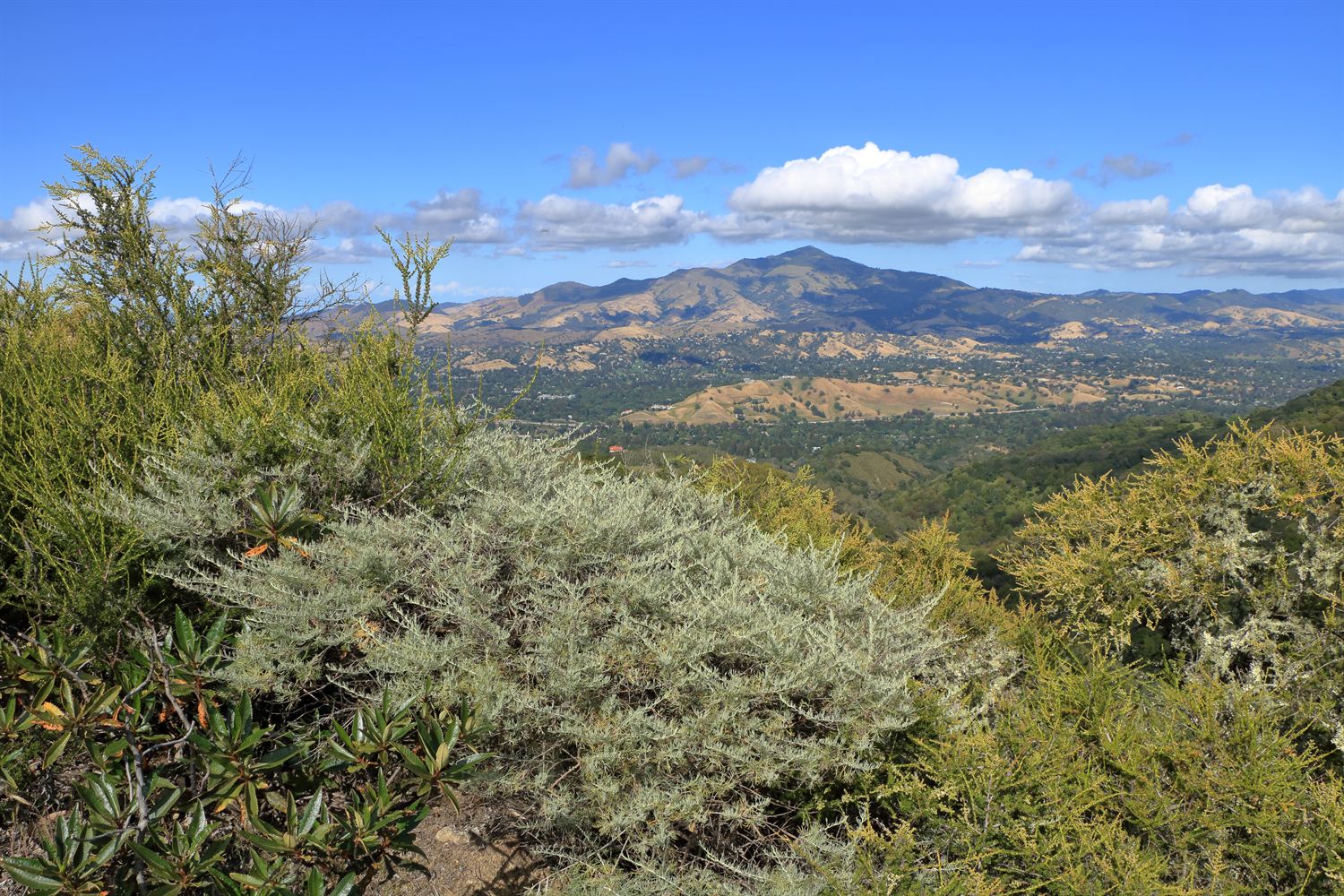
Image (Mount Diablo from Las Trampas): Salil / Adobe Stock (asset 513373471), Standard license. Photographed at Las Trampas Regional Wilderness, Contra Costa County, California.
Graphics (bare zone, range map): The Planters' Guild. (2026). Drawn from the sources cited above. The range map is schematic and generalized from published range descriptions; it is not digitized from occurrence records.