California Natives · No. 03
Showy Milkweed: The Native the Western Monarch Can't Skip
A field guide to Asclepias speciosa, the host plant the western monarch population is built on, and why the milkweed sold at most chain nurseries is making the problem worse, not better.
On this page
13 sections
- About the Plant
- What You're Looking At
- Where It Comes From
- The Mistake Most People Make
- Sun: Full Sun, Some Tolerance for Part Shade
- Water: Less Than You Think, More Than Chaparral Natives
- Soil: Adaptable, Even Clay-Tolerant
- Hardiness: USDA Zones 3 to 9
- One Honest Caveat: It Disappears in Fall
- Sourcing and Planting Window
- The Monarch Story
- The Takeaway
- Quick Reference
About the Plant
Once you know the story of the western monarch butterfly, the milkweed question changes. It's no longer a generic "plant something for pollinators" decision. It becomes a narrower problem: get the species right, get the location right, and a single patch in your yard contributes to a continental migration. Get either of those wrong, and you can actively work against the butterfly you're trying to help.
The numbers tell the story. The western monarch population was estimated in the millions through the 1980s, with a steady decline through the 1990s and 2000s and a major documented collapse by 2018 that left the species at extreme risk of quasi-extinction (Pelton et al., 2019). By the 2020–21 winter count, the population had crashed to roughly 2,000 individuals. A partial recovery followed. Then, in the 2025–26 winter, the count fell again. Volunteers tallied 12,260 monarchs across 249 overwintering sites in late November, dropping to 6,464 by early January. That's the third-lowest tally in the count's 29-year history (Xerces Society, 2026).
This is the plant the monarch larva can't develop without. Every monarch caterpillar in the world has eaten an Asclepias leaf. If you want to do one thing in your garden that matters to this species, you plant milkweed. The catch is that there are roughly fifteen native California milkweed species plus one widely-sold non-native that does measurable harm. This guide is about showy milkweed (Asclepias speciosa), the species most Bay Area gardeners should plant. It also tells you which species to avoid and why.
What You're Looking At
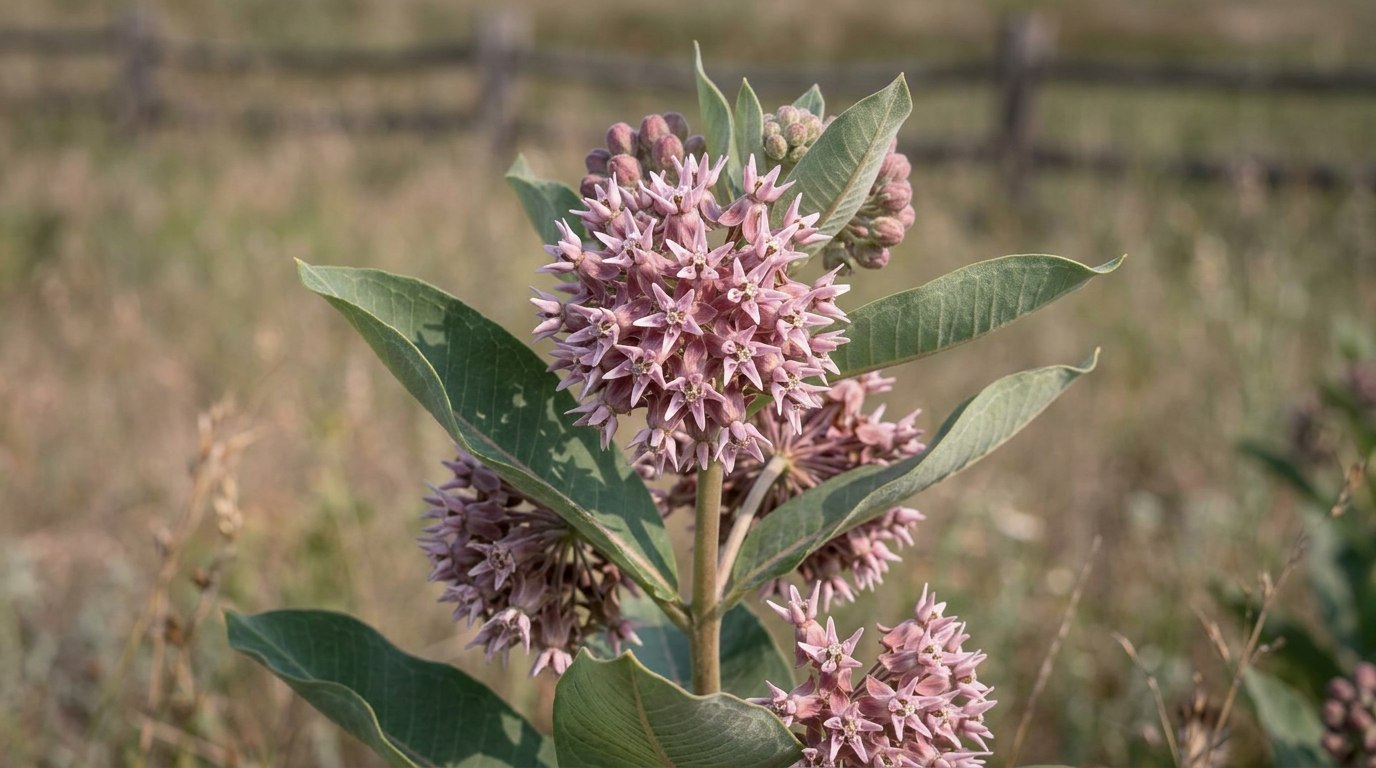
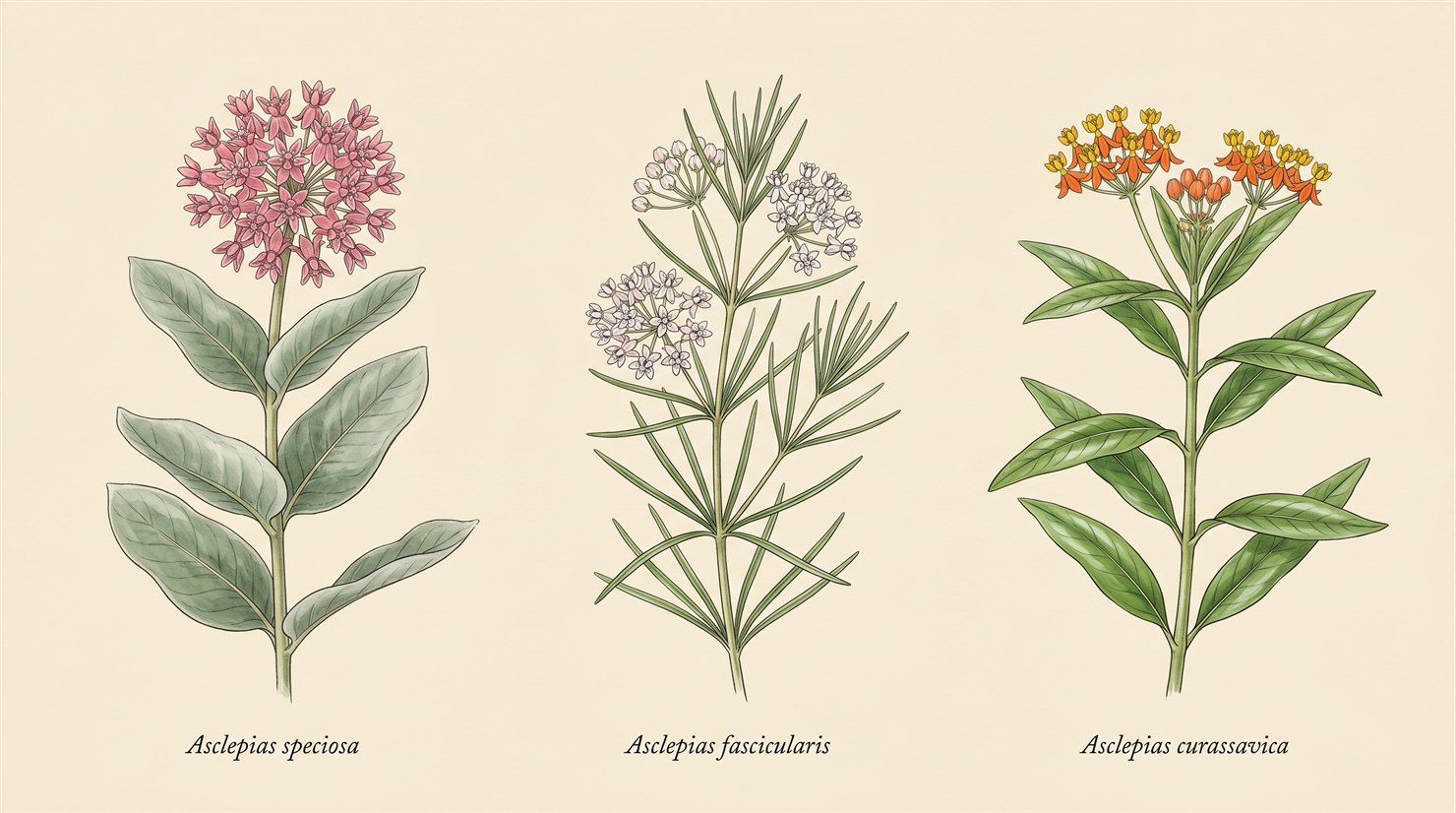
A mature showy milkweed stands two to four feet tall (60 to 120 cm), built around stout upright stems that emerge each spring from a network of underground rhizomes (creeping horizontal stems that send up new shoots at intervals). One plant becomes a patch within three to five years. The leaves grow in opposite pairs along the stem: broad ovals about four to eight inches long (10 to 20 cm), soft gray-green on top and paler beneath, and distinctly velvety to the touch. That fuzz is the easiest tell. Narrowleaf milkweed (Asclepias fascicularis, another California native worth planting) has narrow, almost needle-thin leaves. Tropical milkweed (Asclepias curassavica, the one you should not plant) has glossy smooth leaves. If the leaf is fuzzy and broad, you have the right plant.
The flowers arrive in late spring and continue through midsummer. Each bloom is small on its own, but they're packed into ball-shaped umbels (rounded clusters of flowers held on short stalks radiating from a single point) two to four inches across (5 to 10 cm), rose-pink to pale lavender, with a sweet vanilla-honey scent that carries on warm afternoons. The blooms give way to large green seed pods that split in fall to release silky-tufted seeds on the wind.
Snap a stem and a thick white sap bleeds out. That's where the name comes from, and it's doing more than naming the plant. The latex carries cardenolides (a family of plant-defense compounds also called cardiac glycosides, toxic to most vertebrates). Monarch larvae feed on milkweed leaves, sequester the cardenolides into their own tissues, and carry that chemistry into adulthood. The black-and-orange warning coloration on an adult monarch is advertising toxicity the caterpillar earned by eating this plant. More on this below.
Where It Comes From
Showy milkweed has the widest North American range of any Asclepias species native to the West. It grows from British Columbia south through California, east to the Great Plains, with strong populations in Oregon, Washington, Idaho, Nevada, Utah, and Colorado. Within California, it's primarily a Central Valley, Sierra foothill, and inland Coast Range plant. It's less common right on the immediate coast and rare in dense chaparral, but it shows up reliably in any open inland habitat with some seasonal moisture.
The habitat tells you what to give it: open grassland, the edges of seasonal creeks, the margins of agricultural fields, roadside ditches, disturbed ground. This is a meadow plant, not a chaparral plant. It tolerates seasonal flooding, handles clay soils that would kill California Buckwheat or California Fuchsia, and expects more moisture in summer than the chaparral natives do. If you live inland in the Bay Area (Santa Clara Valley, the East Bay flats, Solano County, anywhere east of the immediate coast), showy milkweed is the right native milkweed for your garden. If you're in a hotter, drier interior, narrowleaf milkweed (A. fascicularis) is the more drought-tolerant alternative. Both species are correct choices.
The Mistake Most People Make
Walk into almost any chain nursery in May and ask for milkweed, and you'll be handed Asclepias curassavica, tropical milkweed. It blooms longer than the natives, the orange-and-yellow flowers are showier, the leaves stay glossy and lush all season. It's sold as "monarch milkweed" or "butterfly weed." It is not the right species. And in California, planting it does measurable harm to the butterfly population it claims to help.
Three reasons, in order of weight.
The first is parasite buildup. Monarchs have a specialist protozoan parasite called Ophryocystis elektroscirrha (OE for short). Spores accumulate on milkweed leaves, larvae eat the spores while feeding, and infected adults emerge weaker, smaller-winged, and less able to complete migration. Native California milkweeds die back in fall, which breaks the parasite's transmission cycle each year. Tropical milkweed, in California's mild winters, does not die back. Spore loads accumulate on the same plants year-round, and infection prevalence in monarchs feeding on year-round milkweed runs dramatically higher than in monarchs feeding on seasonal natives (Satterfield et al., 2015).
The second is migration disruption. The senescence of native milkweed in autumn is one of the environmental cues that triggers the monarch's southward migration. Year-round tropical milkweed jams that signal. Adults stay and breed locally instead of migrating, producing late-season offspring that can't make the trip and carry the higher OE loads of the sedentary populations. Laboratory work has shown the effect compounds under warming temperatures, where the cardenolide chemistry of tropical milkweed shifts from beneficial to actively toxic to the larvae feeding on it. The authors of that study called it an ecological trap: a habitat that looks attractive but reduces fitness (Faldyn et al., 2018).
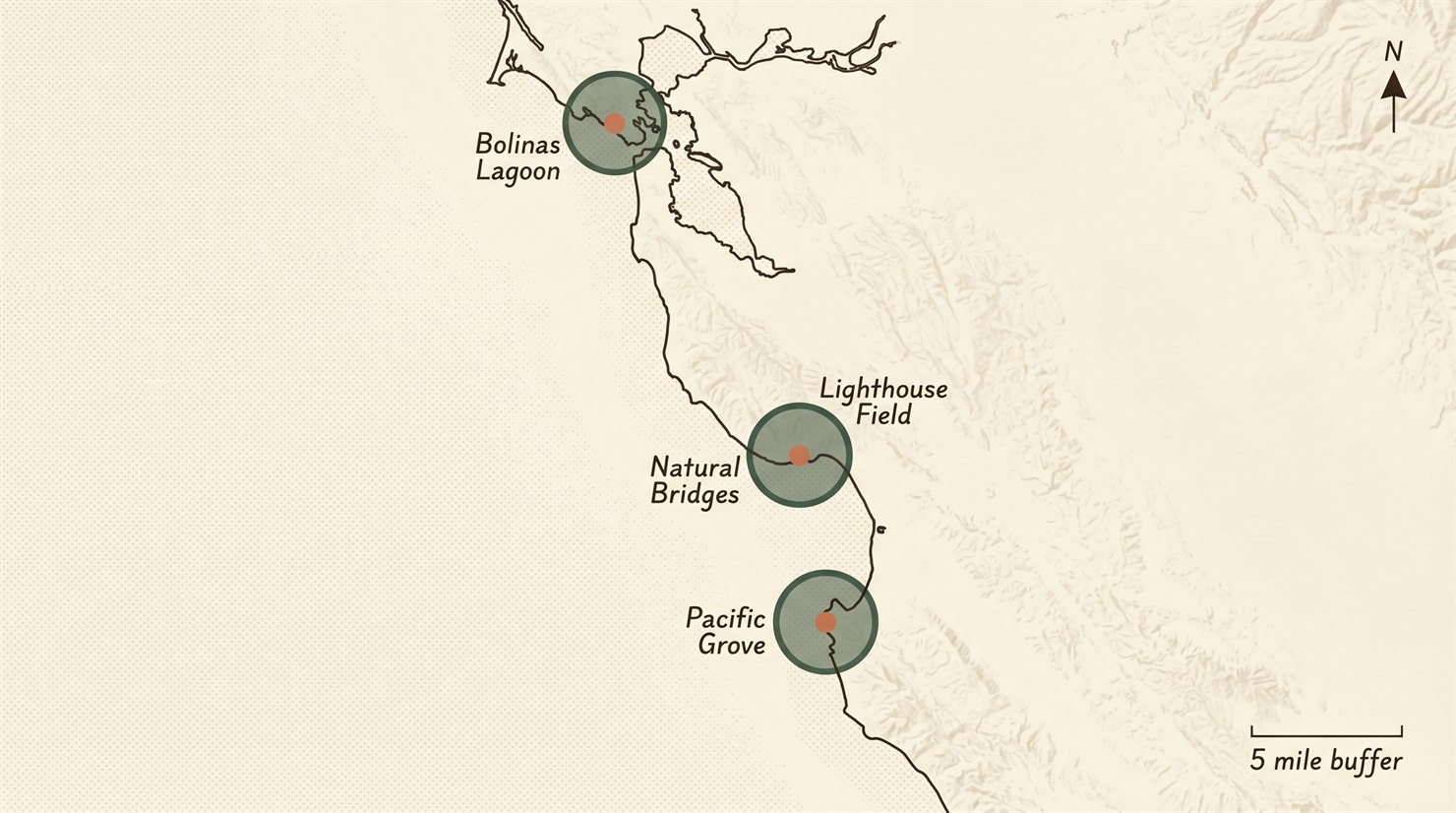
The third is location. Even native milkweed, planted in the wrong place, can disrupt the migration. The Xerces Society's current planting guidance is to plant no milkweed of any species within five miles of an active monarch overwintering grove if you're north of Santa Barbara, or within one mile of a grove if you're south (Xerces Society, n.d.). Bay Area overwintering groves include sites in Pacific Grove, Santa Cruz (Lighthouse Field and Natural Bridges State Beach), and the Bolinas Lagoon area. Xerces maintains a current overwintering-site map. If you're inside that buffer, the right thing to do for monarchs is not milkweed. It's nectar plants: California fuchsia, California buckwheat, asters, native goldenrod. Save the milkweed for the breeding corridor inland.
Buy Asclepias speciosa or Asclepias fascicularis. Ask by Latin name, and walk out of any nursery that can only sell you the tropical one.
Sun: Full Sun, Some Tolerance for Part Shade
Six or more hours of direct sun is ideal, and showy milkweed performs best in fully open conditions. It tolerates two or three hours of afternoon shade better than chaparral natives because it evolved in open meadow rather than exposed slope, but the bloom drops quickly in deep shade. The deeper test isn't sun versus shade; it's air movement. Crowded plantings with poor airflow encourage fungal issues on the leaves. Give it room.
Water: Less Than You Think, More Than Chaparral Natives
This is where showy milkweed diverges from the dry-loving Bay Area natives. Through year one, water deeply once a week during the dry months. That's more than you'd give California Buckwheat, less than you'd give a vegetable bed. After year one the patch is established, and a monthly deep watering through summer keeps the foliage lush and the bloom strong. It can survive on winter rainfall alone, but it'll go dormant earlier (sometimes by August) and the bloom window shortens.
This isn't a chaparral plant. Grasslands and riparian edges expect a moderate dry-summer drawdown, not the bone-dry chaparral cycle. Treat it like a perennial that wants summer water, not like a buckwheat.
Soil: Adaptable, Even Clay-Tolerant
Almost any soil works. Sandy, loamy, decomposed granite, gravelly slopes, and (uniquely among Bay Area natives worth growing) Bay Area adobe clay. Showy milkweed tolerates winter saturation better than nearly any other California native garden plant, which makes it a strong choice for the flat heavy-soil yards across the South Bay and East Bay where chaparral natives struggle. Lean is still better than rich. Don't amend with compost or fertilizer; the plant grows soft and floppy in enriched soils, and the cardenolide chemistry in the leaves shifts in ways that may matter to the larvae feeding on them.
Plan for a patch, not a specimen. Healthy showy milkweed sends rhizomes outward and will fill a four to six foot area over three to five years. That spread is a feature for pollinator support and a problem if you wanted a tidy clump. Decide which one you want before you plant.
Hardiness: USDA Zones 3 to 9
Showy milkweed is hardy across United States Department of Agriculture (USDA) zones 3 through 9, with inland Great Plains populations tolerating −40 °F (−40 °C). Every Bay Area microclimate is well within range, and the plant is appropriate across most of the continental US west of the Mississippi.
One Honest Caveat: It Disappears in Fall
The plant vanishes above ground. By mid-October the leaves yellow, the seed pods split and release their fluff, the stems dry and break off at the base, and where you had a four-foot patch in August you have bare ground in November. The rhizomes are alive underground, and fresh shoots will push through in late March or early April. Mark the patch with a stake before it disappears, so you don't dig it up in January thinking the previous owner left you a dead spot.
Sourcing and Planting Window
Fall planting works best. Plant October through early December, before the winter rains settle in, and the rhizomes have the full wet season to establish before their first dry summer. Spring planting (February through March) is workable but commits you to summer watering through year one.
Source from your local California Native Plant Society (CNPS) chapter sale. In the Bay Area that means the Santa Clara Valley chapter, the East Bay chapter, and the Yerba Buena chapter in San Francisco. Specialty California-native nurseries carry both A. speciosa and A. fascicularis year-round; phone ahead before driving anywhere, because milkweed stock moves quickly in spring.
A simple rule for any nursery counter: ask for the plant by Latin name. "Milkweed" as a label without a species is the red flag. If the only thing they have is Asclepias curassavica, walk out.
The Monarch Story
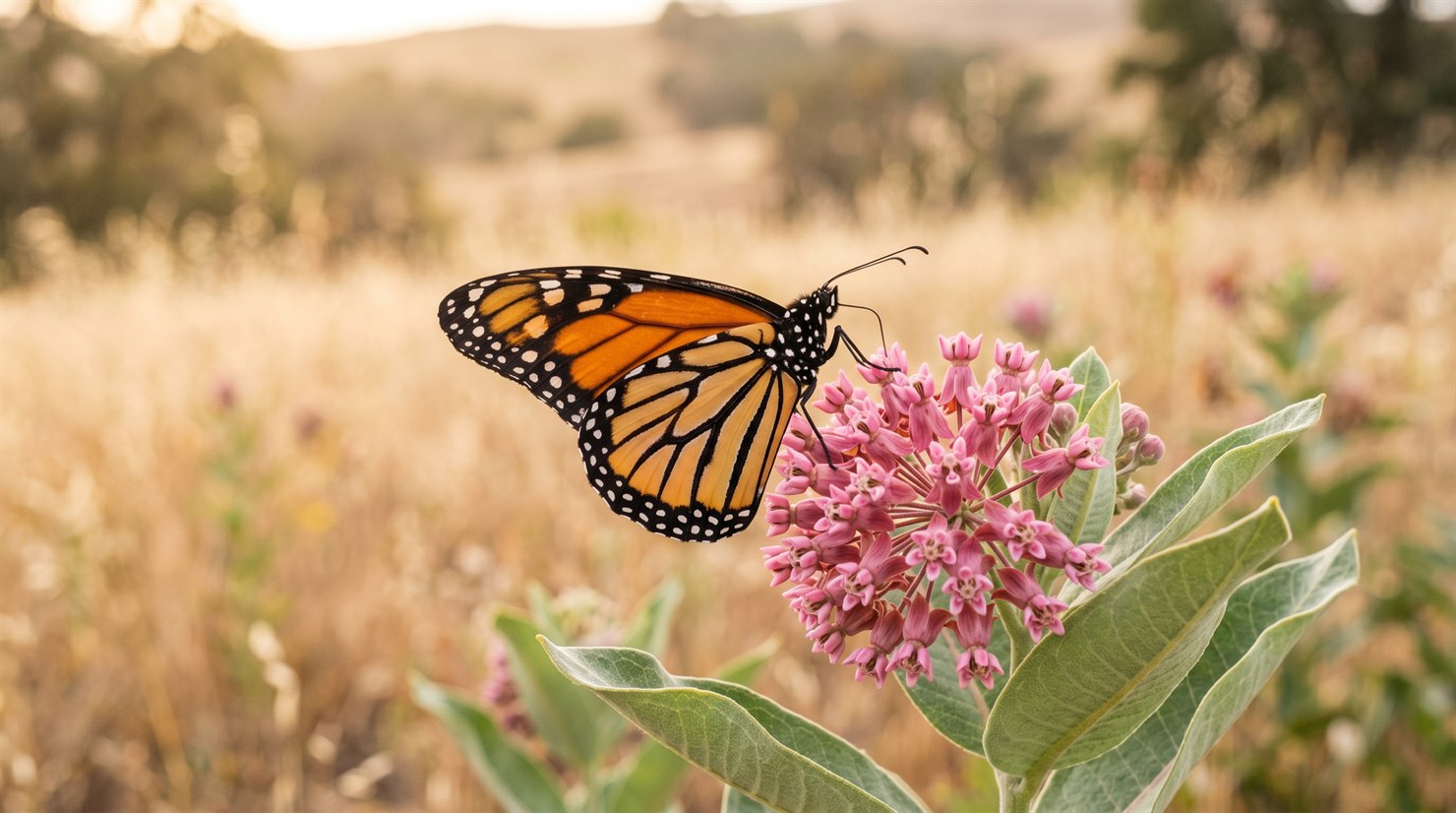
Monarch butterflies (Danaus plexippus) are obligate milkweed specialists. Their larvae develop on no other plant genus. That dependency is the foundation of the entire monarch defense system: as caterpillars feed on milkweed, they sequester the plant's cardenolides into their own tissues. The compounds are bitter and toxic to most vertebrate predators, and the bright orange warning coloration on adult monarchs is advertising it. The relationship between this one plant genus and this one butterfly species is one of the most-studied coevolutionary stories in biology (Agrawal, 2017).
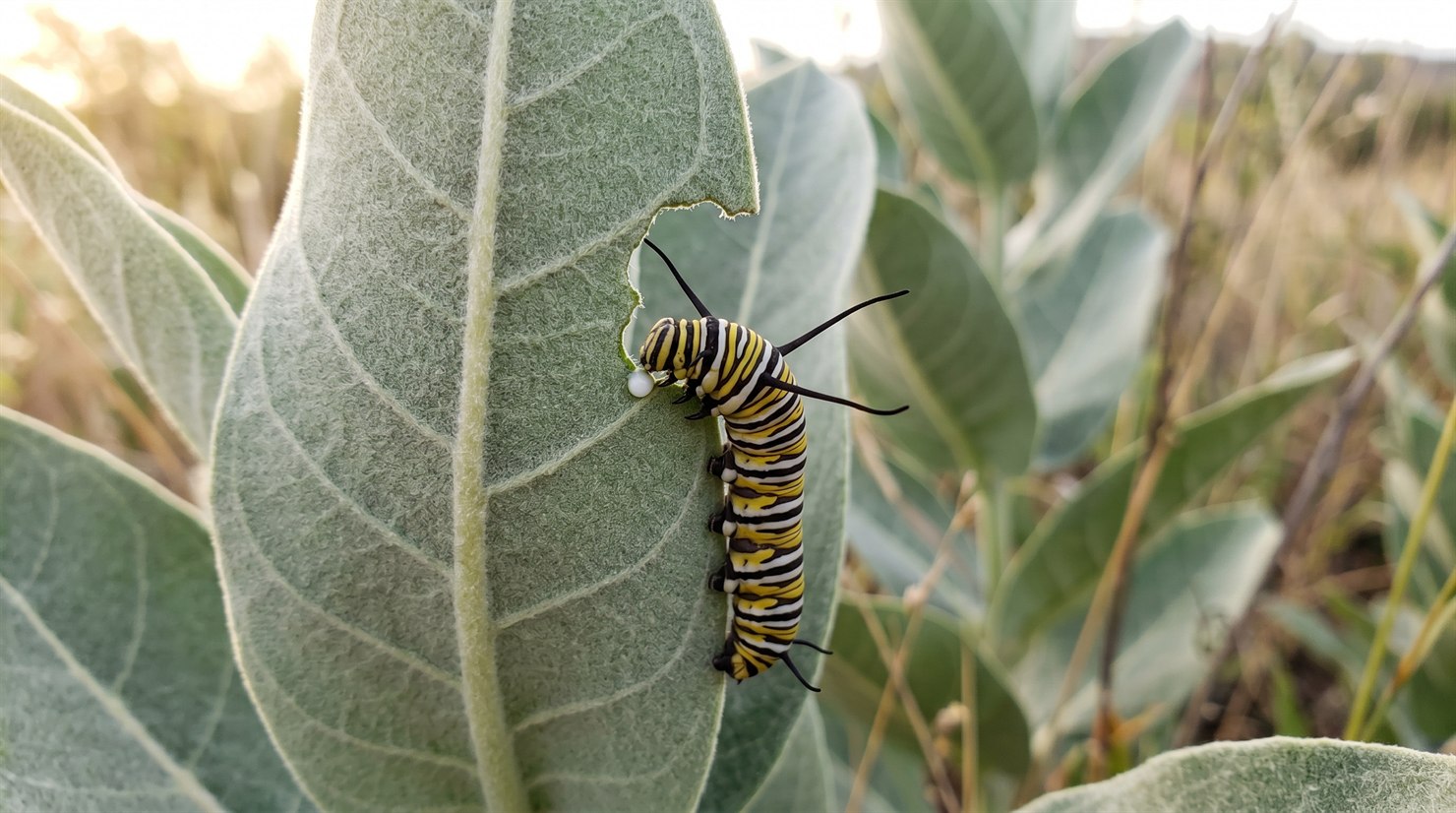
For the broader migration, the arithmetic is simple. The western population overwinters in a relatively small set of coastal California groves, then disperses inland each spring to breed across the western US, a migration corridor that stretches from California north into British Columbia and east into the Rocky Mountain states. Every breeding-corridor patch of native milkweed contributes. A single well-sited A. speciosa patch in an inland Bay Area garden may host caterpillars whose adult selves overwinter in Pacific Grove or Pismo Beach. With the 2025–26 winter count at 12,260 and trending downward, every patch in the corridor matters. A hundred tropical-milkweed plants near the coast work in the opposite direction.
Beyond monarchs, showy milkweed is high-value nectar forage for native bumblebees (Bombus spp.), large solitary bees, queen butterflies, swallowtails, and hummingbirds. Many of these species don't lay eggs on milkweed; they use it for the long-bloom, high-nectar resource it represents.
Quick Reference
- Sun: Full sun, 6+ hours; tolerates light afternoon shade.
- Water: Year 1 weekly deep water; established monthly through summer.
- Soil: Adaptable; tolerates Bay Area adobe clay and seasonal saturation.
- Hardiness: USDA zones 3 to 9.
- Bloom: Rose-pink to lavender ball-shaped umbels, late spring through midsummer.
- Size: 2 to 4 ft tall (60–120 cm); patches 4 to 6 ft wide at maturity.
- Spread habit: Aggressive rhizomes; plan for a patch, not a specimen.
- Plant in: October to early December for best establishment.
- Source from: Local CNPS chapter plant sales; California native specialty nurseries; ask by Latin name.
- What to avoid: Tropical milkweed (A. curassavica); planting within 5 miles of an overwintering grove (1 mile south of Santa Barbara); compost amendment; summer-only drip irrigation.
The Takeaway
Showy milkweed is the rare native where the choice has consequences beyond your fence line. Choose the right species (A. speciosa or A. fascicularis, never tropical), site it inland and well outside the five-mile buffer around Bay Area overwintering groves, and a single well-tended patch feeds caterpillars that go on to cross hundreds of miles to the coast. Choose wrong on either count and you're working against the butterfly you wanted to help. With the western population back below 13,000 individuals as of January 2026, the corridor doesn't have room for misplaced effort. Put it in the right place inland, and your yard becomes part of the migration.
Sources
Agrawal, A. (2017). Monarchs and milkweed: A migrating butterfly, a poisonous plant, and their remarkable story of coevolution. Princeton University Press.
Bornstein, C., Fross, D., & O'Brien, B. (2005). California native plants for the garden. Cachuma Press.
California Native Plant Society. (n.d.). Asclepias speciosa (Showy Milkweed). Calscape. Retrieved May 26, 2026, from https://calscape.org/Asclepias-speciosa-(Showy-Milkweed)
Faldyn, M. J., Hunter, M. D., & Elderd, B. D. (2018). Climate change and an invasive, tropical milkweed: An ecological trap for monarch butterflies. Ecology, 99(5), 1031–1038. https://doi.org/10.1002/ecy.2198
Pelton, E. M., Schultz, C. B., Jepsen, S. J., Black, S. H., & Crone, E. E. (2019). Western monarch population plummets: Status, probable causes, and recommended conservation actions. Frontiers in Ecology and Evolution, 7, Article 258. https://doi.org/10.3389/fevo.2019.00258
Satterfield, D. A., Maerz, J. C., & Altizer, S. (2015). Loss of migratory behaviour increases infection risk for a butterfly host. Proceedings of the Royal Society B: Biological Sciences, 282(1801), 20141734. https://doi.org/10.1098/rspb.2014.1734
Xerces Society for Invertebrate Conservation. (2026). Western Monarch Count: 2025–2026 season results. Retrieved May 26, 2026, from https://westernmonarchcount.org/data/
Xerces Society for Invertebrate Conservation. (n.d.). Native milkweed in California: Planting and establishment. Retrieved May 26, 2026, from https://xerces.org/sites/default/files/publications/19-004.pdf