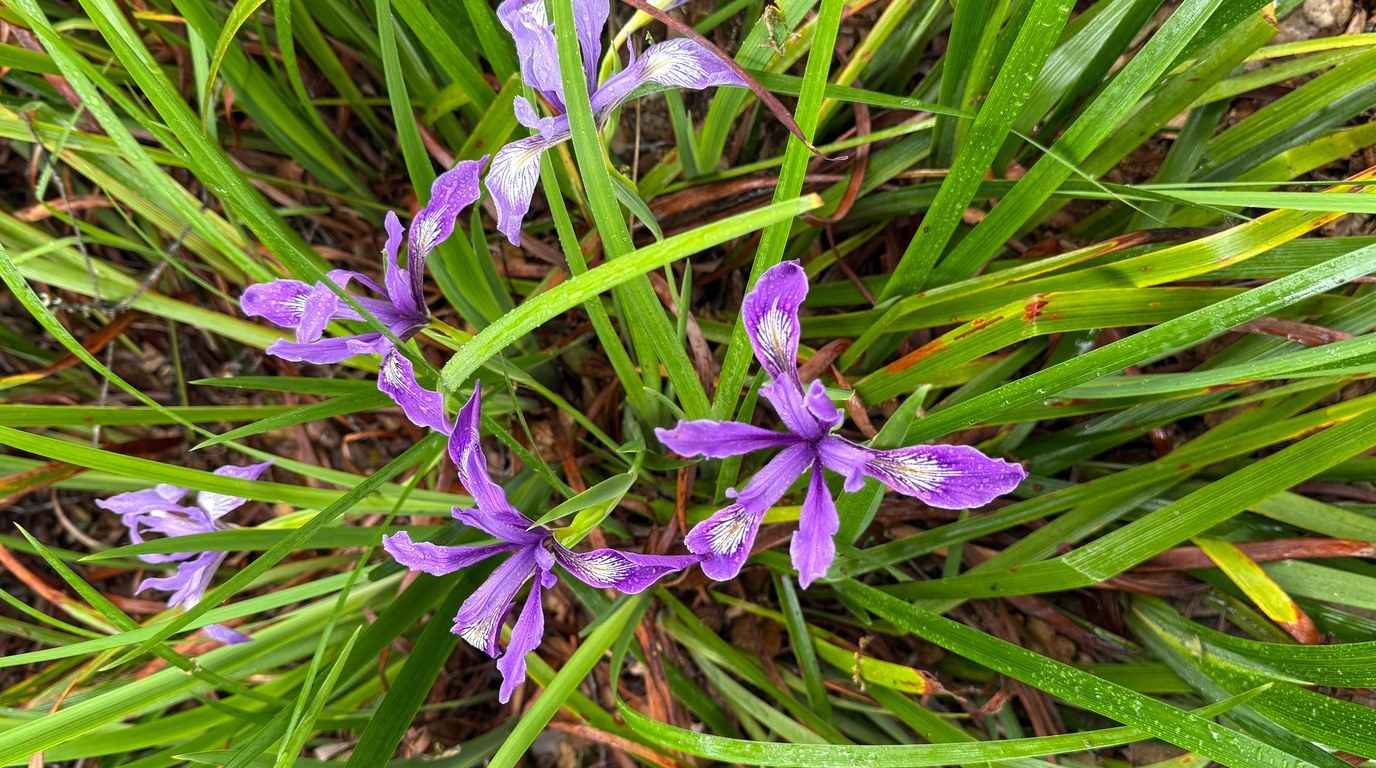
California Natives · The Timing Plant · No. 10
Douglas Iris: The Native That Tells You When to Move It
A field guide to Iris douglasiana, the evergreen fan of the coastal grasslands. When to move or divide it, how the roots show you it's growing, and why it takes more shade and summer water than most of the natives in this series.
On this page
13 sections
- About the Plant
- What You're Looking At
- Where It Comes From
- When to Move It
- Sun: It Depends on Where You Garden
- Water: The One That Takes Some
- Soil: Organic Matter, and a Disagreement About Drainage
- Cold, Growth, and How Long It Lasts
- Silk From the Leaf Edges
- A Caveat: The Rancher's Weed
- Sourcing
- The Takeaway
- Quick Reference
Corrected October 2026: we've revised parts of this guide. See the correction note at the end.
About the Plant
Most of this series has been a lesson in restraint. Don't feed the lupine. Keep the hose off the buckwheat in summer. Pick the right manzanita and then mostly leave it alone. California natives tend to want less than you're inclined to give them, and the recurring skill is learning to hold back.
Douglas iris loosens that pattern. It takes shade, it can take summer water, and it's evergreen, so it keeps its fans of leaves all year. The USDA plant guide describes native irises as free flowering, mostly long-lived, and needing very little attention (Stevens, 2000).
The one thing it asks of you is timing. Douglas iris grows in the cool, wet half of the year, and the plant guide's advice for dividing it is to wait until new roots have started in fall or winter and to finish before the flowers form (Stevens, 2000). The roots show you when that is, the first time you lift one.
What You're Looking At
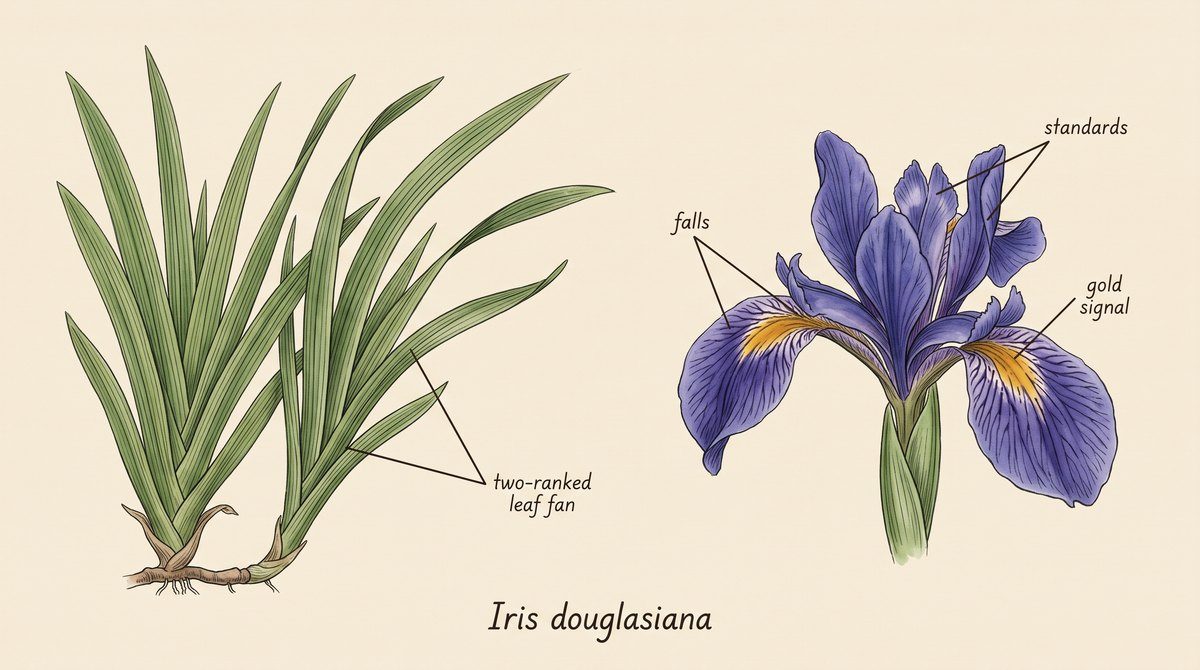
Start with the leaves. The plant guide's field mark for irises is the leaves, set in two rows that "overlap like praying hands" (Stevens, 2000). The whole clump reads as a flat green fan. The leaves are long and narrow with parallel veins (Stevens, 2000), and Douglas iris keeps them through winter.
The flower is harder to pin down, because Iris douglasiana comes in many colors. Flora of North America lists flowers in white, cream, gray-blue, lavender, or deep red-purple, marked with a gold signal patch and blue or purple veins (Henderson, 2002b). Each bloom has three outer parts called falls, which carry the signal patch (botanically they're sepals), and three inner petals called standards. The sources differ a little on when it flowers: April to June in Flora of North America (Henderson, 2002b), May to June in the USDA plant guide (Stevens, 2000), and winter and spring on Calscape (California Native Plant Society, n.d.).
The color range isn't only between regions. Flora of North America quotes the botanist L. W. Lenz, writing in 1954: "Well marked and distinct geographic races cannot be detected; however, pronounced variations are to be found within a single population" (Henderson, 2002b). Lenz put part of that variation down to crossing with other species the plant has met, and for those reasons he didn't split the species into named subgroups.
The seed capsules come after the flowers. Each holds 20 to 80 seeds, and the capsules open at the top when ripe. The plant guide warns that "two days after ripening, the seed is gone" (Stevens, 2000). Below ground is the rhizome, which Flora of North America (following Holm) defines as "a horizontal, usually subterranean, stem" (Henderson, 2002a). The same flora describes the rhizomes as freely branching and forming large colonies (Henderson, 2002b).
Where It Comes From
Douglas iris grows mostly near the coast. The USDA plant guide gives its range as the coast from northern Santa Barbara County into Oregon, mostly below about 330 feet (100 m). There it grows in coastal prairie and mixed evergreen forest, in shade, in moist soils with plenty of organic matter (Stevens, 2000). Calscape adds scattered inland locations and occasional sites up to about 3,300 feet (1,000 m) (California Native Plant Society, n.d.).
Its calendar follows the rains. The plant guide says irises begin growing when the cool weather and rain arrive in fall, grow most in spring and early summer, and go dormant after seed set in the hot, dry summer (Stevens, 2000). The American Iris Society describes the Pacific Coast irises' native climate as Mediterranean: cool, wet winters and long, dry summers (American Iris Society, n.d.).
It belongs to a group the American Iris Society calls the Pacific Coast irises, Iris series Californicae, native along the western coast of the United States (American Iris Society, n.d.). They cross easily: Flora of North America lists ten species that I. douglasiana hybridizes (crosses) with, and names its natural hybrid with I. innominata as Iris ×thompsonii (Henderson, 2002b). That matters when you buy one; see Sourcing below.
When to Move It
Douglas iris is in flower in spring, and that's when it's easiest to notice in a nursery. The planting and dividing advice in the sources points to a different season.
The sources give overlapping windows. The USDA plant guide's preferred method is division, "in fall or winter after the first new roots are established but before the flowers form" (Stevens, 2000). For Pacific Coast irises as a group, the American Iris Society's culture notes say to wait until the roots are plump and white, an inch or more long, and actively growing. On the West Coast that's late fall, and in places with harsher winters early spring may be the better time (American Iris Society, n.d.). Calscape offers a different window: divide after blooming, and best of all in winter as new growth begins at the base of the plant (California Native Plant Society, n.d.).
You have a little more leeway with a potted plant from the nursery. The plant guide's own seed method plants young seedlings out in May and waters them through the dry season until their roots are established (Stevens, 2000), so a spring planting can work if you plan on watering it through its first summer.
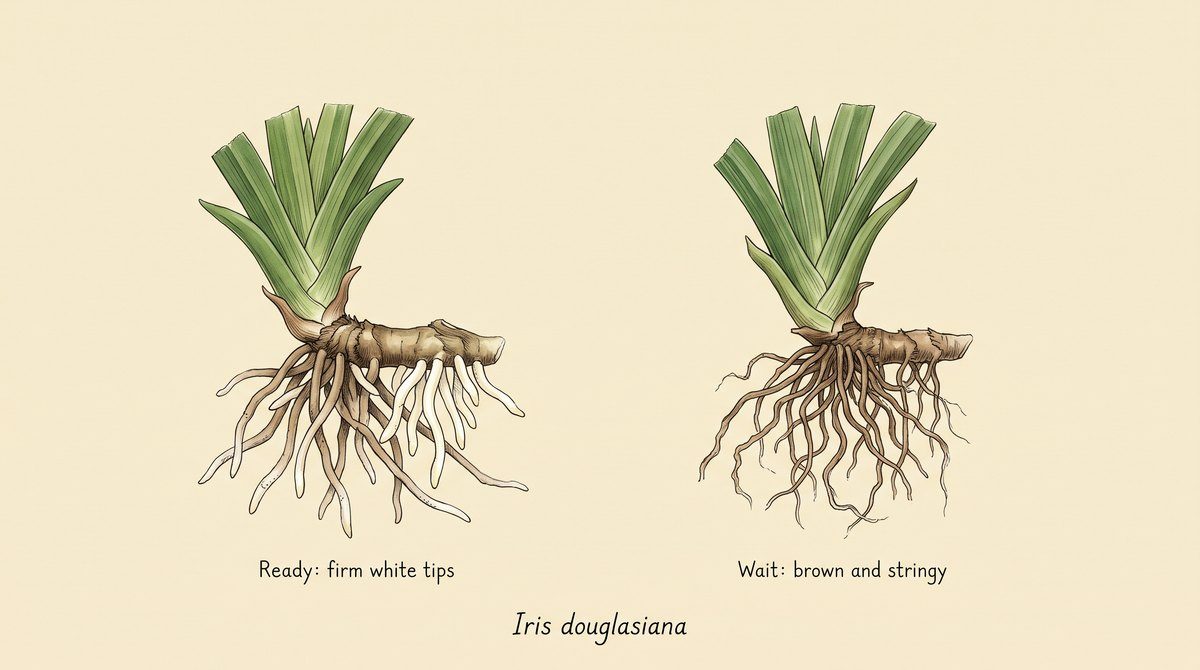
The roots show you when the plant is growing. Lift a clump or turn a pot out and look. The American Iris Society's signal is roots that are plump, white, an inch or more long, and actively growing. If a division has no new roots yet, the Society suggests keeping it in water, changed every two to three days, until new roots appear before you plant it (American Iris Society, n.d.).
Sun: It Depends on Where You Garden
In the wild Douglas iris grows in open woods and on sunny slopes and fields (Henderson, 2002b), as well as in shade (Stevens, 2000). How much sun it wants in a garden depends on how hot your summers are.
The USDA plant guide says the native irises "will tolerate sun for most of the day in mild areas, and should have afternoon shade and ample water in the interior regions" (Stevens, 2000). Calscape notes that Douglas iris handles drought better near the coast, where fog and cooler temperatures help it (California Native Plant Society, n.d.). In practice that means more sun on the coast and more shade the farther inland you go.
It also does well in shade. The plant guide, citing Schmidt (1980), calls the native irises "excellent in shade situations, even dense shade of walls and fences" (Stevens, 2000). If you have a shaded strip along the north side of a fence, Douglas iris is a candidate for it.
Water: The One That Takes Some
Most entries in this series warn against summer water. Douglas iris is an exception, within limits.
After their first year, the plant guide says, plants should look after themselves without extra water unless there's an unusually hot, dry spell, though they may be watered year round (Stevens, 2000). Calscape gets more specific: away from a creek or naturally wet spot it likes summer water every two to four weeks, and once established no more than about once a month (California Native Plant Society, n.d.). The American Iris Society adds that Pacific Coast irises do well with a summer watering now and then but should never get water during the hottest part of the day, which growers have linked to crown rot (American Iris Society, n.d.).
For a new division, the plant guide says to water it in and shade it for a few days if it's in full sun (Stevens, 2000).
Soil: Organic Matter, and a Disagreement About Drainage
Douglas iris grows wild in moist soils with plenty of organic matter (Stevens, 2000). Calscape describes it as preferring heavy soils with organic matter and lists its soil drainage as slow (California Native Plant Society, n.d.).
The American Iris Society puts more weight on drainage. The American Iris Society's notes for Pacific Coast irises call drainage, along with good air circulation, the single most important factor, and suggest a slope, raised bed, mound, or container to get it. The same notes say these irises won't perform in light, sandy soil and want a neutral to slightly acid pH (American Iris Society, n.d.). Those notes cover the whole group, not Douglas iris alone. If your clay stays wet through winter, a slight rise in the bed is cheap insurance.
Feeding is optional. The USDA plant guide says fertilization increases biomass and seed production (Stevens, 2000), and the American Iris Society suggests an occasional feeding with a fertilizer made for azaleas and camellias (American Iris Society, n.d.). That's a change from the last two entries, lupine and poppy, which do best without it.
Cold, Growth, and How Long It Lasts
Douglas iris is evergreen, and winter is part of its growing season. Sources disagree on how much cold it takes. Calscape lists cold tolerance to 30°F (-1°C) (California Native Plant Society, n.d.), and the American Iris Society says Pacific Coast irises are not reliably hardy below 5 to 10°F (-15 to -12°C) (American Iris Society, n.d.).
Calscape describes Douglas iris as fast growing near the coast and lists its growth rate as fast to moderate (California Native Plant Society, n.d.). The plant guide describes it as clonal, growing outward from the center, and says that when allowed to increase freely, plants naturalize and eventually form extensive ground cover (Stevens, 2000).
Several of the last entries came with a note about short-lived plants that need replacing. The plant guide says most native irises are long-lived and need very little attention (Stevens, 2000). It also gives the upkeep. In autumn, remove old leaves from the center of large clumps, cut the foliage back and mulch, and divide from time to time, since dividing often appears to keep plants vigorous (Stevens, 2000).
Silk From the Leaf Edges
Iris leaves were a source of cordage, meaning string and rope, in Native northern California, and the work of turning them into rope was slow (Chesnut, 1902; Kroeber, 1925).
For Douglas iris specifically, the account we have is Chesnut's, from Mendocino County in the late 1890s. He recorded the plant under its Pomo name and noted that the edges of the leaves, "as fine and strong as silk," were gathered for the strongest nets and ropes. Only the margin of the leaf was used, which made the work exceedingly laborious. The strands were separated and cleaned with a sharp piece of abalone shell fastened to the thumb. One man, Frank Youree, told Chesnut that "it took nearly six weeks to make a rope twelve feet long." The rope was strong and pliable and was especially valued for deer snares, so it was known as "deer rope" (Chesnut, 1902).
Kroeber, writing in his handbook about the northwest more broadly, names a different species. It says that "from the Tolowa to the Coast Yuki, and inland at least to the Shasta," a small species of iris, I. macrosiphon, was the string material, and that the work was very tedious but gave an unusually fine, hard, even string (Kroeber, 1925). The USDA plant guide's account of iris cordage, with its fiber counts, shell scrapers and deer-rope measurements, describes irises in general rather than Douglas iris alone (Stevens, 2000).
The plant guide adds one point a gardener can use. Traditional management included cutting large bundles of leaves each fall and keeping them until they were needed, which, the guide says, "naturally accomplished the pruning and mulching that modern horticulturists practice to maintain iris beds" (Stevens, 2000).
A Caveat: The Rancher's Weed
A rancher and a gardener can look at Douglas iris and see different things.
The USDA plant guide says irises can turn into noxious pasture weeds because grazing animals find the bitter leaves unpalatable (Stevens, 2000). Calscape gives the same reason for cattle and adds that the clumps hold back other plants (California Native Plant Society, n.d.).
For most home gardens that's background. Two practical notes come out of it. If your property borders working grazing land, plant something else along that edge. And if you're letting the iris naturalize, know that its rhizomes branch freely and can form a large colony (Henderson, 2002b), which is either what you wanted for a shady bank or the opposite. Decide before you plant.
It also isn't a plant to eat, and pet owners should know where it is. Fresh iris roots may be toxic, the plant guide warns (Stevens, 2000), and the ASPCA lists iris as toxic to dogs, cats, and horses, with the highest concentration in the rhizomes (ASPCA, n.d.). NC State Extension rates it as low toxicity if eaten and notes minor skin irritation from contact with the seeds, rootstock, or sap (NC State Extension, n.d.). Wear gloves when you divide a clump, and keep the trimmings away from animals.
Sourcing
Look for Douglas iris at a local California Native Plant Society (CNPS) chapter sale or a native nursery, and check the roots before you plant or divide. Planting in fall or winter lets the rains do much of the watering while the roots establish.
Be deliberate about what you're buying. The American Iris Society says most of the Pacific Coast irises grown today are hybrids between the species (American Iris Society, n.d.), and Flora of North America says repeated hybridization, natural and artificial, has produced hundreds of garden forms (Henderson, 2002a). The garden hybrid of I. douglasiana and I. innominata even has a formal name, Iris ×aureonympha (Henderson, 2002b). Hybrids are fine garden plants, but they aren't the species. The USDA plant guide advises planting species from your local area, adapted to your site (Stevens, 2000), and that matters most if you garden near open space with wild stands. Ask for the plant by its Latin name and ask whether it's the species or a selection. Calscape, the California Native Plant Society's plant database, shows what the species looks like.
Skip wild-dug plants. The plant guide says "native irises in the wild tend to produce only a small, dry rhizome with stringy roots, which is difficult to dig," while "vigorous garden or greenhouse plants produce firm, white, growing roots especially in winter and spring" (Stevens, 2000).
Seed is the other route. The plant guide says autumn is the best time to sow in the ground and that germination begins in two or three months. Some seed waits a year, so expect more seedlings the second year. Plants should start blooming in their second year if they've grown without interruption (Stevens, 2000). The American Iris Society notes that only the species come true from seed (American Iris Society, n.d.), so seed from a garden hybrid can give you something different from its parent.
We review our guides against the research and extension guidance available at the time, and we correct them when a source doesn't say what we took it to say or when we can't find support for a point. In this review we corrected the guide's central advice on when to plant, move, or divide Douglas iris and what it said about the plant's safety around pets and people, and we revised its details on cold, sun, water, soil and growth rate, the history of its leaf fiber, and the main photo. We also fixed points we'd credited to sources that don't make them and removed claims we couldn't source, including parts of our account of how its flowers are pollinated.
Quick Reference
- Sun: Sun most of the day in mild coastal gardens; afternoon shade inland. Does well in shade, even the dense shade of walls and fences.
- Water: Grows on the winter rains and goes dormant in the hot, dry part of summer. Can be watered year round. Calscape suggests summer water every two to four weeks away from a creek or wet spot, and lists no more than once a month once established.
- Soil: Calscape lists a preference for heavy soils with organic matter. The American Iris Society puts good drainage first for Pacific Coast irises. Neutral to slightly acid.
- Plant or divide: Divide or move it once new roots have started in fall or winter, and before flower stems form. Water divisions in, and water young seedlings through their first dry season.
- Cold: Evergreen. Sources disagree on its cold limit, from about 30°F (-1°C) to 5–10°F (-15 to -12°C).
- Bloom: April into June in Flora of North America. Colors run from white and cream through gray-blue and lavender to deep red-purple, with a gold signal patch and blue or purple veins.
- Habit: Evergreen rhizome, with leaves in a flat double row. Flower stems roughly 0.5–2.3 ft (1.5–7 dm). Rhizomes branch freely and form large colonies.
- Propagate by: Division when the roots are growing, or seed sown in autumn. Capsules hold 20–80 seeds and shed them about two days after ripening, so watch them closely.
- Source from: California Native Plant Society (CNPS) chapter sales and native nurseries. Ask for I. douglasiana by name if you want the species rather than a Pacific Coast hybrid.
- What to avoid: Digging plants from the wild; siting it in pasture next to grazing land; eating any part of it. Iris is listed as toxic to dogs, cats, and horses, and fresh roots may be toxic to people.
The Takeaway
Douglas iris asks for less than most plants in this series. It takes shade, some summer water, and heavy soil with organic matter, and in return you get evergreen fans and a spring flower whose color can change from plant to plant in a single stand. What it asks is that you move it on its schedule. When you want to divide or move one, wait for the cool, wet season, lift the plant and look at the roots. Plump, white, actively growing roots an inch or more long mean the plant is ready. If there are none yet, wait until they appear.
Sources
American Iris Society. (n.d.). Pacific Coast iris culture (reprinted from Basic iris culture). Iris Encyclopedia. Retrieved October 5, 2026, from https://wiki.irises.org/Pcn/Info_Pacific_Coast_Iris_Culture
ASPCA. (n.d.). Iris. Toxic and non-toxic plants. Retrieved October 6, 2026, from https://www.aspca.org/pet-care/animal-poison-control/toxic-and-non-toxic-plants/iris
California Native Plant Society. (n.d.). Douglas iris (Iris douglasiana). Calscape. Retrieved October 5, 2026, from https://calscape.org/Iris-douglasiana-(Douglas-Iris)
Chesnut, V. K. (1902). Plants used by the Indians of Mendocino County, California. Contributions from the U.S. National Herbarium, 7, 295–408.
Henderson, N. C. (2002a). Iris. In Flora of North America Editorial Committee (Eds.), Flora of North America north of Mexico (Vol. 26). Oxford University Press. http://www.efloras.org/florataxon.aspx?flora_id=1&taxon_id=116503
Henderson, N. C. (2002b). Iris douglasiana. In Flora of North America Editorial Committee (Eds.), Flora of North America north of Mexico (Vol. 26, p. 384). Oxford University Press. https://floranorthamerica.org/Iris_douglasiana
Kroeber, A. L. (1925). Handbook of the Indians of California (Bulletin 78). Bureau of American Ethnology, Smithsonian Institution.
NC State Extension. (n.d.). Iris. North Carolina Extension Gardener Plant Toolbox. Retrieved October 6, 2026, from https://plants.ces.ncsu.edu/plants/iris/
Stevens, M. (2000). Douglas iris (Iris douglasiana) plant guide. USDA Natural Resources Conservation Service, National Plant Data Center. https://plants.sc.egov.usda.gov/DocumentLibrary/plantguide/pdf/cs_irdo.pdf
Image (hero): Hackney, M. (2020, June 1). Iris douglasiana, Humboldt County, California [Photograph]. iNaturalist observation 48183297. Licensed CC BY. https://www.inaturalist.org/observations/48183297
Illustrations (identification plate, root comparison): The Planters' Guild. (2026). Generated illustrations, labeled from the sources cited above.
Note: Stevens (2000) cites Schmidt, M. G. (1980), Growing California native plants (University of California Press), for the dense-shade statement; we quote Stevens and did not consult Schmidt.