California Natives · No. 05
Ceanothus: California Lilac, and Choosing One That Thrives for a Decade
A field guide to the genus Californians call California lilac, led by blueblossom (Ceanothus thyrsiflorus): the nitrogen-fixing, bee-clouded chaparral shrub that turns a hillside electric blue every spring, and how to pick and water the one that will thrive where you live.
On this page
13 sections
About the Plant
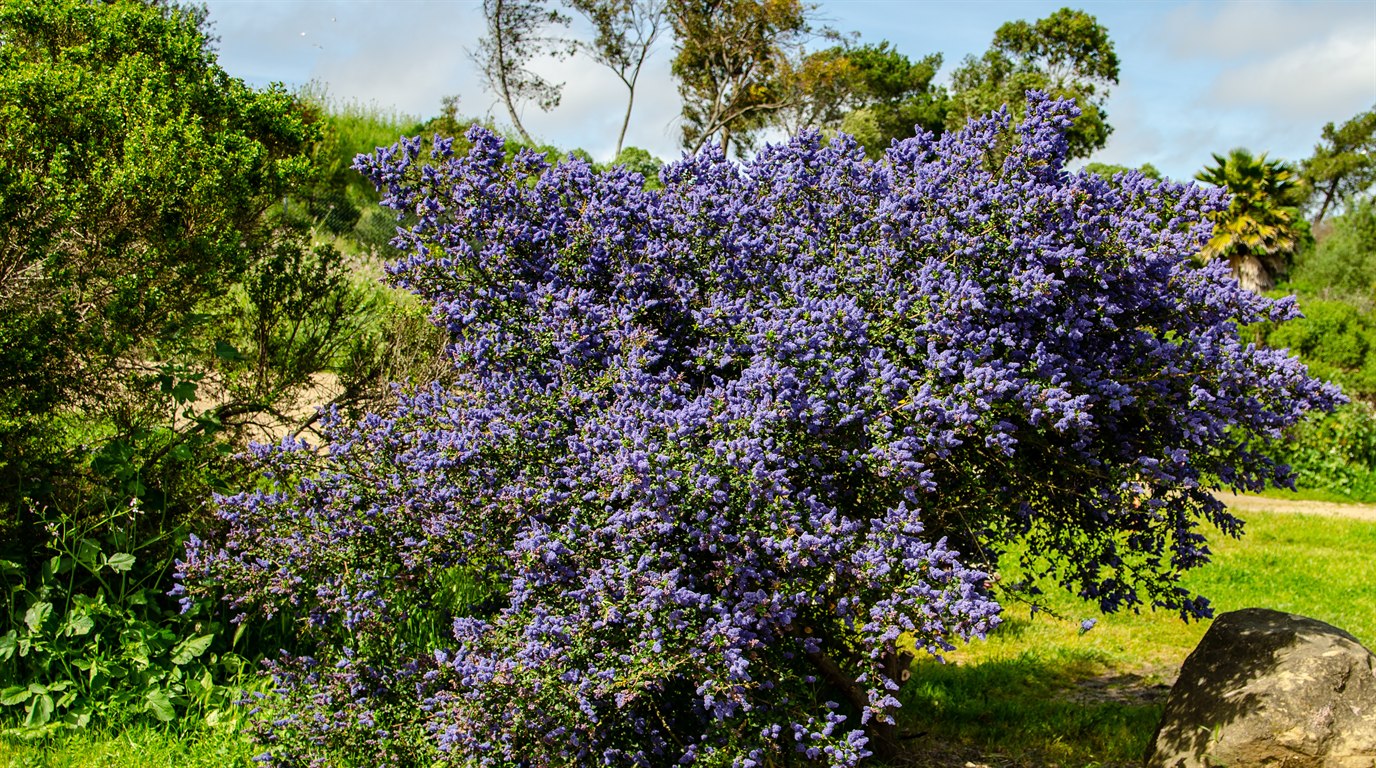
For a few weeks every spring, somewhere on a California hillside, a shrub stops looking like a plant and starts looking like weather. The whole mass goes one color, a blue so saturated it reads as haze from across a canyon, and the air around it hums loud enough to hear from ten feet off. That's ceanothus in bloom, and once you've seen it you understand why nearly every California gardener eventually tries to grow one.
Ceanothus (pronounced see-uh-NO-thus) is a genus of roughly 50 to 60 species of shrubs and small trees in the Rhamnaceae, the buckthorn family (Schmidt & Wilken, 2016). Most Californians know it as California lilac, which is a useful nickname and a botanical fib: true lilacs are Syringa, in the olive family, and they are not related. The flowers look similar from a distance and that's where the resemblance ends. The genus is centered on the California Floristic Province, the botanical region running down the West Coast that holds one of the highest concentrations of plants found nowhere else on Earth. Of the roughly 58 species in the genus, around 42 grow only here (Burge et al., 2016).
This guide leads with blueblossom (Ceanothus thyrsiflorus), the tall coastal species that most people picture when they picture a California lilac, and the one most likely to be sold to you under that name. But the part that matters most with ceanothus is bigger than any one species, so we'll get to it fast: the genus splits cleanly into two halves that want two completely different gardens. Buy from the wrong half and you will lose the plant. More on that below.
What You're Looking At
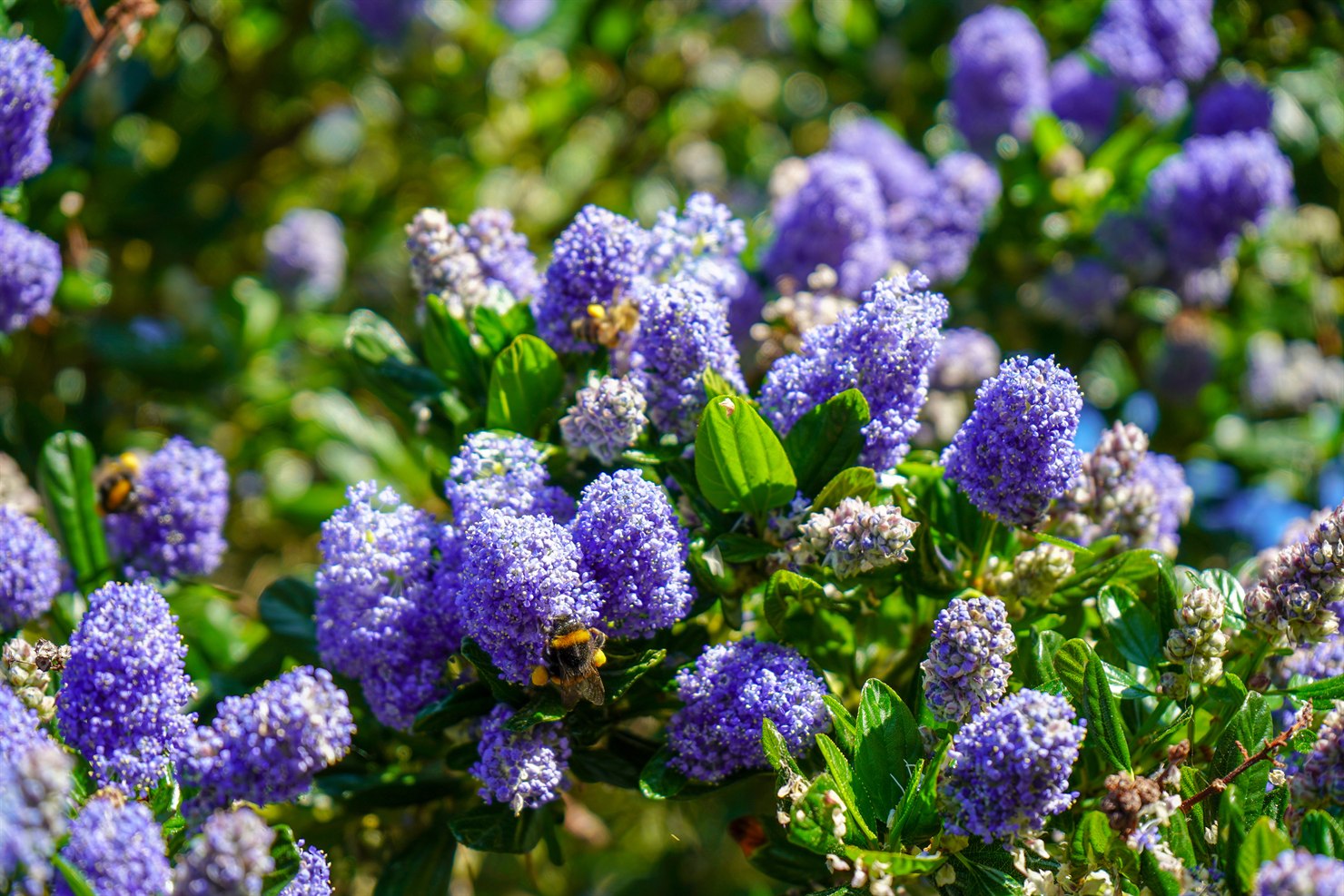
Blueblossom is a large evergreen shrub, sometimes a small single-trunked tree, anywhere from 0.5 to 6 meters tall (roughly 2 to 20 feet), with the form varying dramatically across its range (Schmidt & Wilken, 2016). The leaves are small, glossy, dark green on top and paler beneath, with three prominent veins running from the leaf base and finely toothed margins. The flowers are tiny, five-petaled, and packed into dense elongated clusters two to nine centimeters long; the color runs from pale powder blue through deep blue-violet, with the occasional near-white individual. The fruit that follows is a small three-lobed capsule that dries, splits, and flings its three seeds away from the parent plant.
Now the split that matters. The genus is divided into two subgenera (a rank just below genus, grouping the species that share deep evolutionary structure), and you can learn to read them by hand in a nursery. Subgenus Ceanothus, which includes blueblossom, has thinner leaves usually arranged alternately along the stem (single leaves staggered up the branch), and many of its species can resprout from a woody root crown after a fire. Subgenus Cerastes has thick, leathery, often holly-stiff leaves usually arranged in opposite pairs, with wart-like growths where the leaf meets the stem, and its species reproduce only from seed (Burge et al., 2016; Schmidt & Wilken, 2016). The practical translation: the Ceanothus group tends to be the fast, soft-leaved, showy coastal crowd, and the Cerastes group tends to be the slow, tough, heat-and-clay-tolerant interior crowd. The crosses between the two subgenera are sterile, which is the genus telling you, in its own language, how far apart these two halves really are.
Where It Comes From
Blueblossom runs up the coast from Coos County in southern Oregon down to Santa Barbara County, with a disjunct outpost (an isolated population cut off from the main range by a gap where the plant doesn't grow) near Eréndira in Baja California, almost always within a few miles of the ocean and below about 600 meters of elevation (Schmidt & Wilken, 2016). Its habitat is maritime chaparral (California's coastal drought-adapted shrubland of hard-leaved evergreens), the edges of mixed evergreen forest, and open sandy or rocky slopes. It is a coastal plant that grew up with fog, winter rain, sharp drainage, and bone-dry summers.
The genus as a whole is one of the defining shrubs of chaparral, and a lot of what ceanothus does only makes sense in the context of fire. The seeds are tough-coated and long-lived, banking in the soil for years, in some species reportedly decades, waiting. Many won't germinate until a fire cracks the seed coat with heat. After a burn, a hillside that looked bare erupts in ceanothus seedlings, and the subgenus Ceanothus species also resprout from their surviving root crowns. They are pioneers: first in after disturbance, fast to cover bare ground, and not built to live forever once the slower oaks and manzanitas catch up.
Part of how they pull off that pioneer speed is underground. Ceanothus is actinorhizal, meaning it forms a partnership with Frankia, a filamentous soil bacterium that lives in nodules on the plant's roots and pulls nitrogen straight out of the air, converting it into a form the plant can use (Salgado et al., 2018). Blueblossom specifically partners with a Frankia lineage that researchers have studied closely as a model for the symbiosis (Salgado et al., 2018). In plain terms: a ceanothus makes its own fertilizer, enriches the soil around it, and asks nothing of you on that front. It also explains a recurring garden mistake, which is feeding the thing. Don't. You'll get into why in a moment.
Where People Go Wrong
Here's where it usually goes sideways. Someone falls for the spring bloom at a chain nursery, buys whatever blue shrub is flowering hardest, brings it home to a yard with heavy clay soil and a hot inland summer, plants it in a bed on the same drip line as the roses, and waters it all summer to keep it looking fresh. By the second or third summer the plant yellows, wilts on a hot afternoon despite wet soil, and collapses. The owner concludes ceanothus is finicky. It isn't. It was the wrong plant in the wrong soil getting the wrong care, three mistakes stacked into one dead shrub.
Unstack them and they're simple. Start with the plant. The fast, soft-leaved coastal species and cultivars (the subgenus Ceanothus crowd, blueblossom among them) evolved on sharp coastal drainage and can't tolerate heavy, wet ground that stays soggy. If your soil is clay and your summers are hot, you needed a clay-tolerant selection or a tougher subgenus Cerastes species from the start. Then the water. Established ceanothus and summer irrigation are a bad combination; the warm wet soil is an open invitation to the soil-borne fungi that cause root rot, and the plant's own roots, adapted to a dry summer dormancy, can't cope. And the food: a nitrogen-fixing plant put into fertilized soil grows soft, fast, floppy growth that is more disease-prone and shorter-lived, not healthier.
So before the prettiest plant goes in the cart, look at your own yard honestly. What does your soil do with water in August? How hot does the bed get? Those two answers decide which ceanothus you can grow, and there is one for almost every situation. There is no ceanothus that wants what a lawn wants.
Sun
Full sun, especially near the coast. Six or more hours of direct light gives the densest growth and the heaviest bloom. Inland, where the afternoon turns brutal, blueblossom and most species will take a few hours of light afternoon shade without complaint, and the shade can actually extend the plant's life in a hot garden. The trade is fewer flowers. In deep shade a ceanothus stretches, thins out, and barely blooms. This is a sun plant that tolerates a little shade, not a shade plant that tolerates a little sun.
Water
This is the section that saves the plant, so it gets the most space. Through the first dry season, water a new ceanothus deeply but infrequently, a long slow soak every one to two weeks, enough to wet the full root zone and then let it dry down before the next one. The goal of year one is to coax the roots deep, and frequent shallow watering does the opposite, keeping roots near the surface where summer heat will eventually cook them.
From the second year on, an established ceanothus in the ground wants little to nothing through summer. On the coast, give it none. Inland, in a hot garden, an occasional deep soak once a month in the worst of the heat is the most it should ever get, and many plants do better with even less. The most common way a thriving ceanothus dies in its third or fourth year is a sprinkler system running all summer in the bed where it lives. If it shares a bed with anything thirstier, keep its root zone out of the spray pattern entirely. A drought-adapted chaparral shrub doesn't read summer water as a kindness. It reads it as rot.
Soil
Drainage first, drainage second, nutrition never. Ceanothus evolved on lean, fast-draining ground: sandy flats, rocky slopes, decomposed granite, and in a number of species serpentine, the harsh magnesium-rich soils (derived from serpentine rock) that poison many plants and that several ceanothus tolerate easily. What they share is that water moves through them and doesn't sit.
If your soil is sand or loam that drains, you can grow nearly anything in the genus. If your soil is heavy clay that stays wet after rain, you have two honest options. Choose a selection bred or selected for clay tolerance ('Ray Hartman' and 'Concha', covered in the sourcing section below, are the usual recommendations), or change the geometry by planting on a slope or on a raised mound so water drains away from the crown. What you should not do is dig a hole in flat clay, backfill with potting soil, and drop a coastal ceanothus in. You will have built a bucket, and the plant will drown in slow motion. And in every soil type, skip the compost and the fertilizer in the planting hole. The plant brings its own nitrogen and performs worse in rich ground.
Hardiness
Blueblossom is reliable in USDA (United States Department of Agriculture) hardiness zones 8 through 10, taking temperatures down to roughly 15 °F (about −9 °C). The genus overall spreads across zones 7 to 10 depending on the species, with some montane species (those native to the mountains, at higher elevation) considerably hardier and many of the coastal species more tender. Across cismontane California (the part of the state on the ocean side of the major mountain ranges, where the climate is mildest) cold is rarely the limiting factor. Drainage and summer water decide whether a ceanothus lives, far more often than winter cold does.
One Honest Caveat: Plan for a Decade, Not a Lifetime
Most of the trees and shrubs you plant are an investment in decades. Ceanothus is different, and pretending otherwise sets you up to take its eventual decline personally.
These are fast-living pioneer plants. In the wild they colonize burned and disturbed ground, grow hard, seed heavily, and get crowded out as the slower chaparral matures around them. In a garden, even a perfectly sited, never-overwatered ceanothus commonly lives somewhere in the range of eight to fifteen years, with some individuals and some of the tougher species pushing past twenty. The fast, showy coastal cultivars tend toward the shorter end of that. You didn't do anything wrong. This is just how the plant is built.
So plant it the way it lives. Give it a decade of the best blue in the garden, let it feed the soil and the bees while it's here, and have the next one in the ground or in mind before the first one starts to thin and open up at the base. Treat ceanothus as a renewable burst of color and you'll stay happy with it. Expect an heirloom shrub and you'll be disappointed by a plant that was never trying to be one.
Sourcing and Planting Window
Plant in fall through early winter. Getting a ceanothus in the ground before the rains means the root system establishes through the wet season and is ready to face its first dry summer with depth already built. Spring planting can work with careful year-one watering, but fall is markedly better.
Buy from a source that knows what it's selling. Local California Native Plant Society (CNPS) chapter sales are ideal; in the Bay Area that means the Santa Clara Valley, East Bay, and Yerba Buena chapters, where the volunteers can tell you which species actually suits your conditions. California-native specialty nurseries are the next best stop. The genus hybridizes so freely that there are over 200 named garden selections, and a few are worth knowing by name. 'Ray Hartman' is a large, fast, tree-like hybrid (C. arboreus × C. griseus) reaching around 20 feet, unusually tolerant of clay and of a little more water than most, and the default recommendation for a big blue specimen in a tougher garden. 'Concha' is a denser 8-foot shrub with deep blue flowers and red-tinged buds that also takes clay and occasional summer water more forgivingly than the coastal species. 'Julia Phelps' is a smaller, very drought-tough selection with intense dark-indigo flowers for lean, well-drained sites.
Whatever the label says, match the plant to your soil and your summer heat rather than to the flower color. Ask the nursery what subgenus or parent species a selection comes from and how it handles clay; a native-plant nursery will know, and the answer tells you more about whether the plant will live than anything on the tag.
Pollinator and Wildlife Note
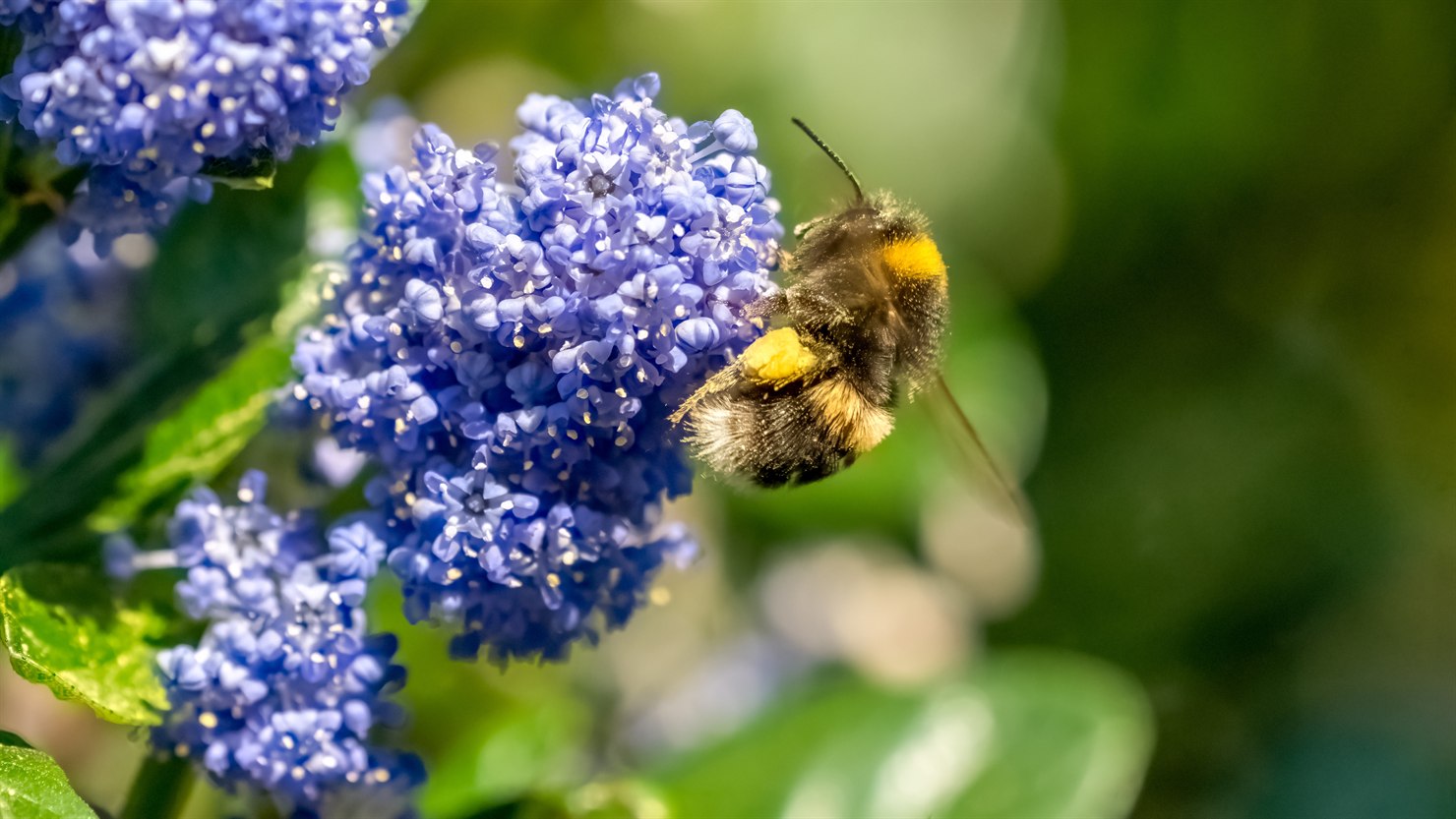
The bee cloud is not an exaggeration. A ceanothus in full bloom is one of the loudest plants in the spring garden, working honeybees, native bees, hoverflies, and beetles through a flush of nectar and pollen at a time of year when not much else is open. It is one of the more valuable early-season nectar sources you can put in a California garden.
The flowers are only half of it. Ceanothus is a larval host plant, meaning a plant whose leaves caterpillars eat, for a notable list of native butterflies, including the California tortoiseshell (famous for occasional population booms so large the migrating adults are reported as clouds), the pale swallowtail, the spring azure, the hedgerow hairstreak, and the Pacuvius duskywing (Bornstein et al., 2005). The seeds feed quail and other ground-foraging birds, and the foliage is browsed by deer, which is the one place the wildlife value cuts against the gardener: in deer country, young ceanothus often needs protection until it's tall enough to take the grazing. And then there's the nitrogen, which the plant shares with its neighbors through the soil as its root nodules turn over. A ceanothus is feeding the pollinators above ground and the plant community below it at the same time. For a shrub that asks for nothing but sun, sharp drainage, and a hose left in the garage, it gives back more than almost anything else you can plant.
Quick Reference
- Sun: Full sun on the coast; light afternoon shade tolerated inland. More sun means more bloom.
- Water: Year 1, a deep soak every 1–2 weeks through the dry season. Established plants want little to none, and going easy on summer water matters more than anything else.
- Soil: Fast drainage is non-negotiable. Happy in lean, rocky, sandy, or serpentine ground. Most species rot in wet clay; pick a clay-tolerant selection ('Ray Hartman', 'Concha') if your soil holds water.
- Hardiness: Blueblossom USDA zones 8–10 (hardy to about 15 °F). The genus as a whole spans zones 7–10 depending on species.
- Bloom: Clouds of tiny blue (occasionally white) flowers. Blueblossom peaks March through June.
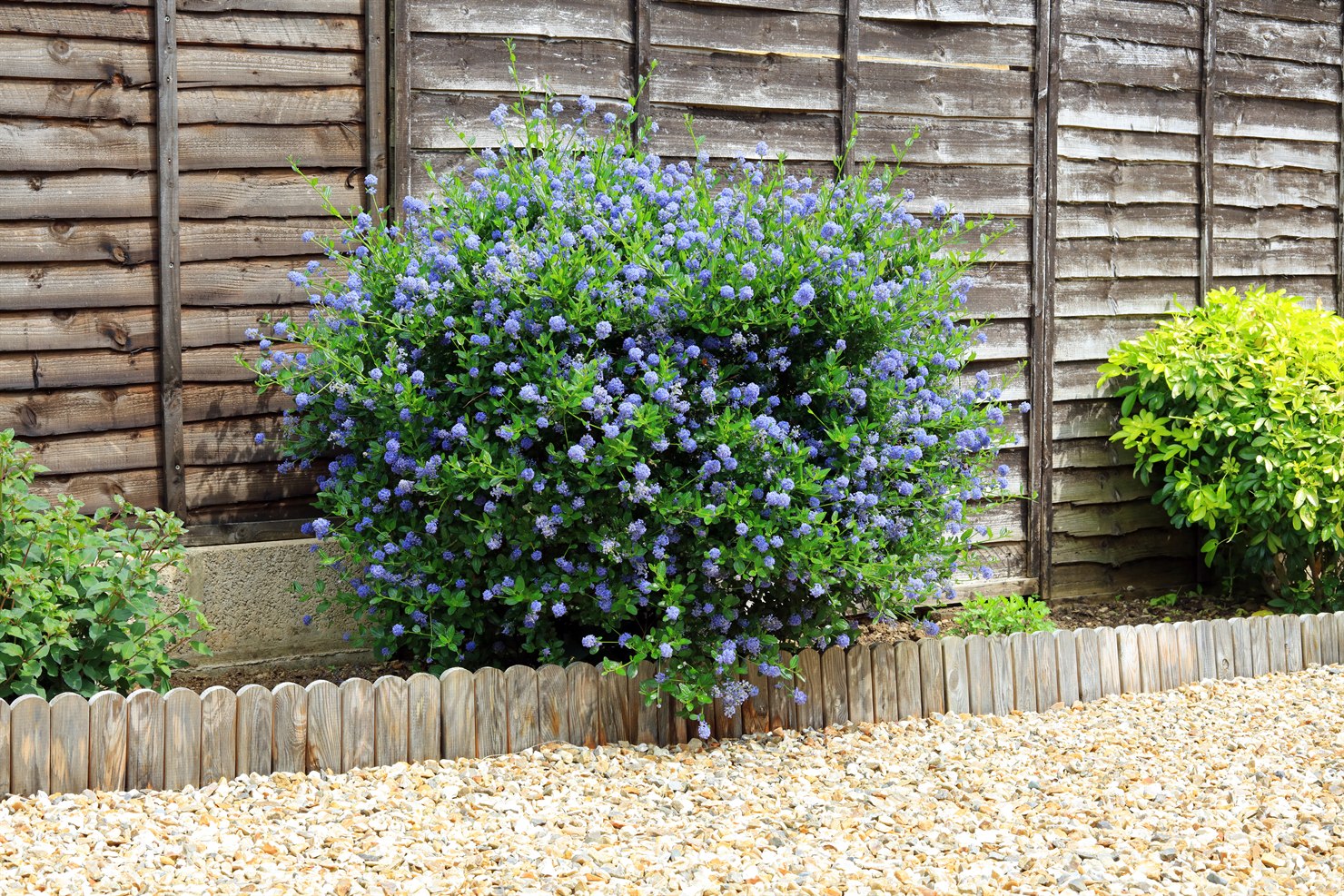
- Size: Blueblossom ranges from a 2 ft groundcover to a 20 ft small tree depending on the form. Garden cultivars run 6–20 ft.
- Lifespan: Short-lived by design. Many garden ceanothus live 8 to 15 years, some past 20. Plan for it rather than fight it.
- Nitrogen: Actinorhizal: fixes its own nitrogen through Frankia bacteria in its roots. Never fertilize.
- Plant in: Fall through early winter, before the first dry summer.
- Source from: Local California Native Plant Society chapter sales; California-native specialty nurseries. Match the species to your soil and climate, not to the bluest label on the bench.
- What to avoid: Summer irrigation on established plants; rich soil and fertilizer; planting a fast coastal type in hot inland clay; tucking it into a lawn-watered bed.
The Takeaway
Ceanothus is the plant that sells itself. Nobody walks past one in April. The trick is everything that happens after you get it home. Read your own yard first: if your soil drains and your summers are dry, almost any blueblossom or coastal cultivar will give you a decade of blue. If your soil is heavy clay or your summers are hot and inland, skip the fast coastal types the chain nursery is pushing and ask for a clay-tolerant selection or a tougher subgenus Cerastes species. Plant it in fall, water it through one dry season to get the roots down, then walk away and leave the hose coiled. Don't feed it; it makes its own nitrogen. And when it bows out at fifteen instead of fifty, that's not failure. It's a fast-living chaparral pioneer doing exactly what it evolved to do. Plant the next one before the first one goes.
Sources
Bornstein, C., Fross, D., & O'Brien, B. (2005). California native plants for the garden. Cachuma Press.
Burge, D. O., Zhukovsky, K., & Wilken, D. H. (2016). A taxonomic conspectus of Ceanothus subgenus Cerastes (Rhamnaceae). Systematic Botany, 40(4), 950–961. https://doi.org/10.1600/036364415X689997
California Native Plant Society. (n.d.). Ceanothus thyrsiflorus (Blueblossom Ceanothus). Calscape. Retrieved June 9, 2026, from https://www.calscape.org/Ceanothus-thyrsiflorus-(Blueblossom-Ceanothus)
Salgado, M. G., van Velzen, R., Nguyen, T. V., Battenberg, K., Berry, A. M., Lundin, D., & Pawlowski, K. (2018). Comparative analysis of the nodule transcriptomes of Ceanothus thyrsiflorus (Rhamnaceae, Rosales) and Datisca glomerata (Datiscaceae, Cucurbitales). Frontiers in Plant Science, 9, 1629. https://doi.org/10.3389/fpls.2018.01629
Schmidt, C. L., & Wilken, D. H. (2016). Ceanothus. In Flora of North America Editorial Committee (Eds.), Flora of North America North of Mexico (Vol. 12, pp. 77, 90). Oxford University Press. https://floranorthamerica.org/Ceanothus_thyrsiflorus