Most "perfectly good" potting mix is bad at the job it's being sold for. Once you understand what a root is actually asking for, you can rescue most struggling houseplants in ten minutes at the garden center.
The mistake almost every Apprentice makes, and most experienced Growers eventually correct, is assuming a bag labeled "potting soil" is engineered for the plants in their home. It rarely is. The bag is engineered to ship cheap, sit on a shelf for two years, and look right when poured. None of those goals overlap with what a Calathea wants to live in.
This is the foundation entry of the Substrate Library. Once you have the root-zone framework, every other entry (pumice, perlite, coir, bark, mineral blends) is a question of ratio rather than mystery.
A Pot Is Not a Piece of Ground
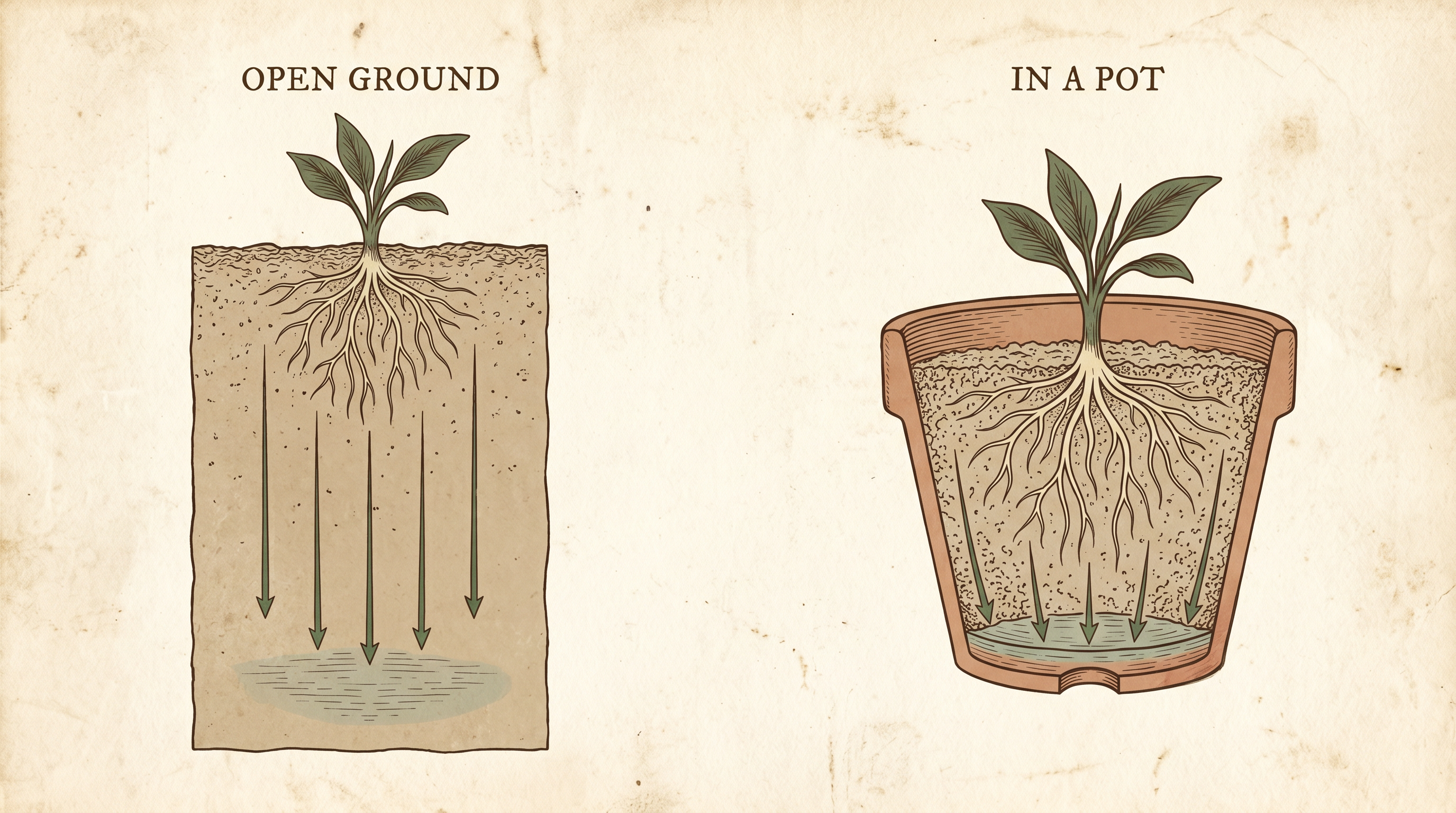
The first weird fact: a pot behaves nothing like actual ground.
In a garden bed, gravity pulls water straight down through miles of soil. Roots chase moisture downward; air stays in the upper layer where everyone can breathe. The system is forgiving because it's effectively bottomless.
A pot has a floor. Water drains until it can't, then sits in the bottom because surface tension holds it there. The horticultural term for this is the perched water table, and it's been documented in the container-substrate literature for decades (Argo, 1998, HortTechnology). Anything growing in that bottom zone is sitting in a shallow puddle every time you water. That puddle is where overwatering kills plants, and it's not the water that does the killing. It's the absence of oxygen in the saturated zone.
This is why two people with the same plant, the same watering can, and the same routine can have wildly different outcomes. One has a substrate that stays airy when wet. The other doesn't. The plant isn't mysterious. The pot is.
The most common cause of root rot the Guild sees in member-submitted photos is not overwatering. It's substrate compaction. The owner waters on a reasonable schedule. The substrate just no longer has air pockets to support oxygen exchange. The fix is rarely "water less." It's usually "repot in something with structure."
What a Root Is Actually Asking For
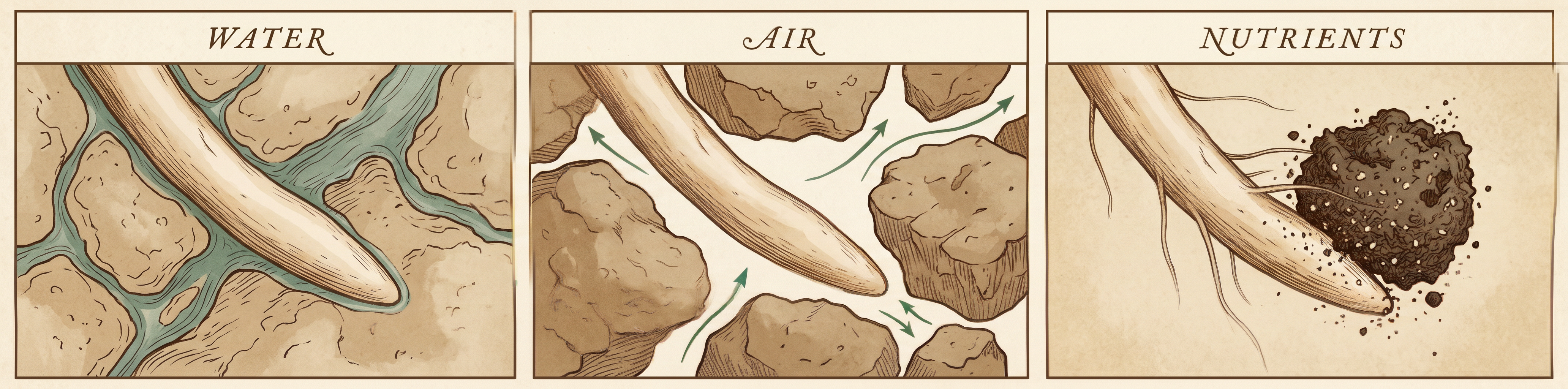
Roots want three things.
Water. Specifically, water clinging to particle surfaces (capillary water). Not the water sitting in a puddle at the bottom. That puddle is hostile.
Air. Roots respire, taking in oxygen and releasing CO₂. When substrate is wet or dense enough that air can't move through the gaps, roots suffocate within hours. Rot isn't caused by water. It's caused by the bacterial bloom that follows suffocation (Yamauchi et al., 2018, Plant Physiology; for the working physics, see our Substrate Primer).
Nutrients. Delivered slowly, retained between waterings. Some substrates hold fertilizer like a sponge (peat, coir). Others let it wash straight through (pure perlite, pumice). A plant in rich, compost-heavy mix can go months between feedings; a plant in pure minerals needs fertilizer in most waterings.
A good substrate balances all three. Most bad ones solve for one at the expense of another, usually water retention at the cost of air.
The Four Kinds of Bagged Substrate
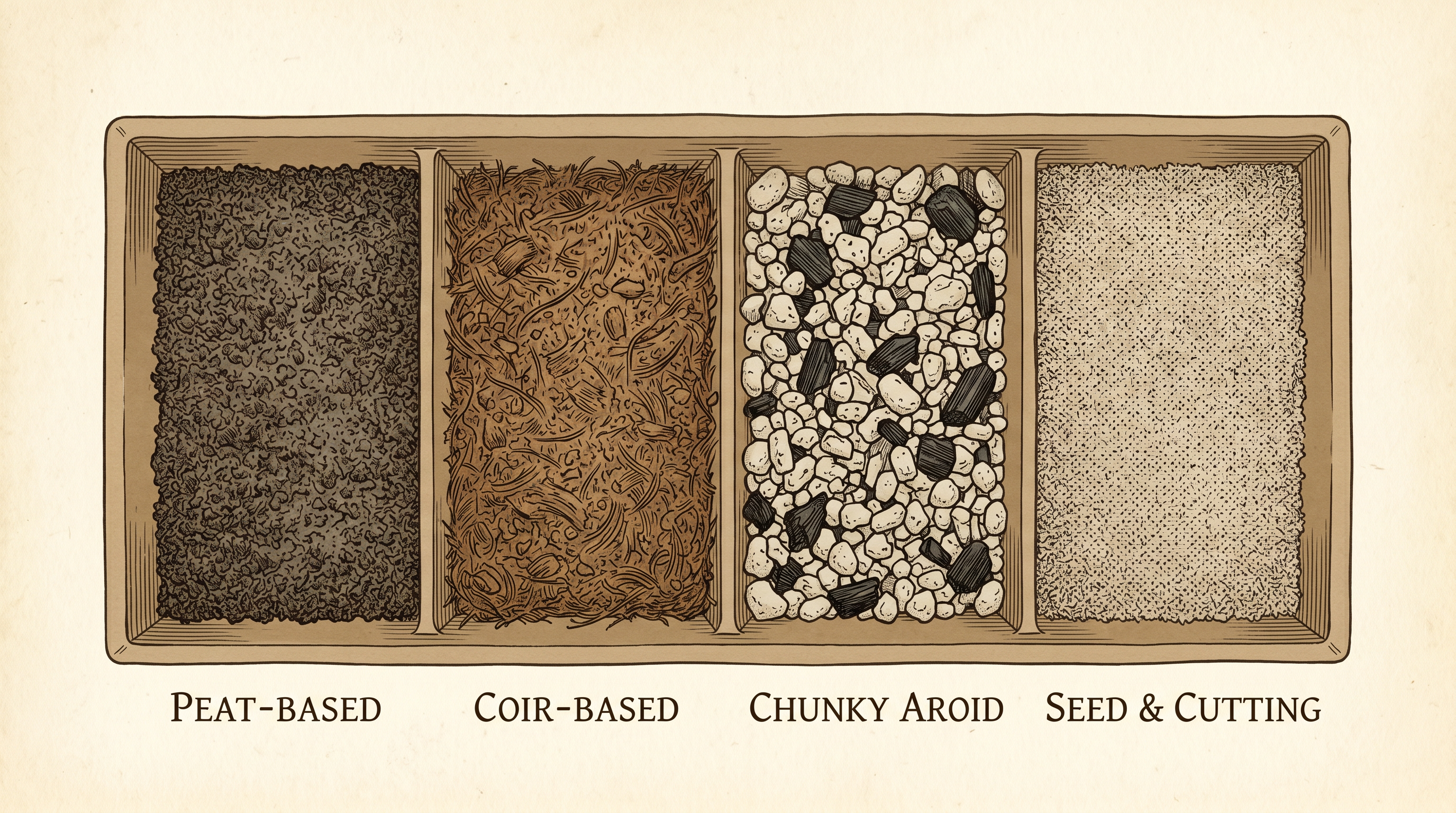
Most garden centers stock four types. Here's what's in each bag and where each one fails.
| Category | Composition | Strong at | Common failure mode |
|---|---|---|---|
| "All-purpose" potting soil | Peat, bark fines, modest perlite | Cheap; passable for outdoor seasonal containers | Compacts indoors within 6 months. Holds too much water. Dries to a brick that hydrophobes water. |
| Cactus & succulent mix | Sand, perlite, small fraction peat | Drains fast. Right for cacti, agaves, most succulents. | Dries too fast for tropicals. Low cation exchange capacity, so fertilizer washes out. |
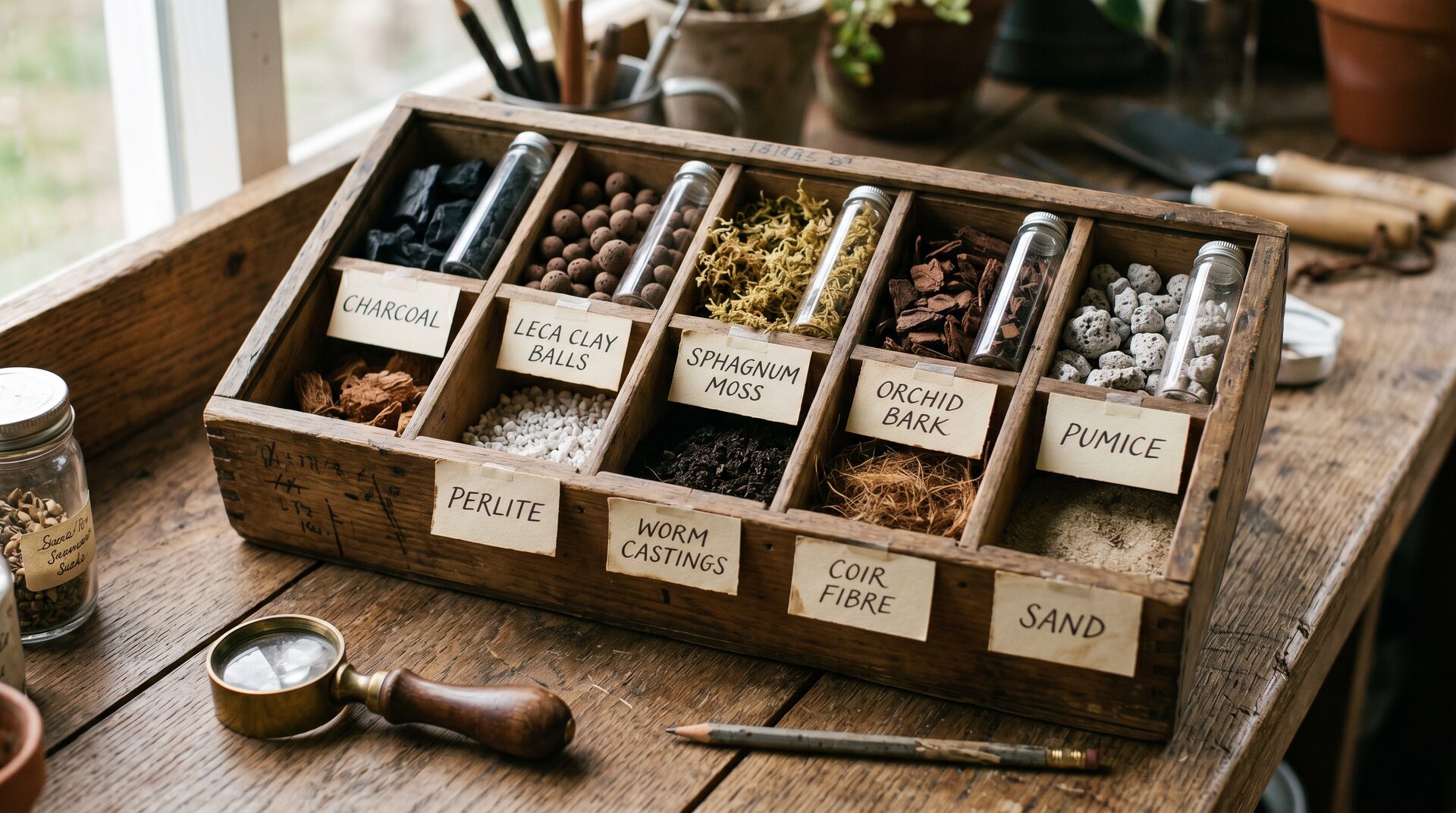
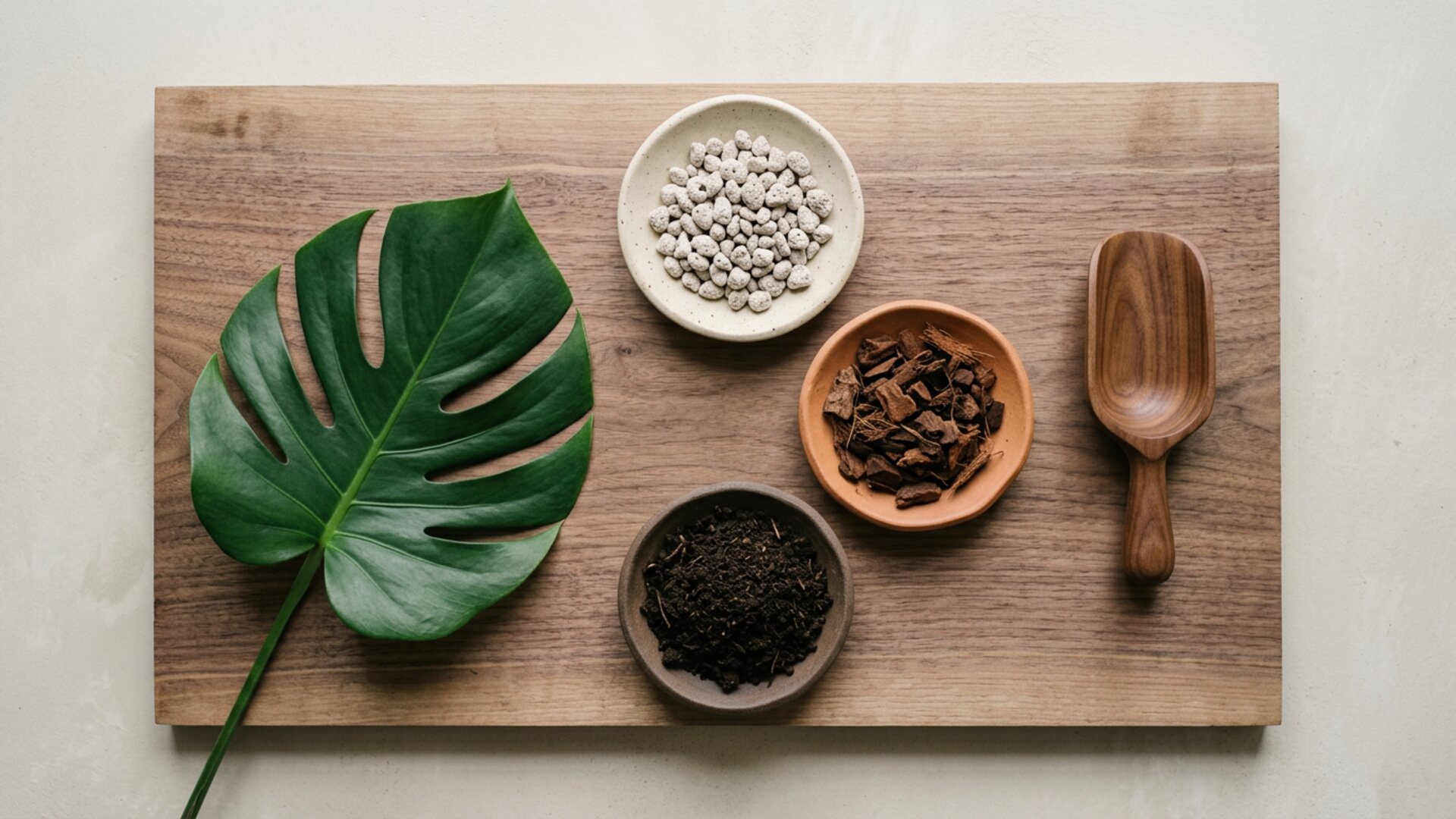
| Aroid / chunky mix | Bark, perlite, coco chips, sometimes charcoal | Excellent air-filled porosity. The standard for Monstera, Philodendron, Anthurium, most aroids. | Pricier. Dries quickly. Low nutrient retention, so it needs consistent feeding. |
| Seed-starting mix | Peat, vermiculite, fine bark | Gentle on emerging seedlings. | Particles too fine for mature roots. Compacts. Holds moisture against the stem and risks damping-off. |
The most common Apprentice error is buying "all-purpose potting soil" for a houseplant that would be much happier in a chunky mix. Pothos, philodendrons, monsteras, peperomias, snake plants, ZZ plants, hoyas, most aroids. All of them prefer chunky over dense and peaty. The bag will not tell you this (Missouri Botanical Garden Plant Finder, per species).
Updated August 2026. This callout used to say that gravel at the bottom of a pot pools water above the rocks and lifts the wet zone into your roots. That's the common argument, and the first study to measure it in real flowerpots found the opposite: drainage layers usually reduced the water a container held, and never increased it (Rowe, 2025). A pot with an open hole is already substrate over air, which is the strongest pore-size contrast available, so gravel weakens it rather than adding to it. The advice doesn't change. A drainage layer still isn't worth adding, because it spends root volume on a small and unreliable gain. The actual lever is particle size throughout the substrate: chunkier mix, bigger air pockets, shallower wet zone. Fill the pot with one uniform mix, top to bottom. Full detail in Myths Demystified No. 02.
The Ten-Minute Fix
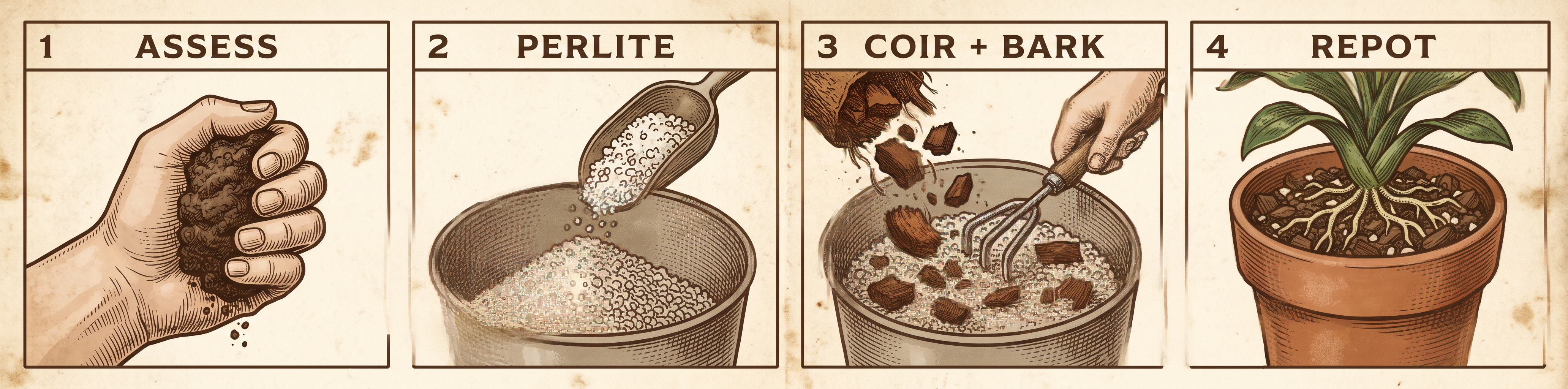
Most underperforming houseplants can be rescued by upgrading the substrate. Here's the cheapest reliable recipe, made from ingredients sold at any garden center.
Recipe · Foundation Houseplant Mix
The Generic Better Mix
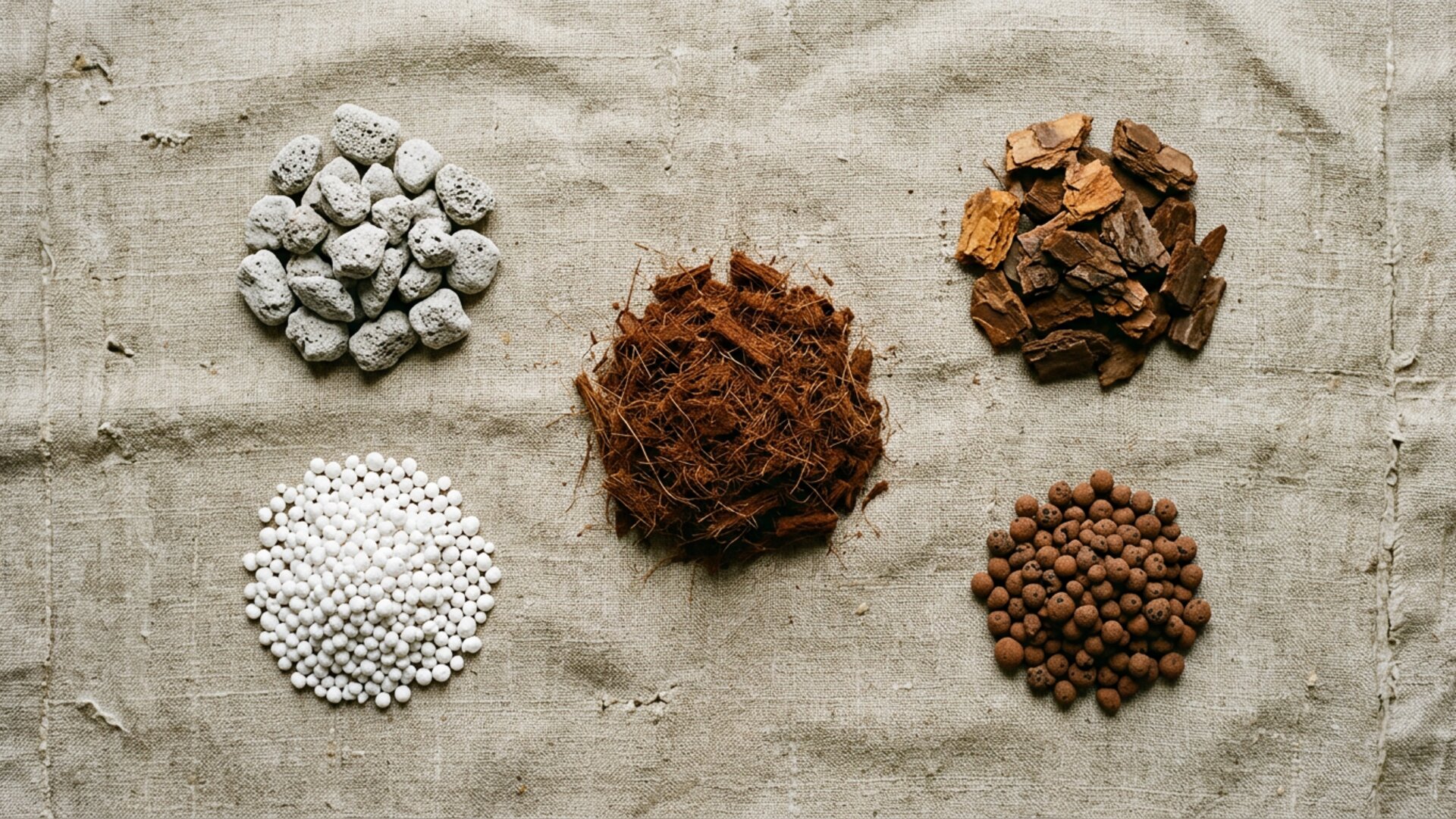
- 3 parts coarse perlite (the chunky grade, not the fine dust)
- 2 parts coco coir or quality potting soil
- 1 part orchid bark or horticultural charcoal
That's the whole recipe. Mix in a bucket. Pot. Water when the top inch is dry. Fertilize at half strength every other watering. It outperforms most bagged mixes for most houseplants. It won't be optimal for everything (a moisture-loving Calathea wants less perlite, a string-of-hearts wants more), but it's a safer starting place than the default bag and a better baseline to tune from.
You don't need a measuring cup. Handfuls work. Three handfuls perlite, two handfuls coir, one handful bark. The ratio matters more than the precision. The Guild has yet to repot a plant where measuring to the milliliter changed the outcome.
A Thirty-Second Diagnostic
If a plant is struggling, check the substrate before blaming anything else. This takes less than a minute.
- Stick a finger two inches into the pot. Is it still wet 48 hours after watering? Substrate is too dense. Repot in something chunkier.
- Is there a white crust on the soil surface? Mineral buildup from tap water. Flush thoroughly with plain water two or three times.
- Smell the substrate. Sour, swampy, mushroomy? Anaerobic. Repot immediately and back off the watering schedule.
- Lift the pot a week after watering. Does it weigh roughly the same as just after watering? Substrate is not drying. Either the pot is oversized or the mix holds too much water.
- Roots circling the inside of the pot with nothing in the middle? Substrate at the center has gone anaerobic. Oxygen only reaches the pot walls.
Most "why is my plant dying?" questions resolve here. The remainder are typically light, pest, or fertilizer problems, not substrate.
When to Repot, and When Not To
If the diagnostic points at substrate, don't wait. Repotting into something with proper structure is the single highest-leverage intervention for a struggling houseplant. Timing notes:
- Best window: spring through early summer, while the plant is actively growing. Warm temperatures and longer days mean fast root recovery.
- Acceptable any time: if the substrate is the problem (anaerobic, root rot, compaction). The plant will recover more slowly in winter, but waiting makes it worse.
- Don't repot just because: the plant is "due." Healthy plants in mixes that still drain well don't need repotting on a calendar. Check the substrate, not the date.
Going Deeper
If you want the bench-notes version of why all of this works the way it does, the Substrate Library has dedicated entries on each ingredient (pumice, perlite, coir, bark, charcoal, mineral blends) and on the science underneath: air-filled porosity, cation exchange capacity, the tap water problem, designing a mix backwards from what the plant is asking for.
Continue · The Substrate Library
The Substrate Library
Three deeper entries that pick up where this one ends:
- How Substrate Actually Works: air-filled porosity, capillary water, the physics
- The Aroid Ingredient Glossary: every ingredient that might go in a chunky mix, and why
- Designing a Mix: working backwards from what the plant needs to the recipe
The One Thing to Remember
When a houseplant is struggling and you've ruled out light and water and pests, the answer is almost always the substrate. You don't have to become a soil scientist to fix it. Buy a better mix, or build one from three ingredients, and watch what happens.
Your plant is not mysterious. The substrate just isn't giving it what it's asking for.
Rowe, A. (2025). Effect of drainage layers on water retention of potting media in containers. PLOS ONE, 20(2), e0318716. https://journals.plos.org/plosone/article?id=10.1371/journal.pone.0318716
Argo, W. R. (1998). Root medium physical properties. HortTechnology, 8(4), 481–485. https://journals.ashs.org/horttech/view/journals/horttech/8/4/article-p481.xml
Bilderback, T. E., Warren, S. L., Owen, J. S., & Albano, J. P. (2005). Healthy substrates need physicals too! HortTechnology, 15(4), 747–751.
Yamauchi, T., Colmer, T. D., Pedersen, O., & Nakazono, M. (2018). Regulation of root traits for internal aeration and tolerance to soil waterlogging-flooding stress. Plant Physiology, 176(2), 1118–1130. https://academic.oup.com/plphys/article/176/2/1118/6117062
University of Nebraska–Lincoln Extension. (n.d.). The hard truth about rocks at the bottom of planting containers. https://extension.unl.edu/statewide/stanton/the-hard-truth-about-rocks-at-the-bottom-of-planting-containers/
Missouri Botanical Garden. (n.d.). Plant Finder. https://www.missouribotanicalgarden.org/plantfinder/plantfindersearch.aspx