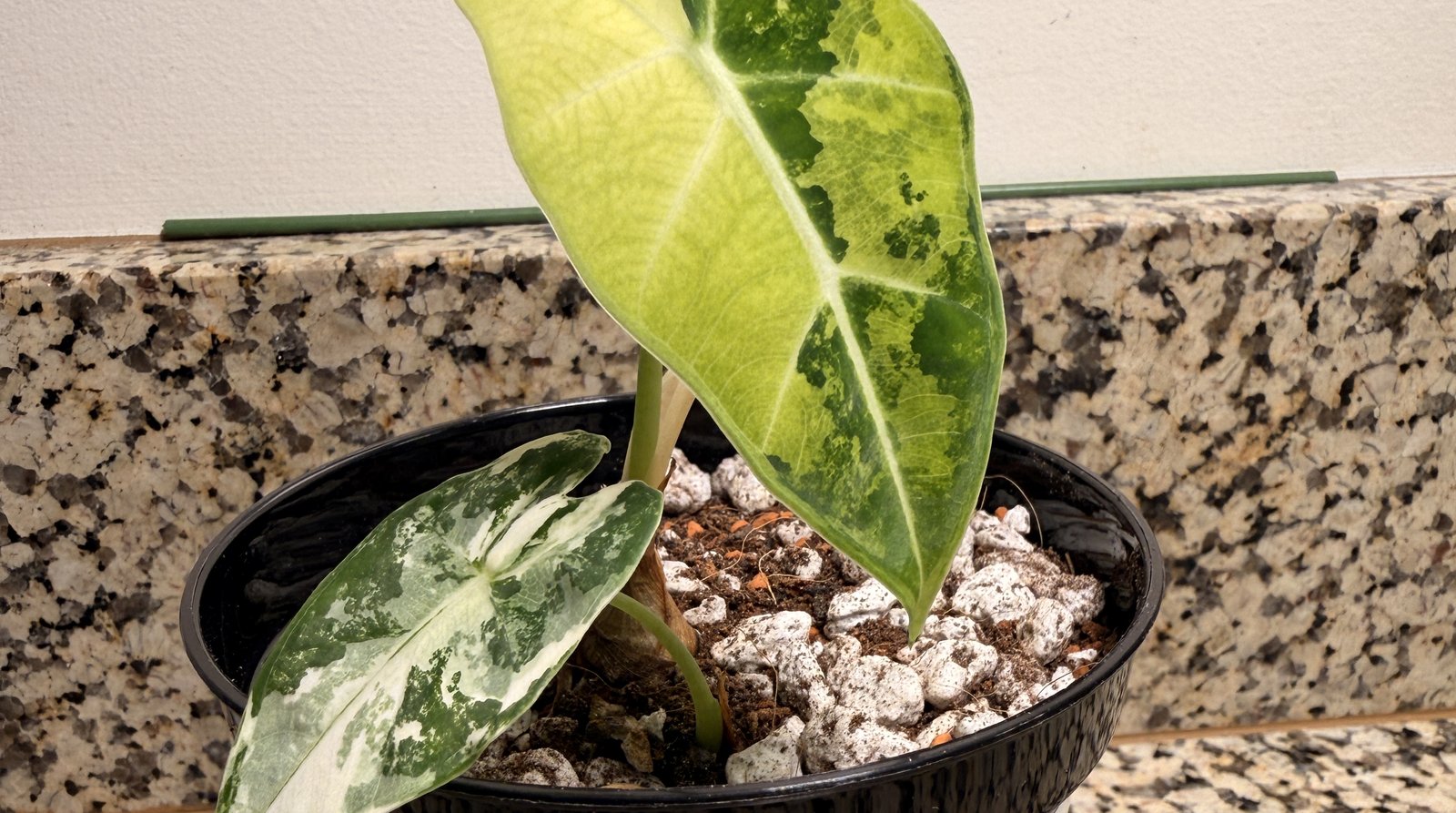
Thirty percent coir, the rest mostly pumice, perlite and calcined clay, and no bark. It's the mix we pot our Alocasia into. It has more coir than our other mineral mixes because the one study we found on Alocasia and water favored steady moisture. It still drains, because at the study's wettest setting, root distribution was restricted in the waterlogged bottom of the pot.
We haven't run a controlled trial of this recipe. We've potted a dozen of our own Alocasia into it, most of them more than a month ago, and they're doing well. That's what we've seen on our shelves, not a test against another mix, so everything below says which parts rest on published research and which are simply how we do it.
The Recipe
All percentages by volume. For a 10-cup (about 2.4 L) batch:
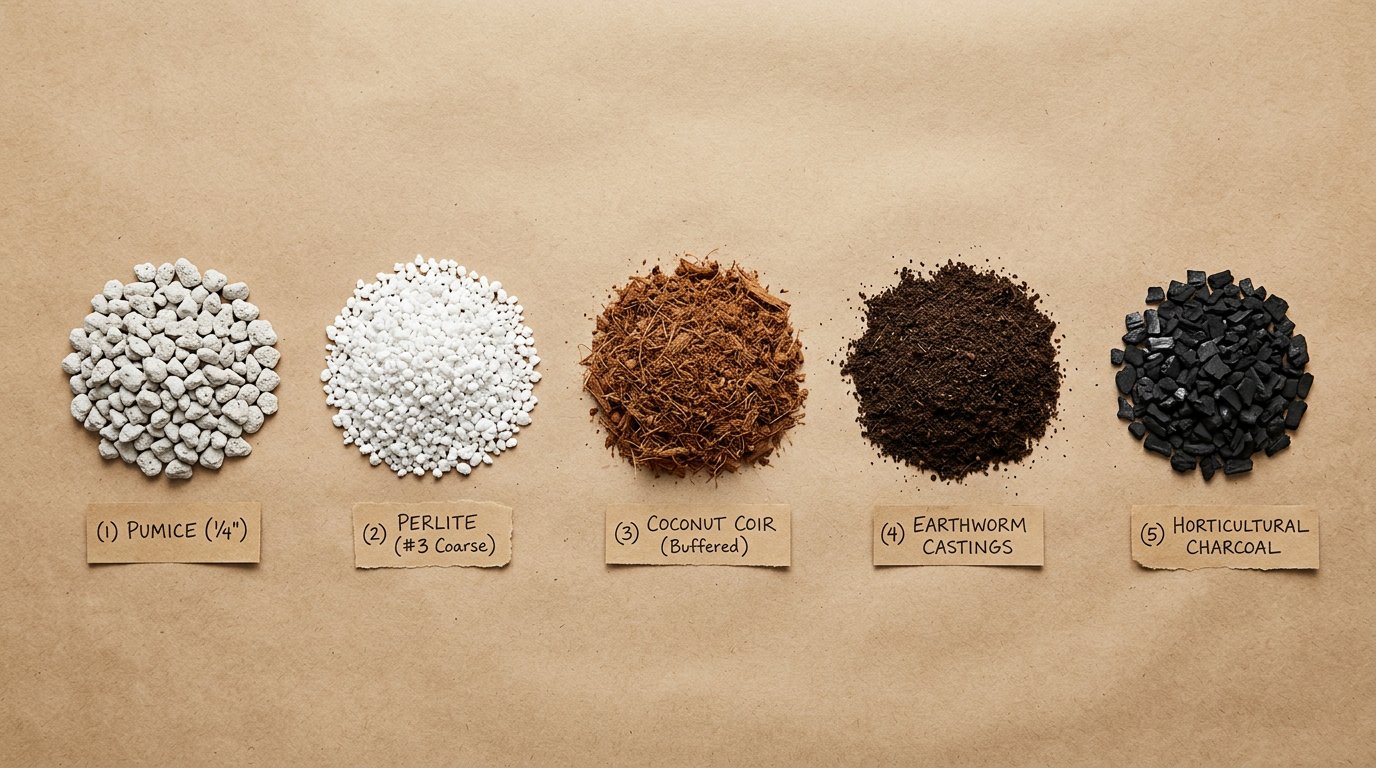
| Ingredient | Percentage | Cups | Grade / Particle Size |
|---|---|---|---|
| Buffered coir | 30% | 3.0 | Medium pith |
| Pumice | 27% | 2.7 | 6 mm (1/4 inch) |
| Perlite (coarse) | 15% | 1.5 | #3 grade |
| Calcined clay | 10% | 1.0 | Turface MVP |
| Pumice | 8% | 0.8 | 3 mm (1/8 inch), dust screened out |
| Earthworm castings | 7% | 0.7 | Sifted |
| Biochar | 3% | 0.3 | 3 to 6 mm (1/8 to 1/4 inch) |
Then add horticultural gypsum (calcium sulfate dihydrate), the powder sold as a soil amendment, at 1 teaspoon per gallon of finished mix, about two-thirds of a teaspoon for this 10-cup batch. That's 63% mineral and 37% organic (coir and castings). As on our other recipe pages, we count the biochar with the minerals. The proportions are our own formulation, not figures from a study.
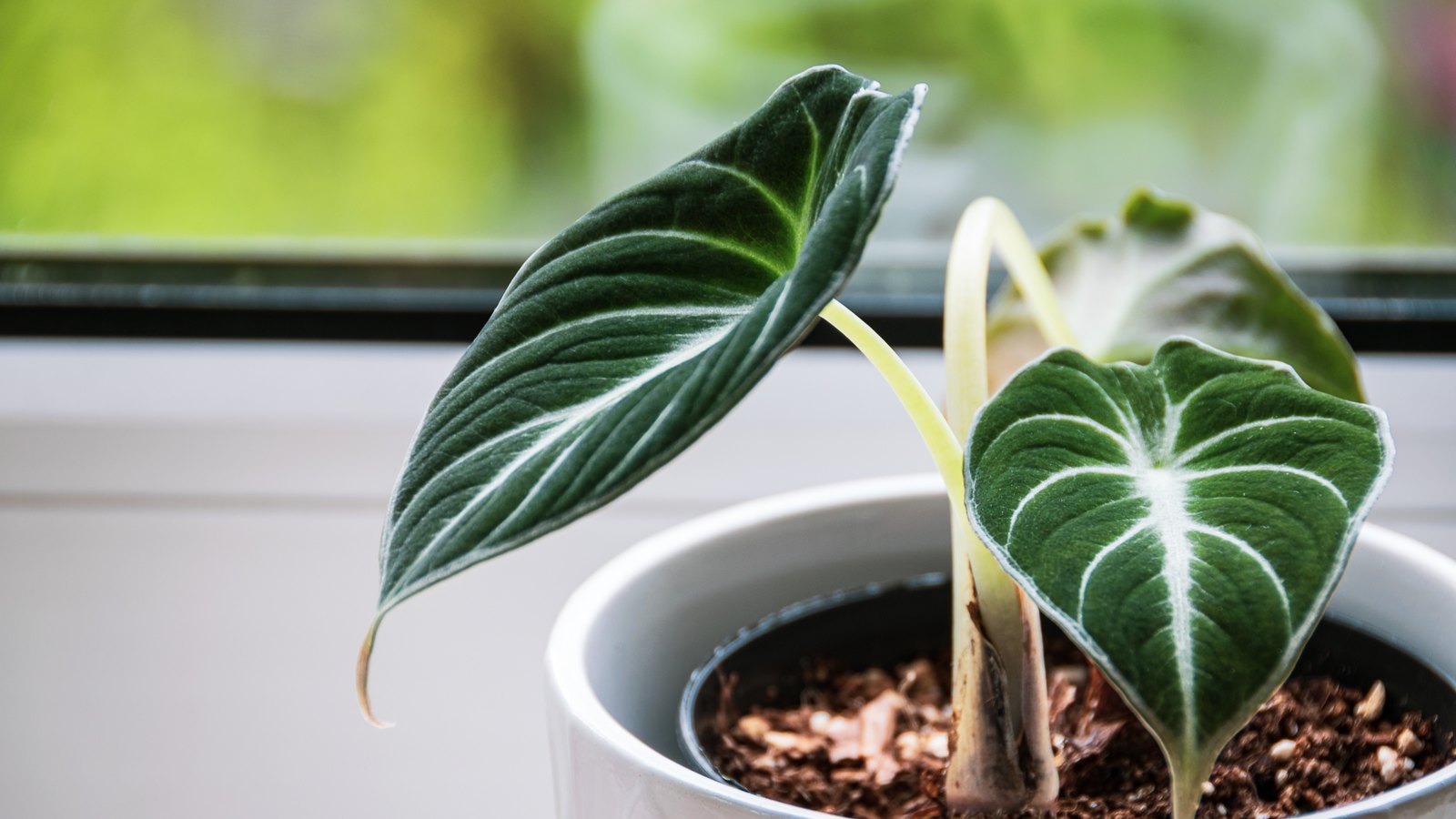
For jewel-type Alocasia such as 'Black Velvet' and 'Dragon Scale', we swap 5% of the coir for more of the fine pumice. That's our own practice.
Target pH: 5.8 to 6.4.
Target runoff EC (electrical conductivity), once you're feeding: 1.5 to 2.5 mS/cm (millisiemens per centimeter) by the pour-through test. See How to Use It.
Why This Recipe
Why it holds more water
The controlled evidence on Alocasia and potting mix is thin. The one study we found is a greenhouse trial on Alocasia 'Bambino' grown from tissue culture (lab-propagated plantlets), in 1.4-liter pots of equal parts peat and perlite (Hsieh & Yeh, 2025). It compared four moisture treatments, measured as volumetric water content (the share of the mix's volume taken up by water). Three held the mix at a set level, and one cycled it between dry and wet. New leaves, leaf area, dry weight and photosynthesis were all highest in the wettest treatment and lowest in the driest. Plants kept evenly moist also grew more than plants cycled between dry and wet. The authors took that as a sign the plant prefers "consistently moist conditions over periodic watering" (Hsieh & Yeh, 2025).
The same study had a catch. In the wettest treatment, where the pots stood in a few centimeters of water, root distribution was restricted in the waterlogged lower layer of the mix. The authors took that as a sign the plant doesn't tolerate prolonged flooding (Hsieh & Yeh, 2025). They also note that some commercial growers favor distinct dry and wet cycles for Alocasia and avoid heavy watering to prevent root rot. One Alocasia propagator's advice sits between the two: "Keep media moist. Avoid constant media saturation" (Oglesby Plants International, n.d.).
So we give this mix more coir than Standard Mineral Mix, which is 20% coir, and still build most of it from coarse minerals. One study on one cultivar in a different mix is a direction to lean, not a recipe, and the 30% figure is our call.
Buffered coir (30%)
We count on the coir for most of this mix's water holding, and we buy it buffered. Unbuffered coir can take up calcium and magnesium from the first feedings, especially with reverse-osmosis water, which carries none. One processing method soaks the coir in a calcium and magnesium solution to prevent that (Malík & Tlustoš, 2025). Peat stays out of our houseplant mixes, by preference. The Ingredient Glossary covers what to look for in a bag.
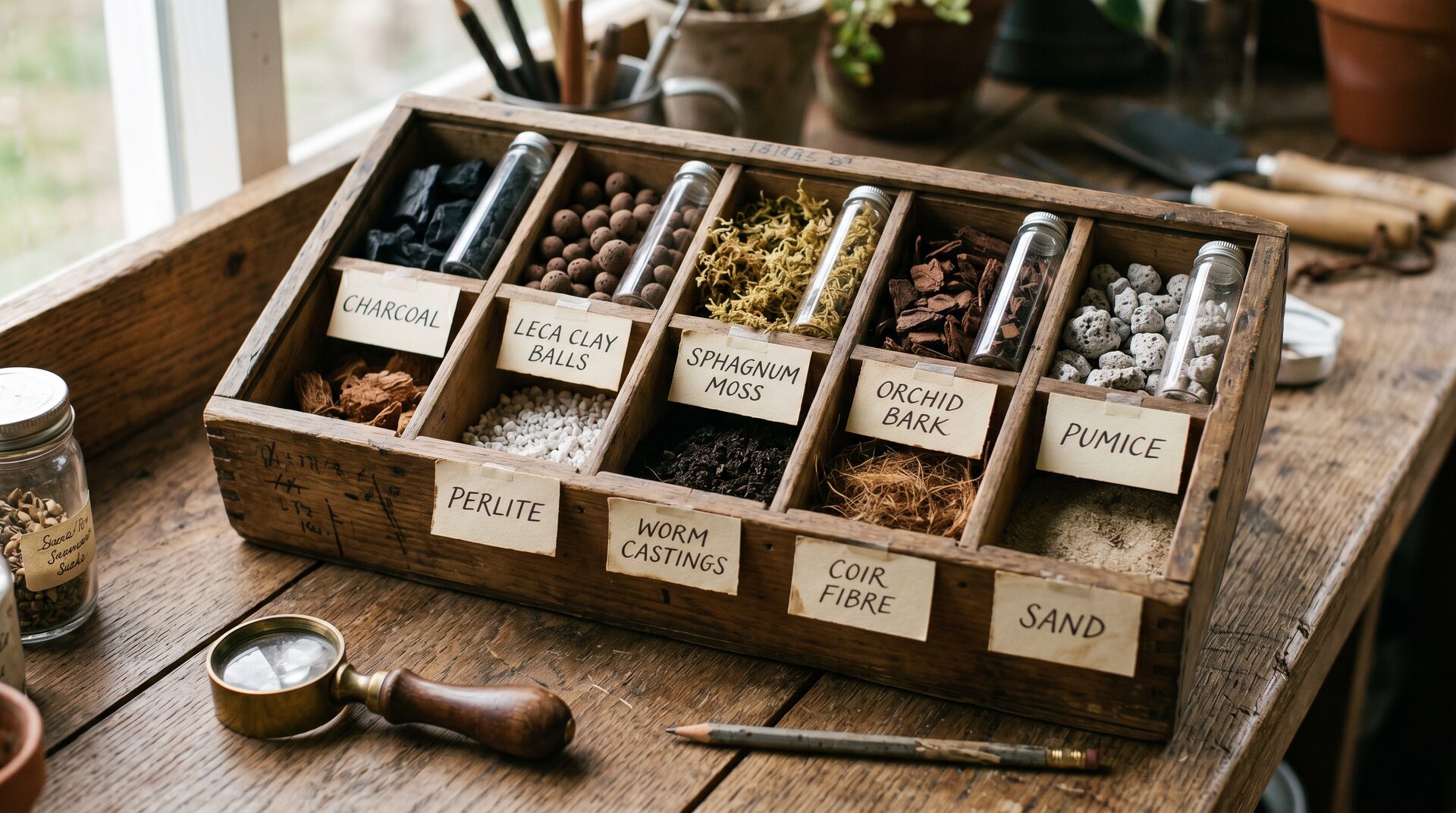
Pumice and perlite (50%)
Minerals such as pumice, perlite and calcined clay don't decompose, or break down only slowly. Mixing them with organic ingredients can slow the changes a mix goes through as it ages (Bilderback et al., 2005). That doesn't make a mix permanent. In a nursery study of Douglas fir bark mixed with pumice, air space (the share of the pot that holds air once it drains) fell over time, and growing plants tended to make it fall further. The authors concluded that air space falls as roots fill the pores (Altland et al., 2011). The two pumice grades are our choice: the quarter-inch grade for most of the structure, and the eighth-inch grade, with the dust screened out, to fill in between. The substrate primer explains air space in more detail.
Calcined clay (10%)
Industrial clay aggregates such as calcined clay are mined, screened and heat-treated into uniform granules (Bilderback et al., 2007). Some of what they do in a potting mix is settled, and some isn't.
It's durable. Clay amendments are useful potting-mix components that break down little over time (Bilderback et al., 2007), and the maker's specification allows particle loss of no more than 4% over 20 years (Profile Products, 2017a). It holds water inside its granules, but how much of that water a plant can use is disputed. In sands amended for golf-green root zones, standard lab tests found that porous minerals, calcined clay among them, raised total water holding without raising the water plants can use. A ryegrass test in calcined clay, though, suggested plants could draw more than the lab method measured (Bigelow et al., 2004). In pine bark nursery mixes, adding a clay aggregate raised water holding and lowered air space (Bilderback et al., 2007). None of these studies used coir, and none used Alocasia.
Clay also holds some nutrients. Cation exchange capacity (CEC) is a material's ability to hold positively charged nutrients, called cations, on charged sites on its surface (Evans, n.d.-c). The maker lists a CEC of 30, plus or minus 5, milliequivalents per 100 grams (Profile Products, 2017a). A turf article notes, citing earlier work, that inorganic amendments as a group, calcined clay among them, tend to hold single-charge nutrients like potassium in preference to double-charge ones like calcium (McCoy & Diedrick, 2012), so we don't count on the clay to hold calcium.
One buying note. We use Turface MVP. The safety data sheet for NAPA 8822 Floor-Dry, an industrial absorbent, names it calcined diatomaceous earth (EP Minerals, 2010), which is a different material from calcined clay.
Earthworm castings (7%)
Castings supply nutrients in forms plants can use, along with a wide range of microbes (Vuković et al., 2021). Composts and vermicomposts can suppress some plant diseases, but the suppression is inconsistent, which is why growers can't rely on it (Jack & Nelson, 2010). We use castings at 7% and don't count on them to protect roots.
Biochar (3%)
Biochar is a processed, carbon-rich material made from biomass, such as wood or crop waste. A review of container studies found that biochar generally raises the pH of a mix and that some biochars raise its salt level. The effects depend on the source material and how the biochar was made (Huang & Gu, 2019). We use a little because we like it in our mixes, and we buy biochar labeled for horticulture with its source material named on the bag.
Gypsum (1 teaspoon per gallon)
Gypsum supplies calcium and sulfur without changing the mix's pH much (Evans, n.d.-a). NC State researchers suggest gypsum as an alternate calcium source for mixes that don't need much lime to raise their pH, such as coir-based ones (Bailey et al., 1996). Published rates for greenhouse mixes are small: 1.5 to 2.0 pounds per cubic yard (Bailey et al., 1996; Evans, n.d.-b). At about 3 grams per teaspoon (Down To Earth Distributors, n.d.), that works out by our arithmetic to about 1.1 to 1.5 teaspoons per gallon of mix for a fine powdered gypsum. We use a level teaspoon.
Buy horticultural gypsum. That means a garden or soil-amendment product whose label says gypsum or calcium sulfate dihydrate. One label we checked, a fine powder sold for fertigation (feeding through irrigation water) and spraying, lists 97% calcium sulfate dihydrate (Down To Earth Distributors, n.d.). Don't use plaster of Paris, other building plaster or drywall scraps. Most gypsum used in the U.S. goes into wallboard and plaster products. Heating it (calcining) drives off its water, and the result can be mixed with water again and hardened, which is how wallboard is made (Crangle, 2018). Building plaster has no place in a potting mix. We use a fine powder rather than pellets because a teaspoon spreads more evenly through a batch.
More gypsum also means more salt. In greenhouse trials at Auburn University, a synthetic gypsum added at 5.5 pounds per cubic yard and up raised the salt level of the mix. In a separate test in containers without plants, it washed out in fewer than 10 waterings (Brown, 2018). We use gypsum as a small top-up of calcium, not a long-term supply.
Bark-Free, and Handling
None of our published mixes uses bark. That's our choice, not a finding that bark is a poor ingredient. One of our reasons is mold. Everyday jobs such as mulching the garden expose people to spores of Aspergillus fumigatus, a common mold. For most healthy people that isn't a health concern, but people who are asthmatic, immunosuppressed or seriously ill may be at risk from high spore levels (Minnesota Pollution Control Agency, 2005). Serious lung infections have been reported in healthy gardeners after heavy exposure to moldy bark (Butler et al., 2013). In New Zealand testing, DNA of Legionella longbeachae, a bacterium behind some cases of Legionnaires' disease, turned up in pine bark and pine-containing potting soils but not in peat (Chambers et al., 2021).
Bark-free isn't the same as free of risk. Swiss testing found Legionella DNA in 41 of 46 potting mixes, two-thirds of them peat-based (Whiley & Bentham, 2011). Coir and castings are organic too. Turface's safety data sheet warns that its dust may cause respiratory irritation (Profile Products, 2017b), and perlite dust is an irritant (National Institute for Occupational Safety and Health, 2019). We mix with the ingredients dampened, with ventilation, wearing a mask.
How to Use It
Potting. We pot one size up, no more. Proven Winners' Alocasia growing guide says plants "prefer to be slightly pot bound" and advises waiting to repot until roots show at the drainage hole (Proven Winners, n.d.-b). We also wait for any leaf that's still opening to firm up before we repot.
Watering. The 'Bambino' study points toward even moisture rather than letting the mix dry out between waterings, with the caveat above about waterlogged roots (Hsieh & Yeh, 2025). Overwatering still matters: UF/IFAS notes that root rot may occur in Alocasia from overwatering (Graves et al., 2025).
Feeding. Feed lightly. We aim for 1.5 to 2.5 mS/cm on a pour-through test, which measures the salts in the water that drains out of the pot.
Here's how that compares. In NC State's chart, pour-through readings of 1.0 to 2.6 fall in the "low" band, suitable for salt-sensitive plants (Cavins et al., 2000). The same band covers 0.26 to 0.75 by the 1:2 dilution method, which tests one part mix stirred into two parts water. The 'Bambino' plants grew most at a mix EC of 0.4 by that method (Hsieh & Yeh, 2025), which sits in the same band. The paper gives its dilution ratio two different ways. NC State advises comparing pour-through results with the saturated media extract, a lab method, to set acceptable ranges (Cavins et al., 2000). A review of the pour-through method notes that saturated media extract readings run about 30 to 40% lower than pour-through readings, and that some comparisons haven't produced a usable conversion factor (Altland, 2021). A grower sheet for Alocasia gives an EC of 0.6 to 0.9 by its own extraction method and rates the plant a medium feeder (Proven Winners, n.d.-a).
Refreshing. We repot into fresh mix every 18 to 24 months. That's our schedule, not a published one.
What We Don't Know
We haven't measured this mix's air space or water holding, and we haven't trialed it against other mixes for Alocasia. We know of no published trial that has. Our plants in it are doing well, but with no comparison group we can't say the mix is the reason. The moisture evidence comes from one cultivar in a peat and perlite mix. The calcined clay evidence comes from sand and pine bark, not coir. Our jewel-type swap isn't tied to a habitat finding. Of the two jewel species we checked, a regional checklist places Alocasia reginula on heavily shaded karst (limestone) cliffs. It places Alocasia cuprea on rainforest slopes over many kinds of rock, sandstone among them (Wong & Joling, 2021). We'd rather tell you that than dress the recipe up as more than it is.
The Short Version
Thirty percent buffered coir for steady moisture, the rest mostly pumice, perlite and calcined clay so it still drains, a little castings and biochar, and a teaspoon of horticultural gypsum per gallon. No bark. Water before it dries out, don't let it sit waterlogged, and feed lightly.
Altland, J. E. (2021). The pour-through procedure for monitoring container substrate chemical properties: A review. Horticulturae, 7(12), 536. https://doi.org/10.3390/horticulturae7120536
Altland, J. E., Owen, J. S., Jr., & Gabriel, M. Z. (2011). Influence of pumice and plant roots on substrate physical properties over time. HortTechnology, 21(5), 554–557. https://doi.org/10.21273/HORTTECH.21.5.554
Bailey, D. A., Nelson, P. V., & Fonteno, W. C. (1996). Bedding plant fertilization strategies. N.C. Flower Growers’ Bulletin, 41(1). https://hortscans.ces.ncsu.edu/uploads/b/e/bedding__53ed0b4c0bb97.pdf
Bigelow, C. A., Bowman, D. C., & Cassel, D. K. (2004). Physical properties of sand amended with inorganic materials or sphagnum peat moss. USGA Turfgrass and Environmental Research Online, 3(6), 1–14. https://usgatero.msu.edu/v03/n06.pdf
Bilderback, T. E., Owen, J. S., Jr., Warren, S. L., & Albano, J. P. (2007, April). Non-organic amendments can extend media life. NMPRO: Nursery Management & Production, 37–40. https://nurserycrops.ces.ncsu.edu/documents/493301/Inorganic-amendments-NMPro-Apr-07-Bilderback.pdf
Bilderback, T. E., Warren, S. L., Owen, J. S., Jr., & Albano, J. P. (2005). Healthy substrates need physicals too! HortTechnology, 15(4), 747–751. https://doi.org/10.21273/HORTTECH.15.4.0747
Brown, B. W. (2018). Horticultural uses for flue gas desulfurization gypsum [Doctoral dissertation, Auburn University]. AUETD. https://etd.auburn.edu/handle/10415/6221
Butler, L., Brockley, T., Denning, D., Richardson, M., Chisholm, R., Sinha, S., & O'Driscoll, R. (2013). Acute Aspergillus pneumonia associated with mouldy tree bark-chippings, complicated by anti-glomerular basement membrane disease causing permanent renal failure. Medical Mycology Case Reports, 2, 125–127. https://doi.org/10.1016/j.mmcr.2013.06.001
Cavins, T. J., Whipker, B. E., Fonteno, W. C., Harden, B., McCall, I., & Gibson, J. L. (2000). Monitoring and managing pH and EC using the PourThru extraction method (Horticulture Information Leaflet 590). North Carolina State University. https://content.ces.ncsu.edu/monitoring-and-managing-ph-and-ec-using-the-pourthru-extraction-method
Chambers, S. T., Slow, S., Scott-Thomas, A., & Murdoch, D. R. (2021). Legionellosis caused by non-Legionella pneumophila species, with a focus on Legionella longbeachae. Microorganisms, 9(2), 291. https://doi.org/10.3390/microorganisms9020291
Crangle, R. D., Jr. (2018, June 14). Mineral resource of the month: Gypsum. EARTH Magazine. https://www.earthmagazine.org/article/mineral-resource-month-gypsum/
Down To Earth Distributors. (n.d.). Solution grade gypsum [Product label]. https://cdn.commercev3.net/cdn.arbico-organics.com/downloads/1300325-1300326_SolutionGradeGypsum_label.pdf
EP Minerals. (2010). NAPA 8822 Floor-Dry: Material safety data sheet. https://www.brandenburg.com/IphonePDF/safety/safety%20data%20sheets/napa%208822%20floor-dry.pdf
Evans, M. R. (n.d.-a). Mineral nutrition, Section 3: Secondary macroelements [Greenhouse management online course]. University of Arkansas. https://greenhouse.hosted.uark.edu/Unit08/Section03.html
Evans, M. R. (n.d.-b). Substrates: Tables [Greenhouse management online course]. University of Arkansas. https://greenhouse.hosted.uark.edu/Unit07/Tables.html
Evans, M. R. (n.d.-c). Unit 7: Substrates [Greenhouse management online course]. University of Arkansas. https://greenhouse.hosted.uark.edu/Unit07/Printer_Friendly.html
Graves, K., Wilber, W., Wichman, T., Lewis, C., Hansen, G., & Klein, R. (2025). Alocasia spp.: Elephant’s ear, alocasia, taro (FPS33). UF/IFAS Extension. https://doi.org/10.32473/edisfp033-1999
Hsieh, C.-W., & Yeh, D.-M. (2025). Effects of substrate volumetric water content, nutrient solution concentration, and irrigation method on growth and photosynthesis of Alocasia. HortScience, 60(8), 1372–1378. https://doi.org/10.21273/HORTSCI18701-25
Huang, L., & Gu, M. (2019). Effects of biochar on container substrate properties and growth of plants: A review. Horticulturae, 5(1), 14. https://doi.org/10.3390/horticulturae5010014
Jack, A. L. H., & Nelson, E. B. (2010). Suppression of Pythium damping off with compost and vermicompost [Final report to the Organic Farming Research Foundation]. Cornell University. https://cwmi.css.cornell.edu/organicfarmingfinalreport.pdf
Malík, M., & Tlustoš, P. (2025). Soilless growing media for cannabis cultivation. Agriculture, 15(18), 1955. https://doi.org/10.3390/agriculture15181955
McCoy, E., & Diedrick, K. (2012, March). Dissolved salts in root zones containing inorganic amendments. TurfGrass Trends, 41–49. https://archive.lib.msu.edu/tic/golfd/article/2012mar41.pdf
Minnesota Pollution Control Agency. (2005). Aspergillus fungus spores from yard waste compost facilities (Fact sheet w-sw1-01). https://www.pca.state.mn.us/sites/default/files/w-sw1-01.pdf
National Institute for Occupational Safety and Health. (2019). Perlite. In NIOSH pocket guide to chemical hazards. https://www.cdc.gov/niosh/npg/npgd0491.html
Oglesby Plants International. (n.d.). Alocasia cultural recommendations. https://www.oglesbytc.com/notes-alocasia
Profile Products. (2017a). Turface MVP [Product data sheet]. https://media.jonathangreen.com/2023/09/Turface-MVP-tech-sheet.pdf
Profile Products. (2017b). Turface MVP safety data sheet (SDS No. BLM001). https://media.jonathangreen.com/2023/09/turfacer_mvpr-_blm001.pdf
Proven Winners. (n.d.-a). Alocasia [Grower plant culture]. https://provenwinners.com/professionals/growers/plant-culture/alocasia
Proven Winners. (n.d.-b). Alocasia: The ultimate growing guide. https://www.provenwinners.com/learn/houseplants/alocasia
Vuković, A., Velki, M., Ečimović, S., Vuković, R., Štolfa Čamagajevac, I., & Lončarić, Z. (2021). Vermicomposting: Facts, benefits and knowledge gaps. Agronomy, 11(10), 1952. https://doi.org/10.3390/agronomy11101952
Whiley, H., & Bentham, R. (2011). Legionella longbeachae and legionellosis. Emerging Infectious Diseases, 17(4), 579–583. https://doi.org/10.3201/eid1704.100446
Wong, S. Y., & Joling, J. (2021). Checklist of aroids (Alismatales, Araceae) from Sabah (Malaysian Borneo). Check List, 17(3), 931–974. https://doi.org/10.15560/17.3.931