Six recipes, three layers, zero bark. An overview of the Petruscio Substrate System — which mix fits which use case, from root rot recovery to tissue culture acclimation.
This research was developed and field-validated at Petruscio Farms R&D.
If you've read the Foundation Primer, you already have the physics (capillary water, air-filled porosity, CEC), the ingredients, and the design logic. This piece is the bridge from theory to recipes — our six mixes, what each is for, and how they fit together as a system.
If you just landed here from a search, welcome. Start with How Substrate Actually Works, and the whole library is right groundwork for the recipes below. You can also read this piece cold — we'll link to the physics as it comes up.
Why Bark-Free
Almost every commercial "aroid mix" is built on fir bark. We aren't. Three reasons:
Allergen load. Bark dust is a real respiratory irritant. For growers with asthma, mold sensitivities, or reactive airways, handling a bag of orchid bark isn't a minor inconvenience. It's a hard limit, full stop. Wood dust is classified as a Group 1 carcinogen for upper respiratory effects (OSHA Wood Dust Safety and Health Topics; NIOSH Wood Dust Hazard Review).
Microbial contamination. Fir bark can harbor fungal spores — Trichoderma, Fusarium, and other saprophytes — that remain dormant in healthy plants but activate when the plant is stressed. This is particularly consequential during tissue culture acclimation, when plantlets lack mature cuticles and immune competence. (Petruscio field observation across hundreds of acclimations with and without bark-containing substrates, 2023–2026; also widely reported by commercial TC producers using bark-free protocols.)
Breakdown curve. Bark degrades faster than inert minerals — typically 12 to 18 months — and its breakdown products acidify the mix in ways that tend to go unnoticed until the plant is already struggling. A mineral-based mix holds its structure for two to three years (Bilderback et al., Horticultural Research Institute, Best Management Practices for Producing Container-Grown Plants, 3rd ed.; Altland et al., HortTechnology 21(5), 2011).
Coco chips (the husk chunks, not coir pith) have a similar allergen and EC-variability profile and get left out for the same reasons.
If you don't have allergies and you're disciplined about repotting: bark is a completely legitimate substrate component. Our system isn't "the only way." It's one way that works reliably for growers who can't use the conventional approach.
The Architecture in Thirty Seconds
Every mix in the system is built from three functional layers, in varying ratios:
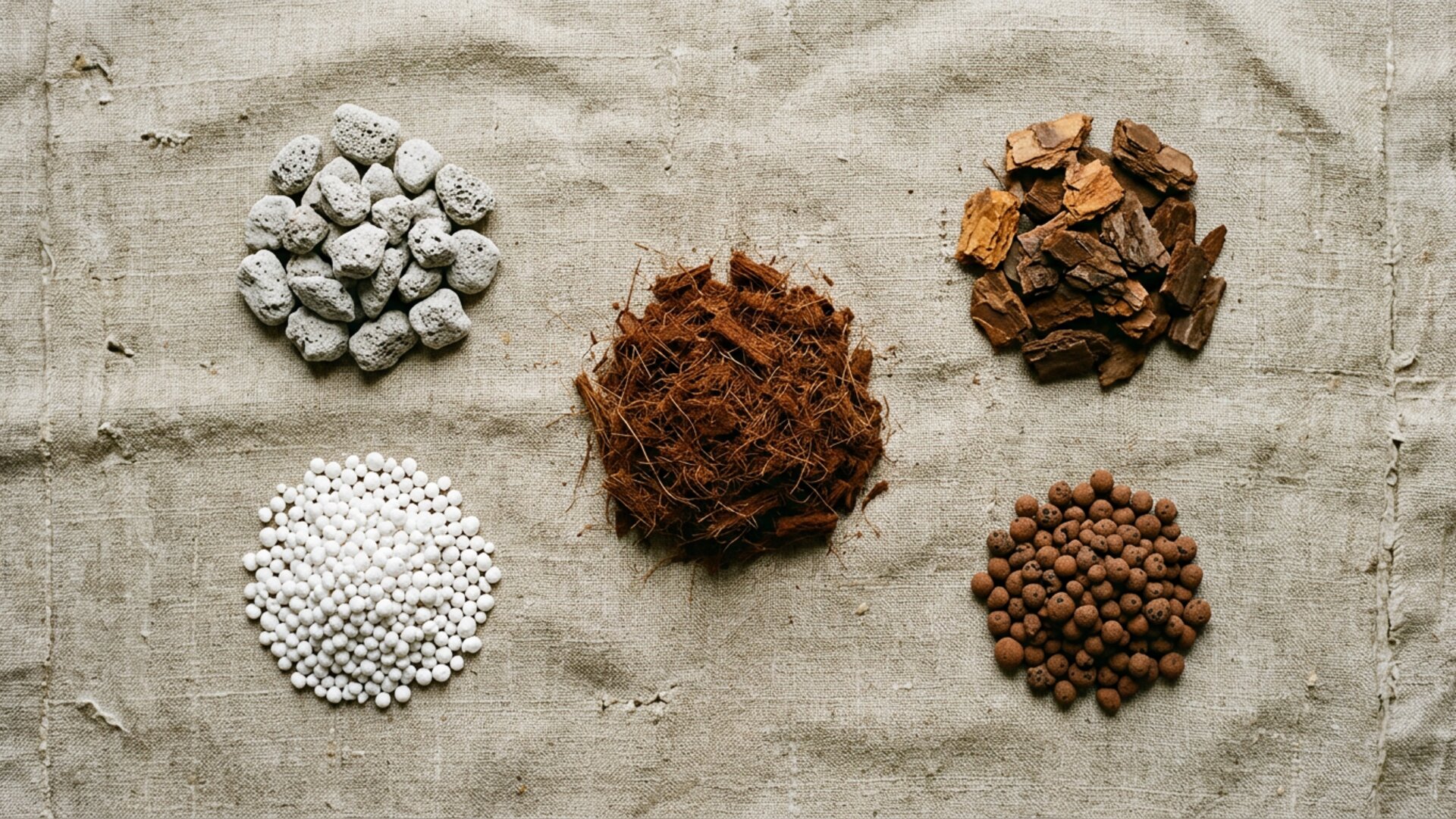
- Structural minerals (50 to 80% of the mix) — pumice, perlite, horticultural charcoal, zeolite, occasionally lava rock. The skeleton. Creates air-filled porosity, doesn't break down, defines how long the mix survives without repotting.
- Water-retentive organics (15 to 40%) — buffered coir and long-fiber sphagnum. Holds capillary water where roots can drink it, provides moderate CEC.
- Biological / nutrient inputs (5 to 15%) — earthworm castings. Slow-release nutrients, beneficial microbes, humic substances.
The six mixes differ mainly in how they balance those three layers. For the design logic — how we work backward from what the plant needs to a recipe that hits it — see Designing a Mix.
Diagram 01 · Mix comparison across six recipes
The Six Mixes at a Glance
ICU Mix v5 — the Recovery Substrate
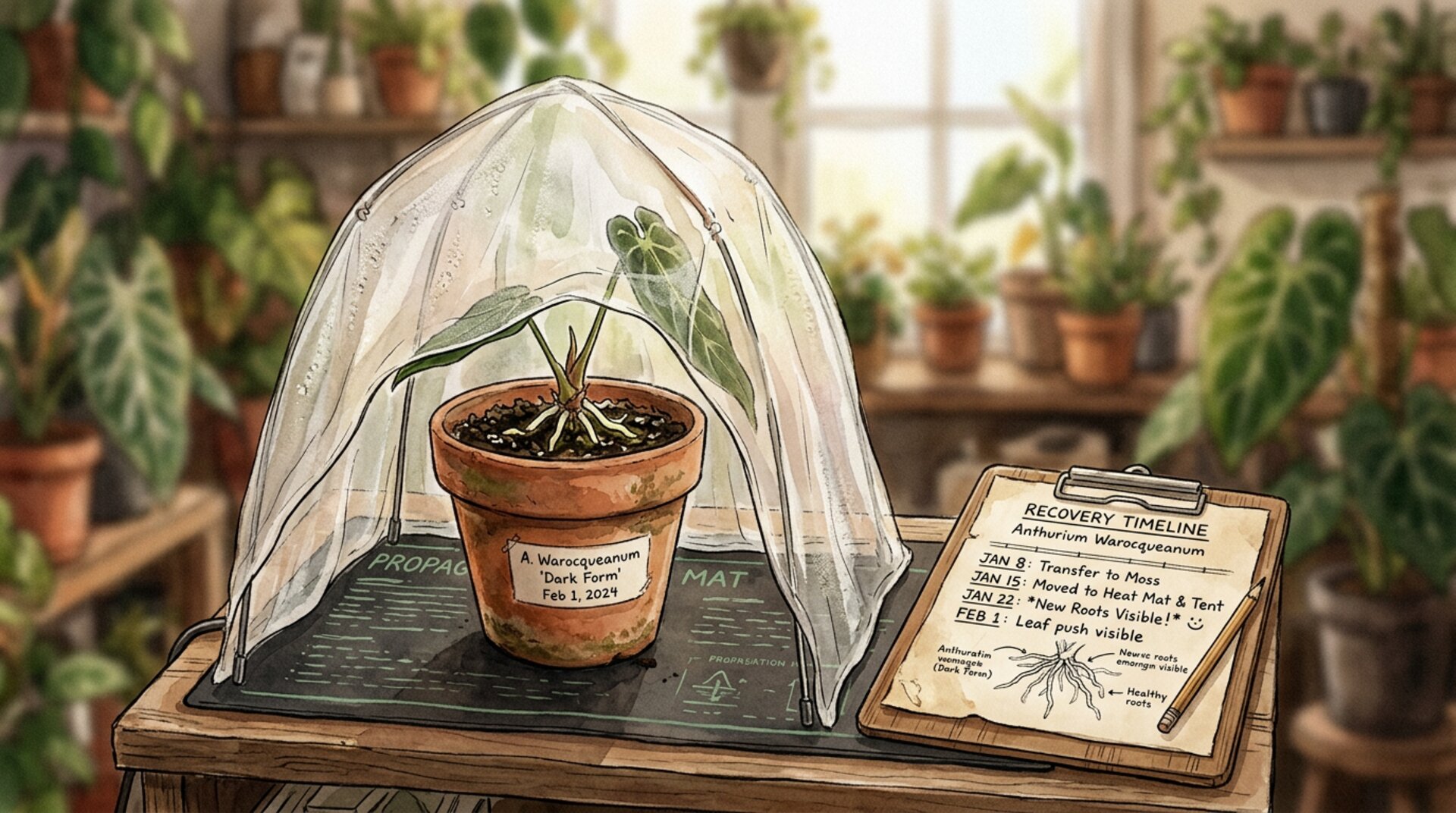
Seventy percent mineral, with zeolite for cation exchange capacity and only 10% earthworm castings to keep microbial food low. This is the mix we reach for when a plant arrives from shipping with compromised roots, when root rot is active, or when an aggressive repot has left the plant vulnerable. It's not a daily driver — it's the mix that buys a struggling plant the oxygen and CEC it needs to rebuild a root system.
Deep dive: ICU Mix v5: The Substrate That Saves Plants You Thought Were Gone.
Standard Mineral Mix v5 — the Workhorse
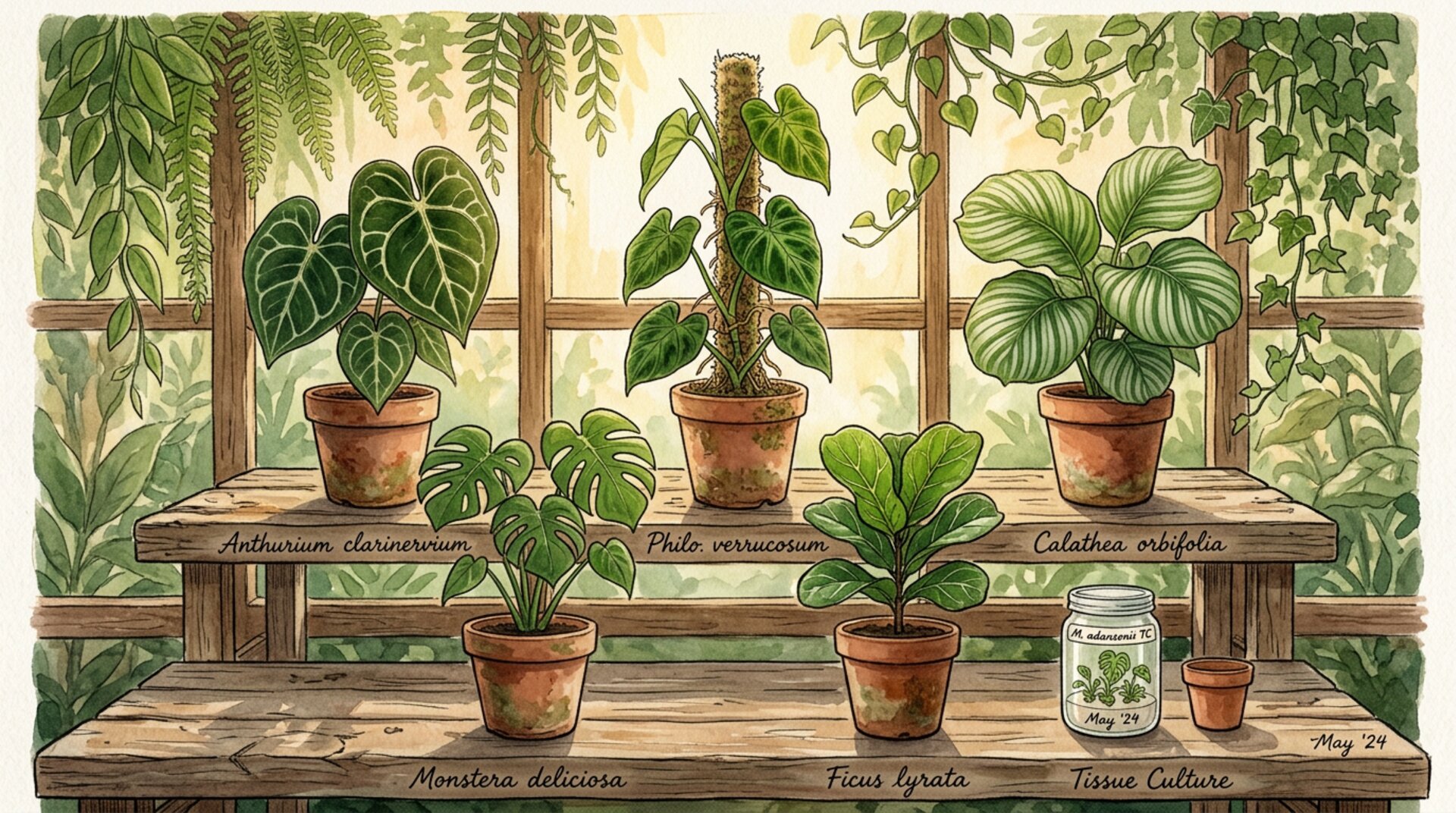
Sixty percent mineral, forty percent organic, with 5% fine charcoal to stabilize the organic fraction over time. This is the daily driver for most healthy tropicals: Philodendron, Syngonium, Alocasia, Hoya, and the majority of indoor aroids. Balanced aeration, balanced moisture, moderate CEC.
Deep dive: Standard Mineral Mix v5: The Workhorse Substrate.
Aroid Mineral Mix v5 — for Epiphytes
Eighty percent mineral. Coarse pumice (1/2 inch) plus 1/4 to 1/2 inch horticultural charcoal chunks as the bark substitute. The chunks give aerial roots of climbing Philodendron, Monstera, Anthurium, and Rhaphidophora something to grip, and in side-by-side trials the aerial-root attachment rate to charcoal is indistinguishable from attachment to fir bark — without the fungal spore load.
Deep dive: Aroid Mineral Mix v5: The Bark-Free Epiphyte Mix.
Tissue Culture Acclimation Mix v5 — the Mineral Substrate Approach
The most opinionated piece of the system, and the one most often done wrong. Our base TC mix is 50/50 Fluval Stratum and fine perlite — a mineral-dominated substrate that doesn't decompose during the 4- to 6-week acclimation window and holds enough CEC for slow nutrient release once the plantlet starts rooting. Species-specific variants tune the ratios for Monstera, Musa, Anthurium, and Marantaceae. But the real work isn't the substrate — it's the humidity schedule, light, and bottom heat.
Deep dive: Tissue Culture Acclimation: The Mineral Substrate Approach That Works.
Goeppertia / Calathea Mix v5 — the Moisture-Retentive Mix
Forty-five percent mineral, with 10% long-fiber sphagnum for even moisture and 5% fine charcoal to keep the wetter baseline from souring. For Marantaceae — Goeppertia, Calathea, Stromanthe, Ctenanthe — that want consistent moisture without anaerobic pockets. Also requires rainwater, RO, or filtered tap, because these plants are famously sensitive to fluoride, chloramine, and hard water.
Deep dive: coming soon in the Substrate Library.
Ficus Mix v5 — the Clear-Cycling Mix
Thirty-five percent pumice, 30% buffered coir, 20% perlite, 10% castings, 5% fine charcoal. For mesic tropicals that want a clean wet-dry cycle rather than constant moisture — Ficus lyrata, F. elastica, F. altissima, plus Ceropegia, Dischidia, and Hoya when you're leaning a bit more toward the moist side.
Deep dive: coming soon in the Substrate Library.
Ingredient Rules That Apply Everywhere
These three are non-negotiable across every recipe. The full ingredient glossary (including the ones we don't use) is in The Aroid Ingredient Glossary, but these are the ones worth repeating:
- Coir must be buffered. Raw coir leaches potassium and sodium that displace calcium and magnesium at the root surface. Calcium-buffered or pre-rinsed low-EC coir only. Test a new lot at EC <0.5 mS/cm in a 1:1.5 slurry before trusting it.
- Perlite must be coarse. #3 grade or chunky only. Fine perlite compacts, floats, and generates airway-irritating dust — especially relevant given this system exists partly for growers who can't handle bark dust in the first place.
- Charcoal must be horticultural grade. Not BBQ (which has binders and accelerants). Horticultural charcoal is sterile, porous, chemically inert, and the closest thing to a bark-free structural element.
What You'll Need on the Shelf
If you want to mix any of these yourself, the total ingredient list across all six recipes is short:
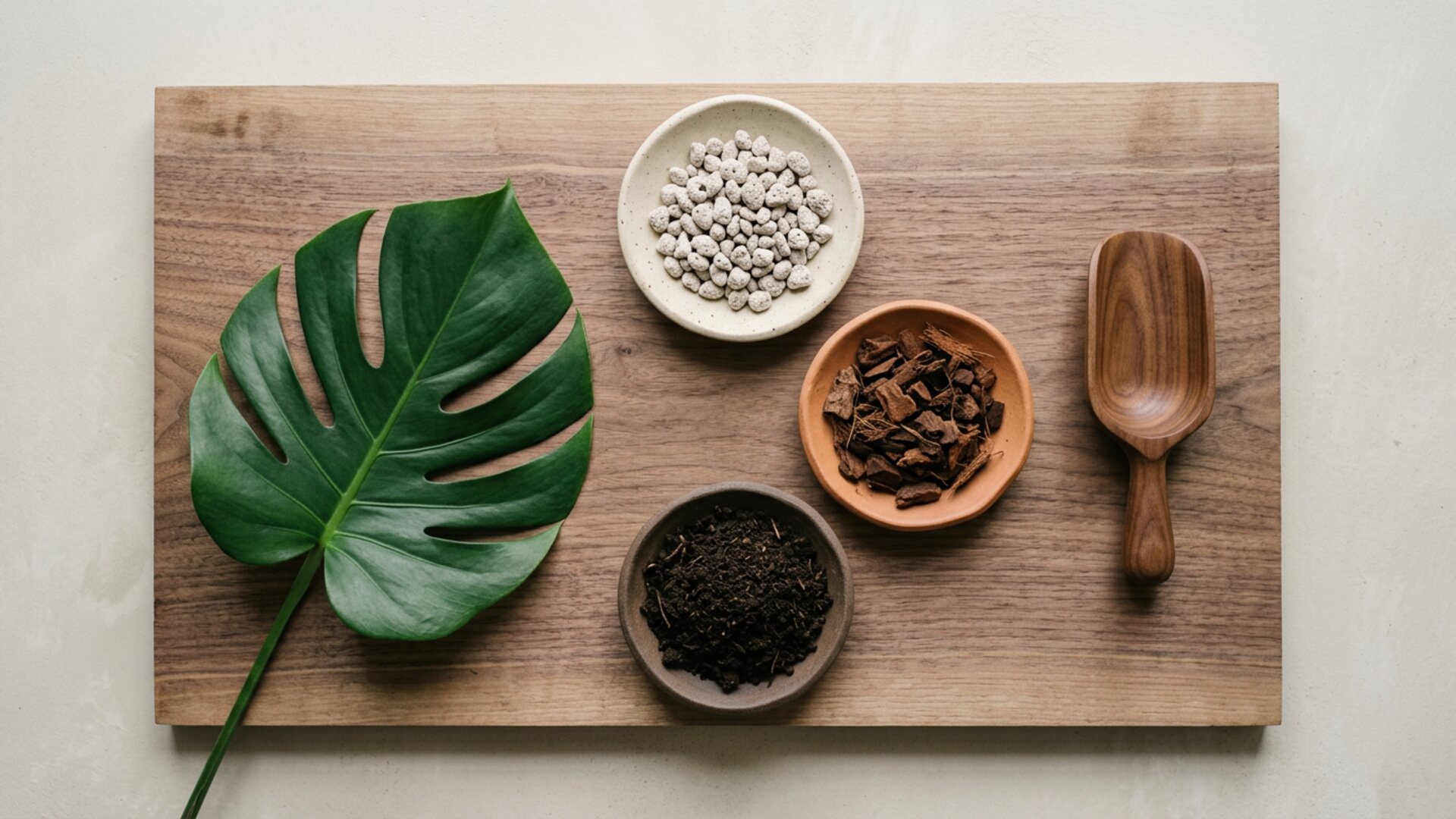
- Pumice, 1/4 inch and 1/2 inch grades
- Coarse perlite (#3)
- Clinoptilolite zeolite, 1–3 mm and 3–5 mm
- Horticultural charcoal, 1/8 inch and 1/4 to 1/2 inch grades
- Calcium-buffered coir (medium and fine pith)
- Long-fiber sphagnum (New Zealand or AAA Chilean)
- Earthworm castings, sifted
Eight ingredients across six mixes. Everything by volume, not weight — a "10 cup" recipe is just a proportioning shorthand you can scale to any batch size.
What This System Doesn't Solve
A few honest limitations before you commit:
Cost. Buying ingredients individually runs higher per volume than a bagged commercial mix. You make that back in plant survival rates and the ability to repot without introducing pests or pathogens, but the upfront number is higher and worth naming.
Watering attention. Mineral-heavy mixes dry faster than peat-based mixes. That's usually a feature (less root rot, faster gas exchange), but in a hot, dry home the Aroid Mineral Mix can dry out in three days in a 6-inch terracotta pot, four to five days in plastic. Plan accordingly, or adjust (see Designing a Mix for the adjustment logic).
Nutrient delivery. Low-organic, high-drainage mixes need an active feeding program. If you're a "water-only, no fertilizer" grower, these mixes will slowly starve your plants. Budget for a dilute liquid feed (EC 1.0 to 1.5 mS/cm, roughly quarter to half bottle-label strength) every other watering — or pick mixes from our system that lean more organic (Goeppertia, Ficus) and fertilize less frequently.
Not a cure-all. Substrate is one variable. A better mix won't rescue a plant that's being under-lit, over-fertilized, or kept in a pot three sizes too large. If the rest of the environment isn't working, changing substrate just gives you a cleaner failure.
Where to Go Next
The rest of the library is organized around plant groups and use cases. Jump in where your collection lives:
- Plant in trouble — ICU Mix v5. Start here if you have root rot, shipping damage, or a plant you're actively trying to save.
- Healthy tropicals, daily driver — Standard Mineral Mix v5. The workhorse for Philodendron, Alocasia, and general tropicals.
- Climbing Philodendron, Monstera, Anthurium — Aroid Mineral Mix v5. The chunky bark-free mix for epiphytes.
- Tissue culture deflasking — TC Acclimation Protocol. The highest-leverage piece if you're acclimating anything fresh from agar.
- Goeppertia, Calathea, Stromanthe — Goeppertia / Calathea Mix (coming soon). The moisture-retentive option for Marantaceae.
- Ficus, Dischidia, Ceropegia — Ficus Mix (coming soon). For mesic tropicals that need clean wet-dry cycles.
Each deep dive has the full recipe with particle-size specs, target pH, target runoff EC, watering cadence, pros and cons, and what changes when you adapt it for your conditions. This overview exists to get you to the right one — from here on out, every article is a recipe you can actually use.
Bilderback, T.E., Warren, S.L., Owen, J.S., and Albano, J.P. Best Management Practices for Producing Container-Grown Plants, 3rd ed. Horticultural Research Institute.
Altland, J.E., Owen, J.S., and Gabriel, M.Z. 2011. Influence of pumice and plant roots on substrate physical properties over time. HortTechnology 21(5): 554–557. [link]
OSHA Wood Dust Safety and Health Topics. U.S. Occupational Safety and Health Administration. [link]
NIOSH Wood Dust Hazard Review. U.S. National Institute for Occupational Safety and Health.