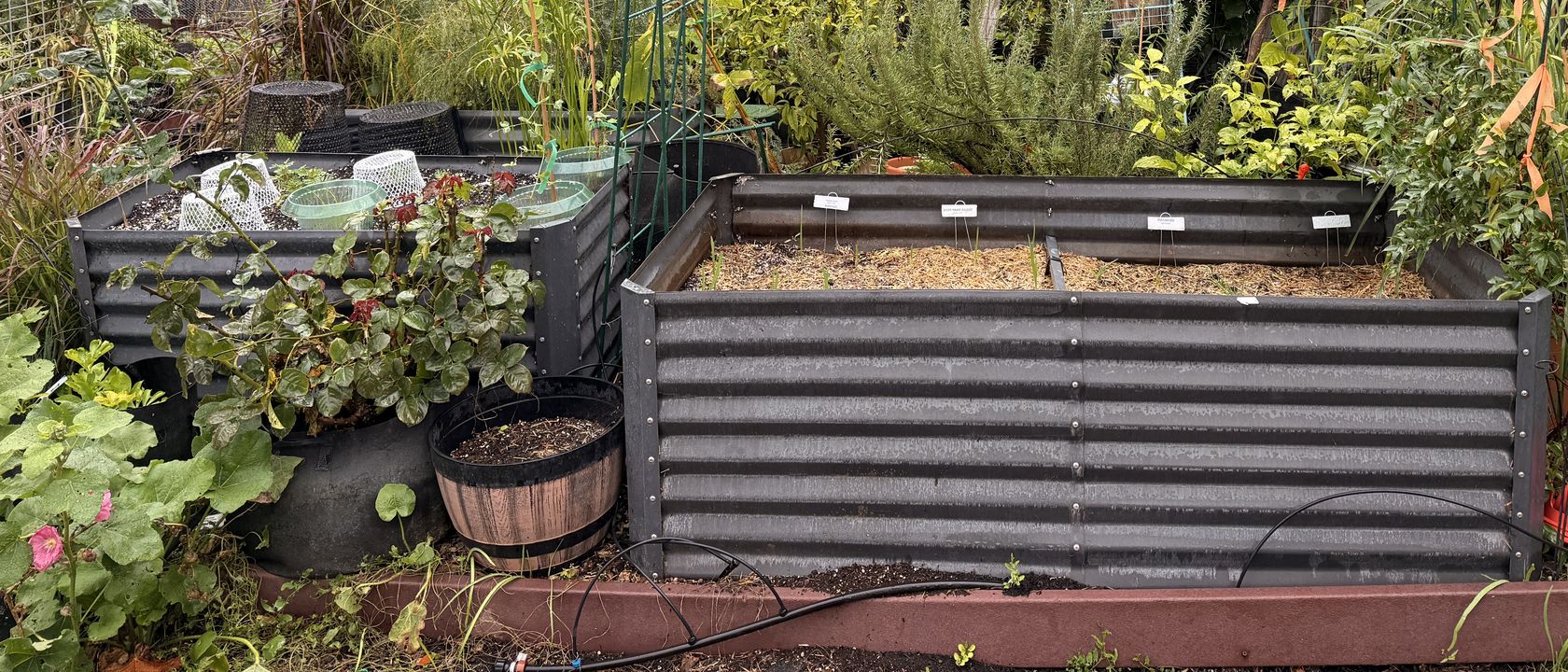
Preparing a bed here means building it in heat and dust for a winter that arrives all at once. Most bed-prep advice was written for a gentler autumn than ours. This is what holds up when you check it against the measurements, and what turns out to be advice repeating itself.
A Santa Clara County autumn puts you in an awkward position. You prepare the bed in heat, in dust, with a hose. Then roughly four-fifths of the year's rain arrives between November and March, and it arrives in bursts. Whatever you built in September has to survive that change. Most bed-preparation advice was written for places where autumn means gentle cooling and steady drizzle, and it shows.
Our companion piece on what to sow leaves off at the seedbed: keep it damp, because the rain isn't coming until November. This is the other half of that. Once the rains do arrive, the job changes from keeping a bed damp to making sure it drains.
Leave the Structure Alone
The autumn ritual is to turn the bed over. Fork it, break it up, mix in whatever you're adding, and leave it looking like a fresh loaf. It feels like the responsible thing to do.
The soil-structure evidence doesn't support it, though it's worth being precise about what the evidence actually is. Across seven European long-term arable experiments running between eight and fifty-four years, inversion tillage, which is the technical name for turning the soil over the way a plough or a garden fork does, reduced the mass of large water-stable macroaggregates in the top 6 inches (15 cm) and the organic carbon held inside macro- and microaggregates, and the effect grew as tillage intensity rose (Panagea et al., 2022). Water-stable aggregates are the crumbs that hold together when soil gets wet rather than slumping into mud, which is exactly the property a bed needs in January.
Two qualifications travel with that. The first is in the authors' own sentence: inversion tillage did not reduce the mass of macroaggregates overall, which is contrary to what they expected. The second is scale. Those were tractor-drawn moldboard ploughs on arable fields, sampled to 6 inches only, and the authors note that whole-profile carbon under reduced tillage may be unchanged. A garden fork in a 4-foot bed is a different implement doing a different amount of damage. The mechanism transfers, but the magnitude does not.
At two of those seven sites, the least-disturbed treatment carried almost double the aggregate mean weight diameter of the conventionally tilled plots (Panagea et al., 2022). That's a measure of how big the stable crumbs are. At the other five, differences weren't significant.
One more finding from the same work is worth having, because it cuts against a common habit. Incorporating the previous crop's residues did not increase the mass of water-stable macroaggregates or the organic matter held inside them, and its effect on carbon in the smaller fractions was inconsistent (Panagea et al., 2022). Digging in spent bean vines is not the same intervention as adding finished compost, and the evidence treats them differently.
Pull the spent crop, cut it at the base and leave the roots in place, lay whatever you're adding on the surface, and stop. If the bed is genuinely compacted, loosen it with a fork without turning it over: push in, lever, withdraw, move along. You're making cracks, not making a loaf.
Stay Off It Once It's Wet
Everyone knows not to walk on wet soil. The threshold is lower than the folk rule suggests.
On a sandy loam in Hebei, China, tractor traffic applied at soil moisture the authors record as below field capacity still raised bulk density in the 4 to 8 inch (10 to 20 cm) layer by roughly 9 to 13% above untrafficked control in one year, and 14 to 16% the next (Nawaz et al., 2023). Bulk density is how tightly packed the soil is: the same volume weighing more means less pore space for air and water. Field capacity is the amount of water soil holds after free drainage has stopped, and it's the usual mental line between "workable" and "too wet." Compaction happened on the dry side of it.
A Mediterranean-climate study puts numbers on the wet-versus-dry difference. On a loam forest soil in central Italy, passes of a logging tractor raised bulk density 26% above control where the soil was dry and 33% where it was moist (Cambi et al., 2016). So wet is worse, clearly. But dry is not safe, and in that study the authors add that even their worst case did not reach values they consider harmful to the stand.
Both of those are tractors. A 3.5-ton axle is not a gardener in boots, and I could not find a study that measured what a person standing on a vegetable bed does. We know which way it goes, but we don't know how far.
The practical version is old and needs no citation. Squeeze a handful. If it ribbons between your fingers and stays in a slick lump, it's too wet to stand on. If it forms a ball that crumbles under a thumb, you're fine. Either way, a plank laid across the bed spreads your weight and costs nothing, and permanent paths mean you never have to make the judgment at all.
Compost: We Went Looking for a Measurement
I expected to write a tidy correction. The standard advice is two to three inches of compost on the bed every autumn. Oregon State University Extension recommends applying a quarter-inch to one inch to the surface of an existing bed each year (Miller & Mann, 2021), which is a fraction of that, and the obvious article writes itself: everyone is overdoing it.
Then I checked whether anyone else agreed.
The one-inch ceiling holds up well. North Carolina's Department of Agriculture caps maintenance at a maximum of one inch per year (McGinnis & Myers, 2018). Utah State University Extension calls about one inch a year the amount that can be sustainably added to most Utah soils (Stock et al., 2019), and Utah's alkaline soils are the nearest thing in this literature to what many Santa Clara County gardeners are working with. Three separate services, three different states, same upper bound.
The bottom of the range is another matter. Outside Oregon State, one other source gives a quarter-inch, but not in terms I'd stand behind. Treat the low end as unsettled.
And then the guidance a gardener here will actually meet. UC Marin Master Gardeners tell gardeners to apply a half-inch to 3-inch layer of compost on garden beds at least once a year, and to apply it again in autumn if they plan to grow edibles in winter (UC Marin Master Gardeners, n.d.). Follow that and you could be adding six inches a year, which is six times what the other three call a ceiling. So the correction holds in three states and comes apart in this one.
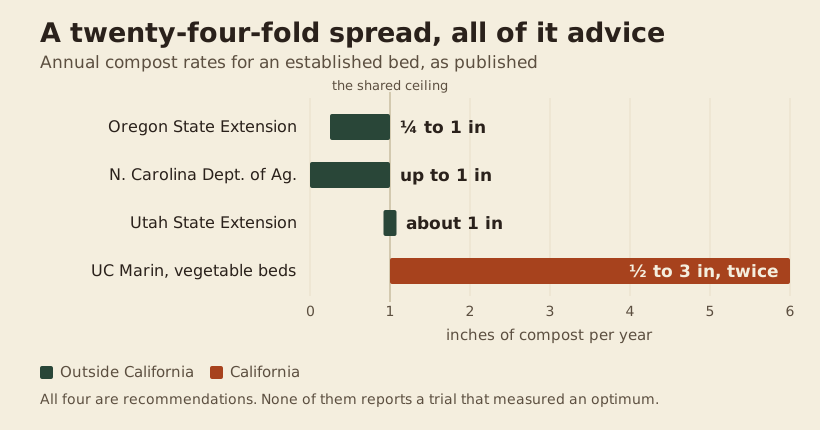
I could not find a study that measured it. Every depth figure above is guidance. None of the sources I reached reports a trial applying competing rates to comparable beds and measuring what followed. The published rates span twenty-four-fold, from a quarter-inch a year to three inches twice a year, and they are considered judgments rather than findings.
There are measured rates in the agricultural literature. The long-term European experiments behind the tillage findings earlier include one adding 45 tonnes of compost per hectare a year for twenty-two years, an intensity the paper calls extreme and includes to evaluate maximum effects (Panagea et al., 2022). That is a field rate in tonnes per hectare, set to probe a limit rather than to advise a gardener, and I could not convert it to a depth on a bed.
That sounds like an impasse. It isn't, because one thing in this area has been measured, and it points somewhere useful.
What the phosphorus says
One definition first, because the rest of this section turns on it. The three numbers on a bag of fertilizer are always the same three nutrients in the same order: nitrogen, phosphorus and potassium. That is where the shorthand NPK comes from. Compost carries all three. The question is whether it carries them in the proportions a vegetable bed actually uses, and for one of them it doesn't.
Phosphorus is the nutrient that accumulates. Plants take up much less of it relative to nitrogen than compost supplies, so feeding a bed enough compost to meet its nitrogen needs necessarily overshoots on phosphorus. That isn't an empirical result, it's arithmetic about what compost contains, and researchers working on urban gardens state it as a design premise: when compost was applied based on anticipated crop nitrogen demand, phosphorus was necessarily added in excess of crop demand (Small et al., 2020). In their Minnesota raised-bed trial, applying compost to meet the crops' anticipated nitrogen demand meant applying three to four times the rate needed to meet their phosphorus demand.
The accumulation is real and measurable. In the same program, initial garden soil tested almost three times higher in phosphorus than an unfertilized reference lawn, 75 parts per million against 26 (Small et al., 2020). A companion paper concludes that compost-derived phosphorus is often applied far in excess of crop nutrient demand, raising concentrations in garden soils and moving phosphorus out through runoff and leachate (Small et al., 2019).
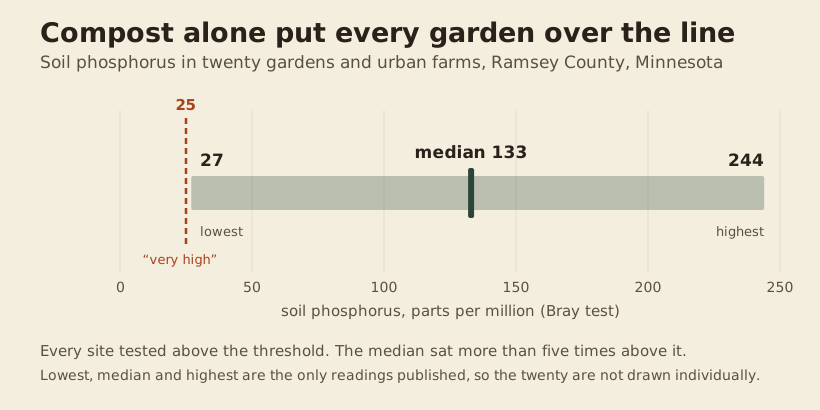
And a survey of working gardens shows where that lands. All twenty community gardens and urban farms in a Ramsey County, Minnesota survey tested above the 25 ppm that University of Minnesota Extension calls a very high soil phosphorus reading, with a median of 133 ppm and a maximum of 244. Almost none of the gardeners in that survey had applied anything but compost (Hoidal & Wilcox, 2023).
Oregon State's guidance describes the consequence plainly: if too much compost is added, nutrients including phosphorus and potassium can leach past the root zone and move beyond the garden (Miller & Mann, 2021).
Two extraction methods are in common use and they are not interchangeable. University of Minnesota Extension states the pair in one sentence: above 25 ppm on a Bray test, or 18 ppm on an Olsen test, stop adding phosphorus for a few years (Hoidal, 2023). Bray is the default for soils at or below pH 7.4, Olsen above it. If your report says Olsen, compare against 18, not 25. I could not find a California-specific home-garden threshold published with its extraction method, so I can't tell you which one your lab will use. Ask them.
The answer isn't a number. I searched for a rate trial in home or market vegetable beds and came up with recommendations, not results, so treat any confident figure you meet as a considered judgment, including the ones we've printed elsewhere.
What has been measured is the phosphorus. So that's the thing to steer by. Get a soil test and let the phosphorus reading set your rate. A bed testing low can take the higher end of the published guidance. A bed testing high needs less, or compost only as a surface mulch, whatever the calendar says.
Two rates that are not in dispute, worth separating out: a new bed is a different case from an established one, and every source that distinguishes them allows much more at the start. North Carolina permits a 3-inch layer tilled to 6 inches when a bed is first made, against one inch a year afterwards (McGinnis & Myers, 2018). If you're building a bed rather than maintaining one, none of the restraint above applies to you.
Raised Beds Are Drier, Not Warmer
Raised beds get recommended every autumn on two grounds: they drain better and they warm up faster. The second one deserves a harder look.
The only study I found that varied bed height as a treatment, held the soil constant across treatments and logged soil climate all season ran in subarctic Ontario. Over the season, the mean soil-temperature difference between standard raised boxes and ground-level beds was zero, give or take about 1 °F (0.0 ± 0.5 °C), and the individual differences ran from about 1.5 °F cooler to 3.5 °F warmer (−0.8 to 1.9 °C) (Wilton et al., 2023). Late in the season the ground ran very slightly warmer than either box type. The warming that everybody talks about showed up for about ten days in early summer and then vanished from the seasonal average.
That is one small study a long way from home: four plots per treatment, one season, no inferential statistics on the soil-climate data, and the boxes carried landscape fabric at their base that the ground treatment lacked. It cannot establish that a raised bed in Santa Clara County never warms in October. It can remove our confidence that it does, and nothing measured has put the confidence back.
The moisture difference, by contrast, was large and consistent all season: water made up 36% of the soil's volume at ground level against 21% in the raised boxes (0.36 against 0.21 m³/m³) (Wilton et al., 2023). That is the finding to carry. A raised bed is a drainage instrument.
Which means its value flips with the season here. The same behavior that's a liability in a rainless September, when the raised bed dries out faster and needs watering sooner, is the entire point in a saturated January. If your beds hold water through winter, raising them is a reasonable response. If they don't, you're buying a watering problem for eight months to solve a drainage problem you may not have.
Whether a raised bed improves the soil under it is a separate question, and the evidence splits in an instructive way. At a research station in semi-arid India, water moved down through a heavy clay at about 5.5 inches per hour (141 mm) under raised beds against 2.2 inches (57 mm) under flat beds (Garg et al., 2022). That is its saturated hydraulic conductivity, and it is a substantial difference. But those beds had been left undisturbed for thirty years, with only the furrows reopened each season. Meanwhile a five-year trial in the Eastern Himalaya found that after five cropping cycles, bulk density did not differ significantly between flat beds, ridge-and-furrow and broad-bed-and-furrow (Babu et al., 2020), with beds re-formed annually.
Thirty years of never walking on something, versus five years of rebuilding it every season. Neither study separates the geometry from the traffic exclusion, so I can't tell you which one is doing the work. My reading is that the permanent part of “permanent raised bed” may matter more than the raised part, and I'd like to see someone test that.
Pots and Planters
A container is not a small bed. The difference is physics, not size. A perched water table forms at the bottom of container soil even though the container drains freely (Spomer, 1980), which is why the bottom inch or two of any pot stays wetter than the rest no matter how good the drainage hole is. Our substrate primer works through that in full, along with what roots need from a mix, so we won't repeat it here.
Three things matter specifically for a container going into a wet winter.
Bed soil does not work in a pot. Even an excellent garden or field soil placed in a container will probably remain saturated after watering and drainage, resulting in poor soil aeration and poor plant growth (Spomer, 1980). If you're prepping beds and pots the same weekend, the temptation to fill the planters from the same pile is strong. Resist it.
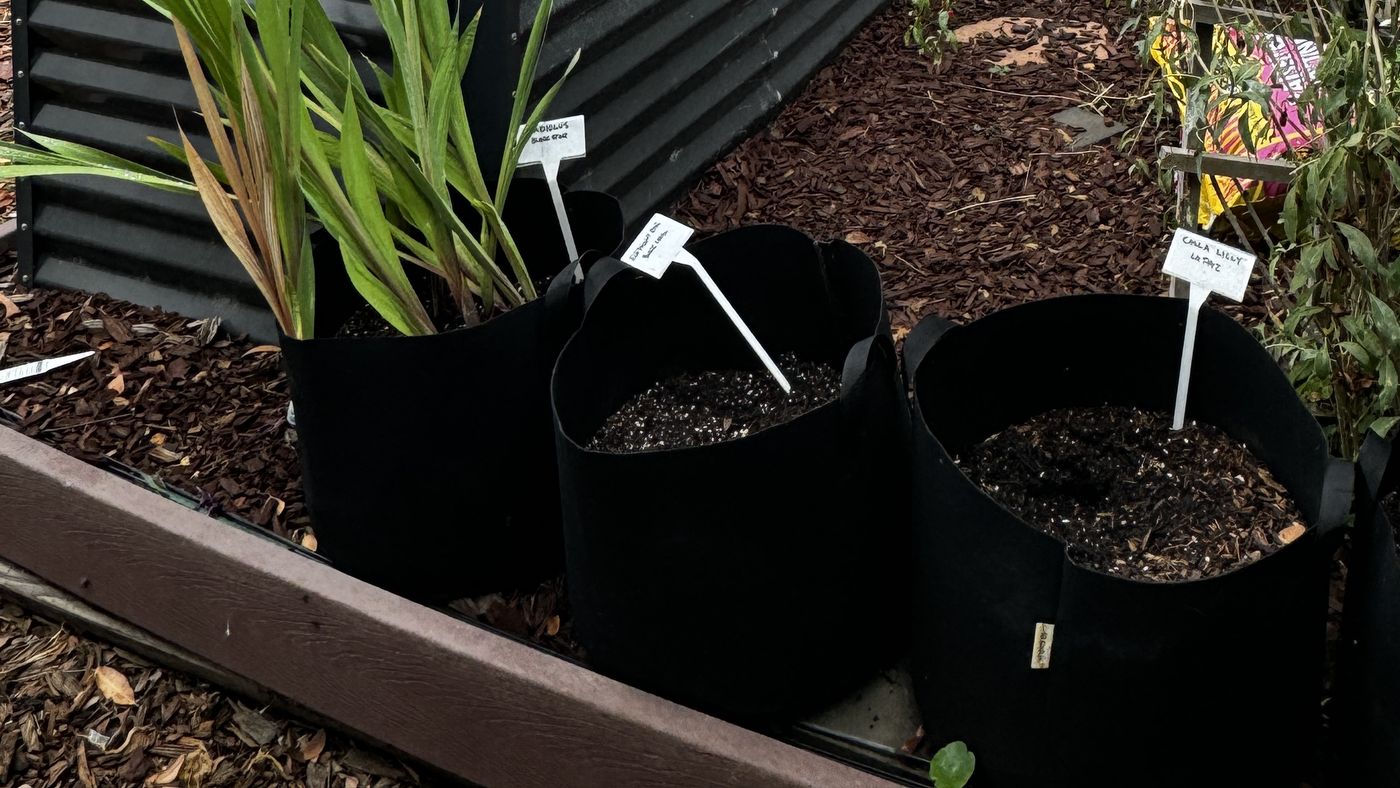
Size is doing more than you think. The figure here is total plant mass across a broad experimental literature, not a vegetable yield, and it's about volume, not depth, so it settles nothing about how deep a planter should be. With that said: across the pot-size literature, plants increased on average 43% in mass for every doubling in pot size, with no significant difference between herbaceous and woody species (Poorter et al., 2012). Go one size up.
Skip the gravel, but not for the reason you've read. We rated the drainage-layer myth false and had to correct ourselves when someone finally measured it in real flowerpots. The full account is in our Myths Demystified entry on drainage rocks. The short version that survives: a gravel layer still isn't worth adding, because it costs you root volume to solve a problem a decent substrate had already solved.
One thing I looked for and did not find: measured root-zone temperatures in containers through a mild winter. The container-temperature literature I could reach is almost entirely about summer heat in nursery cans. What we have is the mechanism, and it's worth knowing anyway. A container holds a small volume of medium and sits exposed on all sides, so its roots are poorly buffered against temperature swings. Root hardiness tracks temperature directly: roots toughen against cold as the cold arrives and give that toughness up again when it eases, which is what deacclimation means. So a warm spell in January can undo hardiness the roots had already built, at a point in the year when you'd assume nothing was happening. I can't put a number on what that costs in this county, and I didn't find one.
Two Things We're Not Settling Here
Mulch. There's a nitrogen question about wood chips that garden writing usually settles too confidently in one direction, and the primary literature is messier than the popular version. It turns on whether a plant is already established or newly planted, which matters a great deal for a bed full of autumn seedlings and transplants. We're giving it a full entry rather than a paragraph, because the short version has been wrong in both directions.
Cover crops. These get their own treatment. One caution belongs here, though, because it's counterintuitive in a dry-summer climate and easy to get backwards. In a synthesis of Californian and Mediterranean arable farmland, a soil-water comparison drawing on twenty-three experiments found cover-cropped plots held 13% less soil water than plots without cover crops (Shackelford et al., 2019). A cover crop is a living plant and it drinks. That's field cropping, not garden beds, and nothing else corroborates it, so treat it as which way, not how much. But if you're sowing a cover crop partly to conserve moisture, the evidence doesn't support that.
What to Do Before the Rains
Everything above, in one place.
- Don't turn the bed over. Cut the spent crop at the base, leave the roots, add on the surface. Fork to crack compacted ground without inverting it.
- Get a soil test before you buy compost. The phosphorus number is the one that should set your rate, because it's the one number here that somebody actually measured. Ask the lab which extraction method they use.
- If the test comes back high, use less, or use compost as a surface mulch rather than a soil amendment, regardless of what the season seems to demand.
- Building a new bed is a different job with a legitimately higher rate. Maintaining one is where the restraint applies.
- Stay off it once the rain starts. Squeeze test, or a plank, or permanent paths.
- Raise the bed if it holds water in winter, and not because you think it will warm up. Expect to water it more from May onward.
- Don't fill pots with bed soil, go one container size up, and skip the gravel layer.
And one meta-point, which is really what this piece is about. A great deal of autumn bed advice, including some we've published ourselves, is recommendation dressed as finding. When three services give the same number, a fourth gives six times it, and not one of them cites a trial, that's a signal about the state of the knowledge, not a fact about beds.
Babu, S., Singh, R., Avasthe, R. K., Yadav, G. S., Das, A., Singh, V. K., Mohapatra, K. P., Rathore, S. S., Chandra, P., & Kumar, A. (2020). Impact of land configuration and organic nutrient management on productivity, quality and soil properties under baby corn in Eastern Himalayas. Scientific Reports, 10, 16129. https://doi.org/10.1038/s41598-020-73072-6
Cambi, M., Grigolato, S., Neri, F., Picchio, R., & Marchi, E. (2016). Impact of wheeled and tracked tractors on soil physical properties in a mixed conifer stand. iForest, 9(1), 89–94. https://doi.org/10.3832/ifor1382-008
Garg, K. K., Anantha, K. H., Dixit, S., Nune, R., Venkataradha, A., Wable, P., Budama, N., & Singh, R. (2022). Impact of raised beds on surface runoff and soil loss in Alfisols and Vertisols. CATENA, 211, 105972. https://doi.org/10.1016/j.catena.2021.105972
Hoidal, N. (2023). You might be over-fertilizing your garden. University of Minnesota Extension.
Hoidal, N., & Wilcox, J. (2023, April 12). How much compost should you apply to your garden this spring? University of Minnesota Extension, Yard and Garden News. Retrieved via the Internet Archive; the site blocks automated access. Spring-framed; we use its annual rate to discuss an autumn habit.
McGinnis, M., & Myers, J. (2018). Compost use guidelines for gardens, landscapes, & small farms. North Carolina Department of Agriculture & Consumer Services.
Miller, C., & Mann, J. (2021). Using compost in gardens and landscapes (EM 9308). Oregon State University Extension. Extension guidance, not a measured optimum.
Nawaz, M. M., Noor, M. A., Latifmanesh, H., Wang, X., Ma, W., & Zhang, W. (2023). Field traffic-induced soil compaction under moderate machine-field conditions affects soil properties and maize yield on sandy loam soil. Frontiers in Plant Science, 14, 1002943. https://doi.org/10.3389/fpls.2023.1002943
Panagea, I. S., Berti, A., Čermak, P., Diels, J., Elsen, A., Kusá, H., Piccoli, I., Poesen, J., Stoate, C., Tits, M., Toth, Z., & Wyseure, G. (2022). Impact of agricultural management on soil aggregates and associated organic carbon fractions: Analysis of long-term experiments in Europe. SOIL, 8(2), 621–644. https://doi.org/10.5194/soil-8-621-2022
Poorter, H., Bühler, J., van Dusschoten, D., Climent, J., & Postma, J. A. (2012). Pot size matters: A meta-analysis of the effects of rooting volume on plant growth. Functional Plant Biology, 39(11), 839–850. https://doi.org/10.1071/FP12049
Shackelford, G. E., Kelsey, R., & Dicks, L. V. (2019). Effects of cover crops on multiple ecosystem services: Ten meta-analyses of data from arable farmland in California and the Mediterranean. Land Use Policy, 88, 104204. https://doi.org/10.1016/j.landusepol.2019.104204
Small, G., Shrestha, P., & Kay, A. (2019). Measuring the fate of compost-derived phosphorus in native soil below urban gardens. International Journal of Environmental Research and Public Health, 16(20), 3998. https://doi.org/10.3390/ijerph16203998
Small, G., Shrestha, P., Metson, G. S., Polsky, K., Jimenez, I., & Kay, A. (2020). Quantifying nutrient recovery efficiency and loss from compost-based urban agriculture. PLOS ONE, 15(4), e0230996. https://doi.org/10.1371/journal.pone.0230996
Spomer, L. A. (1980). Container soil water relations: Production, maintenance, and transplanting. Journal of Arboriculture, 6(12), 315–320. Mechanism, not measurement; the author reports no measurements of his own.
Stock, M., Maughan, T., & Miller, R. (2019). Sustainable manure and compost application: Garden and micro farm guidelines. Utah State University Extension.
UC Marin Master Gardeners. (n.d.). How to use compost. University of California Agriculture and Natural Resources. UC source, disclosed. The page carries no publication date.
Wilton, M. J., Karagatzides, J. D., Solomon, A., & Tsuji, L. J. S. (2023). An examination of outdoor garden bed designs in a subarctic community. ARCTIC, 76(1), 60–71. https://doi.org/10.14430/arctic77061 Four plots per treatment, one season; no inferential statistics are reported for the soil-climate data.