If you've spent any time on the Substrate Series, you already know we treat ICU Mix as triage and Aroid Mineral Mix as architecture for epiphytes. This is the third leg of the system: the mix a plant lives in once it's healthy, growing, and not climbing a moss pole. Most of the plants in our collection spend most of their lives in this substrate. That's what "workhorse" means.
It's also the mix most likely to get opinions from other collectors. "Sixty percent mineral, forty percent organic" sits between two camps. Too organic for the gritty-mix purists, too mineral for the bagged-tropical-mix crowd. We landed there because that's where the physics, the nutrient cycling, and the refresh interval all converge for what we're growing.
The recipe
All percentages by volume. For a 10-cup batch:
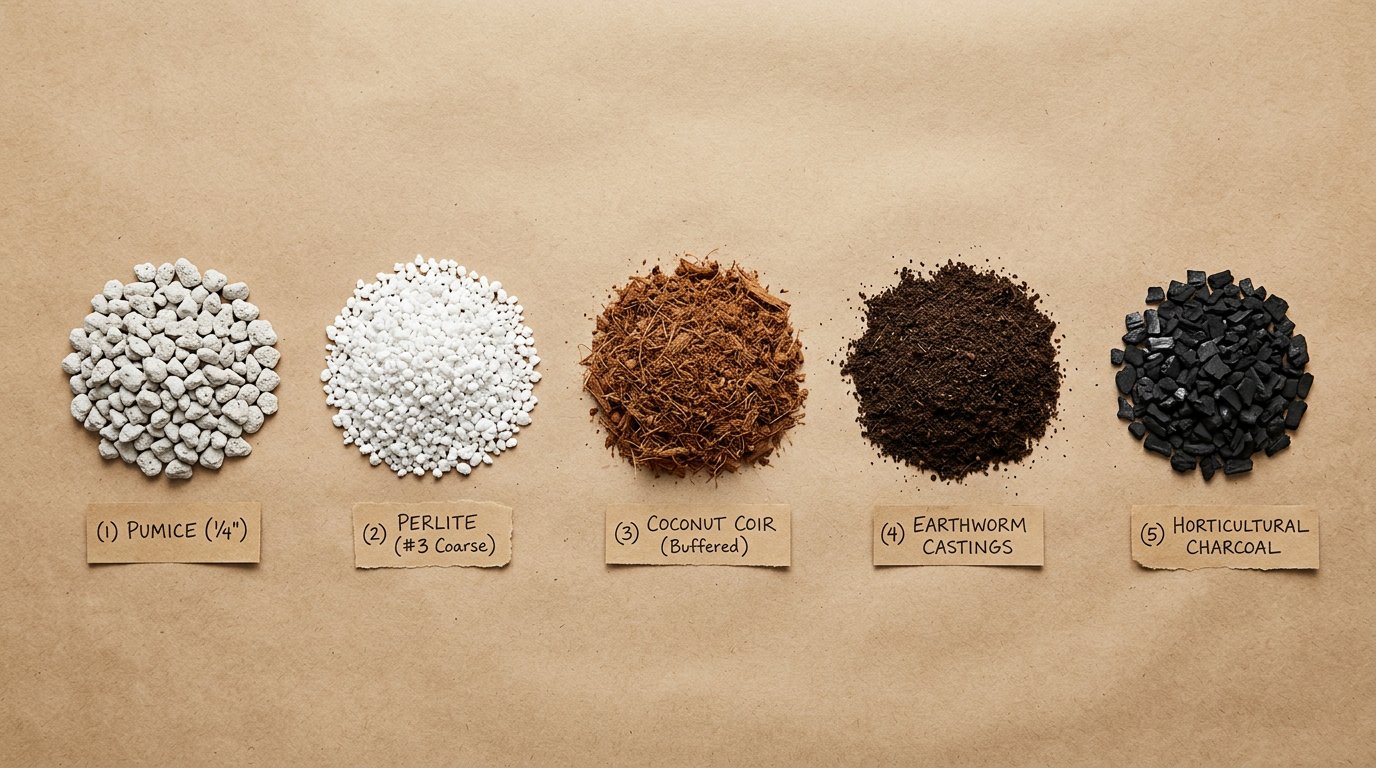
| Ingredient | Percentage | Cups | Grade / Particle Size |
|---|---|---|---|
| Pumice | 35% | 3.5 | 1/4 inch |
| Perlite (coarse) | 25% | 2.5 | #3 grade |
| Buffered coir | 20% | 2.0 | Medium pith |
| Earthworm castings | 15% | 1.5 | Sifted, screen out clumps |
| Horticultural charcoal | 5% | 0.5 | 1/8 to 1/4 inch |
Target pH: 6.0 to 6.5
Target runoff EC: 1.0 to 1.5 mS/cm
Watering cadence: Water when the top 1 inch is dry. In a 4-inch pot at moderate light that's around five to seven days in terracotta, and a couple of days longer in injection-molded plastic. Larger pots and cooler conditions stretch both. These are our intervals in our light, so treat them as a starting point rather than a schedule.
Refresh: Every 12 to 18 months. The organic fraction will compact. Plan for it.
Why 60/40 — and why not 70/30 or 50/50
The first question to answer is the obvious one: if Aroid Mineral Mix is 80% mineral and ICU is 70%, why drop to 60% here?
Healthy plants eat. A daily-driver substrate has to deliver nutrients on a sustained cycle, not just buffer them during recovery. Above ~70% mineral, we end up either watering daily or fertigating constantly to keep up. Sixty percent is the balance point, and it is ours: we arrived at it by trial across the collection rather than reading it off a paper.
The published physics bears on that choice without settling it. Air space in a container mix falls over a growing cycle as roots colonise it and the organic fraction settles and compresses, while the water it holds rises (Altland et al., HortTechnology 21(5), 2011). Mineral aggregates do not decompose, which is the reasoning behind leaning mineral-dominant in the first place (Bilderback et al., HortTechnology 15(4), 2005). What that work does not do is test a mix like this one. It runs to about 30% mineral in bark and peat bases, in outdoor nursery production over weeks to a season, rather than to 60% mineral in coir and castings on a windowsill over years.
If you want the underlying physics on air-filled porosity, the substrate primer (Article 1) goes deep on it. The short version comes with a caution. Published guidance puts air space for container substrates at 10 to 30 percent by volume, measured at free drainage in a standard 7.5 cm (3 inch) core (Bilderback et al., 2013). The European optimum often quoted alongside it, about 25 percent of total volume, is measured differently again: at container capacity in a 15 cm pot (de Boodt and Verdonck, 1972, reported in Argo, 1998). Those two numbers are not interchangeable, and air space rises with pot height, so a figure quoted without a container depth is not comparable to anything. Where our own mixes sit in those terms we have not measured.
Sixty/forty is where we land when we work backwards from what a healthy Philodendron needs over a 5- to 7-day watering cycle in a 4-inch pot. It's not the only viable balance, but it's the one that actually works at scale.
Why each ingredient is where it is
Pumice (35%) — the structural backbone
Quarter-inch pumice is the largest single component for a reason. It defines air-filled porosity, holds particle structure for years, and contributes a small amount of internal water storage from its porous interior. The grade matters as much as the percentage. Half-inch pumice in a 4-inch pot creates macropores that small root systems can't bridge effectively. Quarter-inch is fine enough that capillary water moves through the mix as a connected film, but coarse enough that air keeps moving even when the substrate is wet.
We don't substitute lava rock for pumice in this recipe. Lava is dense (it's lava), which raises the bulk density and changes the watering dynamics. Lava is appropriate in our Aroid Mineral and Gritty Mineral mixes for specific reasons. In SMM, pumice is the right call.
Coarse perlite (25%) — the air guarantee
Perlite is here to lock in air-filled porosity and to keep the mix loose. #3 grade only. Fine perlite floats to the surface within a few waterings, then compacts at the top of the pot. It is also a good deal dustier than the coarse grade, which is the practical reason to buy coarse and to dampen it before you scoop. Perlite itself is predominantly amorphous volcanic glass, and it is regulated as a nuisance dust rather than under any limit of its own; the alarming findings in the literature come from industrial accidents at twenty to four hundred times that limit, not from someone mixing a bowl of substrate on a kitchen counter (Du et al., 2010).
Coarse perlite at 25% sounds like a lot, and it is. We use it because day-one AFP is not the problem—month-12 AFP is. As the coir compresses and the castings break down over months, the perlite maintains the air-space the mix needs. Reduce it below ~20% and we see the refresh window start collapsing before 12 months.
Buffered coir (20%) — the water buffer
Coir holds capillary water where roots can drink it, and it contributes real cation exchange capacity: 31.7 to 95.4 meq per 100 g, measured on the organic fraction alone, across thirteen commercial coir dusts from six countries (Abad et al., 2002). It also provides the cushion that keeps the mineral fraction from feeling brittle. Twenty percent is a deliberate sweet spot. Push coir much past a quarter of the mix and it holds water longer than we want it to. Below 15% and you've effectively built a lower-grade Aroid Mineral Mix.
Buffered is non-negotiable. Raw coir carries high potassium and sodium and very little available calcium or magnesium of its own (Abad et al., 2002), which is what buffering addresses: the coir is pre-rinsed and calcium-treated during manufacturing. Test a new lot at EC under 0.5 mS/cm in a 1:1.5 coir-to-water slurry (the 1:1.5 volume-extract method) before trusting it. The Ingredient Glossary has the full breakdown of why this matters.
Earthworm castings (15%) — the nutrient and microbial input
This percentage surprises readers who've read the ICU article, which uses 10%. The reasoning is different in each case.
ICU Mix uses 10%, and Standard Mineral Mix uses 15% because healthy plants have active root uptake and can use it. Vermicompost at low inclusion rates has been shown to improve the growth of marigold and vegetable seedlings in coir- and perlite-based container media (Atiyeh et al., 2000). The proportion itself is ours: we arrived at 15% by trial, not by reading it off a paper.
Across the City Heights collection (200+ plants on this mix from 2023 to 2026), 15% has produced consistent leaf output and root density without the salt accumulation we saw in earlier 20% trials. Castings also bring a live microbial community; Bacillus is among the genera isolated from vermicompost, including strains with documented biocontrol activity (Saeed et al., 2026).
Horticultural charcoal (5%) — the long-term stabilizer
Five percent is the smallest ingredient by volume, and it's there to do work that the rest of the mix can't.
Horticultural charcoal (biochar, produced by pyrolysis of organic matter) went into v5 for one reason: the previous "humus-enhanced" mix would develop sour, anaerobic pockets around month 9 to 12, well before the structural refresh date. Five percent charcoal pushed that out past 18 months reliably. That is a bench result from our own mixes, not a published one.
Why 5% and not 10 or 15? Five percent is where we landed across the collection. More charcoal did not buy more time before the mix went sour, and charcoal is the one ingredient in SMM whose behaviour changes most with how it was made, so we keep the fraction small and the sourcing consistent.
Why no zeolite
You'll notice this if you've read the ICU and AM articles. Both lean on zeolite for cation exchange. SMM doesn't. The reason: SMM already carries 35% combined coir and castings. Adding zeolite on top would over-buffer the mix and slow the nutrient cycling we want in a daily-driver substrate.
In ICU, the plant isn't reliably eating, so we add zeolite to hold cations at the root surface until the recovering roots can reach them: ammonium, potassium, calcium, magnesium. It does nothing for nitrate or phosphate, which is worth knowing if you fertigate. In Aroid Mineral, we have only 15% coir and 5% castings, which is too little organic CEC to buffer fertigation across a 7- to 10-day cycle, so zeolite fills that gap. In SMM, the coir and castings already do that work.
If you're the kind of grower who fertigates heavily and wants more retention buffer, you can add 5% zeolite at 1–3 mm by displacing 5% of the perlite. We don't, but it's not unreasonable.
What this mix is for
The plants that live happily on Standard Mineral Mix are the bulk of a mid-experience aroid collection:
- Philodendron — terrestrial and semi-epiphytic varieties: P. Birkin, P. McColley's Finale, P. White Knight, P. Pink Princess, P. Painted Lady, most of the hybrid program. Climbing Philodendron with substantial aerial roots (P. gloriosum on a slab, P. melanochrysum, P. gigas) do better in Aroid Mineral Mix.
- Syngonium — straightforward fit. The 15% castings suits their moderate feeding habit, and the 60% mineral fraction is forgiving of the heavy hand Syngonium often gets watered with.
- Alocasia — most species, including A. zebrina, A. cuprea, A. Polly, and A. baginda 'Dragon Scale' on this mix. Tuberous Alocasia in particular like the drainage. Variegated and demanding TC-derived Alocasia (A. gageana 'Aurea', some chimeric variegates) often prefer Aroid Mineral for the chunkier mineral structure.
- Hoya — the soil-dwelling-ish ones. H. carnosa standard form, H. macrophylla, H. obovata, H. wayetii. The more epiphytic Hoya (H. linearis, H. carnosa compacta, H. lacunosa) prefer Epiphytic Bark Mix or Aroid Mineral.
- Anthurium — terrestrial Anthurium (A. clarinervium, A. magnificum) on this mix, with the optional zeolite swap if you fertigate heavily. Epiphytic Anthurium (A. warocqueanum, A. veitchii) want Aroid Mineral.
- Other broadly suitable genera: Aglaonema, Spathiphyllum, Calathea-adjacent terrestrials that aren't full Marantaceae, healthy Begonia (depending on species, see the Tropical Humus mix for fine-fibered Begonia), most leafy non-aroid tropicals that aren't doing something specialized.
If you're not sure which mix a specific plant wants, the Plant Mix Lookup (and the genus index in the printable Recipe Reference) flags the borderline cases by species.
What this mix is not for
A few categories of plant where SMM is the wrong answer:
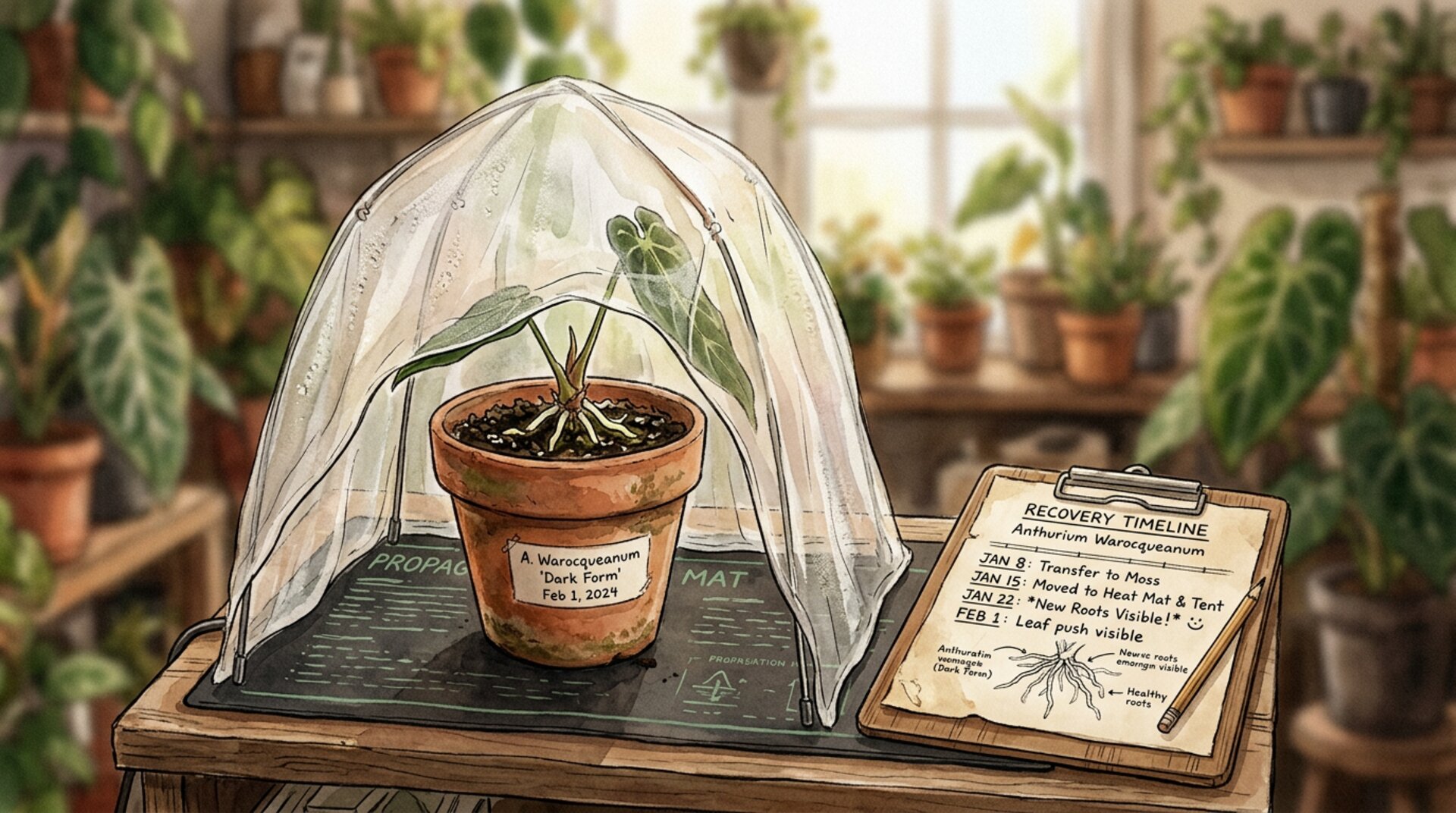
- A plant in active recovery. Use ICU Mix until the plant is pushing new growth and the roots are at least 2 inches long and lignifying.
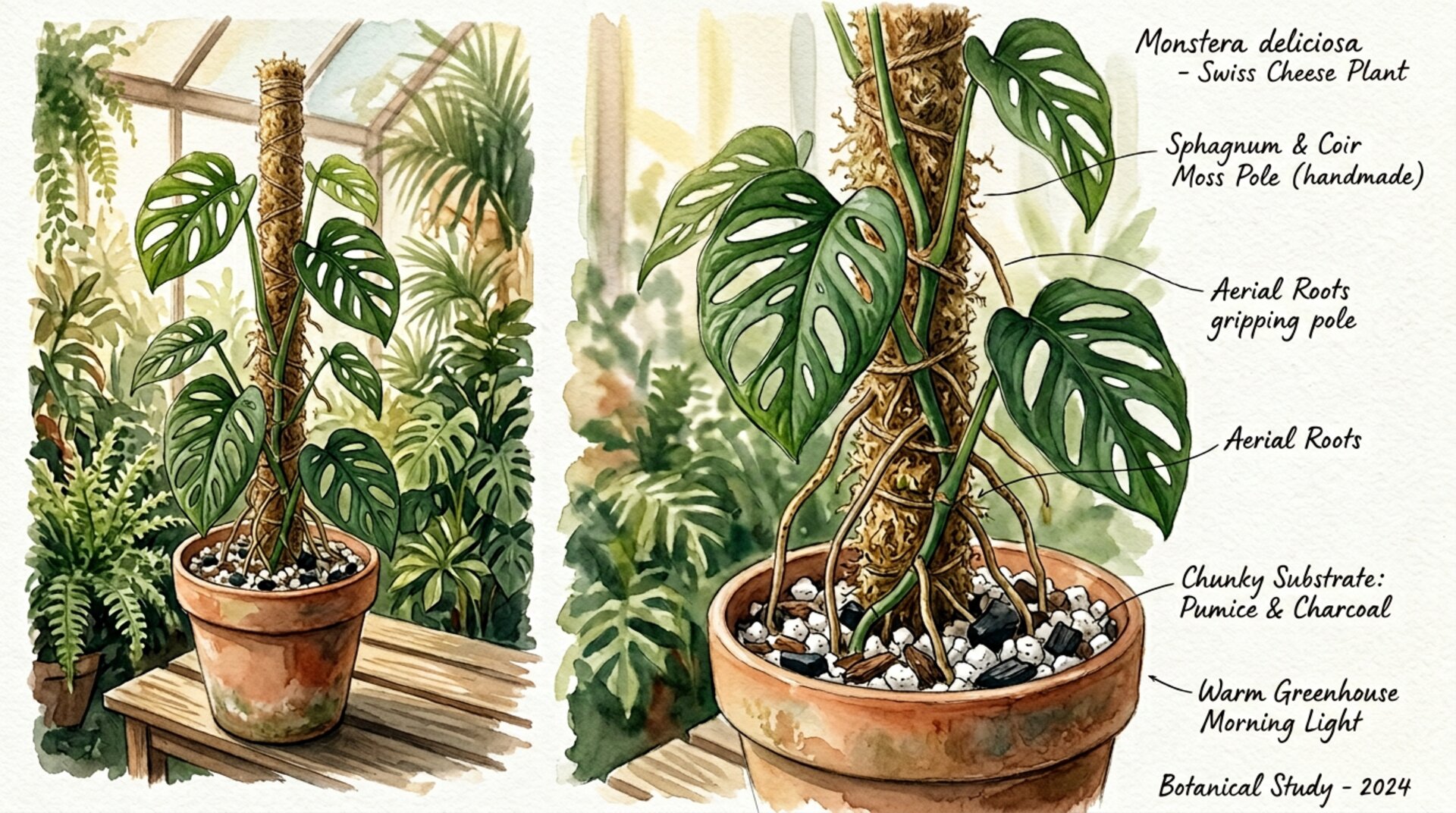
- An epiphytic climber wanting aerial root grip. The 1/4 inch pumice in SMM doesn't give aerial roots anything to grab. Aroid Mineral Mix has 1/4 to 1/2 inch charcoal chunks for this reason.
- A fresh-from-agar tissue culture plantlet. TC plants need the two-stage acclimation protocol covered in Article 6. SMM is the substrate they graduate to once Stage 2 is complete.
- A Marantaceae (Goeppertia, Calathea, Stromanthe, Ctenanthe). These want consistent moisture without anaerobic pockets, which SMM can't deliver across the watering cadence Marantaceae prefer. Article 9 covers the Goeppertia/Calathea Mix.
- A succulent, caudex, or cactus. Different gas-exchange profile entirely. Use the Gritty Mineral Mix instead.
- A water-only grower. SMM has nutrient delivery built into the castings, but it's not enough to feed a plant indefinitely without supplemental fertigation. If you'd rather not deal with liquid feed, look at our slow-release top-dress options or consider a more organic-leaning recipe (the Tropical Humus mix, for example) and accept the trade-offs.
How to use it
Pre-moisten before potting
Dry SMM is loose and dusty in the perlite-and-charcoal fraction. Add water until the mix is evenly damp but not wet. It should clump loosely in your hand and break apart when tapped. Pre-moistening gets the coir hydrated so it doesn't wick water away from the freshly potted root system on day one.
Pot size and material
Step up at most one size from the previous pot. Healthy plants don't need aspirational pot size, and over-potting in a mineral-heavy mix usually means the mix dries unevenly and the plant has stretches of roots sitting in damp, unused substrate. Terracotta is our default for SMM in 4 to 6 inch sizes; the porous walls match the dry-down rate of the mix. Glazed ceramic and plastic both work fine if you adjust watering cadence accordingly. Plastic holds water noticeably longer than terracotta in our experience.
Watering cadence
Water when the top 1 inch of substrate is dry. In a 4-inch terracotta pot at moderate indoor light (about 200 to 400 µmol/m²/s PPFD, or a bright window with no direct sun), expect a 5- to 7-day cycle. The same plant in a 4-inch injection-molded plastic pot runs a couple of days longer, since the walls don't breathe and much less water leaves through the sides. Step up to a 6-inch pot and add two or three days to either. Glazed ceramic behaves like plastic. In summer with active growth, those numbers compress; in cooler months, they stretch.
When you water, water through. Pour at the substrate surface, not the leaves, until water runs from the drainage holes. Mineral-heavy mixes don't channel the way peat-based mixes do, so a thorough soak actually saturates the mix evenly.
If you've come from a peat-based bagged-mix world, the most common SMM mistake we see is over-watering on cadence the previous mix taught you. The new cadence is shorter on individual watering events and longer between them, not the other way around. If you're watering twice a week because that's what your old fern wanted, you'll keep a Philodendron too wet on this mix.
Fertigation
A daily-driver mineral mix needs an active feeding program. Without it, the plants slowly run down.
The default is a balanced liquid feed at quarter to half label strength every other watering, targeting an applied EC of 1.0 to 1.5 mS/cm. We use a 13-13-13 or 20-10-20 base depending on growth phase. In the active growing season (typically March through October in our Bay Area conditions), every other watering. In the cooler months, every third or fourth watering as growth slows.
If you don't want to track EC, the simpler heuristic is: visible leaf production every 4 to 6 weeks is the signal that nutrition is on track. No new leaves over a 6-week stretch on an otherwise healthy plant in adequate light usually means feeding cadence has slipped.
Test runoff EC quarterly. If it climbs above 1.8 to 2.0 mS/cm, flush with plain water (3x pot volume) until runoff drops back into range.
Refresh interval
Plan to repot, even into the same size pot, every 12 to 18 months. The organic fraction in this mix breaks down over that interval. AFP at month 18 is meaningfully lower than AFP at month 1, and the watering dynamics shift accordingly. If a plant on SMM starts showing slower dry-down, mid-leaf yellowing, or a watering cycle that suddenly stretches by a few days, the mix is probably tired before the plant is.
The charcoal addition extends this window past where v4 was failing. It doesn't make the mix permanent. The Aroid Mineral Mix runs longer (2+ years) because it's almost entirely mineral; the trade-off is that AM plants need closer attention to fertigation. Choose your mix, then commit to its refresh cadence.
Common failure modes
A few things we see when growers transition to SMM from a different system:
Yellowing lower leaves three weeks after repotting. Watering cadence issue. Mineral-heavy mixes need to dry partway down between waterings. If you're keeping it consistently moist like the old peat-based mix wanted, you're leaving the roots without air.
Stalled growth despite good light. Under-fertigation. SMM is a sustained-feed mix, not a "water and forget" substrate. Move to every-other-watering quarter-strength feed for 4 to 6 weeks and watch for new leaf signal.
Salt crusting on the substrate surface. Fertigation is too concentrated, or you haven't flushed in a while. Drop fertigation to one-third strength for a month and run a 3x volume flush of plain water. Recheck runoff EC.
Mix dries faster every month. Two possibilities. One: the plant has rooted out aggressively and the substrate volume occupied by water-holding components has dropped. Repot into the next size up. Two: the organic fraction is breaking down and AFP is dropping, but the plant has compensated by drying the bulk water reservoirs faster. Refresh into new mix.
Substrate stays wet 10+ days. Either the plant isn't actively growing (light, temperature, dormancy issue), or the pot is oversized, or the mix has compacted enough that drainage is impaired. Diagnose in that order before assuming substrate failure.
When to graduate plants on or off SMM
Plants come onto SMM from:
- ICU Mix, after a 4 to 6 week recovery and the plant is pushing new growth.
- TC Acclimation Stage 2, once the plantlet is autotrophic with established roots.
- Bagged commercial mixes, at the next routine repot.
Plants come off SMM toward:
- Aroid Mineral Mix if they've started climbing aggressively or if aerial roots are demanding chunkier structure.
- Goeppertia/Calathea Mix if they're a Marantaceae you misclassified as a generic tropical.
- ICU Mix if they're in active distress (root rot, pest collapse, dramatic leaf loss).
If a plant has been on SMM for years, growing well, and showing no signs of stress, the right move is just to refresh into fresh SMM at the 12 to 18 month mark. Some plants happily live on this mix for their entire collection life, and they're not the problem.
The short version
Sixty percent mineral, forty percent organic, five percent fine charcoal. The castings proportion and the mineral fraction are both ours, arrived at by trial across the collection rather than read off a paper. Buffered coir for water and CEC. Castings for nutrients and microbes. Charcoal against the sour pockets that were ending v4 early. Quarterly EC checks, every-other-watering quarter-strength feed in growing season, refresh every 12 to 18 months.
It's the substrate most plants in our collection live in most of the time, and it's the one we recommend to collectors who want a single mix that handles the bulk of a healthy aroid collection without species-by-species tuning.
Altland, J.E., Owen, J.S., & Gabriel, M.Z. 2011. Influence of pumice and plant roots on substrate physical properties over time. HortTechnology 21(5): 554–557. [link]
Abad, M., Noguera, P., Puchades, R., Maquieira, A., & Noguera, V. (2002). Physico-chemical and chemical properties of some coconut coir dusts for use as a peat substitute for containerised ornamental plants. Bioresource Technology, 82(3), 241–245. https://doi.org/10.1016/S0960-8524(01)00189-4
Du, C.-L., Wang, J.-D., Chu, P.-C., & Guo, Y. L. (2010). Acute expanded perlite exposure with persistent reactive airway dysfunction syndrome. Industrial Health, 48(1), 119–122. https://doi.org/10.2486/indhealth.48.119 [Cited for the exposure magnitude in the reported incident, not for any effect at hobbyist scale.]
Saeed, M. B., Alnasser, A., Alaruk, N., Algrwai, A., Aloudah, S., Al-Eid, S., & Laing, M. (2026). Biocontrol potential of three bacterial strains, isolated from vermicompost, against pre-emergence damping-off of tomato caused by Rhizoctonia solani, under laboratory and greenhouse conditions. Microorganisms, 14(2), 371. https://doi.org/10.3390/microorganisms14020371 [Cited for the isolation of Bacillus from vermicompost. The senior author runs a biocontrol commercialisation programme and the paper's stated aim includes commercialising these strains.]
Argo, W.R. 1998. Root medium physical properties. HortTechnology 8(4): 481–485. [link] [A review rather than primary research; figures taken from it are chain citations. Author affiliation: Blackmore Company, a commercial growing-media supplier.]
Bilderback, T. E., Warren, S. L., Owen, J. S., & Albano, J. P. (2005). Healthy substrates need physicals too! HortTechnology, 15(4), 747–751. https://doi.org/10.21273/HORTTECH.15.4.0747
Bilderback, T., Boyer, C., Chappell, M., Fain, G., Fare, D., Gilliam, C., Jackson, B. E., Lea-Cox, J., LeBude, A. V., Niemiera, A., Owen, J., Ruter, J., Tilt, K., Warren, S., White, S., Whitwell, T., Wright, R., & Yeager, T. (2013). Best management practices: Guide for producing nursery crops (3rd ed.). Southern Nursery Association.
de Boodt, M., & Verdonck, O. (1972). The physical properties of the substrates in horticulture. Acta Horticulturae, 26, 37–44. https://doi.org/10.17660/ActaHortic.1972.26.5
Atiyeh, R. M., Edwards, C. A., Subler, S., & Metzger, J. D. (2000). Earthworm-processed organic wastes as components of horticultural potting media for growing marigold and vegetable seedlings. Compost Science & Utilization, 8(3), 215–223. https://doi.org/10.1080/1065657X.2000.10701994