Fall really is the better time to put a native, a perennial, a shrub, or a tree in the ground here. But the reason you usually get is wrong at the depth your plants actually root, and the real one is smaller and more useful than the story it replaces.
Every fall the same advice comes around, and it goes something like this. Plant now, because the soil is still holding summer's heat. Roots will keep growing all winter in that warm ground while the top of the plant sleeps. By June your plant is established and ready for the dry season.
The advice is right. Of the four claims holding it up, one is wrong outright and two are pointed at the wrong thing.
Fall really is the better time to put most things in the ground here, and there's a solid stack of field trials behind that. But the mechanism people repeat isn't the mechanism, and we'd rather hand you the version that survives checking. It's more useful anyway. Once you know what's actually going on below ground, you'll make better calls about what to plant, when to plant it, and what to do in the six months after.
The Claim, and What's Wrong With It
Here's the standard argument, broken into its four parts:
- Soil holds summer's warmth deep into autumn.
- Warm soil keeps roots growing while cool air puts the top of the plant to sleep.
- Winter rain waters the plant for you.
- A plant that roots in over winter builds a better root-to-shoot ratio and survives its first dry summer.
Claim 1 is wrong at the depth your plants root in. Claim 2 describes something real but gets the cause wrong. Claim 3 is right about the rain and wrong about what it does for you. Claim 4 measures the wrong variable, and the right one turns out to be easier to act on. All four need work. Fall planting still wins, for different reasons than the ones you've been handed.
Everything below is about plants that will still be in the ground next July: natives, perennials, shrubs, and trees. The whole argument turns on getting established before the first dry summer.
A fall vegetable bed is a different question with a better-settled answer. Cool-season crops go in now to be picked through winter and spring, and they never meet the summer this article is about. That bed runs on its own logic: sowing windows, the point in the season when daylight rather than warmth becomes the limit, and which crops repay the space. The Guild handles it as its own subject. Garlic and fall-sown wildflowers run on separate triggers again, and aren't covered here.
The Rain, and What It Actually Does
Everything so far could have been written about Virginia. This part couldn't.
California has a Mediterranean climate: the rain and the growing warmth arrive at opposite ends of the year. At the San Jose gauge, 82% of the annual precipitation falls between November and March, and June through August normal 0.21 inches. Of the roughly 38 days a year with a tenth of an inch or more, about 30 land in that same five-month block. Miller (1999) reported the 82% for the National Weather Service; the 1991–2020 normals for the same gauge return 82.3% thirty years later (National Oceanic and Atmospheric Administration, n.d.). One station, read twice, holding steady.
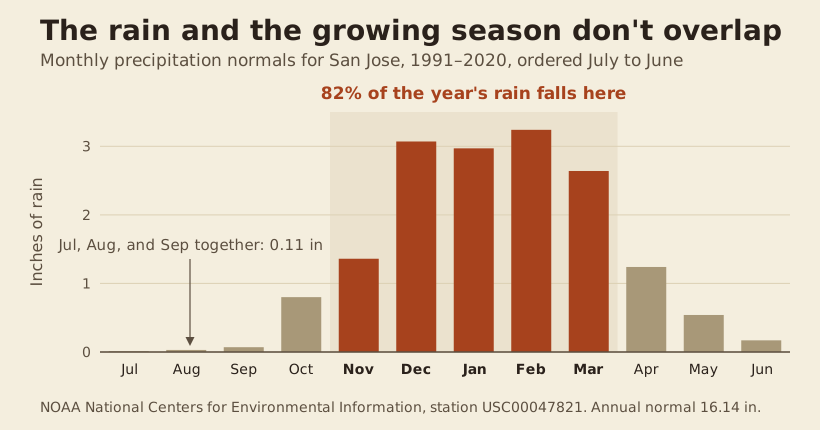
So an autumn planting goes into the ground at the front of the wet season instead of the front of the dry one. That much is just the calendar. What it buys you is narrower than the usual claim.
In semi-arid central Spain, 800 holm oak seedlings were left to natural rainfall or given dry-season irrigation. Survival was 53% on rainfall alone against about 93% with irrigation (Rey Benayas, 1998). Most of the losses came after the first dry season. Worth knowing that shading alone performed as well as irrigation alone, so some of that is about evaporative demand rather than water supply. Different country, drier site, one species. But it's the cleanest test available of "the rain will handle it," and the rain did not handle it.
There's a second problem. The folk version has rain soaking the bed while roots spread out into it all winter. In the one trial that measured it, they didn't: those fringe trees kept everything inside the original rootball until early July (Harris et al., 1996). And a container plant's coarse mix, set into finer garden soil, tends to drain into the bed rather than draw from it, so it can need more water after planting than it did in the nursery (Harris & Bassuk, 1993). That's a Virginia winter and a general principle, not a measurement in a Santa Clara bed. But it retires the picture of roots drinking their way through a wet one.
What survives is better, and it's specific to this climate.
- The rain falls on the rootball, not just the bed. The ball sits in the footprint of the storm, and it's being wetted at the season when the plant is losing almost nothing to the air. That's the same delivery a hose makes, at a fraction of the demand.
- Winter is the only thing that charges the soil your roots will reach next summer. April through September normal is 2.06 inches across six months; July and August together, 0.04. Nothing refills that profile between the last spring storm and the following autumn. When roots finally cross the rootball boundary in early summer, the water they find down there was put there by winter. Plant in spring and you skip the filling.
That second one is the best answer this article has to "why here rather than anywhere," and it lines up with the first-summer survival evidence below.
The handover isn't clean. That same station averages 3.4 days of meaningful rain in November, against 6.3 in December and 6.7 in January. In a Florida irrigation trial, container trees died when watering dropped from twice a week to once (Gilman et al., 1998), and November's rain frequency sits below that failure rate. December onward is close to the schedule that worked. So the rain takes over around December, not the day you plant. Water a new fall planting yourself through October and November, on the rootball, and let the season pick it up from there.
And a five-month average oversells the reliability. Across 131 years on the Central Coast, roughly one autumn in four delivered under four inches from October through December, and one in eleven under two; the driest managed 0.80 inches. Most of California's annual precipitation arrives on five to fifteen wet days (Dettinger et al., 2011). That's a climate assembling its year from a handful of storms, and occasionally forgetting to. Plan for the average and keep a hose reachable for the other years.
What the Soil Is Doing, Briefly
Claim 1 says the soil holds summer's warmth deep into autumn. It doesn't, at the depths your plants occupy.
Fit an annual curve to three years of a California soil-temperature record and the peak arrives nine days behind the air at 8 inches, seventeen days behind at 20 (U.S. Department of Agriculture, Natural Resources Conservation Service, n.d.). Weeks, not months. A three-month lag would need roughly ten feet of depth. What is true, and more useful, is that the whole cycle is shifted, so at any given air temperature autumn soil runs warmer than spring soil, roughly 4.5 to 8.2 °F warmer at 8 inches. Two days that read the same on a weather app are not the same day underground.
That's the short version, and it's all this argument needs. If you want the record, the arithmetic, the three charts, and the four things the data can't tell you, that's the companion piece: What the Soil Is Actually Doing in Autumn.
The part that matters here is smaller and duller than the folklore. At both depths, in all three years, the soil stayed above the roughly 41 °F floor where root growth slows. Our winters don't shut the root zone down. That's the permission slip for everything below.
Roots and Shoots Run on Different Clocks
The second claim, that roots keep growing while the top of the plant goes quiet, is real. The evidence comes from three directions.
- Willow oak seedlings, grown in pots with a clear side for photographing roots. Soil held at 59 °F (15 °C), or brought down to 50 or 41 °F (10 or 5 °C) in late fall. In the pots that stayed at or above 41 °F, roots kept elongating through winter after stem elongation had stopped (Kressuk et al., 2025).
- European beech, eight sites. 40% more root-length density at the start of winter and 51% more at the end than in summer, with summer losses made up during autumn (Garthen et al., 2025).
- NC State's extension handbook. Root growth "can occur" even when the foliage looks dormant, and 40 °F is the floor for woody plants taking up nutrients (Bradley & Fair, 2022). Two separate statements in the source, worth keeping separate, though 40 °F and Kressuk's measured 41 °F landing that close is worth noting.
Then there's the part that usually gets left out. Tracked through winter, below-ground wood growth in four deciduous species did not stop, while stem wood growth halted in autumn regardless of species or location, and the authors report no clear temperature constraint on the below-ground growth, even below 37 °F (3 °C) (Marchand et al., 2025). That's absence of evidence rather than proof of no constraint. But if roots keep laying down wood at 37 °F, autumn root activity is running on the plant's own schedule, not on leftover soil warmth.
So claim 2 comes down to this: roots and shoots run on separate schedules, and soil above about 41 °F lets roots keep working. Warm soil is a permitting condition. Calling it the cause goes further than the research supports.
Which is why our winter minima matter. Where soil genuinely gets cold the picture inverts: three alpine species in cold substrate finished with root length 83% shorter while their above-ground biomass was barely affected (Nagelmüller et al., 2016). In cold ground the roots stall well before the top does. Ours doesn't get cold enough for that, which makes this a regional argument rather than a universal one.
One caution on how far it generalizes. The willow oak authors flag their own species as unlike most temperate species measured. And for the herbaceous perennials people actually plant, I couldn't find a published set of cardinal temperatures at all; the cleanest one available is for corn (Walne & Reddy, 2022).
What the Planting Trials Found
Set the mechanism aside and ask what happened when researchers planted the same stock in fall and in spring and watched. Fall wins in most of them.
- Southeast Spain, 2,400 holm oak seedlings, four sites. October against February, crossed with weeded against unweeded. October plus weeding was best, February unweeded worst, and the October advantage was larger at the colder sites (Navarro et al., 2024).
- Greece, sweet chestnut and Hungarian oak, four planting dates. The chestnuts planted in December and January were significantly less water-stressed than the February and March ones (Radoglou et al., 2003). Two qualifiers: that's the chestnut's result, not both species', and December against March is winter against late winter.
- Spain again, holm oak. Best two-year survival, 61%, needed high-quality seedlings and an early planting date and subsoiling together (Palacios et al., 2009). That figure often gets quoted as if the date earned it alone.
- Virginia, fringe trees, balled and burlapped. Planted November 11, they finished the following summer with more leaf area, wider canopies, and more new-root mass than December or March plantings (Harris et al., 1996).
- Boreal Finland, Scots pine and Norway spruce. Autumn-planted stock put on more shoot growth over two years, even though root growth there stopped hard after mid-September (Luoranen, 2018). Different climate, same direction.
In that first trial, weeding mattered more than planting date for both survival and growth (Navarro et al., 2024). If you take one practical thing from the trial literature, take that one. It's the only study here that crossed weeding with planting date, and weeding won.
In that same fringe tree study, no root growth occurred beyond the original rootball until about early July, one month after bud set, in any treatment (Harris et al., 1996). Fall planting won, but not because the trees spent winter pushing roots out into the surrounding soil. They didn't, in any treatment. The authors' own conclusion is that first-season watering should target the rootball rather than the soil around it. If you water a new fall planting, water the rootball.
Two results complicate the picture. Bare-root scarlet oak and Turkish hazelnut transplanted poorly in early fall as well as late spring, doing well only in early spring and mid fall, while green ash and tree lilac were fine at every date (Harris & Bassuk, 1994). Species matters, and so does where in the season you land. And a seedling's capacity to push new roots after planting peaks once its chilling requirement is satisfied, then declines (Ritchie & Dunlap, 1980). That peak falls in late winter, which is a real tension with any pure fall-is-best argument. For the survey rather than the individual trials, there's a review of transplant timing in temperate climates (Richardson-Calfee & Harris, 2005).
This Trial Hasn't Been Run in California, So Far as We Can Find
I could not find a controlled trial comparing fall and spring planting of nursery stock in California. Not in the horticultural literature, not in the restoration literature, not in the federal forestry literature. The Mediterranean-climate trials above are all from Spain or Greece.
That gap isn't for want of a research program. The California oak establishment literature I could reach runs to trials on acorn collection date, storage, sowing date, acorn size, top-pruning, augering, fertilization, radicle pruning, tree shelters, and grazing. Planting season for seedlings doesn't appear in it. The nearest California work uses seed rather than transplants.
- Blue and valley oak acorns, sown monthly November through March. The earlier they went in, the earlier they emerged and the taller they grew, with a survival penalty confined to the last sowing date (McCreary, 1990). One confound worth naming, since this is the closest California evidence we have: the February and March sowings each got a one-time watering the three earlier ones didn't, at exactly the end of the series where the penalty shows up.
- Bare-root blue oak, the companion study. Same directional result for planted stock (McCreary & Tecklin, 1994). But its earliest treatment went in during December, so there's no autumn arm, and planting date is tangled up with lifting date and storage duration.
Both point the same way as the Spanish and Greek trials. Neither is the experiment.
So: fall planting is supported by consistent evidence from comparable climates, by converging physics, and by California work on seed. It is not supported by a California trial on nursery stock. Stated any more firmly than that, it's confidence filling a gap.
There's a second gap underneath, and it's the bigger one. The argument runs as a chain: plant in autumn, get deeper roots by June, survive the first dry summer. Each link has evidence behind it. I couldn't find a study that tested the chain end to end. That's weaker than a demonstrated mechanism, and you should weigh it that way.
What Gets a Plant Through Its First Dry Summer
Claim 4 said a fall-planted plant builds a better root-to-shoot ratio and therefore survives its first dry summer. The paper that tested exactly that found the opposite.
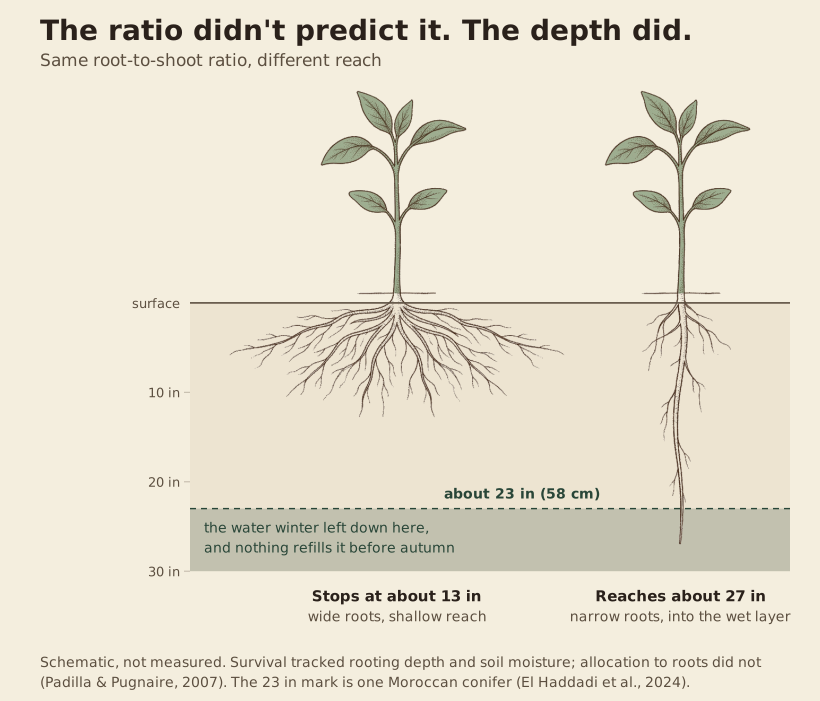
Across five Mediterranean woody species, survival tracked maximum rooting depth and soil moisture: those with roots down in moist layers rode out prolonged drought, those with shallow roots didn't. And explicitly, biomass allocation to roots was not related to establishment success (Padilla & Pugnaire, 2007).
There's a genuine disagreement here. An earlier five-year study across 11 species in Spanish shrubland did find survival correlated with root allocation and seed size (Lloret et al., 1999). But its metric was an allometric slope across species rather than a ratio for any individual plant, it never measured rooting depth, and the authors tie the association to one relatively moist summer. Padilla measured the variable Lloret didn't, and found it did the explaining. Our read, and it's a read rather than a published finding, is that depth is causal and allocation is a noisy proxy for it.
Either way, the practical framing changes: plan for rooting depth, not for a ratio. For a sense of scale, Tetraclinis articulata (the sandarac tree) in semiarid Morocco needed roots past about 23 inches (58 cm) to reach the wettest soil layers eleven months after planting (El Haddadi et al., 2024). One species, one conifer, North Africa. A scale, not a target.
And a reality check from closer to home. In southern California shrubland that had flipped from native cover to weedy annual grass, nine months of supplemental irrigation produced only slightly higher survival after 2.5 years; what separated the plantings was species. Among the irrigated plants, California sage scrub survived at 68% against 11% for chaparral, and the authors conclude supplemental irrigation may not be necessary to hit restoration goals (Underwood et al., 2026). That comparison covered 8 of the 18 species, not all. Even so: what you choose will matter more than how you babysit it.
What to Do This Fall
Everything above collapses into a short list.
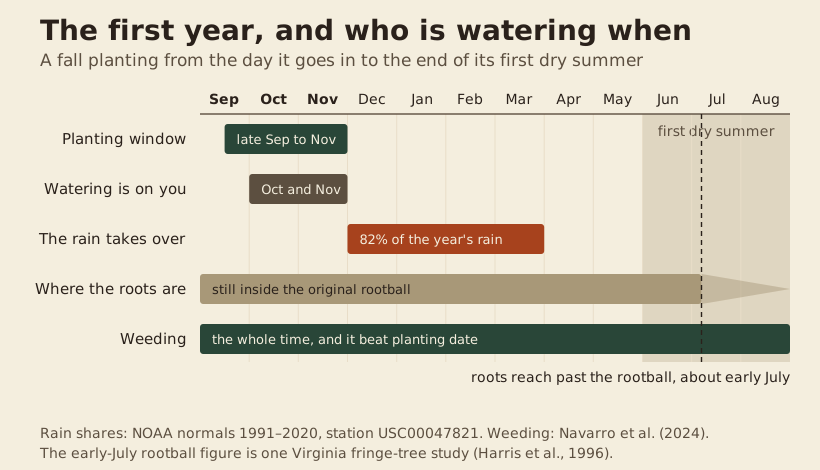
- Plant from late September through November. You're not chasing residual summer warmth. You're planting into ground measurably warmer than it will be at the same air temperature in spring, at the front of the wet season rather than the front of the dry one.
- Water it yourself through October and November. The rain doesn't reliably take over until about December, and November averages only 3.4 days of meaningful rain. Water the rootball, not the bed, and don't stop because it drizzled.
- Weed, and keep weeding. This is the highest-value thing on the list, and it beat planting date in the trial that tested both. Clear the ground before you plant and keep it clear through the first wet season.
- Water the rootball, not the bed. New roots stay inside the original ball far longer than the folklore suggests. Aim the hose where the roots actually are.
- Choose for the site before you optimize the timing. Species choice outperformed nine months of irrigation in a California restoration trial. Right plant, right place, then worry about the calendar.
- A soil thermometer helps less than you'd hope. Use it as a relative check rather than against a fixed number: take a reading at 8 inches through late summer, and plant once it has clearly come down off its summer plateau. Read at the same time of day each time, since a mid-afternoon number runs warmer than a dawn one. Don't wait for a cold threshold to close the window for you. At the reference station the soil at that depth stayed above the 41 °F floor in all three years, bottoming out at 43 °F, and the Santa Clara Valley is milder still.
- Adjust for what you're planting. A few woody species do worse in early fall than at any other time. Scarlet oak and Turkish hazelnut both struggled there in the bare-root trial above. Mid fall is the safer default for trees and shrubs. Cool-season vegetables run on a different clock entirely, and they have their own page: the Santa Clara County planting calendar gives sowing and transplant windows for eighty crops, worked out from the same kind of measured record this article draws on.
What This Comes Down To
Fall planting works here. Autumn ground is warmer than spring ground under the same air temperature. Roots keep working on their own schedule, and our soil stays above the roughly 41 °F floor all winter. And the coming rain will fill the soil your roots reach next July, which is the one thing about this that's genuinely Californian.
What it doesn't do is hold summer's heat. The soil follows the air down about nine days behind it at 8 inches and two and a half weeks at 20, and by November it's been cooling for months along with everything else. That's a smaller claim than the one you usually get, and it's the one that holds up when you go check.
Plant in fall because autumn ground is warmer than spring ground at the same air temperature. Then go pull the weeds, because that mattered more than the timing did.
Bradley, L., & Fair, B. (2022). Woody ornamentals (Chapter 11). In K. A. Moore & L. K. Bradley (Eds.), North Carolina Extension gardener handbook (2nd ed., Publication AG-831). NC State Extension. https://content.ces.ncsu.edu/extension-gardener-handbook/11-woody-ornamentals
[University of California source: see note below] Dettinger, M. D., Ralph, F. M., Das, T., Neiman, P. J., & Cayan, D. R. (2011). Atmospheric rivers, floods and the water resources of California. Water, 3(2), 445–478. https://doi.org/10.3390/w3020445
El Haddadi, R., El Mekkaoui, A., & Douira, A. (2024). Linking field performance to initial morphological traits of thuja seedlings in a semiarid Mediterranean area. Forestry Studies, 81(1), 62–78. https://doi.org/10.2478/fsmu-2024-0014
Garthen, A., Brandt, K., Klisz, M., Malyshev, A. V., Peters, B., Weigel, R., & Kreyling, J. (2025). Seasonal dynamics of fine root length in European beech: Unveiling unexpected winter peaks and summer declines. Oecologia, 207(2), Article 31. https://doi.org/10.1007/s00442-025-05670-y
Gilman, E. F., Black, R. J., & Dehgan, B. (1998). Irrigation volume and frequency and tree size affect establishment rate. Journal of Arboriculture, 24(1), 1–9. https://doi.org/10.48044/jauf.1998.001
Harris, J. R., & Bassuk, N. L. (1993). Tree planting fundamentals. Journal of Arboriculture, 19(2), 64–70.
Harris, J. R., & Bassuk, N. (1994). Seasonal effects on transplantability of scarlet oak, green ash, Turkish hazelnut and tree lilac. Journal of Arboriculture, 20(6), 310–317. https://doi.org/10.48044/jauf.1994.055
Harris, J. R., Knight, P., & Fanelli, J. (1996). Fall transplanting improves establishment of balled and burlapped fringe tree (Chionanthus virginicus L.). HortScience, 31(7), 1143–1145. https://doi.org/10.21273/HORTSCI.31.7.1143
Kressuk, J. M., Collins, J. T., Gardiner, E. S., Bataineh, M. M., & Babst, B. A. (2025). Willow oak (Quercus phellos) seedling roots continue respiration and growth during fall and winter in a soil temperature-dependent manner. Tree Physiology, 45(1), Article tpae154. https://doi.org/10.1093/treephys/tpae154
Lloret, F., Casanovas, C., & Peñuelas, J. (1999). Seedling survival of Mediterranean shrubland species in relation to root:shoot ratio, seed size and water and nitrogen use. Functional Ecology, 13(2), 210–216. https://doi.org/10.1046/j.1365-2435.1999.00309.x
Luoranen, J. (2018). Autumn versus spring planting: The initiation of root growth and subsequent field performance of Scots pine and Norway spruce seedlings. Silva Fennica, 52(2), Article 7813. https://doi.org/10.14214/sf.7813
Marchand, L. J., Gričar, J., Zuccarini, P., Dox, I., Mariën, B., Verlinden, M., Heinecke, T., Prislan, P., Marie, G., Lange, H., Van den Bulcke, J., Peñuelas, J., Fonti, P., & Campioli, M. (2025). No winter halt in below-ground wood growth of four angiosperm deciduous tree species. Nature Ecology & Evolution, 9(3), 386–394. https://doi.org/10.1038/s41559-024-02602-6
[University of California source: see note below] McCreary, D. D. (1990). Acorn sowing date affects field performance of blue and valley oaks. Tree Planters’ Notes, 41(2), 6–9. https://rngr.net/publications/tpn/41-2/acorn-sowing-date-affects-field-performance-of-blue-and-valley-oaks
[University of California source: see note below] McCreary, D. D., & Tecklin, J. (1994). Lifting and storing bareroot blue oak (Quercus douglasii) seedlings. New Forests, 8(2), 89–103. https://doi.org/10.1007/BF00028187
Miller, M. (1999). Climate of San Jose (NOAA Technical Memorandum NWS WR-259). National Weather Service Forecast Office, San Diego, CA. https://www.weather.gov/media/mtr/climate/SJC_CLIMATE.pdf
Nagelmüller, S., Hiltbrunner, E., & Körner, C. (2016). Critically low soil temperatures for root growth and root morphology in three alpine plant species. Alpine Botany, 126(1), 11–21. https://doi.org/10.1007/s00035-015-0153-3
Navarro, F. B., Caño, A. B., Gálvez, C. R., Kazani, A., Carbonero, M. D., Ripoll, M. Á., & Jiménez, M. N. (2024). Interaction between weeding, outplanting date and site in open oak woodland plantations. Forest Ecology and Management, 554, Article 121649. https://doi.org/10.1016/j.foreco.2023.121649
Padilla, F. M., & Pugnaire, F. I. (2007). Rooting depth and soil moisture control Mediterranean woody seedling survival during drought. Functional Ecology, 21(3), 489–495. https://doi.org/10.1111/j.1365-2435.2007.01267.x
Palacios, G., Navarro Cerrillo, R. M., del Campo, A., & Toral, M. (2009). Site preparation, stock quality and planting date effect on early establishment of holm oak (Quercus ilex L.) seedlings. Ecological Engineering, 35(1), 38–46. https://doi.org/10.1016/j.ecoleng.2008.09.006
Radoglou, K., Raftoyannis, Y., & Halivopoulos, G. (2003). The effects of planting date and seedling quality on field performance of Castanea sativa Mill. and Quercus frainetto Ten. seedlings. Forestry, 76(5), 569–578. https://doi.org/10.1093/forestry/76.5.569
Richardson-Calfee, L. E., & Harris, J. R. (2005). A review of the effects of transplant timing on landscape establishment of field-grown deciduous trees in temperate climates. HortTechnology, 15(1), 132–135. https://doi.org/10.21273/HORTTECH.15.1.0132
Rey Benayas, J. M. (1998). Growth and survival in Quercus ilex L. seedlings after irrigation and artificial shading on Mediterranean set-aside agricultural land. Annales des Sciences Forestières, 55(7), 801–807. https://doi.org/10.1051/forest:19980704
Ritchie, G. A., & Dunlap, J. R. (1980). Root growth potential: Its development and expression in forest tree seedlings. New Zealand Journal of Forestry Science, 10(1), 218–248. https://www.scionresearch.com/__data/assets/pdf_file/0005/59243/NZJFS1011980RITCHIE218_248.pdf
[University of California source: see note below] Underwood, E. C., Pratt, R. B., Jacobsen, A. L., Molinari, N. A., Lesage, J., Brehm, N., Knapp, D., Dewees, S., Mateiro, A., & Chavez, E. (2026). Factors affecting early plant survival in restoration of Mediterranean-type climate shrublands. Conservation Science and Practice, 8(7), Article e70318. https://doi.org/10.1111/csp2.70318
U.S. Department of Agriculture, Natural Resources Conservation Service. (n.d.). Soil Climate Analysis Network (SCAN) site 2234, Vallecitos, San Benito County, California: Daily soil and air temperature, 2023–2025 [Data set]. National Water and Climate Center. Retrieved August 30, 2026, from https://wcc.sc.egov.usda.gov/nwcc/site?sitenum=2234&state=ca NRCS flags this record provisional. The lag and spring/autumn figures quoted here are The Planters’ Guild’s own arithmetic on that file; the full method and its limits are set out in the companion piece.
National Oceanic and Atmospheric Administration, National Centers for Environmental Information. (n.d.). U.S. monthly climate normals, 1991–2020: Station USC00047821, San Jose, CA [Data set]. Retrieved August 30, 2026, from https://www.ncei.noaa.gov/access/us-climate-normals/ The seasonal shares and rain-day counts quoted in this article are The Planters’ Guild’s own arithmetic on the published monthly normals. The October–December autumn statistics come from the same agency’s Climate at a Glance divisional series for California Climate Division 4, 1895–2025, and are also our own arithmetic.
Walne, C. H., & Reddy, K. R. (2022). Temperature effects on the shoot and root growth, development, and biomass accumulation of corn (Zea mays L.). Agriculture, 12(4), Article 443. https://doi.org/10.3390/agriculture12040443
Note on University of California sources. The Guild’s standing practice is to source from peer-reviewed literature, standards bodies, non-UC extension services, and botanical institutions first, and to disclose any University of California source it uses. Four appear above. McCreary (1990) and McCreary & Tecklin (1994) are the nearest California work that exists to the question this article asks, and naming them is what lets us state the gap precisely rather than in a form a knowledgeable reader could falsify. Underwood et al. (2026) has a UC Davis first author and a UC Santa Barbara co-author among ten; the remaining eight are CSU Bakersfield, the USDA Forest Service, and Santa Barbara Botanic Garden. Dettinger et al. (2011) carries a Scripps Institution of Oceanography affiliation, which is UC San Diego, on three of its five authors; the lead author’s primary employer is the U.S. Geological Survey and the venue is an independent open-access journal.