A reader asked us to take on the chunky aroid mix for Alocasia. It's a fair target. One retail guide we found recommends a single chunky recipe for the whole aroid family on the grounds that aroids climb trees, and Alocasia doesn't climb.
Corrected September 2026: we've revised parts of this guide. See the correction note at the end.
A family word doing a genus job
Some aroid advice comes as one potting recipe for the whole family. Soltech's "classic" aroid blend, for example, is three parts orchid bark, two parts coconut coir, two parts perlite, one part horticultural charcoal and half a part worm castings. The same guide calls its mix ideal for the Araceae family, Alocasia included (Soltech Solutions, n.d.).
The reasoning it gives is about climbing. The guide says most indoor aroids, Alocasia among them, are epiphytic or hemiepiphytic (growing on trees for all or part of their lives) and climb trees in the wild, and that its large bark chunks "mimic the natural environment where aroids climb."
Araceae is a big family to share one recipe. Kew's World Checklist of Vascular Plants counts 151 genera and 4,890 accepted species in it (Govaerts et al., 2021). The family includes floating water plants such as the duckweeds and many climbers, and it probably originated in more or less marshy habitats (Stevens, 2001 onwards). So knowing a plant is an aroid tells you little about how it grows, and not much about what to pot it in.
Not every source agrees on what Alocasia should grow in. The Royal Horticultural Society suggests peat-free houseplant compost, or peat-free multi-purpose compost with horticultural grit at about three parts compost to one part grit (Royal Horticultural Society, n.d.). NC State Extension describes a shaded site with moist, well-drained, humus-rich, fertile loam, and notes the plant tolerates a wide range of soils (North Carolina State Extension, n.d.). Brigham Young University's greenhouse page for African mask, a hybrid Alocasia, lists a well-draining potting mix, with orchid bark or perlite as optional additions (Brigham Young University Life Science Greenhouse, n.d.).
Where Alocasia actually grows
Kew's checklist gives the genus a native range of tropical and subtropical Asia to eastern Australia (Govaerts et al., 2021). Nauheimer and colleagues describe the typical habitat as the understory of very wet lowland forest, with only a few species growing above about 3,300 feet (1,000 m) or in forest gaps, clearings and secondary growth (Nauheimer et al., 2012).
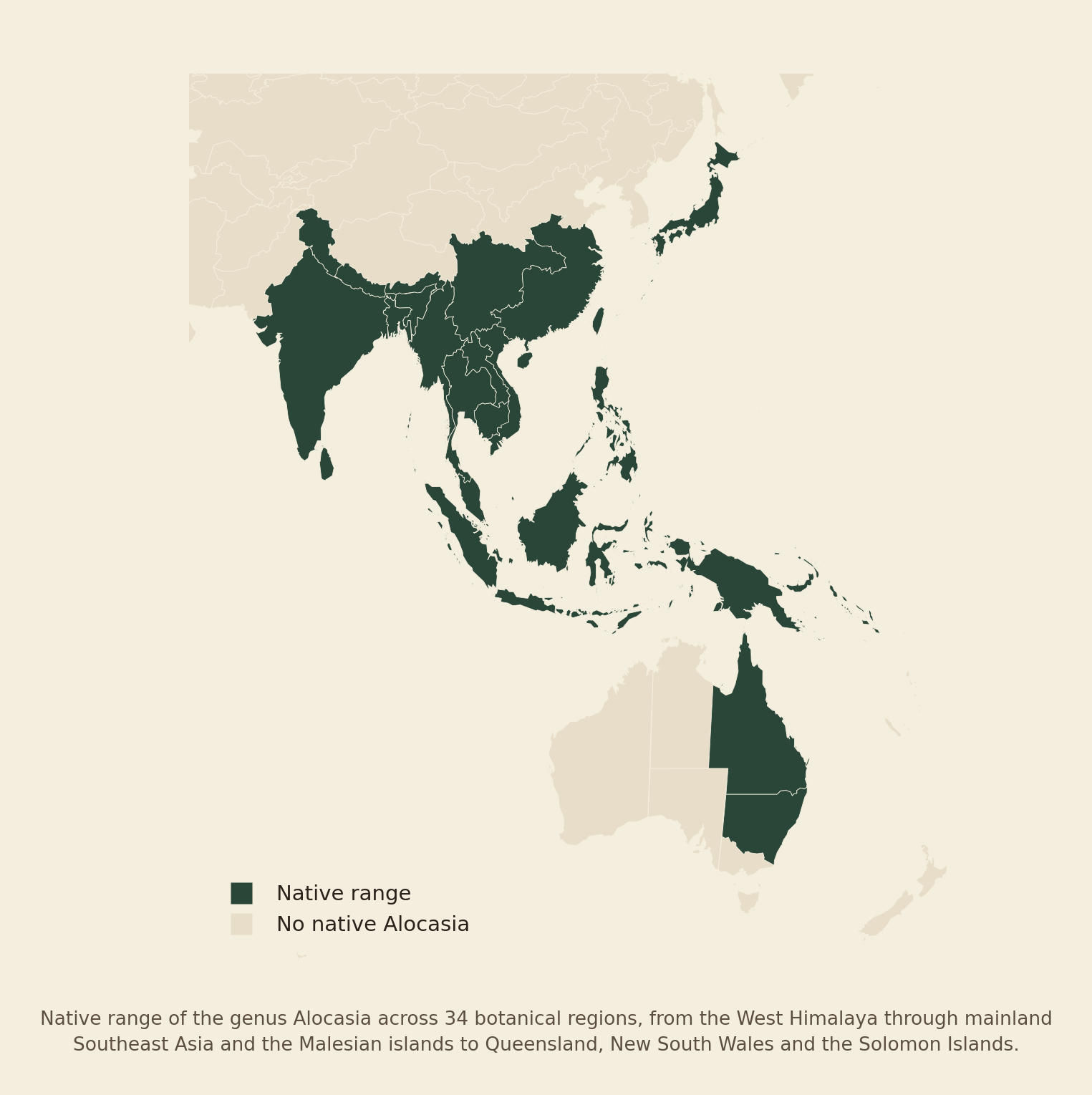
The monograph for West Malesia and Sulawesi fills in the variety (Hay, 1998). Hay describes Alocasia as terrestrial or rock-dwelling herbs, from massive, sometimes tree-like plants to small creeping ones, found in old-growth and secondary forest, young regrowth and open swamps. Some species prefer or are restricted to swampy ground, others to well-drained sites, and six in the region are confined to limestone. The giant species turn up in open places such as forest gaps, landslips, riverbanks, swamps and roadsides, while the smaller ones are generally found within forest.
One caveat: Kew's checklist does code one species, A. vietnamensis, as an epiphyte (Govaerts et al., 2021).
In most if not all species, Hay writes, the rhizome produces short, slender runners at or below soil level, branched or unbranched, ending in more or less rounded cormels (small, bulb-like offsets) that can stay dormant for long periods.
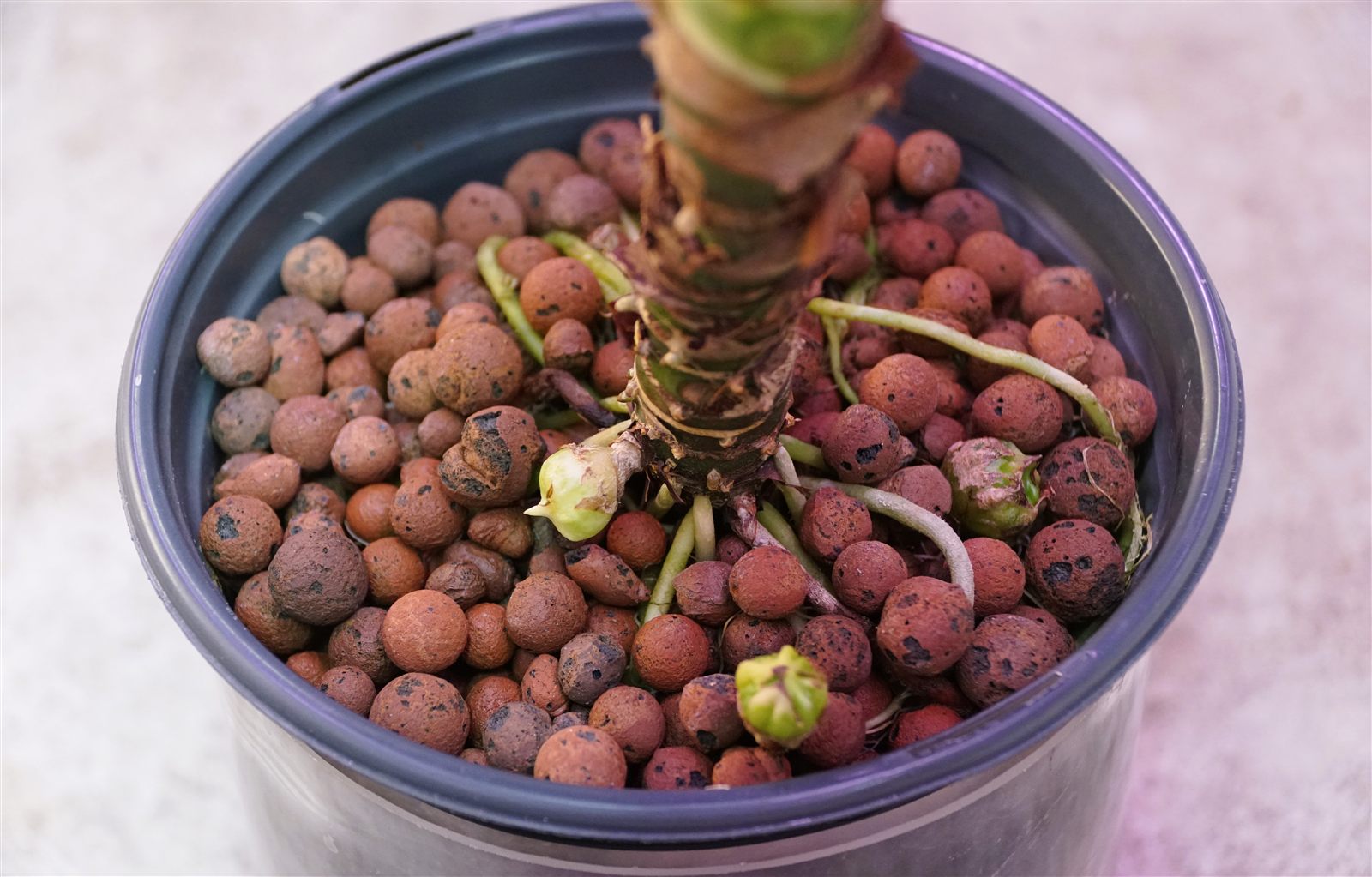
Species counts change, so these carry their years. Nauheimer and colleagues counted 113 Alocasia species in 2012, with 27 more awaiting description (Nauheimer et al., 2012). Kew's checklist lists 92 accepted names in 2026, one of them a hybrid (Govaerts et al., 2021).
What the climbers are doing instead
Several other aroid genera do climb. Croat (1981) writes that "all species of Syngonium are climbers and generally hemiepiphytic." Monstera deliciosa starts on the ground and grows up tree trunks, with roots from the stem nodes that help it climb (National Parks Board Singapore, n.d.). Kew's checklist codes every Epipremnum species and more than half of Philodendron species as climbers (Govaerts et al., 2021).
Climbers like these, which start in the ground and climb a host, are often called secondary hemiepiphytes, a label Zotz argues should be discontinued in favor of "nomadic vine" (Zotz, 2013). That's a dispute about definitions, not about whether these plants climb.
In Syngonium, the roots split the work. Clasping roots emerge below each node and mainly hold the plant to its support, while a separate feeding root grows downward to take up nutrients some distance from the plant (Croat, 1981, summarizing earlier work). The attachment itself can be elaborate. In Syngonium podophyllum, Yang and Deng suggest that root hairs on the aerial roots help release a mucilaginous (slimy) substance and anchor the root (Yang & Deng, 2017). They also describe root hairs that deform into helical ribbons, which they interpret as energy-dissipating units that slow "the failure of adhesion under high winds and loads."
Aerial roots can change as the plant climbs. In the aroid vine Rhodospatha oblongata, as each aerial root matures, the side exposed to the air replaces its outer tissues with lignified cork, which the authors say resists water loss better, while on the side pressed against the host those replacements don't occur (Filartiga et al., 2021).
Climbing doesn't settle the potting question for these plants either. University of Florida guidelines for commercial production of Philodendron and Epipremnum describe media combining sphagnum peat, pine bark, vermiculite or perlite, with good moisture-holding capacity and aeration (McConnell et al., n.d.-a; McConnell et al., n.d.-b).
What coarse bark does to air and water
Two of the properties substrate researchers measure matter most here. Air space is the share of a substrate's volume holding air after it has been watered and allowed to drain. Available water is the share holding water that roots can take up, as opposed to water held too tightly to use (Bilderback et al., 2005; Nemali, n.d.).
Particle size moves both. Bilderback and colleagues note that physical properties vary with particle size, that amending an organic substrate with coarse components can improve drainage, and that decomposing organic components can leave a surplus of small particles that hold too much water and limit air.
One set of numbers comes from a study by Harrelson and colleagues (2004), as reported by Bilderback et al. (2005). Measured in lab cylinders 3 inches (7.6 cm) tall, fresh pine bark had 39.3 percent air space and 9.8 percent available water. Pine bark aged a year in an unprotected location had 25.2 percent air space and 26.3 percent available water, about 2.7 times as much. The review explains the difference by structure, citing earlier work: the fresh bark "had few micropores to hold moisture." Micropores are the narrow pores that let a substrate retain water (Nemali, n.d.).
For scale, the same review gives suggested ranges for the easiest management of commercial production substrates: 10 to 30 percent air space and about 25 to 35 percent available water. It credits those ranges to Yeager and colleagues (1997) and says there are no universally accepted standards (Bilderback et al., 2005).
Fresh pine bark sits above that air range and well below that water range. For an 8-to-1 blend of fresh pine bark and sand, Harrelson and colleagues concluded that the substrate would need frequent irrigation with small quantities of water because its available water was limited.
That's nursery research on pine bark. It measured no chunky aroid mix, and a retail blend with coir and perlite mixed in may behave quite differently from straight fresh bark. The general point is narrower: coarse components can improve drainage, and a substrate that holds little available water needs watering more often.
Mixes don't hold still
Organic mixes change in the pot. In the same review, Harrelson and colleagues' 8-to-1 fresh pine bark and sand blend went from 36.3 percent air space and 15.8 percent available water at 56 days to 24.9 percent air space and 22.3 percent available water at 336 days. Their aged-bark blend lost air too, from 25.9 to 17.0 percent, which the review describes as marginally acceptable (Bilderback et al., 2005).
Roots change it as well. In a study of Douglas fir bark substrates with and without pumice, air space fell over time in every substrate once plants were growing in them, including those with pumice (Altland et al., 2011). The authors conclude that air space will decrease as roots fill the pores.
So a recipe describes the pot on the day you mixed it. If a plant that did well last year is struggling now and nothing else in its care changed, the mix may have changed under it.
What one Alocasia study found
We found one study that tested substrate moisture on an Alocasia directly. Hsieh and Yeh (2025) grew Alocasia 'Bambino' at four moisture levels, measured as volumetric water content (the share of the substrate's volume taken up by water): 70 percent (constant sub-irrigation), 40 percent (even moisture), a 25 and 55 percent dry-wet cycle, and 20 percent (dry). New leaves, leaf area, plant dry weight and photosynthesis ranked in that order, from wettest to driest (Hsieh & Yeh, 2025).
The authors read that as a plant that needs higher watering levels and prefers "consistently moist conditions over periodic watering." Even in the wettest treatment, though, root distribution was restricted in the saturated lower layers of the substrate, which they take as a preference for moist conditions with an intolerance of prolonged flooding.
It's one cultivar in one study, not a plant on your windowsill. The same paper notes that some commercial growers favor distinct dry-wet cycles for Alocasia and warn against excessive irrigation to prevent root rot. The University of Florida's landscape fact sheet on the genus pulls both ways: it says "many selections grow well in soggy soil," and it lists root rot from overwatering as a risk (Graves et al., n.d.).
What to do instead
No proportions here, because the right ones depend on your light, your pot and how often you water.
Start from the plant, not the family name
Alocasia doesn't climb, so the climbing story behind the chunky mix doesn't apply to it. The one moisture study we found favored consistent moisture over letting the mix dry out between waterings. That isn't a case for a dense, packed mix: compacting a substrate reduces its air space and increases the share of water roots can't use (Nemali, n.d.).
Match the mix to how often you actually water
An open, coarse mix isn't better or worse in the abstract. It holds less water, so it needs watering more often. Be honest about how often you water, then choose a substrate that suits that interval.
Know what the minerals do
Mineral aggregates such as pumice and perlite don't decompose, or decompose only slowly, so blending them with organic components can slow the changes described above (Bilderback et al., 2005). Perlite and pumice aren't a way to add water, though. In the same review, screened 1/2-inch aged pine bark on its own had 19 percent air space and 33 percent available water, and a 70-to-30 blend of that bark with perlite had 29 percent air space and 23 percent available water. Altland et al. (2011), summarizing Gabriel et al. (2009), report that adding pumice to Douglas fir bark lowered its available water.
Designing a Mix walks through how the ratios get set and how to move them for your own conditions.
The pot is part of the substrate
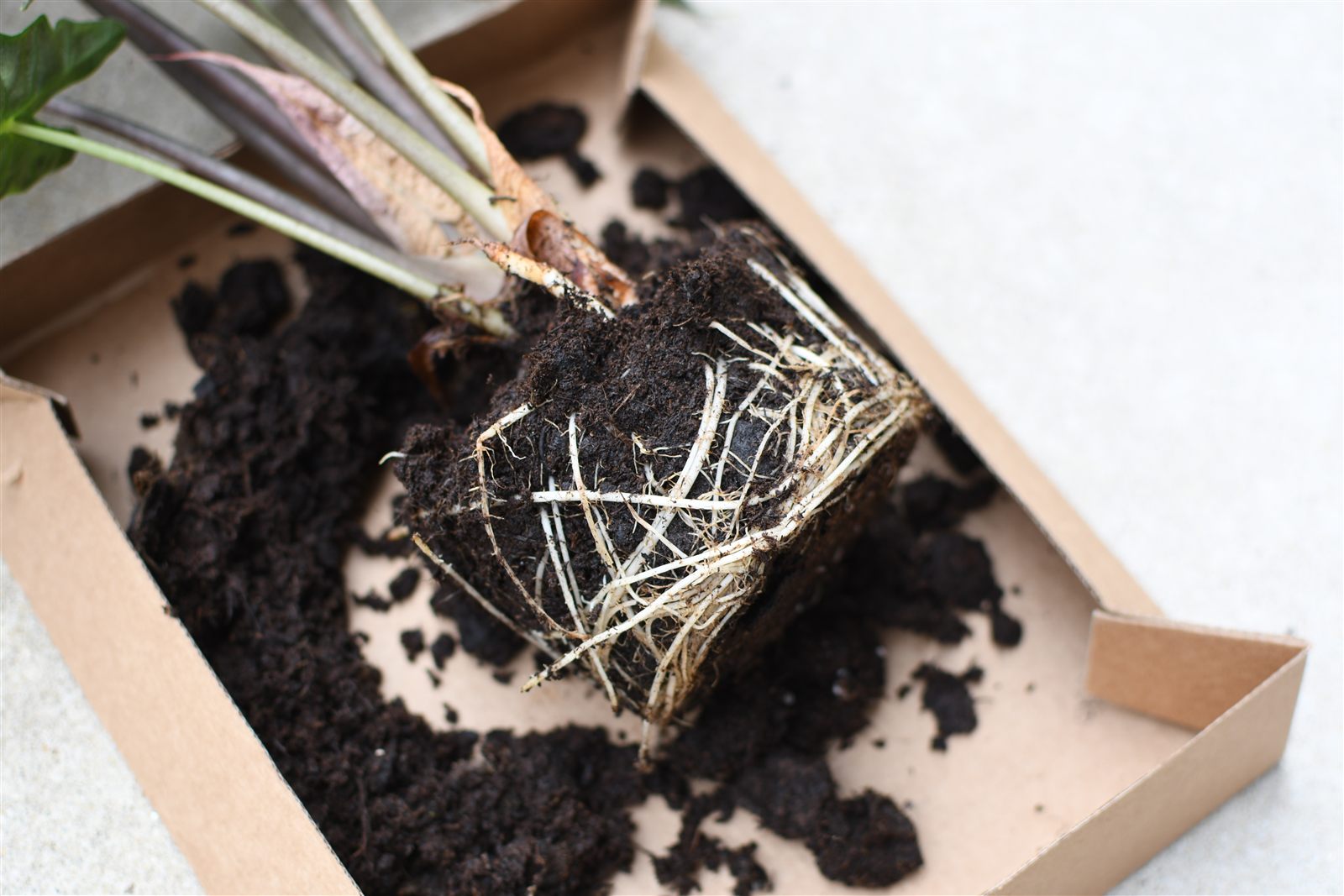
Air space and water-holding belong to the substrate and the container together, not the mix alone. For a given pot diameter, a substrate's water-holding capacity drops as the pot gets taller (Nemali, n.d.), and Bilderback et al. (2005) note that air space and container capacity both depend on container height. If a mix behaves differently for you than for someone else, the pot is one of the first places to look.
The short version
The climbing rationale for the chunky mix doesn't fit Alocasia. Pick a substrate and a pot for the watering you'll really do, and check them again as the mix ages.
We review our guides against the research and extension guidance available at the time, and we correct them when a source doesn't say what we took it to say or when we can't find support for a point. In this review we corrected our account of Alocasia, its plant family and the advice usually given for it, and of how common mix ingredients hold water and air, which changes how often a pot needs water. We also fixed points we'd credited to sources that don't make them, and removed claims we couldn't source, including where the chunky mix came from.
Altland, J. E., Owen, J. S., Jr., & Gabriel, M. Z. (2011). Influence of pumice and plant roots on substrate physical properties over time. HortTechnology, 21(5), 554–557. https://doi.org/10.21273/HORTTECH.21.5.554
Bilderback, T. E., Warren, S. L., Owen, J. S., Jr., & Albano, J. P. (2005). Healthy substrates need physicals too! HortTechnology, 15(4), 747–751. https://doi.org/10.21273/HORTTECH.15.4.0747
Brigham Young University Life Science Greenhouse. (n.d.). African mask. Brigham Young University. https://pws.byu.edu/greenhouse/african-mask
Cregg, B., & Johnson, R. (2024). Untangling the issue of circling roots. Arnoldia, 81(1), 42–49.
Croat, T. B. (1981). A revision of Syngonium (Araceae). Annals of the Missouri Botanical Garden, 68(4), 565–651. https://archive.org/details/biostor-12284
Filartiga, A. L., Mantuano, D., Vieira, R. C., De Toni, K. L. G., Vasques, G. M., & Mantovani, A. (2021). Root morphophysiology changes during the habitat transition from soil to canopy of the aroid vine Rhodospatha oblongata. Annals of Botany, 127(3), 347–360. https://doi.org/10.1093/aob/mcaa182
Govaerts, R., Nic Lughadha, E., Black, N., Turner, R., & Paton, A. (2021). The World Checklist of Vascular Plants, a continuously updated resource for exploring global plant diversity. Scientific Data, 8, 215. https://doi.org/10.1038/s41597-021-00997-6 (data: WCVP bulk download, Royal Botanic Gardens, Kew, June 2026)
Graves, K., Wilber, W., Wichman, T., Lewis, C., Hansen, G., & Klein, R. (n.d.). Alocasia spp.: Elephant's ear, alocasia, taro (FPS 33). UF/IFAS Extension. https://edis.ifas.ufl.edu/pdf/FP/FP03300.pdf
Hay, A. (1998). The genus Alocasia (Araceae-Colocasieae) in West Malesia and Sulawesi. Gardens' Bulletin Singapore, 50, 221–334. https://archive.org/details/biostor-140160
Hsieh, C.-W., & Yeh, D.-M. (2025). Effects of substrate volumetric water content, nutrient solution concentration, and irrigation method on growth and photosynthesis of Alocasia. HortScience, 60(8), 1372–1378. https://doi.org/10.21273/HORTSCI18701-25
McConnell, D. B., Chen, J., Henny, R. J., & Everitt, K. C. (n.d.-a). Cultural guidelines for commercial production of interiorscape Philodendron (ENH893). UF/IFAS Extension. https://edis.ifas.ufl.edu/pdf/EP/EP15000.pdf
McConnell, D. B., Chen, J., Henny, R. J., & Everitt, K. C. (n.d.-b). Cultural guidelines for commercial production of interiorscape Epipremnum (ENH894). UF/IFAS Extension. https://edis.ifas.ufl.edu/pdffiles/EP/EP15100.pdf
National Parks Board Singapore. (n.d.). Monstera deliciosa. Flora & Fauna Web. https://www.nparks.gov.sg/florafaunaweb/flora/1/4/1453
Nauheimer, L., Boyce, P. C., & Renner, S. S. (2012). Giant taro and its relatives: A phylogeny of the large genus Alocasia (Araceae) sheds light on Miocene floristic exchange in the Malesian region. Molecular Phylogenetics and Evolution, 63(1), 43–51. https://doi.org/10.1016/j.ympev.2011.12.011
Nemali, K. (n.d.). Understanding the pores of a soilless substrate (HO-287-W). Purdue University Extension. https://www.extension.purdue.edu/extmedia/HO/HO-287-W.pdf
North Carolina State Extension. (n.d.). Alocasia. NC State Extension Gardener Plant Toolbox. https://plants.ces.ncsu.edu/plants/alocasia/
Royal Horticultural Society. (n.d.). Alocasia: Growing guide. https://www.rhs.org.uk/plants/alocasia/growing-guide
Soltech Solutions. (n.d.). The ultimate guide to the best aroid soil mix [Retailer blog]. https://soltech.com/blogs/blog/the-ultimate-guide-to-the-best-aroid-soil-mix
Stevens, P. F. (2001 onwards). Angiosperm Phylogeny Website, Alismatales. Missouri Botanical Garden. http://www.mobot.org/MOBOT/research/APweb/orders/alismatalesweb.htm
Yang, X., & Deng, W. (2017). Morphological and structural characterization of the attachment system in aerial roots of Syngonium podophyllum. Planta, 245(3), 507–521. https://doi.org/10.1007/s00425-016-2621-4
Zotz, G. (2013). 'Hemiepiphyte': A confusing term and its history. Annals of Botany, 111(6), 1015–1020. https://doi.org/10.1093/aob/mct085