Seventy percent mineral, ten percent zeolite, zero bark. The recovery substrate we reach for when a plant shows up in trouble, plus the week-by-week protocol that actually gets it back.
This research was developed and field-validated at Petruscio Farms R&D.
If you've ever unboxed a rare aroid that arrived late, looked at the black, mushy roots, and wondered whether it's salvageable, this is the mix. It's what we reach for the moment a plant shows up in distress, whether from shipping, root rot, pest damage, or an aggressive repot. It's not our daily driver and it's not meant to be. It exists for the recovery window. Once a plant is out of that window, we move it off ICU and onto a standard mix.
ICU Mix v5 is also the recipe that changed our thinking about cation exchange capacity. CEC is the variable most hobbyist substrate discussions skip entirely, and it's the one that separates a mix that survives a six-week recovery from a mix that slowly starves a plant while it tries to regrow a root system.
The Recipe
All percentages by volume. For a 10-cup batch:
| Ingredient | Percentage | Cups | Grade / Particle Size |
|---|---|---|---|
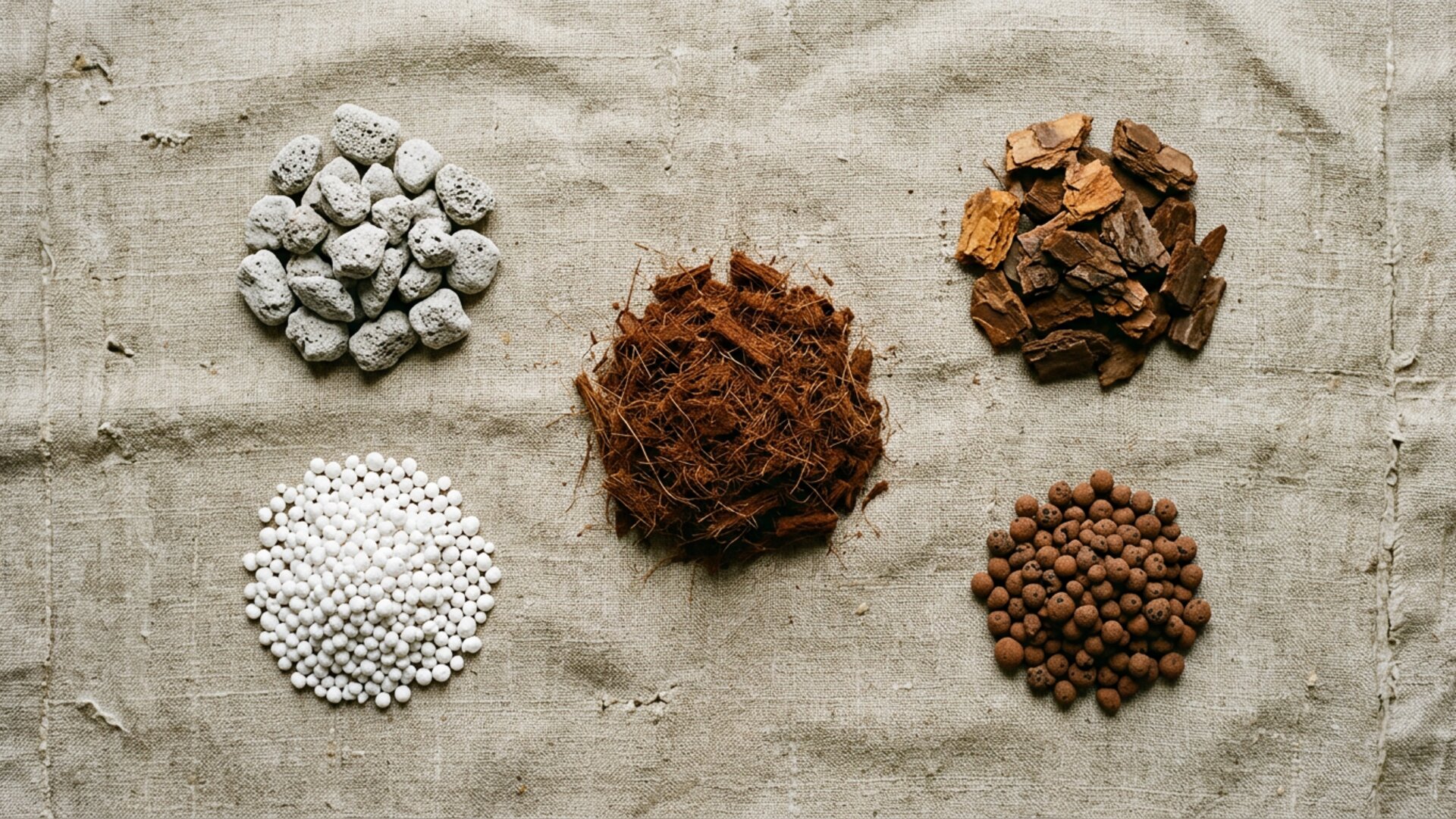
| Pumice | 35% | 3.5 | 1/4 inch |
| Perlite (coarse) | 25% | 2.5 | #3 grade |
| Buffered coir | 20% | 2.0 | Medium pith |
| Zeolite (clinoptilolite) | 10% | 1.0 | 1–3 mm |
| Earthworm castings | 10% | 1.0 | Sifted |
Target pH: 6.0 to 6.5
Target runoff EC: 0.8 to 1.2 mS/cm
Watering cadence: Water when the top 1 inch is dry. Never let it sit wet.
Critical note: Use with bottom heat (72 to 78 °F / 22 to 26 °C) for faster root regeneration. Do not fertilize for the first two weeks.
Why This Recipe — A Walk Through the Root Zone
A plant in ICU is trying to regrow roots. The new roots it puts out are thin, tender, and extraordinarily sensitive to low-oxygen conditions. They haven't developed their woody core yet, so they can't handle oxygen deprivation at all (Yamauchi et al., Annals of Botany 121(4), 2018, on root oxygen deprivation). A plant with damaged roots is also immune-compromised. Opportunistic fungi and anaerobic bacteria that a healthy plant brushes off can finish off a struggling one in 72 hours.
Those two facts drive every decision in the recipe.
The Mineral Fraction (70%)
At container capacity (right after watering), a mix holds water in three places: inside porous particles, in capillary spaces between particles, and in the air gaps. The air gaps are the survival variable. A mix with too little mineral fraction loses its air spaces within an hour of watering, and the roots drown before the plant can even register thirst. Seventy percent mineral means air space persists even when wet. Even when the mix drains down to 30% of its water capacity, the structure holds.
For the underlying physics, see How Substrate Actually Works.
Particle Size: 1/4 Inch, Not Coarser
For a recovering root system, capillary water needs to reach the fine new roots, not just drain past them. Smaller pumice particles create tighter capillary pathways and shorter wick distances that thin new roots can actually use. Larger particles (half-inch and up) create macropores that a mature root system navigates fine but that regenerating roots struggle to bridge. The particle-size effect on capillary rise and air-filled pore space is well established in container substrate literature (Argo, Root Medium Physical Properties, UF/IFAS; Nemali Lab, "Looking through the pores of a soilless substrate," Purdue CEA). Half-inch pumice is what we use in the Aroid Mineral Mix for established epiphytes. It's wrong for ICU.
Zeolite Is the New Piece
Zeolite is the addition in v5 that separates it from older ICU formulations. It's also the reason this version actually works.
Pumice and perlite have effectively no cation exchange capacity. They don't hold nutrient ions against leaching. Coir has some. Earthworm castings have good CEC but carry microbial load, so we can only use so much. Clinoptilolite zeolite has extraordinary CEC for an inorganic mix component. Recent peer-reviewed measurements put it at roughly 2.16 meq/g, with the natural range spanning about 2.19 to 3.11 meq/g depending on the deposit (Grifasi et al., Environmental Science and Pollution Research, 2024; Rodríguez-Iznaga et al., Minerals, 2022). For context, that's roughly an order of magnitude higher than coir and hundreds of times higher than perlite. See the Ingredient Glossary for side-by-side numbers. Zeolite is also biologically inert, which matters in a recovery mix where every extra food source for pathogens is a liability.
The practical outcome: when the plant starts putting out new roots and begins taking up nutrients, the nutrients are present at the root surface instead of already washed through. Earlier versions of ICU Mix, without the zeolite, drained excellently and then produced recoveries that stalled around week four. Slow leaf yellowing, paused root growth. We'd been blaming it on light or temperature. When we ran our own side-by-side batches in 2024 (roughly 30 plants per arm, zeolite-free vs. zeolite-containing), the zeolite mix eliminated the week-4 stall and produced consistent root and leaf output through week six. The mechanism is CEC. Without it, dilute fertilizer leaches faster than recovering roots can take it up.
Castings: 10%, No More
Castings are tricky on a recovering plant. They bring beneficial microbes (Trichoderma, Bacillus subtilis, various PGPR species) that actively suppress pathogens including Pythium, Rhizoctonia, and Verticillium. The effect is well documented in the vermicompost literature (Chaoui, Edwards, Brickner, Lee & Arancon, Brighton Crop Protection Conference 2002). But castings are also organic matter, which means food for anything that wants to eat it, including the pathogens you're trying to avoid. The horticultural range for castings in propagation and container mixes runs 10 to 20 percent by volume, with diminishing returns above 20. We sit at the low end of that range on purpose. Across our own recovery batches from 2023 to 2025, 10% has produced consistent microbial benefit without the anaerobic pockets and saprophytic overgrowth we saw at 15 and 20%. For a daily-driver mix we push castings higher. Not in ICU.
Buffered Coir, Always
Unbuffered coir leaches potassium and sodium that displace calcium and magnesium at the root surface. A plant already struggling to absorb anything will show a calcium deficiency within weeks in unbuffered coir. Buffered coir is pre-treated to swap those K and Na ions for Ca during manufacturing. Non-negotiable. More detail in the Ingredient Glossary.
How to Use It
1. Assess the Plant Before Potting
ICU Mix is a substrate, not magic. Before it touches the plant:
- Remove every mushy, black, or slimy root. Don't try to save borderline roots. If it looks compromised, cut it. Sterilize shears between cuts with 70%+ isopropyl alcohol (standard horticultural sanitation practice). A quick dip or wipe is enough; no soak needed.
- Let the cuts callous for 2 to 12 hours in open air, depending on severity. Don't skip this.
- Optional for heavy rot: a 5-minute soak in a 1:10 hydrogen peroxide solution (3% peroxide diluted 1:10 with water). Rinse thoroughly.
2. Pot Choice Matters
Use a pot one size smaller than the plant's last pot, not the same size. A recovering plant has less root mass than it had before. Putting it in a large pot creates unused substrate that stays wet and breeds problems. Terracotta is our default for ICU. The porous walls let the substrate dry evenly, which is exactly what you want. Plastic works fine but demands more attention to watering cadence.
Nursery pots with extra drainage holes in the sides (or DIY-drilled holes) are ideal. Clear plastic nursery pots are useful during ICU because you can watch root regrowth without disturbing the plant.
3. Potting Technique
Pre-moisten the mix before potting. Dry ICU Mix is dusty and will channel water past the roots when you first pour it in. Add water until the mix is evenly damp but not wet. It should clump loosely in your hand and break apart when you tap it.
Seat the plant so the root crown sits right at the substrate line. Don't bury the crown. Rot climbs up from a buried crown faster than it travels down. Gently firm the mix around the remaining roots without packing it. You want particle-to-root contact, not compression.
4. The First 72 Hours
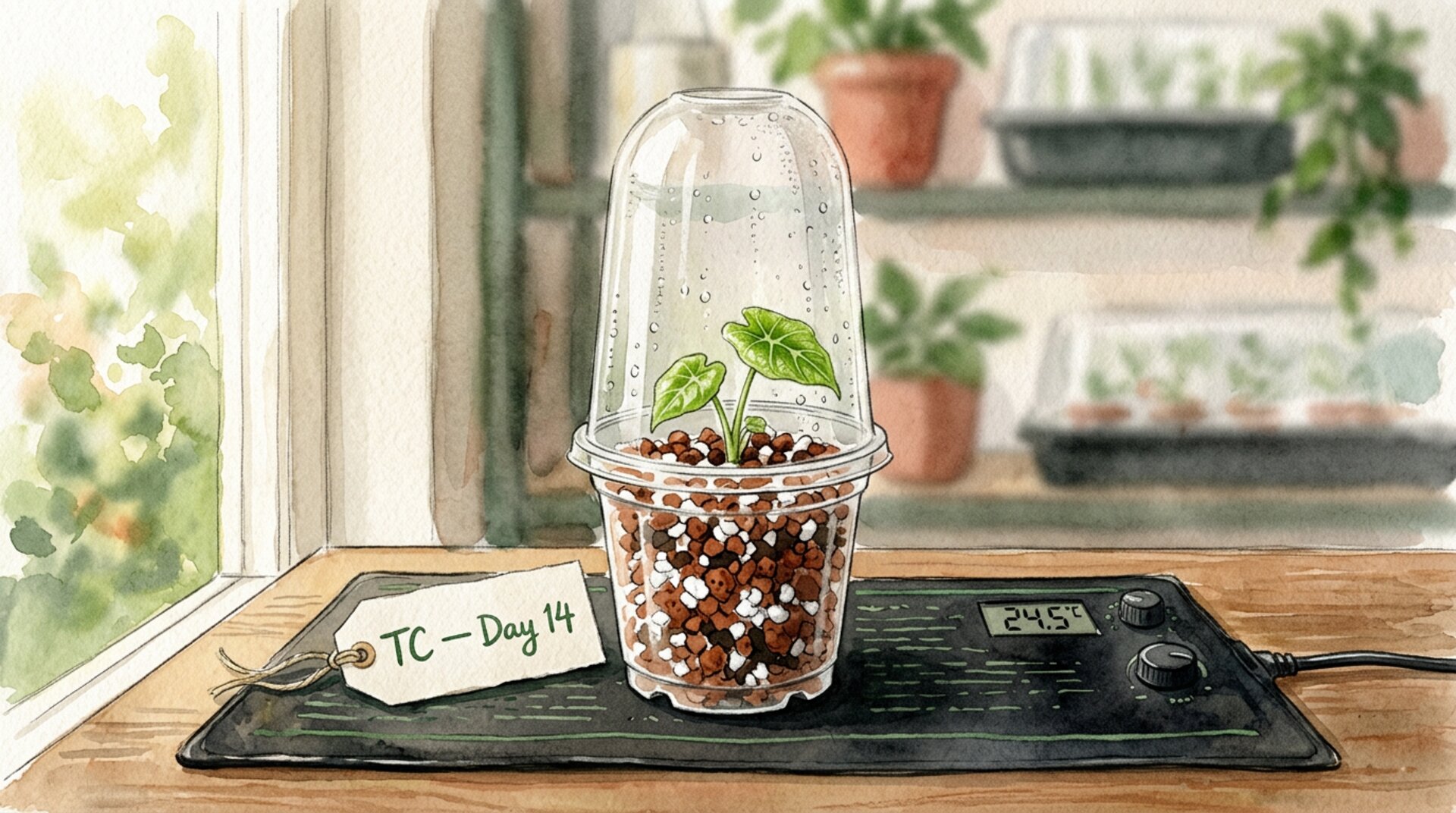
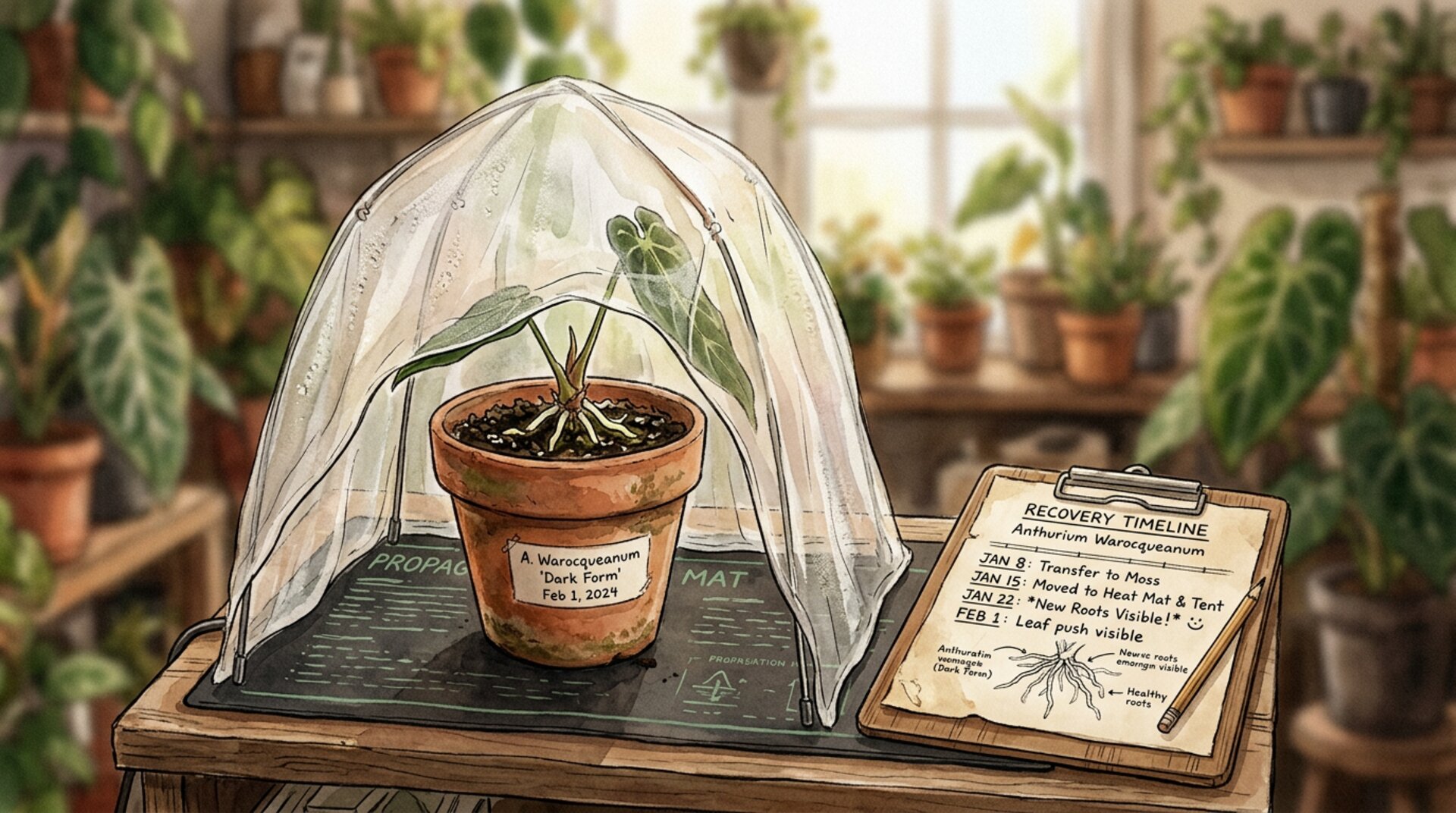
Place the pot in a warm, bright, indirect-light location. Bottom heat between 72 and 78 °F (22 and 26 °C) accelerates root regeneration more than any other variable we've tested. A seedling heat mat under the pot is worth its weight in rescued plants. Avoid direct sun. The plant can't support transpiration yet (root growth temperature optima for tropical foliage are documented in UF/IFAS Cultural Guidelines for Commercial Production of Interiorscape Anthurium; Hartmann, Kester, Davies, and Geneve, Plant Propagation: Principles and Practices, 9th ed.).
Do not water for 72 hours after potting. Let the plant sit in the pre-moistened mix. This gives the cuts time to seal fully and prevents fresh pathogens from entering wet wounds.
5. The Recovery Window
Week 1 to 2. Water only when the top 1 inch is dry. Do not fertilize. Early high-N feed on compromised roots drives hyperhydricity, the weak, waterlogged growth first documented in tissue-culture plantlets (Hazarika, Current Science, 2003) but that shows up in any plant with no functional root system. Keep humidity at 60 to 70% if possible (a loose humidity dome or tent helps). Watch for new root initials at the root crown. Small white nubs are your first success signal.
Week 3 to 4. Begin very dilute fertilization at 1/4 label strength, every other watering. The zeolite will hold the excess rather than letting it wash through.
Week 5 to 6. If the plant has produced new functional roots and a new leaf (or is actively pushing one), graduate it to a standard mix at the next repot. If it's still struggling, stay on ICU Mix and investigate other variables. Light, temperature, humidity, undiagnosed pest pressure.
Common Failure Modes (and What They Mean)
Plant stays stable but doesn't recover. Almost always a temperature problem. Root regeneration in tropical aroids slows dramatically below 70 °F (21 °C) (UF/IFAS interiorscape Anthurium guidelines). Add bottom heat.
New roots emerge but turn brown within a week. You're watering too often. ICU Mix is meant to dry between waterings. Back off and let the mix run drier than feels comfortable.
Leaf yellowing starting from the base. Usually over-watering plus the classic recovery cycle. Older leaves are being sacrificed to fuel new root growth. Accept the leaf loss; the plant is making a rational investment.
Mix develops a sour smell. Anaerobic zones are establishing. Unpot, reassess the root system, and likely move to fresh ICU Mix. Check that your castings lot isn't the source. A too-wet casting input can sour the whole mix from day one.
White fuzz on the substrate surface. Usually saprophytic fungi eating the casting fraction. Not harmful in small amounts, but a sign you may be running slightly too wet. Let the surface dry completely between waterings.
No new root initials after three weeks. The crown may be compromised. Unpot, inspect closely. If the crown is soft or discolored, you may need to take a cutting above the damage and start over. Aroid crowns can rot silently.
What About LECA, Semi-Hydro, or Pure Sphagnum?
All three are legitimate recovery options for specific cases:
- LECA / semi-hydro works well for aroid recovery when you have a controlled nutrient solution and are willing to manage EC actively. Different system with different inputs, worth its own article. If you haven't used semi-hydro before, ICU Mix is simpler and more forgiving.
- Pure long-fiber sphagnum is appropriate for small plants (under 4 inch pot size) and for very delicate tissue culture acclimation. It's our Stage 1 for TC Acclimation. For an established plant with some root mass, sphagnum-only holds too much water and suffocates regenerating roots.
- Straight perlite with bottom-watering is the old-school aroid rescue move, and it works. ICU Mix v5 is essentially an engineered version of that approach, with CEC and mild nutrient availability added so the plant doesn't starve during a long recovery.
When to Graduate Off the Mix
ICU Mix isn't where a plant lives. It's where a plant rebuilds. The signs to graduate:
- New roots are 2+ inches long and lignifying (turning from pure white to cream or tan)
- A new leaf has emerged or is actively pushing
- The plant has been stable for at least two weeks with no further leaf drop
- The substrate is behaving normally, drying in 5 to 7 days, no off-smells
At that point, repot into a standard mix (for most tropicals) or the Aroid Mineral Mix (for climbing epiphytes). The recovery is complete.
The Short Version
Seventy percent mineral for oxygen. Ten percent zeolite for cation exchange. Ten percent castings for microbes and mild nutrients. Twenty percent buffered coir for capillary water. Bottom heat, patient watering, no fertilizer for two weeks, then 1/4 strength every other watering. Graduate off the mix once the plant is pushing new growth.
It's not the mix a plant lives in forever. It's the mix that buys it time to rebuild the root system that'll let it thrive in the next one.
Chaoui, H. I., Edwards, C. A., Brickner, A., Lee, S. S., & Arancon, N. Q. (2002). Suppression of the plant diseases caused by Pythium, Rhizoctonia, and Verticillium in vermicompost-treated soils. Brighton Crop Protection Conference Proceedings.
Grifasi, N., et al. (2024). Properties and characterization of clinoptilolite zeolite for agricultural and environmental applications. Environmental Science and Pollution Research.
Hazarika, B. N. (2003). Acclimatization of tissue-cultured plants. Current Science, 85(12), 1704–1712.
Rodríguez-Iznaga, I., et al. (2022). Natural zeolite properties for ion exchange. Minerals, 12.
University of Florida IFAS Extension. (n.d.). Cultural guidelines for commercial production of interiorscape Anthurium (Publication EP159). https://edis.ifas.ufl.edu/publication/EP159