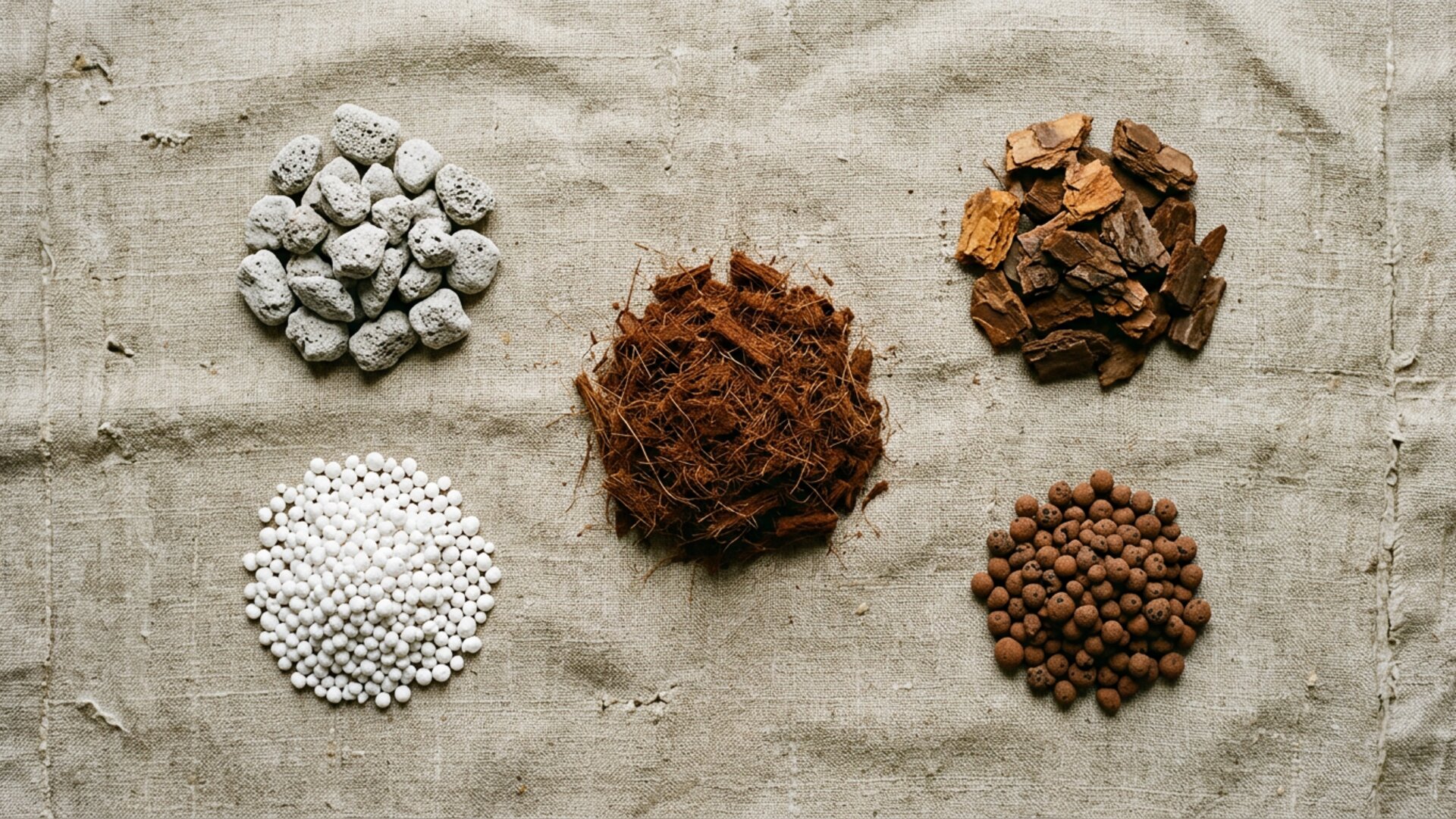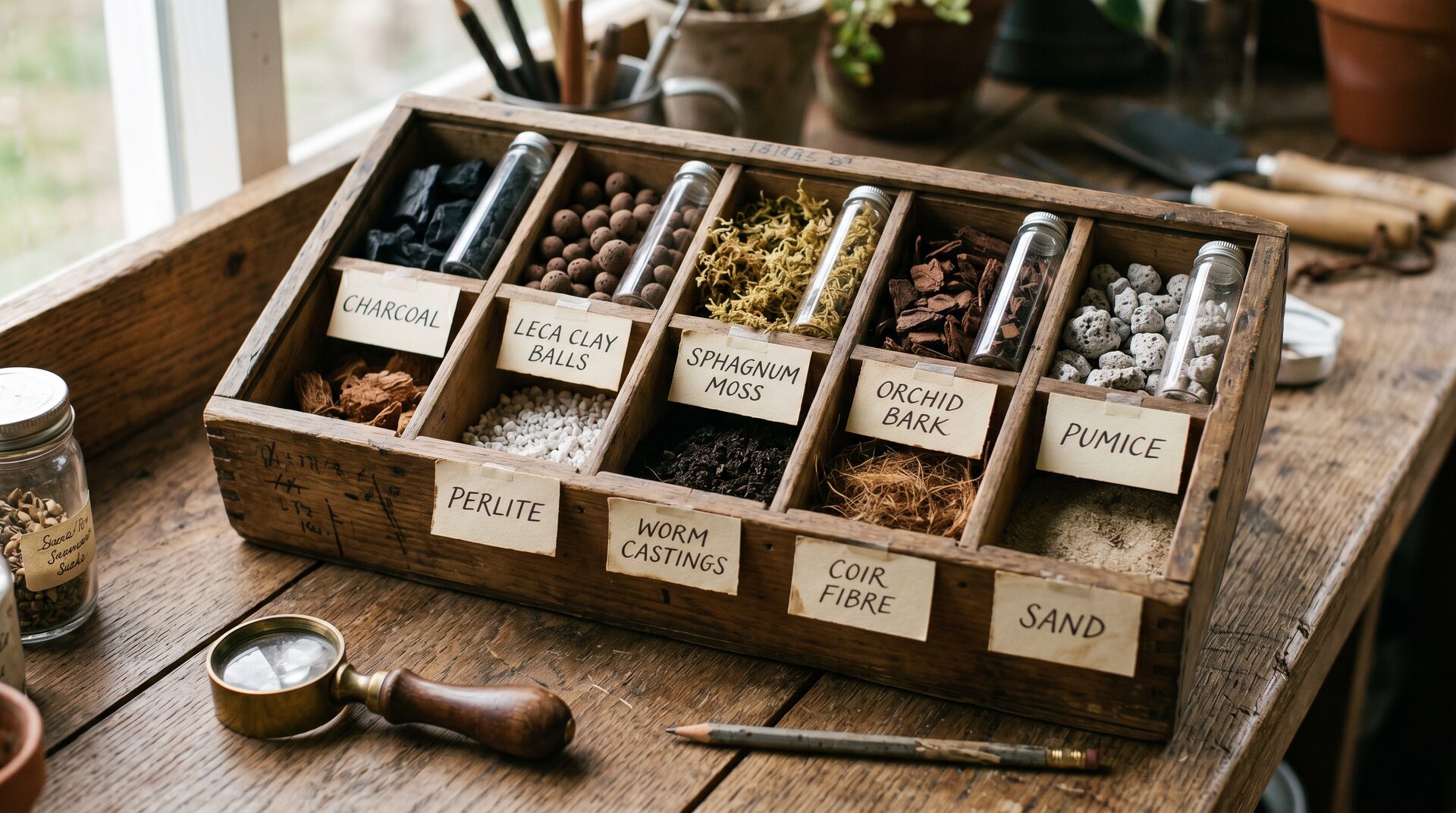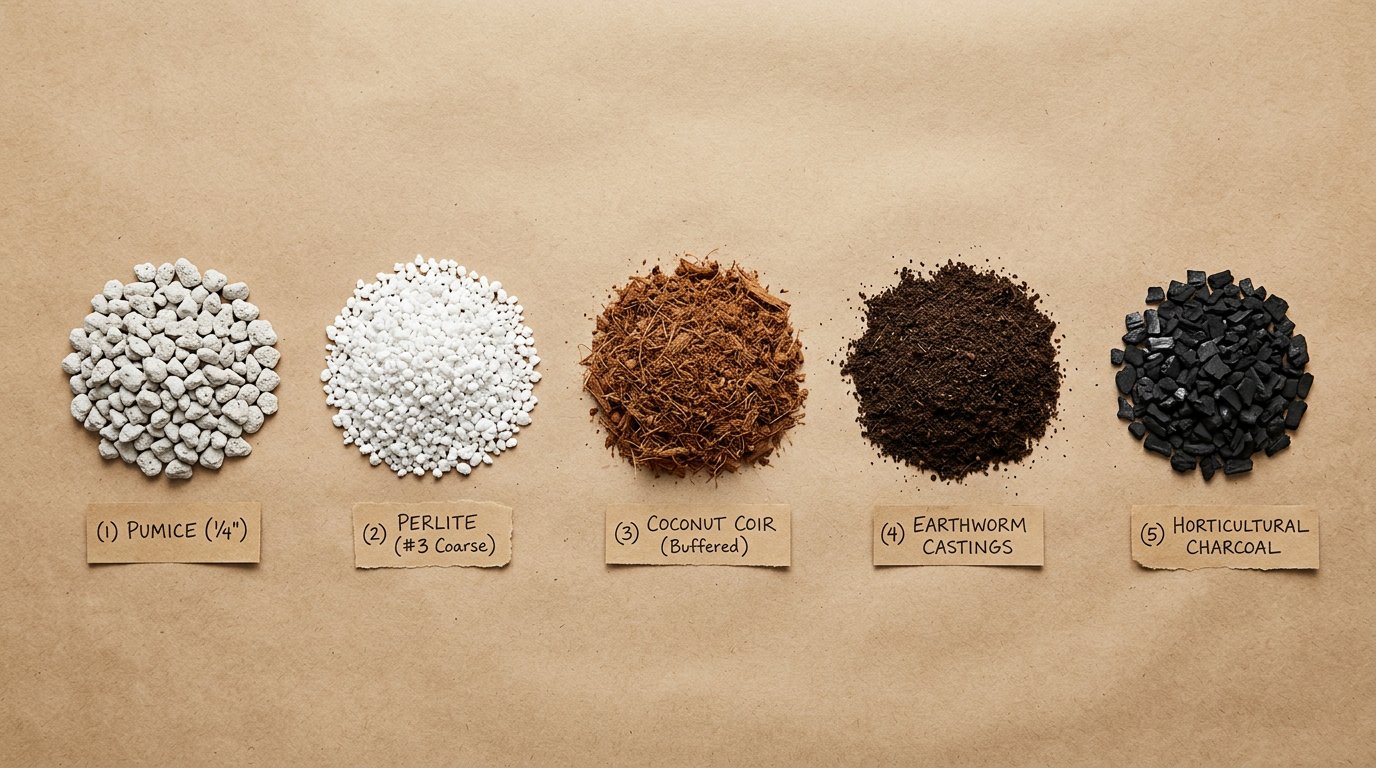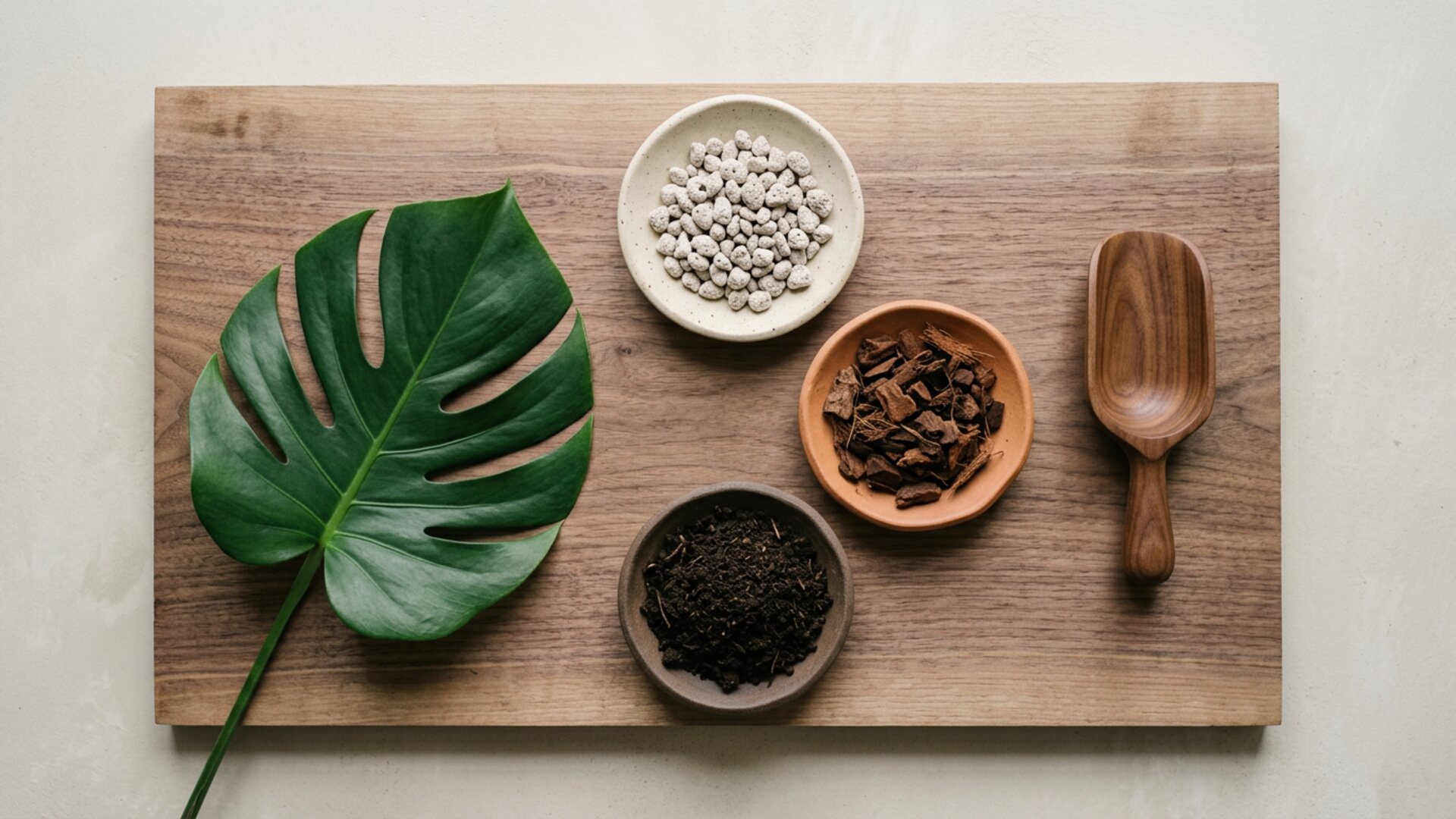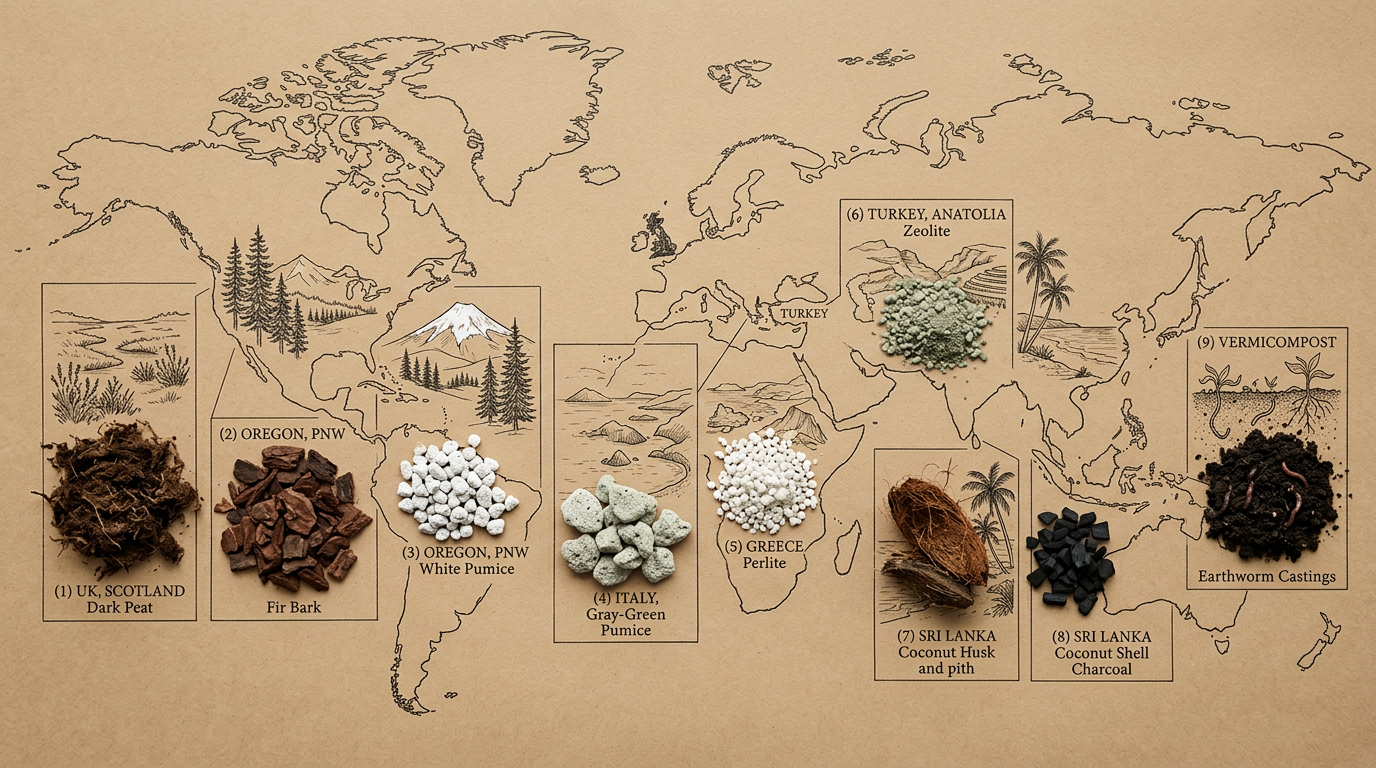
Open a bag of well-built substrate and you're holding pieces of at least four continents. The pumice came from a volcano in Italy or Oregon. The coir was processed from coconut husks in Sri Lanka. The fir bark came off a Douglas-fir log in the Pacific Northwest. The zeolite was mined in Turkey or New Mexico. The charcoal was pyrolyzed from coconut shells or hardwood. None of these are abstractions. They're real materials with supply chains, environmental costs, and reasons to be in the bag. This article isn't an argument against any ingredient. It's a map.
Every ingredient in a bag of substrate has an origin, a cost the price tag doesn't show, and a reason it's still on the shelf. We don't moralize about any of them. We name what's there so you can decide on real information. (This one runs long and risks getting earnest. Bear with me.)
— Christopher · Founder, The Planters' Guild§ 01Substrate is an industry, not a craft store
The chunky mixes a serious indoor grower builds draw on six different global industries: peat extraction, coconut processing, lumber, volcanic mineral mining, mineral expansion, and pyrolysis. Plus vermicompost from food-waste and agricultural-residue streams.
None of these industries were built for us. We're a rounding error on each one. One grower switching ingredients doesn't move them. A whole hobby's buying pattern can move them, slowly, over time. The Royal Horticultural Society (RHS) calls that a demand-side shift, and at this scale it's the only mechanism that actually does anything.
This piece walks ingredient by ingredient through the bags on the shelf. Each section names where the material comes from, what the cost actually is (not what someone said it was on Instagram), and what the tradeoffs are for working growers. It does not tell you what to use. That's the whole frame of TPG: the grower decides on real information.
§ 02Peat moss: the ingredient TPG doesn't use, and why that matters
- What it is
- Decomposed, milled sphagnum harvested from peat bogs. Wetlands that accumulate partially-decayed plant matter at about 1 mm per year for thousands of years.
- Where it's from
- UK, Ireland, the Baltic states, Russia, Canada, parts of northern Europe.
- Carbon math
- Peatlands cover ~3% of global land surface but store ~30% of all soil carbon: roughly 600 gigatonnes globally, more than all the world's forests combined (International Union for Conservation of Nature [IUCN], n.d.). Drained peatlands emit ~2,000 Mt CO₂/year (Joosten, 2010).
- End-of-life
- Irreplaceable on any timescale a human will see.
The policy backdrop matters. The UK announced a retail peat ban in 2022 (Department for Environment, Food & Rural Affairs [Defra], 2022); professional-sector enforcement has since slipped to 2030 (The Wildlife Trusts, 2023), though the retail position holds. The RHS, the largest horticultural body in the UK, stopped selling peat compost in 2019 and committed to "no new peat" across all operations from 1 January 2026 (RHS, n.d.-c).
Why TPG doesn't use it. Two reasons. One: our mixes are chunky, mineral-heavy, and drainage-driven. Peat brings water retention, pH-lowering, and compaction, none of which our system wants. Two: the environmental cost is real and the alternatives are good enough that there's no functional reason to keep peat in the recipe. This is a grower-facing efficiency call, not a moral one. Peat works fine for nursery propagation and seedling plug systems. It just isn't a chunky-aroid ingredient.
§ 03Sphagnum (live, not peat): the distinction that matters
I want to be careful here. TPG uses live long-fiber sphagnum in Goeppertia mixes and moss poles. So "sphagnum bad" gets the genus wrong. It's not in the same supply chain as peat.
Live sphagnum is the actively growing plant, harvested whole. Whole fibers, intact cell structure. The main commercial source is New Zealand (S. cristatum, S. subnitens), hand-harvested from managed swamps on the West Coast of the South Island. Operations like Besgrow, an industry source, describe roughly 5–7 year rotational cycles where harvested plots re-vegetate before re-harvest (Besgrow, n.d.). Chilean AAA-grade is the other major commercial source.
Peat is sphagnum that died, fell to the bog bottom, and partially decomposed over thousands of years under anaerobic acidic conditions. The industry, the carbon math, and the timescale all sit somewhere else entirely from live sphagnum harvest.
The environmental costs aren't the same. Live sphagnum harvested on a 5–7 year rotation from a managed swamp is closer to a managed forestry operation than to peat extraction. Peat is irreplaceable on any timescale a human will see. Live sphagnum re-vegetates inside a decade.
One caveat: "sustainably harvested" claims vary in rigor, and suppliers vary. Hand-picked, air-dried, traceable lots are the gold standard. The lowest-grade craft-store "sphagnum moss" is often unmarked in origin and may include peat-fragment contamination.
§ 04Coir: the byproduct that grew into its own industry
What it is. The fibrous and pith material from the inner husk of coconuts. Coir is what's left after the edible coconut, coconut water, and coconut oil have been processed out.
Where it comes from. Sri Lanka, India, Vietnam, Indonesia, the Philippines. India and Sri Lanka dominate the global trade. Most coir is produced in Tamil Nadu, Kerala, and Andhra Pradesh in India; the dry coast of Sri Lanka is the historic center.
Industry origin. Coir started as a waste stream of the coconut food and oil industry. Husks rotted in piles or got burned locally. Demand from horticulture and from European peat-replacement programs has since pulled some operations into dedicated coir processing, where coconut food yield isn't the main economic driver (RHS, n.d.). At the retail end, a particular bag could be true byproduct or could come from an operation that's rebalanced toward horticultural output. That's a supplier-level question, not a global one.
The salt problem the price tag doesn't show. Raw coir is salty. Coconut husks accumulate sodium and chloride from saltwater contact during retting (the controlled microbial soaking that separates the fiber from the surrounding tissue). Industrial coir requires buffering, a calcium and magnesium soak that pushes sodium and potassium off the coir's exchange sites (the charged spots on the fiber that hold positively-charged nutrients) before it's safe for plants. Unbuffered coir is the quiet cause of calcium and magnesium deficiencies in indoor collections (HortGrow Solutions, an industry source, n.d.). TPG only uses calcium-buffered coir.
The shipping question. Coir is exported as compressed bricks or pith blocks from Asia to North America and Europe. Container shipping carbon is real but per-unit modest. Sea freight runs on the order of 10–40 g CO₂ per ton-km, versus about 500 g/t-km for air freight (International Maritime Organization, 2020). Compressed bricks ship at high density per container, so per-brick shipping carbon is small compared with the lifecycle carbon of producing peat. (Numbers vary by source. Industry literature claims much lower per-tonne carbon than peat; the academic side is less settled.)
Labor and water. Coir processing employs hundreds of thousands of people across South and Southeast Asia. Wage standards and working conditions vary, and the work itself is physically demanding (husking, retting, drying, baling). Retting is also water-intensive. Traditional retting soaks husks in pools or rivers for months; modern mechanical defibering (the same separation done by machine rather than soak) shortens that and uses less water. Audit programs exist (the RHS sustainability work; supplier-level audits from a few buffering vendors, including Char Coir and Botanicoir, both industry sources). At the retail end, the signal lives at the supplier name on the bag, not at the country of origin.
§ 05Fir and pine bark: the lumber-industry waste stream
What it is. Outer bark of softwood trees: Douglas-fir, ponderosa pine, loblolly pine, longleaf pine, redwood. It's stripped from logs at sawmills and pulp mills before lumber processing.
Where it comes from. Pacific Northwest (Douglas-fir bark dominates the western and orchid market) and the Southeast US (pine bark dominates the eastern nursery industry). Both regions strip more bark than horticulture can absorb. What doesn't go to substrate goes to mulch, fuel pellets, or compost feedstock.
The byproduct frame is real and well-documented. Bark is genuinely a forestry waste stream. The lumber industry was going to strip the logs regardless. Without horticulture and landscape buyers, more of it gets burned as boiler fuel at the mill, fed into wood-pellet plants (sawmill residuals make up about a third of US pellet feedstock as of 2021), or sent to lower-grade mulch markets (Rodriguez-Franco, 2022). Pine bark is the primary nursery container substrate across the eastern US; Bilderback et al. (2005) at NC State have spent decades characterizing the physical properties of commercial pine bark substrates.
Grower-facing tradeoffs. Bark breaks down. Particle size shifts over 12–18 months, pH drifts acidic, air-filled porosity (the share of pot volume that's air rather than water or solids) drops. Replacement frequency is a real cost. Bark also harbors fungi (often Trichoderma, which is generally beneficial in substrates; occasionally pathogenic Fusarium). The bark dust itself is a known respiratory irritant for sensitive growers.
Why TPG doesn't feature it in core recipes. Our chunky mixes substitute horticultural charcoal plus coarse pumice for bark's structural role, partly for the allergy and dust reasons, partly for the breakdown-rate problem. Bark is legitimate. It's just substitutable. For growers without dust sensitivity who repot on a disciplined schedule, bark is a clean choice with a strong waste-stream story.
§ 06Pumice and perlite: the volcanic minerals
Pumice. Volcanic glass with trapped gas bubbles, formed when high-silica (rhyolitic) magma cools fast. All US pumice is mined by open-pit methods in California, Idaho, Kansas, New Mexico, and Oregon (U.S. Geological Survey [USGS], 2024). Imported pumice comes from Italy, Greece, Turkey, and Iceland.
The pumice mining footprint. Open-pit, no chemical processing required, mined dry. Lightweight ore. The main carbon footprint comes from transport (truck to the processing plant, then rail or ship to market), not from processing: pumice doesn't go through a thermal or chemical step the way perlite does. Functionally inert end-of-life: pumice doesn't break down on any meaningful timescale. The only energy input is digging, hauling, and sorting. Soft volcanic rock means no high-energy explosives are needed. There's no chemical processing, so no leaching streams. The lack of a thermal step keeps the fuel burn off the bill. The footprint sits on the lower end of mineral-extraction operations because there are fewer high-impact steps in the chain, not because of regulation. But open-pit extraction is open-pit extraction. It removes surface ecology and the pit doesn't recover quickly.
Perlite, a mineral that gets cooked. A different volcanic glass (rhyolitic, water-trapped). The raw ore is mined primarily in Greece (the dominant global producer; 92% of US imports per USGS, 2024), Turkey (estimated 70% of world reserves), the US (lead state New Mexico), China, and Mexico. Then the ore is shipped to expansion plants where it's flash-heated to roughly 1,600 °F / 870 °C. Trapped water vaporizes and the glass "pops" up to 10–30 times its original volume.
The perlite-expansion energy cost. Expansion is the energy-intensive step, not mining. There are 51 perlite expansion plants in 27 US states. Heating to 1,600 °F (870 °C) continuously isn't free. Perlite expansion sits on the higher end of horticultural-ingredient energy intensity per unit volume. Historically the expansion furnaces ran on natural gas; electrification is an active R&D area. (The horticultural share of US expanded perlite is 16% per USGS, 2024. Most perlite goes to building construction and filter aids.)
End-of-life. Both are functionally inert silicates. Pumice doesn't break down at all. Perlite mechanically degrades in pots. It crumbles, floats, migrates over years. The silicate itself is stable. Both return to the mineral cycle when a pot is dumped, exactly the way the original rock would.
§ 07Zeolite: the mined ion exchanger
What it is. Clinoptilolite, a naturally occurring aluminosilicate with a crystalline cage structure and exceptionally high cation exchange capacity (CEC, around 2.0 meq/g) (Mumpton, 1999).
Natural vs synthetic. Industrial catalysis uses synthetic zeolites built in chemical reactors. Horticultural zeolite is natural mined clinoptilolite, a completely different supply chain. Reading product labels matters; "zeolite" without "clinoptilolite" or "natural" can mean either.
Where it comes from. Producers include the US (Arizona for chabazite, another natural zeolite mineral; California, Idaho, New Mexico, Oregon, Texas for clinoptilolite per USGS, 2024), Cuba, China, Slovakia, Bulgaria, Turkey, and New Zealand. The US sold about 85,000 tons in 2023. Small global volume compared with pumice or perlite, but large enough that horticultural-grade ore is widely available.
Mining footprint. Open-pit, similar to pumice. Lightweight ore. No chemical extraction step; just mining, crushing, screening, and bagging. The horticultural fractions (1–3 mm, 3–5 mm) are screened sizes from the same ore stream that supplies pet-odor products and industrial absorbents.
End-of-life. Inert. Doesn't break down. Doesn't release ions to groundwater. You can reclaim it from old potting mix and re-use it if you sift it.
§ 08Activated charcoal and biochar: the carbon math
What it is. Charcoal is biomass that's been pyrolyzed (heated without oxygen) to drive off volatile compounds, leaving a porous carbon skeleton. Processing temperature and feedstock shift what you end up with. Horticultural charcoal comes out of a simple high-temperature kiln. Activated carbon takes that further with steam or CO₂ activation, which dramatically increases surface area. Biochar is the version defined by the International Biochar Initiative (IBI): soil-application charcoal with traceable feedstock.
Where it comes from. Three main horticultural feedstocks: coconut shell, hardwood, and bamboo. Coconut shell comes out of Sri Lanka, Indonesia, the Philippines, and India. It's a major agricultural byproduct, with about 20 million tons generated globally per year (Ajien et al., 2023). Hardwood horticultural charcoal is mostly US and European forestry residues and sawmill offcuts. Bamboo charcoal is mostly Asia, particularly China. Coconut-shell activated carbon dominates the high-end market because the feedstock is dense, low-ash, and consistent.
The biochar carbon-negative argument. Pyrolysis converts about 50% of feedstock carbon into a stable form that resists decomposition for centuries to millennia. Compared with letting that biomass rot (which returns CO₂ to atmosphere in years) or burning it (which returns it in minutes), pyrolysis-to-biochar is one of the few genuinely negative-emissions technologies available at scale. Early estimates from Lehmann and colleagues put biochar's global drawdown potential at about 1.8 billion metric tons (1.8 Pg) of CO₂-equivalent per year (Lehmann et al., 2006). The IPCC's Sixth Assessment Report raises that to roughly 2.6 billion metric tons per year as a central estimate, with credible scenarios reaching higher (IPCC, 2022). Either way, it's meaningful at the climate-policy scale. The IBI maintains the standards that define what counts as biochar (IBI, n.d.).
Grower-facing read. Horticultural charcoal is structurally porous and chemically inert in the pot. Its CEC is moderate; its pH is on the mild-alkaline side. The carbon-negative argument is a global-scale frame, not a per-pot one. A 5-gallon pot with 10% charcoal isn't drawing down meaningful tonnage. But the supply chain story is genuinely clean: pyrolyzed waste-stream biomass that locks carbon up for centuries while doing useful work in the substrate.
What to avoid. BBQ charcoal (binders, accelerants). Activated carbon labeled for water filtration (overprocessed, expensive). Unspecified "soil charcoal" without feedstock label (variable, sometimes too fine, occasionally contaminated). The IBI standards page is a useful filter.
§ 09Vermicompost: the closed-loop ingredient
What it is. Earthworm castings. The digested output of Eisenia fetida, Eisenia andrei, or Lumbricus rubellus fed on agricultural residues, food waste, or manure feedstocks.
Where it comes from. Scaled production operations (Worm Power in New York and BioFiltro in Chile and the US, both industry sources; plus dozens of regional and farm-scale producers) use continuous-flow vermicomposting reactors that can process over 1,000 tons of organic waste per reactor per year (Edwards et al., 2011). The feedstock side is the supply-chain story: most commercial-scale operations take food-processing residues, manures, or municipal organics that would otherwise need disposal.
The closed-loop frame. Vermicompost is the only ingredient in this article that takes a waste flow and converts it into a horticultural input with no thermal step, no mineral extraction, no shipping from another continent. It's the cleanest supply-chain story in the bag.
Grower-facing tradeoffs. Quality varies more than any other ingredient in this article. Three things drive it: what the worms were fed, what the microbial profile of the finished casting looks like, and how consistently it's screened. None of those are guaranteed to be on the bag. Atiyeh et al. (2001) documented the physicochemical and growth effects; the Aroid Ingredient Glossary covers the usage logic (5–15% of the mix by volume, depending on the recipe). Local producers are often better than national brands.
§ 10The takeaway: what to do with this information
A working grower at any scale faces six or eight ingredient choices when building a substrate. Each one has an origin, an environmental cost, and a tradeoff. None of them are clean. None of them are damning.
The framing TPG uses: substitute when the ingredient is substitutable and the cost is real; keep the ingredient when it does work no substitute can do. Pumice earns its spot because nothing else gives that drainage at that price. Zeolite is the only practical ion-exchanger on the mineral side of a chunky mix. Horticultural charcoal does three jobs at once (structure, mild CEC, and chemical buffering) for a single inclusion. Coir does the capillary work that nothing else does at scale.
Peat isn't in the bag because the substitutes are good enough, the cost is real, and the ingredient doesn't earn its mechanical spot in a chunky aroid mix anyway.
The Stewards-tier point of this article isn't "buy peat-free." It's: know what's in the bag, know where it came from, know what it costs the world the price tag doesn't show, then decide. That's the entire TPG editorial promise on substrate. More than soil from a bag. The supply chain is part of the substrate.
Ajien, A., Idris, J., Md Sofwan, N., Husen, R., & Seli, H. (2023). Coconut shell and husk biochar: A review of production and activation technology, economic, financial aspect and application. Waste Management & Research, 41(1), 37–51. https://pmc.ncbi.nlm.nih.gov/articles/PMC9925910/
Altland, J. E., Krause, C., Locke, J. C., & Hand, A. (2018). Physical and hydraulic properties of commercial pine-bark substrate products used in production of containerized crops. U.S. Department of Agriculture, Agricultural Research Service.
Atiyeh, R. M., Edwards, C. A., Subler, S., & Metzger, J. D. (2001). Pig manure vermicompost as a component of a horticultural bedding plant medium: Effects on physicochemical properties and plant growth. Bioresource Technology, 78(1), 11–20. https://doi.org/10.1016/S0960-8524(00)00172-3
Besgrow. (n.d.). Spagmoss sphagnum moss: At the root of healthier plants [Industry source]. https://besgrow.com/spagmoss/
Bilderback, T. E., Warren, S. L., Owen, J. S., Jr., & Albano, J. P. (2005). Healthy substrates need physicals too! HortTechnology, 15(4), 747–751.
Department for Environment, Food & Rural Affairs. (2021). England peat action plan. GOV.UK. https://www.gov.uk/government/publications/england-peat-action-plan
Department for Environment, Food & Rural Affairs. (2022, August 27). Sale of horticultural peat to be banned in move to protect England's precious peatlands. GOV.UK. https://www.gov.uk/government/news/sale-of-horticultural-peat-to-be-banned-in-move-to-protect-englands-precious-peatlands
Edwards, C. A., Arancon, N. Q., & Sherman, R. L. (Eds.). (2011). Vermiculture technology: Earthworms, organic wastes, and environmental management. CRC Press.
HortGrow Solutions. (n.d.). Coco coir as a medium-CEC substrate: Balancing precision and buffering [Industry source]. https://hortgrow.com/blogs/blog/coco-coir-as-a-medium-cec-substrate-balancing-precision-and-buffering
International Biochar Initiative. (n.d.). Biochar standards. https://biochar-international.org/biochar-standards/
Intergovernmental Panel on Climate Change. (2022). Chapter 7: Agriculture, forestry and other land uses (AFOLU). In Climate change 2022: Mitigation of climate change. Cambridge University Press. https://www.ipcc.ch/report/ar6/wg3/chapter/chapter-7/
International Maritime Organization. (2020). Fourth IMO GHG study 2020. https://www.imo.org/en/ourwork/environment/pages/fourth-imo-greenhouse-gas-study-2020.aspx
International Union for Conservation of Nature. (n.d.). Peatlands and climate change. https://iucn.org/resources/issues-brief/peatlands-and-climate-change
IUCN UK Peatland Programme. (n.d.). Peat extraction. https://www.iucn-uk-peatlandprogramme.org/peat-extraction
Joosten, H. (2010). The global peatland CO2 picture. Wetlands International. https://www.wetlands.org/publication/the-global-peatland-co2-picture/
Lehmann, J., Gaunt, J., & Rondon, M. (2006). Bio-char sequestration in terrestrial ecosystems – a review. Mitigation and Adaptation Strategies for Global Change, 11, 403–427.
Mumpton, F. A. (1999). La roca magica: Uses of natural zeolites in agriculture and industry. Proceedings of the National Academy of Sciences, 96(7), 3463–3470. https://pmc.ncbi.nlm.nih.gov/articles/PMC34179/
NC State University. (n.d.). Wood substrates program: Publications. https://woodsubstrates.cals.ncsu.edu/publications/
Rodriguez-Franco, C. (2022). Forest biomass potential for wood pellets production in the United States of America for exportation: A review. Biofuels, 13(8), 983–994. https://doi.org/10.1080/17597269.2022.2059951
Royal Horticultural Society. (n.d.). RHS peat policy. https://www.rhs.org.uk/about-us/what-we-do/policies/rhs-statement-on-peat
The Wildlife Trusts. (2023, March 23). UK Government confirms ban on all peat-based gardening products will not be implemented until 2030. https://www.wildlifetrusts.org/news/uk-government-confirms-ban-all-peat-based-gardening-products-will-not-be-implemented-until
U.S. Geological Survey. (2024). Perlite; Pumice and pumicite; Zeolites (natural). In Mineral commodity summaries 2024. U.S. Department of the Interior.