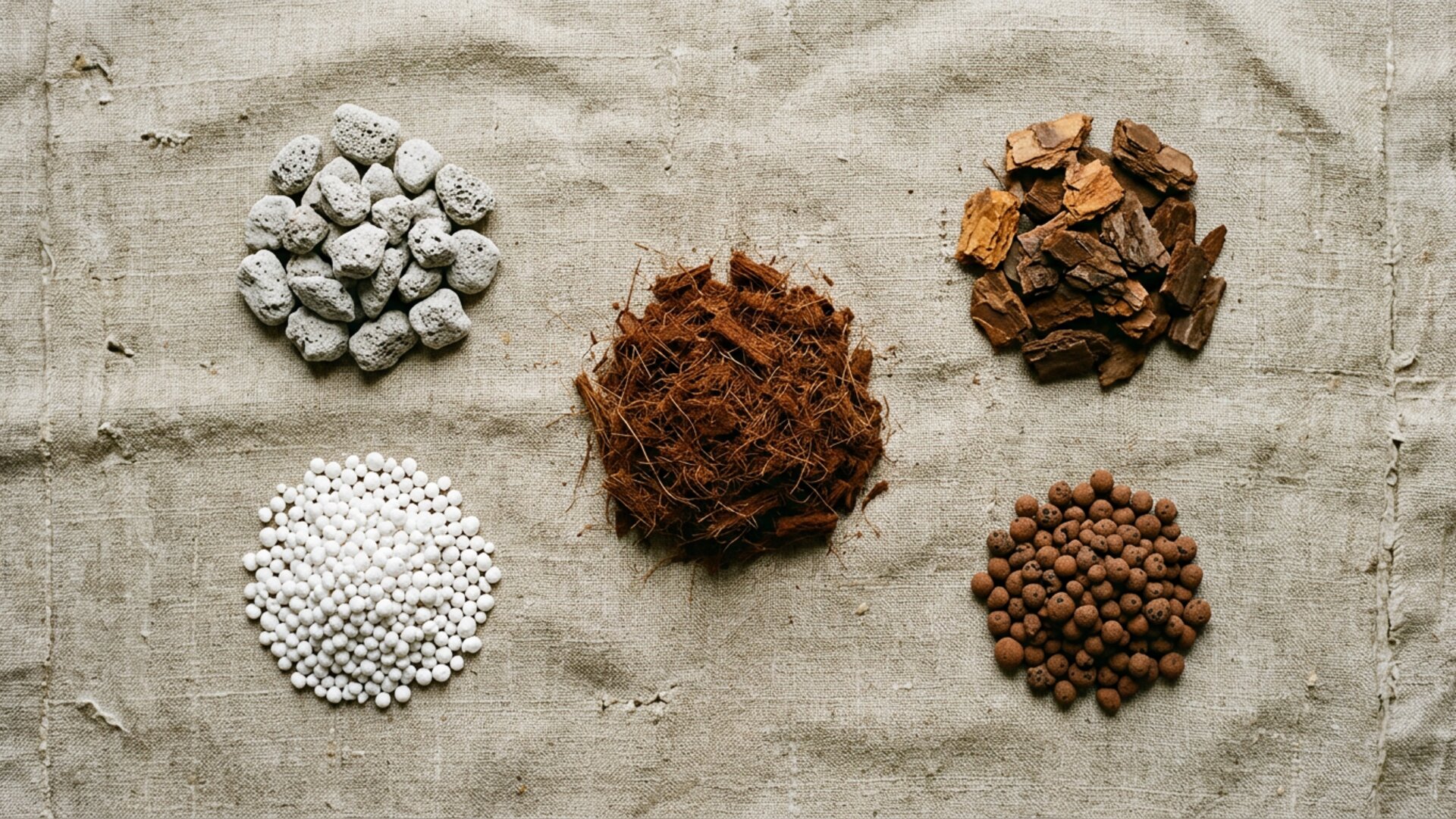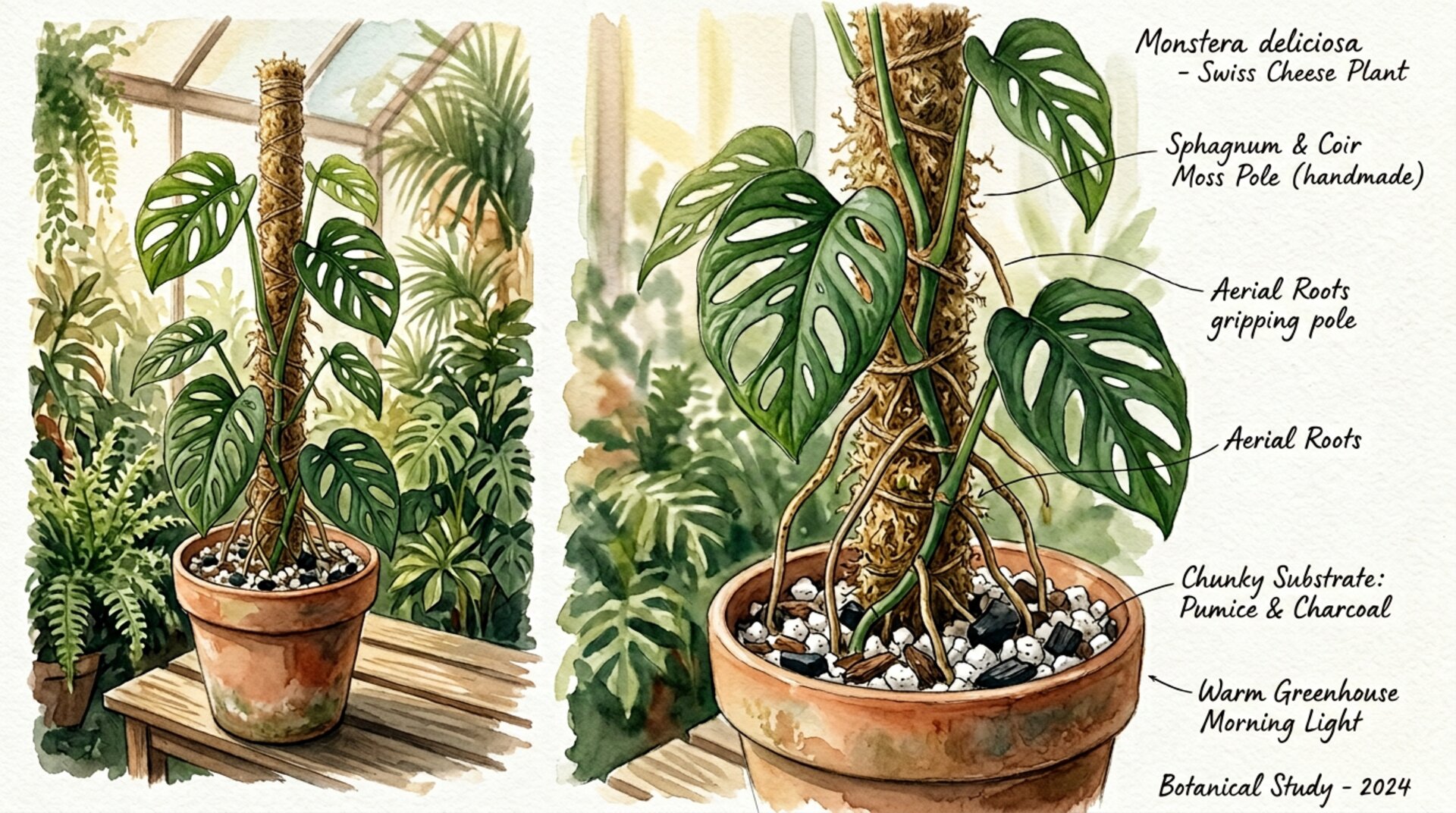
Eighty percent mineral, fifteen percent chunky horticultural charcoal, twenty percent organic. The substrate for climbing Philodendron, Monstera, Anthurium, and the rest of the epiphyte rack, built around how aerial roots actually work.
If the Standard Mineral Mix is the substrate most plants spend most of their lives in, Aroid Mineral Mix is the substrate built for the plants that are different. Climbers with serious aerial roots. Epiphytes whose ancestors evolved on tree bark, not soil. Plants that rot in a week if you water them on a 5-day terrestrial cadence.
This is also the mix that earned the bark-free system its name. Charcoal stops being an accent ingredient here and starts doing structural work, replacing the orchid bark that anchors most commercial epiphytic aroid mixes. That swap is the whole point.
The Recipe
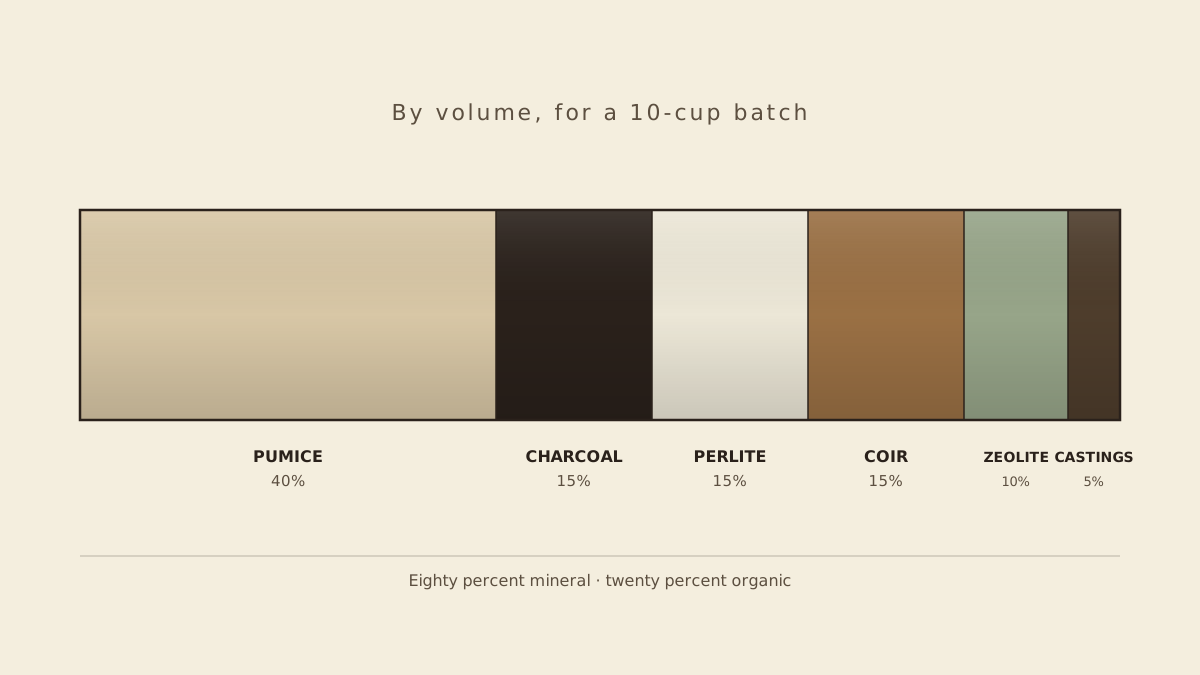
All percentages by volume. For a 10-cup batch:
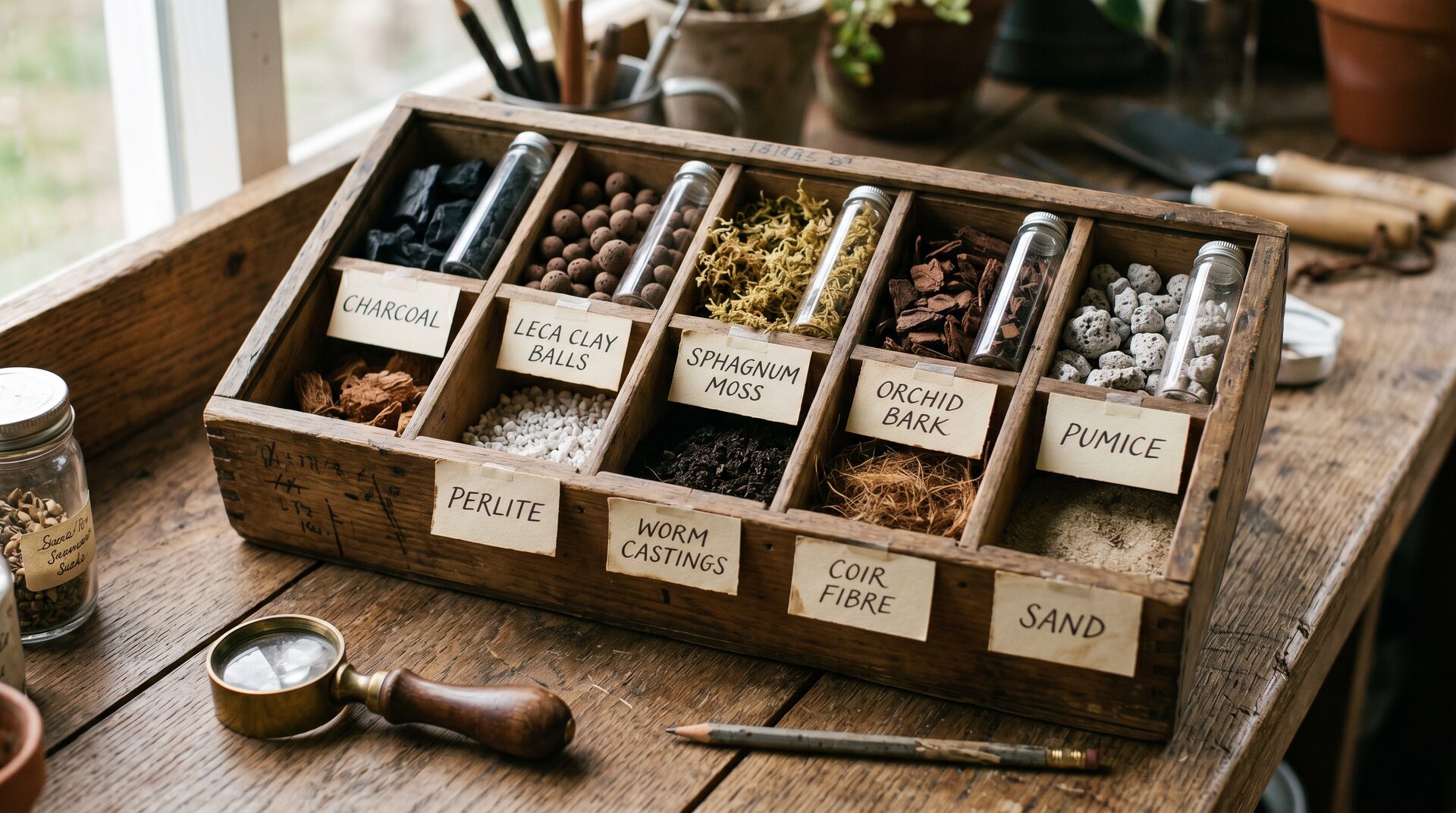
| Ingredient | Percentage | Cups | Grade / Particle Size |
|---|---|---|---|
| Pumice (coarse) | 40% | 4.0 | 1/2 inch |
| Horticultural charcoal | 15% | 1.5 | 1/4 to 1/2 inch |
| Perlite (coarse) | 15% | 1.5 | #3 grade |
| Buffered coir | 15% | 1.5 | Medium pith |
| Zeolite (clinoptilolite) | 10% | 1.0 | 3 to 5 mm |
| Earthworm castings | 5% | 0.5 | Sifted |
Target pH: 5.8 to 6.3
Target runoff EC: 0.8 to 1.2 mS/cm
Watering cadence: Water thoroughly when the substrate is dry to the touch 2 inches down. In a 4-inch pot at moderate light, expect 7 to 10 days in terracotta and 9 to 13 days in injection-molded plastic. Larger pots and cooler conditions stretch both.
Refresh: Every 24 months, sometimes longer. Eighty percent mineral doesn't compact the way a 40% organic mix does.
Sourcing note: the exact pumice, horticultural charcoal, and worm castings I buy for this mix are on the Guild's recommendations page. Those are affiliate links.
Why 80/20, and Why Not 70/30 or 90/10
The Standard Mineral Mix article makes the case for 60/40 as the workhorse balance for healthy hemiepiphytic and semi-epiphytic tropicals. Aroid Mineral Mix moves the needle to 80/20 for two specific reasons.
Epiphytic aroids didn't evolve in soil. They evolved on tree bark, where rain saturates them in minutes and the substrate dries to almost nothing within a day or two. Their root anatomy is built for that pulse: wet briefly, dry mostly, oxygen always available. A 60/40 mix holds water too long for a true epiphyte's root zone. By month nine, when the organic fraction starts to compress, that problem gets worse. Aerial-rooted Philodendron in a wetter mix don't develop the woody root anchors they should, and their bases stay damp enough to rot if the plant hits any stress.
The second reason is the long arc of substrate physics. Below 70% mineral, the organic component breaks down so fast that air-filled porosity tanks below the 15 to 25% range we need (Argo, HortTechnology 8(4), 1998). Above 90% mineral, you're basically at semi-hydroponic LECA. It works, but you're fertigating constantly because there's nothing there to buffer nutrients between waterings. Eighty splits the difference. The structure stays open for two-plus years, and there's still enough coir and castings to hold CEC and capillary water for the aerial roots to drink between rains.
Why Each Ingredient Is Where It Is
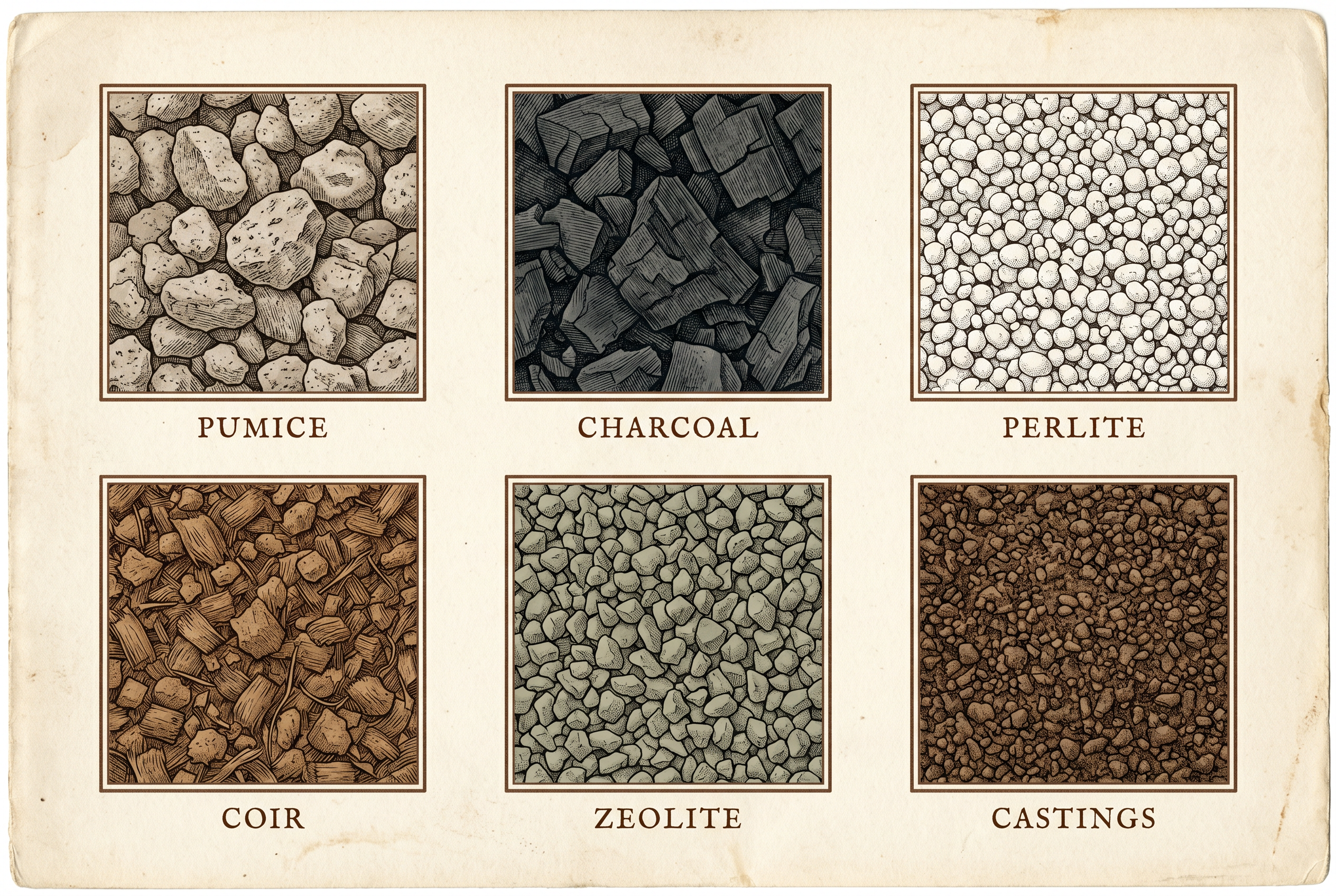
Coarse pumice (40%): the structural backbone
Half-inch pumice is the largest single component, doing as much work through grade as through percentage. Owen and Altland found air-filled porosity drops from roughly 24% at particles larger than 3 mm down to 13% at smaller than 1 mm (HortTechnology 21(5), 2011). For 20% or more air-filled porosity across two years, go as coarse as you can practically pot. Half-inch works for 4-inch pots and up. In 3-inch and smaller, grade down to 1/4 inch so it doesn't bridge the gaps.
Pumice also stores a small amount of water in its porous structure, giving roots a dry-but-not-arid landing zone. Coarse pumice isn't gravel. It's a chunky air-filled sponge that happens to be rigid.
Horticultural charcoal (15%): the bark substitute
Charcoal is what makes this mix what it is. Most commercial aroid mixes use orchid bark at 25 to 40 percent as the chunky structural component. Bark works, but the costs add up: variable lot quality, persistent fungal spore loads (Trichoderma, Fusarium, and saprophytes that turn nasty in a stressed root zone), respirable dust, and soft fir breaks down in months. For growers with respiratory sensitivities, bark isn't a minor hassle. It's a real barrier. That's the constraint this whole system was built to solve.
Charcoal works both chemically and mechanically. Chemically, it's sterile out of the bag, chemically inert, porous enough for CEC, and free of spore load. Mechanically, the question is grip. Research on hemiepiphytic aroid aerial root attachment shows that surface texture drives success more than anything else (Croat 1997, Annals of the Missouri Botanical Garden 84(3)). Charcoal at 1/4 to 1/2 inch has the same surface roughness as fir bark.
In our collection, climbing Monstera deliciosa and Philodendron gloriosum show aerial roots gripping charcoal chunks just as well as fir bark, over multiple years and without the spore load. Charcoal isn't a new technique, but it's still rare in commercial mixes. We think it's underused. For grades and specs, the Aroid Ingredient Glossary has the full breakdown.
Coarse perlite (15%): the air guarantee
Perlite locks in air-filled porosity and resists the compression that would tank AFP. The 15% rate is lower than the 25% in Standard Mineral Mix because charcoal and pumice are already doing the heavy lifting. Perlite here is the insurance policy for gaps between the larger chunks.
Grade matters as much as percentage. #3 (chunky) only. Fine perlite in mineral-heavy mix is worse than useless. It floats to the top, creates dust during repotting, and packs into gaps that need to stay open for gas exchange.
Buffered coir (15%): the capillary water buffer
Pure mineral substrate dries too fast for an indoor aerial-rooted aroid without tropical humidity. Fifteen percent buffered coir gives capillary connectivity so water moves as a continuous film instead of channeling. It also gives the underground feeder roots (yes, epiphytic aroids have them) a moist zone to draw from between waterings.
Buffered is non-negotiable. Raw coir loads the root zone with K and Na that displace Ca and Mg at the root surface. That's the slow deficiency that looks like every other nutrient problem. Test any new lot at EC under 0.5 mS/cm in a 1:1.5 coir-to-water slurry before using it. Same chemistry as the ICU Mix article: doesn't matter which mix it lands in.
We use medium pith, not fine. In an 80% mineral mix, fine pith would settle into the bottom third of the pot over time and create a perched water layer the rest of the substrate is specifically engineered to avoid.
Zeolite, clinoptilolite (10%): the cation reservoir
We keep castings at only 5%, well below the 10 to 20% range where vermicompost peaks for growth (Atiyeh et al., Bioresource Technology, 2001). That's intentional. Epiphytes get hammered by salt accumulation, and this mix is built for fertigation, not substrate nutrition. Low castings means low organic CEC. Without something holding cations between waterings, you're flushing nutrients straight through the pot.
Zeolite solves that. Its CEC runs 180 to 250 meq/100 g (Mumpton, La roca magica, PNAS 96(7), 1999), roughly ten times higher than coir's 10 to 30. At 10%, it holds K, NH₄, and other base cations between waterings. It has a strong affinity for ammonium, which smooths out the spike-and-flush cycle that often happens with container fertigation.
We grade it at 3 to 5 mm here, coarser than the 1 to 3 mm we use in ICU Mix. Larger zeolite grains stay distributed through the chunky aggregate without sifting to the bottom of the pot, and they don't impede drainage.
Earthworm castings (5%): the microbial primer
Five percent is deliberately low. This isn't a sustained-feeding substrate like Standard Mineral Mix. The castings do two jobs: a mild nutrient pulse during the first month after potting (useful for plants coming out of nursery containers or off ICU recovery), and beneficial microbes (Trichoderma, Bacillus subtilis, PGPRs) that suppress pathogens in a root zone that's mostly air and mineral (Atiyeh et al., Bioresource Technology, 2001).
Higher castings rates salt up faster than drainage can flush them out. That's exactly what 80% mineral is designed to prevent. Five percent seeds the microbiome without compromising the salt balance.
Aerial Roots, and Why This Mix Is Built for Them
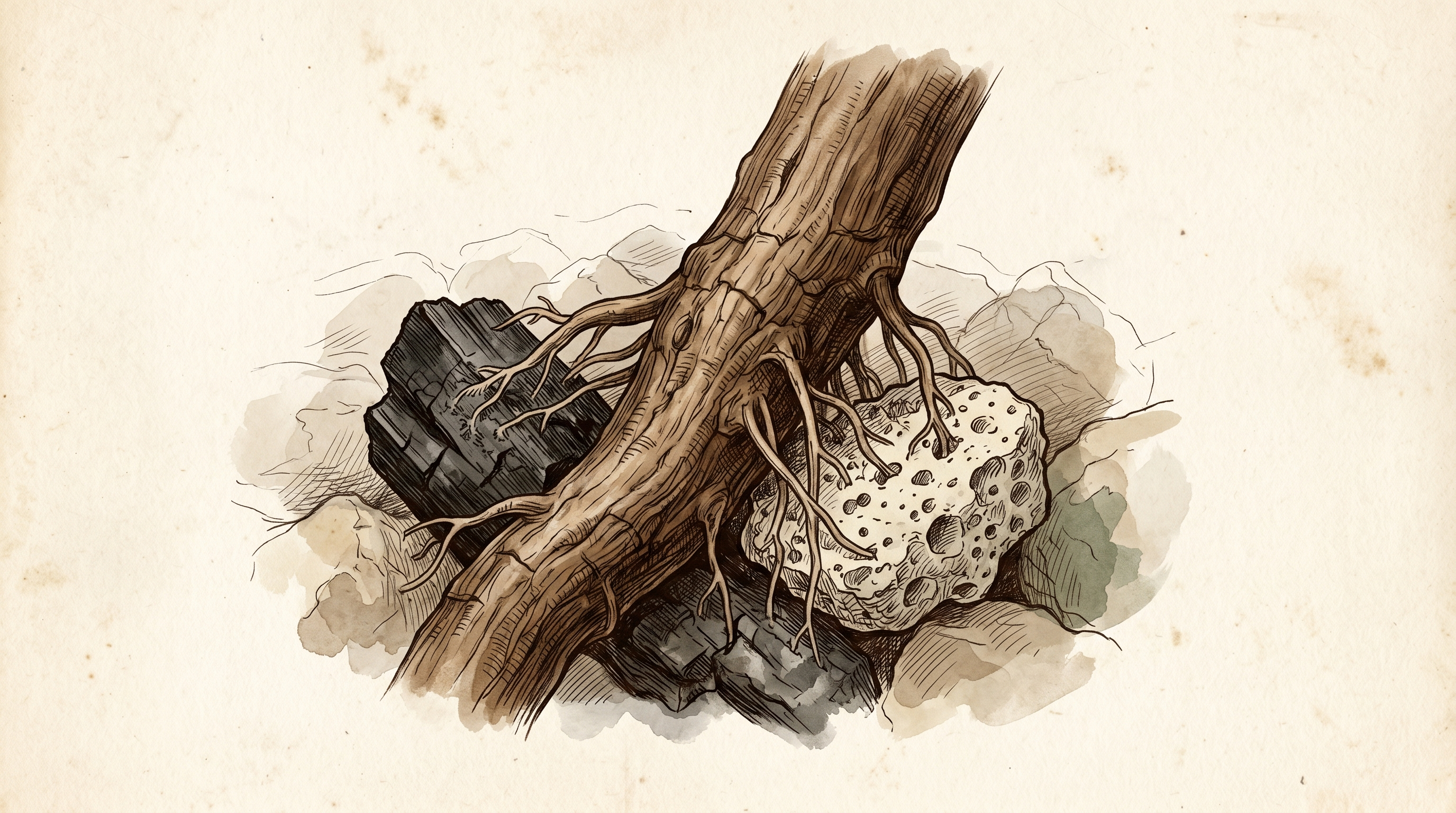
A quick anatomy detour, because the entire recipe assumes a particular kind of root.
Epiphytic aroids carry two kinds of roots. Underground feeder roots draw water and nutrients from the pot. Aerial roots (the ones climbing a moss pole or reaching out the side of a Monstera) have different anatomy and operate on a different schedule.
Araceae aerial roots have a velamen radicum, a multi-layered dead-cell epidermis with porous structure. Same tissue type that defines orchid aerial roots (Zotz & Winkler, The Velamen Radicum of Orchids, Springer 2018). The aroid version is simpler, but does the same job: rapid water uptake during wet pulses, passive seal against evaporation when dry. Water uptake happens in seconds; evaporation takes hours (Zotz et al., Oecologia, 2013). Architecture built for wet briefly, dry mostly.
For substrate, that means two things. First, aerial roots need surface contact, not submersion. They grip textured surfaces, develop the lignified hypodermis that gives them woody maturity. Embed them in compacted organic matter and they suffocate, rot, or fail to differentiate. Second, the substrate needs to breathe because an actively photosynthesizing climbing aroid has real oxygen demands. Research on aroid roots pins oxygen availability and surface porosity as the primary drivers of root development in epiphytes, with water retention secondary.
AM is built around both of those facts. Forty percent pumice plus 15% charcoal give aerial roots plenty of textured surfaces and underground roots an open, oxygenated structure. The 20% organic fraction buffers moisture for the underground roots without ever creating the wet suffocating zone that aerial roots won't enter.
What This Mix Is For
The plants Aroid Mineral Mix is built for share a common profile: epiphytic or hemiepiphytic, climbing or aerial-rooting, evolved away from soil.
- Climbing Philodendron: P. gloriosum, P. melanochrysum, P. gigas, P. verrucosum, P. pastazanum (when climbing), P. squamiferum, P. luxurians, and the velvet-leaf species generally. Anything that wants a moss pole or slab.
- Monstera: M. deliciosa (especially mature, climbing specimens), M. adansonii, M. dubia, M. obliqua, M. standleyana. Everything in this genus eventually wants chunkier than 60/40.
- Anthurium (epiphytic): A. warocqueanum, A. veitchii, A. magnificum (climbing forms), A. forgetii, A. clarinervium if you've been keeping it consistently overwatered on a more organic mix and want to swap. Terrestrial Anthurium are happier on Standard Mineral Mix.
- Rhaphidophora: R. tetrasperma, R. decursiva, R. cryptantha, R. korthalsii. All epiphytic climbers.
- Epipremnum: Including the variegated Epipremnum aureum cultivars that have been treated as terrestrial pothos for years but actually thrive on a chunkier mix once you give them height.
- Scindapsus, Cissus discolor, Syngonium (climbing): Same logic.
If you're looking at a plant that's actively pushing aerial roots out the side of its current pot in search of something to grip, Aroid Mineral Mix is the answer. If a plant flags as borderline between Standard Mineral Mix and Aroid Mineral Mix, the deciding question is usually "how aggressively is it climbing?" Aggressive climbers want this mix.
What This Mix Is Not For
A few categories where Aroid Mineral Mix is the wrong answer:
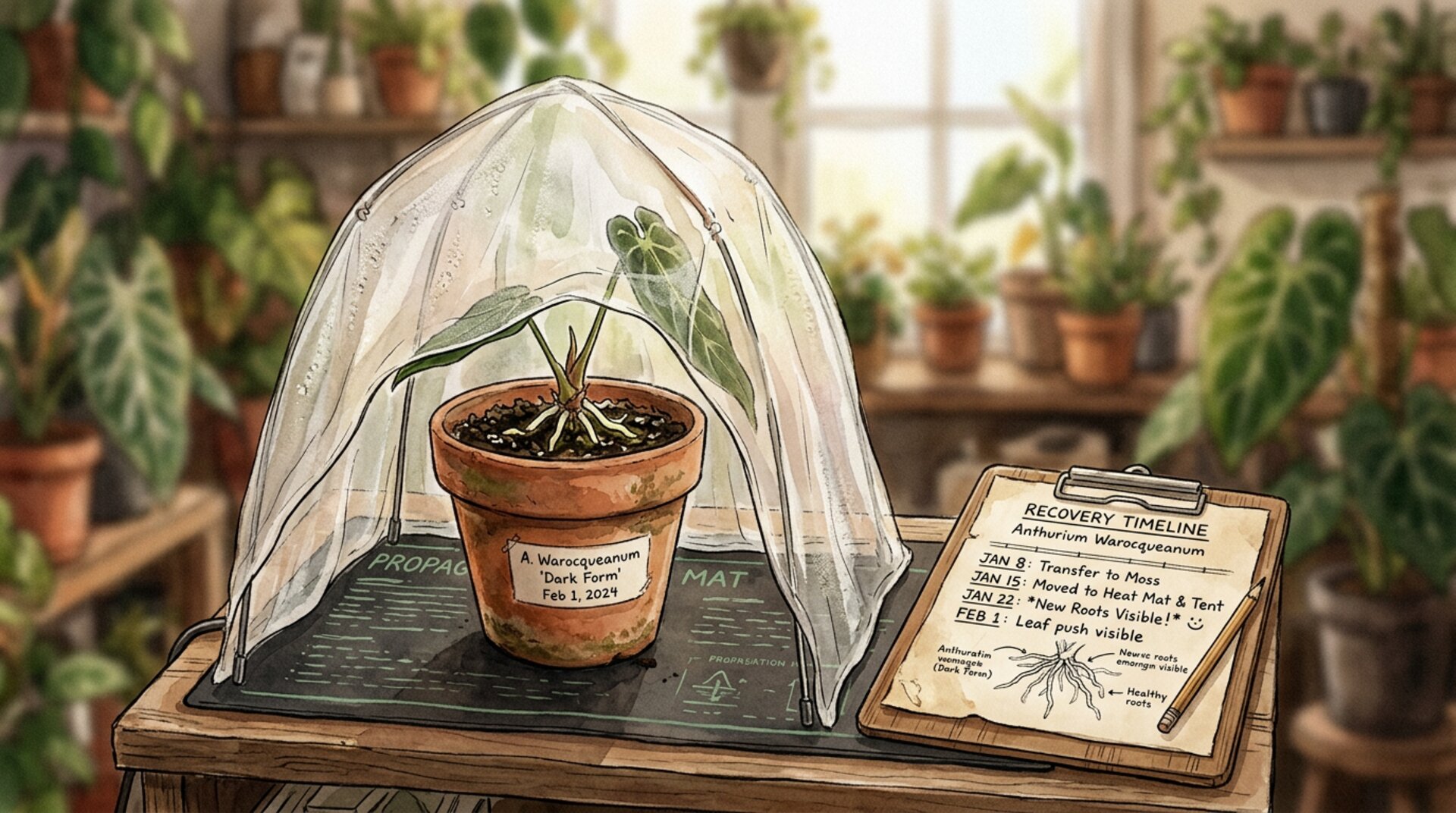
- A plant in active recovery. Use ICU Mix until the plant is pushing new growth and the roots are at least 2 inches long and lignifying. The 80% mineral fraction in AM dries too fast for a compromised root system to keep up with.
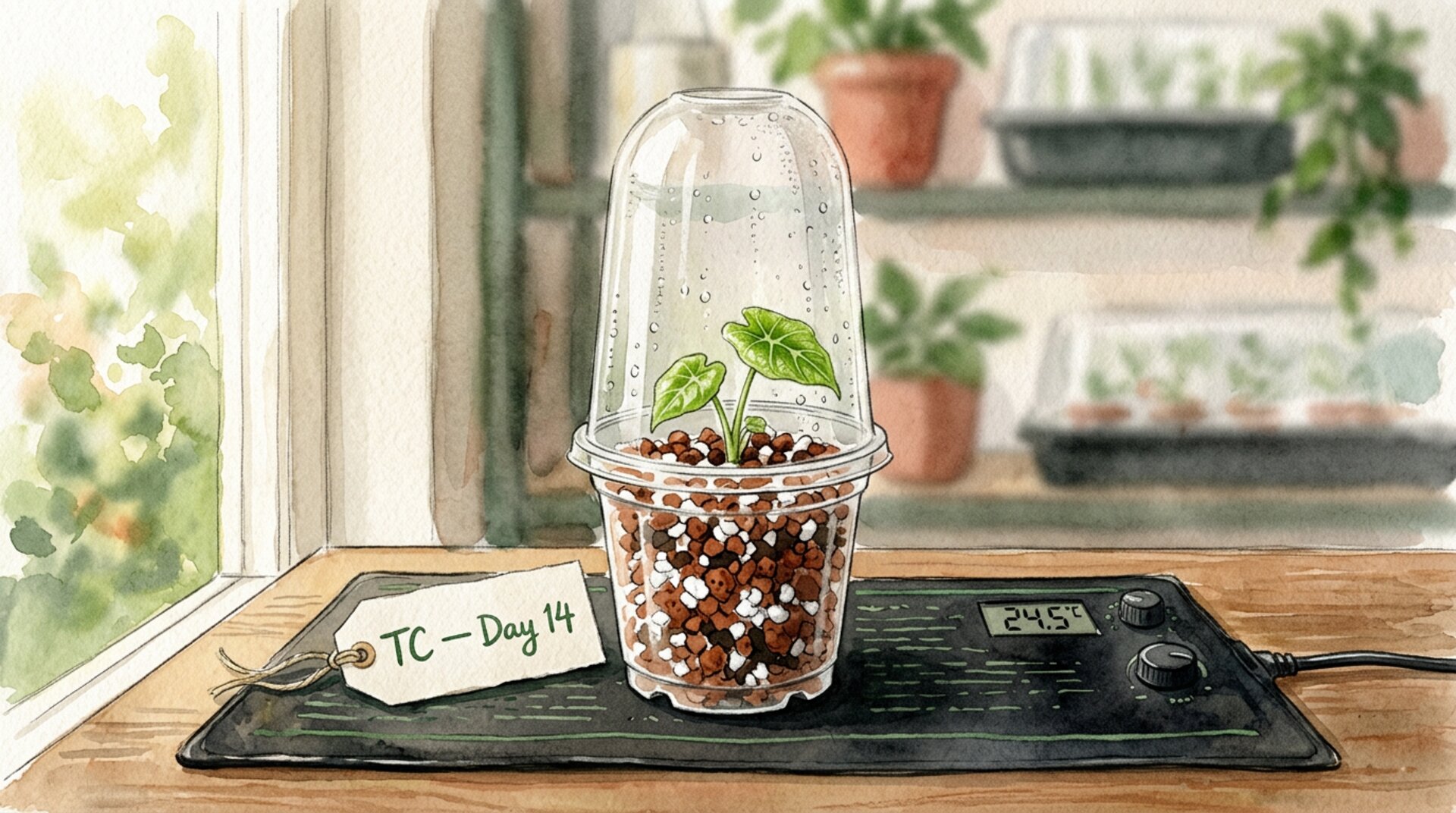
- A fresh-from-agar tissue culture plantlet. TC plants need the two-stage acclimation protocol. AM is several stages downstream from where a deflasked plantlet should live.
- Terrestrial Philodendron and Syngonium. P. Birkin, P. White Knight, most Pink Princess hybrids, and terrestrial Syngonium all stay on Standard Mineral Mix. They'll survive in AM but they'll need watering twice as often, and the casual fertigation cadence that suits an established collection won't match what they actually want.
- Marantaceae. Goeppertia, Calathea, Stromanthe, Ctenanthe want consistent moisture. AM dries too fast.
- Hoya in general. A few epiphytic Hoya can be grown in AM if you fertigate aggressively, but the Hoya genus is broad enough that a dedicated mix or the Epiphytic Bark Mix is usually a better starting point.
- A water-only grower. AM has almost no resident nutrients. If you're not running an active fertigation program, this mix will starve plants on a 60- to 90-day timeline.
How to Use It
Pre-moisten before potting
AM is dusty in the perlite-and-charcoal fraction when dry. Add water until the mix is evenly damp but not wet. It should hold its shape loosely when squeezed and break apart when tapped. Pre-moistening hydrates the coir and seasons the charcoal, which otherwise floats to the surface during the first watering.
Pot size and material
For climbers transitioning to a moss pole, step up at most one size from the previous pot, and step up sooner if the plant is producing aerial roots faster than the pot can house them. Terracotta is our default for AM in 4 to 8 inch sizes. The porous walls match the dry-down rate of an 80% mineral mix. Plastic and glazed ceramic both work, but stretch the watering cadence by 2 to 3 days to compensate for slower lateral evaporation.
For plants going onto a slab or in a hanging basket, AM works as the rooting matrix at the base while the aerial roots find the slab itself. Pack lightly. Compaction defeats the purpose of an 80% mineral mix.
Watering cadence
Water thoroughly when the substrate is dry to the touch 2 inches down. In a 4-inch terracotta pot at moderate indoor light (200 to 400 µmol/m²/s PPFD, or a bright window with no direct sun), expect 7 to 10 days. The same plant in a 4-inch injection-molded plastic pot runs 9 to 13 days, since the walls don't breathe and lateral evaporation drops to near zero. Step up to a 6-inch pot and add 3 to 4 days regardless of material: 10 to 14 days in terracotta, 13 to 17 days in plastic. Glazed ceramic behaves like plastic. In summer with active growth, those numbers compress; in cooler months and lower light, they stretch.
When you water, water through. Pour at the substrate surface until water runs from the drainage holes for at least 10 seconds. Mineral-heavy mixes don't channel the way peat-based mixes do, and a thorough soak actually saturates the aggregate. A short watering on AM leaves dry pockets in the middle of the pot that take weeks to rewet.
The most common AM mistake we see in growers transitioning from a more organic mix is under-watering on volume. The right cadence is less frequent waterings and a much heavier soak each time, not the same frequency with less water.
Fertigation
A mineral-heavy substrate needs an active feeding program. Without it, AM will slowly starve a plant.
Default: a balanced liquid feed at one-third to half label strength every other watering, targeting an applied EC of 1.0 to 1.4 mS/cm. We use a 13-13-13 or 20-10-20 base depending on the season. In active growing months (March through October in our Bay Area conditions), every other watering. In cooler months, every third watering as growth slows.
The 10% zeolite in AM does meaningful buffering work here. Applied nutrients hang on the zeolite's exchange sites between waterings rather than washing straight through, which means feeding cadence can be slightly less aggressive than a fully zeolite-free mineral mix would demand.
Test runoff EC quarterly. If it climbs above 1.6 to 1.8 mS/cm, flush with plain water (3x pot volume) until runoff returns to range. The 5% castings adds a small ongoing nutrient contribution; the rest is on you.
Refresh interval
Plan to refresh AM every 24 months, sometimes longer. Eighty percent mineral with chunky charcoal does not compact the way a 60/40 or 50/50 mix does. The first signal that an AM plant needs refresh is usually the coir fraction visibly degrading at the surface (color shift toward grey, slight surface compaction) rather than a watering-cadence change.
When you refresh, you can typically reuse the pumice and zeolite if you wash them well. The charcoal we replace; the coir and castings always replace.
Common Failure Modes
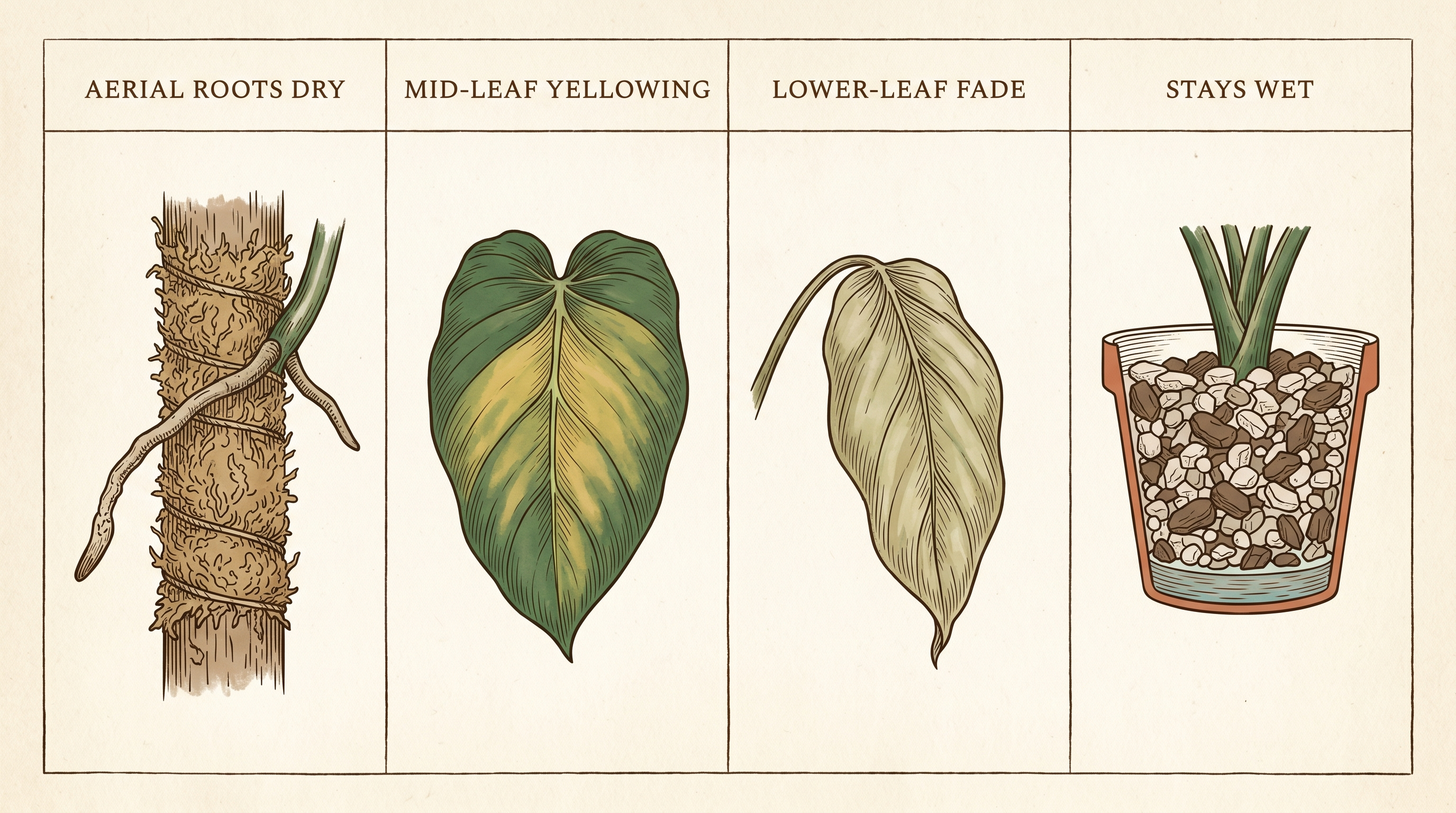
A few things we see when growers transition to AM from a peat-or-bark mix:
Aerial roots failing to attach to the substrate or pole. Humidity issue, not substrate. Aerial roots need ~60% RH minimum to grip and elongate. A dry moss pole won't work. Saturate it when you water.
Drying out faster than you can keep up with. Pot is too small, light is too high, or the plant is way more rooted than you realized. Step up one pot size and check root mass.
Mid-leaf yellowing 4 to 6 weeks after repotting. Under-fertigation. AM needs active feeding. Five percent castings runs out after a month or two.
Lower-leaf decline despite frequent watering. Opposite problem: too much water on a plant with no root system yet, or poor drainage. Check for a perched water table caused by a too-fine bottom layer.
Substrate stays wet 14+ days. Plant is dormant, light is too low, pot is way too big, or a combination. Check those before blaming the substrate.
When to Graduate Plants On or Off AM
Plants come onto AM from:
- Standard Mineral Mix, when they start producing significant aerial roots and need chunkier structure for grip.
- ICU Mix, after recovery is complete and the plant is pushing new growth.
- Tissue Culture Acclimation Stage 2, if the plantlet is going to be a climbing aroid eventually. It can move directly to AM once Stage 2 is fully complete and the plant has a real root system.
Plants come off AM toward:
- Standard Mineral Mix if their growth habit shifts terrestrial as they mature, which is rare for climbing aroids but happens.
- ICU Mix if they're in active distress and need recovery.
- A larger AM pot, in most cases. Climbers stay on this mix for years once they're on it.
The Short Version
Eighty percent mineral, fifteen percent chunky charcoal, five percent organic. Coarse pumice for air-filled porosity that holds two years. Charcoal at 1/4 to 1/2 inch as the bark replacement that roots grip without spore load. Zeolite at 10% to hold cations between waterings. Buffered coir and castings at minimum because epiphytes salt up fast. Quarterly EC checks, every-other-watering half-strength feed in growing season, refresh every 24 months.
It's the climber substrate, the mix that defined the bark-free system, and the recipe that surprises growers coming from organic aroid mixes in the best possible way.
Next in the series: Goeppertia / Calathea Mix v5: The Moisture-Retentive Mix. The mix for Marantaceae, for plants that want consistent moisture and absolutely cannot tolerate the dry-then-soak cycle that an epiphytic mix is built around.
Argo, W. R. (1998). Root medium physical properties. HortTechnology, 8(4), 481–485. https://doi.org/10.21273/HORTTECH.8.4.481
Atiyeh, R. M., Edwards, C. A., Subler, S., & Metzger, J. D. (2001). Pig manure vermicompost as a component of a horticultural bedding plant medium. Bioresource Technology, 78(1), 11–20.
Owen, J. S., & Altland, J. E. (2011). Container nursery substrate hydrology. HortTechnology, 21(5), 554–562. https://doi.org/10.21273/HORTTECH.21.5.554
Zotz, G., et al. (2013). The velamen radicum of orchids. Oecologia, 171(3), 733–741.
Zotz, G., & Winkler, U. (2018). The velamen radicum of orchids. Springer.