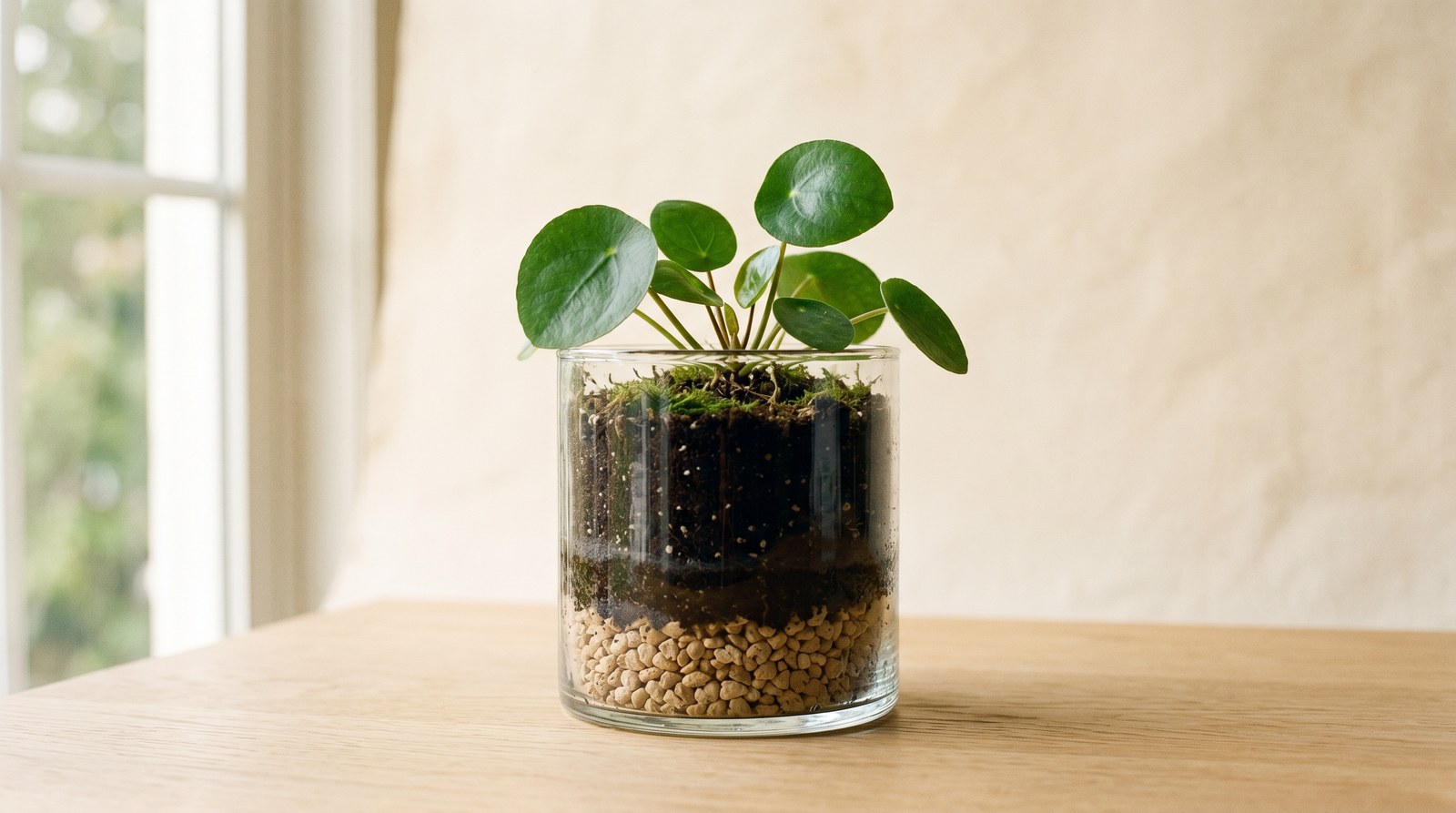
A layer of gravel at the bottom of the pot for better drainage. It's a common practice among home gardeners, and when we first wrote about it we said flatly that it makes drainage worse. Extension sources said the same, and we cited them. It turns out that warning rested on theory that had seen little formal testing in actual pots. When a 2025 study tested it in containers, drainage layers usually reduced the water held, sometimes made no difference, and almost never increased it.
On this page
7 sections
When this article first ran in June 2026 we rated the claim False, and said that a gravel layer lifts the saturated zone up into the root ball and makes drainage worse. Extension sources made the same case, and we cited them.
It was also, on the evidence we have now, wrong. A study published in PLOS ONE in 2025 weighed the water held in test pots with and without drainage layers, and found that the layers usually reduce it, sometimes make no difference, and almost never increase it. We've rewritten the article, moved the verdict to It's Complicated, and left the original reasoning visible below so you can see what changed and why.
Our practical recommendation has not changed. The reason behind it has.
A further correction: an earlier version of this box said drainage layers never increase the water a container holds. One of the study's container measurements did, so we've changed that to "almost never" everywhere it appeared. We had also given the author's first name wrongly. The study is by Avery Rowe.
The claim
The advice goes like this. Put a layer of gravel, pebbles, broken pot shards, or styrofoam peanuts at the bottom of your pot. The water will drain out of the soil, collect in the layer below, and run out the hole. Your plant gets the moisture it needs and the roots stay out of the wet. It's a common practice.
What we said in June, and why
The argument against drainage layers goes like this. Back in 1959 Hsieh and Gardner showed that when water moving down through soil reaches a boundary with a soil of different porosity, it doesn't cross until the soil above is nearly saturated (cited in Rowe, 2025). A later study found that a layer of coarse material "acts as a barrier to water movement in field soils" (also cited in Rowe, 2025). That much is real.
From there the reasoning takes one more step: if water piles up above the boundary, then adding gravel must push the saturated zone, the perched water table, higher into the pot and closer to the roots. Linda Chalker-Scott at Washington State University makes this case, and University of Illinois Extension puts it just as plainly, saying that instead of draining into the gravel the water "perches" in the soil above it (Chalker-Scott, n.d.; University of Illinois Extension, n.d.).
It's a tidy argument. Extension sources make it, and in June, so did we. And that last step, the one that goes from "there is a boundary effect" to "therefore the wet zone rises," had seen little formal testing in actual pots (Rowe, 2025).
Then someone put it in a flowerpot
In 2025 Avery Rowe published an applied test of the question in PLOS ONE. The design is deliberately unglamorous: three common potting media, four drainage substrates, two layer depths, test pots chosen to closely replicate real growing containers, saturated and then left to drain, using materials and methods chosen to emulate what home gardeners typically have. Rowe weighed what the containers held, then used two models to estimate the water held in the medium alone, subtracting the water sitting in the drainage layer itself.
For the two loamless mixes, which were coir-based and chosen to stand in for common peat-type media, almost every drainage layer reduced the water retained in the container. For the loam-based mix, most layers made no statistically significant difference to the water the container held, and one, a layer of LECA (a lightweight aggregate) about 1.2 inches (30 mm) deep, increased it. Rowe's summary is that drainage layers almost never increased water retention, and that the result "can be taken to show" the warnings that a layer raises the perched water table and makes a pot hold more water "should be considered inaccurate" (Rowe, 2025).
Why the theory pointed the wrong way
Here's the part worth sitting with, because it's a nice piece of physics.
A capillary barrier works on contrast. Work Rowe cites found that a capillary barrier holds more water above it when the barrier layer is coarser rather than finer. Smesrud and Selker's theoretical analysis predicted that the effect is maximised when that contrast is infinite, or in Rowe's words, when the soil is "suspended over a void of air" (cited in Rowe, 2025).
Now look at what a plain pot with a drainage hole actually is. As Rowe points out, in a typical pot filled with a single potting mix, the water crosses just one boundary on its way out: the drainage hole, where the mix meets air. On this theory, soil over air is the maximum-contrast case, so soil over any other substrate, gravel included, would be expected to perch less water, not more (Rowe, 2025). It's still a prediction, and one of the loam-based conditions went the other way.
What this doesn't prove
One study is one study, and we'd be repeating our own mistake if we now overcorrected.
Rowe measured water in containers, not plants growing in them, and says so directly: the results "cannot be used to predict whether a given plant will benefit from this intervention." The paper also calls for further replication, and notes that the containers were fully saturated before draining, whereas pots watered from above in everyday use start draining before they're saturated.
So we don't read it as a green light to start putting rocks in your pots, though the author does recommend drainage layers, naming a layer of coarse sand about 2.4 inches (60 mm) deep as the best single recommendation for growers who want more drainage. It's one study suggesting that the confident mechanical story, which we told too, doesn't hold up when you put a flowerpot on a scale.
What we'd rely on instead
Two things, and we'd put both ahead of a layer.
The substrate. A chunky, structured mix with real air-filled porosity drains because the pores in it are large enough to let water move through and out. If a substrate stays sodden for days, the answer is a different substrate, not a layer of rocks underneath it.
The drainage hole. Keep it open. Don't cover it with a coffee filter, don't block it with a piece of pot shard, don't seal it with mesh fine enough to clog. A wide, unobstructed hole and a saucer that doesn't sit in standing water is the entire drainage system most houseplants need.
And the argument against gravel that this study didn't touch: it costs you room. Two inches of gravel in a six-inch pot is two inches we'd rather give to the mix. In Rowe's containers, thicker layers tended to reduce water retention more than thinner ones, and which material worked best depended on the mix. A layer of coarse sand about 2.4 inches (60 mm) deep was the only layer that significantly reduced the water held in the container in all three mixes, and Rowe calls it the most universally effective. We'd still rather spend that space on a better-draining mix, but that's our preference, not something the study tested.
The verdict
It's complicated, and we'd rather say that than keep a clean answer that isn't true.
The confident version of this myth-bust, that gravel raises the wet zone and makes a pot hold more water, wasn't borne out when someone weighed the water pots held. If you have a pot with a gravel layer in it, we wouldn't repot the plant over it. If the study's test pots are any guide, it's holding less water than the same pot without one or about the same, and it's very unlikely to be holding more.
We still don't add one, and here we part ways with the study. Rowe calls drainage layers "a potentially useful tool" for growers who want a pot to hold less water (Rowe, 2025). Our reasons are practical: we'd rather give that depth to the mix, and fix a pot that stays wet by changing what's in it. That's the Guild's call, not a finding. Skip the layer. Pick a mix that drains because of its structure. Keep the hole clear.
The advice is the same as it was in June. We just know a good deal more about the evidence.
Rowe, A. (2025). Effect of drainage layers on water retention of potting media in containers. PLOS ONE, 20(2), e0318716. journals.plos.org
Hsieh, J. C., & Gardner, W. H. (1959). Water movement in soils [Film]. Washington State University. (The capillary-barrier demonstration the older prediction rests on; cited in Rowe, 2025.)
Smesrud, J. K., & Selker, J. S. (2001). Effect of soil-particle size contrast on capillary barrier performance. Journal of Geotechnical and Geoenvironmental Engineering, 127(10), 885–888. (Cited in Rowe, 2025.)
Chalker-Scott, L. (n.d.). The myth of drainage material in container plantings. Puyallup Research and Extension Center, Washington State University. wpcdn.web.wsu.edu
University of Illinois Extension. (n.d.). Container drainage options. extension.illinois.edu
Spomer, L. A. (1976). Container soils are different. Ornamentals Northwest Newsletter, 1(8), 9–10. (Originally published as Illinois State Florists' Association Bulletin No. 365, May–June 1976.) agsci.oregonstate.edu

