Semi-hydro means growing a plant in an inert mineral medium, usually expanded clay pebbles (sometimes called LECA, short for lightweight expanded clay aggregate), with a shallow reservoir of water under the pot or in its bottom layer. The studies behind this entry were done in labs and greenhouses, not living rooms. Here's what the studies we could read in full actually measured.
What semi-hydro is
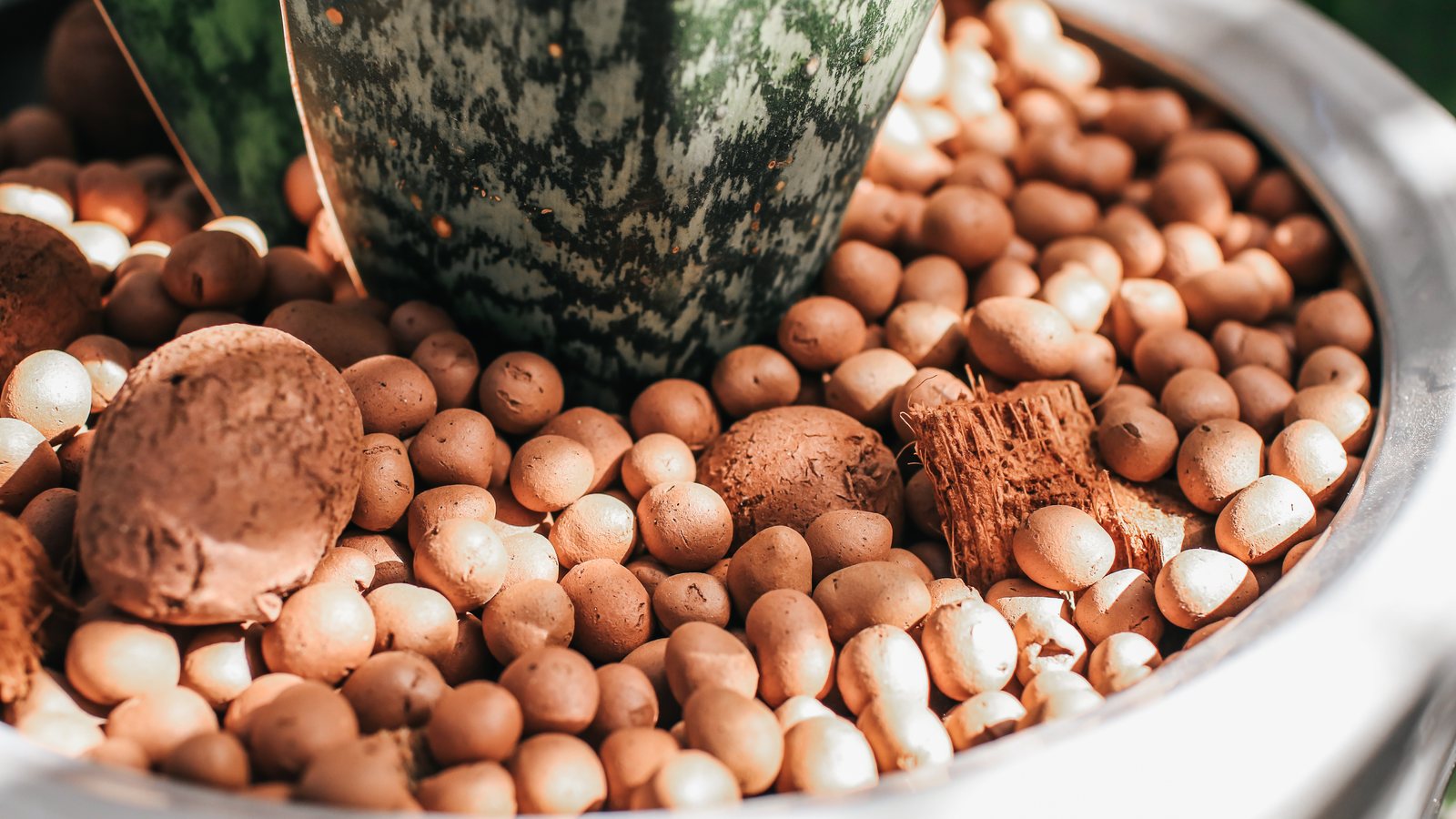
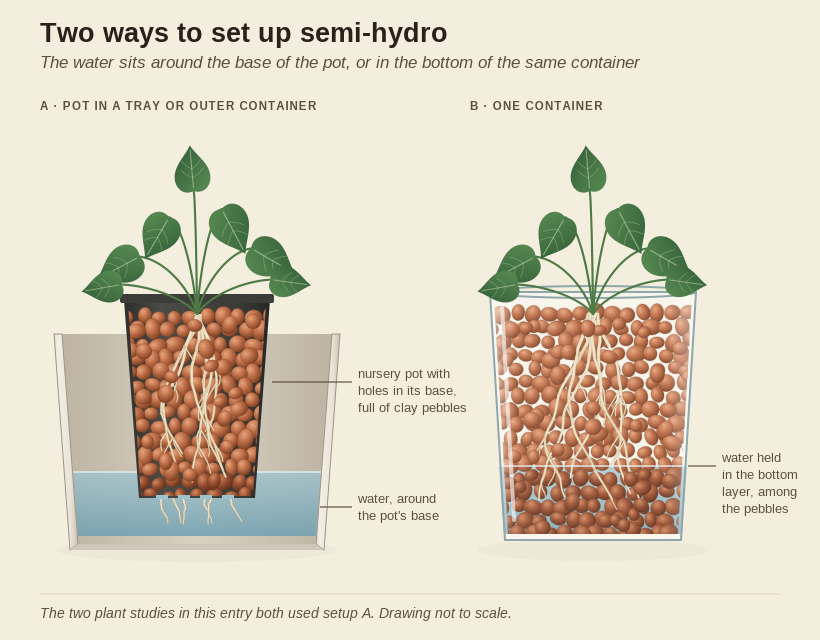
In a semi-hydro setup, the plant grows in an inert mineral medium instead of potting mix, most often lightweight expanded clay aggregate (LECA), the round clay pebbles. The water, with fertilizer in it, sits in one of two places: in a tray or outer container that the pot stands in, or in the bottom of a single container, with the clay running down into it. You'll also see the setup called hydroculture. The two plant studies below both stood their pots over a reservoir: Jeong et al. (2017) set them in a bottom-watering tray kept full of water, and Ievinsh et al. (2022) set them on plates that held fertilizer solution. This entry sticks to what has been measured, and most of that is about expanded clay.
| Study | Setting | Medium and plants | What it measured |
|---|---|---|---|
| Schabauer et al. (2026) | Lab, no plants | Nine mineral materials, including expanded clay, mostly 4 to 7 mm (0.16 to 0.28 in) | Water held, plant-available water, drying, pH, conductivity and electron-microscope images of each material |
| Jeong et al. (2017) | Plastic greenhouse, heated bed under a humidity cover; six weeks for the root trial | 7 mm (about 1/4 in) hydroballs in pots standing in a tray of water; six to eight foliage plants per trial | New roots after root pruning, shading and a rooting stimulator |
| Ievinsh et al. (2022) | Temperature- and humidity-controlled greenhouse; 7 to 9 weeks | Expanded clay, 10 to 16 mm (about 3/8 to 5/8 in), in pots on plates of fertilizer solution; six houseplants | Growth and plant physiology under different fertilizer types and strengths |
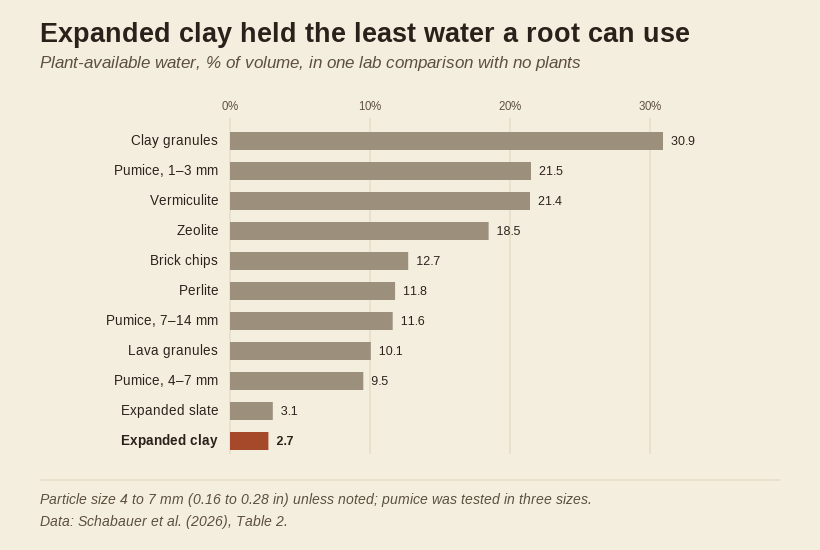
Expanded clay holds very little water a root can use
In a lab comparison of nine mineral growing media, the expanded clay sample held the least plant-available water: 2.74% of its volume (Schabauer et al., 2026). That was one product, in 4 to 7 mm (0.16 to 0.28 in) pebbles, tested without plants.
The microscope images point to a reason. In the pebbles the authors imaged, the outer surface was largely closed and glassy, while the larger, open pores sat inside (Schabauer et al., 2026). In their discussion, the authors argue that the closed surface keeps water out of the internal pores, leaving much of that pore space doing nothing for the plant (Schabauer et al., 2026).
The same sample tested at pH 8.4 in a water extract, which is on the alkaline side. Its conductivity reading, a sign of dissolved salts, was also higher than all the other media except brick chips. The authors say that's likely due to residues from manufacturing (Schabauer et al., 2026). After soaking and then draining, it held about 16.6% of its dry weight in water (Schabauer et al., 2026). That's a different measure from the 2.74% above, which is by volume and counts only water a root can use. These are one product's numbers, not a rule for every bag.
How water moves through the pebbles
The idea behind semi-hydro is that water rises from the reservoir by capillary action, the pull that draws water up through narrow spaces. That same study tested how its samples dried. In a lab drying test, the researchers soaked a sample and let it dry with no plants and no water supply underneath. The expanded clay's evaporation dropped off abruptly, which the authors read as too little capillary resupply because of its closed pores and low water retention (Schabauer et al., 2026).
The authors infer, without testing plants, that in indoor plantings the top layer of expanded clay would dry quickly and call for frequent, small waterings to protect shallow roots. They also note that a dry top layer slows water loss, like a mulch (Schabauer et al., 2026). They report that fine pumice, 1 to 3 mm (0.04 to 0.12 in), showed a more gradual fall in evaporation rate than coarser materials, which they put down to its narrower pores (Schabauer et al., 2026).
Keep the setting in mind. The study measured materials only, without plants, and the authors say their figures still need checking against living roots (Schabauer et al., 2026).
Moving a plant from potting mix into clay balls
One Korean study looked at exactly this move. The researchers took six to eight common foliage plants out of potting mix and into hydroballs, the paper's name for 7 mm (about 1/4 in) clay balls (Liaflor, imported from Germany). The plants went into small 3-inch (8 cm) pots sitting in a tray kept filled with water about half an inch (1.3 cm) deep (Jeong et al., 2017). This was not a living room. The pots sat on a heated propagation bed, kept at 68 °F (20 °C) or above, in a plastic greenhouse. They were under a plastic cover for humidity and, outside the shading trial, a 50% shade net (Jeong et al., 2017).
The authors write that the current practice is to cut roots back to about an inch (2 to 3 cm) before the move, because old roots left on are thought to rot. They add that no study had yet reported whether leaving them causes rot or poorer rooting (Jeong et al., 2017). They also state that plants take roughly four to eight weeks to root into the hydroballs, depending on species (Jeong et al., 2017).
In a six-week root-pruning trial, Chinese podocarpus (Podocarpus macrophyllus var. maki, pod-oh-KAR-pus) (North Carolina Extension Gardener Plant Toolbox, n.d.) produced the most new roots, and survived best, when its roots were left uncut. Common pothos rooted equally well whether its roots were left uncut or trimmed to about an inch (2 to 3 cm), and better than when all roots were removed. Dracaena (druh-SEE-nuh), schefflera (SHEF-ler-uh), and pothos 'Enjoy' produced a similar number of new roots whether all, some, or none of their old roots were cut (Jeong et al., 2017). Two species went the other way: Aglaonema (ag-low-NEE-muh) made the most new roots when trimmed to about an inch (2 to 3 cm), and Ardisia (ar-DIZ-ee-uh) when all its roots were cut (Jeong et al., 2017).
| Plant | Most new roots after six weeks |
|---|---|
| Aglaonema | Roots trimmed to about an inch (2 to 3 cm) |
| Ardisia | All roots cut |
| Chinese podocarpus | Roots left uncut |
| Common pothos | Uncut or trimmed, about equally; fewer when all roots were cut |
| Dracaena | No clear difference between treatments |
| Schefflera | No clear difference between treatments |
| Pothos 'Enjoy' | No clear difference between treatments |
| Croton | No clear difference between treatments |
Two cautions. Their root counts included only new roots of about 1/5 inch (0.5 cm) or more, and the paper does not report whether the old roots rotted or kept working (Jeong et al., 2017). The paper's conclusion also names different species as the exceptions from the ones its own results show, so we've gone by its figures and tables.
Feeding when the medium supplies nothing
A Latvian greenhouse study grew six houseplants, including Anthurium (an-THUR-ee-um), pothos, and peace lily, in expanded clay of 10 to 16 mm (about 3/8 to 5/8 in), in pots standing on plates that always held some fertilizer solution (Ievinsh et al., 2022). Evaporation and the plants' own water use changed the liquid level and its conductivity. So the researchers checked solution strength and, whenever it matched or rose above the feed's own strength, topped up with deionized water to avoid salt building up around the clay (Ievinsh et al., 2022). How much extra feed helped depended on the species: the slow-growing Anthurium responded least, and Plectranthus (plek-TRAN-thus) needed the most (Ievinsh et al., 2022).
The water you use matters too. Distilled water carries no dissolved nutrients, and Virginia Cooperative Extension warns that using it for a long time may lead to nutrient deficiencies (Criscione & Holliday-Goulart, 2026). With very pure water such as reverse osmosis (RO) water or rain, the fertilizer may be the only source of calcium, magnesium, and sulfur (Argo, 2003). In greenhouse containers watered with low-alkalinity water (water with little dissolved carbonate to neutralize acid), fertilizers high in ammonium-type nitrogen tend to drive substrate pH down over time (Argo, 2003).
Salts are the other side of it. A trade article on hydroponic substrates notes that salt buildup and drying out can be problems with expanded clay in badly managed systems, and recommends flushing it regularly (White, 2004). One extension guide covers reservoir feeding in a different setup. Mississippi State's guide to subirrigated (watered-from-below) vegetable containers filled with peat-based mix advises against putting water-soluble fertilizer in the reservoir, because soluble salts could build up there. It recommends a band of granular fertilizer on top of the mix instead. Even so, the same guide does put a teaspoon of calcium nitrate in the reservoir as an occasional extra feed for heavy feeders like tomatoes (Bachman & Coker, n.d.).
Two promises the research qualifies
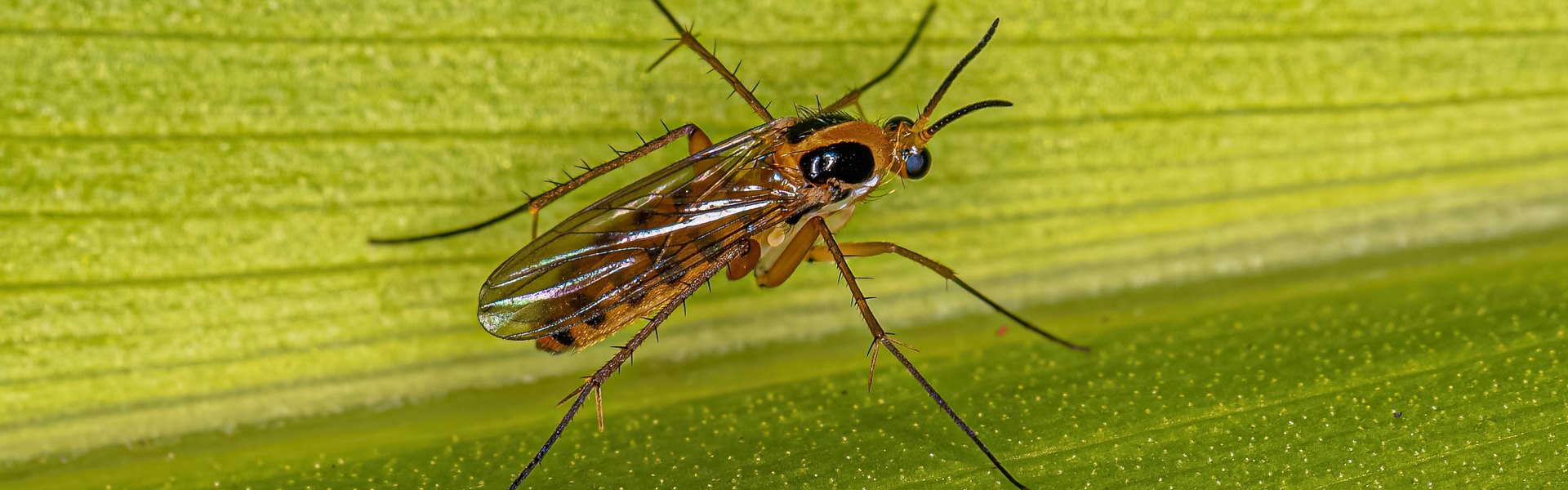
The first promise is that semi-hydro ends fungus gnats. The gnat research below was done in potting and greenhouse growing media, not expanded clay. It describes what the larvae favor: a moist growing medium, with fungi as a food they need to finish developing (Cloyd, 2010). Gnats prefer media with lots of microbial activity for their development (Cloyd, 2010). A review by Cloyd, citing his own earlier experiments, reports that sand or diatomaceous (dye-uh-tuh-MAY-shus) earth on the surface of the growing medium did not stop adults emerging or females laying eggs (Cloyd, 2015). UConn Extension puts it simply: no potting mix is immune to fungus gnats (Pundt, 2024).
The second promise is that roots in semi-hydro won't rot. Pythium (PITH-ee-um), which causes root rot in many herbaceous (her-BAY-shus), or non-woody, plants, favors wet conditions (Beckerman, n.d.).
The bottom line
In the lab study that measured it closely, expanded clay sieved to 4 to 7 mm (0.16 to 0.28 in) had a largely closed, glassy outer surface and held the least plant-available water of the nine materials tested. The authors read its drying curve as a sign of weak capillary resupply. In a heated, covered greenhouse bed, several foliage plants moved into clay balls grew about as many new roots in six weeks with their old roots left on as with them cut back. Aglaonema did best trimmed, Ardisia did best fully cut, and Chinese podocarpus did best with its roots left on, while common pothos did as well left on or trimmed. In the feeding study in expanded clay, the researchers kept checking the solution's strength to stop salts building up. Distilled water, for its part, brings no nutrients of its own. Most of this comes from labs and greenhouses, so it describes the material and the method, not what will happen on a windowsill.
Go deeper in the free Apprenticeship: Module IV, What Substrate Is →
Argo, B. (2003). Understanding pH management and plant nutrition. Part 2: Water quality. Journal of the International Phalaenopsis Alliance, 13(1). Reprinted by the St. Augustine Orchid Society. https://staugorchidsociety.org/PDF/IPAWaterQuality.pdf
Bachman, G. R., & Coker, C. E. H. (n.d.). Subirrigated containers for the Mississippi gardener (Publication 2971). Mississippi State University Extension Service. https://extension.msstate.edu/publications/subirrigated-containers-for-the-mississippi-gardener
Beckerman, J. (n.d.). Pythium root rot of herbaceous plants (BP-181-W). Purdue Extension. https://www.extension.purdue.edu/extmedia/bp/bp-181-w.pdf
Cloyd, R. A. (2010). Fungus gnat management in greenhouses and nurseries (MF2937). Kansas State University Agricultural Experiment Station and Cooperative Extension Service. https://bookstore.ksre.ksu.edu/pubs/fungus-gnat-management-in-greenhouses-and-nurseries_MF2937.pdf
Cloyd, R. A. (2015). Ecology of fungus gnats (Bradysia spp.) in greenhouse production systems associated with disease-interactions and alternative management strategies. Insects, 6(2), 325–332. https://pmc.ncbi.nlm.nih.gov/articles/PMC4553482/
Criscione, K., & Holliday-Goulart, J. (2026, June 2). Properly watering container houseplants (SPES-804P). Virginia Cooperative Extension. https://www.pubs.ext.vt.edu/content/pubs_ext_vt_edu/en/SPES/spes-804.html
Ievinsh, G., Andersone-Ozola, U., & Sieriņa, A. (2022). Development and physiological performance of hydroponically-grown ornamental indoor plants in relation to their potential use in botanical biofilters: Effect of mineral nutrient availability. Proceedings of the Latvian Academy of Sciences. Section B, 76(2), 278–288. https://doi.org/10.2478/prolas-2022-0041
Jeong, K. J., Park, C. M., Kang, J. S., Choi, K. O., & Yun, J. G. (2017). Rooting response of foliage plants affected by rooting stimulator, shading, and root pruning during transplanting to hydroball for hydroculture. Horticultural Science and Technology, 35(6), 667–679. https://doi.org/10.12972/kjhst.20170071
North Carolina Extension Gardener Plant Toolbox. (n.d.). Podocarpus macrophyllus var. maki. NC State Extension. Retrieved November 22, 2026, from https://plants.ces.ncsu.edu/plants/podocarpus-macrophyllus-var-maki/
Pundt, L. (2024). Managing fungus gnats and shore flies in commercial greenhouse vegetable transplant production (EXT060). UConn Extension. https://doi.org/10.61899/ucext.v1.060.2024
Schabauer, J., Streit, E., Korjenic, A., Peterková, J., Zach, J., & Sulejmanovski, A. (2026). Water retention and evaporation dynamics of mineral growing media for indoor horticulture systems. Horticulturae, 12(4), 501. https://doi.org/10.3390/horticulturae12040501
White, B. (2004, June). Alternative hydroponic substrates. Greenhouse Product News. https://gpnmag.com/article/alternative-hydroponic-substrates/
Image (hero and hub card): Photograph by Warunporn / Adobe Stock (asset 380486764), Standard license. Cropped from the original.