A reader asked whether adding silica to aroids actually helps them.
The honest answer is: maybe in specific situations, but the direct evidence for aroids is remarkably thin. The one pot trial I found on an aroid successfully pushed more silicon into the leaves without improving plant development or flower production.
That doesn’t make silicon snake oil. It makes the more interesting question which plants benefit from it, under what conditions, and whether a healthy Monstera, Philodendron or Anthurium is likely to be one of them.
Silica, silicon and the part roots can use
First, the words, because people use them interchangeably and they aren’t the same thing.
Silicon is the element. Silica is silicon bound to oxygen, SiO2. Roots don’t simply absorb chunks of silica from the pot. The main dissolved form plants take up is orthosilicic acid, Si(OH)4. At higher concentrations, dissolved silicon can begin polymerizing into larger silica forms rather than remaining conveniently available in solution (Coskun et al., 2019).
Silicon isn’t considered an essential plant nutrient, either. Most plants can complete their life cycle without it. But “not essential” isn’t the same as “does nothing.”
Silicon has documented benefits across a range of species and environmental conditions, particularly in plants under stress (Coskun et al., 2019). In 2015, the International Plant Nutrition Institute moved silicon from no status at all to “beneficial substance” (Coskun et al., 2019).
So the useful question isn’t whether silicon can help a plant.
It’s whether adding it does anything useful for an aroid that’s already growing well on your shelf.
Some plants are built to collect it
Plants vary dramatically in how much silicon they accumulate.
Across species, tissue concentrations can span roughly 0.1 to 10 percent of dry weight, what remains after the water is removed. Species, soil properties, silicon source and the amount available all help determine where a plant lands in that enormous range (Coskun et al., 2019).
The strongest silicon responses also tend to be associated with plants capable of accumulating substantial amounts of it. Some species take up plenty; others take up remarkably little.
Plants are therefore often described as accumulators or non-accumulators. One commonly used dividing line is around 1 percent silicon in leaf dry weight, or 10,000 milligrams per kilogram (Boldt et al., 2018). Rice, wheat and sorghum are among the familiar high accumulators (Coskun et al., 2019).
And this is where the aroid question gets interesting.
If high silicon accumulation were broadly a monocot trait, we’d expect grasses, palms, aroids and their relatives to look reasonably similar.
They don’t.
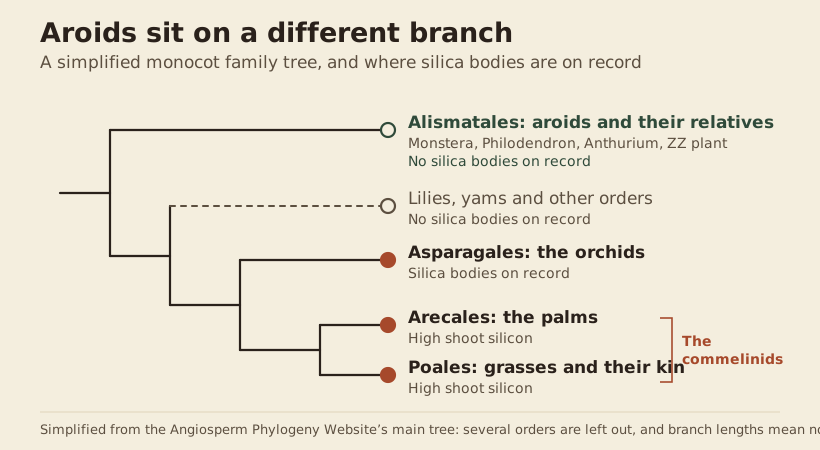
A large meta-analysis combined published measurements of shoot silicon from 735 species across 125 studies (Hodson et al., 2005). The heavyweight silicon users among monocots were concentrated mainly in two orders: Poales, which includes the grasses, and Arecales, the palms. Across most other monocot lineages, shoot silicon was substantially lower.
Grasses and palms both belong to a branch of the monocots called the commelinids.
Some absorbed silicon can eventually be deposited in plant tissues as microscopic silica structures, often called phytoliths. A 2025 study from Kew combined new leaf-section mapping with the published anatomical record and found that controlled biosilicification among monocots is restricted to commelinids and orchids (Rudall et al., 2025).
Aroids belong to neither group.
So what about aroids?
Monstera, Philodendron, Anthurium, Alocasia, peace lily, calla lily and the ZZ plant all belong to Araceae. The family sits within the order Alismatales, outside the commelinid branch of the monocots (Stevens, 2001 onwards).
That puts aroids outside the monocot lineages currently known to form silica bodies.
There are important caveats. The 2025 Kew study relied on earlier published records for Alismatales rather than newly sampling aroids, and the researchers emphasize that high silicon concentrations in leaves don’t always correspond neatly with visible silica deposition. Absorbing silicon and building recognizable silica structures are related questions, but they aren’t identical ones (Rudall et al., 2025).
Hard numbers on aroids are scarce, too.
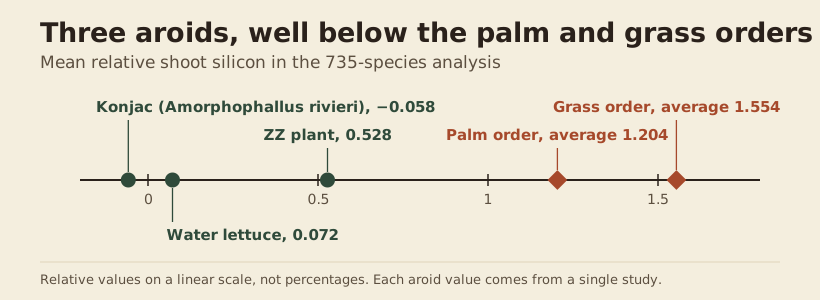
Only three made it into the 735-species dataset: konjac (Amorphophallus konjac, listed there under the synonym A. rivieri; USDA Agricultural Research Service, 2026), water lettuce (Pistia stratiotes) and the ZZ plant (Zamioculcas zamiifolia).
Rank all 735 species in that analysis from lowest relative shoot silicon to highest and they land at 58, 145 and 365, respectively (Hodson et al., 2005).
Those aren’t concentrations. They’re positions on a relative scale designed to let researchers compare species drawn from different studies. Each aroid value also rests on a single study, so this isn’t enough evidence to declare how an entire family behaves.
It does, however, give us some perspective.
| Plant or group | Relative shoot silicon | Rank of 735 |
|---|---|---|
| Konjac, Amorphophallus rivieri (aroid) | −0.058 | 58 |
| Water lettuce, Pistia stratiotes (aroid) | 0.072 | 145 |
| ZZ plant, Zamioculcas zamiifolia (aroid) | 0.528 | 365 |
| Palms, Arecales (order average) | 1.204 | n/a |
| Grasses, Poales (order average) | 1.554 | n/a |
Two smaller experiments add a little more evidence.
In a 15-day greenhouse test of six potted species supplied with potassium silicate in nutrient solution, peace lily landed roughly in the middle for silicon uptake per gram of dry weight: below English ivy and carnation but above kalanchoe and poinsettia (Son et al., 2013).
An Anthurium study approached the question very differently. Anthurium andraeanum ‘Rubi’ plantlets were grown in sterile tissue culture with different concentrations of sodium silicate. Silicon in the plantlets increased, but tissue concentrations remained low enough for the authors to characterize Anthurium as a non-accumulator (Dias et al., 2017).
So far, that isn’t much of a case for putting a silica bottle next to every Monstera.
But uptake is only half of the question.
What happens when you add it
I went looking for silicon trials on aroids grown in pots and found one.
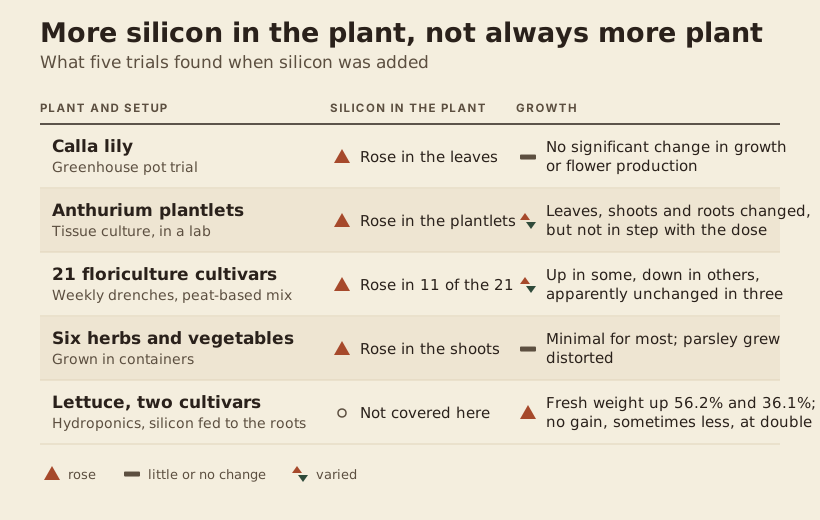
Calla lilies (Zantedeschia aethiopica) were grown in a greenhouse and supplied with potassium silicate through the substrate at concentrations ranging from 25 to 100 milligrams of silicon per liter of substrate (Almeida et al., 2009).
More silicon went in, and more silicon showed up in the leaves.
What didn’t show up was better performance.
The treatments produced no significant improvement in plant development or inflorescence production. The researchers were left with two possibilities: either calla lily simply didn’t respond to supplemental silicon under those conditions, or the concentrations weren’t sufficient to produce a response (Almeida et al., 2009).
The Anthurium tissue-culture experiment is the best reason not to turn that finding into “silicon does nothing for aroids.”
Those plantlets did respond.
Adding sodium silicate changed leaf production, shoot growth and rooting, and some treatments improved plantlet development. But the response wasn’t a simple more-silicon-equals-more-growth curve. Different traits responded differently across the treatments (Dias et al., 2017).
That’s interesting biology.
It’s also a tiny Anthurium plantlet growing on sterile culture medium in a controlled laboratory environment, not a mature Anthurium growing in chunky potting mix beside your window.
Outside Araceae, the results stay mixed.
In a peat-based substrate, weekly potassium silicate drenches raised leaf silicon in 11 of 21 floriculture cultivars over the course of the experiment (Mattson & Leatherwood, 2010). Growth was considerably less predictable. Depending on the plant, measures such as height, diameter, weight, flower diameter and leaf thickness could increase, decrease or barely change.
One limitation matters here: the plants weren’t being deliberately challenged by a particular stress, and stress is where many of silicon’s better-documented effects appear.
Container-grown herbs and vegetables told a similar story. Extra silicon increased shoot silicon in basil, parsley, thyme, rosemary, tomato and cucumber, while effects on growth were minimal for most of them (Tebow et al., 2021).
Then there was parsley.
It developed distorted growth and signs of phytotoxicity under supplemental silicon, an excellent reminder that plant responses aren’t interchangeable between species.
There are clear positive counterexamples, too.
In a 2025 hydroponic lettuce study, adding monosilicic acid to the nutrient solution at 0.07 millimolar increased shoot fresh weight by 56.2 percent in one cultivar and 36.1 percent in another. Doubling the concentration brought no further gain and sometimes cut growth (Choi et al., 2025).
That’s lettuce growing hydroponically, not an aroid in a pot. But it matters because it stops us from turning a useful pattern into a rule.
Silicon can benefit an unstressed plant. It just doesn’t reliably do so across plants or growing systems.
Across the wider literature, the pattern is similar. Many studies find little physiological effect from silicon when plants aren’t under stress, while considerably broader responses appear under stress. Even then, silicon often helps a stressed plant perform more like a normal one rather than pushing an already healthy plant beyond normal performance (Coskun et al., 2019).
Disease protection is another important piece of the story, particularly for pathogens such as powdery mildews. One working explanation is that silicon acts largely as an extracellular prophylactic agent against stresses rather than as an active cellular agent. Coskun and colleagues call this the “apoplastic obstruction hypothesis” (Coskun et al., 2019).
It’s a model, not the final word.
What’s already in the pot
There’s another complication if you’re trying to decide whether your plant “needs” supplemental silicon.
Plants in these studies often accumulated some even when nobody deliberately added any.
Every cultivar in the floriculture experiment contained measurable silicon in the untreated treatment. Trace silicon from the substrate and irrigation water may have contributed (Mattson & Leatherwood, 2010).
The untreated container herbs and vegetables contained silicon too. Possible sources included the substrate, fertilizer, spray surfactant and irrigation water (Tebow et al., 2021).
But that doesn’t mean ordinary potting ingredients are necessarily generous sources of plant-available silicon.
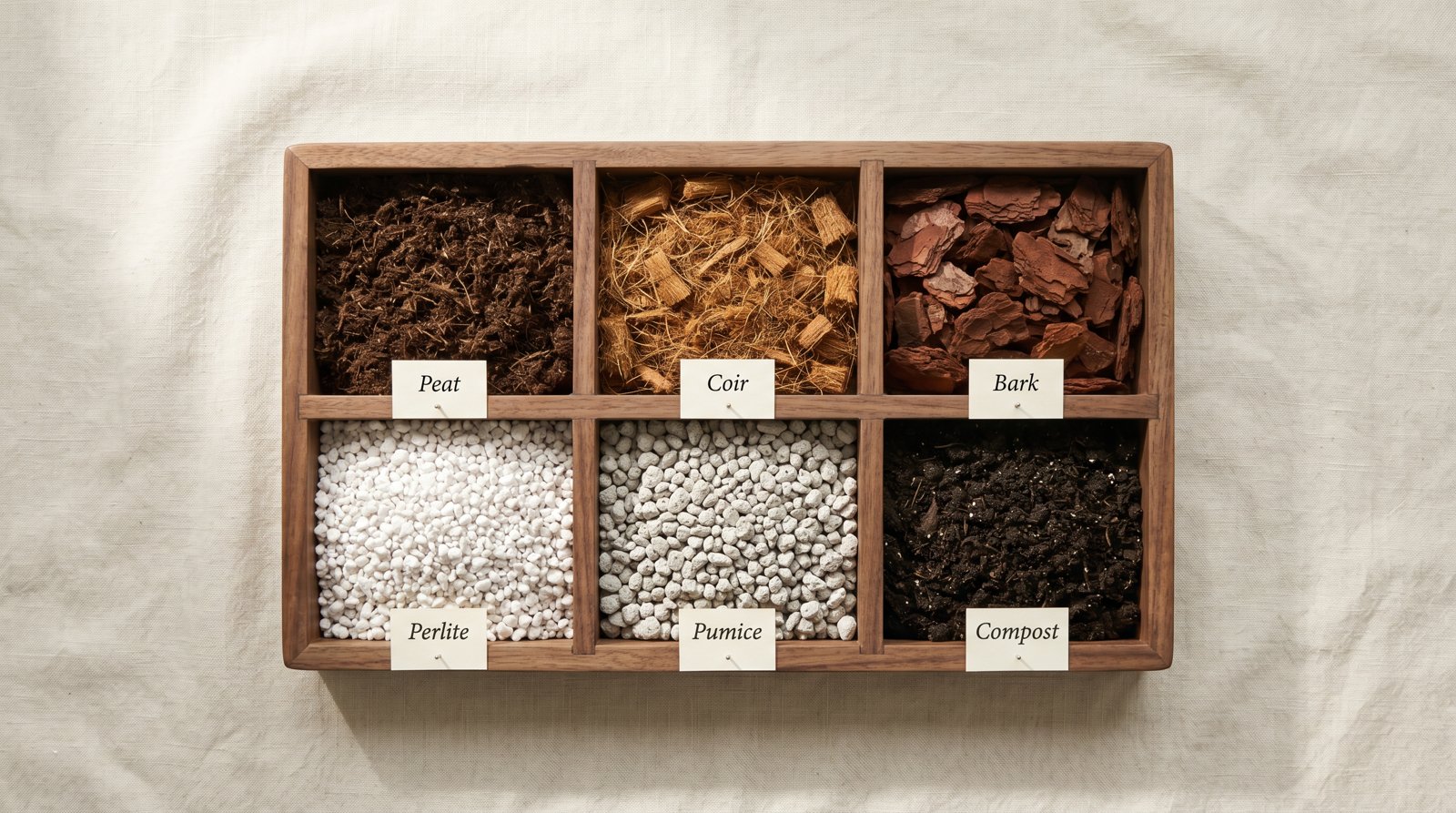
A dissolution study tested common substrates and silicon-containing additives in gently agitated deionized water. Sphagnum peat, coconut coir and perlite each released less than about 0.03 millimoles of silicon per liter of substrate per day. Wollastonite, a calcium-silicate mineral sold as a silicon amendment, released around 4 millimoles per liter per day (Dey et al., 2023).
I didn’t find a comparable measurement for pumice.
So don’t assume that a mineral-heavy potting mix automatically gives roots abundant usable silicon.
Total silicon and plant-available silicon aren’t the same thing.
A product can contain plenty of silicon without releasing much into a form roots can actually acquire. Work with potted sugarcane reached a similar conclusion: total silicon content in an amendment isn’t necessarily a reliable predictor of its ability to supply silicon to the plant (Keeping, 2017).
That’s worth remembering when the biggest number on a product label is its silicon percentage.
If you try it anyway
None of this means you can’t experiment with silicon.
It means the evidence gives us a better idea of what to expect.
Watch the pH
Soluble potassium silicate is strongly alkaline. A USDA National Organic Program technical report cites an aqueous potassium silicate product with a pH in roughly the 11 to 12 range (USDA Agricultural Marketing Service, 2023).
That matters when you’re pouring it into a container root zone.
Soluble silicate salts can also create precipitation problems if not carefully handled (Coskun et al., 2019).
If you’re using a soluble silicate product alongside fertilizer, follow the product’s mixing directions carefully. Check the final solution’s pH before it reaches the pot, and stay within the labeled application rate.
Solid sources can change substrate chemistry as well, another reason not to treat silicon as chemically invisible just because the plant doesn’t require it.
Start with one plant
Parsley is the reason.
One species in the container trial reacted poorly where several others didn’t, and the researchers emphasize the value of preliminary testing before applying supplemental silicon broadly (Tebow et al., 2021).
In a collection, your shelf is the crop.
Treat one plant. If possible, leave a comparable one untreated. Give the experiment enough time to produce meaningful new growth, then compare what actually happened rather than what you expected to happen.
Our own shelf is a good example
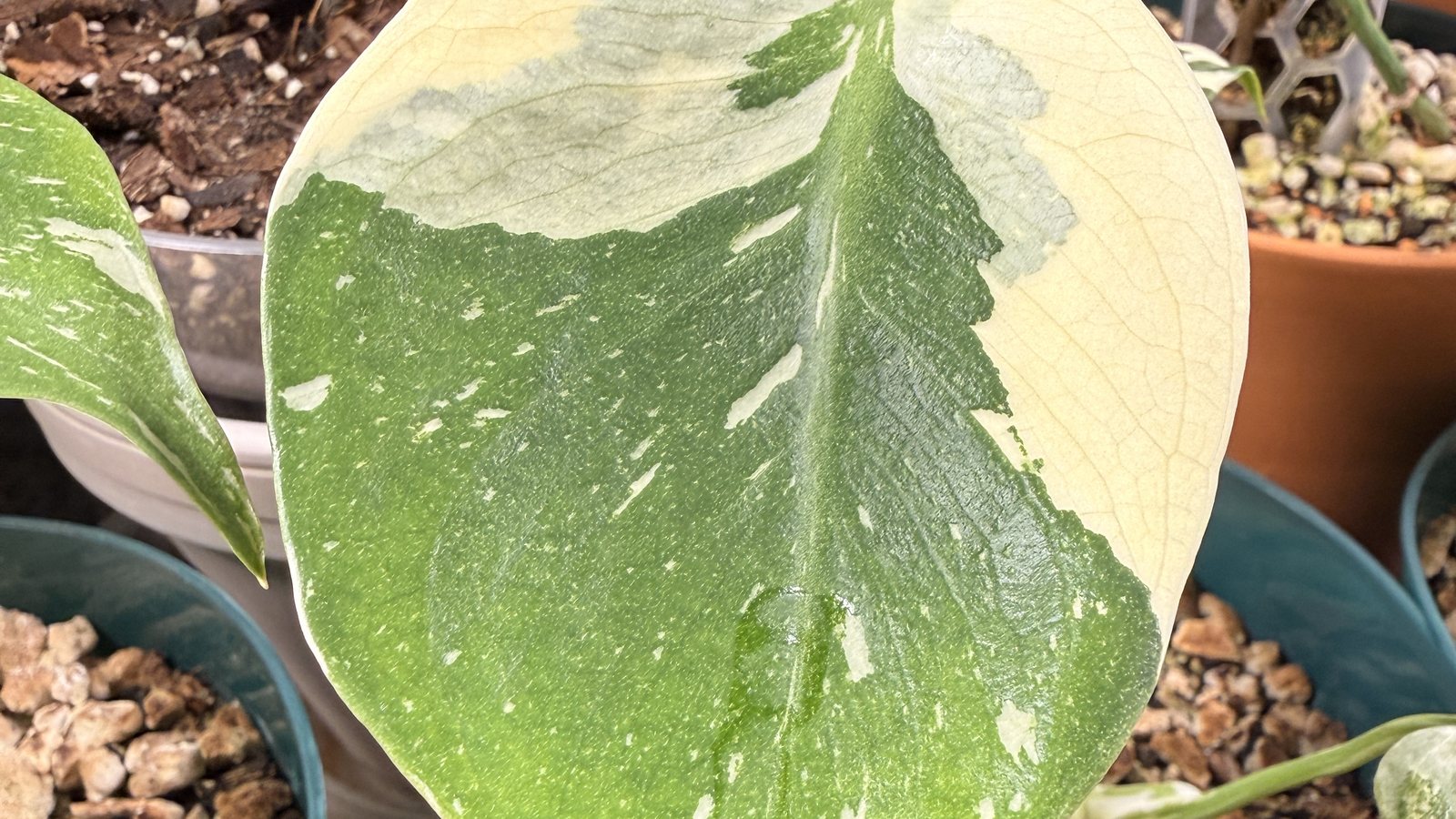
We’d been told that silica would help variegated Monstera hold together the delicate white sections of their leaves.
So we tried it.
We stirred about a teaspoon of a micronized volcanic silica mineral, a fine powder, into each gallon of our regular watering. We haven’t seen a notable difference.
But here’s the important part:
We didn’t set it up as an experiment.
There were no equivalent untreated plants alongside the treated ones, no quantitative measurements and no way to separate the silicon treatment from everything else happening to the plants.
So our experience doesn’t show that silica doesn’t work.
It shows that we saw no obvious change.
Looking back, it’s also exactly the kind of product where the difference between total silicon and available silicon becomes important. The amount printed on the bag doesn’t tell us how much actually dissolved into a form the roots could acquire (Keeping, 2017).
That’s a much less satisfying answer than “it worked” or “it didn’t.”
It’s also the honest one.
About diatomaceous earth
Diatomaceous earth tends to come up in the same conversation.
In the dissolution study, it released silicon relatively quickly at first, although the researchers noted its comparatively high cost (Dey et al., 2023).
It has also produced interesting results in plants.
A study of potted dahlia, black-eyed Susan and gerbera tested diatomaceous earth under both well-watered and water-stressed conditions. Supplemental diatomaceous earth affected growth, flowering and physiological traits, with responses depending on the species, application rate and irrigation treatment (Mills-Ibibofori et al., 2019).
None of those plants is an aroid.
So treat that result as a clue that the material can matter biologically, not a forecast for your Monstera.
The bottom line
Silicon isn’t nonsense.
It has well-documented effects in some plants, especially species capable of accumulating substantial amounts of it and plants dealing with particular stresses.
Aroids are where the case gets much weaker.
The few Araceae measured so far fall well below the classic high silicon accumulators. Anthurium plantlets have responded to silicon in tissue culture, but the one pot study I found on an aroid raised silicon in calla-lily leaves without improving plant development or flower production.
So if your Monstera, Philodendron or Anthurium is struggling, I wouldn’t put silica near the top of the troubleshooting list.
Get the light, watering, root-zone conditions, nutrition and pests right first.
And if the plant is already thriving?
There’s nothing unreasonable about experimenting with silicon. Use an appropriate product, watch the pH and try it on one plant before treating the collection.
Just don’t mistake “silicon can benefit plants” for “my aroid needs a silica supplement.”
Right now, the research doesn’t justify that leap.
Go deeper in the free Apprenticeship: Module IV, What Substrate Is →
Almeida, E. F. A., Paiva, P. D. de O., Carvalho, J. G. de, Oliveira, N. P. de, Fonseca, J., & Carneiro, D. N. M. (2009). Efeito do silício no desenvolvimento e na nutrição mineral de copo-de-leite [Effect of silicon on development and mineral nutrition of calla lily]. Revista Brasileira de Horticultura Ornamental, 15(2), 103–113.
Boldt, J. K., Locke, J. C., & Altland, J. E. (2018). Silicon accumulation and distribution in petunia and sunflower grown in a rice hull-amended substrate. HortScience, 53(5), 698–703. https://doi.org/10.21273/HORTSCI12325-17
Choi, S., Lee, C., Harvey, J. T., Joshi, V., & Leskovar, D. I. (2025). Silicon supplementation improves growth, physiology, and biochemical traits in hydroponic lettuce: Implications for controlled-environment agriculture. HortScience, 60(11), 2026–2033. https://doi.org/10.21273/HORTSCI18955-25
Coskun, D., Deshmukh, R., Sonah, H., Menzies, J. G., Reynolds, O., Ma, J. F., Kronzucker, H. J., & Bélanger, R. R. (2019). The controversies of silicon’s role in plant biology. New Phytologist, 221(1), 67–85. https://doi.org/10.1111/nph.15343
Dey, M. G., Boldt, J. K., & Bugbee, B. (2023). Dissolution of silicon from soilless substrates and additives. HortScience, 58(11), 1282–1290. https://doi.org/10.21273/HORTSCI17189-23
Dias, G. de M. G., Soares, J. D. R., Ribeiro, S. F., Martins, A. D., Pasqual, M., & Alves, E. (2017). Morphological and physiological characteristics in vitro anthurium plantlets exposed to silicon. Crop Breeding and Applied Biotechnology, 17(1), 18–24. https://doi.org/10.1590/1984-70332017v17n1a3
Hodson, M. J., White, P. J., Mead, A., & Broadley, M. R. (2005). Phylogenetic variation in the silicon composition of plants. Annals of Botany, 96(6), 1027–1046. https://doi.org/10.1093/aob/mci255
Keeping, M. G. (2017). Uptake of silicon by sugarcane from applied sources may not reflect plant-available soil silicon and total silicon content of sources. Frontiers in Plant Science, 8, 760. https://doi.org/10.3389/fpls.2017.00760
Mattson, N. S., & Leatherwood, W. R. (2010). Potassium silicate drenches increase leaf silicon content and affect morphological traits of several floriculture crops grown in a peat-based substrate. HortScience, 45(1), 43–47. https://doi.org/10.21273/HORTSCI.45.1.43
Mills-Ibibofori, T., Dunn, B., Maness, N., & Payton, M. (2019). Use of diatomaceous earth as a silica supplement on potted ornamentals. Horticulturae, 5(1), 21. https://doi.org/10.3390/horticulturae5010021
Rudall, P. J., Lourenço, J., Jr., & Mahto, M. K. (2025). Biosilicification in monocots: Comparative analysis highlights contrasting patterns of deposition. American Journal of Botany, 112(7), e70074. https://doi.org/10.1002/ajb2.70074
Son, M. S., Song, J. Y., Lim, M. Y., Sivanesan, I., Kim, G. S., & Jeong, B. R. (2013). Silicon uptake level of six potted plants from a potassium silicate-supplemented hydroponic solution. Korean Journal of Horticultural Science & Technology, 31(2), 153–158. https://doi.org/10.7235/hort.2013.12156
Stevens, P. F. (2001 onwards). Angiosperm Phylogeny Website (Version 14). Missouri Botanical Garden. Retrieved September 30, 2026, from http://www.mobot.org/MOBOT/research/APweb/
Tebow, J. B., Houston, L. L., & Dickson, R. W. (2021). Silicon foliar spray and substrate drench effects on plant growth, morphology, and resistance to wilting with container-grown edible species. Horticulturae, 7(9), 263. https://doi.org/10.3390/horticulturae7090263
USDA Agricultural Marketing Service. (2023). Aqueous potassium silicate: Crops [Limited scope technical evaluation report, compiled by OMRI for the National Organic Program]. https://www.ams.usda.gov/sites/default/files/media/2023LimitedScopeTechnicalReportCropsAqueousPotassiumSilicate.pdf
USDA Agricultural Research Service. (2026). Amorphophallus konjac K. Koch. Germplasm Resources Information Network (GRIN Taxonomy). National Plant Germplasm System. Retrieved November 15, 2026, from https://npgsweb.ars-grin.gov/gringlobal/taxon/taxonomydetail?id=2948