Walk into any garden center and the potting soil aisle is a wall of bags making the same promises. Fertile forest floor. Rich organic blend. Now with mycorrhizae. New and Improved! They can't all be the best. In fact, most of them are more alike than manufacturers want you to believe. You can't shop your way out of the confusion. But you can learn to read. I use two FoxFarm mixes outdoors, Happy Frog and Coco Loco, so this isn't a strictly neutral lab report. It's how I actually think about what goes in the pot.
I use Happy Frog and Coco Loco in my outdoor containers, not indoors (my own houseplants live in chunky mineral-forward mixes, which is a different conversation). So read this as a grower's working notes, not a neutral lab report. The goal isn't to name one bag to rule them all. It's to hand you the four questions that help you decode any bag on any shelf, before you've spent any of your hard-earned money.
— Christopher · Founder, The Planters' Guild§ 01The four decisions in every bag
Every bag of potting mix is really four decisions layered on top of each other. Once you can see them, the marketing copy stops mattering.
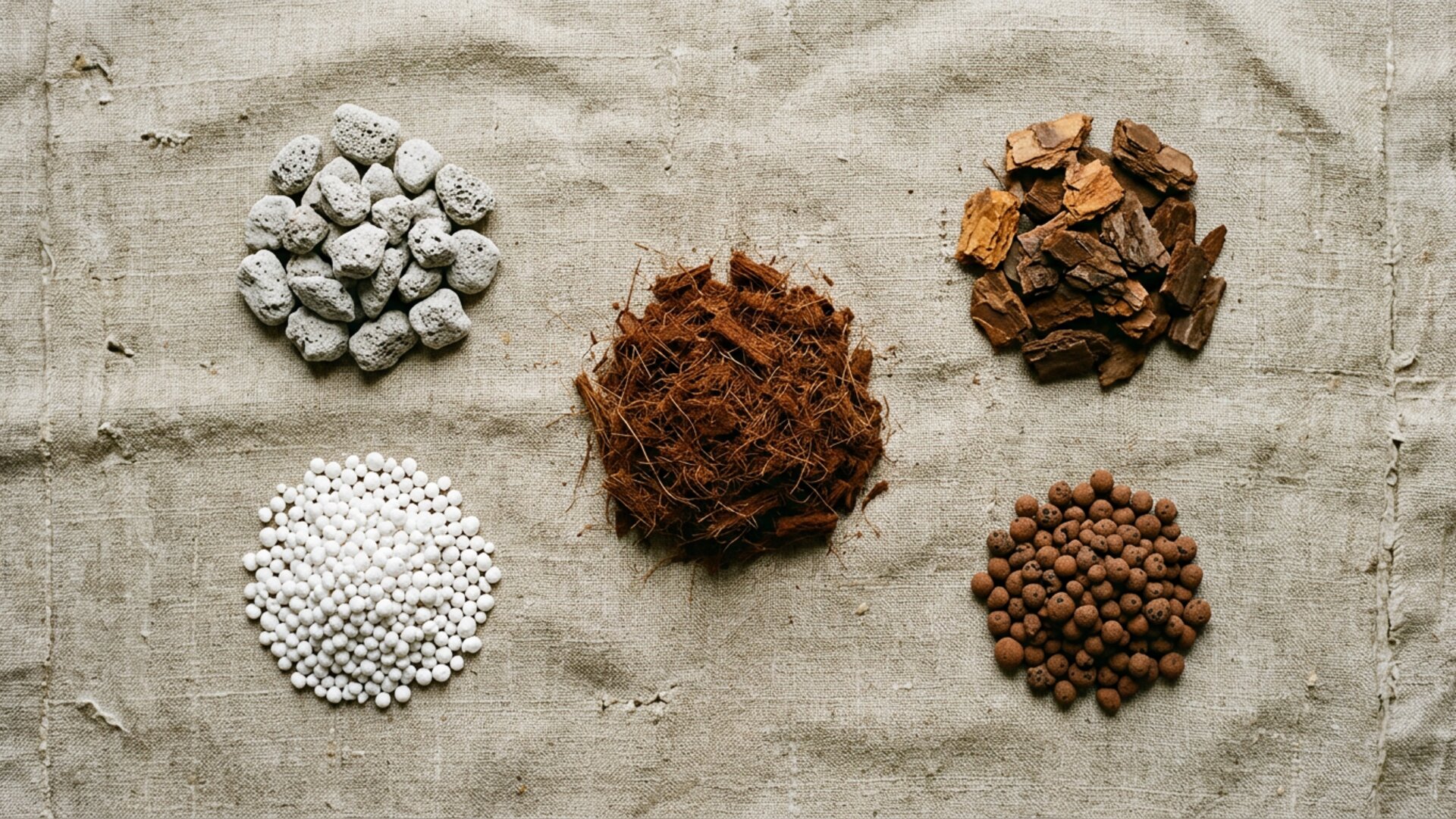
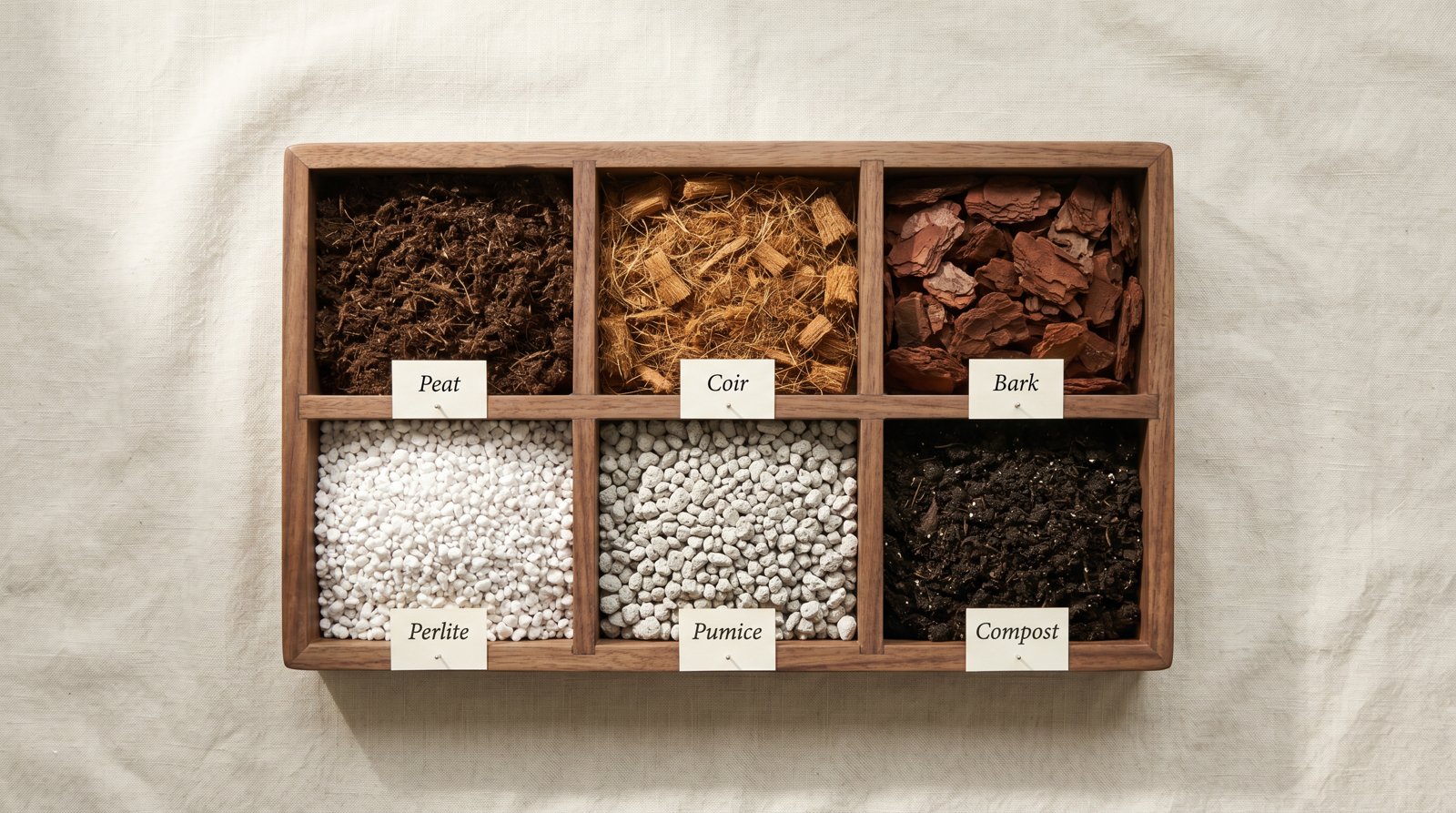
The base. This is 50 to 85 percent of the bag by volume, and it sets the whole personality. Almost always it's sphagnum peat moss, coconut coir, aged bark, or some combination. The base decides how the mix handles water and air. Everything else is a garnish on top of this one big choice.
The aeration. Perlite, pumice, or vermiculite, added to keep the mix from packing into a dense brick. Perlite and pumice are about air and drainage. Vermiculite is the odd one out: it holds water and nutrients instead of shedding them. A mix heavy on perlite dries fast. A mix heavy on vermiculite stays wet longer. Quick read: the whiter and chunkier the specks, the faster it drains.
The charge. How much fertility is already loaded in. A "hot" mix is pre-packed with guanos, meals, and castings and can feed a plant for weeks before you lift a finger. A "blank" mix has essentially none, and you feed from day one. This single trait explains most of the soil disasters people blame on a brand. A hot mix is a gift to an established tomato and a death sentence to a seedling.
The biology and pH. Mycorrhizae, beneficial bacteria, kelp, humic acid, plus a little lime to settle the pH. This is the corner of the bag that does the most marketing and the least disclosing. It's also where a lot of your money quietly goes.
That's the whole framework. Base, aeration, charge, biology. Four questions, and you can ask them of any bag in the aisle. Two terms I'll use, defined once: EC (electrical conductivity) is a quick proxy for how salty, meaning how heavily fertilized, a mix is. Air-filled porosity is the share of the pot that's air after the mix drains, which is what roots actually breathe. If you want the physics under all of this, the root-zone primer goes deep on what the root is actually asking for.
§ 02The clearest lesson on the shelf: peat versus coir
Here's a happy accident of the market. FoxFarm sells essentially the same idea two ways. Happy Frog is the peat build. Coco Loco is the coir build. Same company, same fertile-forest-floor pitch, two different bases. It's a controlled experiment sitting right there on the shelf, and since I run both outdoors, I've watched it play out across seasons of containers. Happy Frog for my ornamental flowers and Bush Doctor Coco Loco for cucurbits (cucumbers and zucchinis) and herbs that I grow in pots.
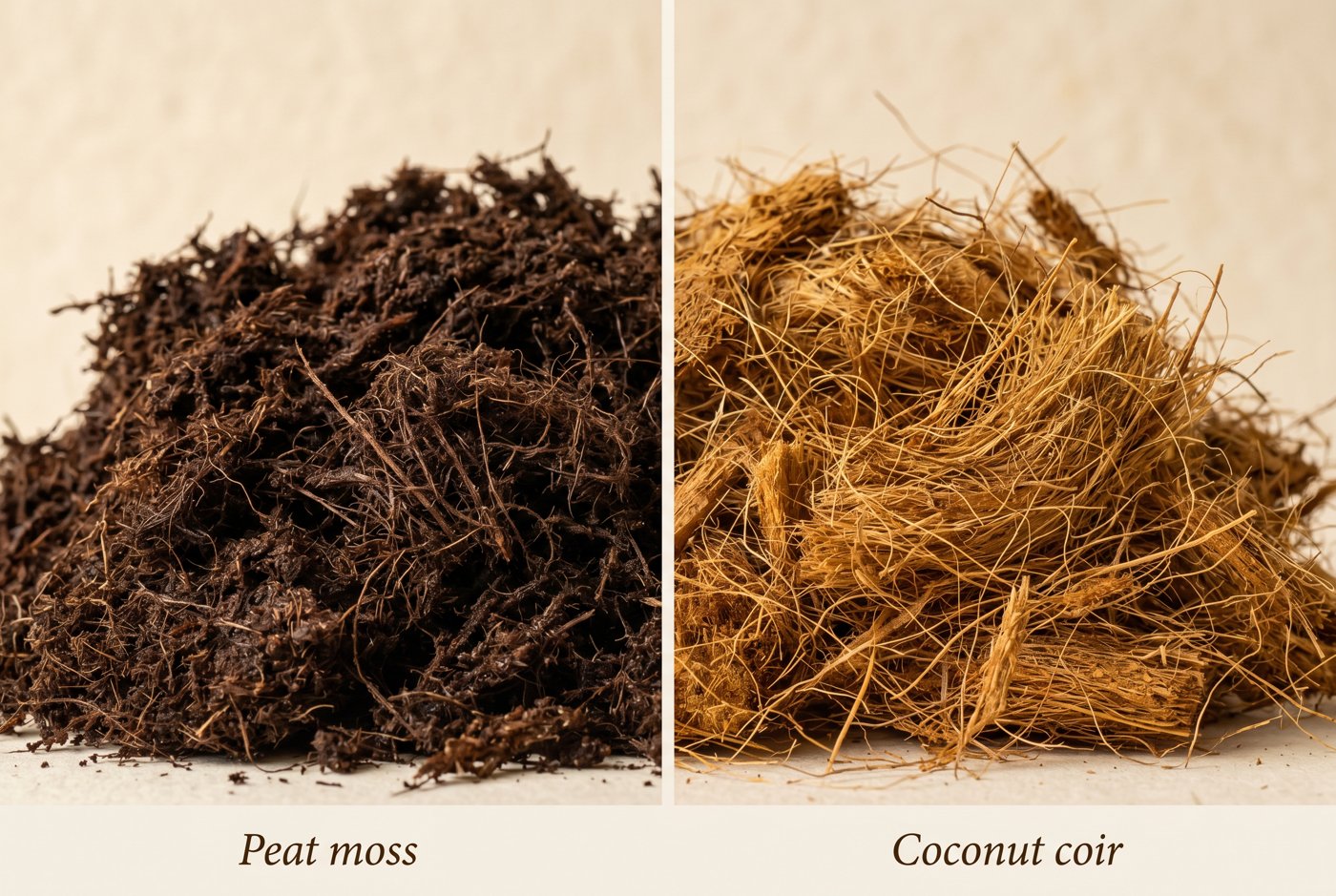
Start with the water. Peat holds a lot of it, somewhere around 60 percent of its volume, and it has a real weakness: once peat dries out completely, it turns hydrophobic and starts shedding water instead of soaking it up. You've seen this if you've ever watered a bone-dry pot (the soil is lightweight yet often a solid mass) and watched it all run straight out the bottom. Coir holds a comparable amount of water, takes water back easily even after it's fully dried, and keeps its structure under pressure longer before it breaks down (Sun Gro, n.d.; Oregon State University Extension Service, 2021). Raw coir carries salt from processing that has to be rinsed, which is why FoxFarm makes a point of triple-washing Coco Loco. That step is real (and necessary), not just ad copy.
Then there's the part the bags' labels don't mention: where the base comes from, and whether we should keep using it. Peat is not a renewable material on any timeline that matters to a gardener. Peat bogs regrow at less than 1/16 inch (about 1 mm) a year, they hold close to a third of all the carbon stored in the world's soils, and draining and harvesting them releases that carbon far faster than it's replaced. The UK banned bagged peat compost for home gardeners in 2024 over exactly this (Oregon State University Extension Service, 2022). Coir, by contrast, is a byproduct of the coconut industry, so it's the more defensible base, though it isn't spotless either. Processing it takes a lot of freshwater, and the leftover salty wastewater is its own problem.
The honest catch is that coir's strength, holding water well, becomes a liability indoors. Straight Coco Loco stays wet long enough to invite root rot and fungus gnats. That's a big reason my own houseplants live in chunky mineral mixes instead of anything bagged. If you do want to take a bag indoors, cut it hard with bark and perlite first. Right base, wrong texture out of the bag, fixable.
§ 03The badge that doesn't earn its hype
Almost every premium bag now advertises added mycorrhizae, the symbiotic fungi that partner with roots and help them pull in water and nutrients. Happy Frog's label lists 15 fungal species by the count. Espoma brands its version "Myco-tone." E.B. Stone, Pro-Mix, and Coast of Maine's Stonington blend all tout it. It sounds like cutting-edge biology, and the underlying science is real.
The problem is what's in the bag. A 2025 meta-analysis in New Phytologist pooled 302 trials and found that fewer than 12 percent of commercial inoculant products delivered both a real growth benefit and viable root colonization, with many producing almost none at all (Koziol et al., 2025). Independent testing of consumer products keeps turning up the same thing: a large share simply aren't viable in the bag (Koziol et al., 2025). The living fungus you're picturing mostly isn't establishing the way the label implies.
This does not make Happy Frog bad soil. It's a good mix for entirely different reasons: nice texture, real earthworm castings, a gentle charge that won't cook a seedling. It just means "now with mycorrhizae" belongs near the bottom of your buying checklist, not the top. If a bag's whole pitch is the fungus, you're paying for a sticker.
§ 04What's actually in the premium bags
Strip away the label poetry and the premium organic tier rhymes. Here's the lineup, current as of mid-2026. I've left prices out on purpose, since cost per cubic foot swings hard by retailer, region, and bag size, so check it at the shelf before you let price decide.
| Mix | Base | Aeration | Charge | What makes it different |
|---|---|---|---|---|
| FoxFarm Happy Frog | Forest humus + peat | Perlite | Gentle | Castings + guano; light enough for young plants |
| FoxFarm Coco Loco | Coconut coir | Perlite | Light–moderate | Coir base, triple-washed; waters less often |
| FoxFarm Ocean Forest | Forest products + peat | Perlite | Hot | Fish, crab, shrimp meal; feeds for weeks |
| Espoma Organic | Peat + humus | Perlite | Moderate | Alfalfa, kelp, feather meal; "Myco-tone" |
| Pro-Mix BX | Canadian peat (75–85%) | Perlite + vermiculite | Blank | Pro grower's blank canvas; you feed it |
| E.B. Stone Recipe 420 | Fir bark + coir + peat | Pumice | Moderate–hot | Bark-forward, pumice-aerated; California-made |
| Coast of Maine Bar Harbor | Peat + composted manure | Perlite | Moderate | Lobster and crab meal; marine nutrition |
| Black Gold Natural & Organic | Peat + bark + compost | Perlite + pumice | Mild | Clean reputation; OMRI listed |
| Miracle-Gro Potting Mix | Peat + coir | Perlite | Synthetic (~6 mo) | Mass-market; chemical feed, not organic |
The pattern jumps out once it's in a row. Almost all of them are a base, plus an aerator, plus a charge of meals and castings, plus a biology garnish. They differ at the edges: which base they use, how hot the charge runs, what the regional nutrition story is. Two break the mold. Pro-Mix BX is the blank professional canvas with no real charge, built for growers who want to control every nutrient themselves. Miracle-Gro is the other extreme, a synthetic feed aimed at the mass market. OMRI, by the way, is the Organic Materials Review Institute, the third party that certifies whether a product is truly organic. It's a real signal in a category full of soft "natural" language.
Your bag has a zip code
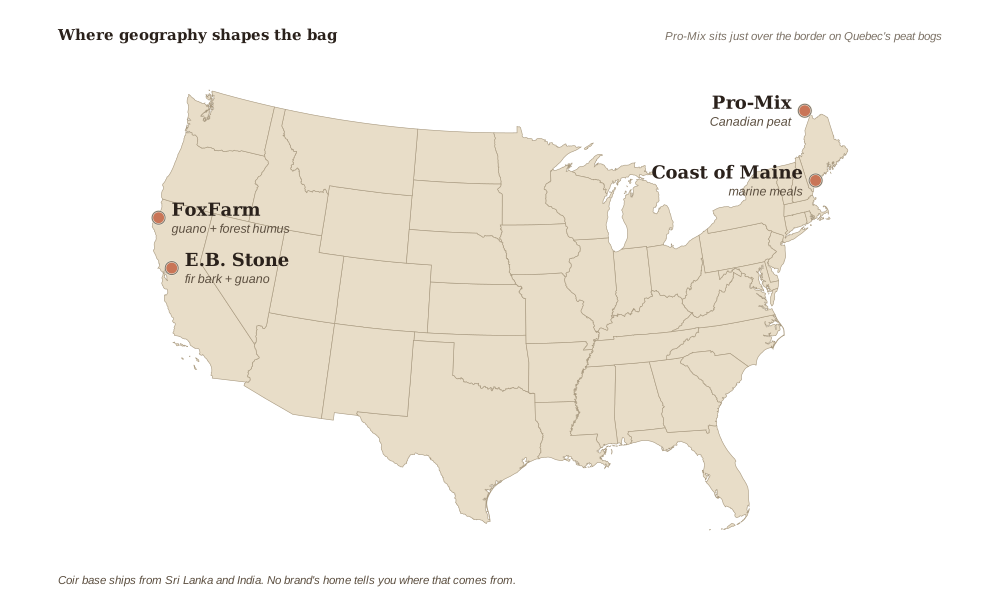
One thing the table hides: geography isn't random. The reason Coast of Maine leans on lobster, crab, and kelp meal is that those are Maine's byproduct streams. Pro-Mix is peat-heavy because Premier Tech sits on top of Canada's sphagnum bogs. FoxFarm and E.B. Stone lean on guano, fir bark, and forest humus because that's California. Your bag, in other words, tends to taste like its zip code. One caveat so the map doesn't mislead: a company's home isn't where every ingredient comes from. The coir is shipped from Sri Lanka and India no matter whose name is on the bag, and the peat comes from northern bogs even for brands headquartered in warm states.
§ 05The gnat truth
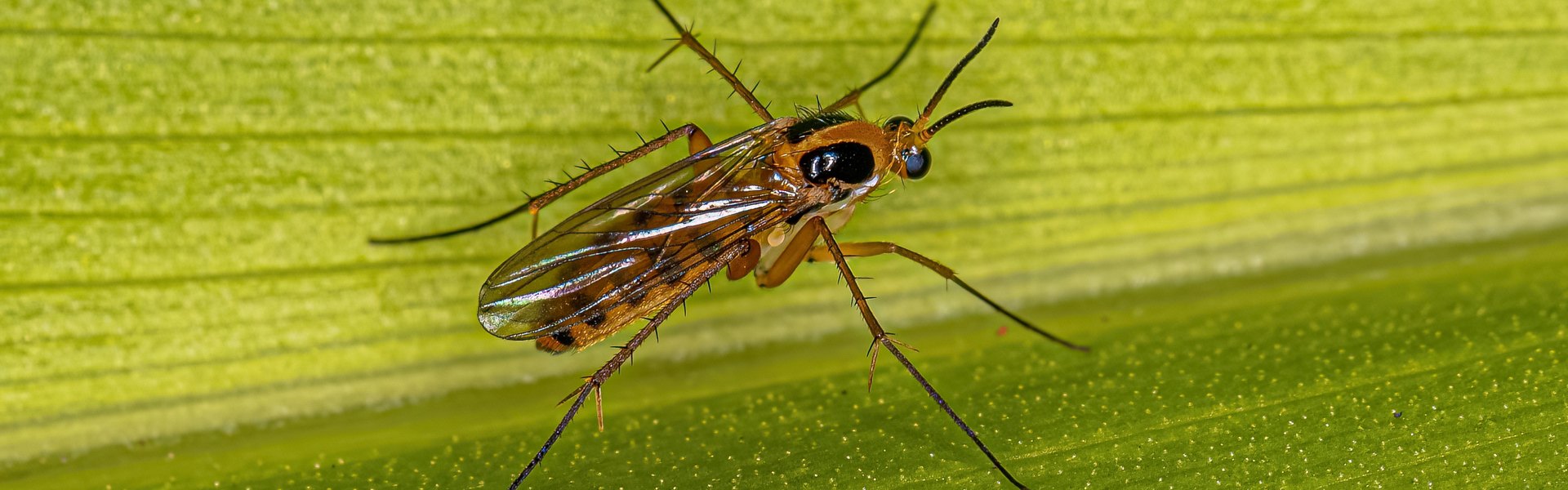
If you've used a living organic mix, you've probably met fungus gnats, and FoxFarm catches as much heat for this as anyone. Growers half-jokingly call Happy Frog "Happy Gnat," and complaints about little black flies rising out of a fresh bag are easy to find. Worth being clear-eyed about both directions here.
It isn't a FoxFarm defect. Any mix rich in compost, humus, and guano is gnat habitat by design, because that's what the larvae eat. The proof is in the irony: Miracle-Gro markets its houseplant version as "less prone to gnats," having stripped out the compost and bark, and still draws a pile of gnat complaints. Gnats track two things, living-organic material and constant moisture, not a particular brand. Manage the water, top the pot with a half-inch of mineral grit, or run a leaner mix indoors, and the problem mostly goes away. And if they've already moved in, clearing them out is its own project, one that comes back to the substrate more than the spray bottle. Our fungus-gnats field guide has the full four-tier protocol.
And the counterweight, so the loud reviews don't run away with the story: in the aggregate, people are happy. Happy Frog sits around 4.7 out of 5 across more than 400 Walmart ratings, with the large majority at five stars (Walmart, n.d.). The gnat and mold gripes are real and worth planning around, but they're the minority experience, not the verdict.
§ 06Match the bag to the job
This is where it pays off. Four common jobs, and the bag I'd reach for.
Houseplants and aroids. The priority is drainage and air at the root, with gnat pressure kept low. Full disclosure: my own indoor plants skip bagged mix entirely and live in chunky mineral-forward substrates (that's the whole Substrate Library). But if you want to stay in the bagged-mix world, start from Coco Loco and cut it at least half-and-half with orchid bark or chunky coco chips and perlite or pumice, which gives the chunky, fast-draining structure aroids want while leaning on coir's easy rewetting. Happy Frog cut the same way works too. What to avoid indoors is anything hot and water-retentive straight from the bag, Ocean Forest especially, since that combination is how you get rot and a gnat cloud over the coffee table. If a clean, low-fuss bag matters more to you than tinkering, Black Gold has the better reputation for running gnat-free.
Container vegetables. Heavy feeders like tomatoes, peppers, and squash want to eat all season, so here the hot charge is a feature. For established transplants I'd go straight to Ocean Forest and let it carry the plant for weeks before I supplement. Start tender or direct-sown veg in gentler Happy Frog first, then step up the feeding as they size up. If you're shopping the California shelf, E.B. Stone's Recipe 420 is a strong local pick, and Coast of Maine's Stonington is the marine-fed "super soil" option.
Raised beds. The honest answer is don't fill a bed with potting mix at all. Bagged potting mixes are soilless and built to drain fast in a small pot, which makes them both wasteful and too thirsty at bed scale, where you want more water retention and a real mineral fraction. Use a blend actually labeled for raised beds (E.B. Stone, Black Gold, and Coast of Maine all make one) or build your own from bulk soil and compost, and save the bagged potting mixes for the containers on the patio. This is also the spot where the cheaper, correct answer is the right one, even though it sells you less.
Seed starting and propagation. Seedlings have zero salt tolerance and high disease risk, so the rules flip. You want fine texture, very low charge, and ideally a sterile mix. Reach for a dedicated seed-starting mix or for Pro-Mix BX, whose near-blank charge is perfect here (the biofungicide version adds a bacterium that helps fight damping-off, the fungal collapse that flattens seedlings at the soil line). Happy Frog works for bigger transplant-stage seedlings, but it isn't sterile or especially fine. The thing to avoid outright is Ocean Forest or any hot mix: high EC burns germinating roots, and the damage gets misread as damping-off when it's really fertilizer (North Carolina State Extension, n.d.; Maine Organic Farmers and Gardeners Association, n.d.).
§ 07The bottom line
You're not really buying a brand. You're buying a base and a charge for a specific job. Once you can read those two things off the back of the bag, the aisle gets a lot quieter, and you stop overpaying for stickers that promise magic. Read the bag, match the job, and let the plant tell you the rest.
FoxFarm Soil & Fertilizer Company. (n.d.-a). Bush Doctor® Coco Loco® Potting Mix. https://foxfarm.com/product/bush-doctor-coco-loco-potting-mix/
FoxFarm Soil & Fertilizer Company. (n.d.-b). Happy Frog® Potting Soil [Product label]. https://www.domyown.com/msds/FOXFARMHAPPYFROGPOTTINGSOILLABEL.pdf
FoxFarm Soil & Fertilizer Company. (n.d.-c). Ocean Forest® Potting Soil. https://foxfarm.com/product/ocean-forest-potting-soil/
Koziol, L., McKenna, T. P., & Bever, J. D. (2025). Meta-analysis reveals globally sourced commercial mycorrhizal inoculants fall short. New Phytologist, 246(3), 821–827. https://doi.org/10.1111/nph.20278
Maine Organic Farmers and Gardeners Association. (n.d.). Seedling problems and compost-based potting mix problems. https://www.mofga.org/resources/fact-sheets/seedling-problems/
North Carolina State Extension. (n.d.). Damping-off in flower and vegetable seedlings. https://content.ces.ncsu.edu/damping-off-in-flower-and-vegetable-seedlings
Oregon State University Extension Service. (2021). Coir is sustainable alternative to peat moss in the garden. https://extension.oregonstate.edu/news/coir-sustainable-alternative-peat-moss-garden
Oregon State University Extension Service. (2022). Peat moss harvesting releases carbon and harms ecosystems, expert warns. https://extension.oregonstate.edu/news/peat-moss-harvesting-releases-carbon-harms-ecosystems-expert-warns
Sun Gro Horticulture. (n.d.). Air porosity and water-holding ability of media components. https://www.sungro.com/air-porosity-and-water-holding-ability-of-media-components/
Walmart. (n.d.). Customer reviews: FoxFarm FX14047 Happy Frog pH-adjusted garden potting soil mix, 2 cu ft. https://www.walmart.com/reviews/product/20594718