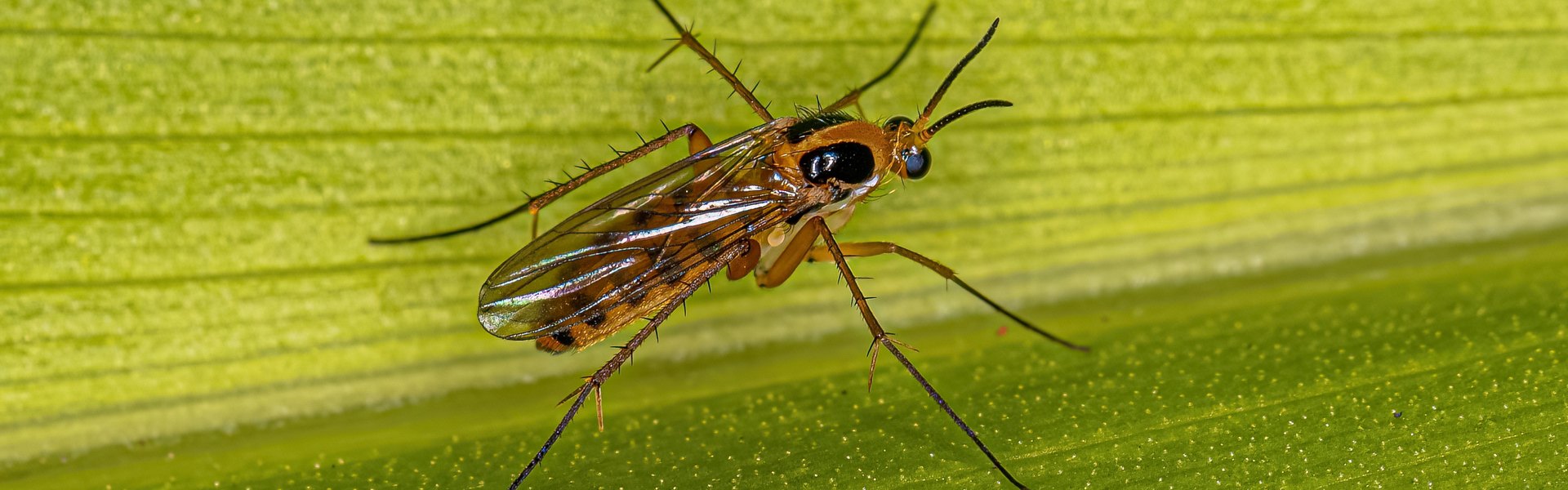
A working grower's guide to identifying Bradysia, understanding why the larval stage lives in the top inch of your substrate, and breaking the lifecycle by changing what you're growing in. The flies are the visible part. The real problem is the mix.
The flies are the symptom.
Fungus gnats announce themselves wrong. You'll see the adults first. They're small dark flies that drift up from your plants every time you water. The obvious move is to swat at them, hang a sticky trap, maybe drench the soil with something. That's treating the part of the lifecycle that does no damage at all.
The damaging stage is the larva, and the larva lives in the top inch of your substrate, eating fungal mycelium and chewing on root tips. The adult you can see is the symptom of a population already entrenched in the part of the pot you can't see.
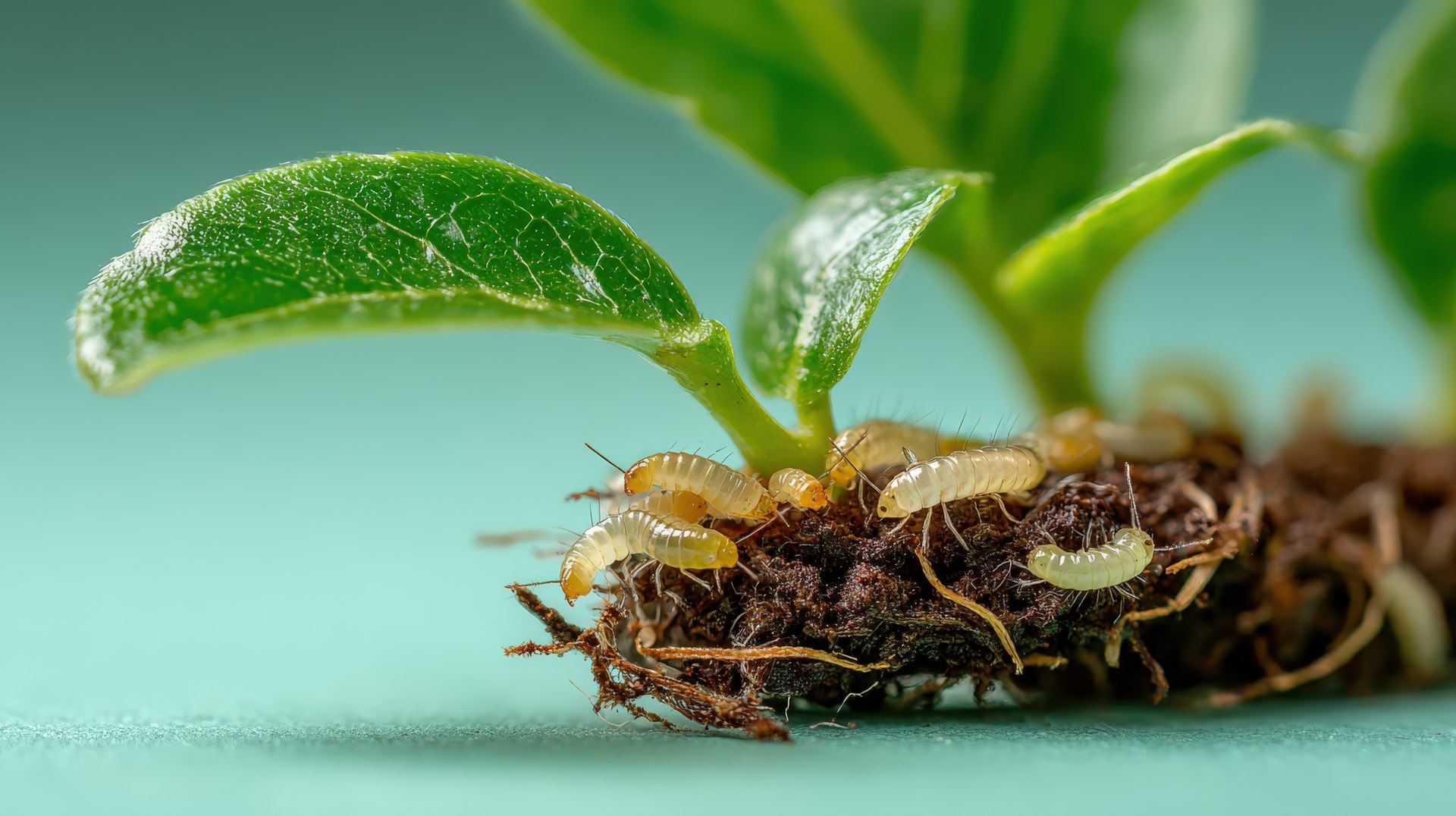
Here's the part most fungus gnat advice never says out loud: a thriving fungus gnat population is telling you something specific about your substrate. The top inch is staying moist between waterings. There's enough decomposing organic matter in that top inch to grow the fungal film and microbial layer the larvae eat. And possibly the bag of potting mix you opened arrived already carrying them (Cloyd & Zaborski, 2004).
You can spray the symptoms or you can change the substrate. This article does both, in that order of urgency and reverse order of durability.
Indoor Pests · Family Sciaridae
Fungus Gnats
Bradysia coprophila · Bradysia impatiens · Bradysia spp.
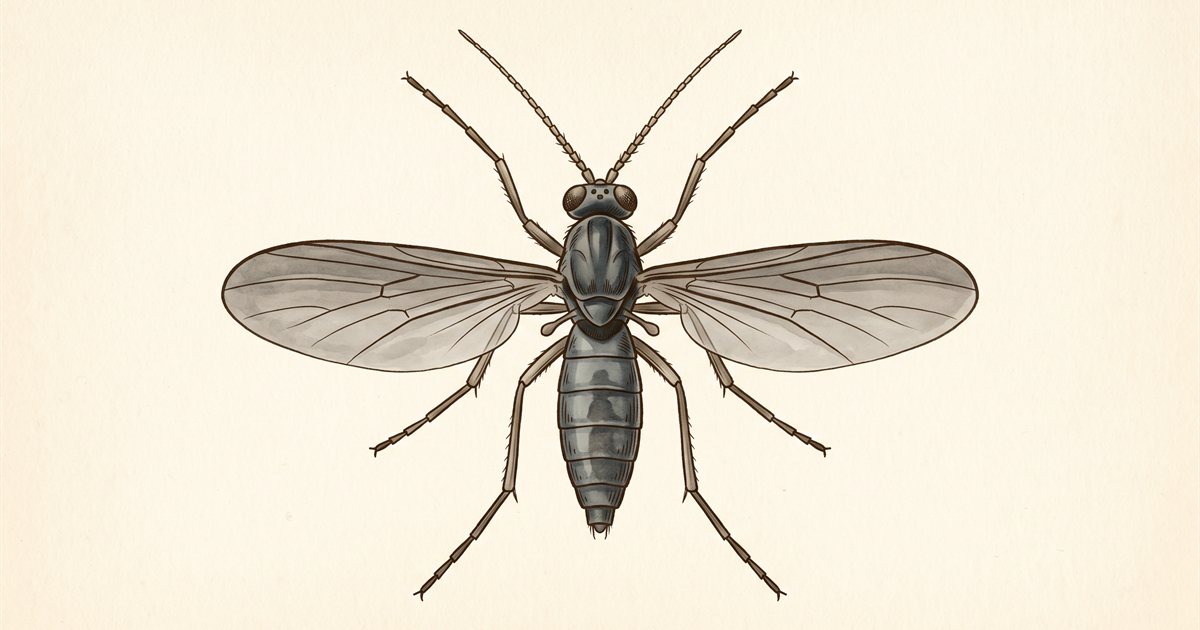 Mug Shot Adult, ~3 mm
Vital Statistics
- Family
- Sciaridae
- Adult size
- 2 to 4 mm
- Larva size
- up to 8 mm
- Lifecycle
- 18 to 28 days
- Larval instars
- 4
- Damaging stage
- larva
Modus Operandi
Larvae feed on fungal mycelium and decomposing organic matter in the upper substrate, opportunistically chewing root hairs, root tips, and lower stem tissue at the substrate line. Documented as mechanical vectors of Pythium, Fusarium, and other damping-off pathogens, which compounds damage in propagation and tissue-culture acclimation (Cloyd, 2015).
Last Seen
The top inch of substrate during the larval and pupal stages. Drainage trays, saucers, and any persistently moist surface where decomposing organic matter accumulates. Adults drift in slow, drunken arcs near the substrate surface and rise when the plant is disturbed.
Apprehension Protocol
The Mug Shot
Fungus gnats are members of the family Sciaridae, the dark-winged fungus gnats, in the order Diptera (true flies). The common indoor species are Bradysia coprophila and Bradysia impatiens, and they look nearly identical in a working houseplant collection.
Adults are 2 to 4 mm long. The body is slate-grey to charcoal-black, slender, with long thin legs and two long forward-pointing antennae. The wings are smoky translucent grey, held flat over the back at rest. The diagnostic feature is in the wings. The venation forms a distinctive Y-shape near the wing tip that you can see with a 10x hand lens. If your suspect fly has that Y, you're looking at a sciarid. Adults are weak fliers and tend to drift in short hops near the substrate surface rather than zipping across the room (Cloyd, 2015).
The larva is what does the work. It's 5 to 8 mm at the fourth (final) instar, translucent white to clear, segmented, and legless, with a distinctive shiny black head capsule that's visible against the pale body. You'll find them in the top centimeter of substrate. Pull back a thumb's worth of mix and watch for movement. The black head moving against a clear body is unmistakable.
Lifecycle runs from egg to emerged adult in 18 to 28 days at 63 to 70 °F (17 to 21 °C), faster at warmer temperatures (Cloyd, 2015). Four larval instars, then pupation in the upper substrate, then a short-lived adult that lives another 7 to 14 days, mostly to mate and lay the next batch of eggs.
Where to find them
Five places to check, in order of likelihood:
The top centimeter of substrate in any pot with a peat-heavy or compost-amended mix. Pull back the surface gently with a finger or a spoon. The drainage saucer under affected pots, where moist debris collects. Yellow sticky cards placed horizontally at substrate level, which catch adults far better than vertical cards at canopy height (Cloyd, 2008). The air a few inches above the pot when you water. Disturbance triggers a small cloud of adults if a population is established. And inside the bag of any commercial peat-based potting mix that has been open for more than a few weeks; documented infestations occur at the point of purchase (Cloyd & Zaborski, 2004).
Yellow sticky cards are a monitoring tool, not a control. They tell you whether the population is growing or crashing. A working threshold for action in a houseplant collection: 0 to 2 adults per card per week is monitor-only; 3 to 10 calls for preventive biological release; more than 10 per card per week means the substrate problem is active and needs attention now.
The lifecycle you have to break
Every piece of advice in this article makes sense or doesn't depending on the lifecycle, so look at it once before you read the rest.
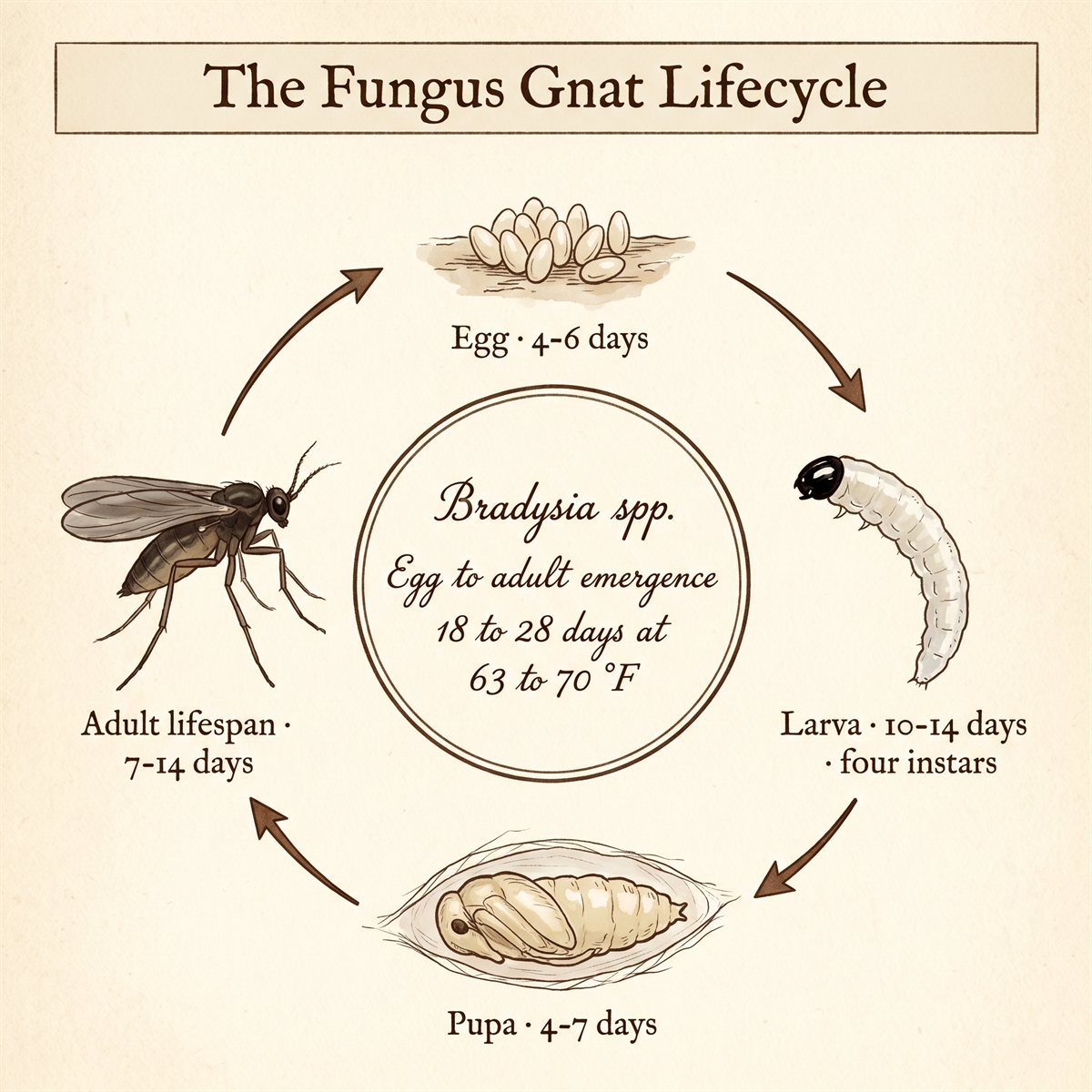
Three things this diagram is telling you:
First, the cycle is short. Three to four weeks from egg to next-generation adult means a problem you ignore in May becomes a problem on three times the scale by mid-June. The math is unforgiving.
Second, only one of the four stages requires substrate-borne food: the larva. Eggs sit on the surface and don't feed. Pupae don't feed. Adults barely feed; they live only a few days and exist mainly to mate and lay the next batch of eggs. The whole cycle hinges on the larval stage finding fungal mycelium and decomposing organic matter to eat. Remove that food source from the top inch of substrate and the lifecycle has nowhere to complete.
Third, the temperature dependence is real. Indoor collections at typical room temperature (around 70 °F / 21 °C) sit in the upper-optimum window for sciarid development. Cooler grow rooms slow the cycle considerably. Heating mats under propagation trays speed it up, which is why fungus gnats often explode in propagation setups even when the rest of the collection is clean.
How they damage plants
The larva does two kinds of damage, and the second one is the reason this pest matters at all.
The first is direct feeding. Sciarid larvae graze on fungal hyphae and decomposing organic matter as their primary food, but in the same top-inch substrate zone they also chew on root hairs, root tips, and the soft tissue of stems at the substrate line. In an established houseplant with a full root system, the damage threshold is high. Cloyd's potato-disk bioassays in greenhouse work suggest a 6-inch pot tolerates 15 to 20 larvae before measurable root injury (Cloyd, 2008). A mature Monstera in a 10-inch pot tolerates a small population almost invisibly.
The second is where it gets serious. Sciarid larvae mechanically vector spores of Pythium, Fusarium, Thielaviopsis, and Verticillium (the damping-off and root-rot pathogens), both externally on the body and internally through the gut (Cloyd, 2015). In propagation, in tissue-culture acclimation, and in any setting with seedlings or unrooted cuttings, the damage threshold drops to 3 to 5 larvae per potato disk before significant root injury appears (Cloyd, 2008). A few gnats in a flat of new cuttings is enough to introduce a Pythium outbreak that will kill the plants long before the gnats themselves would have.
This is why "a few gnats in a houseplant collection" reads very different from "a few gnats in a propagation tray." Same insect, very different stakes.
The Apprehension Protocol
Four tiers. Use them in order. The first is the only one that lasts; everything above it treats a symptom of substrate conditions that haven't changed.
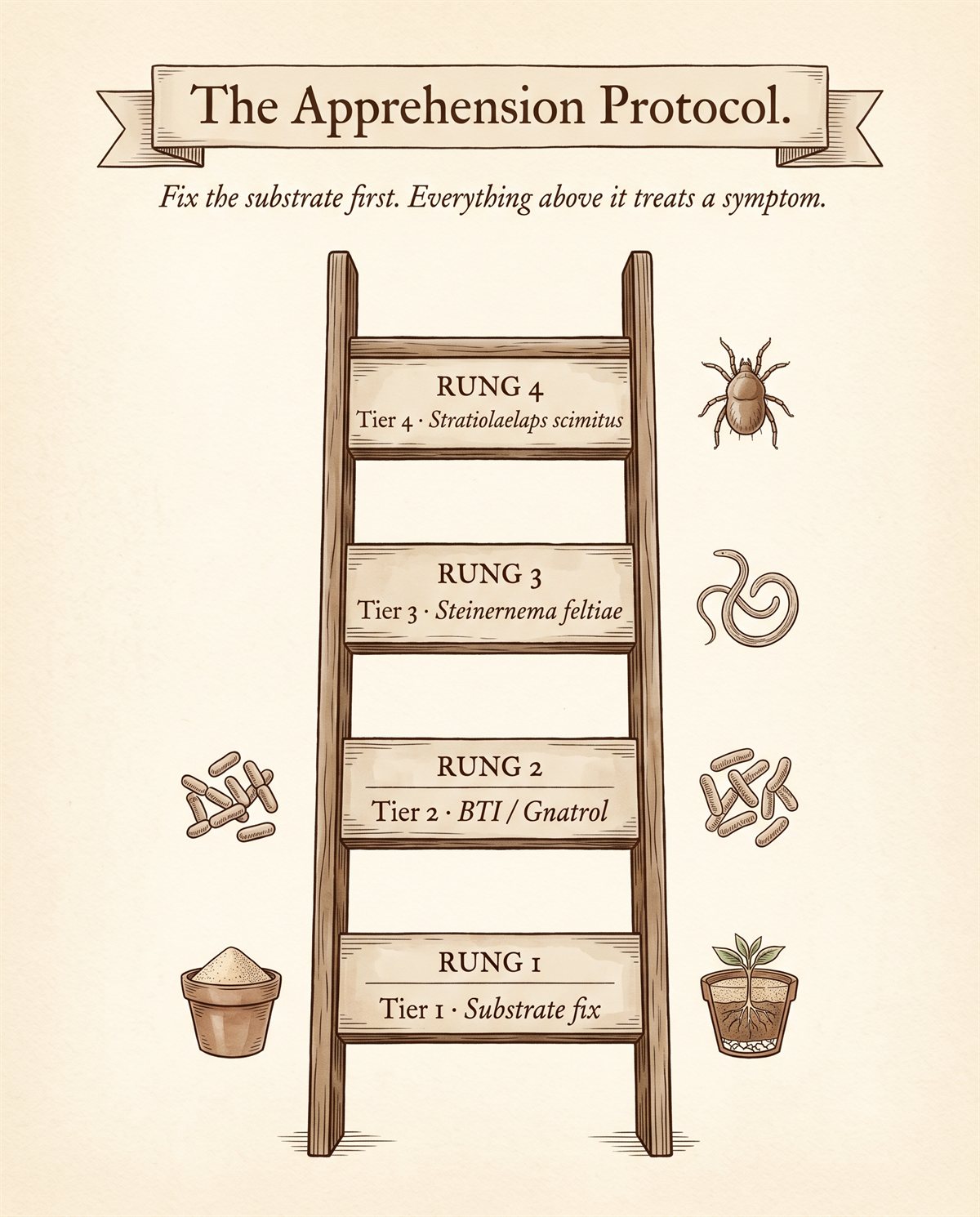
Tier 1: Fix the substrate
Two interventions, in either order, depending on how aggressive the outbreak is.
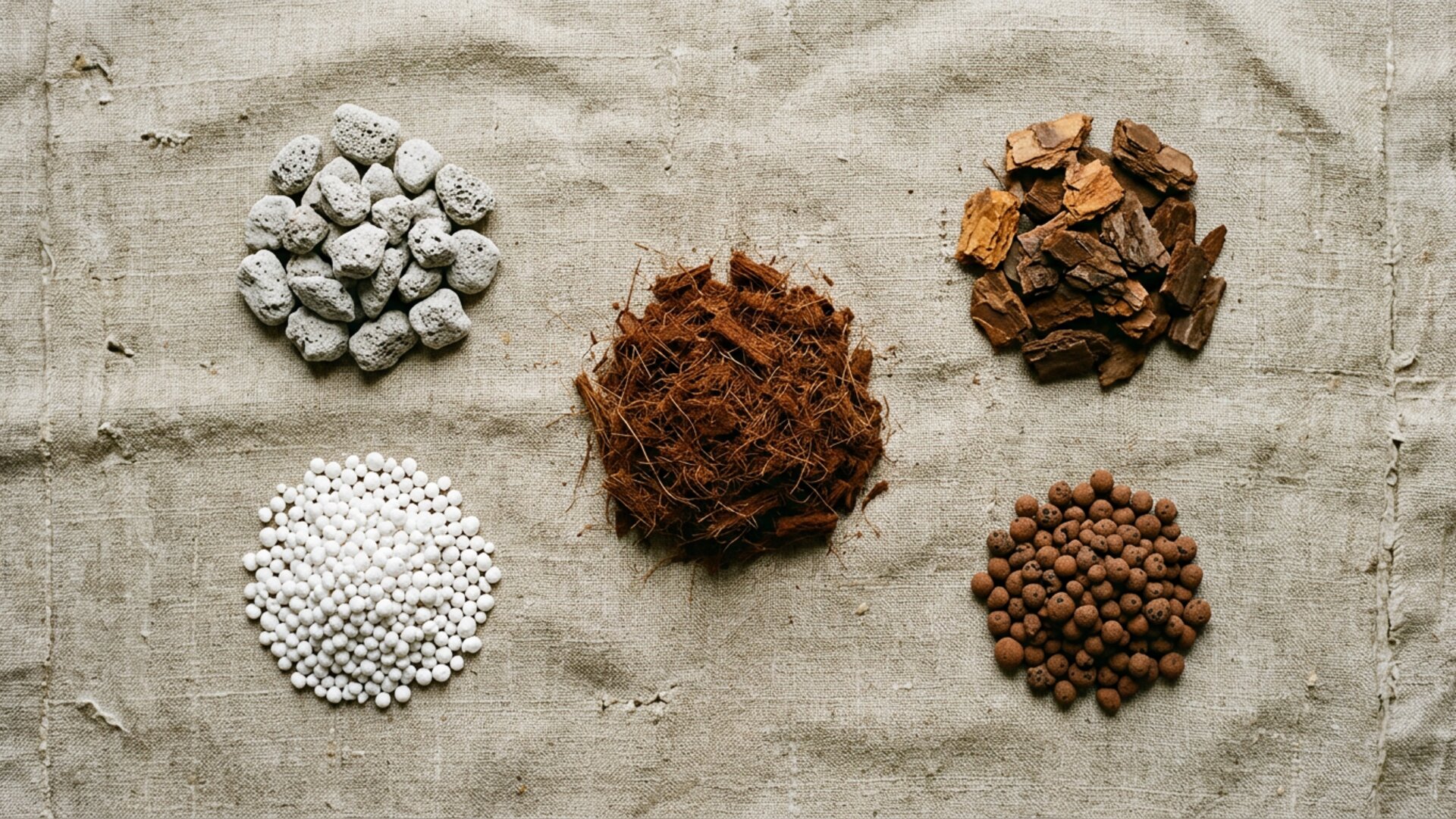
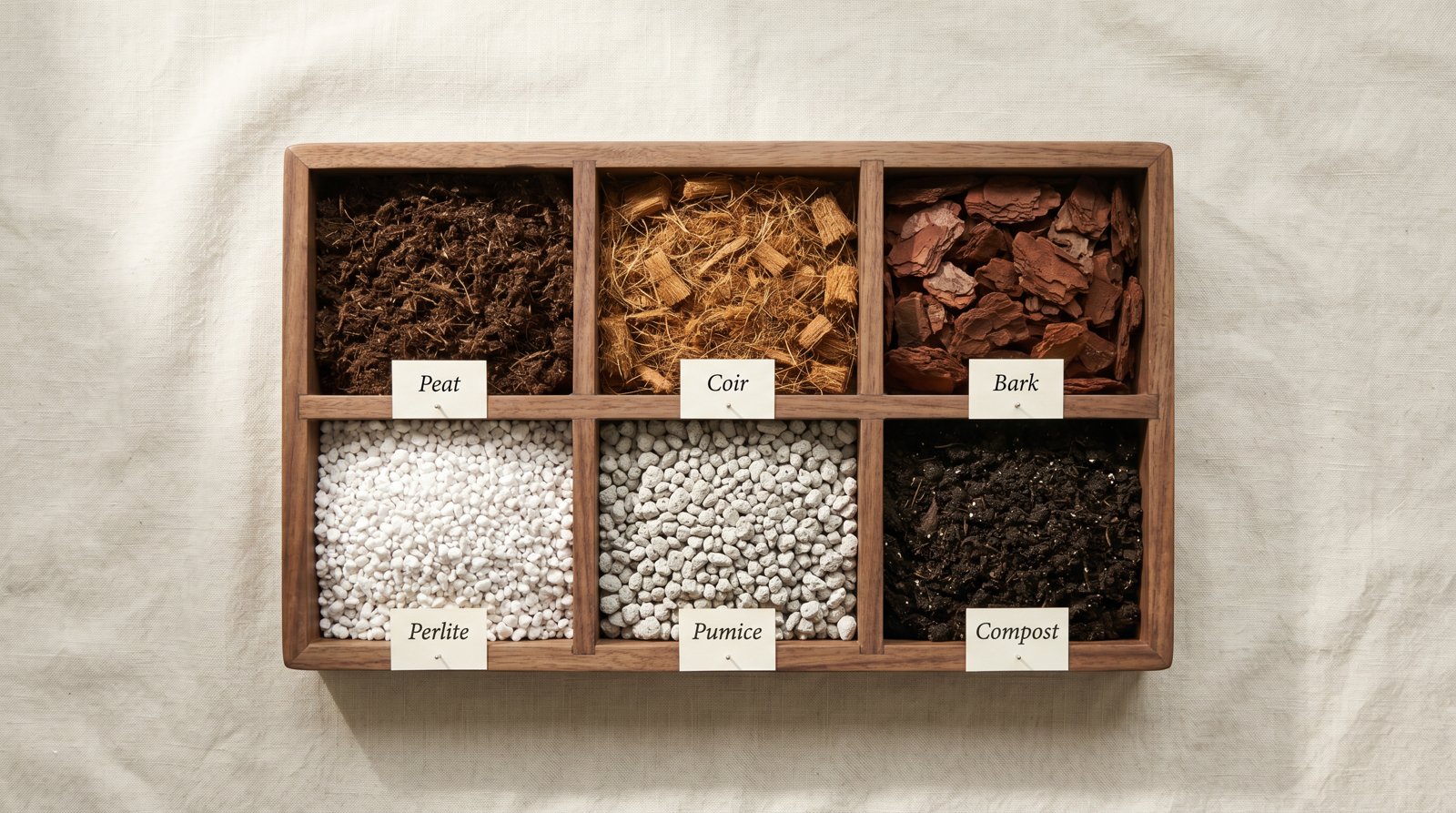
The lighter version is a mineral top-dress. Pour 1/4 to 1/2 inch of coarse sand, perlite, pumice, or fine gravel onto the surface of every affected pot. The mechanism is physical: the female sciarid probes the surface to find the moist organic substrate she needs to lay her eggs onto, and a layer of dry mineral medium frustrates that behavior. Eggs that do get laid into the mineral layer fail to develop because there's no fungal mycelium or organic decomposition there to feed the larvae. Cloyd (2008) documents the disruption in greenhouse trials.
The heavier version is a substrate change. If a plant has chronic fungus gnat pressure in a peat-heavy or compost-amended mix, repot it into a mineral-dominant mix of pumice, lava, perlite, akadama, and fine bark, with the organic fines reduced or eliminated. Mineral-substrate hobbyists (the aroid and the bonsai communities both report this) describe essentially zero fungus gnat pressure on collections that were heavily infested in standard peat mixes. The reason is in the biology: the larva has nothing to eat.
Pair either intervention with watering discipline. Water deeply, then let the top inch dry fully before the next watering. Fungus gnat populations crash quickly when the top inch dries between cycles, because the eggs and first-instar larvae desiccate (Olson, Oetting, & van Iersel, 2002).
Tier 2: BTI drench
Bacillus thuringiensis subsp. israelensis (BTI for short, sold as Gnatrol) is a bacterial larvicide that's been the workhorse for indoor fungus gnat control for years. The mode of action is specific: the larva ingests the bacterium, which produces crystalline protein toxins that paralyze and rupture the gut. The larva stops feeding within hours and dies within about 24 hours of ingestion (Valent BioSciences, n.d.). It has no documented cross-resistance with chemical insecticides, no toxicity to mammals, birds, or beneficial arthropods, and is approved for organic production.
Two caveats. First, BTI is most effective on younger (first and second instar) larvae and less effective on third and fourth instars, which is why a single drench fails: it kills the larvae present that day and ignores the eggs that hatch tomorrow. Apply at label rate every 5 to 7 days for three full cycles to cover the full lifecycle. Second, BTI requires moisture to remain active in the substrate and degrades within a few days, so this is not a residual treatment.
Tier 3: Beneficial nematodes
For sustained pressure or larger collections, Steinernema feltiae nematodes are the next step. Infective juveniles are watered into the substrate, enter the larva through natural openings, and release a symbiotic bacterium (Xenorhabdus bovienii) that kills the host within 24 to 48 hours by septicemia (Jagdale, Casey, Grewal, & Lindquist, 2004).
Three things to get right. Substrate temperature must be between 50 and 80 °F (10 to 27 °C), with the optimum at 60 to 70 °F (16 to 21 °C); efficacy drops sharply outside that band. The standard application rate is approximately 46,500 infective juveniles per square foot of substrate area. And the top inch of substrate must stay moist for two weeks after application so the nematodes can move and find hosts. Preventive applications at the start of a propagation cycle perform far better than reactive applications to an established outbreak (Jagdale et al., 2004).
Buy nematodes from a supplier that ships cold and use them within a week of arrival. Nematode viability drops fast at room temperature.
Tier 4: Predatory soil mites
Stratiolaelaps scimitus (formerly known as Hypoaspis miles, and still sold under both names) is a soil-dwelling predatory mite that hunts fungus gnat larvae, thrips pupae, springtails, and other soil-stage arthropods. Adults live about 70 days, generation time is 10 to 34 days depending on temperature, and the species can survive without prey by feeding on decaying organic matter (Penn State Extension, n.d.; Koppert, n.d.).
That persistence is what makes S. scimitus different from the other tiers. It's not a reactive treatment, it's a standing colony. You release it into a collection once and the population establishes itself, eating fungus gnat larvae as they appear and surviving on substrate debris in between. Most effective when deployed at low established populations (under about 10 adults per sticky trap per week) and least effective when thrown at a full outbreak. For collections with recurring pressure that you don't want to keep treating reactively, this is the maintenance tier.
The substrate connection
This is the part most fungus gnat content skips, and it's the part that makes everything else durable.
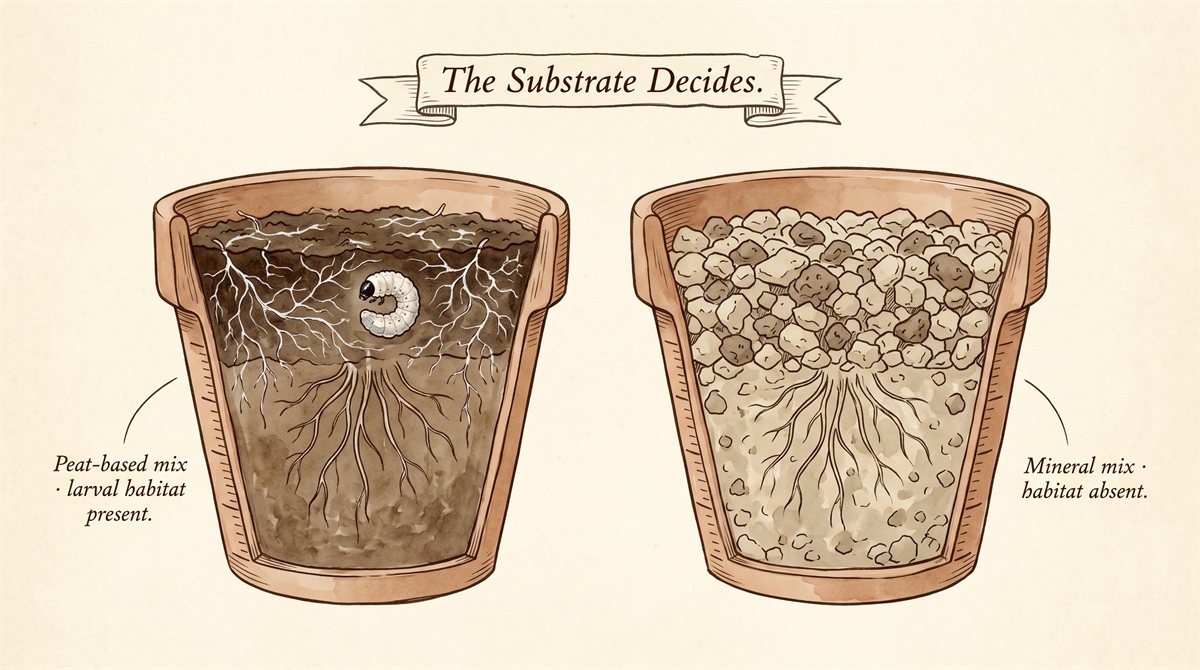
Meers and Cloyd (2005) ran a clean ovipositional preference study: given a choice of growing media, female Bradysia chose composted pine bark, peat moss, and other organically rich, microbially active substrates over low-organic alternatives. The behavior is selective and the cue is in the substrate itself.
Olson, Oetting, and van Iersel (2002) pushed the question further. They placed 20 fungus gnat eggs in pure peat moss and pure coconut coir, then in the same media with a yeast food source added. Pure or sterilized peat or coir yielded fewer than 1 adult per 20 eggs. The same media with yeast added yielded 11 to 13 adults per 20 eggs. The substrate alone wasn't enough; what mattered was the presence of decomposable food the larva could metabolize through fungal intermediates.
That's the entire substrate connection in two sentences. The female chooses where to lay based on what she can smell on the surface. The larva can only complete development if there's microbially active organic matter to eat in the top inch.
Which means: a top inch that's dry on schedule, mineral-dominant, low in fines, and not actively decomposing is not a fungus gnat habitat. A top inch that's persistently moist, peat-heavy or compost-amended, and growing a fine layer of fungal mycelium is exactly the habitat. The substrate is a yes-or-no environmental filter.
A note on "peat-free" as a marketing claim. Sabu, Burow, Lampert, and Franken (2025) document that the horticultural shift away from peat toward composted green waste and other organic-rich peat-free substrates has, ironically, increased fungus gnat pressure in commercial nurseries, because those substrates still hit the high-organic, microbially-active threshold that supports larval development. The protective factor isn't peat-free per se. It's mineral-dominant. The two aren't the same.
If you've never thought about substrate construction at this level, our Substrate Primer is the place to start.
Predictable mistakes
People spray the adults. Adults are short-lived and don't damage plants. Killing them does nothing about the larval population already in the pot, and within a few days a fresh batch of adults emerges. Pyrethrin fogs and adult-targeting sprays are theater.
People drench with BTI once and stop. The first drench kills the larvae present that day. It doesn't kill the eggs that hatch tomorrow. Three drench cycles over two weeks is what closes the egg-to-adult window. One isn't enough.
People reach for spinosad (Captain Jack's Deadbug Brew, Conserve) because it worked on their thrips. Spinosad and BTI are different chemistries for different targets. Spinosad is an ingestion toxin that works on leaf-feeding insects; fungus gnat larvae live in the substrate where a foliar spinosad spray doesn't reach them. BTI is the right tool for fungus gnat larvae. The two aren't interchangeable.
People keep the peat-heavy mix and just treat harder. The substrate is the cause; treating the population on top of the same substrate is a maintenance schedule, not a fix. Either change the substrate or accept that you're now in the recurring-treatment business.
People buy a bag of commercial peat-based potting mix and assume it's clean. Cloyd and Zaborski (2004) sampled bagged soilless growing media and rooted plug trays at the point of sale and found sciarids in commercial supply. Treat new bags of organic mix with suspicion. A mineral-dominant mix you blended yourself is the safer starting material.
People run nematodes prophylactically on a mineral-substrate collection. If the substrate doesn't support the larval stage, there's no lifecycle to disrupt. The biocontrol is unnecessary and the money is wasted.
The takeaway
Fungus gnats are not really a pest of plants. They are an indicator species for a substrate condition: a top inch of growing medium that stays moist between waterings, holds organic fines, and supports a fungal film. Remove that condition and the lifecycle has no place to complete. Biological controls (BTI, nematodes, predatory mites) are the right answer for an active outbreak in a substrate you cannot or will not change today, but they are managing a symptom while the cause sits underneath them.
If you take only one thing from this dossier: when a fungus gnat outbreak shows up, the first question to ask is not "what do I spray?" It is "what is happening in the top inch of this pot, and why is it the kind of environment that supports a fly?"
Change the answer to that question and the outbreak ends on its own.
Cloyd, R. A. (2008). Fungus gnat management in greenhouses and nurseries (MF2937). Kansas State University Agricultural Experiment Station and Cooperative Extension Service. [link]
Cloyd, R. A. (2015). Ecology of fungus gnats (Bradysia spp.) in greenhouse production systems associated with disease-interactions and alternative management strategies. Insects, 6(2), 325–332. [link]
Cloyd, R. A. (2023). Steinernema feltiae: Biological control agent of fungus gnat larvae (MF3649). Kansas State University Agricultural Experiment Station and Cooperative Extension Service. [link]
Cloyd, R. A., & Zaborski, E. R. (2004). Fungus gnats, Bradysia spp. (Diptera: Sciaridae), and other arthropods in commercial bagged soilless growing media and rooted plant plugs. Journal of Economic Entomology, 97(2), 503–510. [link]
Jagdale, G. B., Casey, M. L., Grewal, P. S., & Lindquist, R. K. (2004). Application rate and timing, potting medium, and host plant effects on the efficacy of Steinernema feltiae against the fungus gnat, Bradysia coprophila, in floriculture. Biological Control, 29(2), 296–305. [link]
Koppert. (n.d.). Stratiolaelaps scimitus (Hypoaspis miles) predatory mite. [link]
Meers, T. L., & Cloyd, R. A. (2005). Egg-laying preference of female fungus gnat (Bradysia sp. nr. coprophila) (Diptera: Sciaridae) on three different soilless substrates. Journal of Economic Entomology, 98(6), 1937–1942. [link]
Olson, D. L., Oetting, R. D., & van Iersel, M. W. (2002). Effect of soilless potting media and water management on development of fungus gnats (Diptera: Sciaridae) and plant growth. HortScience, 37(6), 919–923. [link]
Penn State Extension. (n.d.). All about Stratiolaelaps scimitus (Hypoaspis miles) predatory mites. [link]
Sabu, S., Burow, K., Lampert, P., & Franken, P. (2025). Efficacy of entomopathogenic fungi for sustainable biocontrol of fungus gnat (Bradysia difformis) in peat-free substrates: A laboratory study. Sustainability, 17(13), 5897. [link]
Valent BioSciences. (n.d.). Gnatrol biological larvicide. [link]