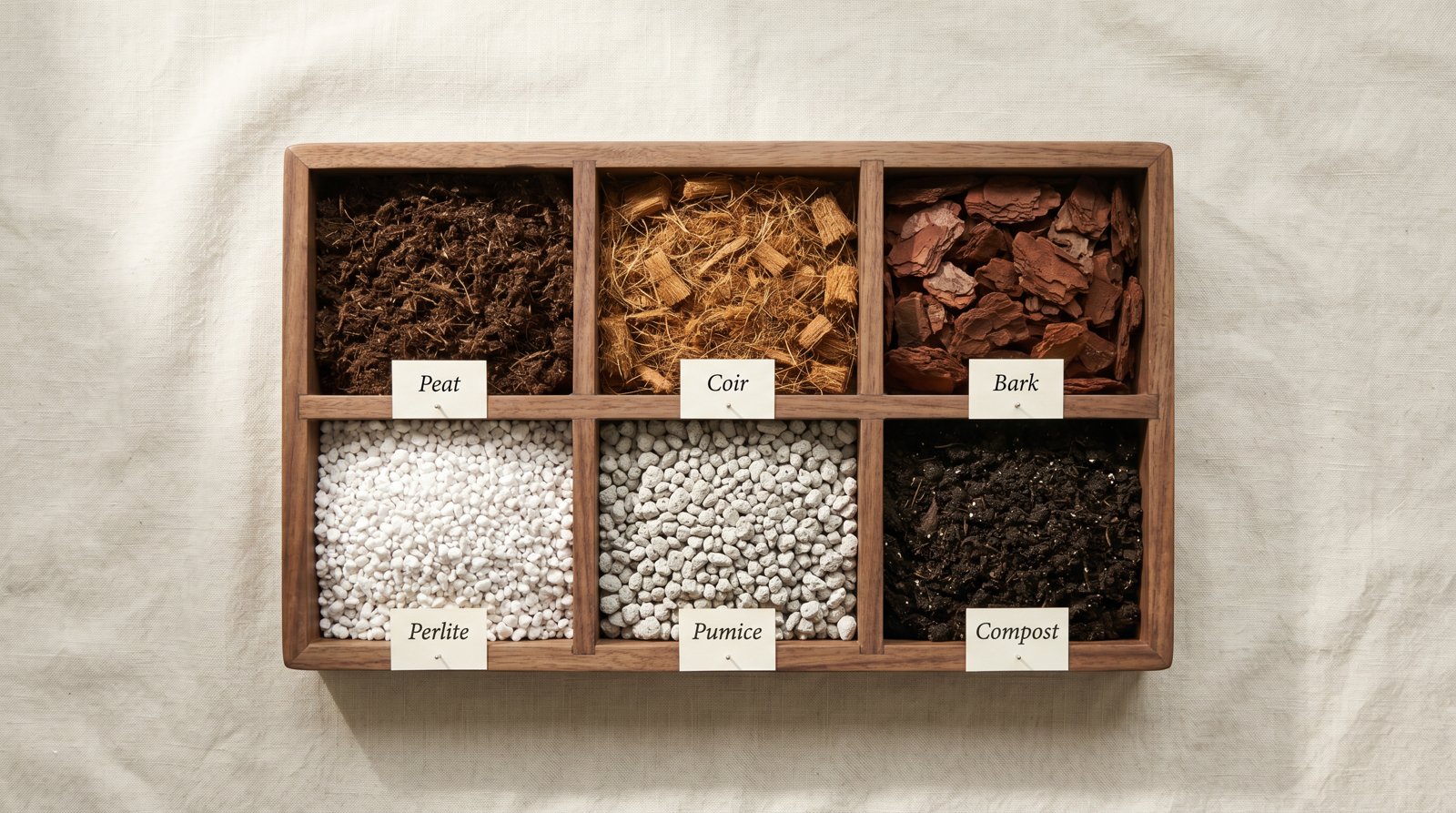
Everything in the Substrate Library so far has been about mixes you build, where you get to pick every ingredient and its ratio. The ground in your yard is the opposite. You inherited it, and you can't dump it out and start over in April. So before you spend a weekend and a pile of money amending it, it's worth an afternoon finding out what you're working with. Three tests do most of that job. Two of them are free.
This is where the Substrate Library steps out of the pot and into the yard. Your ground came with the house. You don't get to pick the base, the aeration, or the charge the way you do in a pot. The good news is that it's readable, and the reading is cheaper and faster than most people assume. Do it once and you stop guessing about every amendment you buy after.
— Christopher · Founder, The Planters' Guild§ 01The ground doesn't play by the pot's rules
A pot is a closed system you get to design. Water goes in the top, drains to the bottom, and sits there in what we call a perched water table (a saturated layer that hangs at the base of a container, held there by surface tension rather than gravity). When the mix stops working, you tip the plant out and start over. That's the whole premise of building a substrate.
Open ground works nothing like that. Water has somewhere to go, sideways and straight down, through soil that connects to more soil for as far as the roots care to travel. There's no false bottom holding a wet layer in place, and there's no dumping the yard out in spring to try a better recipe. You garden with what you have. That one difference is the reason ground rewards measuring before you touch it. In a pot, a bad guess costs you a repot. In a bed it costs you a season, plus a truckload of the wrong amendment.
So the smartest first move in any new bed is reading what's already under your feet. Buying compost comes after that. Three tests cover it: the first reads how the soil is built, the second how it drains, and the third gets at what's actually in it.
§ 02The ribbon test: reading texture with your hands
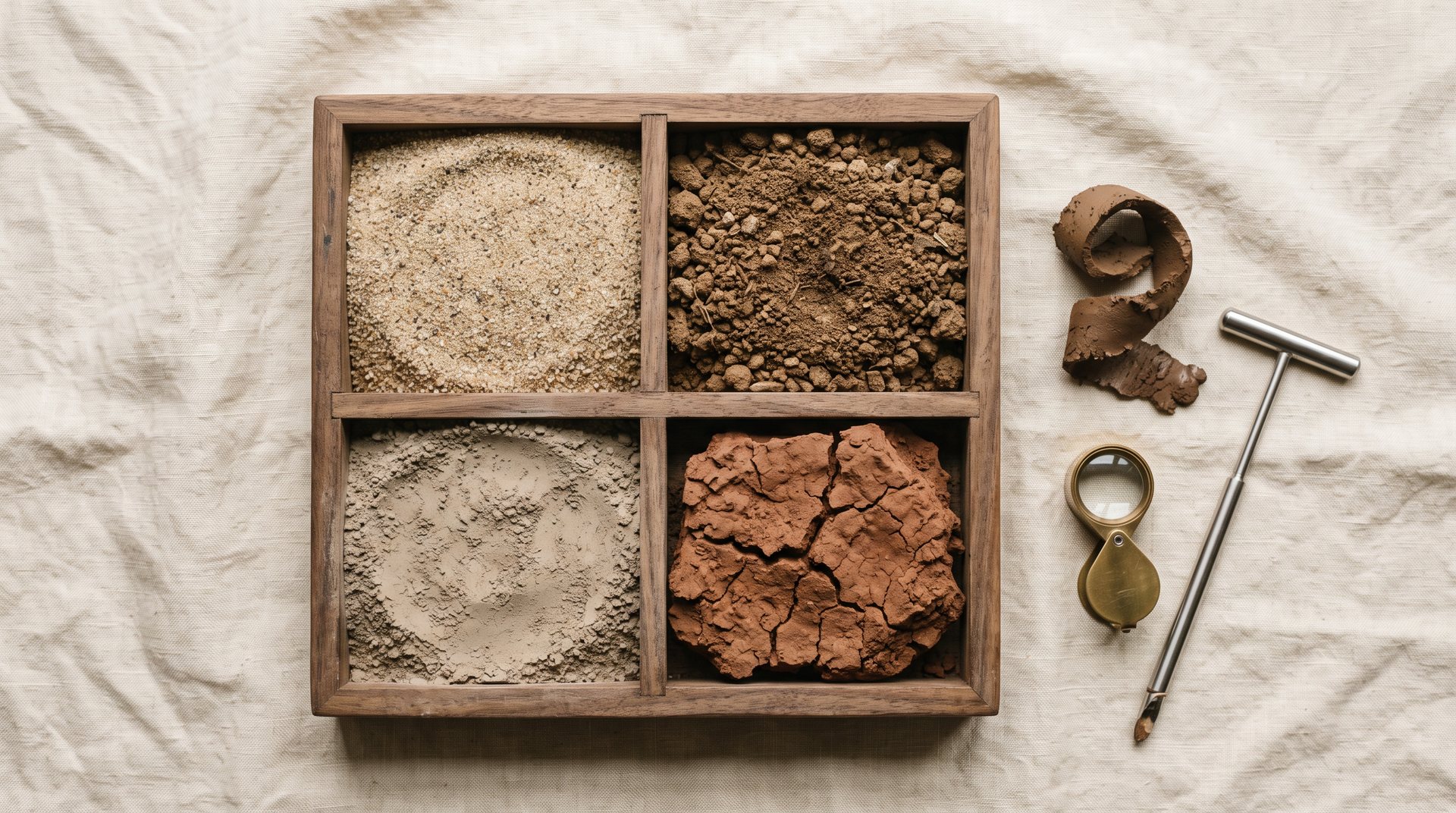
Start with texture, because texture sets everything downstream: how fast the soil drains, how much water and nutrition it holds, even how hard it is to dig. Texture is just the ratio of three particle sizes. Sand is the big grit, silt is the fine flour, and clay is the microscopic stuff that turns sticky when wet. The mix of the three is what gives a soil its personality, and you can read that mix with your bare hands in about ten minutes.
Take a lump the size of an egg, pick out the stones and roots, and wet it a little at a time until it holds together like putty without being soupy. Then squeeze it up between your thumb and the side of your finger, pushing it into a flat ribbon that hangs over the edge. Colorado State's chart puts numbers on how far that ribbon gets before it breaks. A ribbon that gives out before an inch (2.5 cm) is the light-to-medium range: gritty and it's a sandy soil, smooth and floury and it's silt-heavy, and something in between is a loam. A ribbon that holds from one to two inches is a clay loam. Push past two inches and still going and it's a true clay (Card et al., 2022).

The feel confirms the length. Rub a pinch between your fingers: sand is gritty, silt is smooth like dry flour, and clay is sticky and smears rather than crumbles. The category is all you need here, because the category is what decides your next move. A sandy bed and a clay bed need almost opposite treatment, and knowing which one you've got is worth more than any bag of anything.
§ 03The perc test: measuring drainage
Texture predicts drainage. A perc test, short for percolation, actually measures it, and it's the one number that most often explains a bed that keeps failing for no obvious reason. Roots need air as much as water. Soil that drains too slowly stays airless long enough to rot them, and soil that drains too fast never holds a drink long enough for the plant to use it.
The method is a shovel and a bucket of water. Dig a hole at least a foot deep (30 cm), deeper if the rootball you're planting is taller than that, and anywhere from 4 to 12 inches (10 to 30 cm) across. Fill it with water and let it drain all the way down once, which wets the surrounding soil so you're measuring flow and not just a dry sponge soaking up. Then fill it a second time, measure the water level with a ruler, wait 15 minutes, and measure the drop. Multiply that by four and you have an inch-per-hour rate. Iowa State puts the target between 1 and 3 inches (2.5 to 7.5 cm) an hour for most plants. Under an inch is poor drainage. Either you fix it or you plant something that tolerates wet feet. Over four inches and the soil is draining faster than most roots can drink, so it'll want organic matter worked in to hold moisture (Steil, 2024).
Perc rate changes with the seasons, though, and that part is field judgment rather than anything the extension sheets measure. A test in bone-dry August reads faster than the same hole in a soggy February, because the soil around it is already holding different amounts of water. If a bed matters, test it more than once across the year before you commit to a verdict.
§ 04The lab test: the chemistry you can't feel
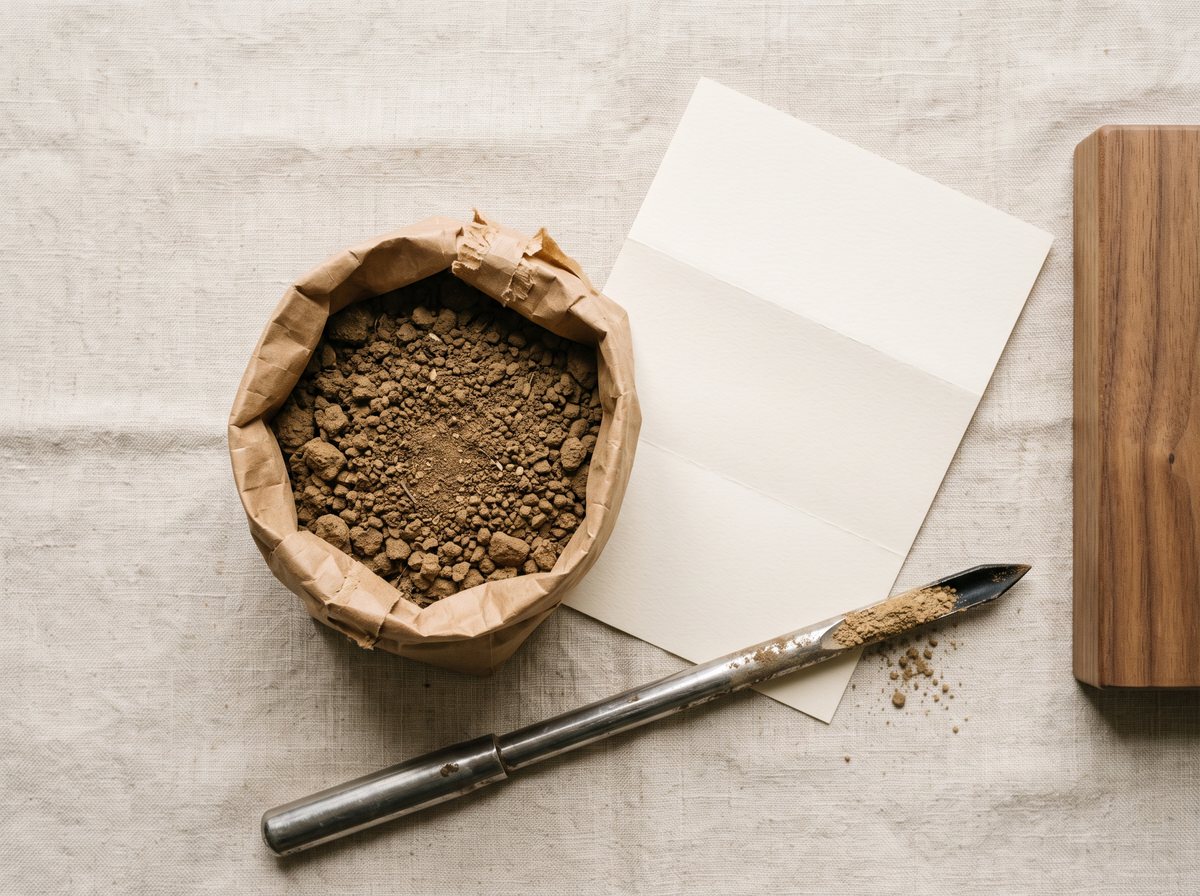
Your hands can read how a soil is built, and a shovel tells you how it drains. Neither can tell you what's chemically in it, and that's where a paid lab test earns its small fee. You mail a dried soil sample to a testing lab and get back a page of numbers. A basic report covers pH, phosphorus (P), potassium (K), calcium, magnesium, organic matter, and a lime-and-fertilizer recommendation, and many reports also list cation exchange capacity (Traunfeld, 2026). Three of those lines do the heavy lifting.
pH is the acidity, and it's the master dial. Most vegetables and ornamentals do best between 5.5 and 7.0, with 6.0 to 7.0 the safest stretch of that range. The reason it matters so much is that pH decides whether nutrients are available even when they're present. Drop below 6.0 and phosphorus starts binding to iron and aluminum; climb above 7.3 and it binds to calcium instead. Either way the plant can't reach it, and you get a deficiency in a soil that technically has plenty (Traunfeld, 2026).
Organic matter (OM) is what used to be alive down there: decomposed leaves, roots, and the like. Two to five percent is the range Penn State treats as a good target for field soil, and Maryland Extension puts the floor at 2 percent or better for a healthy soil (Sánchez & Ford, 2025; Traunfeld, 2026). It's also the one amendment that helps sandy soil and heavy clay alike (Steil, 2024). It feeds soil life, holds water, and slowly releases nitrogen as it breaks down (Sánchez & Ford, 2025; Traunfeld, 2026).
CEC, cation exchange capacity, is the soil's ability to hold onto positively charged nutrients like calcium, magnesium, and potassium so rain doesn't wash them straight through. It's reported in milliequivalents per 100 grams of soil (meq/100g), and higher means more storage. Sandy soils sit low, around 1 to 5; loams land in the middle at 5 to 15; clay loams run 15 to 30, and true clays go past 30. Both clay content and organic matter push CEC higher, which is the technical reason a sandy bed leaks nutrients and a compost-rich one banks them (Sánchez & Ford, 2025).
§ 05Reading the three together
Any one test is a clue. Together they tell you what to do. Once you have all three, you're aiming the amendment at a named problem instead of guessing.
A sandy bed that percs fast and reads low on CEC and organic matter is leaking water and food. The answer is compost, and plenty of it, worked in to raise the soil's holding power. A heavy clay bed that percs under an inch an hour is the opposite problem, too much holding and not enough breathing. It also wants organic matter, but for a different reason: to open up its structure so air and water can move. Resist the folk fix of dumping sand into clay, which tends to set up like weak concrete rather than loosen anything (Steil, 2024).
Most people amend the hole and stop there. Work amendments through the whole planting area instead. A pocket of fluffy compost surrounded by dense native clay tends to behave like a bucket, collecting water at its edges and holding it against the roots, which is why the guidance is to spread compost across the surface and work it into the top 6 to 12 inches (15 to 30 cm) of the bed (Steil, 2024). Amend the bed, not the hole. That's most of fall bed prep right there, which is where the Garden Amendment guides go next.
§ 06The bottom line
Amending soil is the satisfying part of gardening, the weekend where you haul compost and picture the harvest. It's also where money and effort quietly disappear when they're aimed at a problem you don't actually have. An afternoon with a ribbon, a hole, and a mailing envelope tells you which problem is yours. Read the soil first, then amend it on purpose.
Card, A., Whiting, D., Wilson, C., & Reeder, J. (2022). Estimating soil texture: Sandy, loamy, or clayey (GardenNotes No. 214). Colorado State University Extension. https://extension.colostate.edu/resource/estimating-soil-texture-sandy-loamy-or-clayey/
Steil, A. (2024). Testing and improving soil drainage. Iowa State University Extension and Outreach. https://yardandgarden.extension.iastate.edu/how-to/testing-and-improving-soil-drainage
Sánchez, E., & Ford, T. (2025). High tunnel soil test report: Organic matter and cation exchange capacity. Penn State Extension. https://extension.psu.edu/high-tunnel-soil-test-report-organic-matter-and-cation-exchange-capacity
Traunfeld, J. (2026, April 15). Understanding your soil test report. University of Maryland Extension. https://extension.umd.edu/resource/understanding-your-soil-test-report