If you water with distilled or reverse osmosis (RO) water, the fertilizer carries nearly all of the diet. Beyond nitrogen, phosphorus and potassium, it usually needs to bring calcium, magnesium and the micronutrients, which tap water can partly supply. Calcium needs to keep arriving, while magnesium moves around inside the plant. In our reading of the evidence, both can go on a planned rotation.
What pure water leaves out
Tap and well water aren’t just water. For greenhouse growers, irrigation water is a nutrient source in its own right: it rarely carries much nitrogen, phosphorus or potassium, but it can carry significant calcium, magnesium and sulfur (Argo & Fisher, 2008).
Distilled water carries none of that. It’s free of minerals and carries no dissolved nutrients, and using it for a long time may cause deficiencies (Criscione & Holliday-Goulart, 2026). Reverse osmosis (RO) water comes close. Rain or RO water used on its own runs at a pH of 4.0 to 5.5 when measured correctly, with alkalinity under 10 parts per million (ppm) and very little else dissolved in it (Argo, 2003a).
A home RO unit isn’t a still, though. The U.S. Environmental Protection Agency (EPA) WaterSense specification for point-of-use RO systems asks for a cut in total dissolved solids (TDS) of at least 75 percent (U.S. Environmental Protection Agency, 2024). The RO-purified well water in a Michigan State greenhouse study still carried 20 milligrams per liter (mg/L, the same as ppm in water) of calcium and 7 mg/L of magnesium (Argo & Biernbaum, 1996a).
So the fertilizer carries the load
When the water is RO or rainwater, the fertilizer may be the only source of calcium, magnesium and sulfur (Argo, 2003a). Micronutrients go too. Once RO strips micronutrients from greenhouse water, plants may face a wide range of deficiencies, and these can be tricky to identify and correct in such clean systems (Wilkerson, n.d.). In containers filled with soilless mixes, adding micronutrients has become a necessity rather than an extra (Argo, 2003b).
Water-test guidance shows how far short pure water falls. Water with less than 40 mg/L of calcium typically needs calcium added through the fertilizer, and magnesium generally only causes problems below 25 mg/L, which calls for magnesium in the fertilizer (Rhea et al., 2025). The greenhouse targets for irrigation water, Biernbaum’s ranges as reprinted by UMass Extension, are 25 to 75 ppm calcium and 10 to 30 ppm magnesium (Cox et al., n.d.). Distilled water starts below all of it.
That makes the label the thing to read. Along with N-P-K (nitrogen, phosphorus and potassium), look for calcium, magnesium and the micronutrients plants in a soilless mix need from the feed: iron, manganese, zinc, copper, boron and molybdenum (Argo, 2003b).
Why calcium often comes in its own bottle
Calcium is awkward to put in a fertilizer. Among the salts used to blend water-soluble fertilizers, calcium nitrate is the only water-soluble calcium source. In a concentrated stock solution it generally can’t share space with sulfate salts such as magnesium sulfate, because gypsum forms and drops out. At high concentrations it can’t share with monoammonium phosphate either, because calcium phosphate forms. For the sulfate problem, the workarounds are magnesium nitrate in place of magnesium sulfate, or two separate stock tanks (Argo, 2003b). Calcium-containing fertilizers aren’t compatible with the common greenhouse 20-10-20 formulation either (McElhannon, n.d.).
That’s a problem with concentrates. The incompatibility shows up in concentrated stock solutions (Argo, 2003b), not necessarily at watering-can strength. Still, the easy habit is to add each product to the full can of water one at a time, and never pour one concentrate straight into another.
Every watering, or on rotation?
Calcium is the nutrient that decides this. Plants move little calcium from older tissue to new growth through the phloem, so supply depends on what arrives with the water stream, and shortages show up more often in young leaves (Thor, 2019). Magnesium is the opposite: it moves, and a shortage shows first in old growth (Shober & Denny, 2025).
In pothos grown in a nutrient solution with the calcium left out, the first sign was at the root tips, which turned necrotic, meaning the tissue broke down (Ku & Hershey, 1991). Two to six weeks later came chlorotic (yellowed) spots on the uppermost leaf and distorted expanding leaves (Ku & Hershey, 1991). Calcium is also a building block of cell walls, and a U.S. Department of Agriculture (USDA) Forest Service bulletin on tree seedlings puts it simply: "a continuous supply is necessary for normal growth" (USDA Forest Service, 1996). Container-grown seedlings need a steady supply of soluble calcium, and adding dolomite (a calcium-magnesium limestone) to the mix doesn’t guarantee one (USDA Forest Service, 1996).
Steady doesn’t have to mean in every watering, though. Some greenhouse advice uses a rotation: one consultant recommends rotating 20-10-20 plus Epsom salt with a 15-0-15, which he says will supply all the essential nutrients between them (McElhannon, n.d.). In poinsettias, magnesium deficiency can be prevented with a calcium-magnesium fertilizer or a monthly magnesium sulfate application (Cox, 1997). The mix can also hold some reserve. In earlier work on poinsettias watered from the top with regular leaching, the water washing through carried nutrients from the top layer of the pot down to the root zone for up to six weeks after fertilization stopped. In pots watered from below that dried down between waterings, nutrients in that top layer didn’t appear to be available to the plant (Argo & Biernbaum, 1996b, summarizing their earlier work).
I looked for a trial that compared calcium in every watering against calcium on a rotation, and didn’t find one. As we read the evidence, a planned rotation is fine when every nutrient shows up somewhere in the cycle, calcium never goes missing for long, and magnesium comes less often. What the evidence argues against is a feed with no calcium in it and nothing else bringing any.
Keep an eye on the pH
Pure water has one more gap: alkalinity, the dissolved carbonates and bicarbonates that neutralize acid. Below 30 mg/L of alkalinity, water provides no buffering against pH change, which is especially a problem where acid fertilizers are used (Rhea et al., 2025). With low-alkalinity water, the main problem is a slow slide in the mix’s pH, and it usually comes down to fertilizer choice (Argo, 2003a). Feeds rich in ammoniacal (ammonium-based) nitrogen acidify the mix, and with nothing in the water to resist them they tend to drive pH down over time (Argo, 2003a).
Nitrate can push the other way, but only while the plant is taking it up. Roots release bases as they absorb nitrate, which raises the mix’s pH, and small or stressed plants barely shift it that way (Argo, 2003b). Dose matters too. One 56-day study used deionized (purified) water and kalanchoe, the species that lowered pH most in the authors’ earlier trials. Even a basic fertilizer, the kind that tends to raise pH, ended at pH 6.11 (down from 6.49) at the lower feed rate, and fell to 4.92 at twice that rate (Jeong et al., 2016).
Slow-reacting carbonate lime in the mix buys time. In a Michigan State study of impatiens watered from below with RO water and a neutral fertilizer, the treatment with the largest gap showed it: a peat-based mix holding carbonate lime stayed at pH 6.1, 5.9 and 5.8 at weeks 8, 12 and 17, while the mix limed with faster-reacting hydrated lime, added at a much lower rate, fell to 5.1, 4.6 and 4.6 (Argo & Biernbaum, 1996a). Either way, a pour-through test, which checks the water draining out of the pot, tells you where your own pots stand. How Substrate Actually Works walks through it.
What goes in our can
The Guild waters the whole collection with distilled water, for two reasons. Our carnivorous plants need it, and our building’s water runs through a water softener, so the sodium in our tap water can vary. Softening with sodium chloride often leaves water high in sodium (Rhea et al., 2025), so if your home or building softens its water, you may be in the same spot. Every watering gets a complete liquid fertilizer made for foliage plants, at the label’s potting-mix rate, a little over half a teaspoon to about a teaspoon per quart (3 to 5 milliliters per liter), plus BTI (Bacillus thuringiensis subsp. israelensis), the bacterial larvicide we use against fungus gnat larvae. Once a month a calcium-magnesium supplement goes in, and every five weeks the pots get a plain-water flush.
The label is why that rotation holds up. Our base fertilizer lists calcium at 1.3 percent and magnesium at 0.7 percent, along with sulfur and those six micronutrients, and all of its nitrogen is nitrate. At the label rate that works out to roughly 40 to 65 mg/L of calcium and 20 to 35 mg/L of magnesium in every watering. For comparison, 40 to 80 ppm calcium in the fertilizer solution you apply is a good target for container tree seedlings, as long as nutrient ratios are watched too (USDA Forest Service, 1996). The monthly supplement is a top-up, not the main supply. And because the nitrogen is nitrate, an acid slide is less likely than with an ammonium-heavy feed (Argo, 2003b). The kalanchoe in the deionized-water study still lost pH on a basic feed at the higher rate, though, so the pour-through test is still worth doing (Jeong et al., 2016).
Other routes, and one exception
Growers also blend RO water with their regular water (Wilkerson, n.d.). Blending dilutes the salts in the original source (Argo & Fisher, 2008) and puts some of the nutrients back (Wilkerson, n.d.). More calcium isn’t automatically better, either. Above about 100 mg/L it may lead to antagonism and a resulting shortage of phosphorus or magnesium (Rhea et al., 2025).
The exception is carnivorous plants. Venus flytraps and their relatives typically need distilled water for best growth because they get their nutrients from insects rather than fertilizer (Criscione & Holliday-Goulart, 2026). A fertilizer plan like this one isn’t meant for them.
The bottom line
On distilled or RO water, the fertilizer carries nearly all of the diet. Pick a fertilizer whose label lists calcium, magnesium and the micronutrients, or pair one that doesn’t with a calcium-magnesium supplement on a schedule you’ll keep. Make sure calcium keeps arriving, mix products into the full can one at a time, and check the pH of the runoff once in a while.
Argo, B. (2003a). Understanding pH management and plant nutrition. Part 2: Water quality. Journal of the International Phalaenopsis Alliance, 13(1). Reprinted by the St. Augustine Orchid Society. https://staugorchidsociety.org/PDF/IPAWaterQuality.pdf
Argo, B. (2003b). Understanding pH management and plant nutrition. Part 3: Fertilizers. Journal of the International Phalaenopsis Alliance, 13(2). Reprinted by the St. Augustine Orchid Society. https://staugorchidsociety.org/PDF/IPAFertilizers.pdf
Argo, W. R., & Biernbaum, J. A. (1996a). The effect of lime, irrigation-water source, and water-soluble fertilizer on root-zone pH, electrical conductivity, and macronutrient management of container root media with impatiens. Journal of the American Society for Horticultural Science, 121(3), 442–452. https://doi.org/10.21273/JASHS.121.3.442
Argo, W. R., & Biernbaum, J. A. (1996b). Availability and persistence of macronutrients from lime and preplant nutrient charge fertilizers in peat-based root media. Journal of the American Society for Horticultural Science, 121(3), 453–460. https://doi.org/10.21273/JASHS.121.3.453
Argo, B., & Fisher, P. (2008, June 12). Understanding plant nutrition: Irrigation water as a nutrient source. Greenhouse Grower. https://www.greenhousegrower.com/production/fertilization/understanding-plant-nutrition-irrigation-water-as-a-nutrient-source/
Cox, D. (1997). Fertilizing commonly grown greenhouse crops. Floral Notes, 9(4). University of Massachusetts Extension. Reprinted in Southeastern Floriculture. https://hortscans.ces.ncsu.edu/uploads/f/e/fertiliz_51ddad4b58f29.pdf
Cox, D. A., Lopes, P., & Smith, T. (n.d.). UMass Extension Floriculture water quality project: II. pH, alkalinity, calcium, magnesium and other elements. UMass Extension Greenhouse Crops and Floriculture Program. https://www.umass.edu/agriculture-food-environment/greenhouse-floriculture/fact-sheets/umass-extension-floriculture-water-quality-project-ii-ph-alkalinity-calcium-magnesium-other
Criscione, K., & Holliday-Goulart, J. (2026, June 2). Properly watering container houseplants (SPES-804P). Virginia Cooperative Extension. https://www.pubs.ext.vt.edu/content/pubs_ext_vt_edu/en/SPES/spes-804.html
Jeong, K. Y., Nelson, P. V., Niedziela, C. E., Jr., & Dickey, D. A. (2016). Effect of plant species, fertilizer acidity/basicity, and fertilizer concentration on pH of soilless root substrate. HortScience, 51(12), 1596–1601. https://doi.org/10.21273/HORTSCI11237-16
Ku, C. S. M., & Hershey, D. R. (1991). Calcium deficiency symptoms of Epipremnum aureum. HortScience, 26(5), 606. https://doi.org/10.21273/HORTSCI.26.5.606
McElhannon, B. (n.d.). 20-10-20 water soluble fertilizers, an industry work horse. Southeastern Floriculture, 56. https://hortscans.ces.ncsu.edu/uploads/2/0/20-10-20_51e55cbd291db.pdf
Rhea, D., Canfield, C., Snyder, K., & Swistock, B. (2025, September 10). Interpreting irrigation water tests. Penn State Extension. https://extension.psu.edu/interpreting-irrigation-water-tests
Shober, A. L., & Denny, G. C. (2025). Identifying nutrient deficiencies in ornamental plants. University of Delaware Cooperative Extension. https://udel.edu/content/dam/udelImages/canr/pdfs/extension/factsheets/Identifying-Nutrient-Deficiencies-in-Ornamental-Plants.pdf
Thor, K. (2019). Calcium—Nutrient and messenger. Frontiers in Plant Science, 10, 440. https://doi.org/10.3389/fpls.2019.00440
USDA Forest Service. (1996, January). Secondary nutrients: Calcium. Forest Nursery Notes, 8–10. https://npn.rngr.net/publications/fnn/1996-winter/articles/secondary-nutrients2014calcium/at_download/file
U.S. Environmental Protection Agency. (2024). WaterSense specification for point-of-use reverse osmosis systems (Version 1.0). https://www.epa.gov/system/files/documents/2024-11/ws-products-watersense-ro-systems-specification.pdf
Wilkerson, D. (n.d.). Treating irrigation water. In Texas greenhouse management handbook. Texas A&M AgriLife Extension. https://aggie-horticulture.tamu.edu/ornamental/greenhouse-management/treating-irrigation-water/
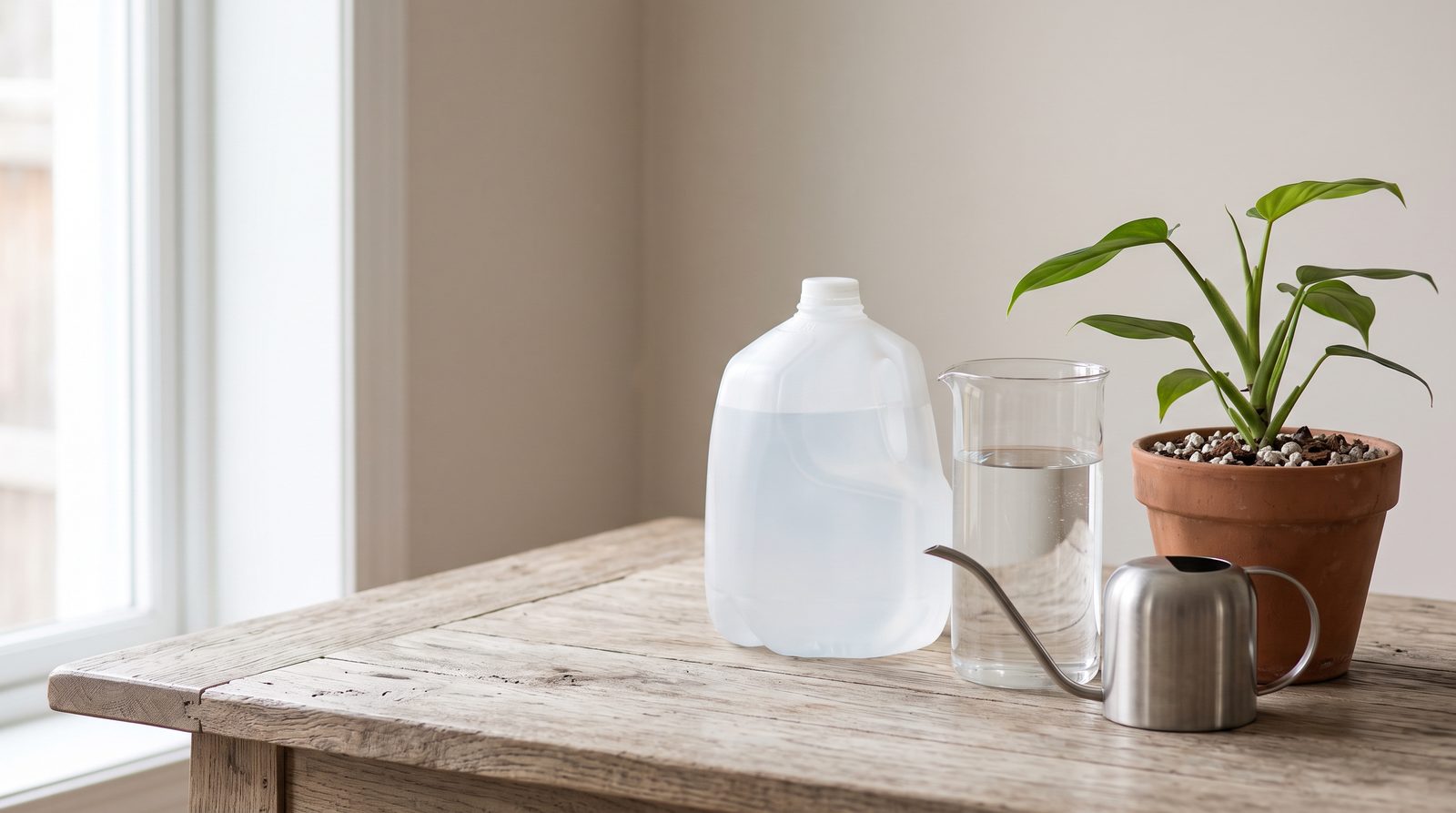
Image (hero): The Planters’ Guild. (2026). Distilled water, a beaker and a watering can beside a potted plant [AI-generated illustration]. Generated with Nano Banana 2 on Artlist. Illustrative only; not a photograph of the Guild’s collection.