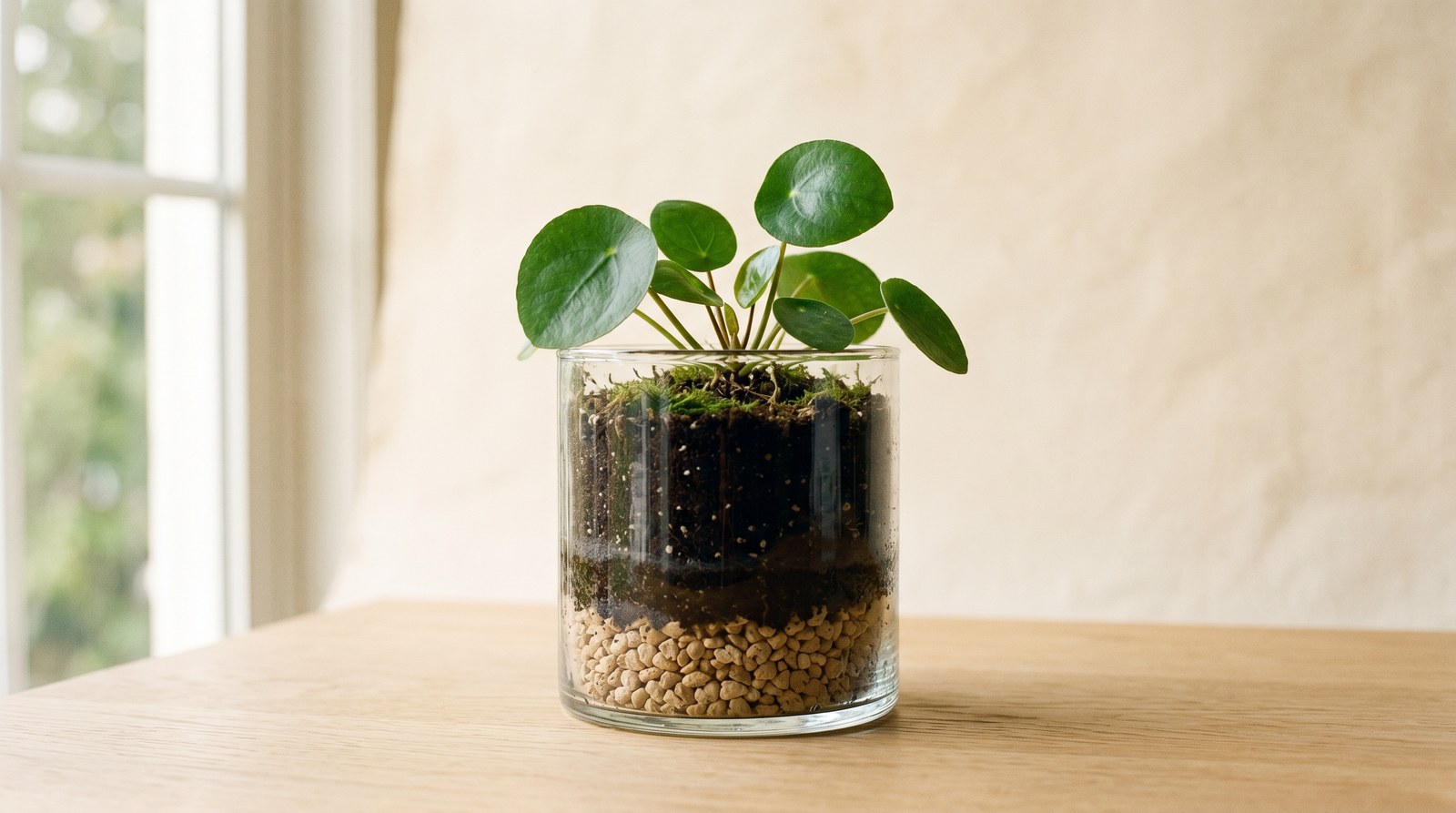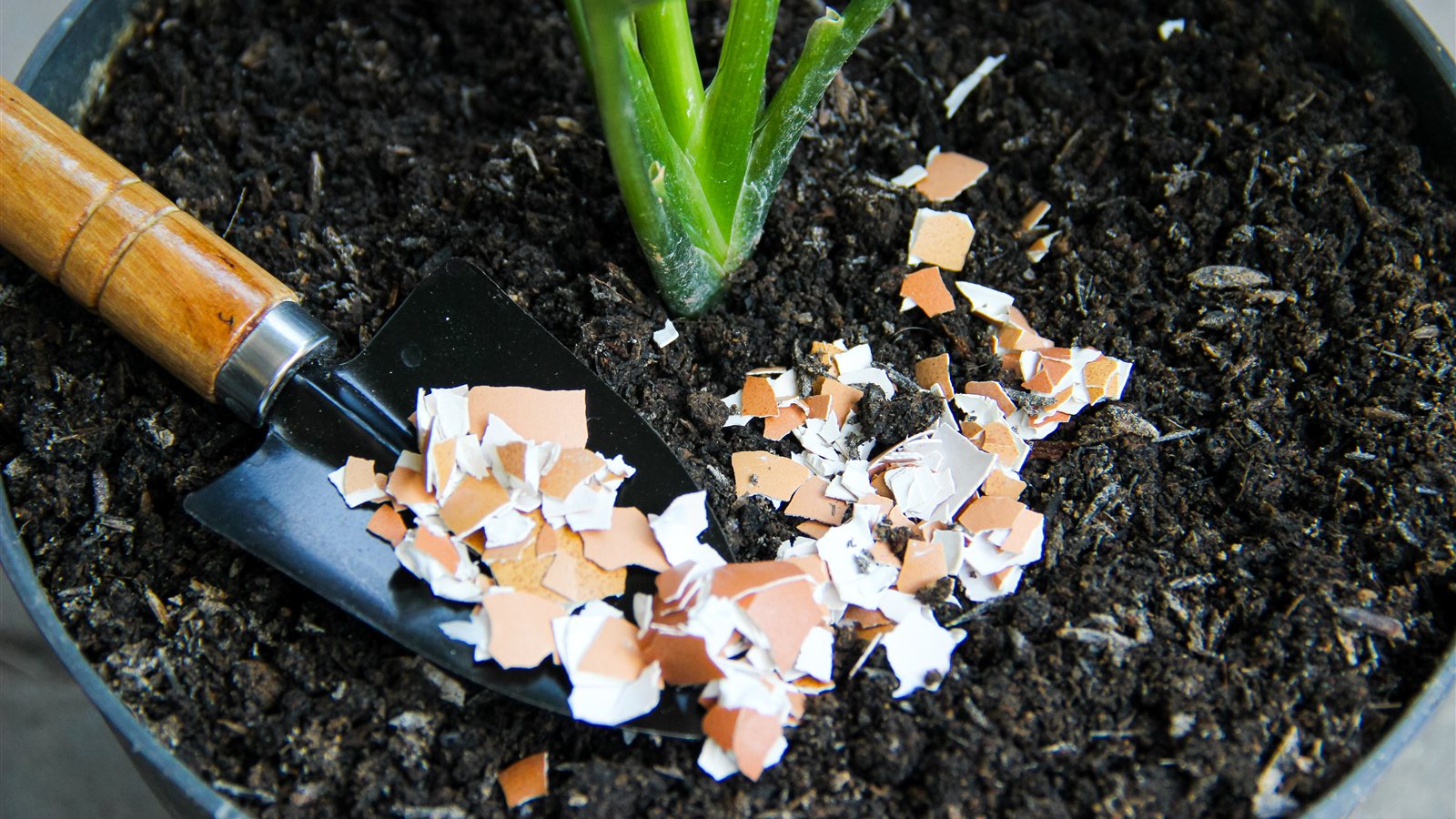
Save your eggshells, crush them up, work them into the pot. The shells really are almost pure calcium, so the math seems airtight. The trouble is the chemistry: in a houseplant pot, that calcium stays locked in the shell longer than most of us keep the plant.
On this page
7 sections
The claim
Don't throw out your eggshells. Rinse them, crush them, and work them into your pots, or steep them in water and pour off the "calcium tea." Shells are nearly pure calcium, plants need calcium, and so the kitchen hands you free fertilizer. Every houseplant forum has a version of this, usually with a photo of shell confetti sitting proudly on the soil.
The kernel is real
Give the myth its due. Eggshell is 94 to 97% calcium carbonate (the mineral that limestone and chalk are made of), which makes it chemically the same material as agricultural lime, the ground limestone farmers spread to raise the pH of acidic soil (Holmes et al., 2011). And it genuinely works in that role. In field trials on two acidic Iowa soils, ground eggshells from an egg-breaking plant corrected soil pH as well as quarry lime, and over several years actually outperformed the rating on their analysis tag (Holmes et al., 2011).
So the people telling you eggshells are "basically lime" are right. They're just gliding past the word ground, which is doing a lot of work in that sentence, plus everything a farm field has that your pot doesn't.
What stands between the shell and the plant
Calcium carbonate barely dissolves in plain water. To give up its calcium it has to be dissolved by acid, and in soil that acid is the same acidity the lime was spread to neutralize. The reaction runs on surface area, so particle size decides almost everything. The one study the Iowa team could point to found that finely ground eggshells worked as lime while coarsely ground shells were essentially ineffective (Mitchell, 1994, as cited in Holmes et al., 2011).
Coarse, in that study, still means far finer than anything you'll produce by squeezing shells over a pot. The Iowa trial shells were machine-ground until everything passed a 4-mesh screen (openings about 4.75 mm, or 3/16 inch), yet only 1 to 2% passed the 60-mesh sieve (openings around 0.25 mm, about 0.01 inch) that defines the fast-reacting fraction of agricultural lime. Even at that grind, incorporated into genuinely acidic soil, the eggshells started slower than quarry lime (whose fine fraction reacts within months) and didn't pull ahead of it until about eighteen months in (Holmes et al., 2011). Hand-crushed shell chips are boulders by comparison, and the timescale stretches from seasons to years.
A pot is where the chemistry stops
Now put all of this in a houseplant pot, because that's where the myth falls apart.
Peat-based potting mixes ship with limestone already blended in, added to neutralize the peat's natural acidity and hold the mix near the pH range houseplants want (Smith & Cox, 2015). That has two consequences for your shell confetti. First, the job the shells could theoretically do is already done, by a material ground fine enough to actually do it. Second, a near-neutral pot offers almost no acid to dissolve them: in the Iowa trials, pH change stalled as soils approached 7 because carbonate dissolution slows right down as acidity runs out (Holmes et al., 2011). A limed pot is about the worst place you could ask calcium carbonate to dissolve.
Meanwhile the calcium itself is arriving from two other directions. The limestone blended into the mix is the same mineral as the shells, ground fine enough to actually dissolve, and put there on purpose (Smith & Cox, 2015). And in much of the country your tap water carries some too: water hardness is mostly dissolved calcium and magnesium, and anything above 61 mg/L rates as at least moderately hard on the U.S. Geological Survey (USGS) scale (USGS, n.d.). If you water from the tap, you may be adding calcium every time you pick up the can.
And suppose the shells did dissolve on houseplant timescales. That would make them a lime application, nudging your pot's pH upward by an amount nobody has measured. Raising pH is what this material is for. It's not a thing to do to a container by accident, one eggshell at a time.
About those tomatoes
The garden version of this myth puts shells in the tomato planting hole to prevent blossom-end rot (the sunken, leathery patch that forms on the bottom of the fruit). A century of research says the disorder tracks how calcium moves inside the plant, tangled up with irregular watering and growing conditions, rather than a shortage of calcium in the soil (Topcu et al., 2022). Shells in the hole miss twice: wrong timescale, and usually the wrong problem. Steadier watering does more for blossom-end rot than any amendment.
What to do with the shells instead
Compost them. Crushed small, they'll ride along harmlessly, add a little slow mineral content, and stop being a decision you have to make. If you actually suspect a pH or calcium problem in a garden bed, order a soil test from your state's extension lab and find out instead of guessing; if the test says lime, buy ground lime with a rating on the bag and apply a measured amount. And if you just enjoy the ritual, a spice grinder will take shells down to powder, which is the only form with any hope of reacting before you've repotted twice.
Your houseplants, though, don't need any of it. Between the limestone already in the mix and the hardness in the water, the shells never had a job to do.
The verdict
Mostly false. The one true thing in this myth, that eggshell is nearly pure calcium carbonate, is the same fact that sinks it: calcium carbonate needs acid, fineness, and time, and a houseplant pot offers none of the three. Ground to powder and worked into acidic soil, shells are respectable lime. Crumbled over a limed pot, they're a garnish. Compost the shells; the mix you bought is already doing this job.
Holmes, J. D., Sawyer, J. E., Kassel, P., & Ruiz Diaz, D. (2011). Using ground eggshells as a liming material in corn and soybean production. Crop Management, 10(1), 1–12. doi.org/10.1094/CM-2011-1129-01-RS · PDF
Mitchell, C. C. (1994). Crushed eggshells in the soil (Farm Demonstration Report S-01-94). Alabama Cooperative Extension Service and Experiment Station, Auburn University. (Cited in Holmes et al., 2011.)
Smith, T., & Cox, D. (2015). Bagged potting mixes and garden soils for home gardeners. UMass Extension, Center for Agriculture, Food, and the Environment. umass.edu
Topcu, Y., Nambeesan, S. U., & van der Knaap, E. (2022). Blossom-end rot: A century-old problem in tomato (Solanum lycopersicum L.) and other vegetables. Molecular Horticulture, 2, Article 1. doi:10.1186/s43897-021-00022-9
U.S. Geological Survey. (n.d.). Hardness of water. Water Science School. usgs.gov