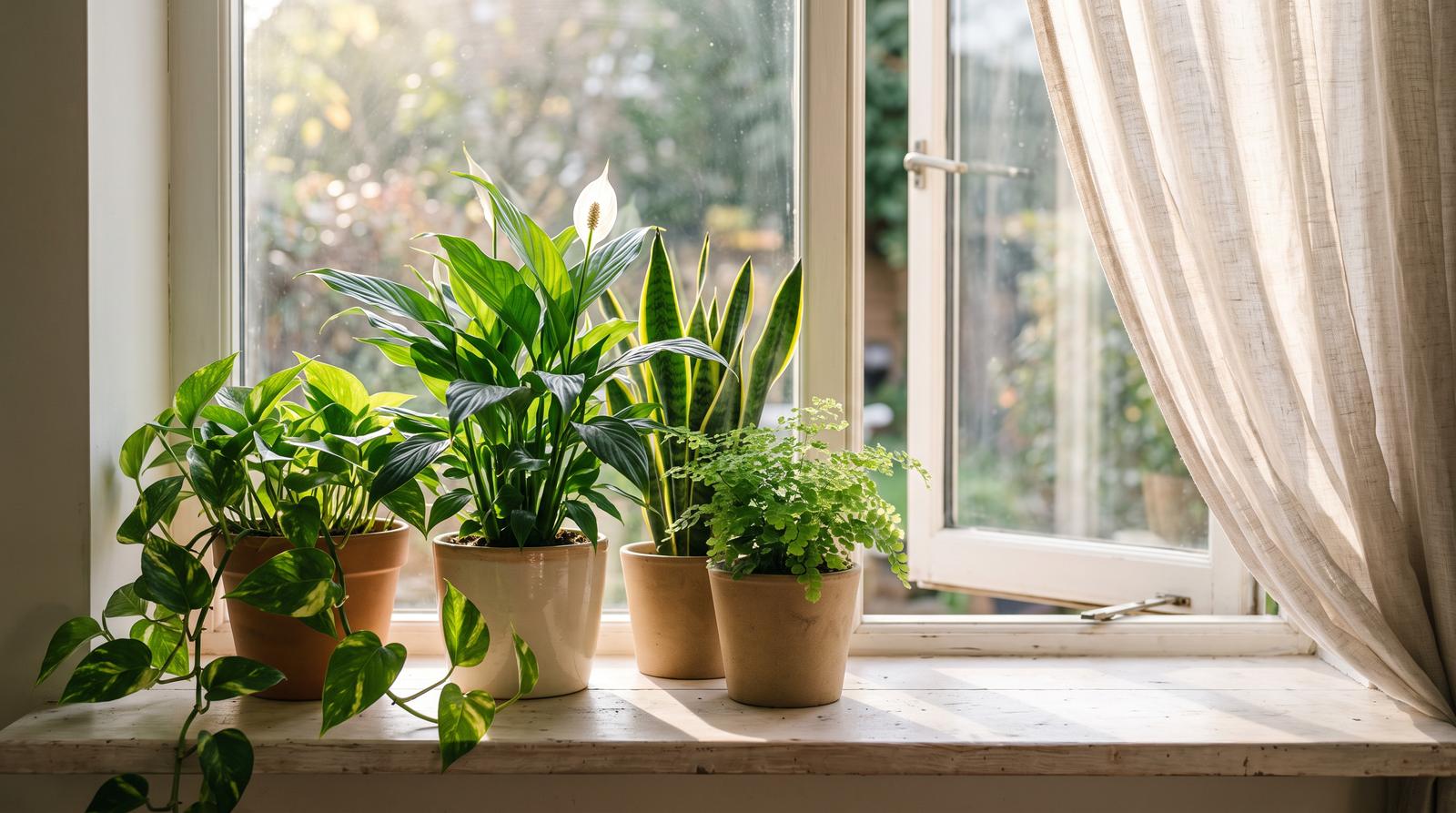
Line a few pothos along the windowsill and they'll scrub the toxins out of your air. It's the reason half the "best plants for clean air" lists exist, and it sold a lot of people their first houseplant. The belief is real, widely repeated, and traceable to a single study from 1989 that was never about living rooms at all.
On this page
6 sections
The claim
Buy a few pothos, line them along the windowsill, and they'll quietly scrub the toxins out of your air while you sleep. It's the reason half the "best plants for clean air" lists exist, and it's why a lot of people brought home their first houseplant. The logic feels airtight: plants breathe, so surely a roomful of them is filtering the place around the clock.
Where it comes from
The whole idea rests on one study, from 1989, and it was never about apartments. NASA was thinking about sealed spacecraft, where you can't crack a window when the air goes stale. Researchers at the Stennis Space Center put common houseplants inside small airtight chambers, pumped in gases like formaldehyde and benzene (volatile organic compounds, or VOCs, the fumes off new furniture, fresh paint, cleaning products), and watched the levels fall (Wolverton, Johnson, & Bounds, 1989). The plants really did pull those chemicals out of the air. The finding was solid. What happened next is that a lab result about airtight boxes got quietly rewritten into a promise about your living room.
What the research actually found
The number that matters isn't whether a plant removes anything. It's how fast, measured against everything else already moving air through your home. A door opening, a gap under a window, the HVAC cycling on: a normal house trades out close to its entire volume of air every hour without any help from you.
In 2020, two Drexel University engineers went back through 30 years of plant studies, twelve chamber experiments and 196 separate results in all, and put every one of them on that common yardstick (Cummings & Waring, 2020). The measure is the clean air delivery rate, or CADR, the same rating used for the air purifiers you'd buy at a store. The typical plant came in at a median of 0.023 cubic meters per hour, a trickle. Stacked against the air your building already swaps on its own, the plant's share nearly disappears. To keep pace with ordinary ventilation, they calculated, you'd need somewhere between 10 and 1,000 plants for every square meter of floor, call it every 10 square feet. The American Lung Association ran the homier version of that arithmetic: about 680 plants packed into a 1,500-square-foot house (American Lung Association, n.d.). "Plants are great," said Michael Waring, one of the study's authors, "but they don't actually clean indoor air quickly enough to have an effect on the air quality of your home or office."
The EPA lands in the same place, in plainer words. There is "no evidence that a reasonable number of houseplants remove significant quantities of pollutants in homes and offices" (U.S. Environmental Protection Agency, n.d.).
What's still true
Two things survive the debunking, and they're the reason to keep plants anyway. The chamber results weren't a trick. Plants genuinely metabolize some of these compounds, and a good share of the credit belongs to the microbes living in the potting mix rather than the leaves. It's just an effect that only shows itself when the air has nowhere to go. The Drexel team was careful to say they were judging passive potted plants, not the engineered "active" green walls that run a fan to pull room air through the root zone. Those move real volumes of air, and they're a different machine altogether.
Then there's the part no air-quality study bothers to measure. Keeping plants is good for you. In one randomized trial, young adults who spent a few minutes repotting a plant felt calmer afterward, with lower blood pressure, than the same people doing a screen-based task (Lee, Lee, Park, & Miyazaki, 2015). A plant on the desk earns its keep. Just not as a filter.
What to do instead
If cleaner air is the real goal, the fixes are boring and they work. The EPA's order of operations puts source control first: stop the pollution where it starts, so reach for gentler cleaners and skip the plug-in fresheners. Ventilation comes next, which is a formal word for opening the windows ten or fifteen minutes a day and letting the outside air do the heavy lifting. When you want to go further, a portable HEPA air cleaner or a MERV-13 furnace filter will strip far more particulate out of a room than any amount of foliage (American Lung Association, n.d.).
The verdict
Mostly false. Inside a sealed box, plants do clean the air, and that part is a genuine finding worth respecting. Inside an actual home, the effect is so small next to a single open window that it rounds down to nothing, and closing that gap would take an indoor forest. So keep the plants. Keep every last one of them. Just love them for how they make a room feel better, and open a window when you actually want to move some air.
Cummings, B. E., & Waring, M. S. (2020). Potted plants do not improve indoor air quality: A review and analysis of reported VOC removal efficiencies. Journal of Exposure Science & Environmental Epidemiology, 30(2), 253–261. doi.org/10.1038/s41370-019-0175-9
U.S. Environmental Protection Agency. (n.d.). Improving indoor air quality. epa.gov
American Lung Association. (n.d.). Actually, houseplants don’t clean the air. lung.org
Wolverton, B. C., Johnson, A., & Bounds, K. (1989). Interior landscape plants for indoor air pollution abatement (NASA-TM-101766). National Aeronautics and Space Administration, John C. Stennis Space Center. ntrs.nasa.gov
Lee, M. S., Lee, J., Park, B. J., & Miyazaki, Y. (2015). Interaction with indoor plants may reduce psychological and physiological stress by suppressing autonomic nervous system activity in young adults: A randomized crossover study. Journal of Physiological Anthropology, 34(1), 21. doi.org/10.1186/s40101-015-0060-8