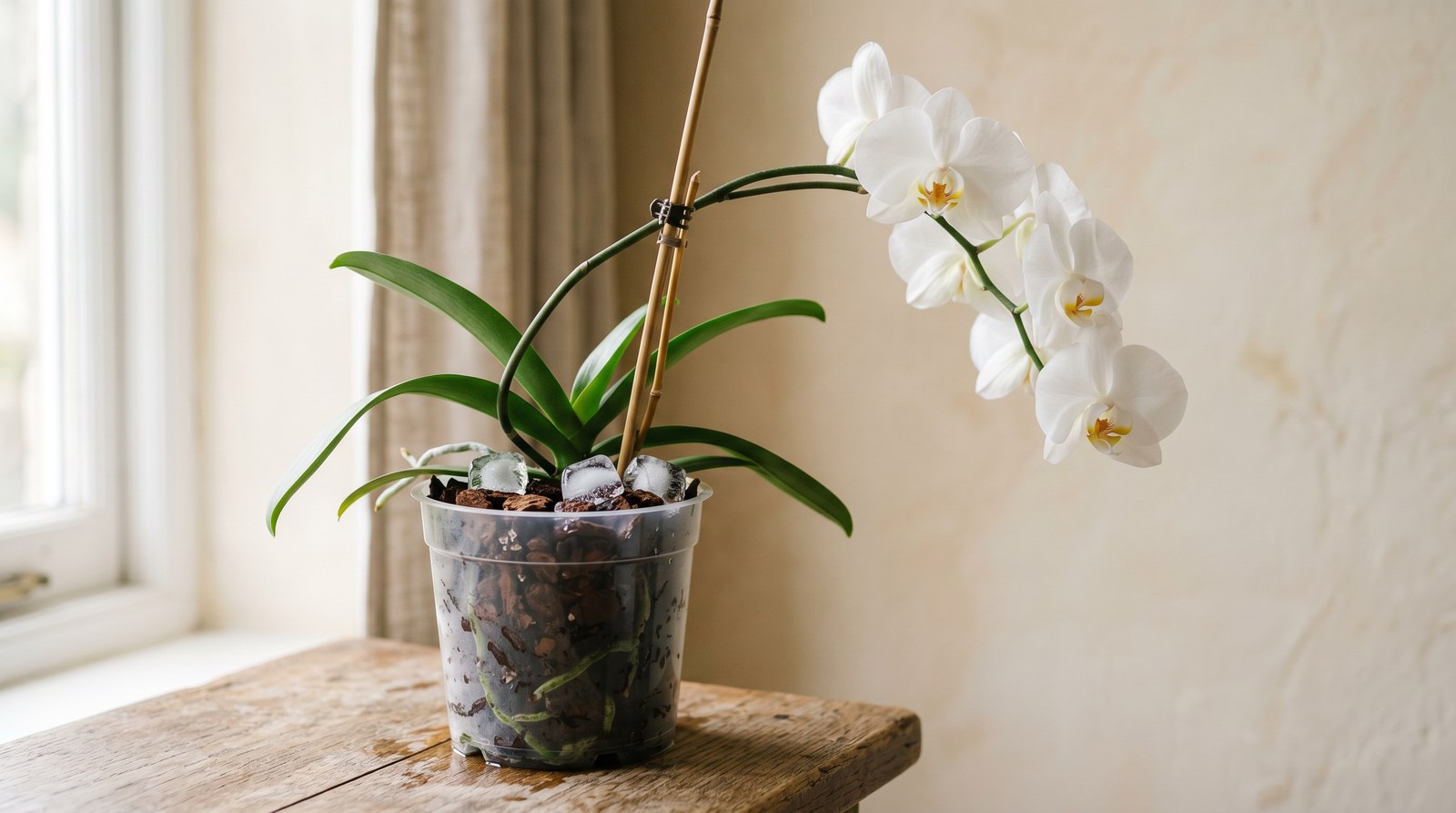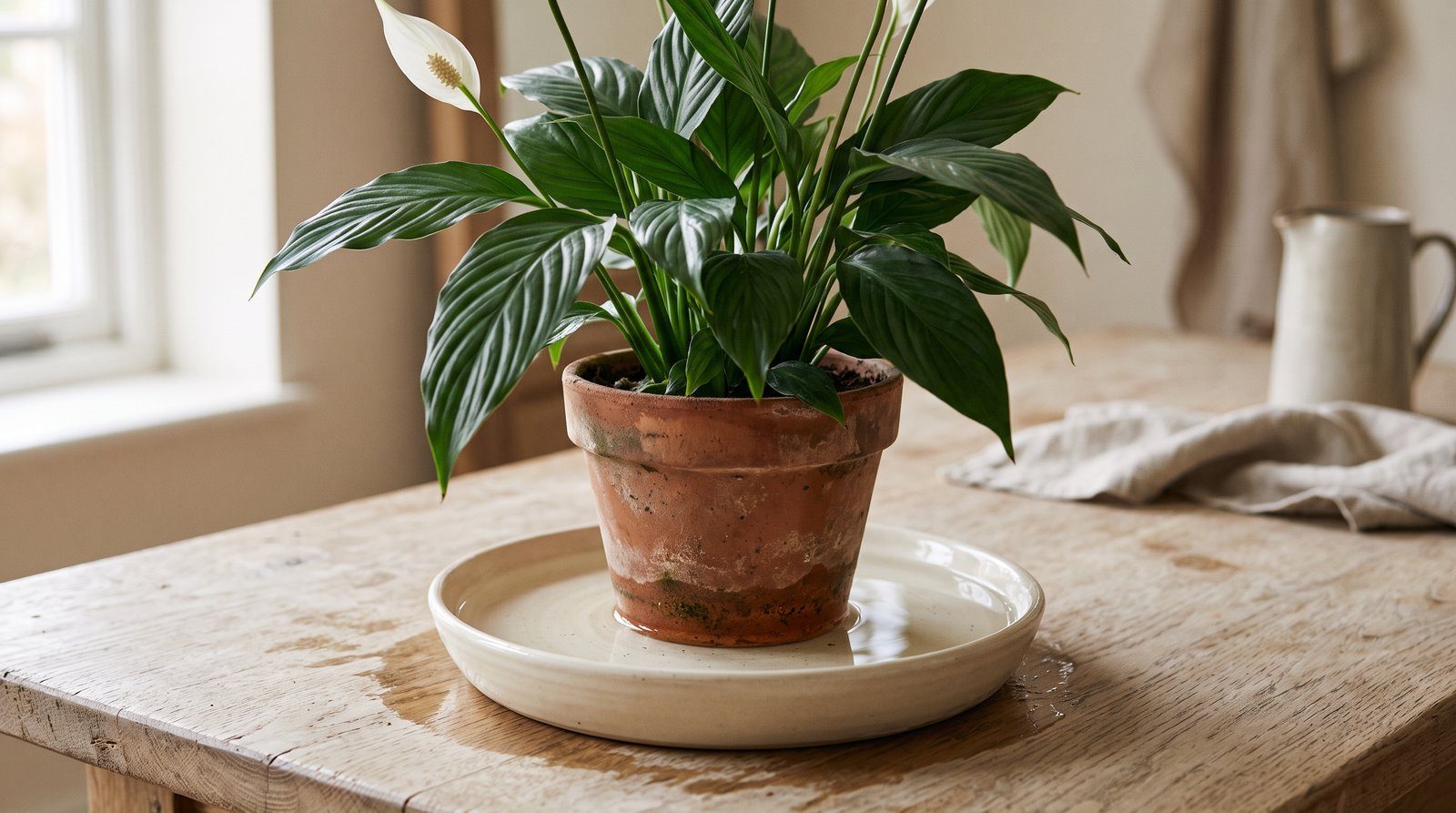
Set the pot in a tray of water, walk away, and let the plant drink from the bottom up. It's often pitched as simply the better way to water. It's a useful tool for some plants and one common problem, but Colorado State's extension service still favors watering from the top, and the reason is where the salts end up.
On this page
8 sections
Corrected October 2026: we've revised parts of this guide. See the correction note at the end.
The claim
The pitch goes like this. Top watering can splash the leaves, and on a mix that has dried and shrunk it can run down the side of the pot without soaking in. Bottom watering fixes that. Set the pot in a tray of water, let the mix pull the water up, and the mix wets from below while the leaves stay dry. So, the argument goes, it's simply the better way to water.
Part of that holds up. Part of it doesn't, and the part that doesn't is about salt.
Where bottom watering earns its place
The mechanism is real. Virginia Tech's houseplant guide compares it to a sponge or a paper towel touching water: potting mix soaks water upward the same way (Criscione & Holliday-Goulart, n.d.).
The same guide says bottom watering is often recommended for three kinds of plants: plants that can't take any water on their leaves, such as African violets, begonias and cyclamens; some cacti and succulents prone to leaf diseases; and houseplants so dense that pouring from above is awkward (Criscione & Holliday-Goulart, n.d.). It also says the method can rewet potting mix that has turned hydrophobic (water-repellent), though that may take longer and may need repeating until the mix feels moist.
Two things narrow that. The first is about violets. The ring spots that show up on African violet leaves come from a temperature difference, usually cold water poured from above or splashed onto the leaves (Pacific Northwest Plant Disease Management Handbook, 2026). The handbook still recommends watering from below, along with room-temperature water and keeping cold splashes off the leaves. Purdue calls violet watering methods "a source of controversy" and says any method that keeps the soil adequately moist is satisfactory, with three pieces of advice: keep the crown (the center of the plant) dry, don't let cold water touch the leaves, and water with room-temperature water (Lerner & Dana, n.d.).
The second is about rewetting. A lab test that gave plain sphagnum peat ten five-minute soaks in 1 inch (2.5 cm) of water found it took up more water when watered from above than from below (Schulker et al., 2020). So bottom watering is one way to rewet a dried-out pot, not a guaranteed one.
Virginia Tech adds a few rules. The pot needs drainage holes. Give it 15 to 30 minutes in the water, longer for a drier mix, and take it out within an hour, since a longer soak risks root rot (Criscione & Holliday-Goulart, n.d.). When it's done, empty whatever water is left in the tray (PlantTalk Colorado, n.d.; University of Maryland Extension, 2023).
The catch: where the salt goes
All water carries some dissolved minerals, and fertilizer adds more. When water evaporates from the mix, those salts stay behind and concentrate, and that can make it harder for the plant to take up water (University of Maryland Extension, 2023).
Watering from the top until the excess drains through flushes extra salts out of the pot (University of Maryland Extension, 2023). Water drawn up from below doesn't leave that way. Colorado State's PlantTalk says subirrigation (watering from below, from a tray or saucer) "can lead to an accumulation of excess soluble salts in and on the surface of the soil," and it's generally better to water plants from the top (PlantTalk Colorado, n.d.). It adds that if you do water from the bottom, you should water from the top now and then to leach the salts out. Not every extension service ranks the two. Missouri says plants "may be watered from either the top or the bottom of the pot," then gives the same warning: water regularly from below and salts may form a white crust on the surface, which occasional top watering helps wash out (Trinklein, 2017). Purdue says the same for African violets watered continuously from the bottom (Lerner & Dana, n.d.).
Greenhouse work shows the same pattern, with one difference: those crops were fed with nutrient solution at every watering. In a tomato trial that ran 268 days, plants watered from below with nutrient solution had higher salt readings in every layer of the pot than plants drip-watered from above. In the middle and bottom layers the reading was about twice as high, and the gap was even greater in the top layer (García-Santiago et al., 2019). (Salt in a pot is measured as electrical conductivity, or EC, a meter reading of dissolved salts.) Writing for poinsettia growers who use ebb-and-flow benches, which flood with fertilizer solution and then drain, Pennisi and van Iersel (2000) say the top layer of a subirrigated pot can carry salt levels "up to ten times higher" than the layers below.
Where the roots are
It's easy to picture that salty top layer sitting right on the roots. In the subirrigation research, it mostly doesn't. Pennisi and van Iersel (2000) report that studies on three species (New Guinea impatiens, peace lily and poinsettia) found most root growth in subirrigated plants concentrated in the bottom and middle of the pot. In the tomato trial, at the strongest feed, top-layer salt cut root growth in that layer by 35%, and the authors say that loss wasn't linked to lower yield, probably because most roots grew in the middle and lower layers (García-Santiago et al., 2019).
That changes how to think about flushing. The problem salt is sitting above most of the roots, and a flush has to carry it past them on the way out.
Flushing: use more water than you think
One greenhouse trial tested this on poinsettias grown in 6-inch pots and fed daily on ebb-and-flow benches (Pennisi & van Iersel, 2000). They then watered from the top with half, one or two times the volume of the potting mix. Half or one pot's volume moved the salt from the top into the bottom layer, where most of the roots were. Twice the volume lowered the salt reading throughout the pot.
In that trial the bump in the bottom layer stayed within the recommended range and had no short-term effect on photosynthesis, and the authors concluded growers don't need to leach subirrigated poinsettias at the end of production, except possibly ones that had been over-fertilized. That was a holiday crop on its way to market. For houseplants, extension advice is to leach on a schedule.
The University of Maryland's method: every four to six months, scrape off any salt crust on top of the mix, then pour at least twice the pot's volume of clear water through and let it drain completely. Leach before you fertilize, not after, so you don't wash out the feed you just gave it (University of Maryland Extension, 2023).
Signs that salt is building up, from the same source: slowed growth, brown leaf tips, lower leaves dropping, and wilting. A crusty ring of salt deposits may also form where the mix meets the pot, by the drainage hole, or on the outside of a clay pot. At extremely high levels, salt draws water out of the root tips and damages them (University of Maryland Extension, 2023).
Feeding through the tray
Sources don't agree here, though they describe different setups. Mississippi State's guide to self-watering vegetable containers doesn't recommend adding water-soluble fertilizer to the reservoir, because the salts can build up there and burn the roots, and it suggests a band of granular fertilizer on top of the mix instead (Bachman & Coker, n.d.). The same guide does put a teaspoon of calcium nitrate directly into the reservoir as an occasional extra feed for heavy feeders like tomatoes. Virginia Tech says bottom watering can carry diluted fertilizer to houseplants, as long as it isn't done too often and alternates with plain water (Criscione & Holliday-Goulart, n.d.).
We feed from the top and keep the tray for plain water.
How the Guild waters
We top-water by default, which is what Colorado State recommends, and let the water run out of the drainage holes. We bottom-water two kinds of plants: ones that don't like wet leaves, and any pot whose mix has dried hard enough to shed water. Either way the pot doesn't stay in standing water. Water left in a saucer gets drawn back up into the pot, which leads to root rot and salt injury (Davison, 1998), so we empty the saucer after top watering and lift a bottom-watered pot out once the surface of the mix is moist. And every four to six months each pot gets a proper leach with at least twice its volume of water.
The verdict
It's complicated. Bottom watering is a good tool for wet-leaf-shy plants and one way to rewet a mix that has dried out hard. It isn't better in general. Water from below can leave salts concentrated in the top of the mix, and in a greenhouse trial a small flush moved that salt down toward the roots, though not to a harmful level. Use the tray for the jobs it's good at, water from the top the rest of the time, and when you flush, use plenty.
We review our guides against the research and extension guidance available at the time, and we correct them when a source doesn't say what we took it to say or when we can't find support for a point. In this review we corrected where the salt from bottom watering sits relative to the roots, how much water a flush needs and how often, and what sources say about feeding through the tray.
Bachman, G. R., & Coker, C. E. H. (n.d.). Subirrigated containers for the Mississippi gardener (Publication 2971). Mississippi State University Extension Service. extension.msstate.edu
Criscione, K. S., & Holliday-Goulart, A. (n.d.). Properly watering container houseplants (SPES-804P). Virginia Cooperative Extension. pubs.ext.vt.edu
Davison, E. (1998). Watering container plants (AZ1025). University of Arizona Cooperative Extension. extension.arizona.edu
García-Santiago, J. C., Valdez-Aguilar, L. A., Cartmill, D. L., Cartmill, A. D., Juárez-López, P., & Alvarado-Camarillo, D. (2019). Subirrigation of container-grown tomato II: Physical and chemical properties of the growing medium. Water, 11(11), 2211. https://doi.org/10.3390/w11112211
Lerner, B. R., & Dana, M. N. (n.d.). African violet care (HO-10). Purdue University Cooperative Extension Service. ag.purdue.edu
Pacific Northwest Plant Disease Management Handbook. (2026). African violet (Saintpaulia spp.)-ring spot (water spot). Oregon State University. pnwhandbooks.org
Pennisi, B. V., & van Iersel, M. (2000, November/December). Subirrigation and long-lasting poinsettias can go hand-in-hand. Southeastern Floriculture, 12–13. hortscans.ces.ncsu.edu
PlantTalk Colorado. (n.d.). Houseplants: Watering (Script 1318). Colorado State University Extension. planttalk.colostate.edu
Schulker, B. A., Jackson, B. E., Fonteno, W. C., Heitman, J. L., & Albano, J. P. (2020). Comparison of water capture efficiency through two irrigation techniques of three common greenhouse soilless substrate components. Agronomy, 10(9), 1389. https://doi.org/10.3390/agronomy10091389
Trinklein, D. H. (2017). Caring for houseplants (G6510). University of Missouri Extension. extension.missouri.edu
University of Maryland Extension. (2023, March 10). Watering indoor plants. extension.umd.edu