Drop three ice cubes on your orchid once a week and you'll never overwater it again. The pitch is printed on the plastic sleeve of half the grocery-store orchids in the country. The surprise is that when someone actually tested it, the plants were fine. That isn't the same as the ice being a good idea, and the gap between those two things is the whole story.
On this page
6 sections
The claim
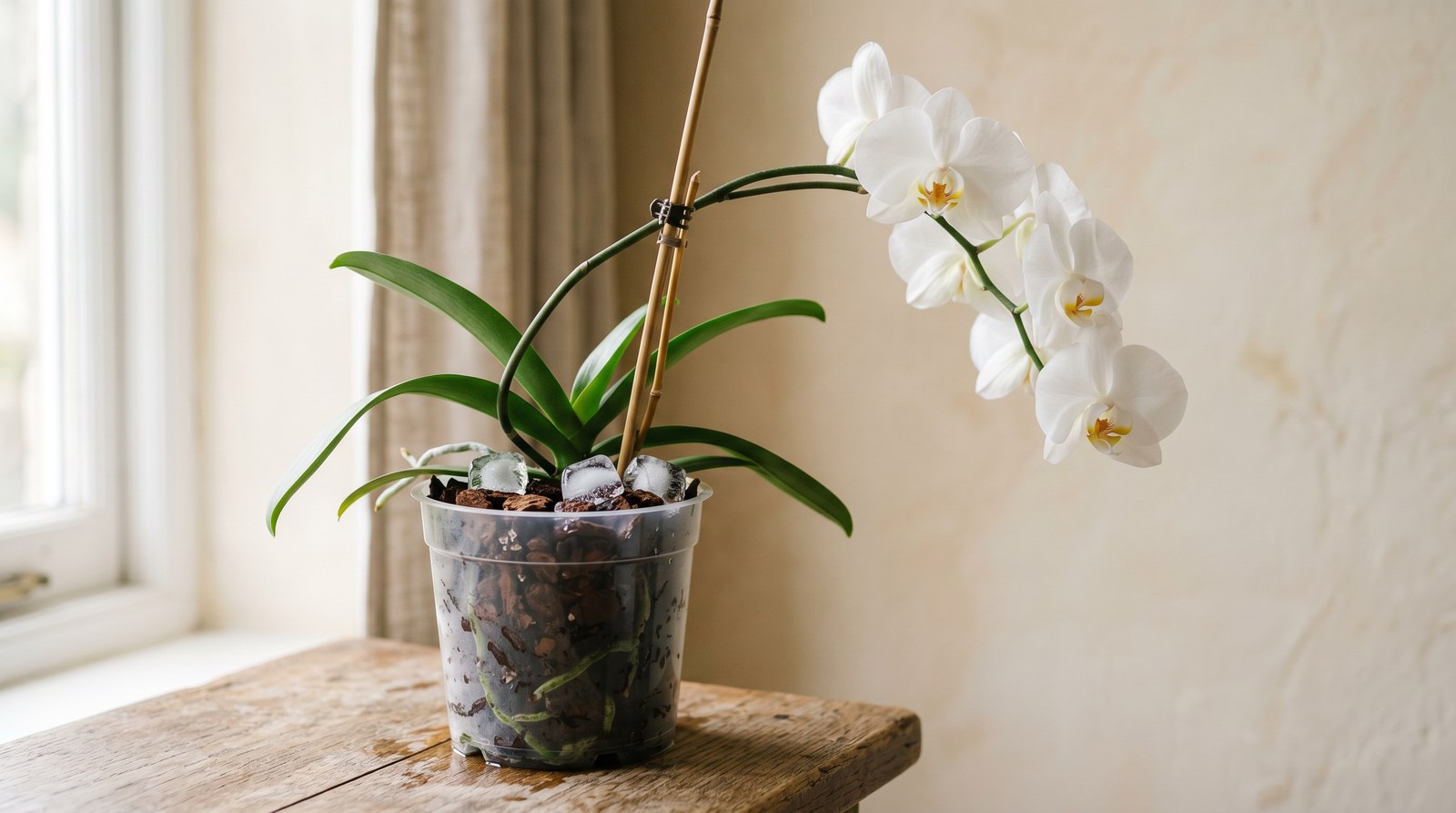
Drop three ice cubes on your orchid once a week and you'll never overwater it again. It's probably the most-printed piece of houseplant advice in America, right there on the sleeve at the grocery store. The logic is tidy: ice melts slowly, so the water trickles into the bark instead of running straight through, and you can't accidentally waterlog the plant on a rushed morning.
Where it comes from
The "just add ice" line traces to a single grower, Green Circle Growers in Ohio, who built a brand around it. Here's the uncomfortable part for anyone who has ever winced at the idea of icing a tropical plant. They donated the plants for a real study to test it, and the orchids came through in good shape.
What the research actually found
Researchers at Ohio State and the University of Georgia grew 48 Phalaenopsis at each site for four to six months. Half got three ice cubes a week. Half got the same volume of room-temperature water (South et al., 2017). The ice-watered plants matched the others on flower longevity, and on the measures you can't see too: chlorophyll, photosynthesis, and shoot mass all held steady.
The bark never got as cold as people fear. It bottomed out around 51 to 56°F (11 to 13°C) and was back to room temperature within about five hours, and isolated roots showed no cold injury until roughly 20°F (about -7°C), far colder than a melting cube on top of the bark ever takes them. So the scary version of this myth, that a few cubes shock a tropical plant into decline, doesn't hold up in a controlled test.
Why "it's complicated" and not "go ahead"
Two things keep this from being a clean green light.
First, the company selling the ice method supplied the orchids for the study that clears it. The money was public, state and federal funds through Ohio State's agricultural research center, and the journal disclosed the plant donation itself. That's a real tie, and it doesn't make the work wrong. The design was sound and it passed peer review. But it's essentially the only rigorous test on record, it ran a few months in greenhouse conditions, and independent replication is thin. One paper is worth reading with your eyes open.
Second, the catch is in the study's own fine print. The cubes go on the bark, never against a leaf or the crown, the central point where the leaves meet. Ice held against plant tissue really does cause cold injury, the collapsed cells and sunken spots you'd expect. The method passes its own test only when you follow the placement rule, which is exactly the rule a distracted person dropping cubes in a hurry tends to break. And the American Orchid Society, with no ice to sell, still lists cold among the things Phalaenopsis handle poorly (American Orchid Society, n.d.).
What to do instead
Nothing about ice beats the simplest method. Carry the plastic pot to the sink once a week, run room-temperature water through the bark for fifteen seconds, let it drain all the way, and pour out whatever collects in the decorative sleeve. That's the soak-and-drain the orchid wants, with no cube parked near the crown.
If the printed ice instructions are the thing that keeps you watering on schedule, the research says you aren't harming the plant, so keep the cubes on the bark and off the leaves. Just know you're following a convenience trick, not the ideal.
The verdict
It's complicated. The best study we have says ice cubes don't shorten an orchid's life, but that study came from the people who sell the method, and it only works when the cube never touches the plant. Room-temperature soak-and-drain is simpler and free of fine print. Use ice if it keeps you consistent. Just keep it on the bark.
South, K. A., Thomas, P. A., van Iersel, M. W., Young, C., & Jones, M. L. (2017). Ice cube irrigation of potted Phalaenopsis orchids in bark media does not decrease display life. HortScience, 52(9), 1271–1277. journals.ashs.org (Study used the "Just Add Ice" protocol. Publicly funded through the Ohio Agricultural Research and Development Center; orchids donated by Green Circle Growers, disclosed in the paper's acknowledgment.)
South, K. A., & Jones, M. L. (2018). Watering Phalaenopsis orchids with ice cubes. Ohio State University Greenhouse. u.osu.edu
American Orchid Society. (n.d.). Growing Phalaenopsis: what can go wrong? aos.org