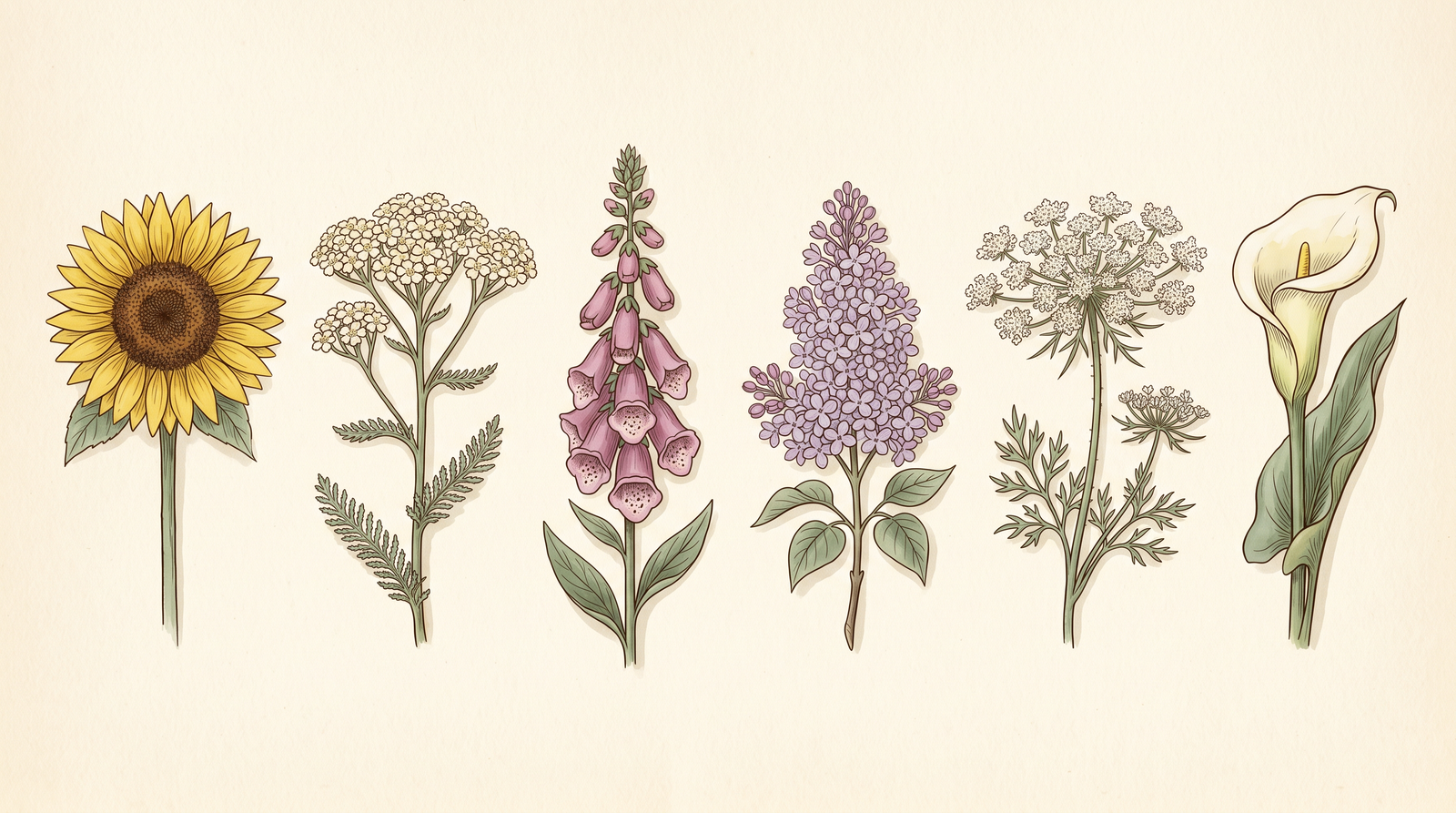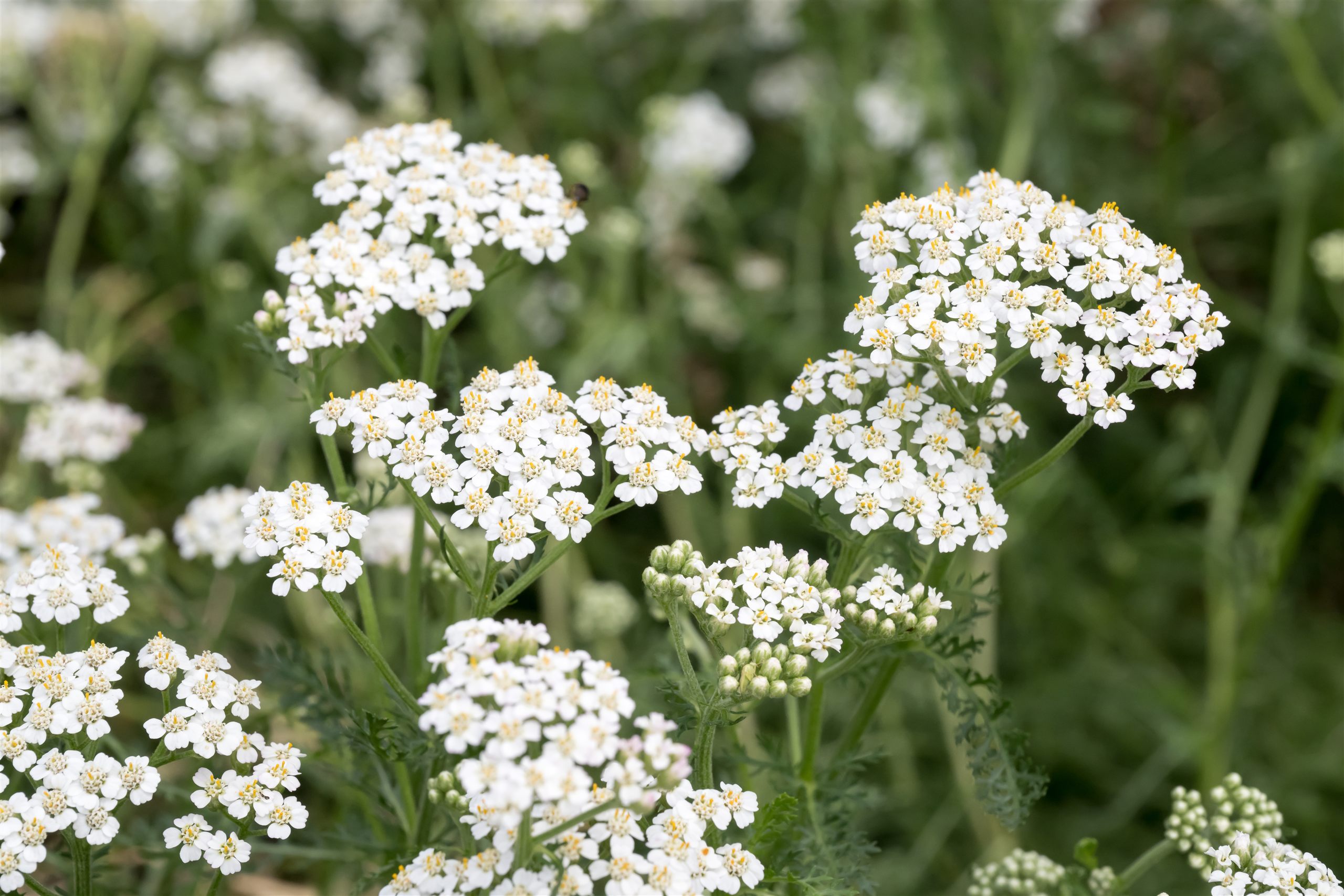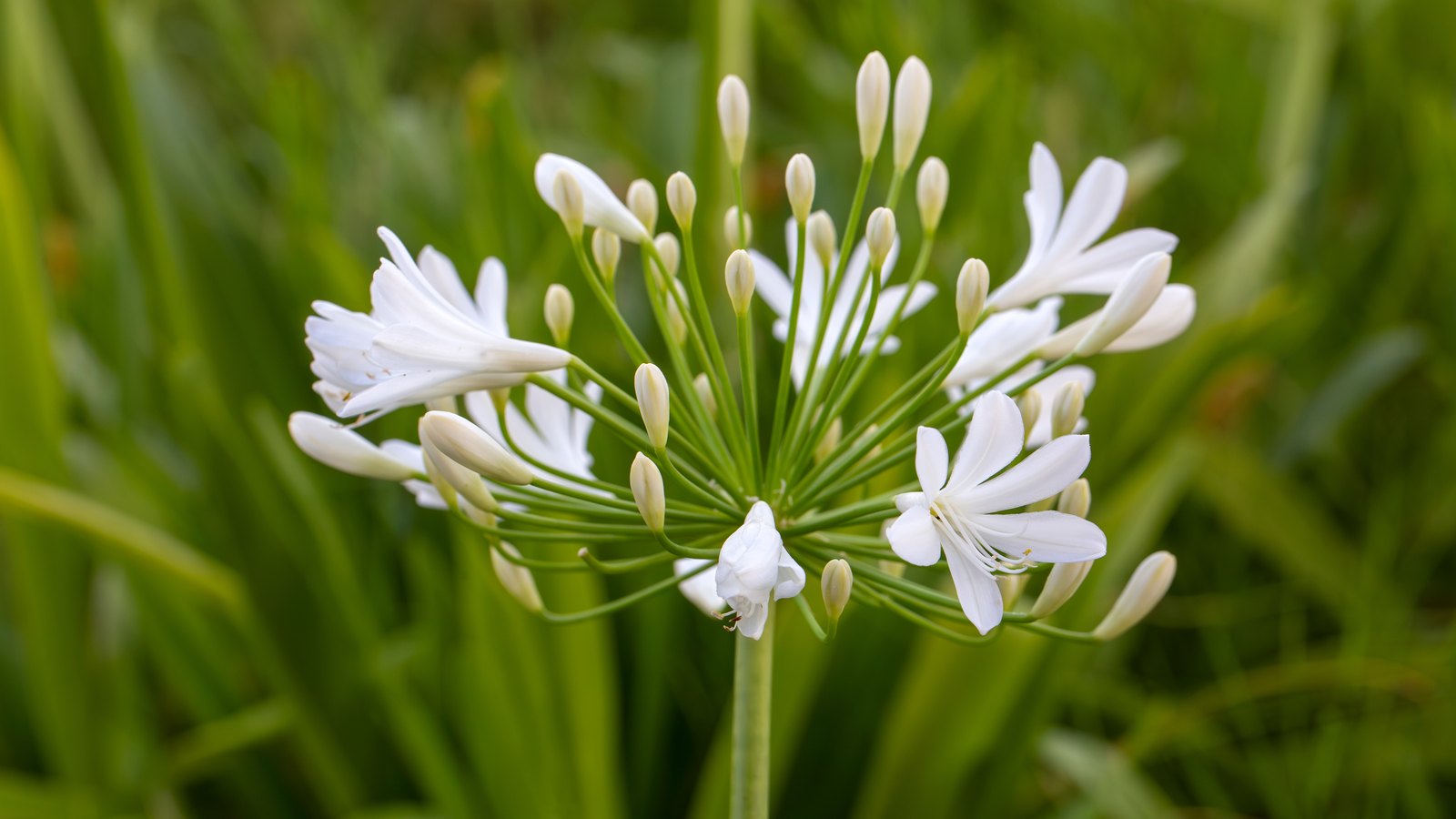
An umbel is the flower cluster where every stalk leaves the stem from the same point, so the flowers fan out like the ribs of an umbrella. Agapanthus is the one most gardeners already own, and it's the textbook picture of the shape. It also belongs to the family that includes the onions, and botanists who study how flower heads form have found that family's heads are umbels in shape only.
§ 01What counts as an umbel
An umbel is a flower cluster whose pedicels , the individual flower stalks, all arise from about the same point at the top of the stem. The result is a flat or rounded head of flowers (Merriam-Webster, n.d.-b). One old glossary definition, quoted in the Missouri Botanical Garden's dictionary of botanical Latin, puts it as a cluster of pedicels springing from one point "like the ribs of an umbrella" (Eckel, n.d.).
That umbrella is in the name. The Latin umbella is a diminutive of umbra, shade, so the word means something like a little shadow: a parasol or sunshade (Eckel, n.d.).
Botanists treat a true umbel as a relative of the raceme , the foxglove-style stem of stalked flowers we covered earlier in this series. Squeeze a raceme's main stem down until there's almost nothing left of it, keep the stalks long, and you get an umbel. Eckel describes it as a cluster that "may be seen as a highly condensed raceme," with a top that can be flat or domed (Eckel, n.d.).
The field test is the one the corymb entry set up. From across the garden, a corymb and an umbel can both read as a flat shelf of flowers. Get beside one and trace the stalks down. In a corymb they leave the stem at different heights and reach about the same height (Merriam-Webster, n.d.-a). In an umbel they all leave from the same spot.
§ 02Agapanthus, and the umbel that isn't
Agapanthus is the umbel most gardeners already have. The species vary, but they're broadly similar: strap-like leaves and an umbel-shaped flower head on a stalk held above them (Notten, 2004).
The plant in your border probably isn't the species gardeners often call it, though. Agapanthus africanus is a winter-rainfall species from South Africa's Western Cape. Writing for South Africa's National Biodiversity Institute (SANBI), Alice Notten notes that gardeners and even some authors "mistakenly call the agapanthus in cultivation A. africanus," a species she describes as difficult in cultivation. By her account, almost every evergreen agapanthus in cultivation is an A. praecox hybrid or named cultivar (Notten, 2004). Another SANBI profile goes further: it calls both subspecies of A. africanus difficult to grow, and the typical one, subsp. africanus, unsuitable as a garden plant except in rockeries (Jamieson, 2004).
In 2022, a team led by botanists at Cornell University traced how umbel-shaped flower heads actually form in a range of monocots, the plant group that includes onions, lilies and their relatives. They distinguish a true umbel, which in the botanical literature is built from a raceme, from an umbel-shaped head that only looks the part (Martínez-Gómez et al., 2022).
The family that includes the onions, Amaryllidaceae , is one of the look-alikes. We'll call it the onion family below. The 2022 paper places agapanthus in it, though SANBI still gives agapanthus a family of its own (Martínez-Gómez et al., 2022; Notten, 2004). Two terms help here. An indeterminate stem keeps the potential to grow at its tip. A cyme is the opposite, a determinate cluster (Eckel, n.d.). Summarizing earlier developmental studies of the onion family, the authors write that its head is an indeterminate main stem carrying cymes as side branches. Their conclusion is that the family's head "is not a true umbel" but a case of convergent evolution, a different starting structure arriving at the same shape (Martínez-Gómez et al., 2022). Their own work on a wild onion, Allium triquetrum , fits that pattern, and they found at least three separate routes by which monocots have evolved umbel-shaped heads (Martínez-Gómez et al., 2022).
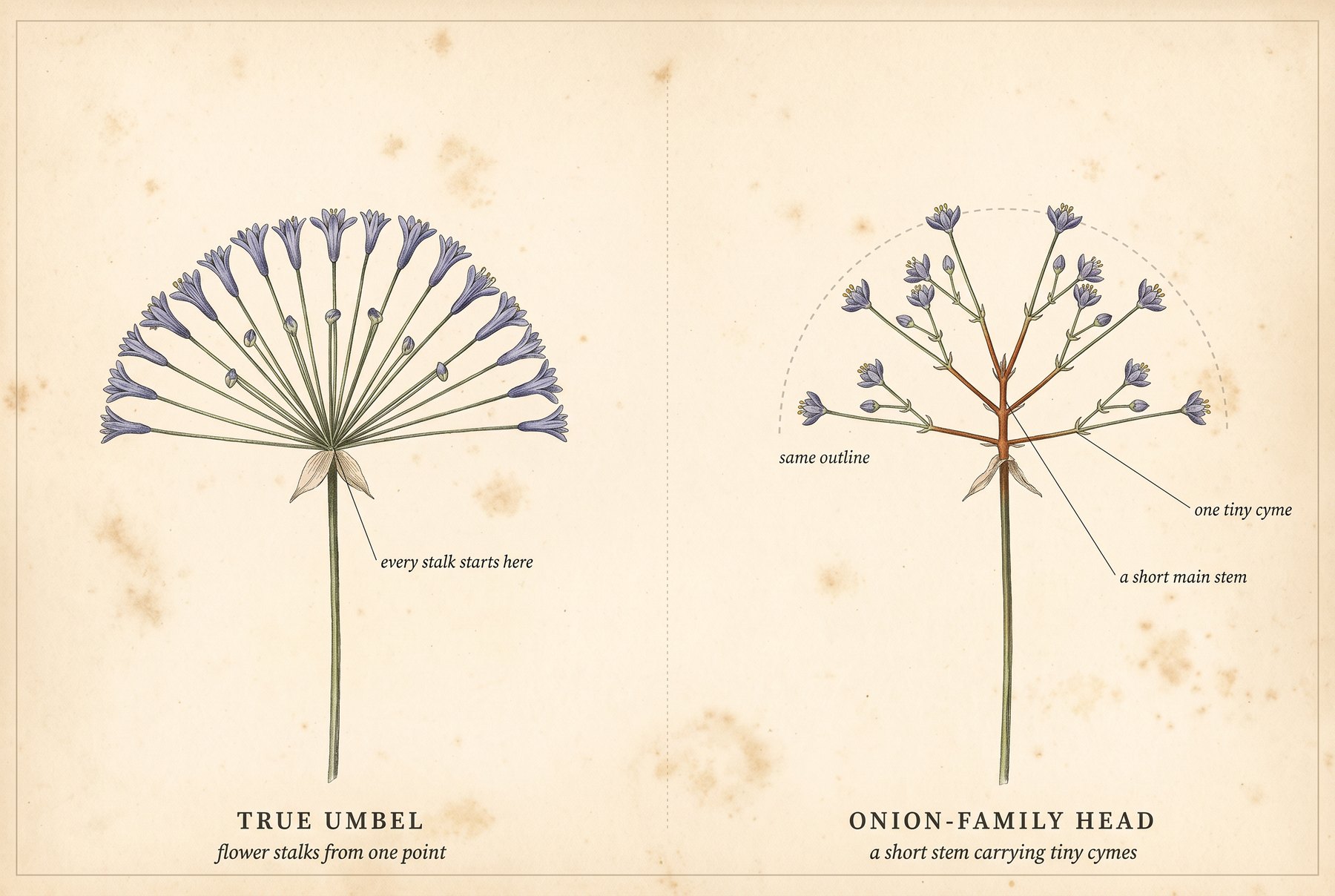
Agapanthus is less settled. The same paper places Agapanthus in the onion family and describes its typical head as similar to others in the family (Martínez-Gómez et al., 2022). It did not trace agapanthus development itself. Among the earlier studies it draws on is one on agapanthus flowers, which isn't openly available, so we couldn't read it. So the fair reading is that agapanthus very likely shares the family's build, an umbel in shape rather than in construction. Even its family has been argued over: Notten (2004) records the genus moving between families several times, and suggests the arguments turned partly on how much weight to give its umbel-shaped head.
None of this changes what you see. The flowers still fan out from one point at the top of the stalk. What it changes is the label: when a reference book calls an onion an umbel, and very likely an agapanthus too, it's describing the shape. How the head is built is a separate question.
§ 03Umbels in a California garden
The onion family gives you a test you can run on any flowering allium. The Flora of North America (FNA) describes the genus as flowering centripetally, meaning the outer flowers of the head open first and the bloom moves toward the center. Chives, Allium schoenoprasum , are the listed exception: they flower centrifugally, from the center outward (FNA, n.d.-a). Plant both and watch a head open.
California has its own umbel-shaped natives. One of the state's wild onions, Allium unifolium , carries a loose, hemispheric head of 15 to 35 flowers (FNA, n.d.-b). FNA describes both Brodiaea and Triteleia as having open, umbel-shaped heads (FNA, n.d.-d, n.d.-i). Triteleia grows across the West, with its greatest diversity in northwestern California and southern Oregon (FNA, n.d.-i). Their cousin Dichelostemma can go either way, with heads FNA describes as umbel-shaped or racemose, laid out like a raceme along a stem (FNA, n.d.-e).
In the 2022 developmental study, two of the three brodiaea relatives examined, Triteleia laxa and a garden Dichelostemma hybrid, came out built like the onions (Martínez-Gómez et al., 2022). The third, ookow (Dichelostemma congestum), came out built on a raceme instead (Martínez-Gómez et al., 2022), and FNA describes its flower cluster as racemose (FNA, n.d.-f).
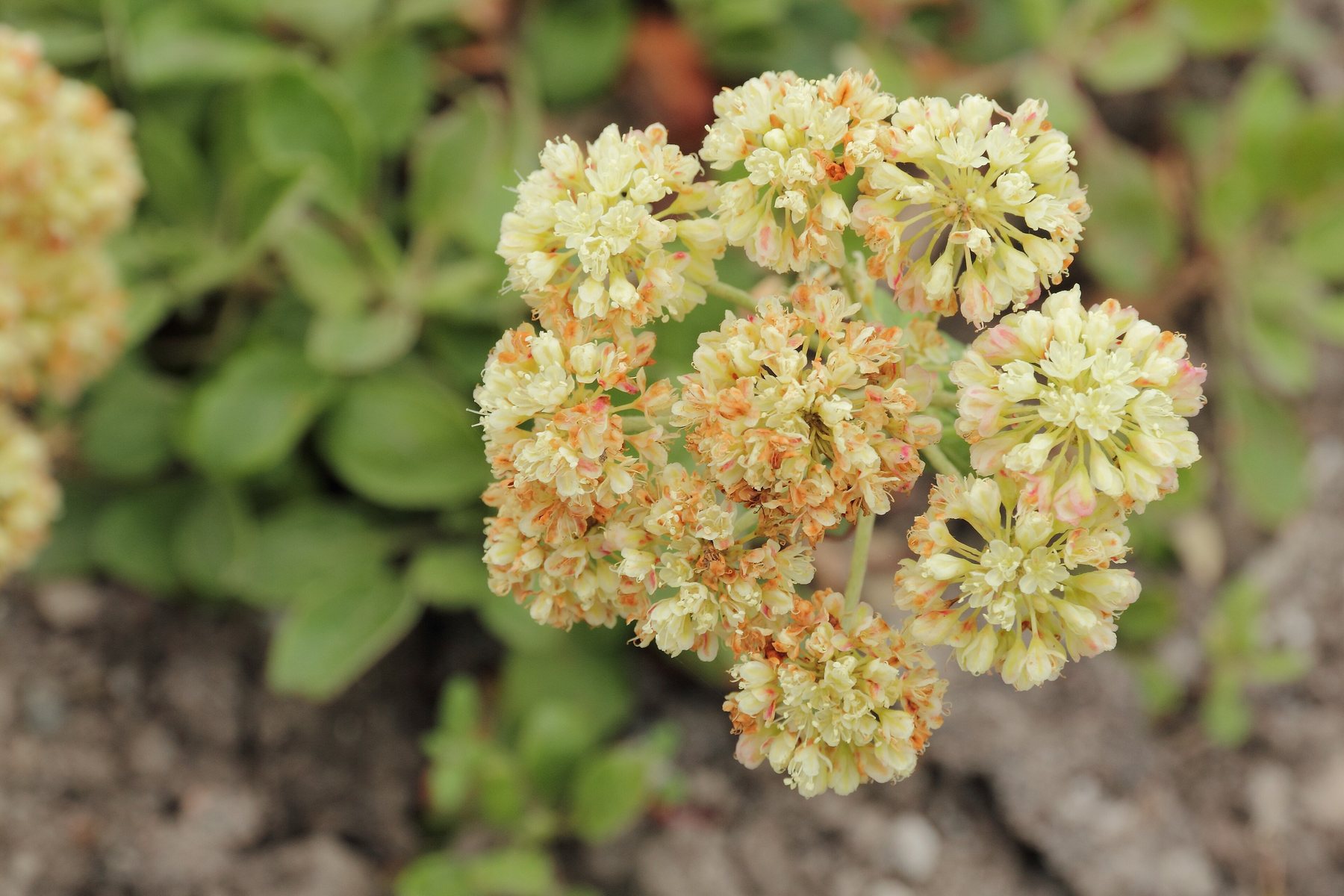
The buckwheats split. FNA describes California buckwheat, Eriogonum fasciculatum , as having cymose flower clusters, only infrequently umbel-shaped (FNA, n.d.-g). The umbel among them is sulphur flower, Eriogonum umbellatum , whose clusters FNA describes as umbellate or compound-umbellate, an umbel of smaller umbels (FNA, n.d.-h).
Milkweeds are another case of shape over construction. FNA calls their flower clusters "umbelliform," umbel-shaped (FNA, n.d.-c). The Flora of China is more direct and describes them as cymes that are "umbel-like" (Flora of China, n.d.-a). Ivy goes the other way: the Flora of China describes the flowers of ivy, Hedera , as carried in umbels, usually several of them arranged along a short terminal stem (Flora of China, n.d.-b).
§ 04The bottom line
An umbel is a cluster whose flower stalks all leave the stem from one point, giving a flat or rounded head. Confirm it by tracing the stalks down, because that's what separates it from a corymb.
Photo credits: the hero (agapanthus) is licensed from Adobe Stock, cropped from the original. Sulphur flower © C T Johansson, CC BY-SA 3.0, via Wikimedia Commons, cropped. The comparison figure is an original illustration by The Planters' Guild.
Eckel, P. M. (n.d.). Umbel. In A grammatical dictionary of botanical Latin. Missouri Botanical Garden. Retrieved October 15, 2026, from https://www.mobot.org/mobot/latindict/keyDetail.aspx?keyWord=umbel
Flora of China Editorial Committee. (n.d.-a). Asclepias. In Flora of China (Vol. 16). Retrieved October 15, 2026, from http://www.efloras.org/florataxon.aspx?flora_id=2&taxon_id=102770
Flora of China Editorial Committee. (n.d.-b). Hedera. In Flora of China (Vol. 13). Retrieved October 15, 2026, from http://www.efloras.org/florataxon.aspx?flora_id=2&taxon_id=114808
Flora of North America Editorial Committee. (n.d.-a). Allium. In Flora of North America north of Mexico (Vol. 26). Retrieved October 15, 2026, from http://www.efloras.org/florataxon.aspx?flora_id=1&taxon_id=101086
Flora of North America Editorial Committee. (n.d.-b). Allium unifolium. In Flora of North America north of Mexico (Vol. 26). Retrieved October 15, 2026, from http://www.efloras.org/florataxon.aspx?flora_id=1&taxon_id=242101413
Flora of North America Editorial Committee. (n.d.-c). Asclepias. In Flora of North America north of Mexico (Vol. 14). Retrieved October 15, 2026, from http://www.efloras.org/florataxon.aspx?flora_id=1&taxon_id=102770
Flora of North America Editorial Committee. (n.d.-d). Brodiaea. In Flora of North America north of Mexico (Vol. 26). Retrieved October 15, 2026, from http://www.efloras.org/florataxon.aspx?flora_id=1&taxon_id=104654
Flora of North America Editorial Committee. (n.d.-e). Dichelostemma. In Flora of North America north of Mexico (Vol. 26). Retrieved October 15, 2026, from http://www.efloras.org/florataxon.aspx?flora_id=1&taxon_id=109895
Flora of North America Editorial Committee. (n.d.-f). Dichelostemma congestum. In Flora of North America north of Mexico (Vol. 26). Retrieved October 15, 2026, from http://www.efloras.org/florataxon.aspx?flora_id=1&taxon_id=220004030
Flora of North America Editorial Committee. (n.d.-g). Eriogonum fasciculatum. In Flora of North America north of Mexico (Vol. 5). Retrieved October 15, 2026, from http://www.efloras.org/florataxon.aspx?flora_id=1&taxon_id=250060281
Flora of North America Editorial Committee. (n.d.-h). Eriogonum umbellatum. In Flora of North America north of Mexico (Vol. 5). Retrieved October 15, 2026, from http://www.efloras.org/florataxon.aspx?flora_id=1&taxon_id=250060536
Flora of North America Editorial Committee. (n.d.-i). Triteleia. In Flora of North America north of Mexico (Vol. 26). Retrieved October 15, 2026, from http://www.efloras.org/florataxon.aspx?flora_id=1&taxon_id=133818
Jamieson, R. (2004). Agapanthus africanus. PlantZAfrica, South African National Biodiversity Institute. https://pza.sanbi.org/agapanthus-africanus
Martínez-Gómez, J., Atluri, T. A. M., Rose, I. J., Holliday, A. J., Strock, C. F., Lynch, J. P., Miller, W. B., Stevenson, D. Wm., & Specht, C. D. (2022). Developmental morphology and anatomy shed light on both parallel and convergent evolution of the umbellate inflorescence in monocots, underlain by a new variant of metatopy. Frontiers in Plant Science, 13, 873505. https://doi.org/10.3389/fpls.2022.873505
Merriam-Webster. (n.d.-a). Corymb. In Merriam-Webster.com dictionary. Retrieved October 15, 2026, from https://www.merriam-webster.com/dictionary/corymb
Merriam-Webster. (n.d.-b). Umbel. In Merriam-Webster.com dictionary. Retrieved October 15, 2026, from https://www.merriam-webster.com/dictionary/umbel
Notten, A. (2004). Agapanthus praecox. PlantZAfrica, South African National Biodiversity Institute. https://pza.sanbi.org/agapanthus-praecox