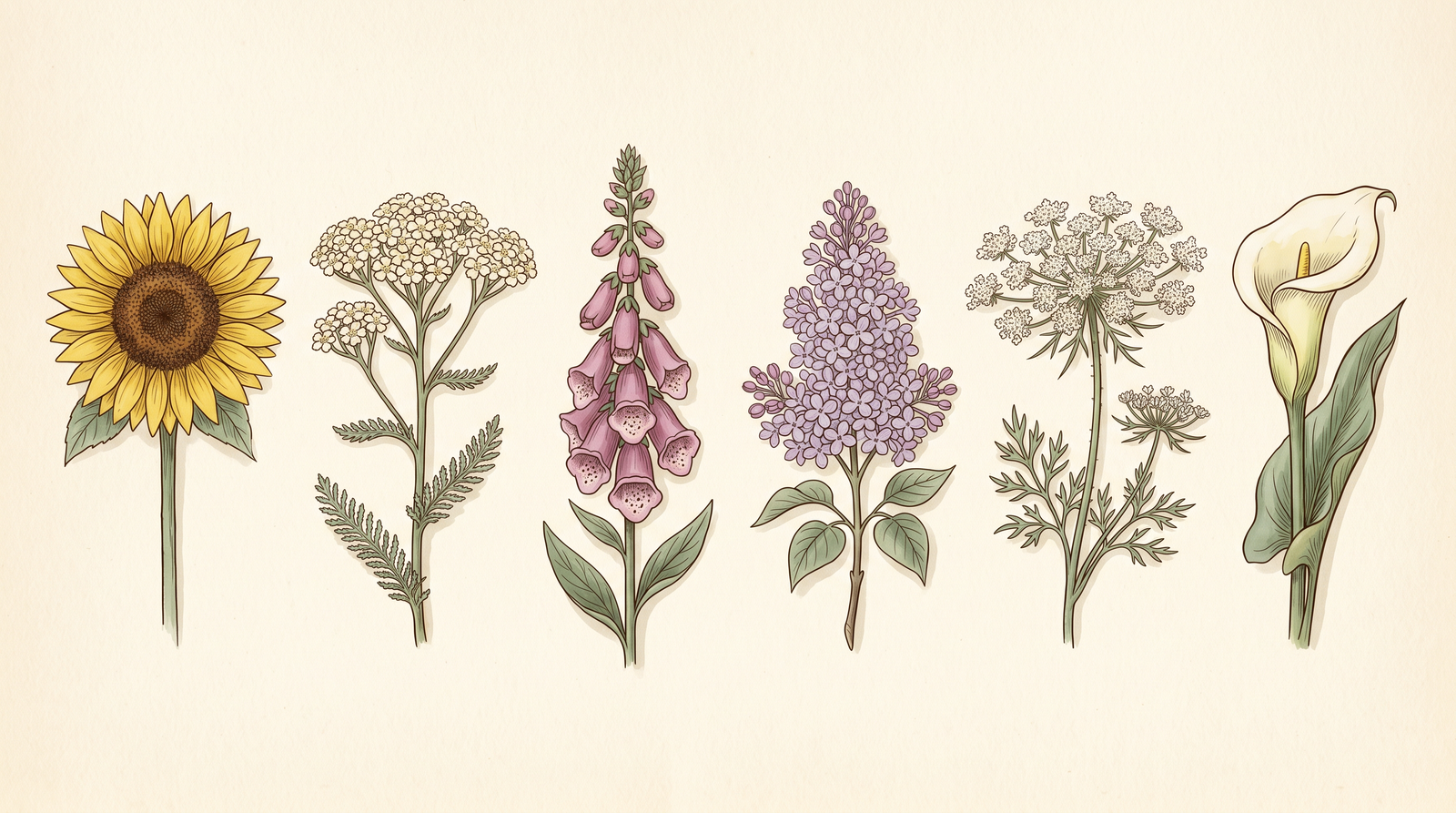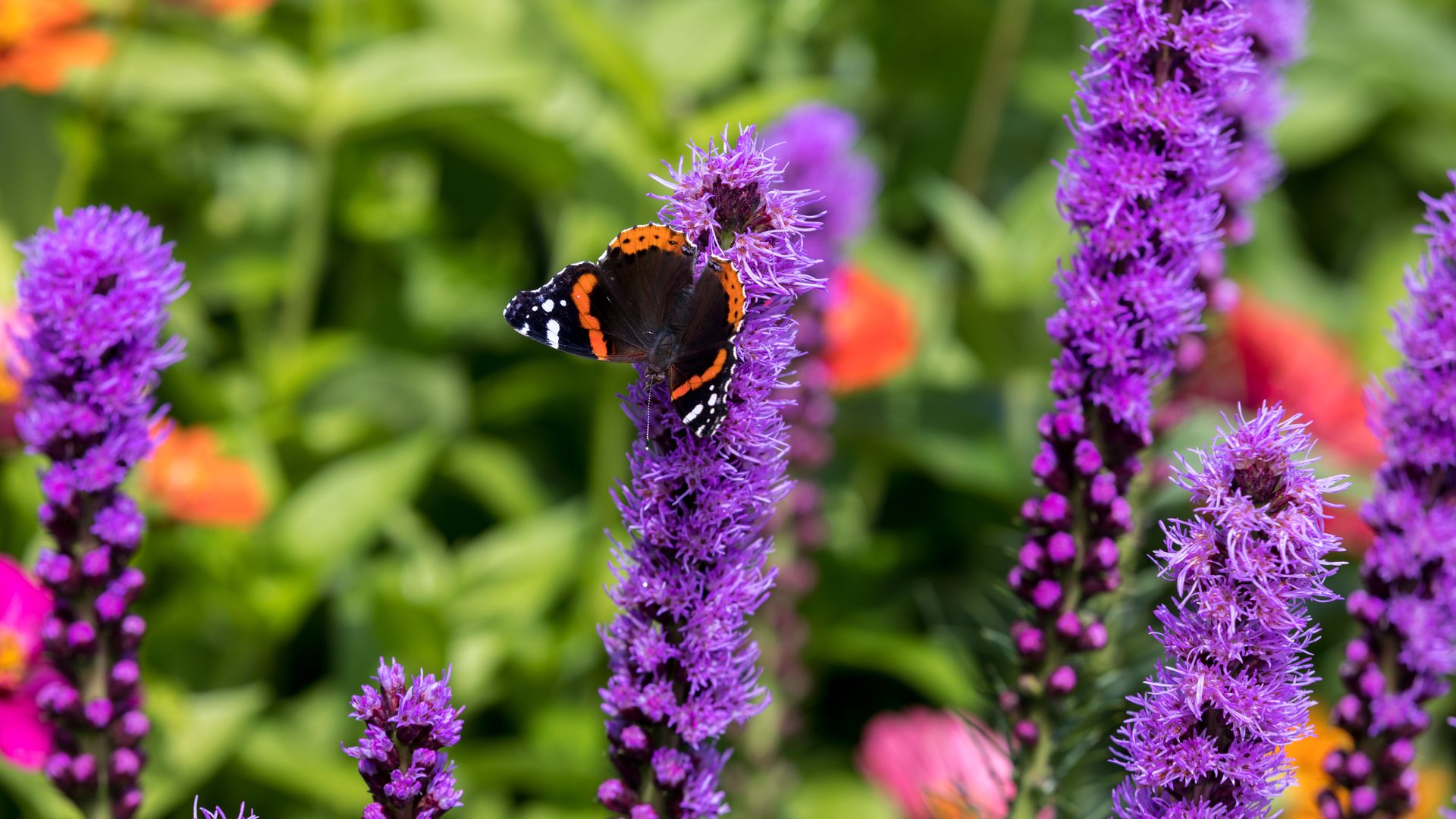
A raceme is a spike that grew stalks. Same upright stem, same flowers running up it, but this time every flower stands out on its own short arm. That one addition, the pedicel, is half the definition. The other half matters more: a raceme keeps growing at the top while it blooms at the bottom, so it's never quite finished. Its most famous example, the common foxglove, turns that open-ended habit into a season-long arrangement with one particular bee.
§ 01What actually counts as a raceme
A raceme is an unbranched stem with flowers running up it, and every flower stands on its own short stalk (Weberling, 1989). That stalk is the pedicel , and it's the single part that separates a raceme from the spike in the last entry. On a spike the flowers press flat against the stem; on a raceme each one is held out on its own little arm. Foxglove, lupine, and snapdragon all pass the test. Look for the stalk under the flower. If it's there, you're holding a raceme.
The raceme carries a second idea, though, and it's the one worth keeping. A raceme is indeterminate, meaning the tip of the stem never turns into a flower and stops. It stays a growing point, adding buds and height for as long as the season allows, opening its oldest flowers at the base and its youngest near the top (Simpson, 2010). That upward, oldest-to-youngest sequence has a name of its own, acropetal , and once you catch it you'll see it on half the flower stems you walk past.
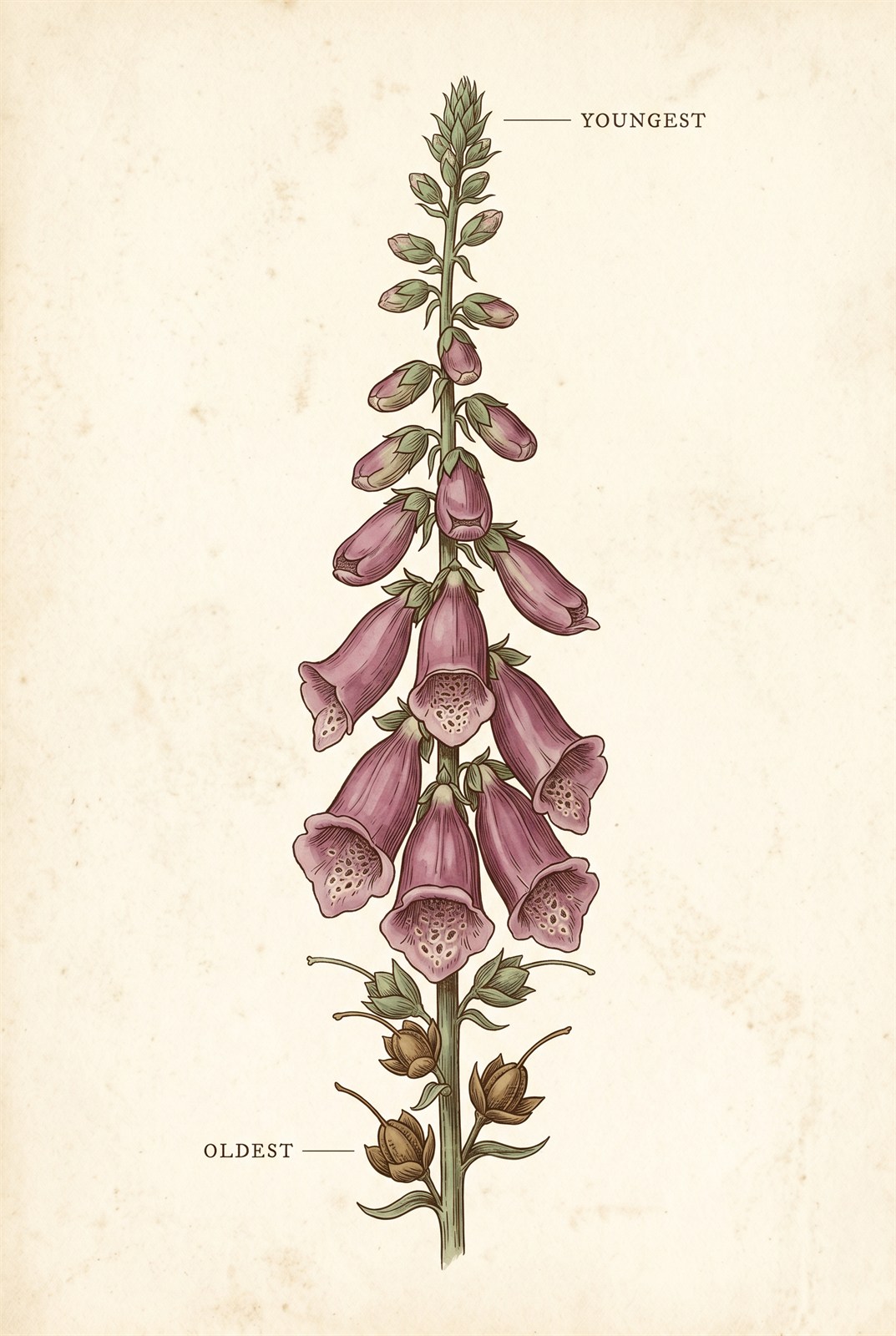
That habit matters more than it sounds. Later in this pillar you'll meet the opposite build, where the top flower opens first and caps the stem for good, and the plant commits to a fixed size. The raceme is your first look at that fork: a stem that keeps its options open against one that closes them. Foxglove never caps itself, so it flowers all summer.
§ 02The plant that reads the season
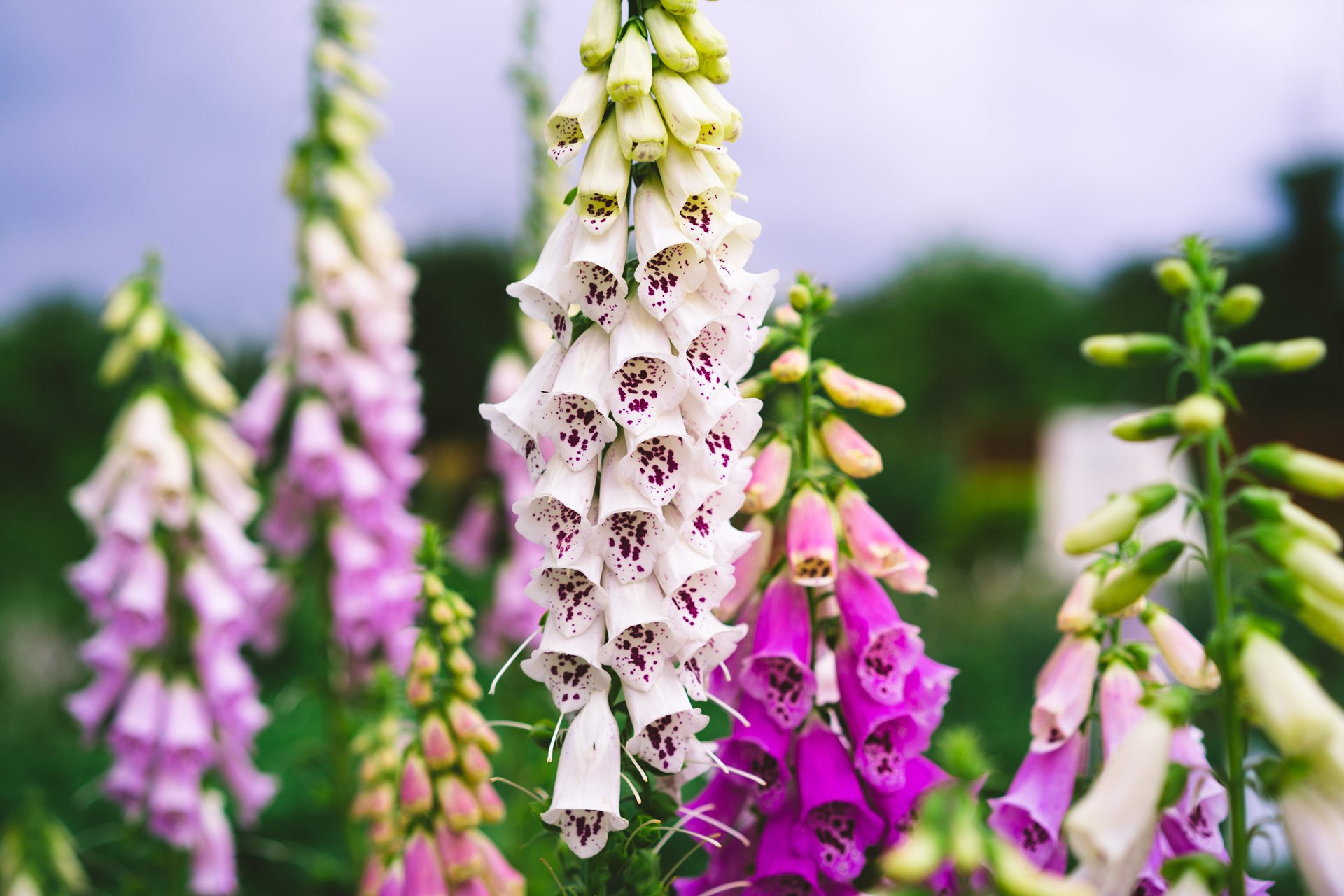
If one plant earns the raceme its place in the pillar, it's the common foxglove, Digitalis purpurea . A first-year foxglove is nothing but a low rosette of leaves. In its second summer it sends up a single raceme, sometimes four feet (1.2 m) of it, and starts opening flowers from the bottom (Best & Bierzychudek, 1982).
The bloom order is doing real work. Foxglove is protandrous, meaning each flower spends its first days in a male phase shedding pollen, then switches to a female phase with a receptive stigma. Because the stem opens bottom to top, the lowest flowers are oldest and already female while the fresh ones up top are still male. A bumblebee lands low, works its way up, and carries pollen from one plant's upper male flowers to the next plant's lower female ones. The layout quietly pushes foxglove toward crossing with its neighbors instead of pollinating itself (Best & Bierzychudek, 1982).
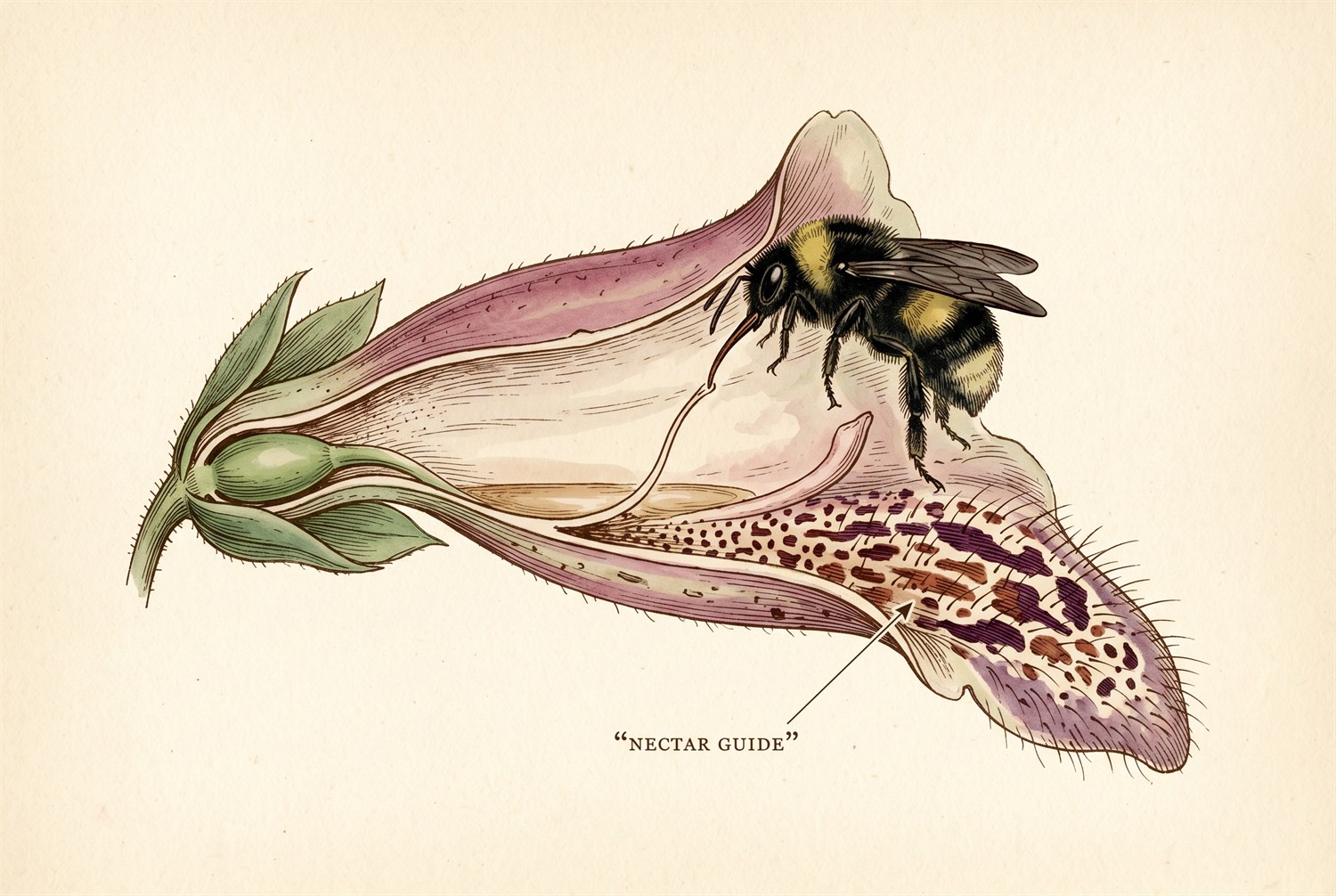
The bee is specific. A foxglove flower is a long tube with a landing lip, and the pollinator doing most of the work in studied populations is the long-tongued garden bumblebee, Bombus hortorum , one of the few visitors that can reach the nectar pooled at the base (Broadbent & Bourke, 2012). Those speckles on the lower lip aren't decoration. They act as a nectar guide, a set of marks that points the bee at the opening, and bumblebees stay the flower's main visitors across its range (Lozada-Gobilard et al., 2026).
§ 03The raceme in your own garden
You don't need foxglove to grow the form. Lupine, snapdragon, delphinium, stock, and grape hyacinth are all racemes, and every one of them blooms bottom to top. That single fact changes how you tend them. A raceme is never fully in bloom at once, so you deadhead from the base, pulling spent lower flowers while the top is still opening, and the stem keeps performing for weeks. Cut one for a vase when the lowest few flowers are open and the rest follow indoors, the same trick the spike entry handed you for gladiolus.
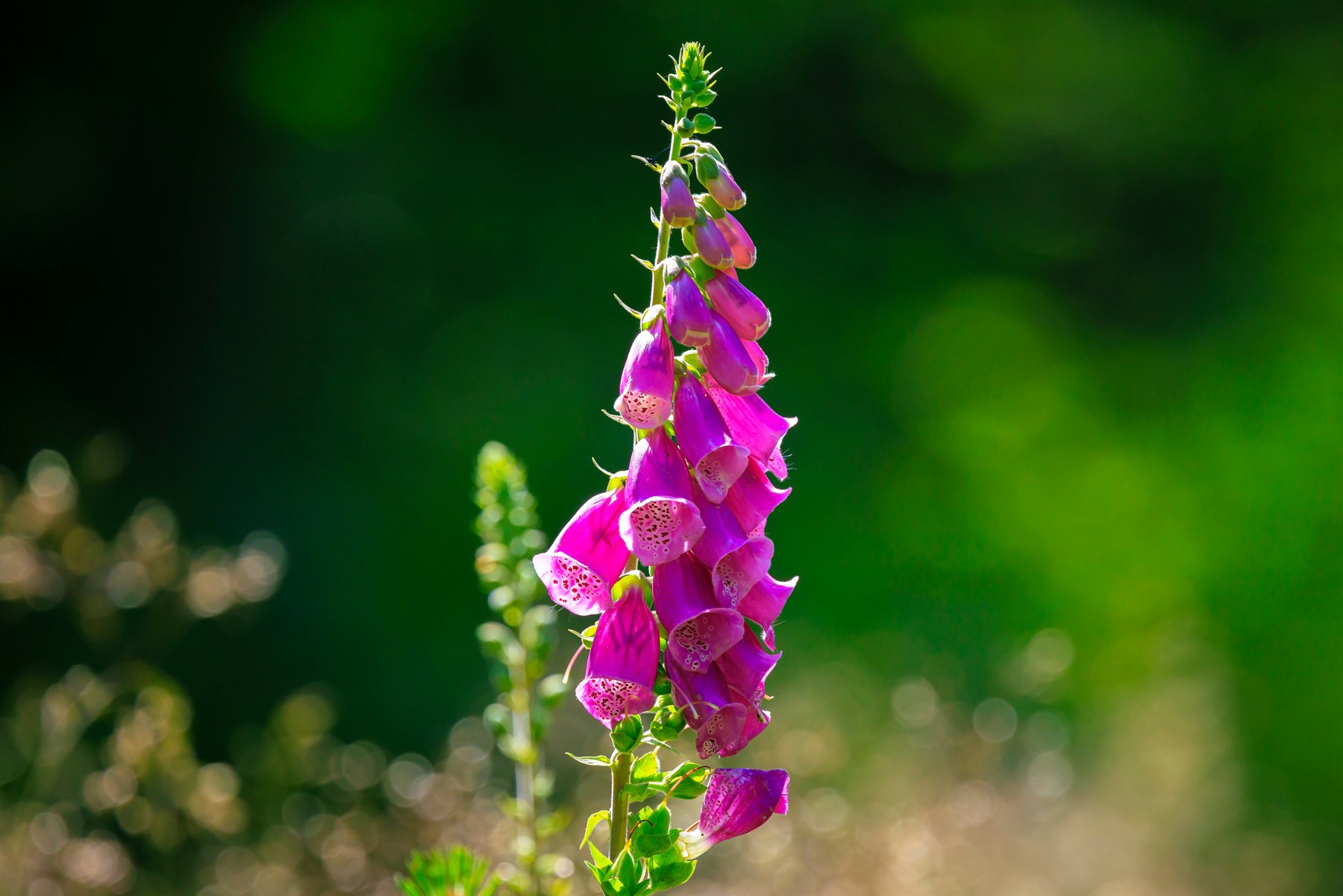
The indeterminate habit has a catch worth knowing. Because the tip keeps stretching, a tall raceme gets top-heavy and leans, so foxglove and delphinium usually want a stake in before they flop. And one caution with foxglove in particular: every part of the plant is toxic if eaten. It's also the plant medicine leaned on for two centuries of heart drugs, since the genus Digitalis is the source of the cardiac glycosides (compounds that act on the heart muscle) like digoxin , still prescribed today and still risky in the wrong dose (Patel, 2024). Grow it, enjoy it, keep it off the plate, and wash your hands after cutting.
§ 04The bottom line
A raceme is a spike with stalks: an unbranched, indeterminate inflorescence of pedicelled flowers, opening oldest-first from the bottom up. Read the bloom order and you already know when to cut it, how to deadhead it, and roughly how long it'll keep going.
Next form: the panicle, which is a raceme that branches, racemes hung on racemes, and the reason so many summer flower heads look like one thing and turn out to be a thousand.
Best, L. S., & Bierzychudek, P. (1982). Pollinator foraging on foxglove (Digitalis purpurea): A test of a new model. Evolution, 36(1), 70–79. https://doi.org/10.1111/j.1558-5646.1982.tb05011.x
Broadbent, A. A. D., & Bourke, A. F. G. (2012). The bumblebee Bombus hortorum is the main pollinating visitor to Digitalis purpurea (Common Foxglove) in a U.K. population. Journal of Pollination Ecology, 8(7), 48–51. https://pollinationecology.org/index.php/jpe/article/view/149
Lozada-Gobilard, S., Espinoza Peñaloza, P., Pascucci, G., Aliwi, Z., Larsson, E., Brydegaard, M., & Opedal, Ø. H. (2026). Flower color variation in Digitalis purpurea: Pollination and soil influences across native and introduced populations. American Journal of Botany, 113(4), e70186. https://doi.org/10.1002/ajb2.70186
Patel, A. (2024). A comprehensive review on unveiling the journey of digoxin: Past, present, and future perspectives. Cureus, 16(3), e56755. https://doi.org/10.7759/cureus.56755
Simpson, M. G. (2010). Plant systematics (2nd ed.). Academic Press.
Weberling, F. (1989). Morphology of flowers and inflorescences. Cambridge University Press.