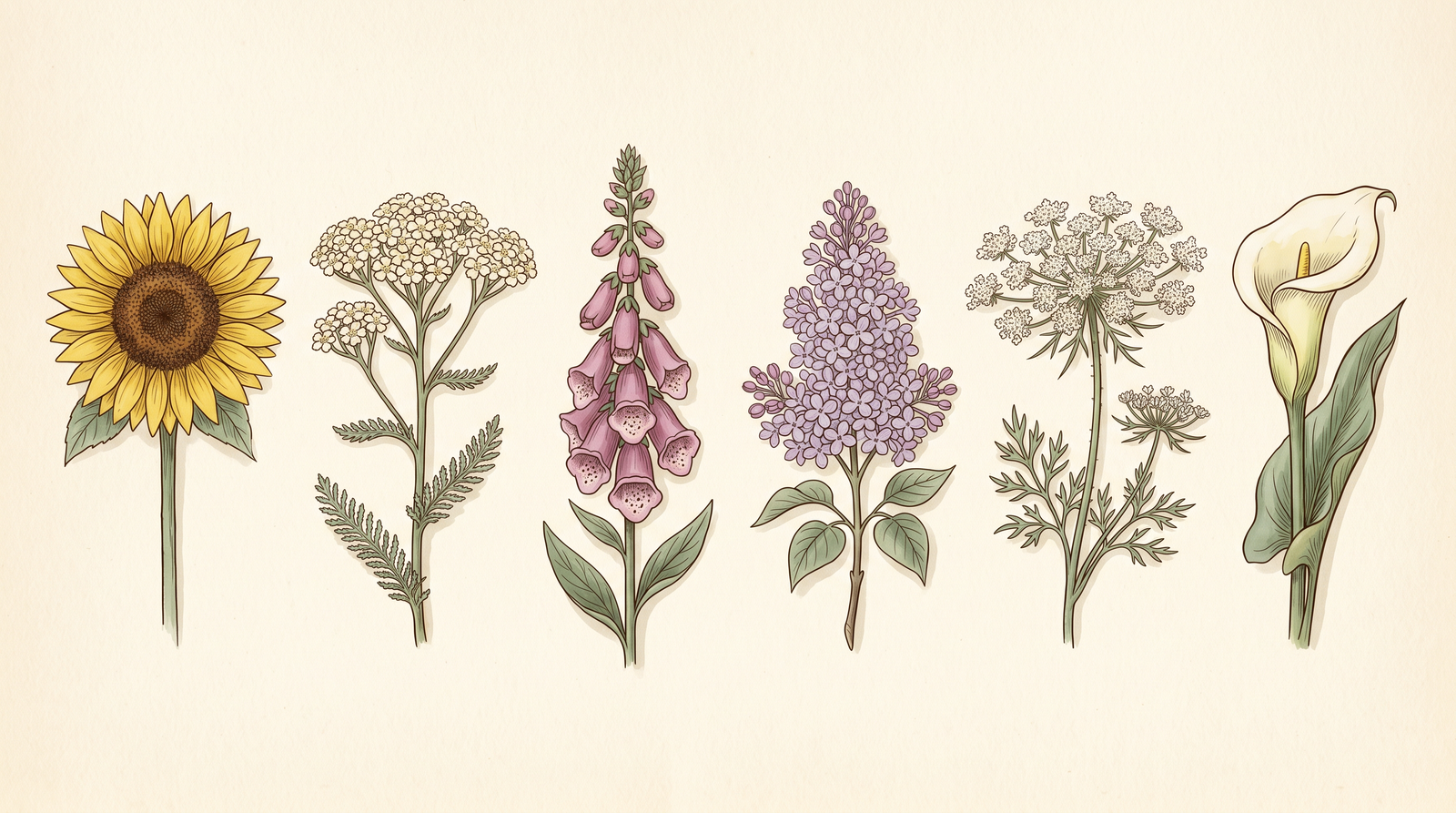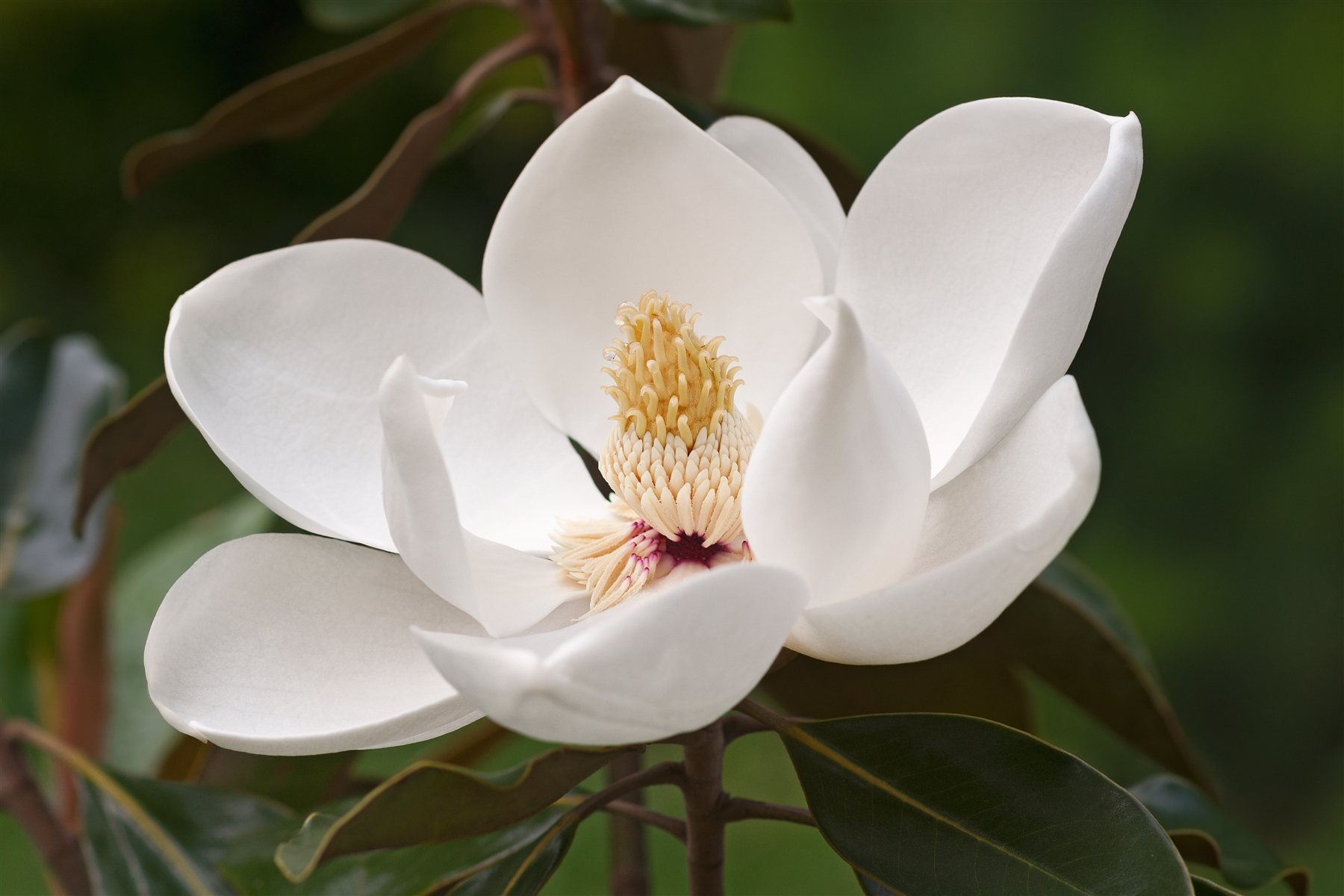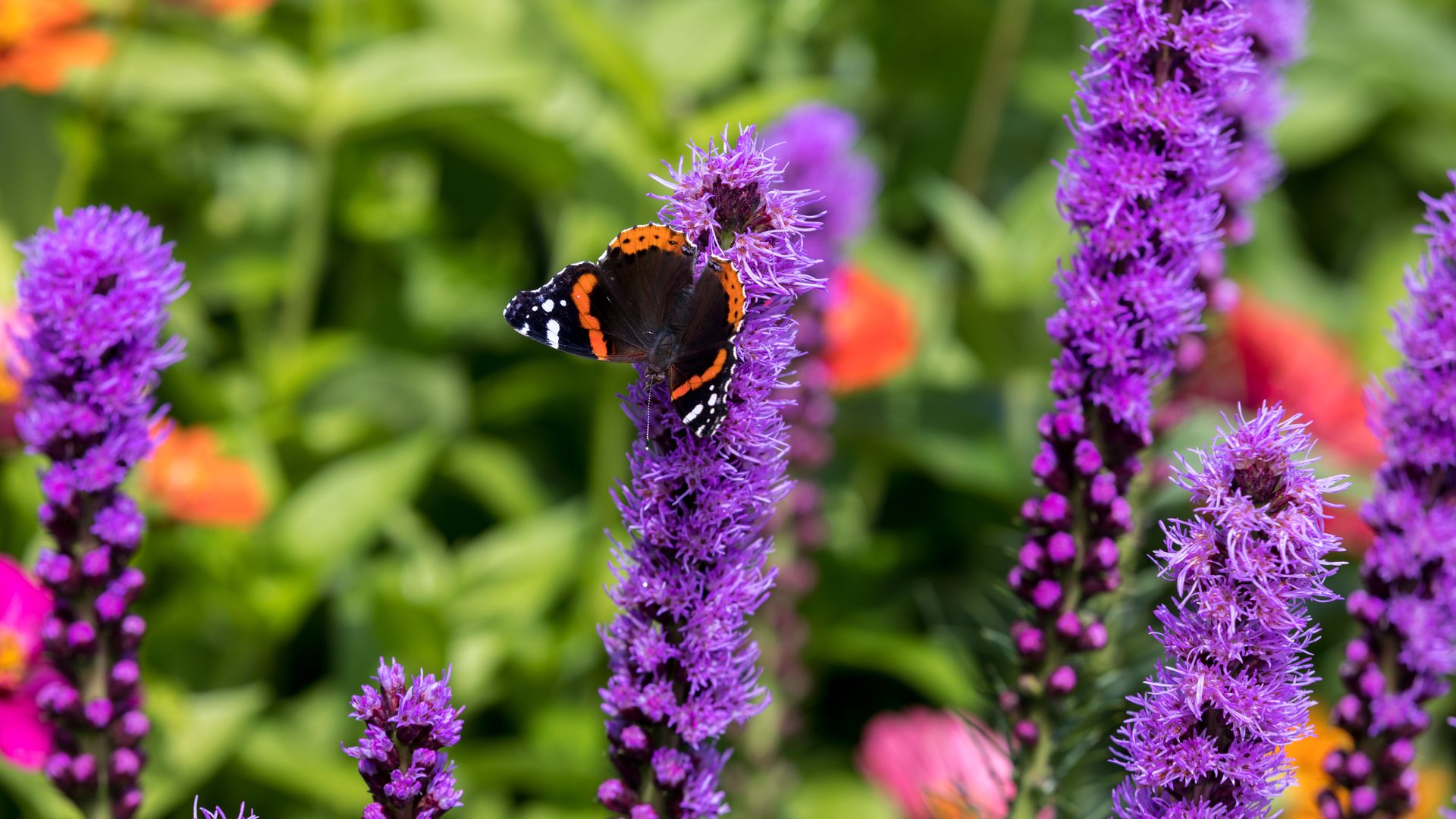
A spike is the form most people picture when they hear the word inflorescence: a single upright stem with flowers running up it, no branches, no stalks. It looks simple, and the definition is. But the spike hides one of the tidiest pollination tricks in the garden, and the plant on the cover of this entry breaks the rule the rest of them follow. Learn the spike and you also learn the question that runs underneath this whole pillar: the shape is never just a shape. It's a strategy.
§ 01What actually counts as a spike
A spike is an unbranched stem with flowers attached directly along it, no individual stalks underneath them (Weberling, 1989). The botanical word for "no stalk" is sessile , and it's the entire definition. The main stem is the rachis ; the flowers sit right on it, oldest near the base, youngest at the tip.
That sounds a lot like the next form in this pillar, the raceme , and it should. The two are nearly identical, and they differ by exactly one part. In a raceme, every flower stands on its own little stalk, called a pedicel . In a spike, that stalk is gone and the flower is pressed flat against the stem (Simpson, 2010). Plantain weeds, blazing star, and a wheat head are spikes. Foxglove, lupine, and snapdragon are racemes. The whole distinction comes down to whether you can see a tiny stalk under each flower.
It's a fussy little difference, but it pays off fast. Once you can spot a missing pedicel, half the upright flower stems you walk past sort themselves into two bins, and you've started reading flowers instead of just looking at them.
§ 02The rule-breaker: blazing star
Most spikes open from the bottom up, and there's a reason worth knowing. When a vertical stem flowers from the base first, its oldest flowers sit low and its youngest sit high. In a lot of these plants the lower flowers have already switched to their female stage while the upper ones are still shedding pollen. Bees tend to land low on a flower stem and work their way up, so they arrive carrying pollen from the last plant, brush it onto the receptive lower flowers, collect fresh pollen up top, and fly off to do it again. The layout quietly pushes the plant toward crossing with its neighbors instead of itself, and across hundreds of species this bottom-up, bee-friendly pattern turns up far more often than chance would predict (Strelin et al., 2023).
Blazing star, or Liatris , didn't get the memo. It blooms from the top down, the uppermost flowers opening first and the wave moving toward the base, which is unusual enough that botanists flag it by name (Hind, 2023). Stand a stalk of blazing star next to a gladiolus in the same vase and they'll be opening in opposite directions.
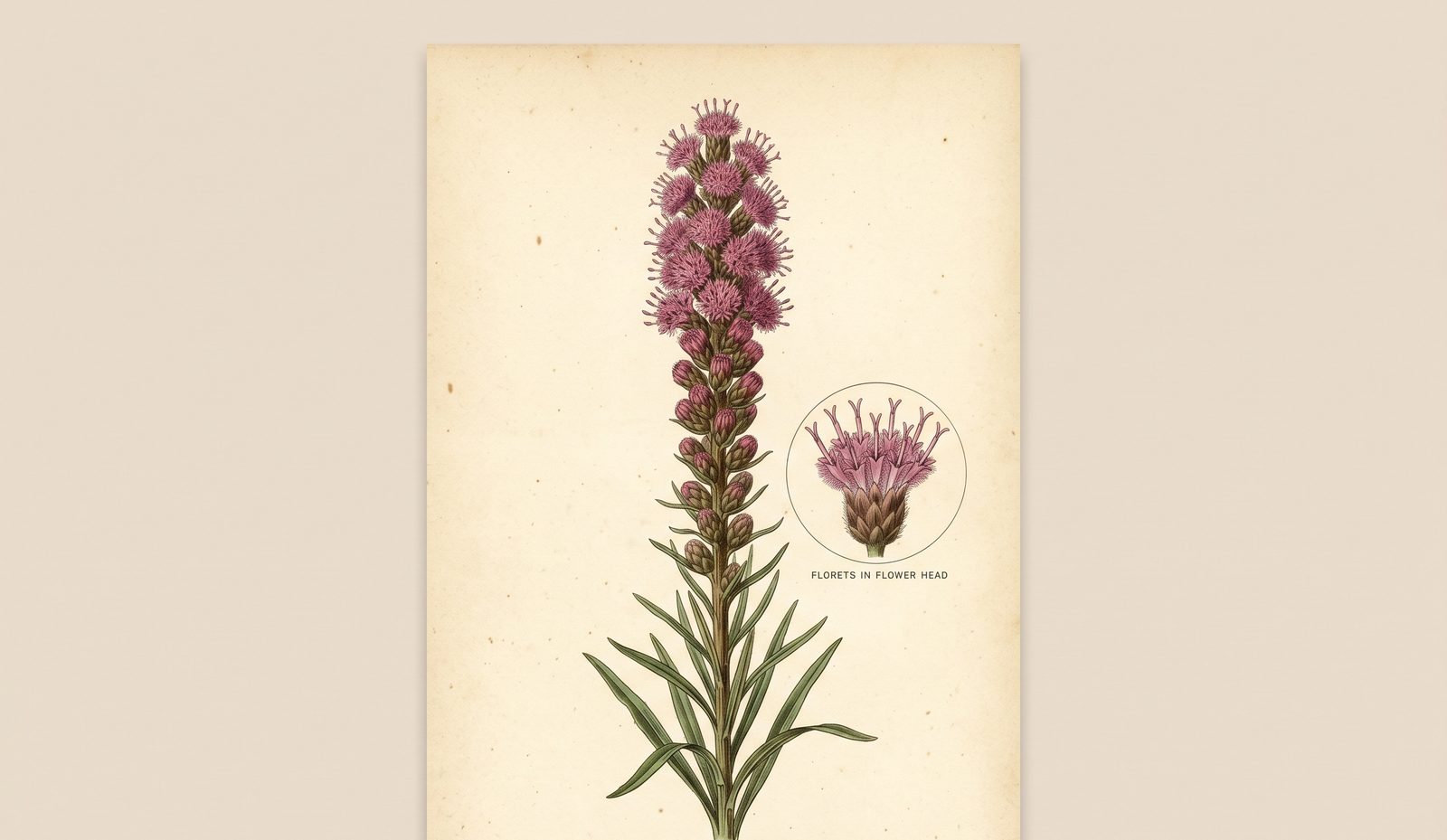
There's a second trick, and it's a callback to the first entry in this pillar. Blazing star belongs to the daisy family, so each of those fuzzy buttons crowded along the stem is its own small head of many tiny tubular flowers, not a single bloom (Hind, 2023). It's a spike, but a spike of heads. Run the test from the Solitary entry on it and the same answer comes back: what looks like one flower is often a tidy crowd of them.
§ 03Spike in your own garden
You see the bottom-up version everywhere once you look. A gladiolus opens its lowest florets first and finishes at the tip days later, which is exactly why a single cut stalk keeps performing in a vase: as the spent flowers fade at the base, fresh ones are still opening above. You can pinch off the lower ones as they go and the show carries on up top. Cut the stalk when the bottom two or three florets have opened and the rest will follow indoors.
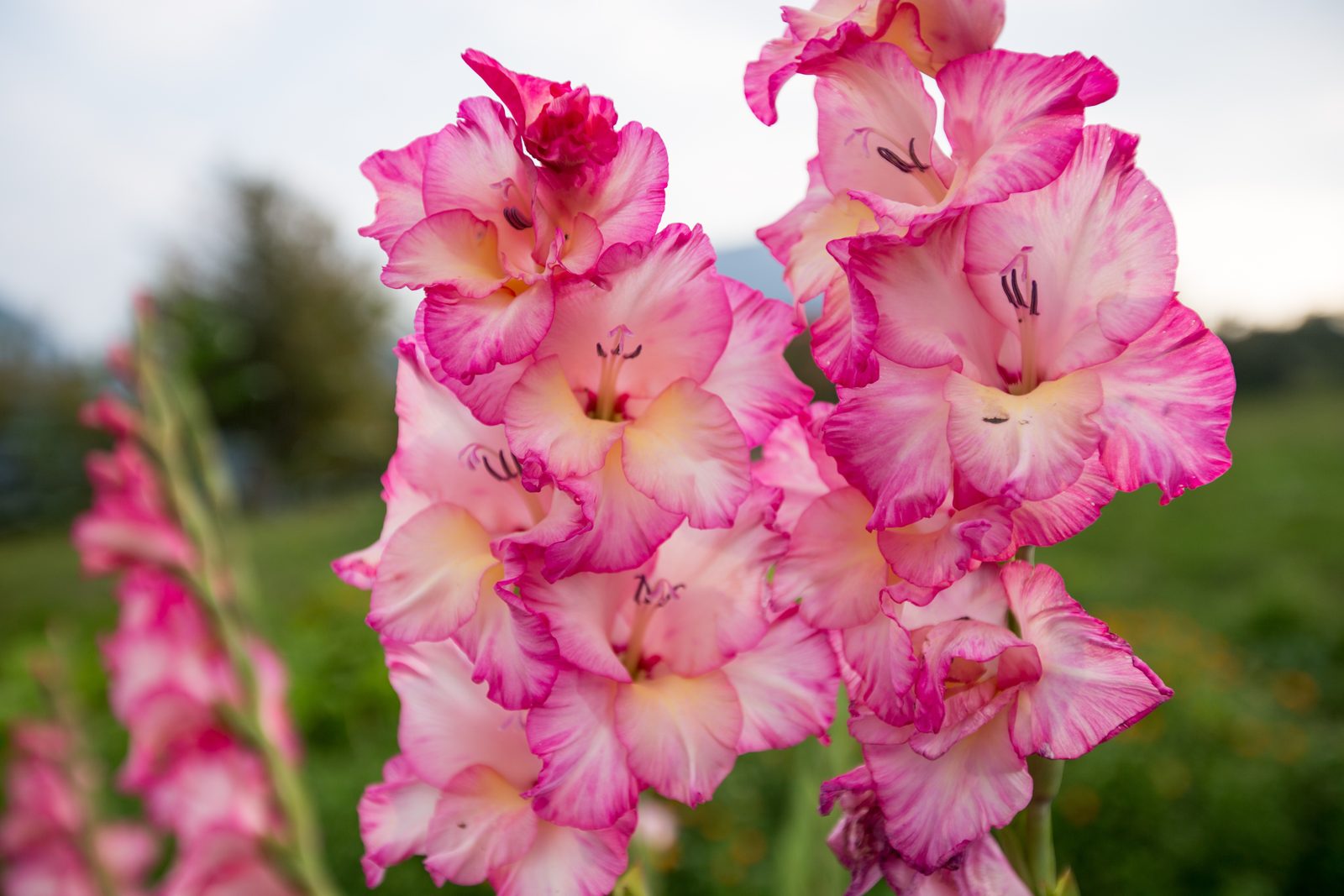
Not every spike is built for show, though. The plantain in your lawn, or Plantago , is a spike too, and it tells the other half of the story. Plantain skips insects almost entirely and lets the wind do the work, so it spends nothing on petals. Its flowers open female first, pushing out feathery stigmas to catch drifting pollen, then a ring of stamens shoots out on long filaments to release clouds of their own into the breeze (Friedman & Barrett, 2009). It's the same basic form as a gladiolus, stripped down to the wiry essentials and pointed at the air instead of at a bee. The catkins later in this pillar push that idea even further.
That's the payoff of naming the form. A spike isn't decoration; it's a way of presenting flowers in sequence, and once you know which way a given spike opens, you know when to cut it, how to tidy it, and what it's trying to attract.
§ 04The bottom line
A spike is the plainest upright inflorescence there is: an unbranched stem of stalkless flowers, usually opening bottom to top, occasionally (blazing star) the other way around. Keep the one-part test handy, because the very next form is its twin.
Next form: the raceme, the spike's close cousin, where every flower gets the stalk that a spike leaves off.
Friedman, J., & Barrett, S. C. H. (2009). Wind of change: New insights on the ecology and evolution of pollination and mating in wind-pollinated plants. Annals of Botany, 103(9), 1515–1527. https://doi.org/10.1093/aob/mcp035
Hind, D. J. N. (2023). 1083. Liatris aspera Michx.: Compositae. Curtis’s Botanical Magazine, 40(4), 503–515. https://doi.org/10.1111/curt.12540
Mauseth, J. D. (2017). Botany: An introduction to plant biology (6th ed.). Jones & Bartlett Learning.
Simpson, M. G. (2010). Plant systematics (2nd ed.). Academic Press.
Strelin, M. M., da Cunha, N. L., Rubini-Pisano, A., Fornoni, J., & Aizen, M. A. (2023). Darwin’s inflorescence syndrome is indeed associated with bee pollination. Plant Reproduction, 37(1), 37–45. https://doi.org/10.1007/s00497-023-00480-9
Weberling, F. (1989). Morphology of flowers and inflorescences. Cambridge University Press.