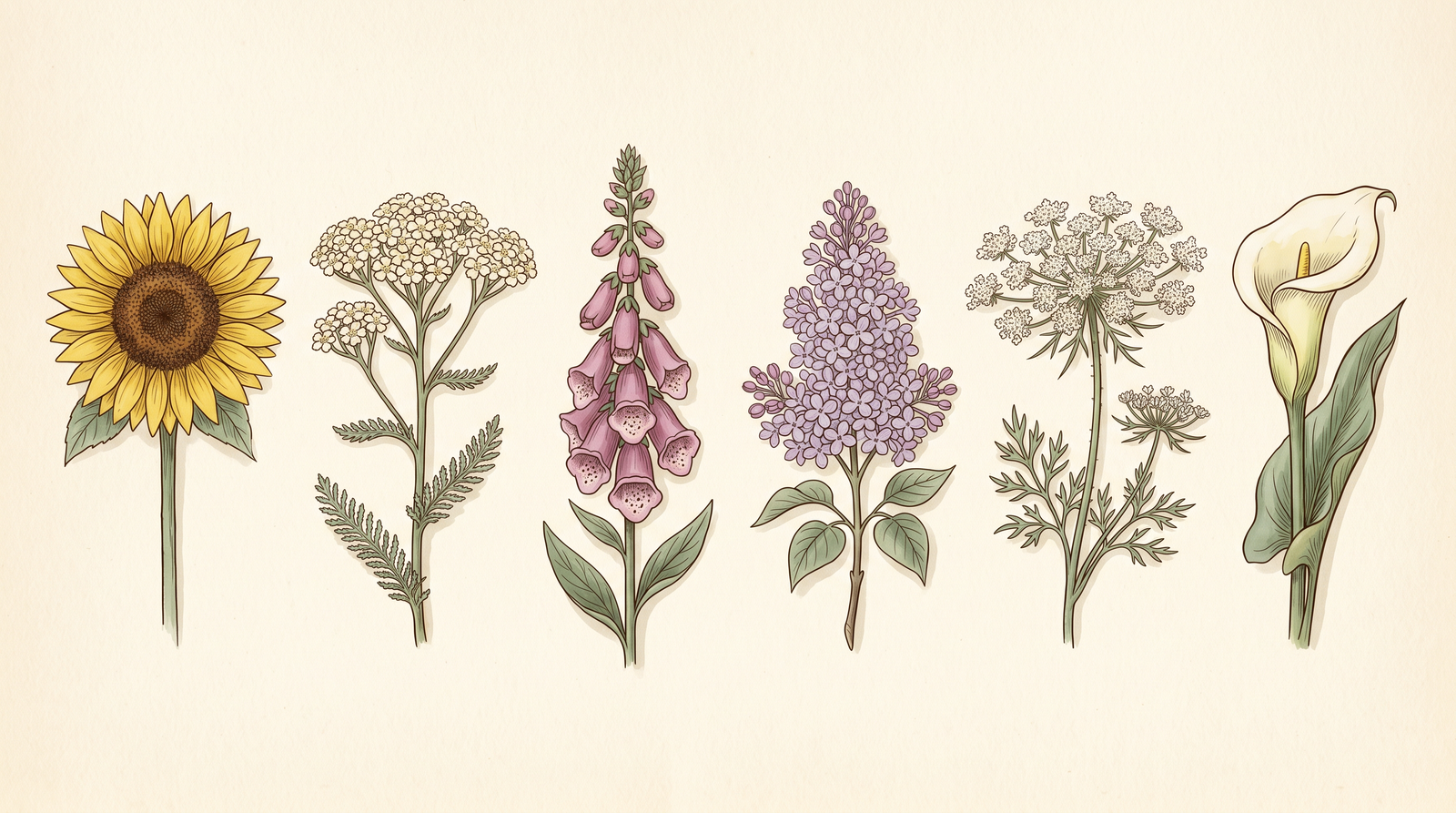
One flower. One stalk. Nothing clustered, nothing branched, nothing hiding behind a disguise. The solitary flower is the simplest arrangement a plant can offer, and it's where the Flower Library starts. Not because it's the most common shape (it isn't), but because it's the baseline every other form in this pillar departs from. Learn to spot a true solitary flower and you've already learned the question that runs through all twelve entries: is this one flower, or many wearing a costume?
§ 01What actually counts as solitary
The botanical definition is refreshingly plain. A solitary flower sits alone on its stalk, formed when a shoot tip turns directly into a single flower instead of branching into a cluster (Weberling, 1989). The stalk that holds it is the peduncle. That's the whole structure: one peduncle, one flower, full stop.
It shows up in two places. A terminal solitary flower caps the very end of a stem, the way a tulip stands straight up on its stalk. An axillary one emerges from the joint where a leaf meets the stem, so the bloom sits off to the side (Simpson, 2010). Same form, two addresses.
Here's the part that earns this form a whole entry. A true solitary flower is rarer than your eye assumes, because the plant world is full of impostors.
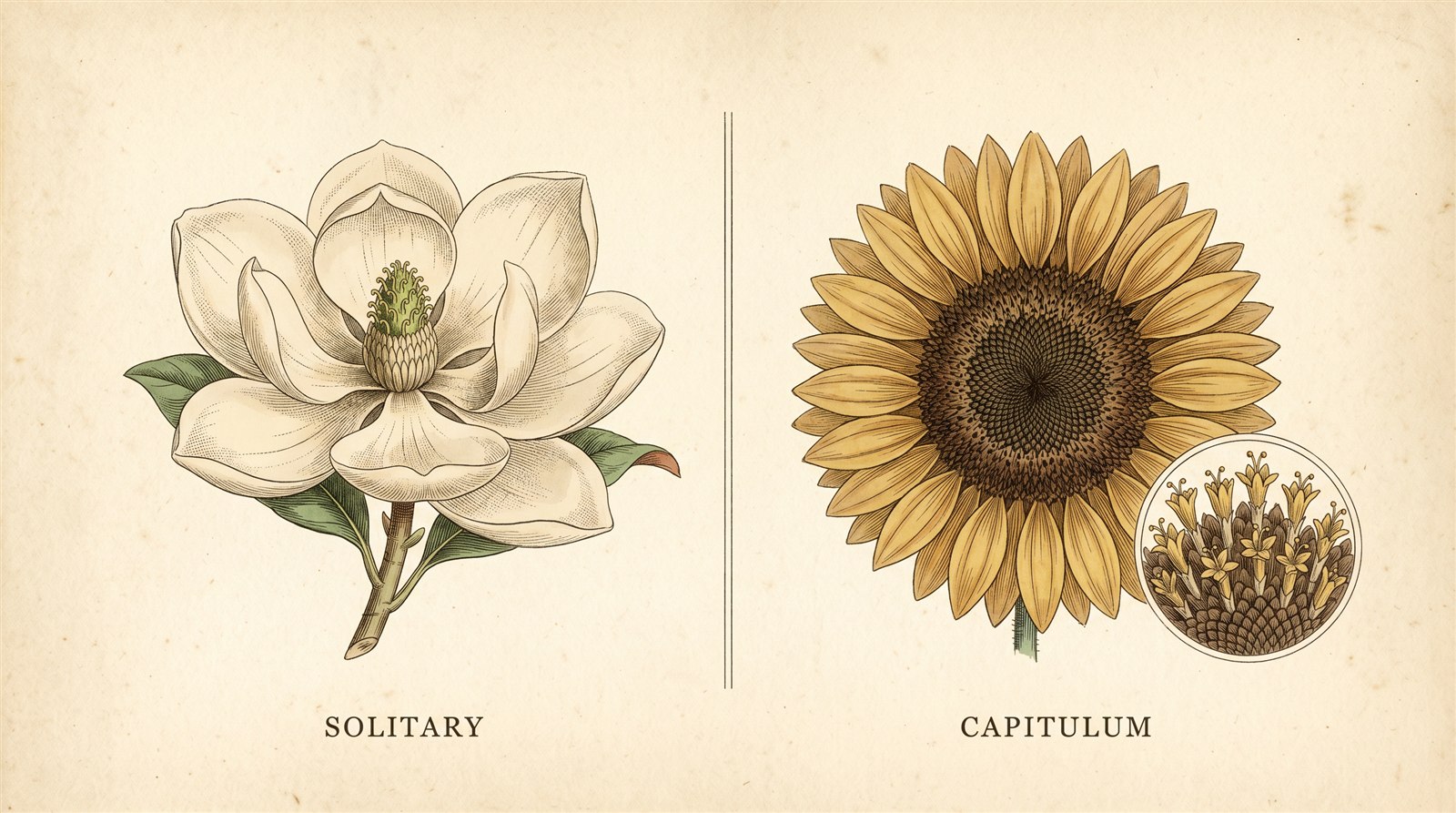
The test is simple once you know to run it. Look for the parts of a single flower (petals or tepals, the petal-like outer parts, then the stamens, then a pistil or two in the center) and count one set. Find a tidy single set and you have a solitary flower. If the "petals" turn out to be dozens of complete miniature flowers crowded onto a shared base, you're holding a cluster in costume. That sunflower above is the most famous fake of all, and the Library comes back to it in September.
§ 02The oldest trick: the magnolia
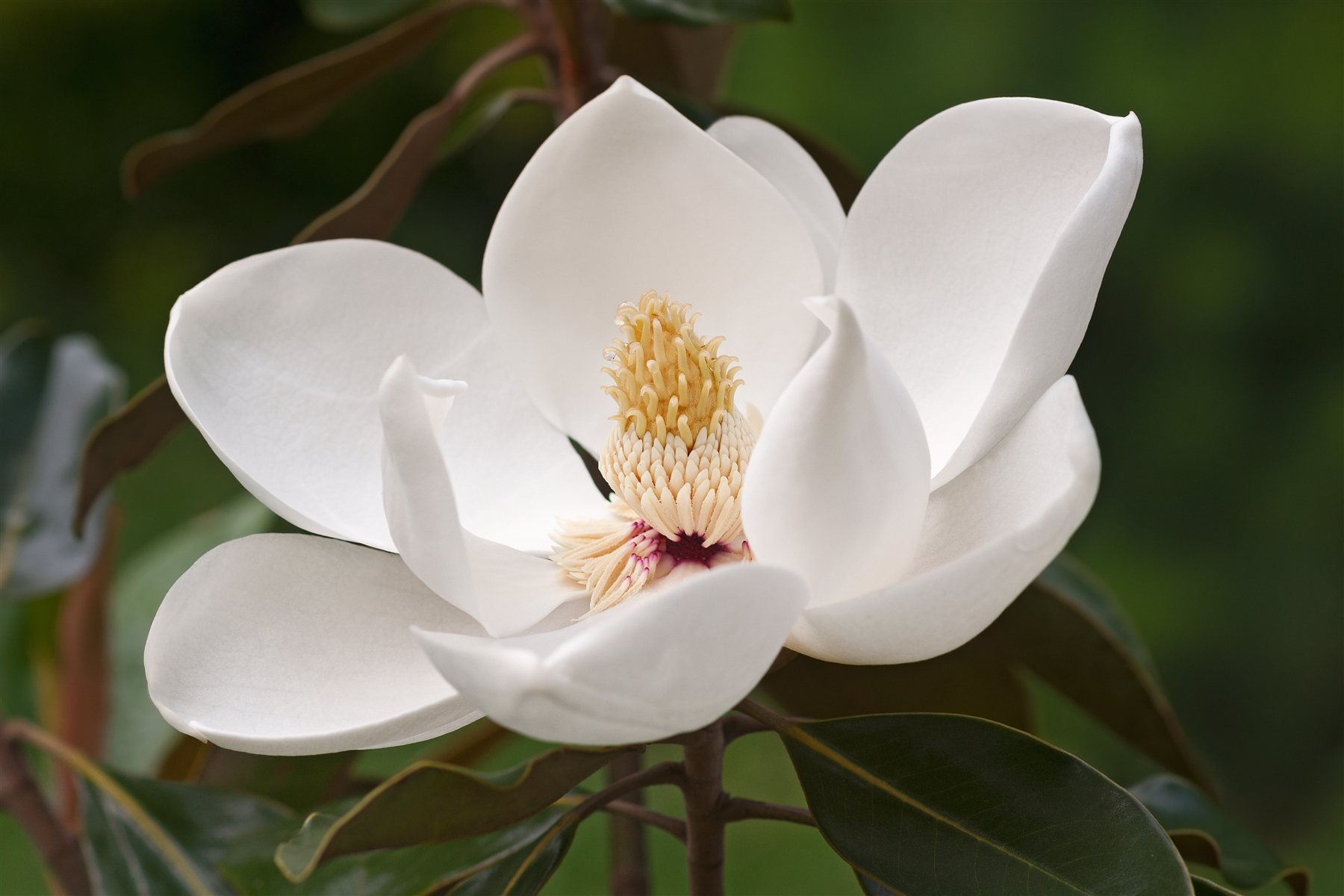
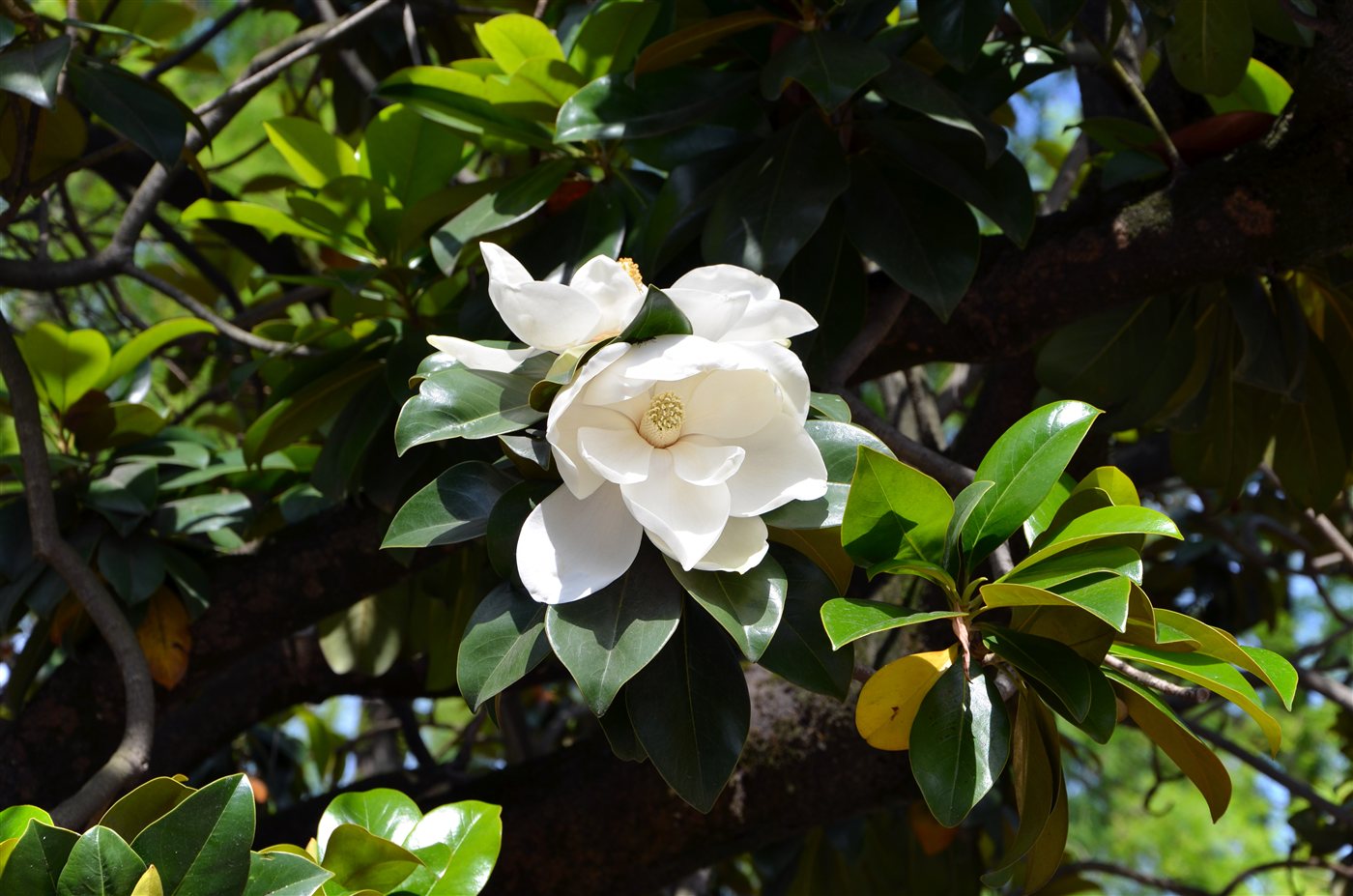
If one plant earns the solitary form its place at the front of the pillar, it's the southern magnolia (Magnolia grandiflora). The flower is solitary, fragrant, and up to a foot (30 cm) across. It's also a living rough draft from deep in flowering-plant history. Magnolias are early-diverging angiosperms (among the oldest lineages of flowering plants), and their flowers are built the old way: stamens and carpels (the pollen-making and seed-making parts) arranged in spirals on a long, cone-shaped receptacle rather than in the neat rings most modern flowers settled into (Endress, 1994; Mauseth, 2017).
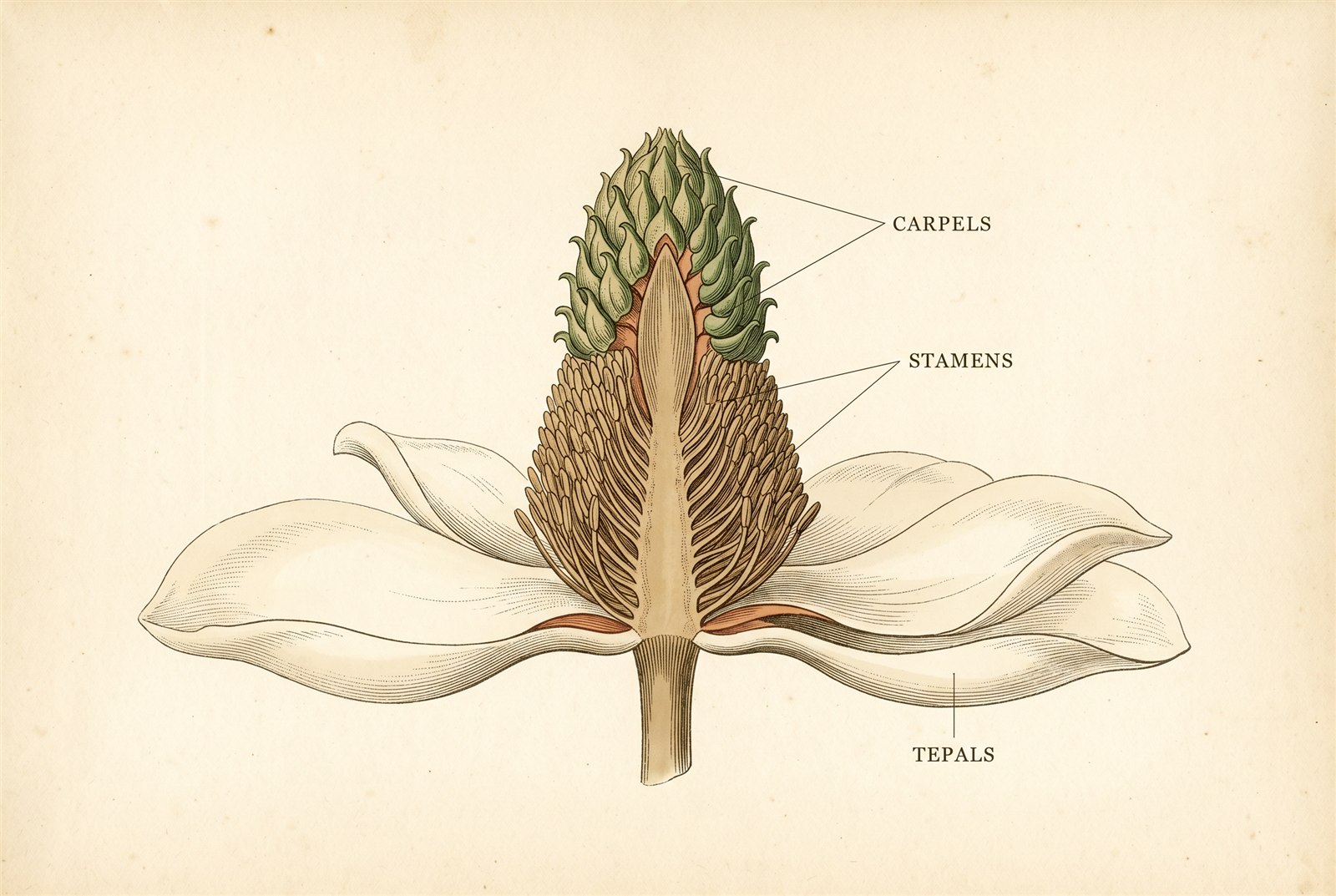
The pollination is just as ancient. Magnolia flowers open from a lineage older than bees, and they're worked by beetles instead (Thien, 1974). The flower opens into a vase-like chamber and runs female first: on the opening evening the stigmas are receptive while the stamens stay shut, so a beetle already dusted with pollen from another tree delivers it without competition. The next evening the same flower switches to male and sheds its own pollen, sending the beetles off to the next bloom. Opening female-then-male is how the flower avoids simply pollinating itself.
It even runs the heat on. Magnolia flowers are thermogenic, meaning their tissues burn energy to warm themselves above the surrounding air (by up to about 10°F, or 5.5°C, above ambient at the peak in one studied species). That warmth does double duty: it lifts the scent into the evening air and gives the beetles a cozy chamber to feed and mate in (Wang et al., 2014). A solitary flower, it turns out, can be a tiny heated room built for a beetle.
§ 03Solitary in your own garden
You don't need a magnolia to see the form. A tulip is a clean terminal solitary. So is a peony, an Oriental poppy, and most hibiscus. Each one puts a single large flower on a single stalk and asks it to carry the whole season's pitch.
That's the practical payoff of naming the form. A solitary flower is one big bet. Instead of spreading its odds across a cluster of small blooms, the plant pours everything into one showy pitch and one pollinator visit. For you, that changes two everyday things. Deadheading a solitary bloomer means taking off one spent flower at a time, right down at its peduncle, not shearing a faded cluster. And cutting one for a vase costs the plant a whole flower rather than a single floret out of many, so a solitary stem is a bigger ask of the plant than it looks.
§ 04The bottom line
Solitary is the baseline: one flower, one stalk, nothing hidden. Hold onto the test, because the rest of the Flower Library is built on it. A spike, a raceme, an umbel, and eventually a sunflower's false face are all answers to the same question you just learned to ask.
Next form: the spike, where the flowers line up sessile along a single unbranched axis, no stalks of their own.
Endress, P. K. (1994). Diversity and evolutionary biology of tropical flowers. Cambridge University Press.
Mauseth, J. D. (2017). Botany: An introduction to plant biology (6th ed.). Jones & Bartlett Learning.
Simpson, M. G. (2010). Plant systematics (2nd ed.). Academic Press.
Thien, L. B. (1974). Floral biology of Magnolia. American Journal of Botany, 61(10), 1037–1045. https://doi.org/10.1002/j.1537-2197.1974.tb12321.x
Wang, R., Xu, S., Liu, X., Zhang, Y., Wang, J., & Zhang, Z. (2014). Thermogenesis, flowering and the association with variation in floral odour attractants in Magnolia sprengeri (Magnoliaceae). PLOS ONE, 9(6), e99356. https://doi.org/10.1371/journal.pone.0099356
Weberling, F. (1989). Morphology of flowers and inflorescences. Cambridge University Press.