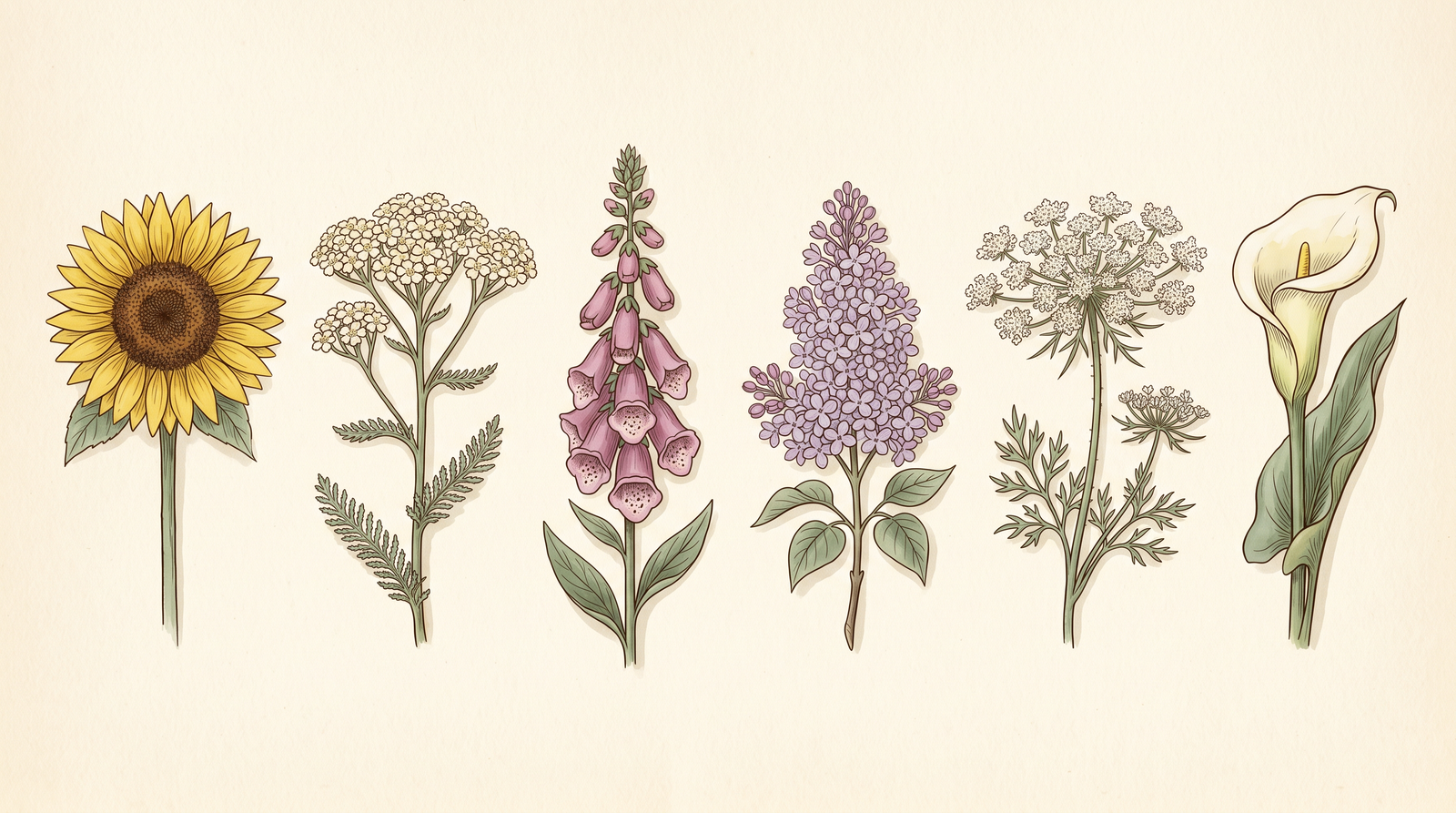
A panicle is a raceme that branched. That's the whole idea, and it's why so much of summer looks the way it does: lilac trusses, astilbe plumes, oat heads, the haze on a smoke bush. Branching turns one line of flowers into a cluster you can see from across a yard, and it changes the timing too, because a panicle arrives all at once instead of climbing for weeks. Lilac carries this entry, and it comes with a complication worth the detour. Most sources call it a panicle. Strictly, it isn't one.
§ 01What actually counts as a panicle
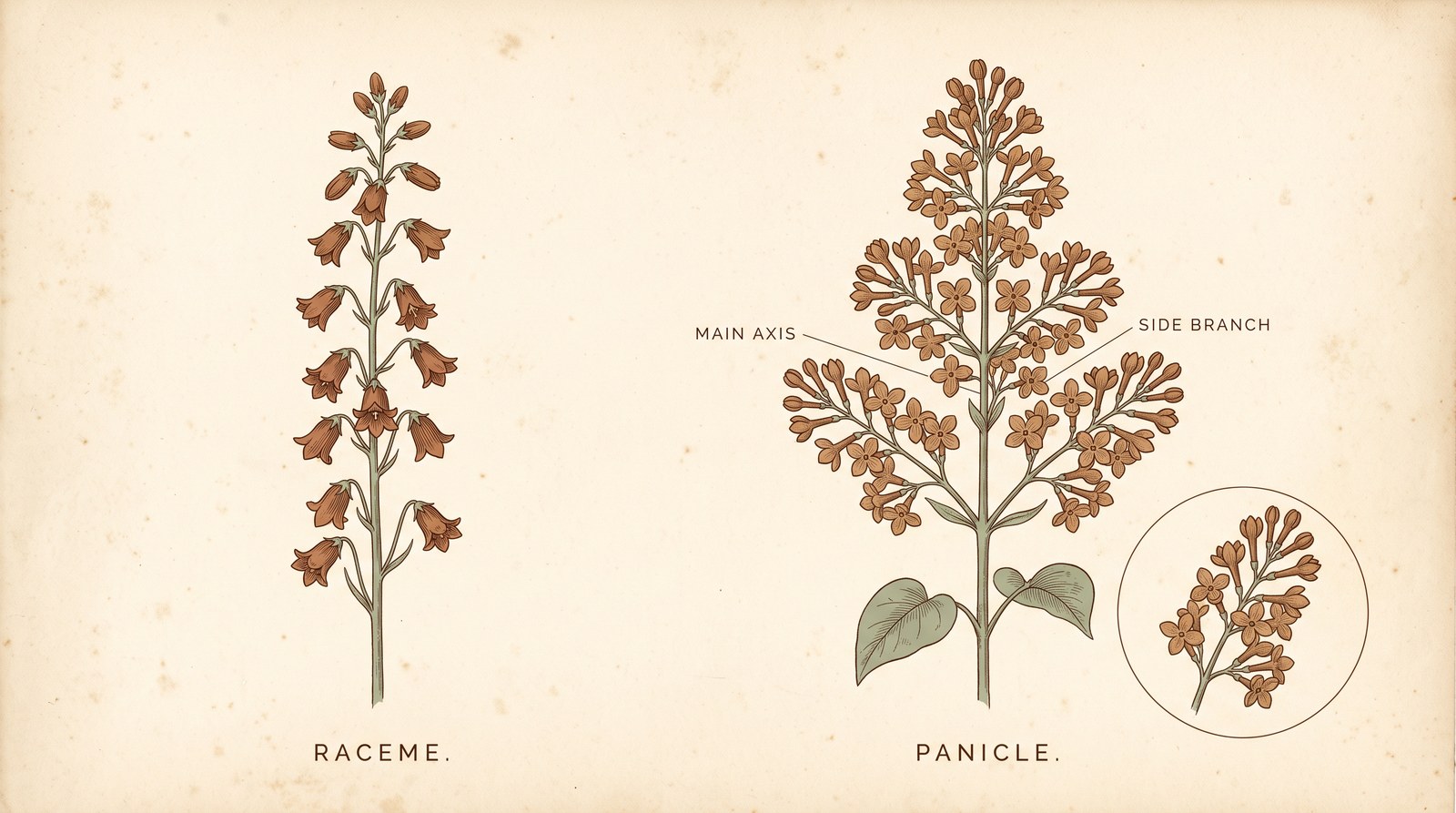
A panicle is a raceme that branched. The main stem still runs upward and still refuses to cap itself with a final flower, but now it puts out side branches, and the flowers ride on those instead of sitting directly on the axis (Weberling, 1989). Each branch is essentially a small raceme of its own, which is why the older books call the panicle a compound raceme: racemes hung on racemes (Simpson, 2010).
The field test is one question. Find the main axis, then look at where the flowers attach: on the axis itself, that's a spike or a raceme; on branches coming off it, that's a panicle. Astilbe, oats, rice, switchgrass, goldenrod, Hydrangea paniculata, and lilac all pass. So do the fluffy summer clusters that look like one flower and turn out to be a thousand.
The word is older than the botany. It comes from the Latin panicula, a little tuft, a diminutive of panus, which meant a swelling and also an ear of millet. The panic grasses take their name from the same root, not from the god Pan, which is the tidier story and the wrong one (Chatham, 2020). Millet earned the word, and if you want to see why, look at an oat head: a whole three-dimensional scaffold of branches, each tip carrying its own small cluster.
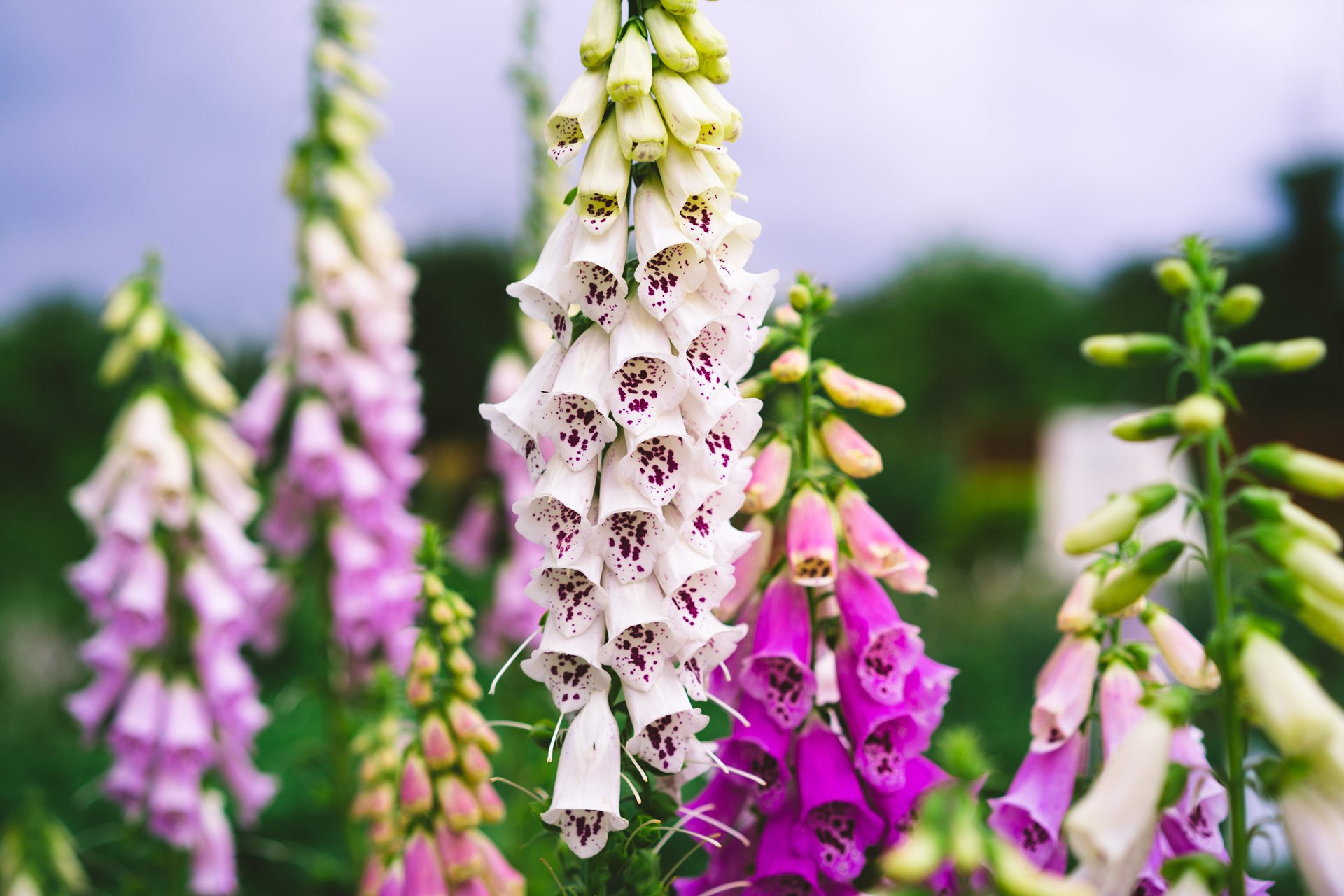
Branching buys a plant more than display area. Models of inflorescence architecture, meaning the way a plant arranges its flowers, treat the panicle as the case where all the growing tips shift toward flowering at about the same rate, so a panicle tends to come into bloom together rather than in the slow bottom-up wave you learned from foxglove (Prusinkiewicz et al., 2007). That's the difference you notice in the garden. Foxglove climbs for weeks. A lilac truss goes off all at once and it's done.
§ 02The lilac, and the complication
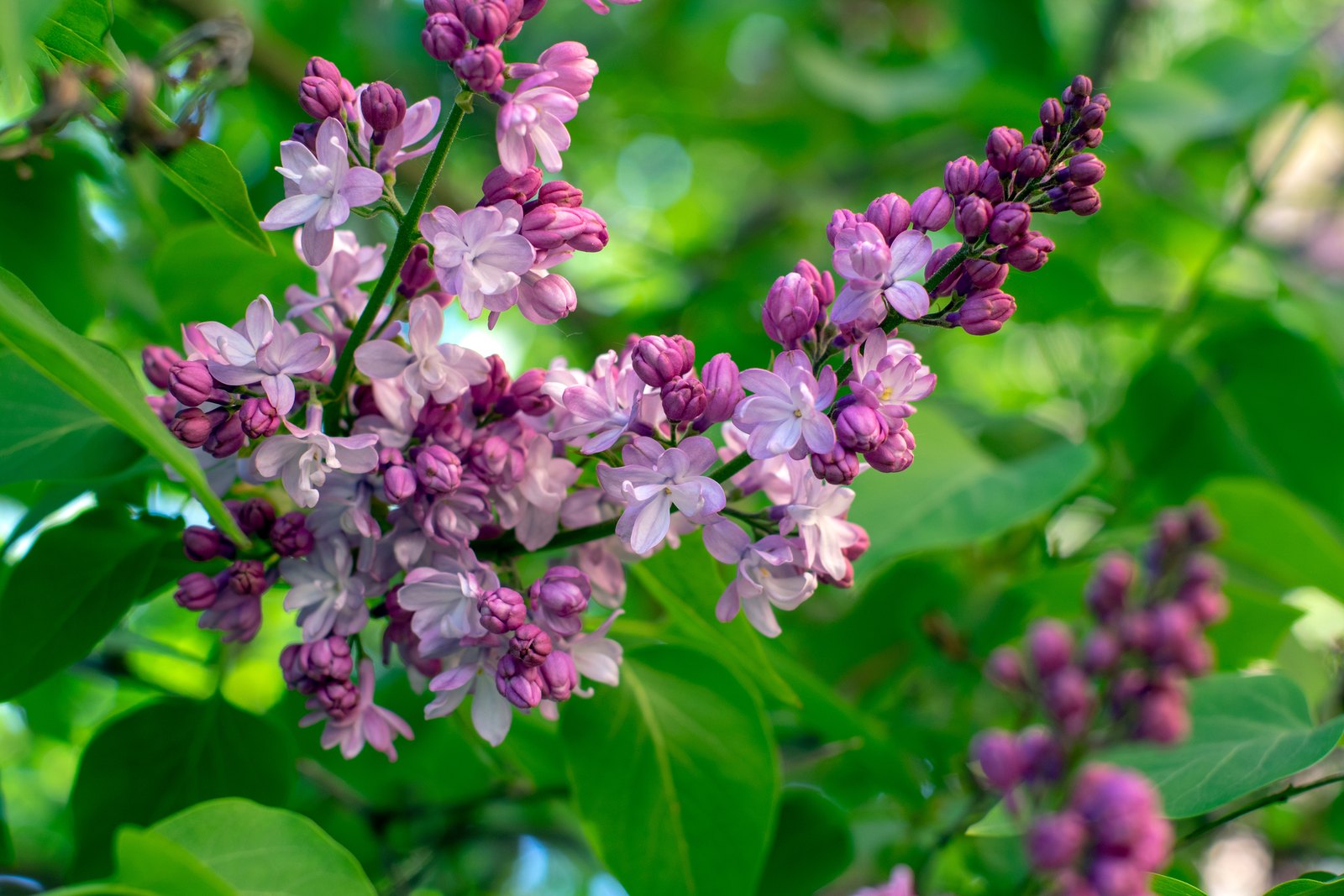
Common lilac, Syringa vulgaris , is the plant most people think of first for this form. Linnaeus named it in 1753, it belongs to the olive family, and its native range is narrower than the folklore suggests: the northern Balkan Peninsula through to north-central Romania (POWO, 2026). It is not native to Russia, or Poland, or Asia generally. The genus reaches Asia; this species doesn't. The flower clusters are conical, usually carried in pairs at the ends of the shoots, and run to about 8 inches (20 cm) long (NC State Extension, n.d.).
That same NC State description calls the lilac inflorescence a "panicle of cymes," and once you know the vocabulary, the phrase quietly contradicts itself. A true panicle branches into more racemes, indeterminate all the way down, every tip still keeping its options open. A cyme is the opposite build: determinate, the central flower opening first and capping the branch for good. Lilac has an indeterminate main axis carrying determinate branches, and that combination has its own name. It's a thyrse : a main axis that keeps growing, hung with side branches that each cap themselves off like a cyme (Endress, 2010, as cited in Bartlett & Thompson, 2014).
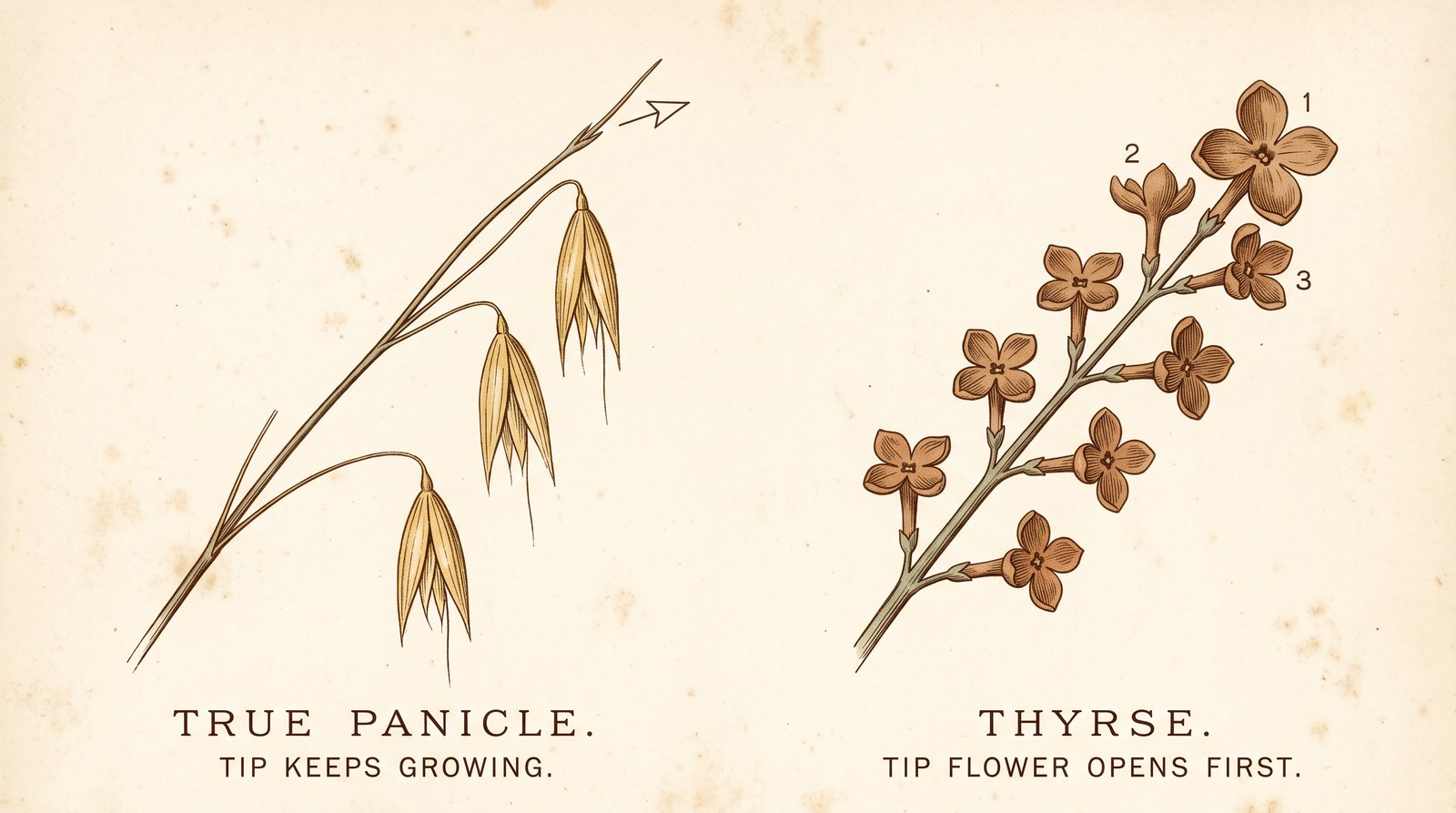
Horticulture will keep calling it a panicle, and that's fine, because "panicle" has always worked as a bucket. Even in the grasses, where the form is at its most elaborate, every inflorescence in the family gets filed under the same word regardless of how differently it's built (Bartlett & Thompson, 2014). Nobody needs correcting at a garden center over this. Keep it anyway, because determinate and indeterminate is the fork this whole pillar keeps returning to, and lilac is the first plant in the arc sitting on both sides of it at once. Entry No. 09, the cyme, picks up the determinate half.
Now the scent, where the marketing gets ahead of the evidence. It's so distinctive that the compounds behind it are named after the plant. The lilac aldehydes were traced in Syringa vulgaris itself, precursor by precursor (Burkhardt & Mosandl, 2003), and moths can pick those compounds out of a scent blend, though the antennae doing the picking were tested on a different plant's flowers (Dötterl et al., 2006). What nobody has published is the part where the moth actually shows up at a lilac. I couldn't find a published pollination study on common lilac at all, and the one paper watching lilacs closely, three seasons of observation on two other Syringa species, reported that insect visitors turned up only sporadically despite heavy, fragrant bloom (Denisow & Strzałkowska-Abramek, 2014). So plant lilac for the two weeks in spring when your whole yard smells like it. Don't plant it as a pollinator bed and expect a crowd.
§ 03The panicle in your own garden
Lilac's care follows straight from the form. The trusses come from buds set the previous year on old wood, and the plant begins setting next season's buds soon after it finishes flowering (Benoit, 2025). That's why the standard advice is to prune immediately after the flowers fade (Missouri Botanical Garden, n.d.): you're shaping the shrub before it commits. Prune later in the season and you get fewer flowers the following year (Benoit, 2025). Full renovation works too, cutting an overgrown clump back hard, but know what it costs you: it removes the flower buds and delays flowering by about three years (Browning, 2019).
The Bay Area problem is chill. Lilac needs a long period of winter cold for its buds to mature, and bloom gets unreliable in hot zones where that chilling is hard to come by (Missouri Botanical Garden, n.d.; NC State Extension, n.d.). Treat the specific chill-hour numbers you'll find online with suspicion, because I couldn't trace any of them to a source for Syringa. The workaround is a piece of California horticultural history: Walter Lammerts obtained non-chilling lilac seed in 1942, brought the work to Descanso Gardens in 1945, and in the spring of 1950 picked his best seedlings and budded them onto privet rootstock, joining a single bud from each selection onto another plant's roots, eventually producing about twenty varieties including 'Lavender Lady', 'California Rose', and 'Descanso Giant' (Lewis, 1988). If you want lilac in a mild-winter garden, a Descanso hybrid is the honest answer, and a supermarket lilac will leaf out happily and flower thinly, if at all.
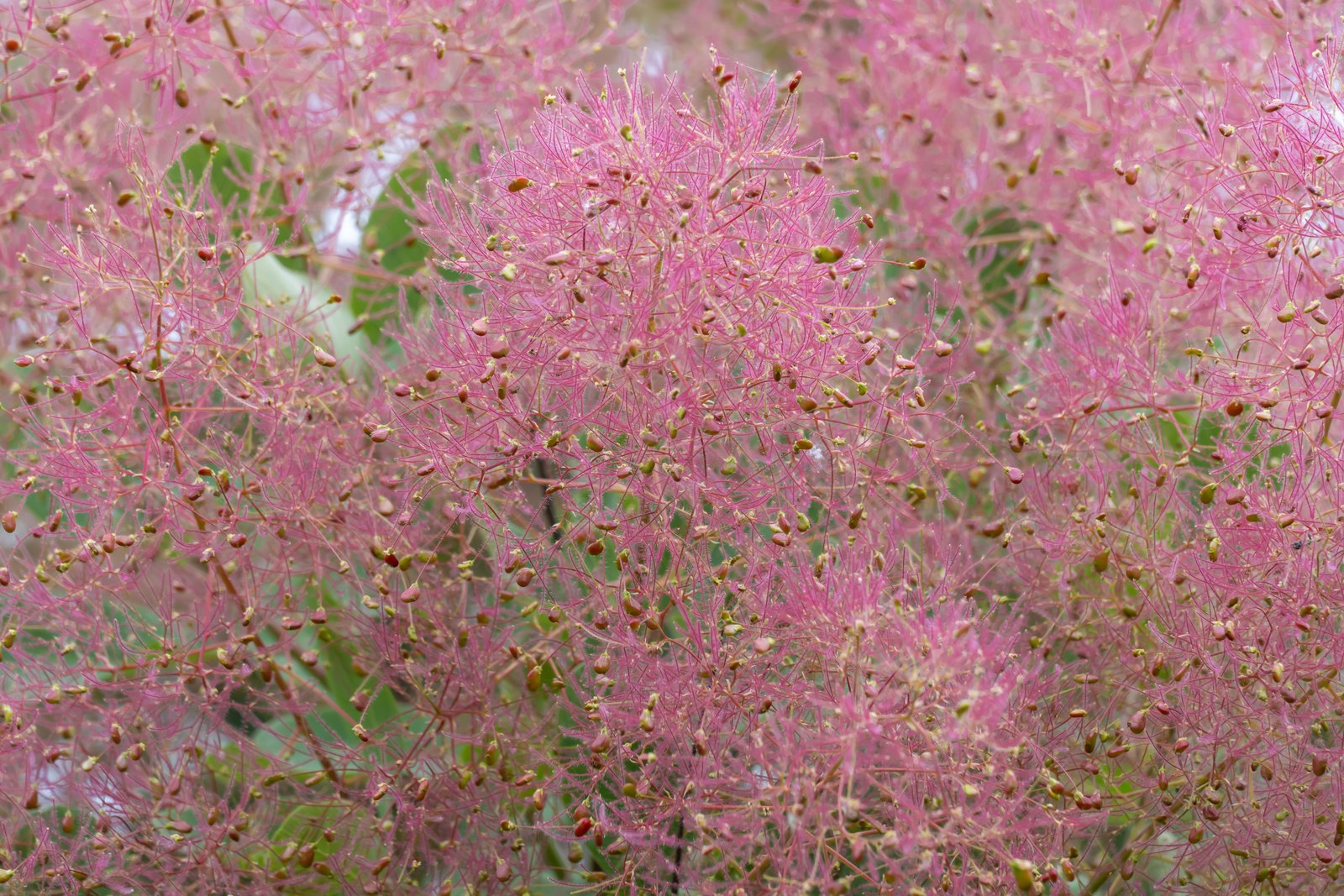
Once you can see branching, the panicles start turning up in strange places. Smoke bush, Cotinus coggygria , is the best of them. The flowers themselves are small and starry, easy to miss inside the developing cluster, and many of them are sterile. What makes the smoke is what happens after they finish: the stalks elongate and grow long silky hairs, and the whole panicle inflates into a haze (Johnson, 2025). All of that happens after the flowering is finished, which is the part that trips people up: prune this shrub for its flowers and you cut the smoke off with them.
Heuchera makes the same joke lilac does, in a different family. The Native Plant Trust describes the inflorescence as "panicle-like thyrsi," which is about as direct as botanical writing gets about this ambiguity (Native Plant Trust, n.d.). If you want the California version, island alum root, Heuchera maxima, is a northern Channel Islands endemic (it grows wild nowhere else on earth) known from Santa Rosa, Santa Cruz, and Anacapa (Center for Plant Conservation, n.d.), and it throws the same airy branched spray of small flowers over a mound of scalloped leaves.
§ 04The bottom line
A panicle is a branched, indeterminate inflorescence: a main axis carrying side branches, each branch carrying its own stalked flowers. Find the branching and you've named it. Then check what the branches do at their tips, because that's where lilac stops being a textbook panicle and starts being a more interesting plant.
Next form: the corymb, where the outer stalks grow longer than the inner ones so every flower lands on the same plane, and a cluster becomes a landing pad.
Photo credits: the hero (common lilac) and the smoke bush figure are both licensed from Adobe Stock, cropped from the originals. The two comparison figures are original illustrations by The Planters' Guild.
Bartlett, M. E., & Thompson, B. (2014). Meristem identity and phyllotaxis in inflorescence development. Frontiers in Plant Science, 5, 508. https://doi.org/10.3389/fpls.2014.00508
Benoit, D. J. (2025, May 7). For the love of lilacs. University of Vermont Extension. https://www.uvm.edu/extension/news/love-lilacs
Browning, S. (2019, June 1). Rejuvenating older lilacs. Nebraska Extension in Lancaster County. https://lancaster.unl.edu/rejuvenating-older-lilacs
Burkhardt, D., & Mosandl, A. (2003). Biogenetic studies in Syringa vulgaris L.: Bioconversion of 18O(2H)-labeled precursors into lilac aldehydes and lilac alcohols. Journal of Agricultural and Food Chemistry, 51(25), 7391–7395. https://doi.org/10.1021/jf0304674
Center for Plant Conservation. (n.d.). Heuchera maxima. Retrieved July 29, 2026, from https://saveplants.org/plant-profile/?CPCNum=2240
Chatham, M. (2020, October 19). Botanic names: Panic! Virginia Native Plant Society, Potowmack Chapter. https://vnps.org/potowmack/botanic-names-panic/
Denisow, B., & Strzałkowska-Abramek, M. (2014). Characteristics of blooming and pollen in flowers of two Syringa species (f. Oleaceae). Acta Agrobotanica, 66(4), 65–72. https://doi.org/10.5586/aa.2013.052
Dötterl, S., Burkhardt, D., Weißbecker, B., Jürgens, A., Schütz, S., & Mosandl, A. (2006). Linalool and lilac aldehyde/alcohol in flower scents: Electrophysiological detection of lilac aldehyde stereoisomers by a moth. Journal of Chromatography A, 1113(1–2), 231–238. https://doi.org/10.1016/j.chroma.2006.02.011
Johnson, O. (2025). Cotinus. Trees and Shrubs Online. https://www.treesandshrubsonline.org/articles/cotinus/
Lewis, G. (1988). Lilacs for warm climates. Pacific Horticulture, 49(4). https://pacifichorticulture.org/articles/lilacs-for-warm-climates/
Missouri Botanical Garden. (n.d.). Syringa vulgaris. Plant Finder. Retrieved July 30, 2026, from https://www.missouribotanicalgarden.org/PlantFinder/PlantFinderDetails.aspx?taxonid=282932
Native Plant Trust. (n.d.). Heuchera americana (common alum-root). Go Botany. Retrieved July 29, 2026, from https://gobotany.nativeplanttrust.org/species/heuchera/americana/
NC State Extension. (n.d.). Syringa vulgaris (common lilac, English lilac, French lilac). NC Extension Gardener Plant Toolbox. Retrieved July 29, 2026, from https://plants.ces.ncsu.edu/plants/syringa-vulgaris/
POWO. (2026). Syringa vulgaris L. Plants of the World Online. Royal Botanic Gardens, Kew. Retrieved July 29, 2026, from https://powo.science.kew.org/taxon/urn:lsid:ipni.org:names:289009-2
Prusinkiewicz, P., Erasmus, Y., Lane, B., Harder, L. D., & Coen, E. (2007). Evolution and development of inflorescence architectures. Science, 316(5830), 1452–1456. https://doi.org/10.1126/science.1140429
Simpson, M. G. (2010). Plant systematics (2nd ed.). Academic Press.
Weberling, F. (1989). Morphology of flowers and inflorescences (R. J. Pankhurst, Trans.). Cambridge University Press.