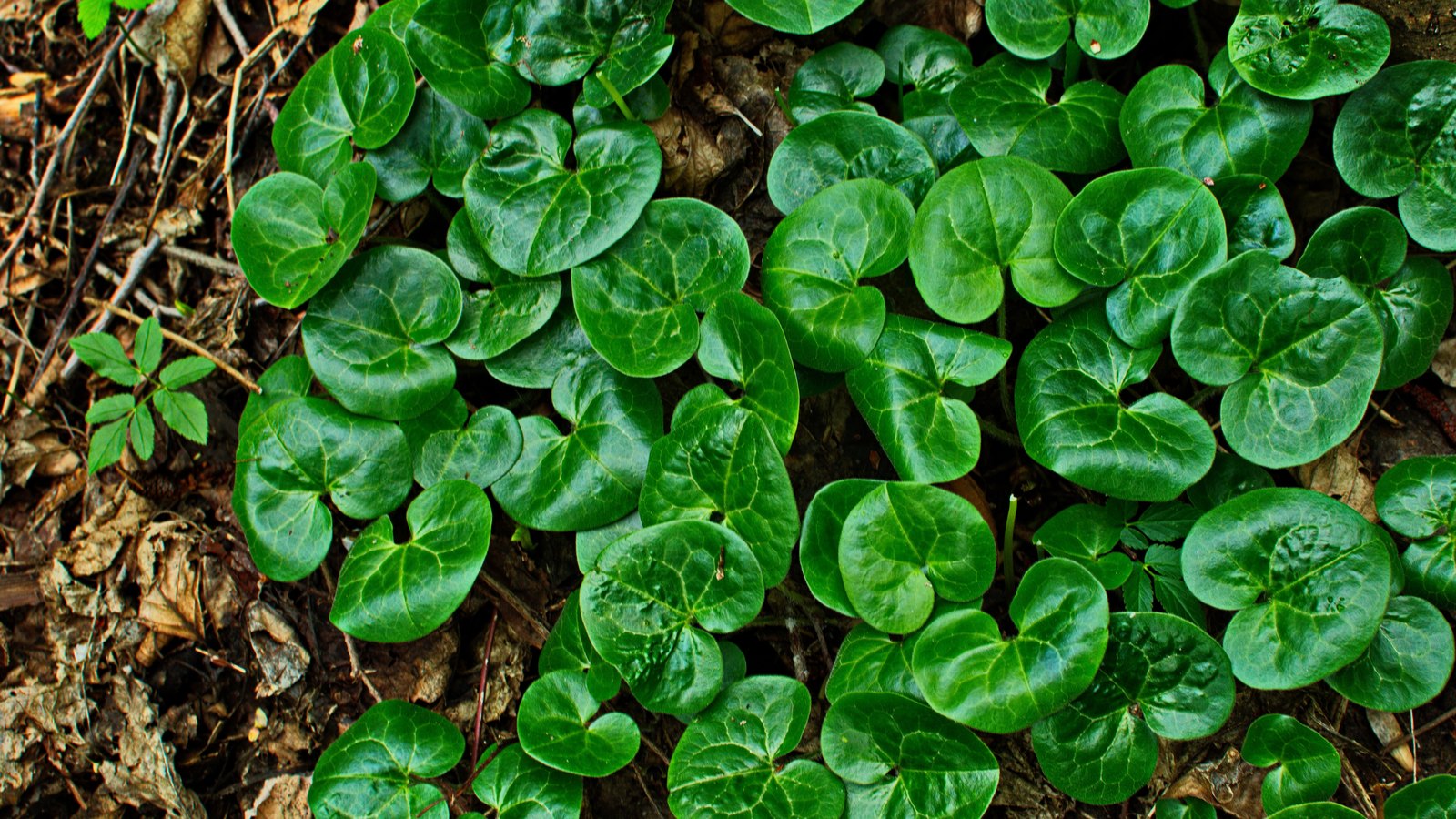
Three leaflets on one leaf. White clover has them, so does beach strawberry, and so does poison oak, which is reason enough for the shape to get its own entry.
A trifoliate leaf is one leaf split into three leaflets, like you see on a white clover leaf (Lady Bird Johnson Wildflower Center, 2007; Klinkenberg, n.d.-c).
Strictly speaking, the word for three leaflets is trifoliolate (New York Botanical Garden, n.d.). The dictionary gives trifoliate both meanings, "three leaves" and simply "trifoliolate" (Merriam-Webster, n.d.), so trifoliate is correct too, and it's the word this article uses.
Two ways to hold them
Botanical Latin has its own word, ternatus, "in threes," as in a leaf divided into three leaflets (Eckel, n.d.). It even has a way to say how the three are held: its example adds palmatim, "leaves palmately in threes" (Eckel, n.d.).
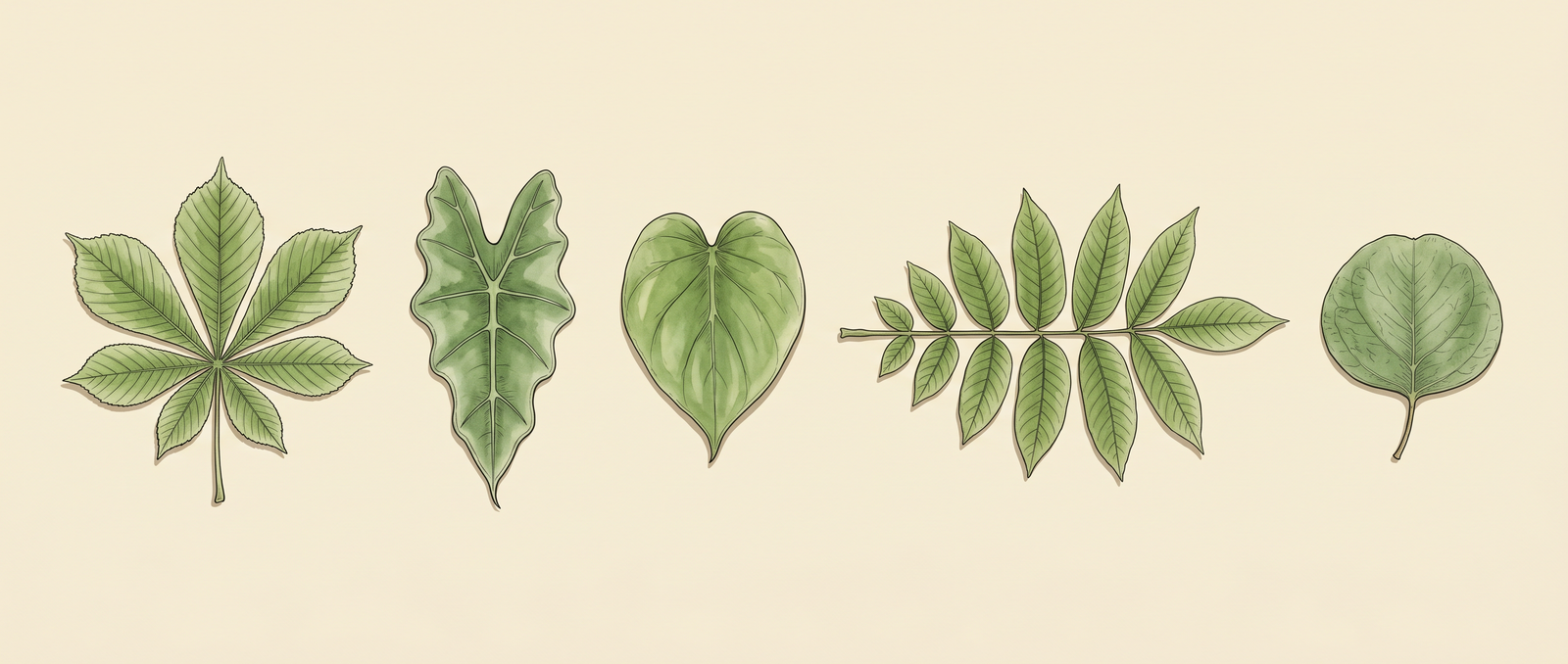
Look at where the three leaflets join the leaf-stalk and you'll find one of two builds. In the first, all three come off the tip at almost the same point, like the palmate leaf from No. 01 cut down to three. In the second, the end leaflet sits out past the side pair on a stalk of its own, closer to the pinnate leaf from No. 02. The plants that follow run from the first build toward the second.
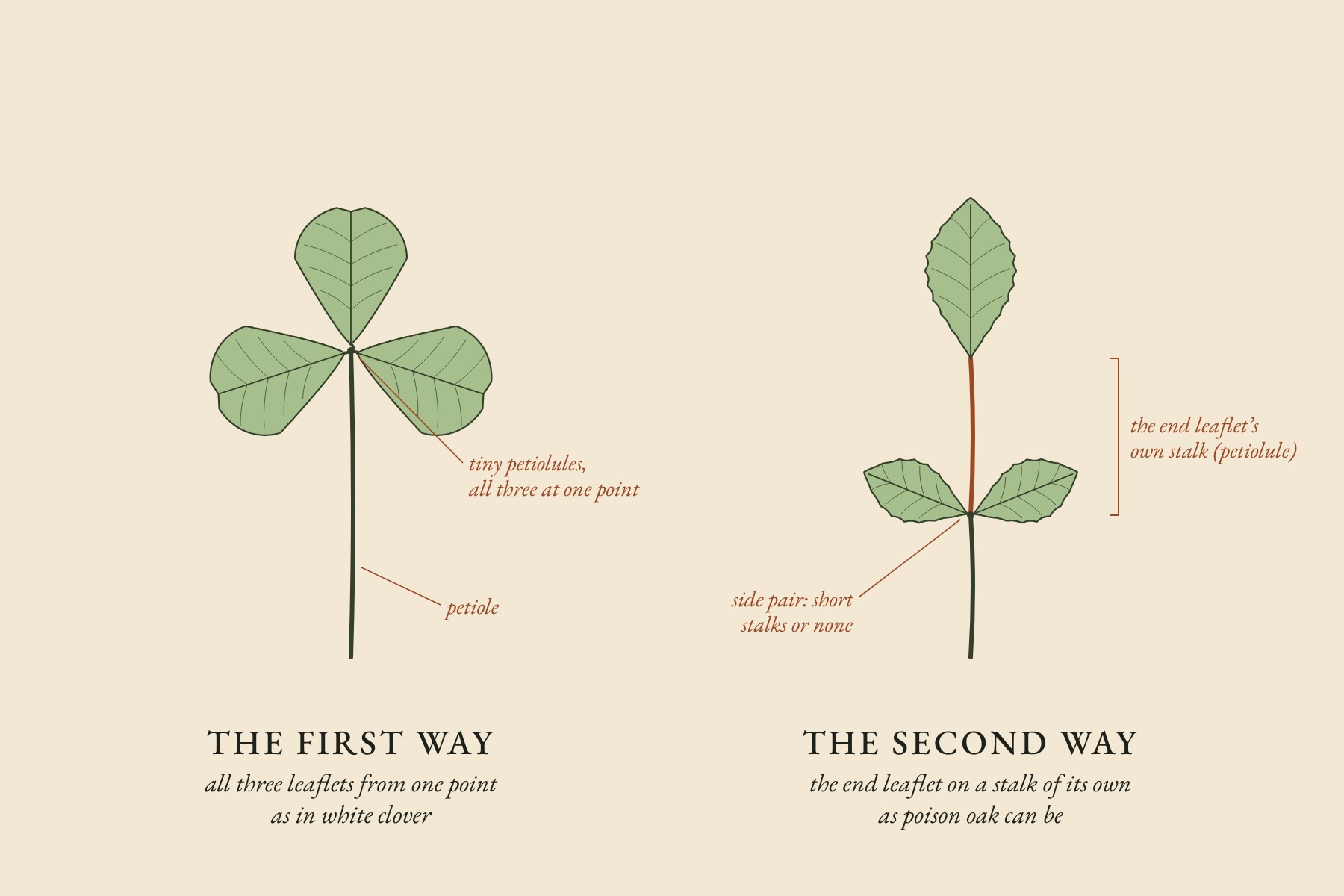
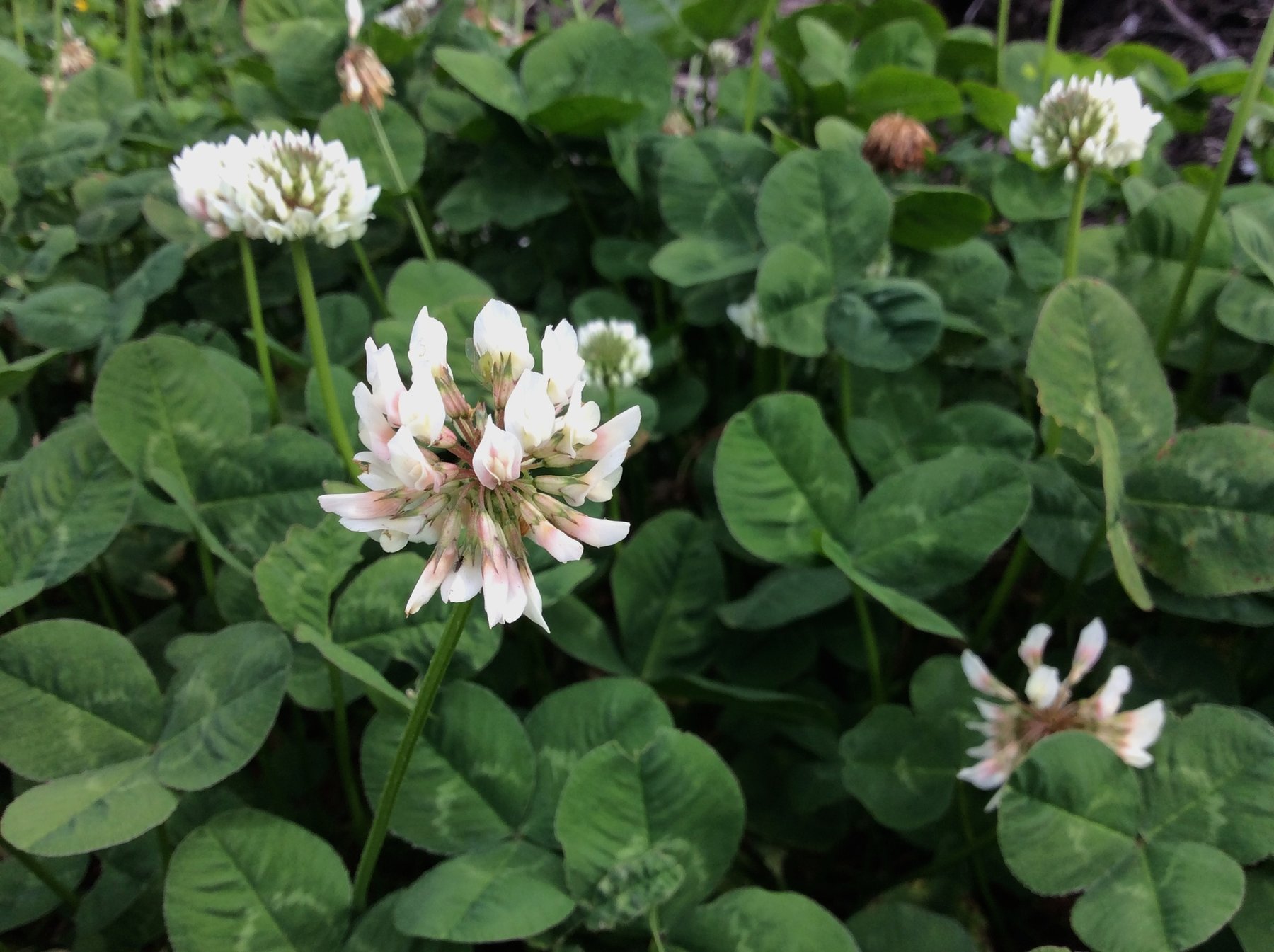
Start with white clover, Trifolium repens , the first way at its plainest. Its leaf is palmate, and its three leaflets sit on a leaf-stalk, the petiole , that runs 2 to 8 inches (5 to 20 cm) and is longer than the leaflets themselves (Klinkenberg, n.d.-c; Flora of North America [FNA], quoted in Burke Herbarium, n.d.-d). Each leaflet then has a much smaller stalk of its own, the petiolule , and on clover it's about 0.04 inch (1 mm) at most (FNA, quoted in Burke Herbarium, n.d.-d). For practical purposes, all three meet at one point.
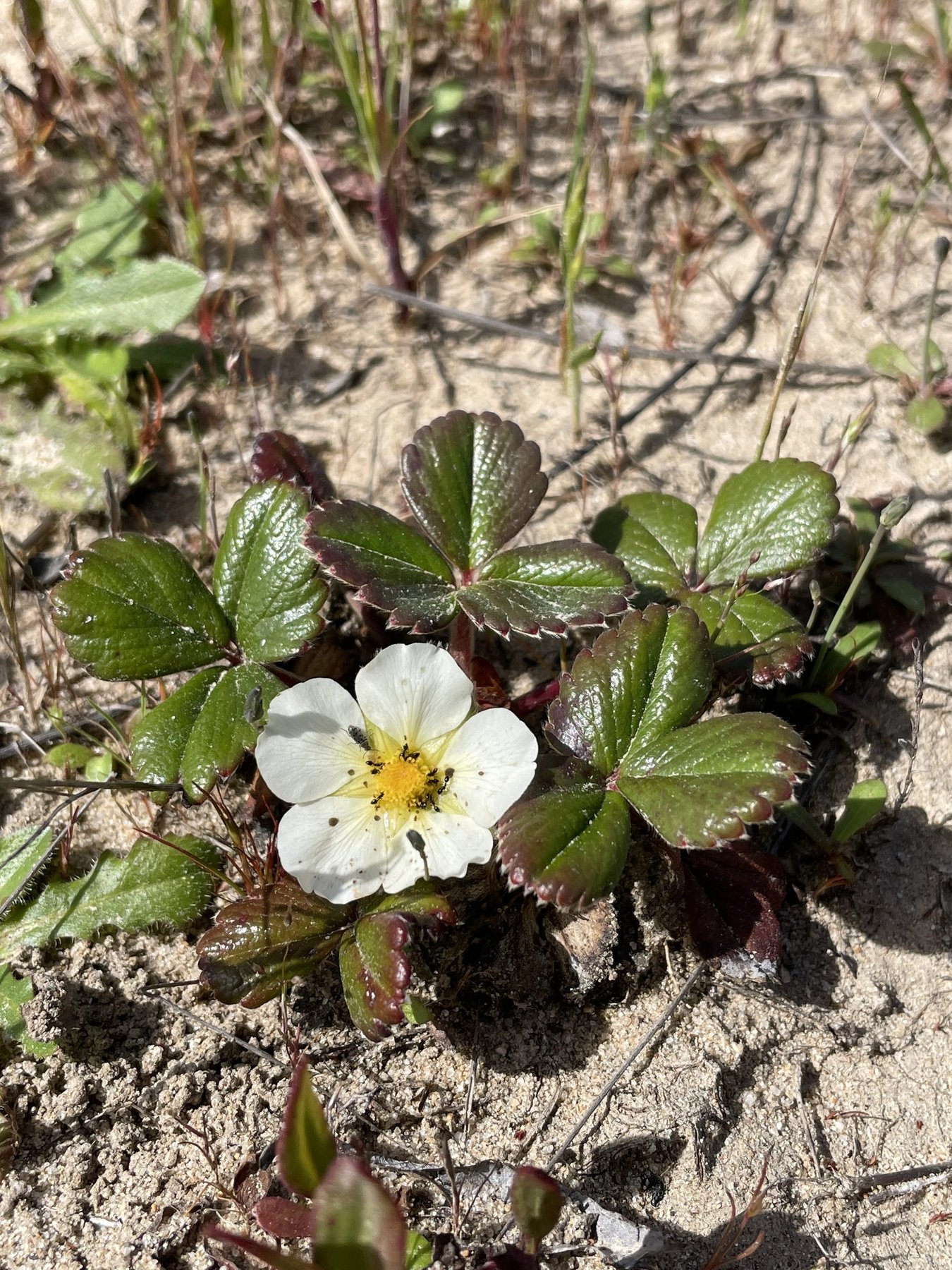
Beach strawberry, Fragaria chiloensis , grows on dunes and headlands from Alaska to California (Burke Herbarium, n.d.-a). It's palmate too, but each leaflet has a short stalk of its own (Klinkenberg, n.d.-a), and the stalk on the end one can reach about 3/8 inch (10 mm) (Burke Herbarium, n.d.-a). It's still the first way, with the end leaflet starting to step forward.
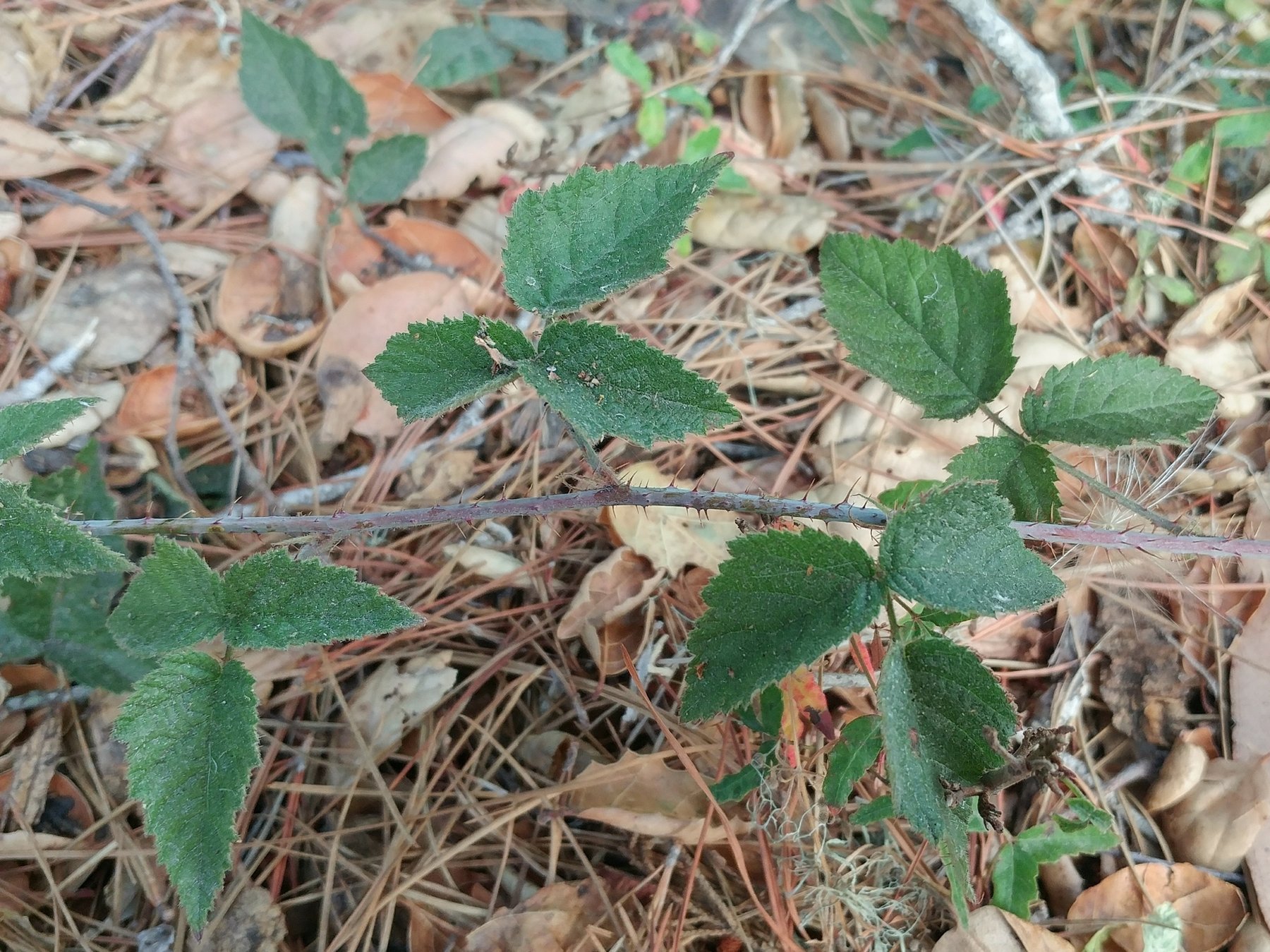
California blackberry, Rubus ursinus , shows how two floras can describe the same leaf in different words. E-Flora BC commits to the second way: it calls the leaf pinnately compound, with three leaflets (rarely five) and the end one the biggest, often cut into three lobes (Klinkenberg, n.d.-b). Flora of North America uses ternate, the word from earlier that only says the leaflets come in threes, and calls the leaves "usually ternate, sometimes simple or pinnately compound" (FNA, quoted in Burke Herbarium, n.d.-b). Neither one calls it palmate. E-Flora is the only one to name a build, and it says pinnate, so blackberry belongs with the second way.
Poison oak
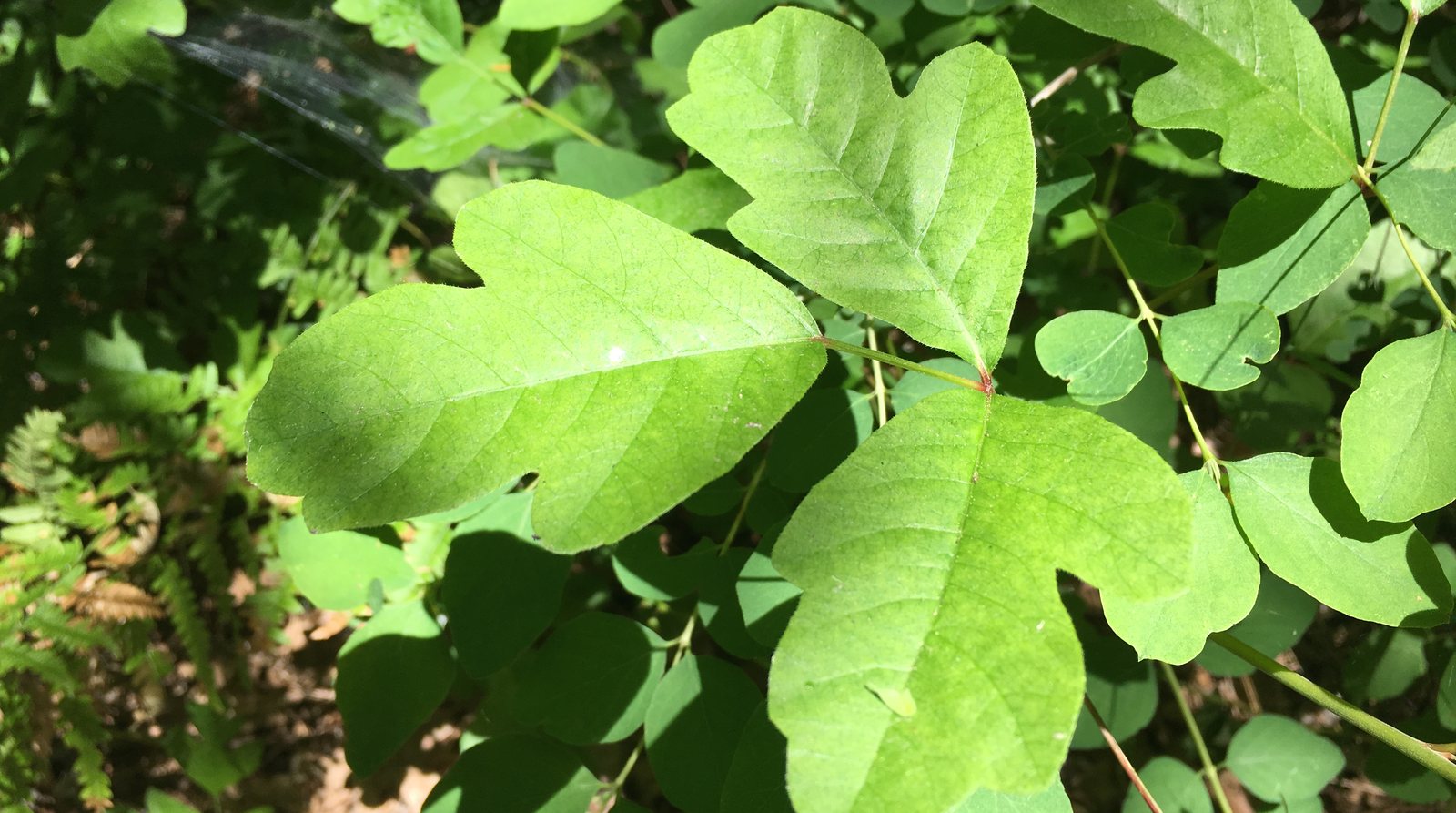
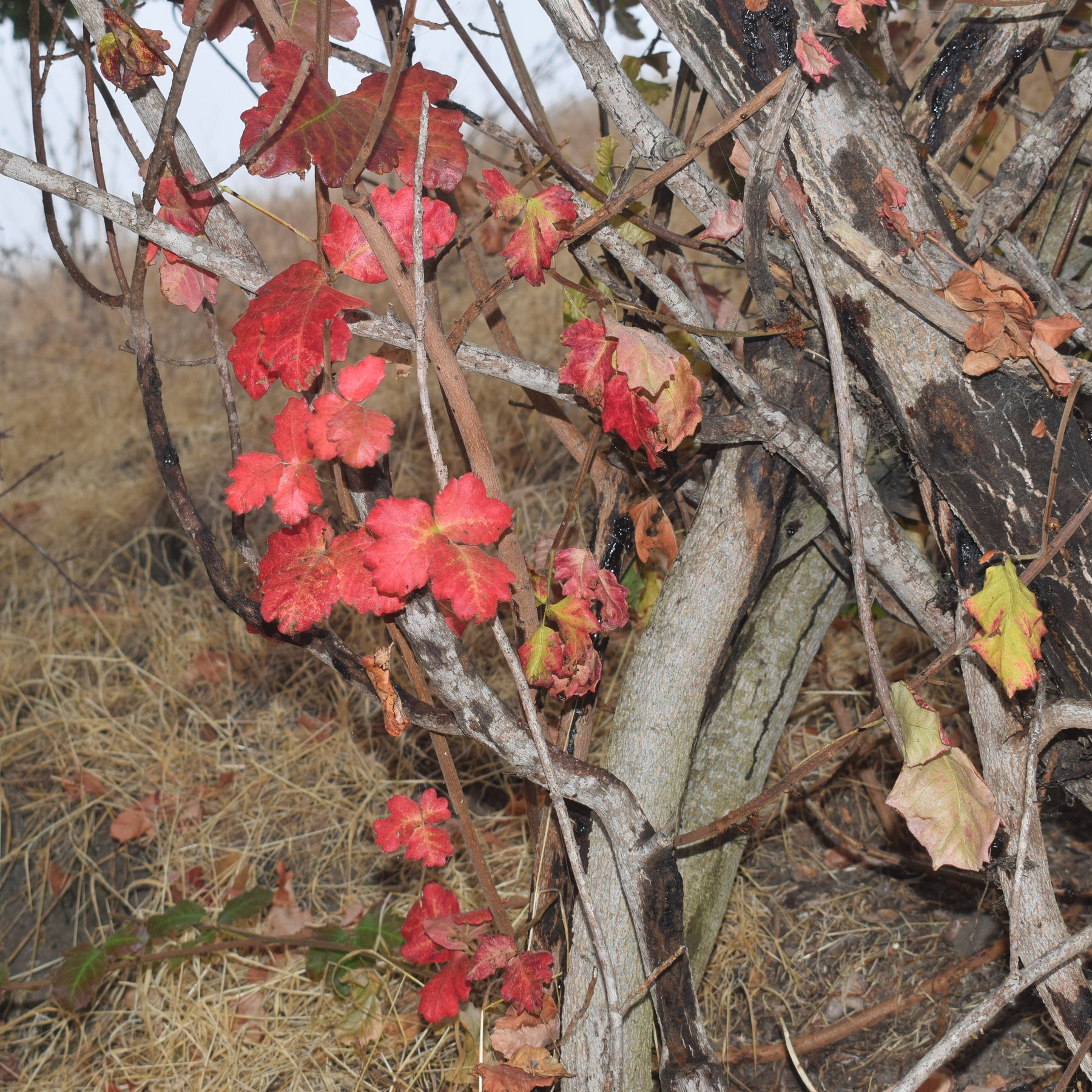
Pacific poison oak, Toxicodendron diversilobum , is the one I most want Bay Area gardeners to know on sight. Look at the stalks. The two side leaflets sit almost tight to the leaf, with stalks that are short or nearly absent, while the end leaflet can ride out on a stalk of its own, anywhere from almost nothing to about an inch long (0.1 to 2.6 cm) (FNA, quoted in Burke Herbarium, n.d.-c). When that end stalk is long, the leaf is the second way, and it isn't the three-from-one-point leaf most of us picture.
Count the leaflets and you'll usually get three, sometimes five (Howard, 1994). Usually isn't always. A National Park Service profile reports stems with up to seven or even nine (Daw, 2020). The leaflets are round to egg-shaped, lobed or toothed, and usually look like oak leaves (Howard, 1994). The lobes can vary even on a single plant, in poison oak and western poison ivy alike (Edmunds et al., 2018).
The color changes through the year. New leaves come in shiny and reddish, turn green for summer, then go yellow or scarlet before they drop in fall (Daw, 2020). Its form varies, too. It grows as a shrub 2 to 6 feet tall (0.6 to 1.8 m), or as a woody vine that climbs trees, with stems that commonly run 10 to 30 feet (3 to 9 m) (Howard, 1994). Flora of North America adds that it's sometimes a tree (FNA, quoted in Burke Herbarium, n.d.-c).
Counting to three
Three leaflets is where identification starts, not where it ends, so look past the count. Blackberry has fine prickles on its leaf-stalks and along the midribs underneath (Klinkenberg, n.d.-b). Beach strawberry keeps its leaves in low rosettes on coastal dunes and bluffs (Klinkenberg, n.d.-a; Burke Herbarium, n.d.-a). Poison oak is woody, a shrub or a climbing vine (Howard, 1994). If a three-leaflet plant is woody and you can't put a name to it, treat it as poison oak until you can.
Handling it safely
The trouble is the plant's oily resin. It covers the whole plant and carries urushiol , the compound behind the rash, and you don't have to touch the plant to get it. Clothing or firewood that has touched the plant can pass it on (Howard, 1994).
Bare winter stems still carry it. The Park Service profile says the oil is there year-round, even on leafless branches (Daw, 2020). A Pacific Northwest Extension guide says it can stay active for a long time on gloves and other clothing, tools, pets and firewood. Careful washing with soap and water after exposure can break it down, the guide says. If a rash still shows up after laundering, dry cleaning or getting rid of the item may be necessary (Edmunds et al., 2018).
If you have to work near it, cover up. If you must handle it, the Extension guide recommends loose clothing or coveralls and vinyl gloves, since the oil can seep through permeable materials. If it does reach your skin, wash with soap and water as soon as you can. Roots and stems removed by digging or pulling carry urushiol too, and the guide suggests that people who react to it probably shouldn't dig or pull it out themselves. Wash exposed clothes on their own, not with the rest of the laundry, and rinse the machine afterward (Edmunds et al., 2018).
And never burn it. The Pacific Northwest Extension guide reports that breathing smoke near burning poison oak or western poison ivy has caused reactions in people thought to be immune (Edmunds et al., 2018). The smoke carries urushiol on bits of dust and ash, not as a vapor. Breathing it can inflame the airways and cause a rash across the body that can require hospitalization and intensive care (Edmunds et al., 2018).
Three leaflets is the shape, and the stalks tell you how it's built. White clover's three meet at almost one point; poison oak's end leaflet can sit out on a stalk of its own, up to about an inch long (FNA, quoted in Burke Herbarium, n.d.-c, n.d.-d). And a woody plant with three leaflets that you can't name is one to leave alone.
Photo credits: the hero, Pacific poison oak in Shasta-Trinity National Forest, is by Region 5 Photography (U.S. Forest Service, Pacific Southwest Region), CC BY 2.0, via Wikimedia Commons, cropped. White clover by Rudyard, beach strawberry by Mike Heine and California blackberry by Casey H. Richart, each CC BY 4.0 via iNaturalist, resized. Poison oak in fall color via iNaturalist, public domain (CC0). The two-ways drawing is the Guild's own.
Go deeper in the free Apprenticeship: Module I, How a Plant Works →
Burke Herbarium. (n.d.-a). Fragaria chiloensis. Burke Herbarium Image Collection, University of Washington. Retrieved October 21, 2026, from https://biology.burke.washington.edu/herbarium/imagecollection/taxon.php?Taxon=Fragaria%20chiloensis
Burke Herbarium. (n.d.-b). Rubus ursinus. Burke Herbarium Image Collection, University of Washington. Retrieved October 21, 2026, from https://biology.burke.washington.edu/herbarium/imagecollection/taxon.php?Taxon=Rubus%20ursinus
Burke Herbarium. (n.d.-c). Toxicodendron diversilobum. Burke Herbarium Image Collection, University of Washington. Retrieved October 21, 2026, from https://biology.burke.washington.edu/herbarium/imagecollection/taxon.php?Taxon=Toxicodendron%20diversilobum
Burke Herbarium. (n.d.-d). Trifolium repens. Burke Herbarium Image Collection, University of Washington. Retrieved October 21, 2026, from https://biology.burke.washington.edu/herbarium/imagecollection/taxon.php?Taxon=Trifolium%20repens
Daw, S. (2020, May). Pacific poison oak. National Park Service. https://www.nps.gov/articles/000/pacific-poison-oak.htm
Eckel, P. M. (n.d.). Ternatus. In A grammatical dictionary of botanical Latin. Missouri Botanical Garden. Retrieved October 21, 2026, from https://www.mobot.org/mobot/latindict/keyDetail.aspx?keyWord=ternatus
Edmunds, B., Grand, L., Christiansen, A., & Hulting, A. (2018). Pacific poison-oak and western poison-ivy: Identification and management (PNW 108, rev.). Pacific Northwest Extension. https://extension.oregonstate.edu/sites/default/files/documents/pnw108.pdf
Howard, J. L. (1994). Toxicodendron diversilobum. In Fire Effects Information System. U.S. Department of Agriculture, Forest Service, Rocky Mountain Research Station, Fire Sciences Laboratory. https://www.fs.usda.gov/database/feis/plants/vine/toxdiv/all.html
Klinkenberg, B. (Ed.). (n.d.-a). Fragaria chiloensis. E-Flora BC: Electronic Atlas of the Plants of British Columbia. Department of Geography, University of British Columbia. Retrieved October 21, 2026, from https://linnet.geog.ubc.ca/Atlas/Atlas.aspx?sciname=Fragaria%20chiloensis
Klinkenberg, B. (Ed.). (n.d.-b). Rubus ursinus. E-Flora BC. Retrieved October 21, 2026, from https://linnet.geog.ubc.ca/Atlas/Atlas.aspx?sciname=Rubus%20ursinus
Klinkenberg, B. (Ed.). (n.d.-c). Trifolium repens. E-Flora BC. Retrieved October 21, 2026, from https://linnet.geog.ubc.ca/Atlas/Atlas.aspx?sciname=Trifolium%20repens
Lady Bird Johnson Wildflower Center. (2007). Trifoliate. In Native plant glossary. University of Texas at Austin. Retrieved October 21, 2026, from https://www.wildflower.org/glossary/show.php?id=117
Merriam-Webster. (n.d.). Trifoliate. In Merriam-Webster.com dictionary. Retrieved October 21, 2026, from https://www.merriam-webster.com/dictionary/trifoliate
New York Botanical Garden. (n.d.). Trifoliolate. In Glossary, William & Lynda Steere Herbarium. Retrieved October 21, 2026, from https://sweetgum.nybg.org/science/glossary/glossary-details/?irn=1611