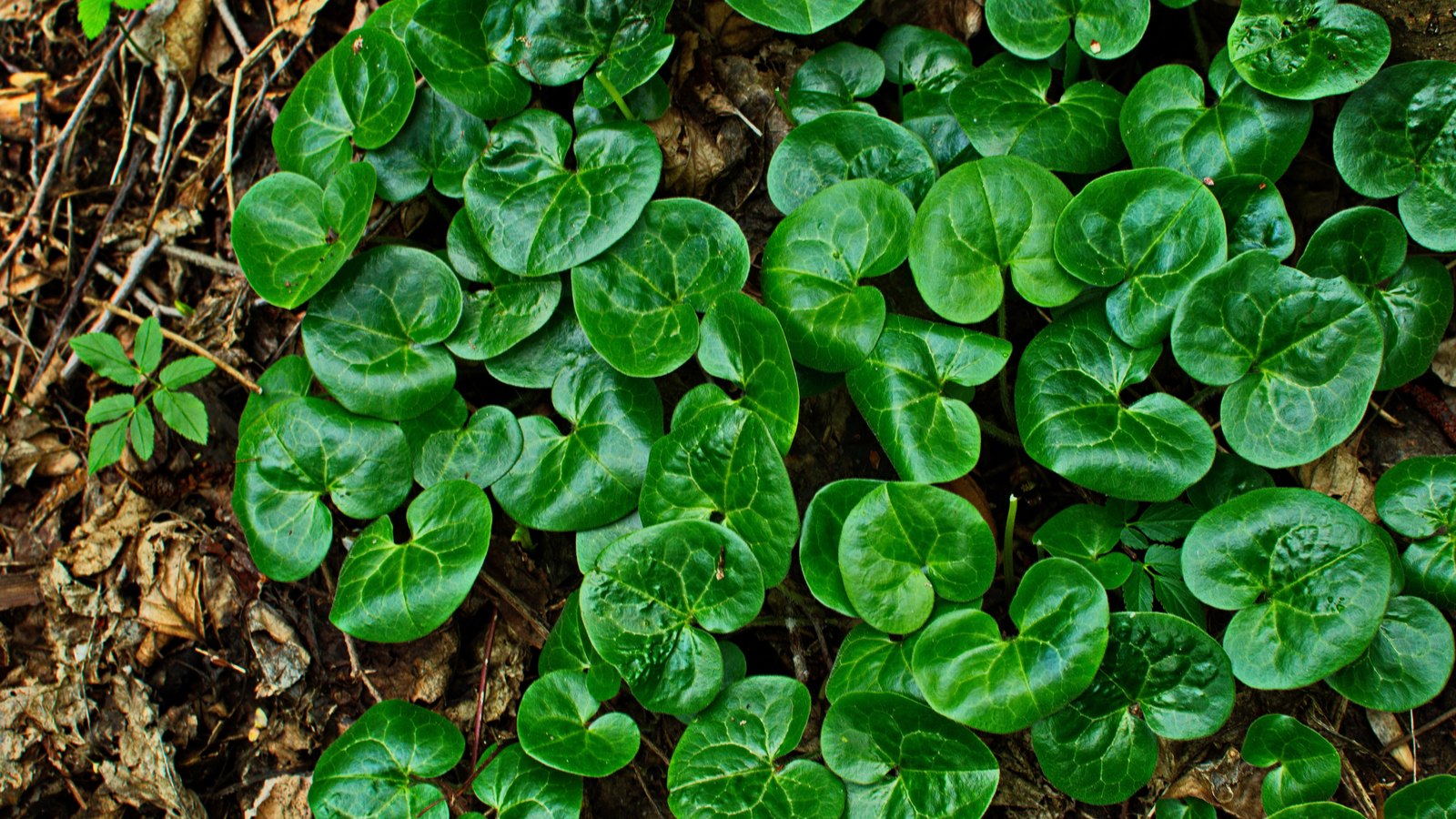
The kidney-shaped leaf: wider than it is long, rounded all the way around, notched where the stalk comes in. The textbook example is a wild ginger. The wild ginger in Bay Area shade gardens is the one the floras argue about.
A reniform leaf is shaped like a kidney. The word comes from the New Latin reniformis, and Merriam-Webster's definition is about as short as they come: "suggesting a kidney in outline" (Merriam-Webster, n.d.-c).
Reading the shape
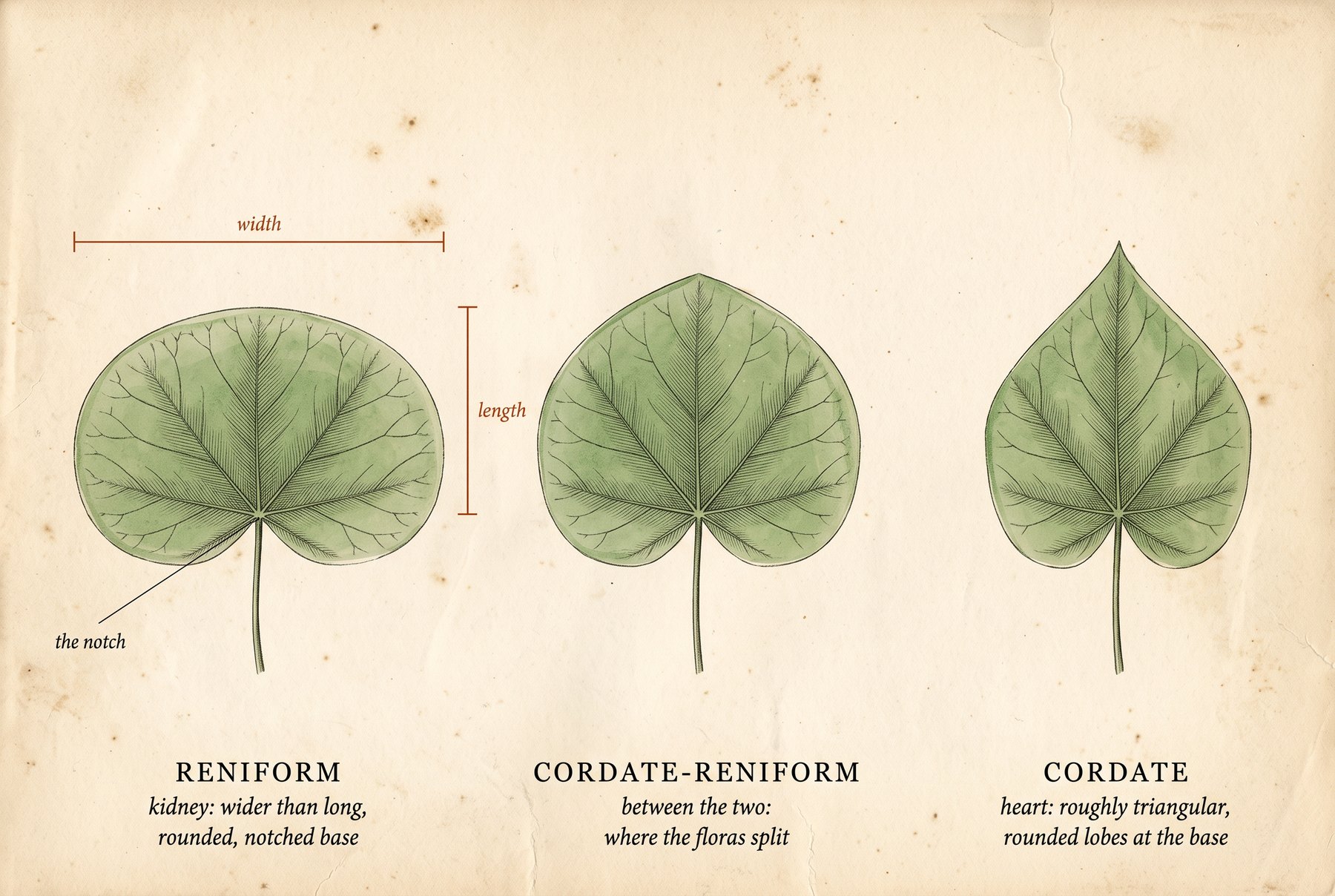
Botanists have been more specific. A definition by Lindley, quoted in the Missouri Botanical Garden's dictionary of botanical Latin, describes a reniform leaf as "crescent-shaped, with the ends rounded," and gives a single example: the leaf of European wild ginger, Asarum europaeum (Eckel, n.d.). The Naturalis Biodiversity Center's botanical glossary puts it plainly: "wider than long with rounded lobes at base" (Naturalis Biodiversity Center, n.d.-b).
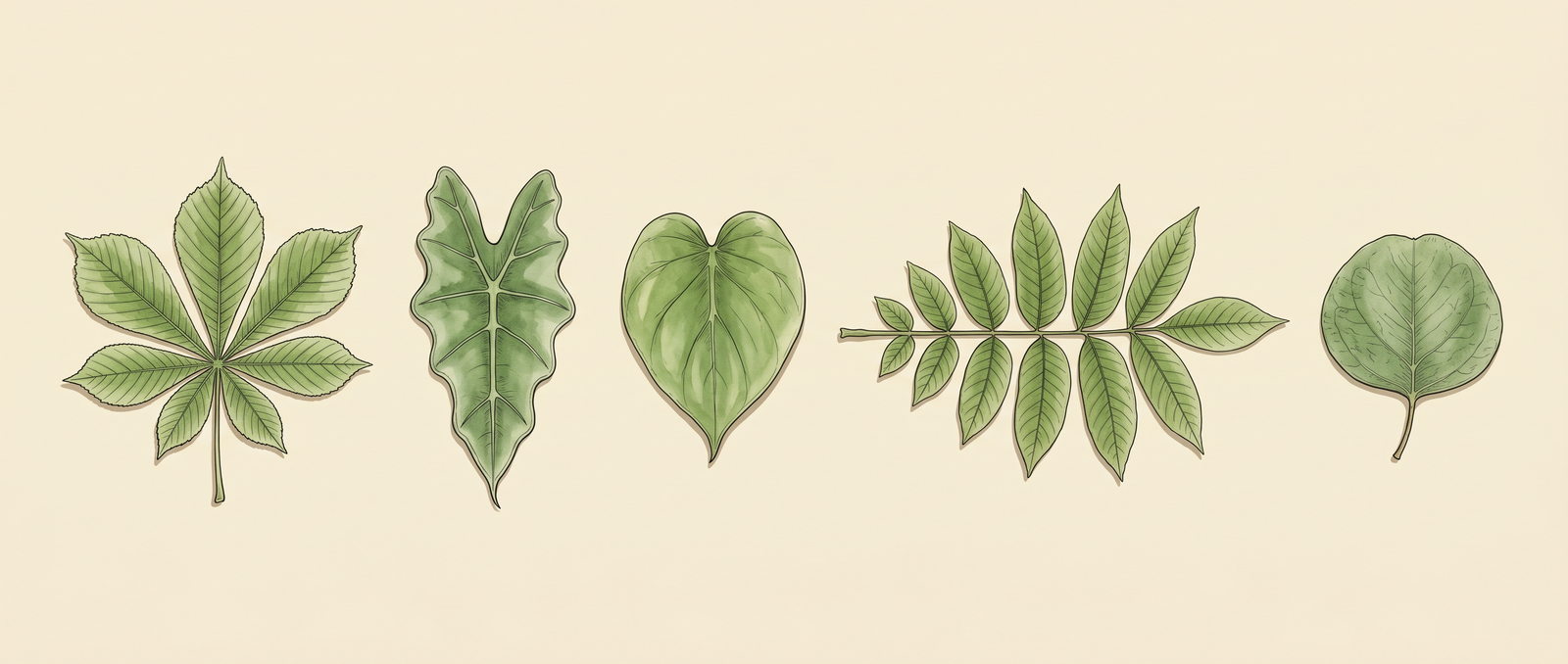
So three features make the shape. The blade is broader than it is long. The outline is rounded rather than pointed. And there's a notch at the base, where the two rounded lobes meet.
That notch is where reniform runs into its neighbor. The same glossary describes a heart-shaped, or cordate, leaf as "more or less triangular with rounded lobes at the base" (Naturalis Biodiversity Center, n.d.-a), so the two shapes share a base and differ in outline. Botanical Latin even has a word for leaves caught between the two, reniformi-cordatus, "both kidney-shaped and heart-shaped combined" (Eckel, n.d.). Modern floras use the plainer "cordate-reniform" for the same in-between outline.
The wild gingers
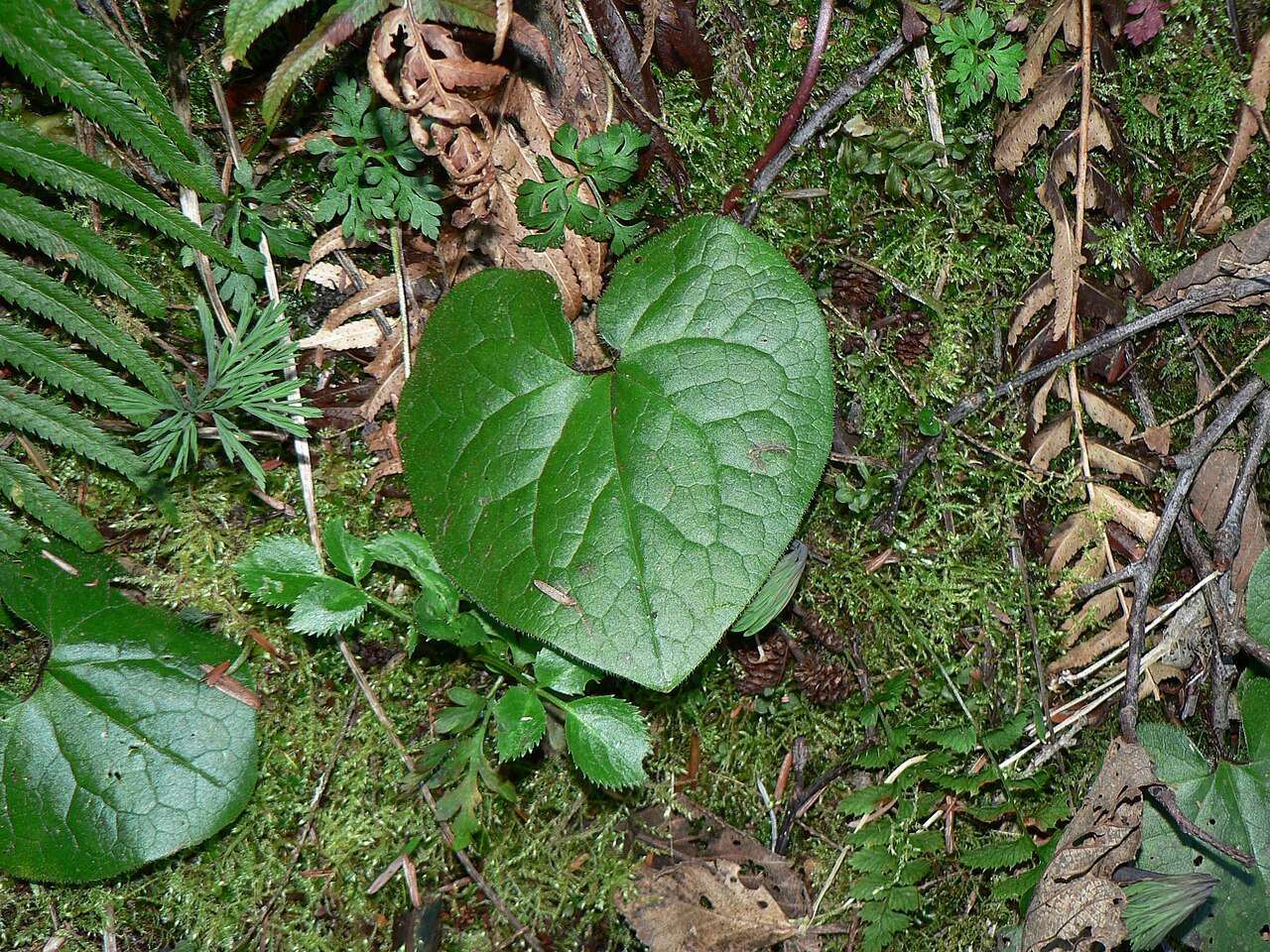
The wild gingers, Asarum, are low, creeping plants that spread by rhizomes (underground stems) and carry their leaves on stalks that rise directly from the ground (Flora of North America [FNA], n.d.-a). They're also where the kidney and the heart are hardest to tell apart.
Take the wild ginger native to California's coast: western wild ginger, Asarum caudatum . Flora of North America calls its leaf blade cordate, about 1.2 to 3.3 inches long by 1.8 to 4.7 inches wide (3 to 8.5 by 4.5 to 12 cm) (FNA, n.d.-c). Its identification key for the genus uses that very call, "leaves cordate," to separate western wild ginger from the eastern and Oregon species whose leaves run "cordate-reniform to reniform" (FNA, n.d.-a).
Other references disagree. E-Flora BC, from the University of British Columbia, describes the same plant's leaves as "Kidney-shaped," with blades about 1 to 4 inches long and 2 to 6 inches wide (2.5 to 10 by 5 to 15 cm) (Klinkenberg, n.d.). The University of Washington's Burke Herbarium calls them "reniform, cordate-based" (Burke Herbarium, n.d.). Merriam-Webster's dictionary entry for wild ginger says the genus usually has "cordate leaves" (Merriam-Webster, n.d.-b). The U.S. Forest Service splits the difference with "heart- or kidney-shaped" (Gucker, 2004), and the California Native Plant Society's Calscape writes "reniform (kidney/heart shaped)" (California Native Plant Society, n.d.).
Our read is that they're mostly describing different parts of the same leaf. The base is cordate: two rounded lobes meeting at a notch. The overall outline is often wider than long, which is the kidney proportion, and FNA's own measurements allow for that. Where you put western wild ginger depends on which feature you weight. If you want leaves the floras put more firmly on the kidney side, look at its relatives: eastern wild ginger, A. canadense, with blades about 1.6 to 3.1 inches long by 3.1 to 5.5 inches wide (4 to 8 by 8 to 14 cm) (FNA, n.d.-b), and Wagner's wild ginger, A. wagneri, from the southern Oregon Cascades, with blades FNA describes as "broadly reniform to cordate-reniform" (FNA, n.d.-d).
Where else you see it
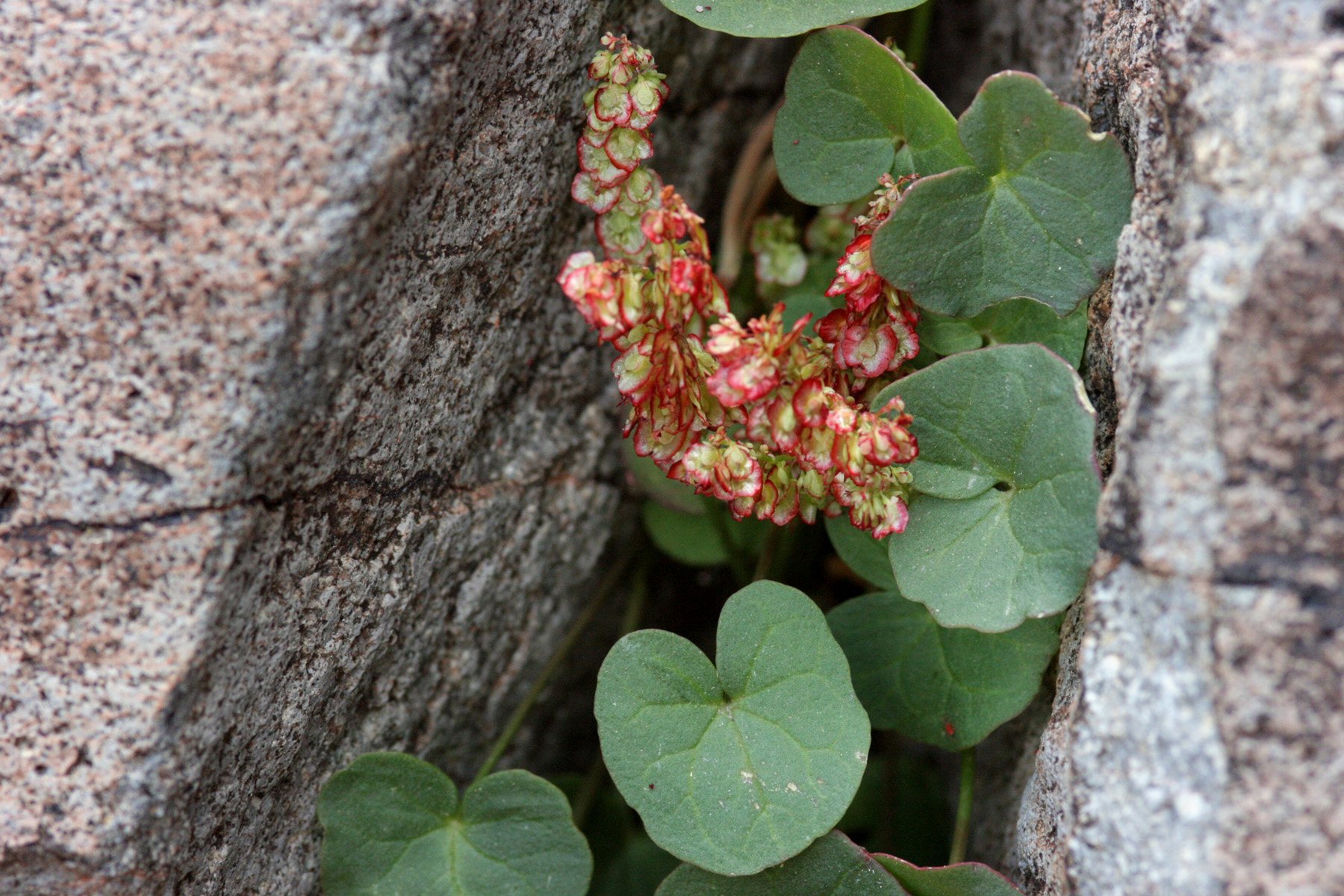
Kidney-shaped leaves turn up in plants that otherwise have little in common. Asian pennywort, Centella asiatica , has blades the Flora of China describes as "orbicular or reniform," round or kidney-shaped (Flora of China, n.d.-a). Mountain sorrel, Oxyria digyna , has blades described as "reniform or orbicular-reniform" (Flora of China, n.d.-b).
Mountain sorrel is also a good reason not to read too much into the shape. It's easy to picture a kidney-shaped leaf as a shade plant's leaf, held low over damp forest soil, and western wild ginger fits that picture. Mountain sorrel doesn't: FNA lists it on early-melting snowbeds, gravel bars, tundra and scree slopes (FNA, n.d.-e). Even Wagner's wild ginger grows in fir forest and in open boulder fields near timberline (FNA, n.d.-d). We looked for research linking the reniform shape itself to shade and found none.
What growers should do with this
If you want a reniform leaf in a Bay Area garden, western wild ginger is the native to try, with the caveat above about which side of the line it falls on. Calscape says that within California it is found "primarily along the coast from Santa Cruz County northward," and says that in the garden it "must have regular water and virtually no direct sun" (California Native Plant Society, n.d.). FNA puts it in the understory of conifer forests, usually in moist or wet places (FNA, n.d.-c). The Forest Service describes it as evergreen in most of its range (Gucker, 2004), though FNA's description of the genus calls it deciduous (FNA, n.d.-a). The flowers are easy to miss: hairy cups, brown-purple to greenish yellow, ending in three long curved lobes and often hidden under the leaves (California Native Plant Society, n.d.).
One safety note. Wild ginger isn't the ginger you cook with. Merriam-Webster places wild ginger in the birthwort family and kitchen ginger in a different family entirely (Merriam-Webster, n.d.-a, n.d.-b). The National Toxicology Program lists aristolochic acids as known human carcinogens and reports finding them in Asarum species, at levels from trace amounts to 3,377 ppm (parts per million) (National Toxicology Program, n.d.). One lab study found high amounts of aristolochic acid I in eastern wild ginger's leaves and didn't detect it in its single leaf sample of western wild ginger (Michl et al., 2017). That's one leaf sample, not a clean bill of health. Grow wild ginger to look at; don't eat it or brew it.
When you meet a rounded leaf with a notched base, check the proportions before you name it. Wider than long and rounded all around is a kidney. More or less triangular above a notched base is a heart. Everything in between is a judgment call, and the floras don't all make the same one.
Photo credits: the hero (European wild ginger) is licensed from Adobe Stock, cropped from the original. Western wild ginger © Walter Siegmund, CC BY 2.5, via Wikimedia Commons, resized. Mountain sorrel by Patrick Alexander, CC0, via Wikimedia Commons. The comparison figure is an original illustration by The Planters' Guild.
Burke Herbarium. (n.d.). Asarum caudatum. Burke Herbarium Image Collection, University of Washington. Retrieved October 15, 2026, from https://biology.burke.washington.edu/herbarium/imagecollection/taxon.php?Taxon=Asarum%20caudatum
California Native Plant Society. (n.d.). Asarum caudatum (wild ginger). Calscape. Retrieved October 15, 2026, from https://calscape.org/Asarum-caudatum-(Wild-Ginger)
Eckel, P. M. (n.d.). Reniformis. In A grammatical dictionary of botanical Latin. Missouri Botanical Garden. Retrieved October 15, 2026, from https://www.mobot.org/mobot/latindict/keyDetail.aspx?keyWord=reniformis
Flora of China Editorial Committee. (n.d.-a). Centella asiatica. In Flora of China (Vol. 14). Retrieved October 15, 2026, from http://www.efloras.org/florataxon.aspx?flora_id=2&taxon_id=200015478
Flora of China Editorial Committee. (n.d.-b). Oxyria digyna. In Flora of China (Vol. 5). Retrieved October 15, 2026, from http://www.efloras.org/florataxon.aspx?flora_id=2&taxon_id=200006711
Flora of North America Editorial Committee. (n.d.-a). Asarum. In Flora of North America north of Mexico (Vol. 3). Retrieved October 15, 2026, from http://www.efloras.org/florataxon.aspx?flora_id=1&taxon_id=102755
Flora of North America Editorial Committee. (n.d.-b). Asarum canadense. In Flora of North America north of Mexico (Vol. 3). Retrieved October 15, 2026, from http://www.efloras.org/florataxon.aspx?flora_id=1&taxon_id=233500168
Flora of North America Editorial Committee. (n.d.-c). Asarum caudatum. In Flora of North America north of Mexico (Vol. 3). Retrieved October 15, 2026, from http://www.efloras.org/florataxon.aspx?flora_id=1&taxon_id=233500169
Flora of North America Editorial Committee. (n.d.-d). Asarum wagneri. In Flora of North America north of Mexico (Vol. 3). Retrieved October 15, 2026, from http://www.efloras.org/florataxon.aspx?flora_id=1&taxon_id=233500173
Flora of North America Editorial Committee. (n.d.-e). Oxyria digyna. In Flora of North America north of Mexico (Vol. 5). Retrieved October 15, 2026, from http://www.efloras.org/florataxon.aspx?flora_id=1&taxon_id=200006711
Gucker, C. L. (2004). Asarum caudatum. In Fire Effects Information System. U.S. Department of Agriculture, Forest Service, Rocky Mountain Research Station, Fire Sciences Laboratory. https://www.fs.usda.gov/database/feis/plants/forb/asacau/all.html
Klinkenberg, B. (Ed.). (n.d.). Asarum caudatum. E-Flora BC: Electronic Atlas of the Plants of British Columbia. Department of Geography, University of British Columbia. Retrieved October 15, 2026, from https://linnet.geog.ubc.ca/Atlas/Atlas.aspx?sciname=Asarum%20caudatum
Merriam-Webster. (n.d.-a). Ginger. In Merriam-Webster.com dictionary. Retrieved October 15, 2026, from https://www.merriam-webster.com/dictionary/ginger
Merriam-Webster. (n.d.-b). Wild ginger. In Merriam-Webster.com dictionary. Retrieved October 15, 2026, from https://www.merriam-webster.com/dictionary/wild%20ginger
Merriam-Webster. (n.d.-c). Reniform. In Merriam-Webster.com dictionary. Retrieved October 15, 2026, from https://www.merriam-webster.com/dictionary/reniform
Michl, J., Bello, O., Kite, G. C., Simmonds, M. S. J., & Heinrich, M. (2017). Medicinally used Asarum species: High-resolution LC-MS analysis of aristolochic acid analogs and in vitro toxicity screening in HK-2 cells. Frontiers in Pharmacology, 8, 215. https://doi.org/10.3389/fphar.2017.00215
National Toxicology Program. (n.d.). Aristolochic acids. In Report on carcinogens (15th ed.). U.S. Department of Health and Human Services. https://ntp.niehs.nih.gov/sites/default/files/ntp/roc/content/profiles/aristolochicacids.pdf
Naturalis Biodiversity Center. (n.d.-a). Cordate. In Orchids of New Guinea: Glossary. Retrieved October 15, 2026, from https://orchids.naturalis.nl/linnaeus_ng/app/views/glossary/term.php?id=12786
Naturalis Biodiversity Center. (n.d.-b). Reniform. In Orchids of New Guinea: Glossary. Retrieved October 15, 2026, from https://orchids.naturalis.nl/linnaeus_ng/app/views/glossary/term.php?id=13102

.jpg)