California buckeye and the case of the summer-deciduous tree. The morphology that lets Aesculus californica drop every leaf before August and call it a year well spent.
Walk through any Bay Area open space in mid-July and you'll find California buckeyes bare and brown, looking finished for the year. They aren't. They're doing exactly what they evolved to do.
By August most have dropped every leaf. By February they're in full flush again. That's the inverse of the seasonal calendar most plant guides assume, and the shape of the leaf is part of how the tree pulls it off.
Reading the shape
In a palmately compound leaf, all the leaflets attach at a single point at the tip of the petiole (the stalk connecting a leaf to its stem). They radiate outward like the fingers of a hand. There's no rachis (the central axis you'd find running down a pinnately compound leaf like a walnut or ash), so the leaflets meet rather than line up (Britannica, n.d.; American Museum of Natural History, n.d.).
The diagnostic test is simple: trace the leaflets back to where they attach. If every leaflet meets at one point, it's palmately compound. If they pair off along an extended axis (think walnut leaf), it's pinnately compound. Maples are a different category again. The blade is one continuous lobed surface, and the lobes never separate into distinct leaflets. So maples are palmately lobed; buckeyes are palmately compound. Hand-shaped, but not the same anatomy.
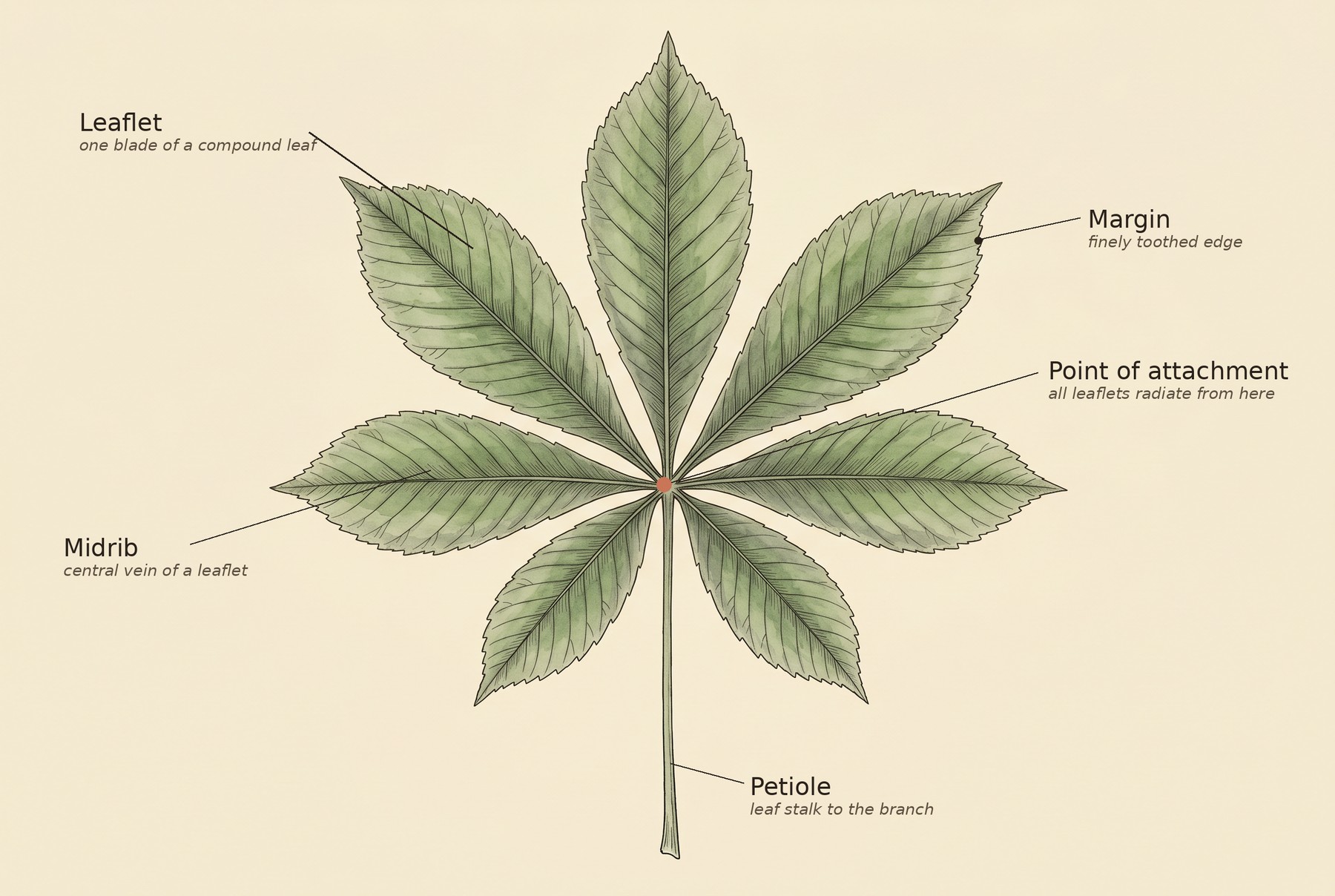
That single point of attachment is the feature to look for, and the morphology that follows from it isn't accidental either. Compound leaves develop through tightly regulated genetic programs (He et al., 2020).
The strategy
Aesculus californica is one of California's few summer-deciduous woody plants. It leafs out in February, runs full photosynthesis through spring, and drops its leaves as soils dry in June or July (Calscape, n.d.; Howard, 1992).
This inverts the temperate-deciduous strategy. New England maples drop their leaves to survive winter cold. California buckeyes drop theirs to survive summer drought. The technical name is drought escape: the plant skips the stress entirely by not running expensive leaves during the period when water is scarcest (Tenhunen et al., 1990).
The shape is part of why it works. A leaf this big and this thin doesn't make sense to hold through a rainless summer, but palmately compound morphology gives buckeye a lot of photosynthetic surface area on a small number of attachment points. In a short wet-season window (February through June in most of the Bay Area), that's enough to do the year's photosynthesis, ripen fruit, and set bud for next spring. Then drop the whole engine in July and rebuild it in February.
Timing varies across the species' range. In the Sierra Nevada foothills, leaves dry up in late spring and often hang brown through summer before falling. Coastal-range buckeyes stay green considerably later, sometimes into early fall, wherever soil moisture holds (Calscape, n.d.). Summer irrigation pushes the green period out by a few weeks, the same way lingering coastal moisture does (Calscape, n.d.).
Where else you see it
Palmately compound shape shows up in lineages that haven't shared a common ancestor in tens of millions of years. Buckeyes, lupines, Schefflera, Pachira, and the pink trumpet tree (Tabebuia rosea) all sit in different plant families. Same shape, completely unrelated plants. The morphology is solving a recurring problem (maximum light capture per attachment point), so evolution has reinvented it more than once.
The shape across six plants
California buckeye
Aesculus californica
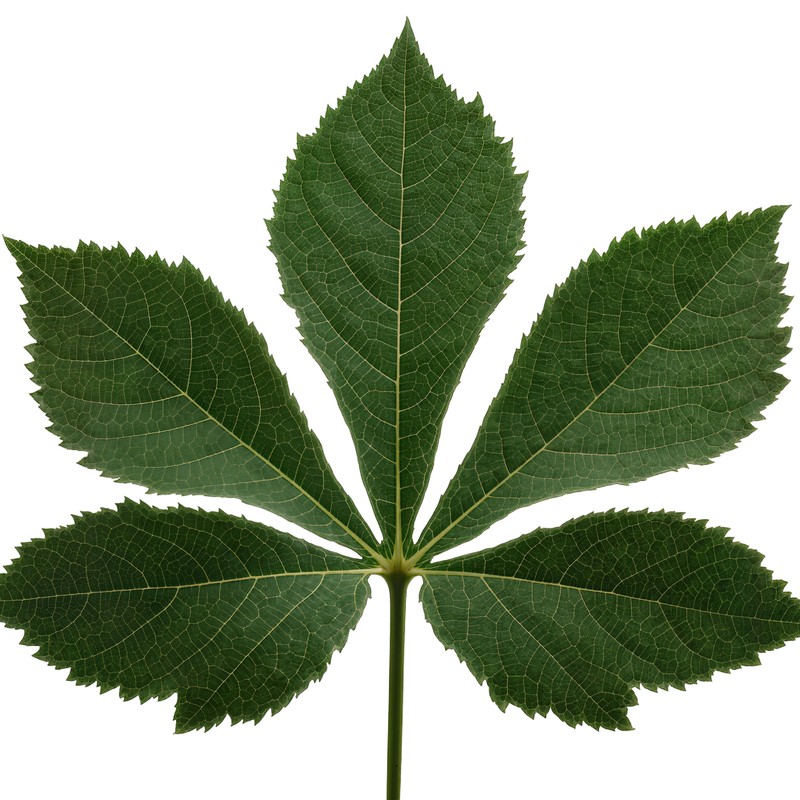
Horse chestnut
Aesculus hippocastanum
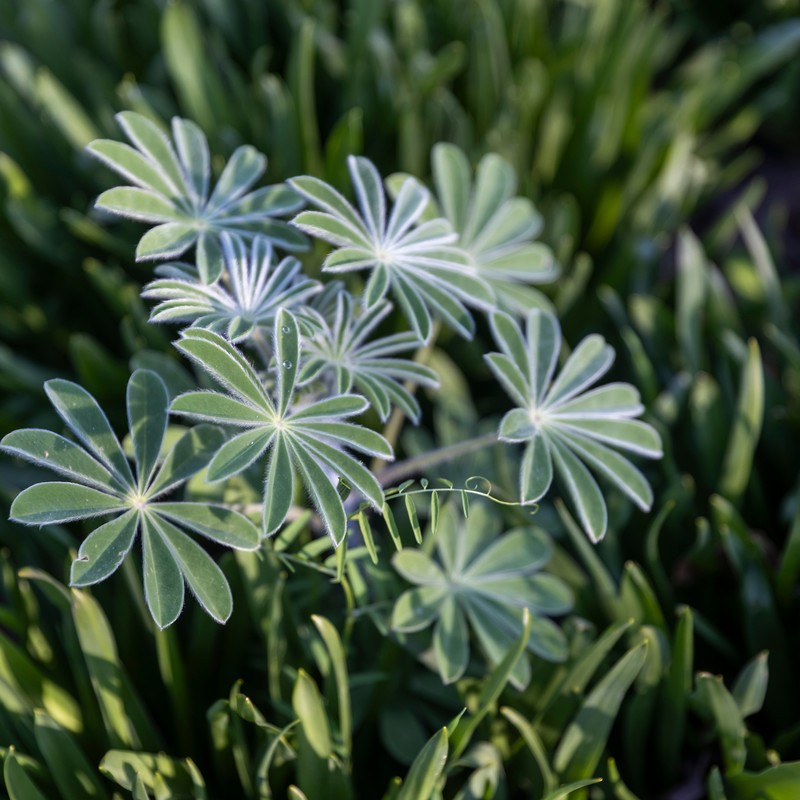
Silver bush lupine
Lupinus albifrons
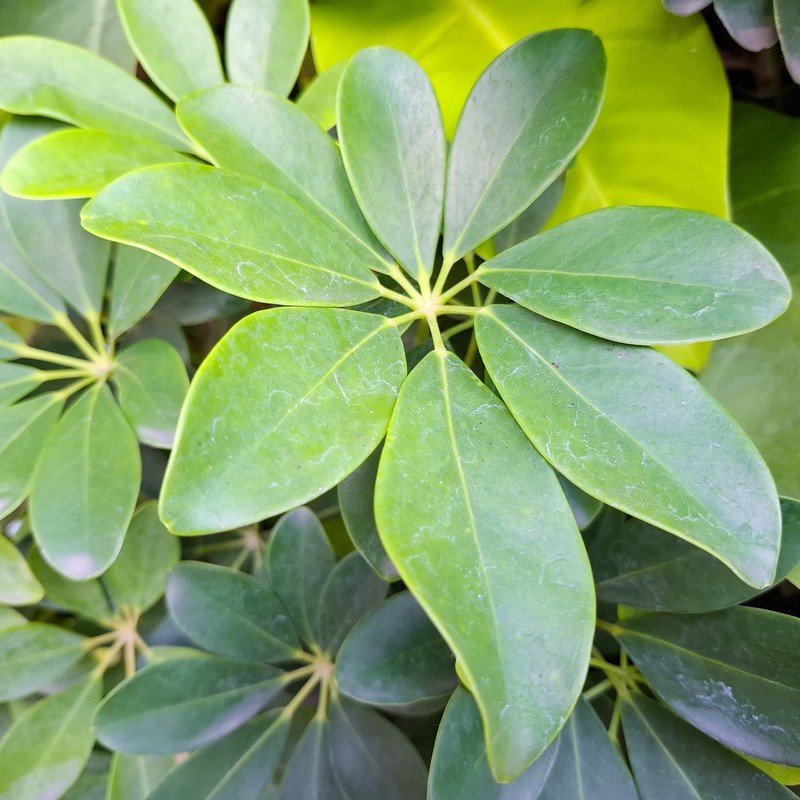
Dwarf umbrella tree
Schefflera arboricola
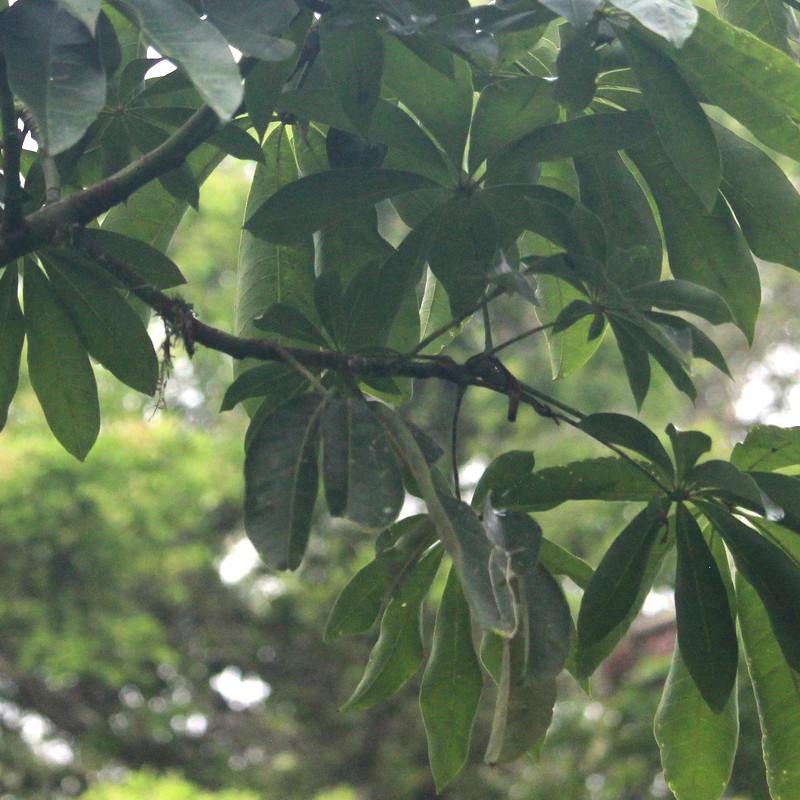
Money tree
Pachira aquatica
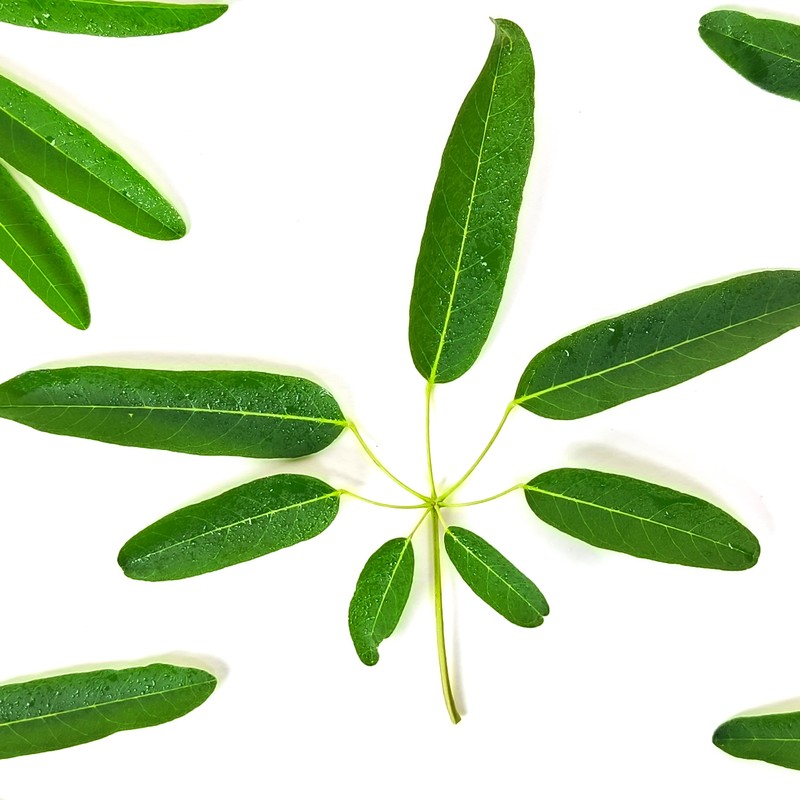
Pink trumpet tree
Tabebuia rosea
What growers should do with this
Shape predicts strategy, but climate decides whether the strategy runs. A Schefflera kept indoors at 72 °F (22 °C) never goes dormant; the same morphology in a Mediterranean climate triggers summer leaf drop. If you've planted Aesculus californica in your garden and watched it go brown in early July, that's not a problem to solve. It's the design working.
One caveat worth knowing before you plant: all parts of California buckeye contain saponins (soap-like plant compounds that disrupt cell membranes) and the pollen is notoriously toxic to honey bees (USDA NRCS, n.d.). Site the tree where you can appreciate it; just don't put it near your hives.
When a buckeye goes brown in July and your hand reaches for the hose, leave it alone. The tree knows what month it is.
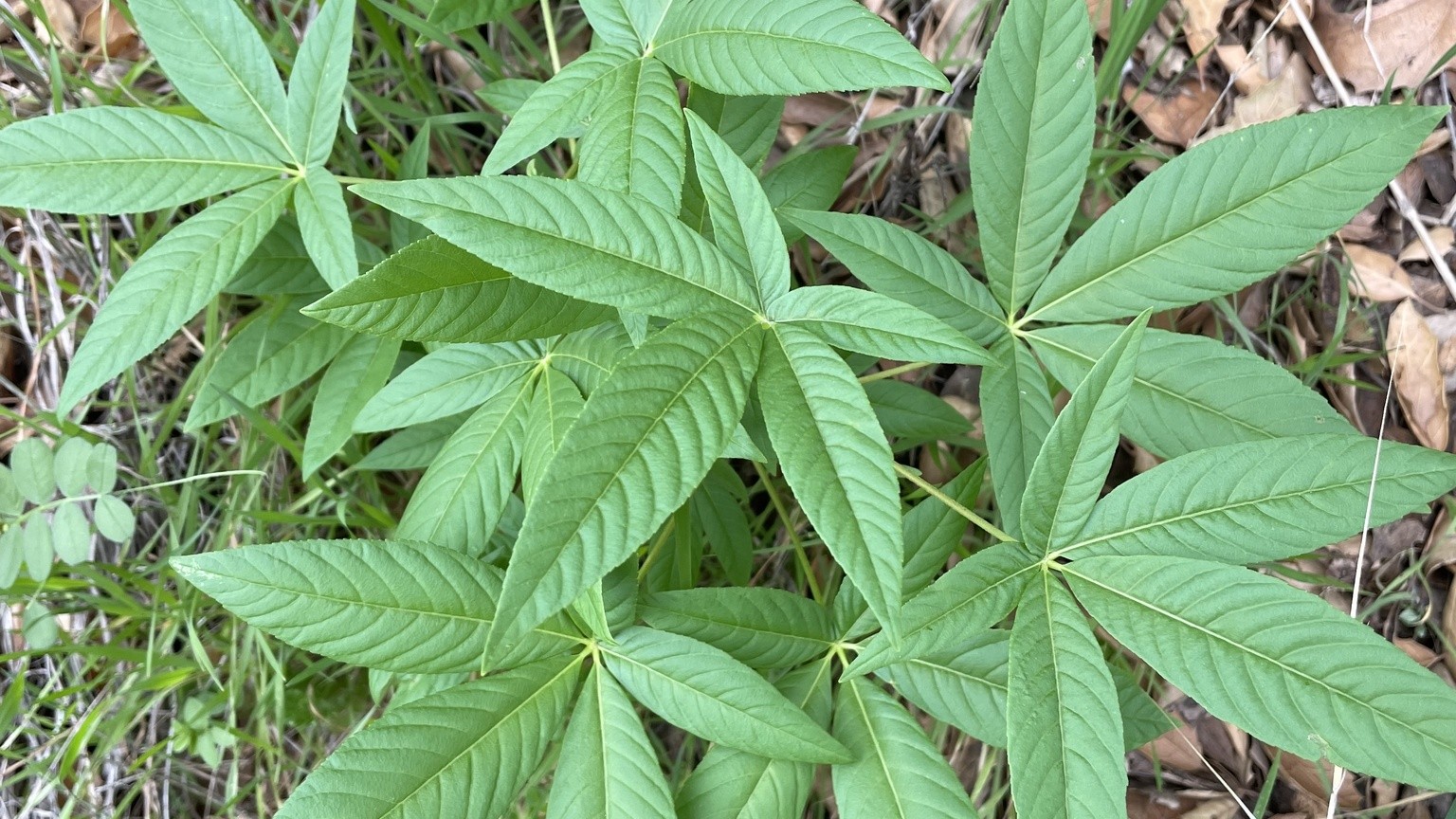
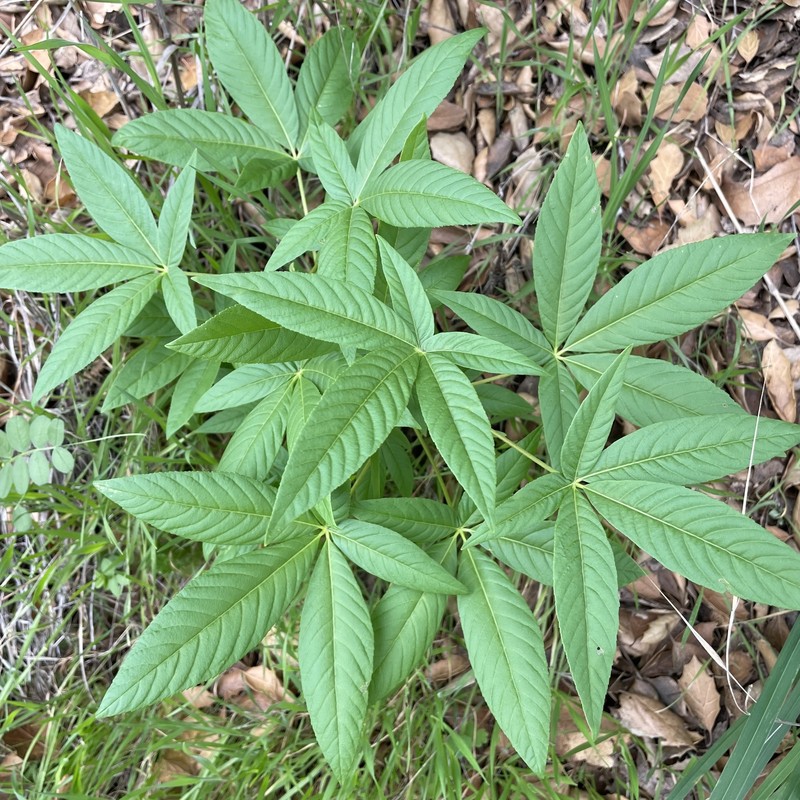
Photo credits: California buckeye leaf © katherinef2 and money tree leaf © Ricard Busquets Reverte, both licensed under CC BY 4.0 (cropped), via iNaturalist. The anatomy figure was generated with Adobe Firefly to a Planters' Guild brief.
American Museum of Natural History. (n.d.). Plant morphology: Types of compound leaves. https://www.amnh.org/learn-teach/curriculum-collections/biodiversity-counts/plant-identification/plant-morphology/types-of-compound-leaves
Britannica. (n.d.). Palmately compound leaf. Encyclopaedia Britannica. https://www.britannica.com/science/palmately-compound-leaf
California Native Plant Society. (n.d.). Aesculus californica (California buckeye). Calscape. https://calscape.org/Aesculus-californica-(California-Buckeye)
He, L., Liu, Y., He, H., Liu, Y., Qi, J., Zhang, X., Li, Y., Mao, Y., Zhou, S., Zheng, X., Bai, Q., Zhao, F., Wang, D., Wang, S., Zhu, Q., Tadege, M., Zhao, B., & Chen, J. (2020). A molecular framework underlying the compound leaf pattern of Medicago truncatula. Nature Plants, 6, 511–521. https://doi.org/10.1038/s41477-020-0642-2
Howard, J. L. (1992). Aesculus californica. In Fire Effects Information System. U.S. Department of Agriculture, Forest Service, Rocky Mountain Research Station, Fire Sciences Laboratory. https://www.fs.usda.gov/database/feis/plants/tree/aescal/all.html
Tenhunen, J. D., Sala Serra, A., Harley, P. C., Dougherty, R. L., & Reynolds, J. F. (1990). Factors influencing carbon fixation and water use by Mediterranean sclerophyll shrubs during summer drought. Oecologia, 82(3), 381–393. https://doi.org/10.1007/BF00317487
USDA Natural Resources Conservation Service. (n.d.). California buckeye (Aesculus californica) plant guide. https://www.nrcs.usda.gov/plantmaterials/capmcpg13492.pdf