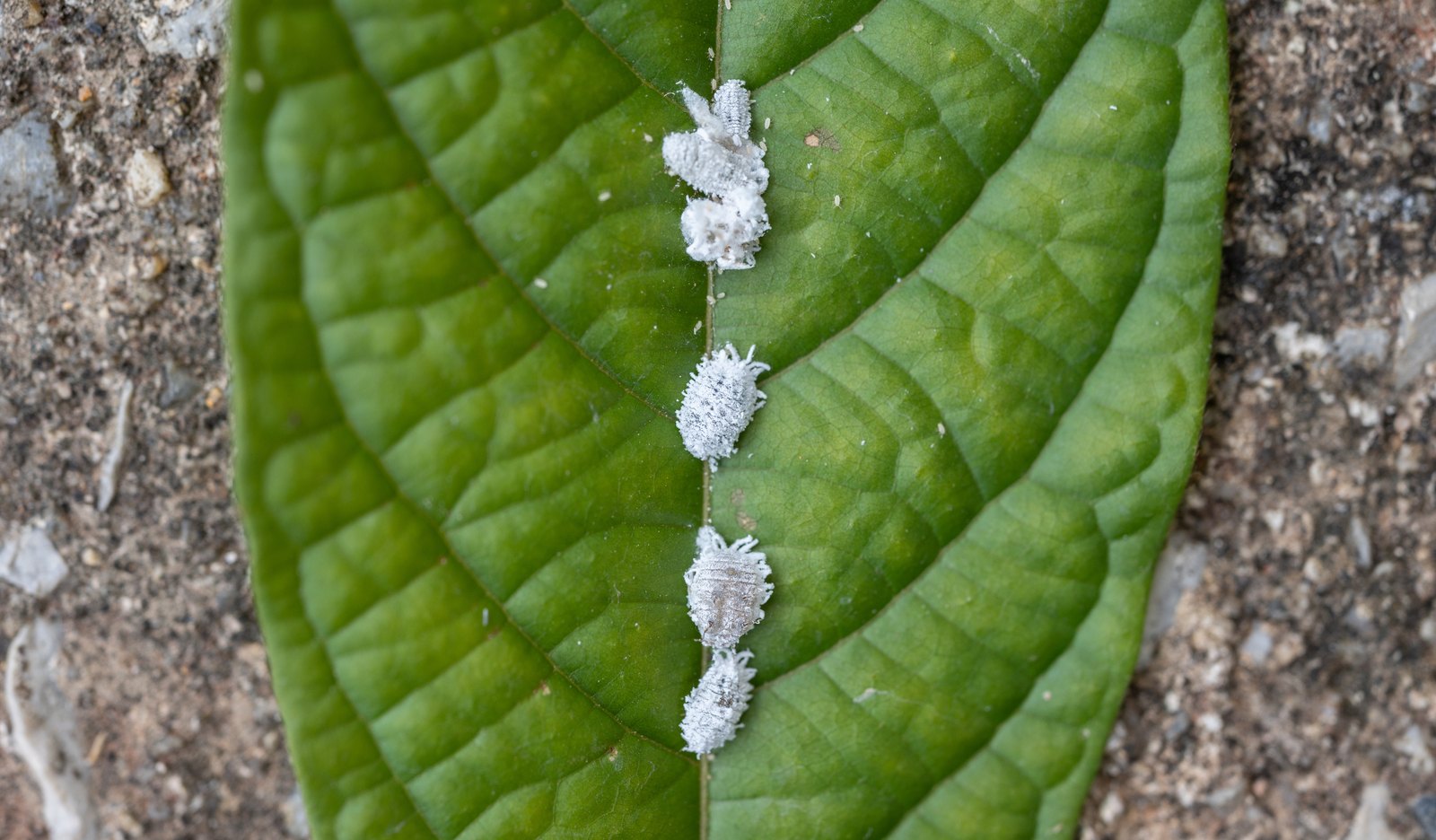
Everything difficult about mealybugs follows from one piece of engineering: a coat of hydrophobic wax. Understand the wax and the whole protocol falls into place, including the part where you check the roots.
Cotton in the crotch of a leaf
You almost never spot the first mealybug. What you spot is a scrap of white lint tucked where a leaf stalk meets the stem, and you flick it off with a fingernail because you assume it's fluff from a sweater.
Two weeks later there are six of them, and the leaf below has gone shiny and sticky.
Mealybugs are the chronic pest of an indoor collection. Fungus gnats you can end in two weeks by changing the substrate. Spider mites crash once you fix the humidity and run a proper cycle. Mealybugs just keep going. Anyone who's kept a collection for a decade knows this one: it's the pest that comes back.
That's not carelessness. It's the wax.
Indoor & Container Pests · Hemiptera: Pseudococcidae
Mealybugs
Planococcus citri · Pseudococcus longispinus · Rhizoecus spp.
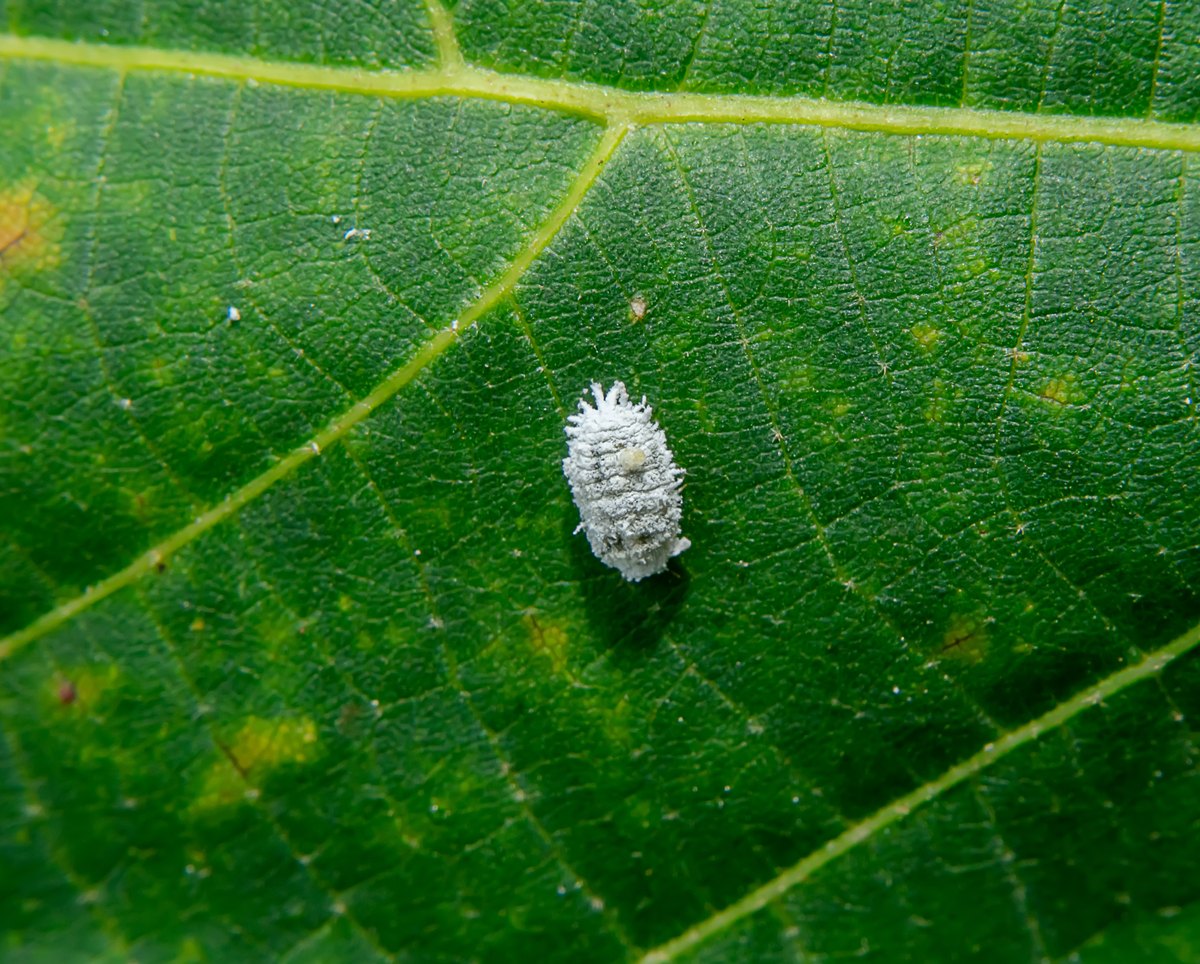 Mug Shot Adult female, ~3 mm
Vital Statistics
- Order
- Hemiptera
- Family
- Pseudococcidae
- Adult size
- 3 mm foliar / 1.6 to 3.2 mm root
- Color
- white wax over a pale body
- Nymph to adult
- 6 to 10 weeks
- Eggs per female
- 300 to 600
- Adult female lifespan
- up to 29 days
Modus Operandi
Inserts threadlike stylets into phloem and draws off sap, then excretes the surplus sugar as honeydew. Growth slows, new leaves come in small and off-color, and a black film of sooty mold colonizes the honeydew on everything below the colony. All stages carry a hydrophobic wax coat that sheds water and most contact insecticides.
Last Seen
Leaf axils and petiole crotches, bud scales, the curl of new growth, undersides near the midrib, the inside of the pot rim, and the drainage hole. One group lives entirely below the soil line on the roots.
Apprehension Protocol
The Mug Shot: three animals, one name
"Mealybug" covers about 2,000 described species. Three of them account for nearly everything a home grower meets, and telling them apart is worth ninety seconds with a hand lens. Two of the three change what you do next: longtailed changes which predator is worth buying, and root mealybugs change where you look in the first place.
Citrus mealybug (Planococcus citri, pronounced plan-oh-KOK-us SIT-ry) is the classic. Adult females run about 3 mm, or 0.12 inches, oval, white to light brown under a powdery bloom, with a faint gray stripe down the back and a fringe of short wax filaments around the margin plus a slightly longer pair at the rear. Winged males are similar in color and measure about 4.5 mm (0.18 in). They can't feed at all, and they live one to two days. The species has been collected from at least 27 host plant families (Gill et al. 2025), which is another way of saying it will take almost anything on your shelf.
Longtailed mealybug (Pseudococcus longispinus, soo-doh-KOK-us lon-jih-SPY-nus) is the same white oval body at about the same 3 mm, but the caudal filaments are as long as the body or longer (Baker 2013b; University of Massachusetts Amherst 2024b). Measure the body, not the tails: overall length with the filaments included can reach a quarter inch, and quoting that as body size is how people talk themselves out of a correct ID. Those filaments also break off easily, so a short-tailed specimen doesn't rule the species out. Hosts skew toward citrus, avocado, grape, pear, persimmon and pineapple, and indoors, cycads and orchids (Byron & Gillett-Kaufman 2025).
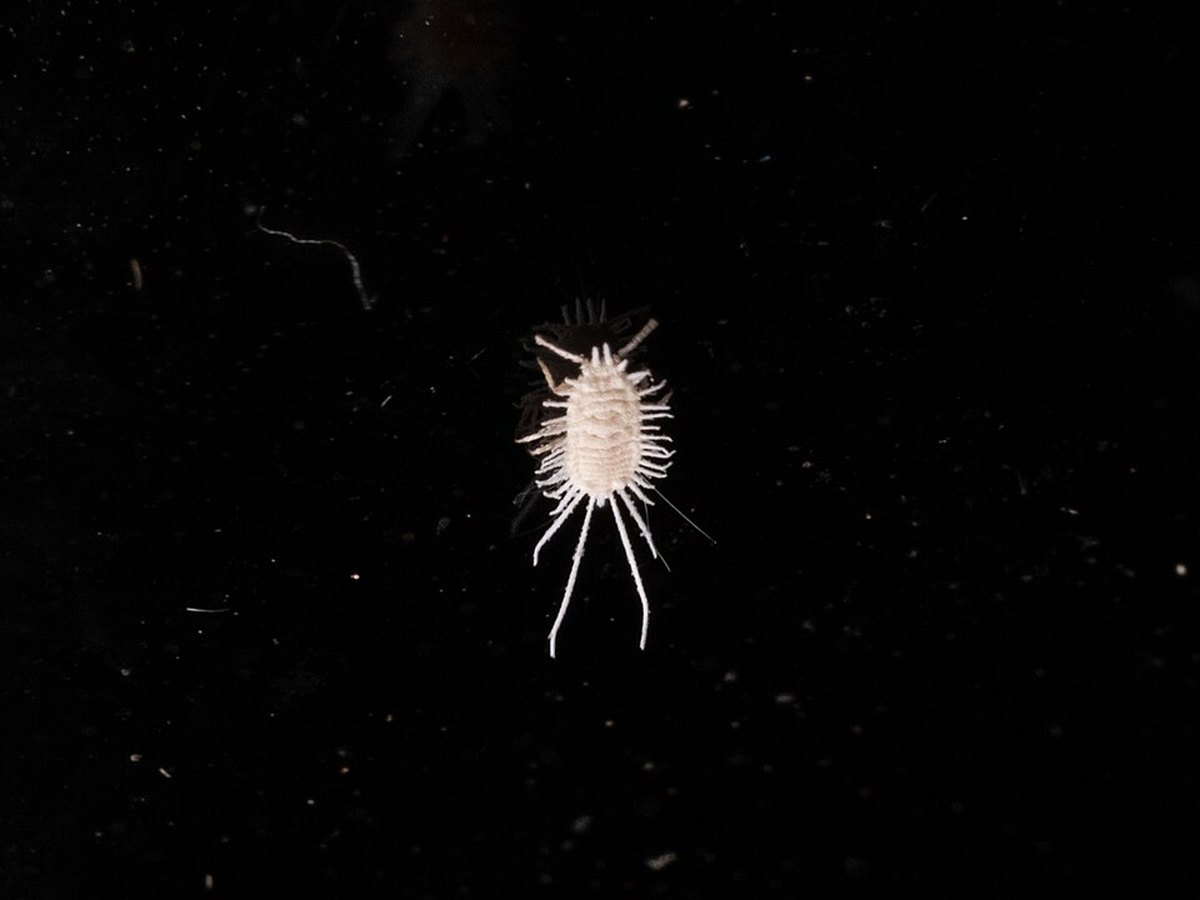
Root mealybugs (Rhizoecus spp., ry-zo-EE-kus) are the ones almost nobody checks for. Adult females are smaller, at 1/16 to about 1/8 inch, slightly flattened and rounded at both ends, the body bluish white under a shallow fluffy bloom, the antennae short and the eyes almost or completely absent (Baker 2018). NC State's description is the one that sticks: they resemble large white springtails but move much more slowly. They live on the roots and in the medium. The species that matters most in the trade, long catalogued as Rhizoecus hibisci, now sits under the accepted name Ripersiella hibisci (EFSA Panel on Plant Health 2020), so you'll meet both names in older nursery literature.
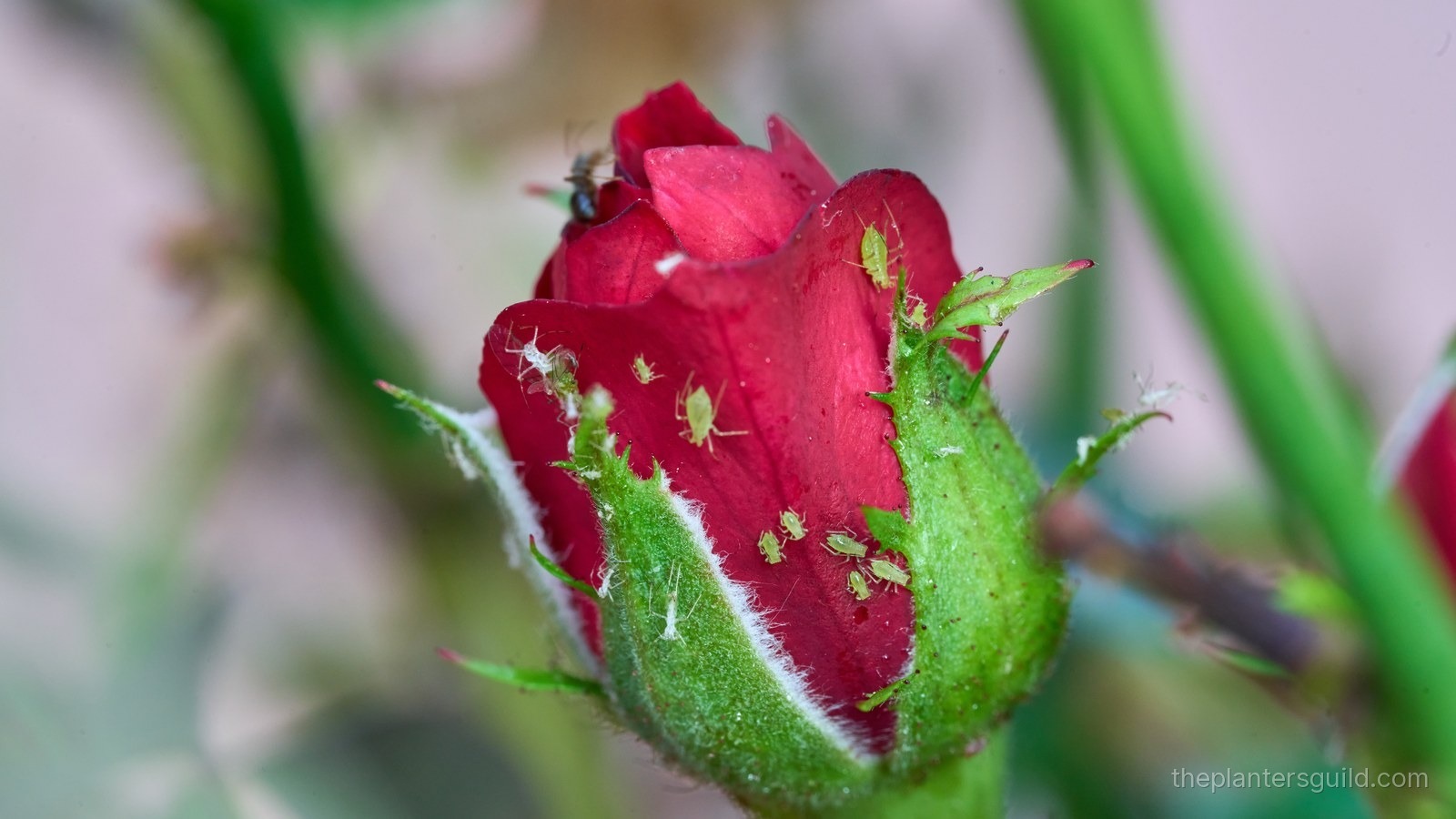
What gets confused with mealybugs. Woolly aphids and cottony cushion scale also produce white waxy fluff. A hand lens settles it: a mealybug is an oval, many-legged body that crawls slowly when you nudge it, with wax filaments around the margin rather than an amorphous mass. Root mealybug wax gets mistaken for perlite, and for the white mineral crust that builds on a pot that's been fed hard. The tell is that it clusters on the roots and against the inner pot wall rather than mixing evenly through the medium.
Why the spray beads off
Every stage of a mealybug secretes a cuticular wax, and that wax is not decoration. It's a working piece of equipment that does two jobs: it slows water loss through the cuticle, and it physically impedes insecticide from reaching the animal.
We know the second part because someone measured it. Tong et al. (2022) identified a key enzyme in wax production, a fatty acyl-CoA reductase, and found that hydrocarbons make up 59 to 68 percent of the coating depending on how you measure it. Then they switched the gene off using RNA interference, which thinned the wax layer, and exposed the insects to deltamethrin. Survival after 48 hours fell from 81 percent to 64 percent in the injected group, and from 72 percent to 50 percent in insects that had fed on a transgenic host. Same insecticide, same dose, thinner coat.
A second team came at it from the other direction. Ulusoy et al. (2022) stripped the wax off three mealybug species with a solvent and then sprayed them, and the insecticides landed far harder on bare animals: pyriproxyfen ran 10.6 times more effective against citrus mealybug once the coat was off. The detail worth carrying to the bench is what happened next. The adult females had rebuilt their wax within 72 hours.
Before anyone quotes any of this at a garden center: both studies used lab solvents and lab technique, and the gene work was done on cotton mealybug (Phenacoccus solenopsis, fen-uh-KOK-us so-len-OP-sis), not on either of the two species most likely to be on your shelf. Read them as mechanism rather than a dose chart. What they establish is that the coat is load-bearing, that removing it measurably lowers what the animal can shrug off, and that the animal puts it back on within three days.
Take the coat away and the same chemistry that was bouncing off starts landing. That's the whole protocol below. Every tactic that works does one of three things:
- Strips the wax, or takes the animal off with it. A solvent dissolves the coat under lab conditions. On a plant, a swab lifts the animals off and a forceful rinse tears wax loose along with them.
- Goes around the wax. A systemic insecticide moves in the phloem, the plant's sugar-transport tissue, and the mealybug drinks it. The coat is irrelevant to a poison already inside the sap.
- Overwhelms the wax by repetition. Soaps and oils do work, but only with thorough coverage and repeat rounds, because any single application leaves sheltered animals untouched.
Anything that doesn't do one of those three is theater.
Where to look
You are not fighting the mealybugs you can see. You are fighting the ones in the refuges, and if you treat only the visible colony you have treated the smallest part of the problem.
Search in this order:
- Leaf axils and petiole crotches. The junction where a leaf stalk meets the stem is the single highest-yield spot on the plant.
- Bud scales and the curl of new growth. New tissue is thin-walled and preferentially colonized, and the curl hides the colony from a sprayer.
- Leaf undersides, especially along the midrib.
- The base of the plant, where stems meet the soil line.
- The inside of the pot rim. UMass lists container lips and drainage holes as standing mealybug habitat (2024a), and most home-grower guidance never mentions the pot at all.
- Under the lip of the saucer.
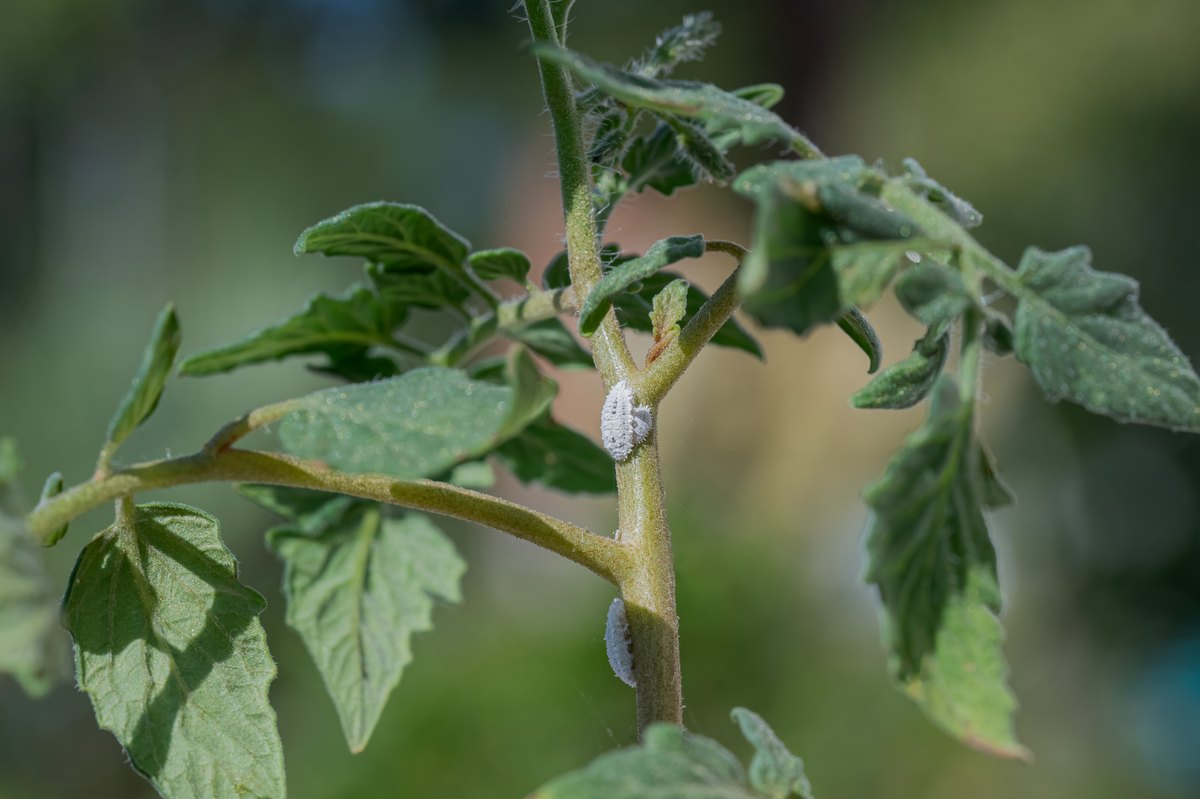
Follow the honeydew. Mealybugs process large volumes of phloem sap and excrete the surplus sugar as honeydew, a sticky clear liquid that coats whatever sits below the colony. Sooty mold, a black non-parasitic fungal film, then colonizes the honeydew. The mold doesn't attack the tissue, but it blocks light and slows photosynthesis, and it fouls the look of the plant. A shiny sticky leaf or a black film on a leaf below a node points upward to something feeding overhead.
Watch for ants, outdoors especially. A trail of ants running up a stem is one of the most reliable indirect signs you will get. Treat it as an outdoor and balcony tell; an indoor collection rarely has ants working it, and if yours does, the ants are their own problem to solve first.
Quarantine every new plant for three to four weeks. This is the highest-value habit in the whole dossier. Infestations usually walk in on a new plant, and a month on a separate shelf will catch most of them before they reach the collection.
The math that beats you
Here's why one treatment never holds.
A citrus mealybug female deposits 300 to 600 eggs over her life into a dense white cottony ovisac, which is a purpose-built egg sac (Gill et al. 2025; Baker 2013a). That sac is a visible target and also a shield. Spray does not wet the eggs inside it, so whatever is sitting in there when you treat will hatch on schedule regardless of what you just applied. That isn't a guess about coverage. Working on a citrus mealybug's relative, Middleton and Diepenbrock (2022) found that isopropanol incapacitated more than 90 percent of crawlers at every concentration they tried, and that no concentration reliably killed the eggs inside the ovisacs.
Development from hatch to reproductive adult takes six to ten weeks. Females pass through four nymphal instars, which are the stages between molts; males pass through three plus a pre-pupal stage before emerging as short-lived winged adults. Indoors there is no winter and no diapause, so generations overlap continuously. At any moment you have eggs, crawlers, and adults present at once.
Longtailed mealybug works differently. There is no visible egg stage: the nymphs hatch the moment the eggs are laid, so what you see is a female producing active crawlers rather than a persistent egg mass (Byron & Gillett-Kaufman 2025; University of Massachusetts Amherst 2024a). There is no cottony egg sac to find (Shelton n.d.). That single difference decides which predator is worth your money, and we come back to it below. One caution on the terminology, since it trips people up: this is not live birth, however much it looks like it, and the UF/IFAS account notes that observers regularly conclude it is.
The operational consequence is the same either way. NC State's guidance is that infested plants probably should be treated at weekly intervals at least twice and probably three times, specifically to let protected eggs hatch into vulnerable crawlers inside your treatment window (Baker 2013a). Three rounds. Not two.
The Apprehension Protocol
Five tiers. Work through them in order. Tier 5 is a real option, not a rhetorical one.
Tier 1: Isolate and search the refuges
Move the plant to another room before you touch anything else. If space won't allow it, a clear plastic tote with drilled air holes works.
Then inspect every plant within arm's reach, and inspect the pots as well as the plants. Crawlers walk. They'll cross a shelf, and they'll ride a watering can or your sleeve to get there faster. Treating one plant in place while its neighbor quietly holds a colony under the pot rim is the most common way a six-week project becomes a six-month one.
Tier 2: Take them off by hand
A cotton swab dipped in rubbing alcohol. Test one leaf and give it a day before you go any further. Thin-cuticled and hairy-leaved species can mark.
Once it's clear, dab the swab onto every colony you found in Tier 1. Be clear about what this is doing, because the internet is not. It is removal, first and foremost: NC State frames the swab as lifting the animals off the plant, and puts wax removal in the next step rather than this one (Baker 2013a). There is contact effect on top of that, and it is real. More than 90 percent of crawlers were incapacitated in the citrus trials. What it does not do is reach into an ovisac (Middleton & Diepenbrock 2022). For a light infestation the swab alone may finish it. For anything more, it's the opening move.
On concentration, the honest answer is that the extension services don't agree. UF/IFAS gives 70 percent or less for indoor plants and calls it removal (Rezazadeh 2023). Clemson and others say only "rubbing alcohol" with no number at all. The 70 percent bottle on the pharmacy shelf is the default for a reason and it's what we use; just don't treat the number as a validated dose.
Follow with a forceful water rinse on anything sturdy enough to take it. A strong stream tears wax off and knocks crawlers loose. NC State then pairs the swab with a wash in mild soapy water at about 2 percent, soap rather than detergent, specifically to remove the residual wax the mealybugs leave behind (Baker 2013a).
Prune out and bin any shoot that's heavily colonized. You will not clean it, and it's a reservoir.
Tier 3: Contact spray, weekly, three rounds minimum
Insecticidal soap or horticultural oil at label rate. These work by smothering and by disrupting the cuticle, and their weakness is precisely the wax and the refuges. Coverage is the whole game.
Spray to runoff. Into every axil. Into the bud scales. Under the leaves. Around the pot rim. If you're spraying the tops of leaves and calling it done, you're wetting the one surface mealybugs don't live on.
Repeat at 7-day intervals for three rounds. UMass gives a wider 1-to-3-week interval for contact materials, keyed to how long the product stays active (2024a); the tighter weekly figure is the one to run, because it keeps the window closed on crawlers hatching out of protected eggs. Round two is where the plant starts looking better and most people quit. Don't.
Tier 4: Go around the wax
Two versions of the same idea, one chemical and one not.
Bare-root and repot. For root mealybugs and for potted plants with colonies you can't reach, slide the plant out, wash all the old medium off the roots, and repot into fresh mix in a clean pot. Retire the old pot or scrub it, because the crust on the inner wall will reseed a clean root ball. This removes the animals physically and it's the option with no label restrictions attached.
A labeled systemic. A systemic insecticide is taken up into the phloem and ingested with the sap, so it reaches colonies a spray never wets, including root mealybugs below the soil line. NC State names imidacloprid or another systemic, and adds the caveat that matters indoors: most systemics sold in garden centers work, but only some are labeled for residential use, and a landscape-only formulation means the houseplant has to go outside to be treated (Baker 2018). See the section on systemics below before you reach for one.
Tier 5: Retire the reservoir
A plant that has been through three full rounds, kept its colony, and gone on reseeding the shelf around it is costing you more than it's worth. Bag it and let it go.
Most sources won't say that. Sentiment about one plant is how a collection ends up managing mealybugs permanently instead of ending them. Binning one specimen buys you the rest of the shelf. It isn't a nice call to make, and we've put it off ourselves longer than we should have.
The ones under the soil
Root mealybugs deserve their own protocol because they present as something else entirely.
There is no honeydew signature above the soil line. Nothing sticky on the leaves, no lint in the axils. What you get instead is a plant in unexplained decline: growth slows, foliage goes dull or slightly off-color, and it stops responding to water and feed the way it used to. It reads as root-bound or overwatered. Growers chase both for months before anyone slides the pot off.
A plant declining with a clean canopy is a root check. Slide it out of the pot and look.
What you're looking for is the wax, not the animal. EFSA's pest categorisation puts it plainly: the creamy-white wax the adult females deposit around the roots, through the medium, and on the inner surface of the container is usually the first sign of an infestation, and close inspection then turns up the white adults and nymphs on the outer surface of the root ball where it sat against the pot wall (EFSA Panel on Plant Health 2020). Hawaiʻi's CTAHR growers describe the same thing from the nursery floor, and add the useful detail that the wax concentrates in the gap between root ball and pot (Hara et al. 2001). In a heavy infestation the roots and medium can look uniformly white, which reads at a glance as a fungal problem rather than an insect one.
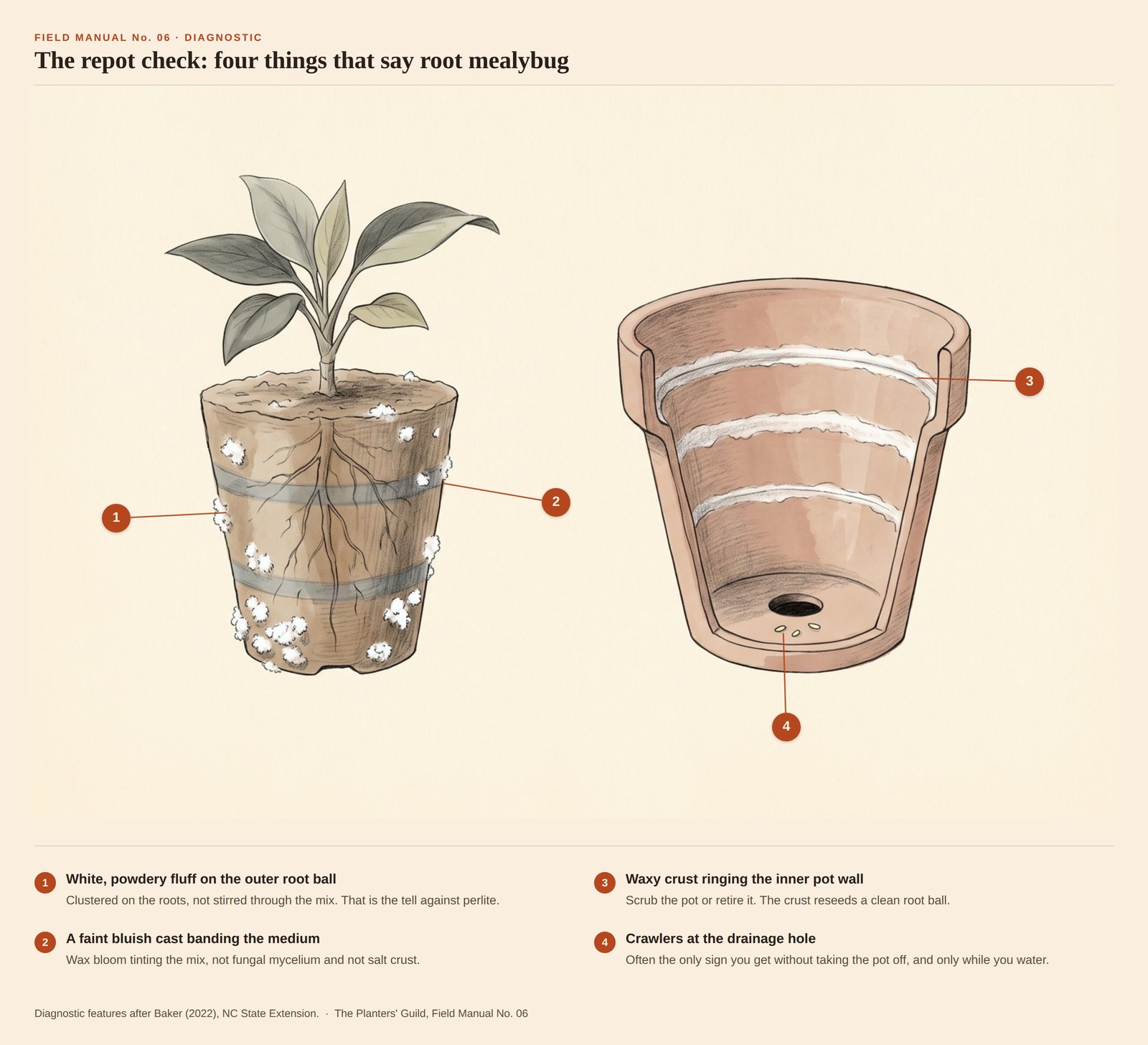
The other way you find them is by accident. During watering, root mealybugs sometimes crawl out of the drainage holes and infest the plants standing nearby (Baker 2018). If you have ever noticed small pale specks on a saucer after a soak and assumed they were perlite, it's worth a second look, and it's worth looking at the neighbors too.
Bare-rooting into fresh sterile medium and a clean pot is the physical answer, and it's the one we'd run first. A labeled systemic is the chemical answer (Baker 2018).
There is also a third option worth knowing about for high-value specimens, and it's better documented than most growers realize. Hu, Hara and Hata (1996) ran the trial on Rhapis palms in 3-gallon pots infested with root mealybug: pots submerged in 49°C (120°F) water until the centre of the root ball reached target, held ten minutes at target, then cooled in ambient water. Hawaiʻi's CTAHR reports the outcome. Submerging the pots in 49°C water until the interior of the root ball reaches 46°C (115°F) was 100 percent effective, with no significant harm to the plants beyond some yellowing of older leaves (Hara et al. 2001).
Note the two temperatures, because they get conflated everywhere. 49°C is the bath. 46°C is the target inside the root ball. You need a probe thermometer, not a guess.
The limits are real. That 100 percent figure belongs to Rhapis palms, and nothing licenses stretching it across your shelf. Plant tolerance varies enormously: many succulents and dormant plants take a hot-water soak comfortably, tender-rooted tropicals may not. Hold at temperature rather than above it, and test on something you can afford to lose.
Treat every repot as an inspection. The habit that catches root mealybugs early is looking on purpose rather than treating the repot as a chore. You already have the plant out of the pot, so give the root ball thirty seconds and a good light before it goes back in.
The ant problem
This one is mostly an outdoor and balcony section. Indoor collections seldom have ants on them, and a grower who does have an ant trail across the living room has a different problem to solve first. Outside, though, if ants are working your plant, nothing else you do will hold.
Honeydew-seeking ants form a protective mutualism with mealybugs: the ants harvest the sugar, and in exchange they defend the colony against the parasitoid wasps and predators that would otherwise be doing your work for you.
Feng et al. (2015) put numbers on it. Working with the ghost ant (Tapinoma melanocephalum, tap-ih-NO-muh mel-an-oh-SEF-uh-lum) and a parasitoid wasp, they found parasitism of mealybugs ran at 34.5 percent on ant-tended plants against 47.7 percent on ant-free plants. That's just under 30 percent less parasitism where the ants are working.
The control condition is what makes the result worth quoting. When the parasitoids were excluded entirely, ant presence made no measurable difference to mealybug survival. So the ants aren't feeding the mealybugs or sheltering them from weather. They are specifically fending off the wasps.
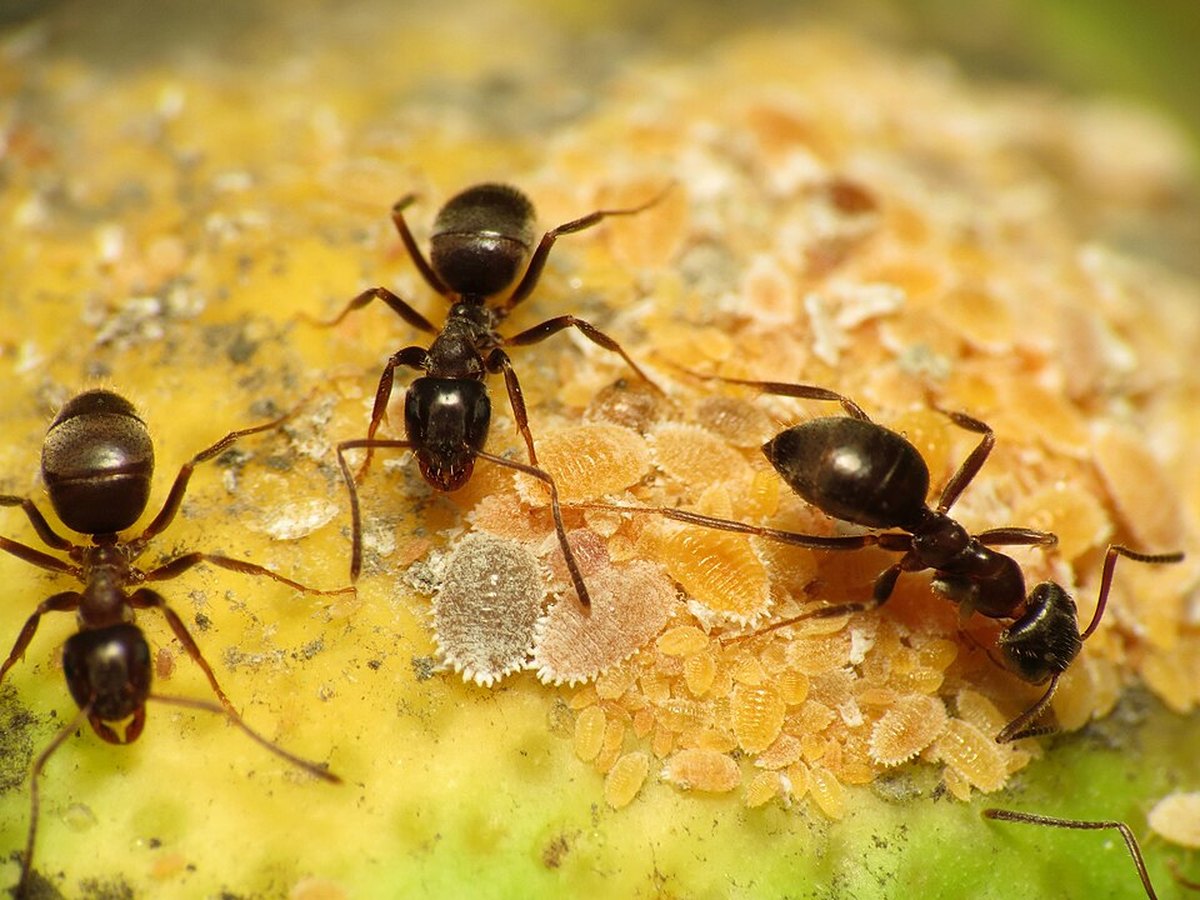
So: ants first. Bait stations set away from the plant, and a physical barrier at the pot. On a Bay Area balcony this matters more than most places, because Argentine ants are relentless tenders and the mild dry summer suits both partners. Cut the ant trail and the wasps you already have out there go back to work.
Buying the right predator
Cryptolaemus montrouzieri (krip-toh-LEE-mus mon-troo-zee-AIR-ee), the mealybug destroyer, is a small lady beetle whose larvae grow their own woolly wax coat and look convincingly like oversized mealybugs. Both adults and larvae are voracious. A single larva may consume up to 250 small mealybugs (Shelton n.d.). It is, on paper, the perfect answer.
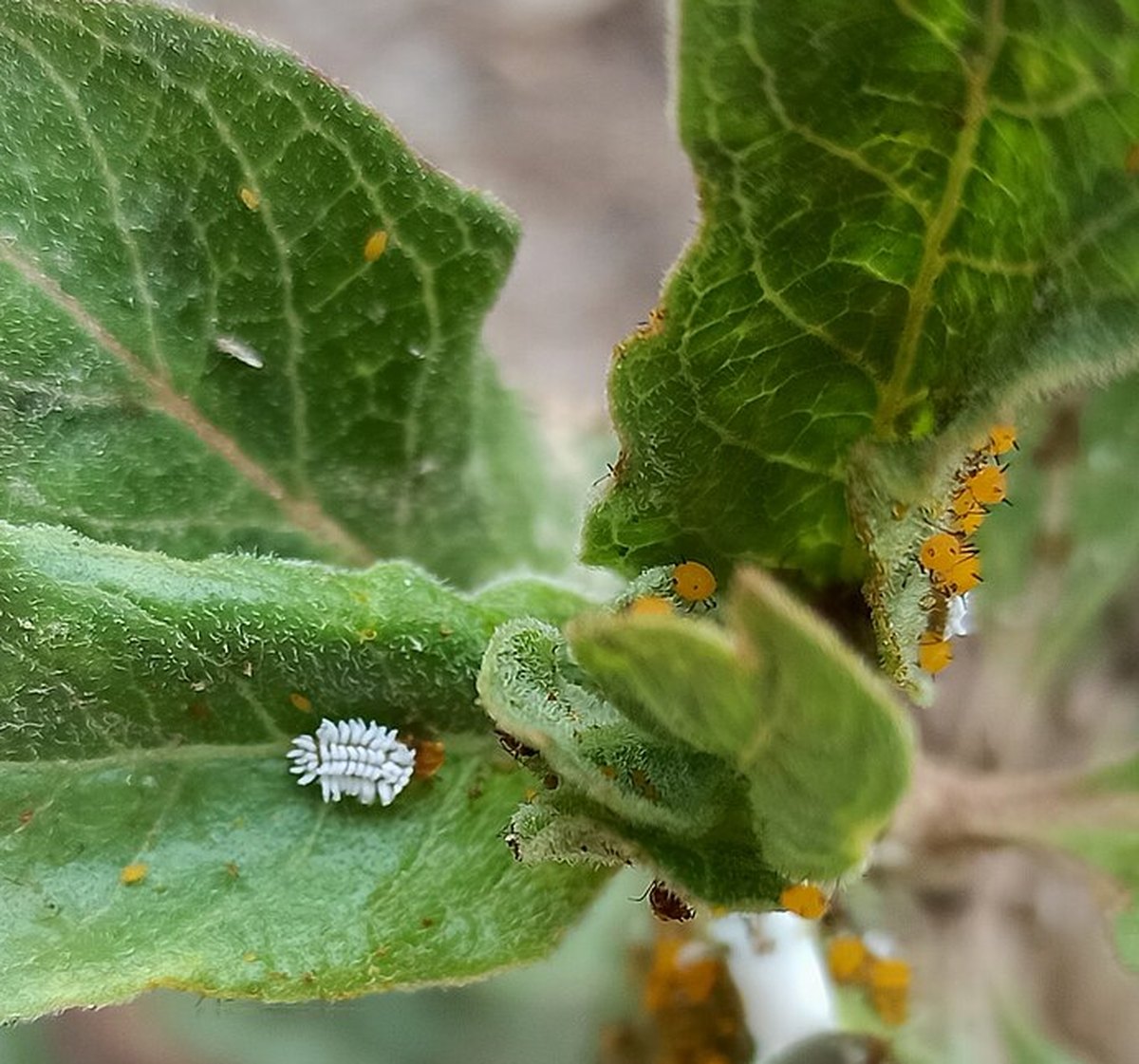
Two problems, and the first is disqualifying.
It needs egg sacs to breed. The beetle lays its own eggs in among a mealybug's cottony ovisac, and longtailed mealybug never builds one, so there is nowhere for a second generation to go. Cornell says as much outright (Shelton n.d.), and UConn arrives at the same place from the other end: no egg masses, no reproduction, and no useful effect on a longtailed infestation (Pundt 2014). Keep the distinction straight, because Cornell's own page also lists longtailed mealybug among the pests attacked and that looks like a contradiction until you separate the two verbs. The beetle will eat longtailed mealybug. It cannot breed on it. Buy it as a standing population and you've bought a one-off snack.
It wants greenhouse conditions. The operating window is 72 to 77°F (about 22 to 25°C) at 70 to 80 percent relative humidity, and it's most active on sunny days and least active through short winter ones (Pundt 2014). Your living room in January is not that. And when mealybugs get scarce the beetles fly off after other prey, aphids and soft scales, though they reproduce far better on mealybugs (Shelton n.d.).
Cryptolaemus is a strong choice in a greenhouse or an enclosed grow tent, against citrus mealybug, with the ants under control. On open houseplants in a living room, against longtailed, it's money out the window.
The parasitoid wasps split the same way. Leptomastix dactylopii (lep-toh-MAS-tix dak-tih-LOH-pee-eye) attacks citrus mealybug only, and UMass rates it very effective at controlling or regulating that species on long-term crops (University of Massachusetts Amherst 2024a). That qualifier is the whole story for a home grower: it's a tool for a conservatory or an interior planting that stays put for a season or more, not for something you want cleared up by the end of the month. Anagyrus pseudococci (an-uh-JY-rus soo-doh-KOK-sy) also works citrus mealybug, optimum around 76°F, minimum 51°F (Pundt 2014). Longtailed mealybug has an entirely different suite, including Anarhopus sydneyensis (an-uh-ROH-pus sid-nee-EN-sis) and Pseudaphycus angelicus (soo-DAF-ih-kus an-JEL-ih-kus) (Byron & Gillett-Kaufman 2025). We checked the two lists against each other and they don't share a single genus. Match the enemy to the species, or don't buy one.
About systemics
The Field Manual's standing position, set out in Dossier No. 01 on thrips, is that systemic neonicotinoids are almost always the wrong tool indoors. That position holds. It's also worth being honest that mealybugs are the case where it's a closer call than we'd like.
The wax is a barrier to contact chemistry and no barrier at all to something already dissolved in the sap. For a sheltered colony in a bud scale, or for root mealybugs living below the soil line, a systemic reaches what a sprayer physically cannot. NC State recommends exactly that for root mealybugs, naming imidacloprid (Baker 2018).
We won't pretend the option doesn't exist. Here are the limits.
Never on a plant that will flower where bees can forage. Neonicotinoids carry pollinator restrictions for good reason, and an outdoor container that blooms is a feeding station.
Never on anything you intend to eat, or on herbs, or in a food garden.
Read the label and follow it, including the residential-use language. Big-box systemics vary in active ingredient and permitted sites, and some are labeled for landscape use only, which means the plant has to go outdoors to be treated (Baker 2018).
Try the physical route first. For root mealybugs, bare-rooting into fresh medium accomplishes the same removal with nothing to disclose and no restriction to observe. It is more work. It's also the answer we'd reach for on our own bench.
One thing that isn't a limit on systemics but belongs in the same decision. Mealybugs vector grapevine leafroll-associated virus 3, and the dose required is very small. Douglas and Krüger (2008) tested Planococcus ficus and Pseudococcus longispinus at group sizes of one, five, ten, twenty and forty nymphs, and a single first- to second-instar nymph was enough to produce infection in 70 percent of plants, the same figure for each species. Raising the number of nymphs didn't reliably raise the infection rate.
On a pothos, a few mealybugs are a nuisance you'll get around to. On a grapevine, one you never spotted is enough to infect the plant. That's an argument for catching them early outdoors, not an argument for a drench.
Predictable mistakes
Treating once and calling it. Overlapping generations and protected eggs guarantee a rebound. Three rounds at weekly intervals, minimum.
Spraying only what's visible. The colony lives in the axils, the bud scales, and under the pot rim. Untreated refuges reseed the plant on their own schedule.
Expecting soap to beat the wax on its own. It beads off sheltered, waxed animals. Take them off by hand first, or go around the coat entirely.
Ignoring the ants. Just under 30 percent less parasitism on ant-tended plants. You're paying for predators the ants are chasing off.
Skipping quarantine. Most infestations walk in on a new plant. Three to four weeks of isolation prevents them.
Missing root mealybugs entirely. A declining plant with a clean canopy is a root-check case, and skipping the root ball at repot is how it goes unfound for a year.
Buying Cryptolaemus against longtailed mealybug. No egg sacs means it can't breed on your pest. You've bought a beetle that eats a few and then leaves.
Keeping a lost cause on the shelf. One sentimental reservoir plant reinfests everything near it.
The takeaway
Mealybugs are stubborn. They aren't complicated. Every hard thing about them traces back to the wax and to where they choose to sit.
Work the wax. Lift the animals off with a swab where you can reach the colony, tear the coat away with a hard rinse where the foliage will take one, and go around it entirely when they're somewhere a sprayer will never wet. Three weekly rounds, not two, because nothing you put on the outside gets into an ovisac. Handle the ants before you buy a predator, and buy the predator that matches the species you actually have rather than the one on the shelf at the shop.
And check the roots. If a plant has stalled and the canopy is clean, you won't find the answer without taking the pot off. Do it at the next repot, or do it tonight.
Baker, J.R. 2013a (rev. 10 Aug. 2023). Citrus Mealybug. NC State Extension Publications. [link]
Baker, J.R. 2013b (rev. 27 Sep. 2022). Longtailed Mealybug. NC State Extension Publications. [link]
Baker, J.R. 2018 (rev. 2 Dec. 2022). Root Mealybugs. NC State Extension Publications. [link]
Byron, M.A. & Gillett-Kaufman, J.L. 2025. Longtailed Mealybug, Pseudococcus longispinus (Targioni Tozzetti) (Insecta: Hemiptera: Pseudococcidae) (EENY-666/IN1149). UF/IFAS Extension. [link]
Douglas, N. & Krüger, K. 2008. Transmission efficiency of Grapevine leafroll-associated virus 3 (GLRaV-3) by the mealybugs Planococcus ficus and Pseudococcus longispinus (Hemiptera: Pseudococcidae). European Journal of Plant Pathology 122(2): 207–212. [link]
EFSA Panel on Plant Health. 2020. Pest categorisation of Ripersiella hibisci. EFSA Journal 18(6): e06178. [link]
Feng, D.-D., Michaud, J.P., Li, P., Zhou, Z.-S., & Xu, Z.-F. 2015. The native ant, Tapinoma melanocephalum, improves the survival of an invasive mealybug, Phenacoccus solenopsis, by defending it from parasitoids. Scientific Reports 5: 15691. [link]
Gill, H.K., Goyal, G., & Gillett-Kaufman, J.L. 2025. Citrus Mealybug, Planococcus citri (Risso) (Insecta: Hemiptera: Pseudococcidae) (EENY-537/IN947). UF/IFAS Extension. [link]
Golsteyn, L., Mertens, H., Audenaert, J., Verhoeven, R., Gobin, B., & De Clercq, P. 2021. Intraguild interactions between the mealybug predators Cryptolaemus montrouzieri and Chrysoperla carnea. Insects 12(7): 655. [link]
Hara, A.H., Niino-DuPonte, R.Y., & Jacobsen, C.M. 2001. Root Mealybugs of Quarantine Significance in Hawaii (Insect Pests IP-6). College of Tropical Agriculture and Human Resources, University of Hawaiʻi at Mānoa. [link]
Hu, B.K.S., Hara, A.H., & Hata, T.Y. 1996. Hot water as a potential treatment against root mealybugs, Hawaii, 1995. Arthropod Management Tests 21(1): 382–383. [link]
Middleton, E.G. & Diepenbrock, L.M. 2022. Sanitizing equipment and personnel to prevent the spread of hibiscus mealybug [Nipaecoccus viridis (Hemiptera: Pseudococcidae)] in Florida citrus. Journal of Economic Entomology 115(5): 1592–1600. [link]
Pundt, L. 2014 (rev. 2019). Biological Control of Mealybugs. UConn Extension Integrated Pest Management. [link]
Rezazadeh, A. 2023. Mealybug on Tomato and Its Management. UF/IFAS Extension St. Lucie County. [link]
Shelton, A.M. (ed.), n.d. Cryptolaemus montrouzieri. In Biological Control: A Guide to Natural Enemies in North America. Cornell University. Accessed 6 August 2026. [link]
Tong, H., Wang, Y., Wang, S., Omar, M.A.A., Li, Z., Li, Z., Ding, S., Ao, Y., Wang, Y., Li, F., & Jiang, M. 2022. Fatty acyl-CoA reductase influences wax biosynthesis in the cotton mealybug, Phenacoccus solenopsis Tinsley. Communications Biology 5: 1108. [link]
Ulusoy, S., Kahya, D., Bilgin, M.G., & Apalak, A. 2022. The effectiveness of wax secretion on chemical control in some mealybug species. Journal of Asia-Pacific Entomology 25(3): 101954. [link]
University of Massachusetts Amherst. 2024a. Mealybugs in Greenhouses [Fact Sheet]. UMass Extension Greenhouse Crops and Floriculture Program, Center for Agriculture, Food, and the Environment. [link]
University of Massachusetts Amherst. 2024b. Pseudococcus longispinus [Professional Insect & Mite Guide]. UMass Extension Landscape, Nursery and Urban Forestry Program, Center for Agriculture, Food, and the Environment. [link]


.jpg)
_larva.jpg)