A working grower's guide to the aphid: how to know it by its twin tailpipes, why a handful become thousands in a week, the ant problem nobody warns you about, and a four-tier protocol that leans on the predators already living in your garden.
You won't miss them. That's the problem.
Thrips you catch late. Aphids you catch early and still lose ground, because by the time you notice the cluster on the rose cane it's already a city. Walk out on a warm June morning and a stem that was clean on Sunday is sleeved in soft green by Friday. Bend a milkweed and the underside of the new leaves is packed with bright yellow bodies. Roses, brassicas (cabbage, kale, broccoli), beans, fruit trees, the tender tip of almost anything growing fast: that's where they set up.
This is not a pest you hunt with a hand lens. You can see the colony from standing height. Save the loupe for thrips and mites; we tested five hand lenses for pest diagnosis in Workshop No. 01 if you're deciding which one to buy. The work is knowing what you're looking at, why it multiplied that fast, and which of the tools you could reach for actually fixes it without torching the good bugs in the same yard.
Garden & Indoor Pests · Family Aphididae
Aphids
Aphis nerii · Myzus persicae · Macrosiphum euphorbiae · Aphis gossypii
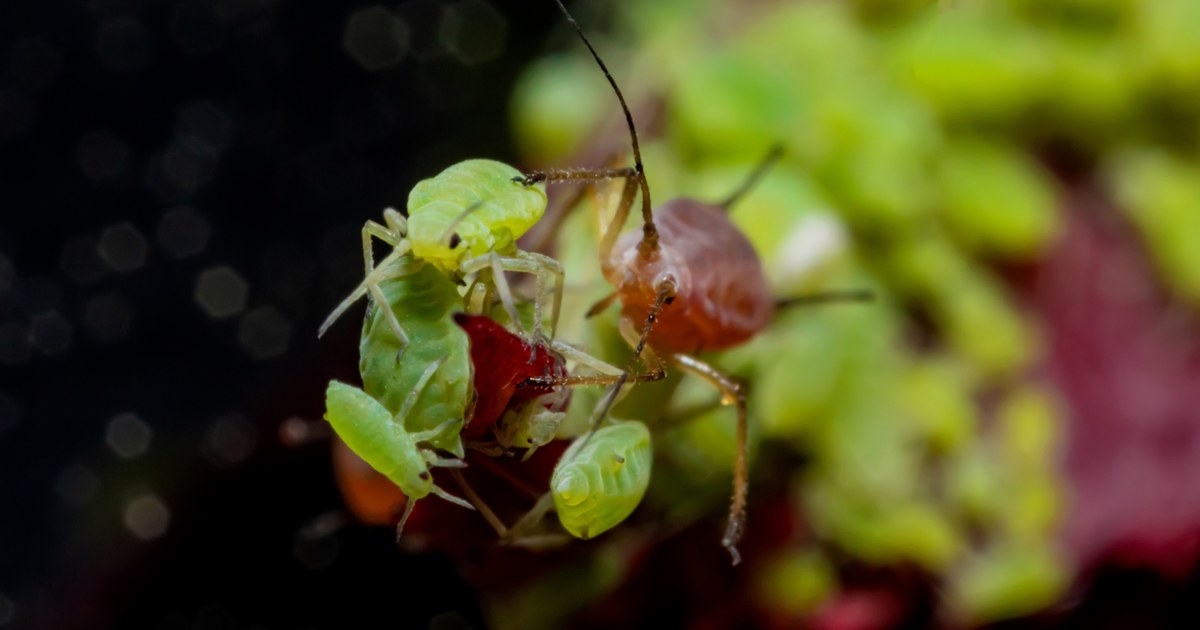 Mug Shot Adult, 1–4 mm
Vital Statistics
- Family
- Aphididae
- Adult size
- 1 to 4 mm
- Color
- green / black / yellow / pink / gray
- The tell
- paired cornicles
- Reproduction
- clonal, live young
- Generation time
- 7 to 10 days
Modus Operandi
Slides a needle-thin stylet into the plant's phloem and lets the plant's own pressure pump sugar-rich sap into it. New growth curls, yellows, and stunts. The sugar it can't use drips out as honeydew, which blackens into sooty mold and brings the ants running. Clusters on the youngest, softest tissue it can find.
Last Seen
The tips of new growth, the undersides of young leaves, flower buds, and the stems of roses, brassicas, and milkweed. Follow any ant trail running up a stem and you'll usually find the colony at the end of it.
Apprehension Protocol
The Mug Shot
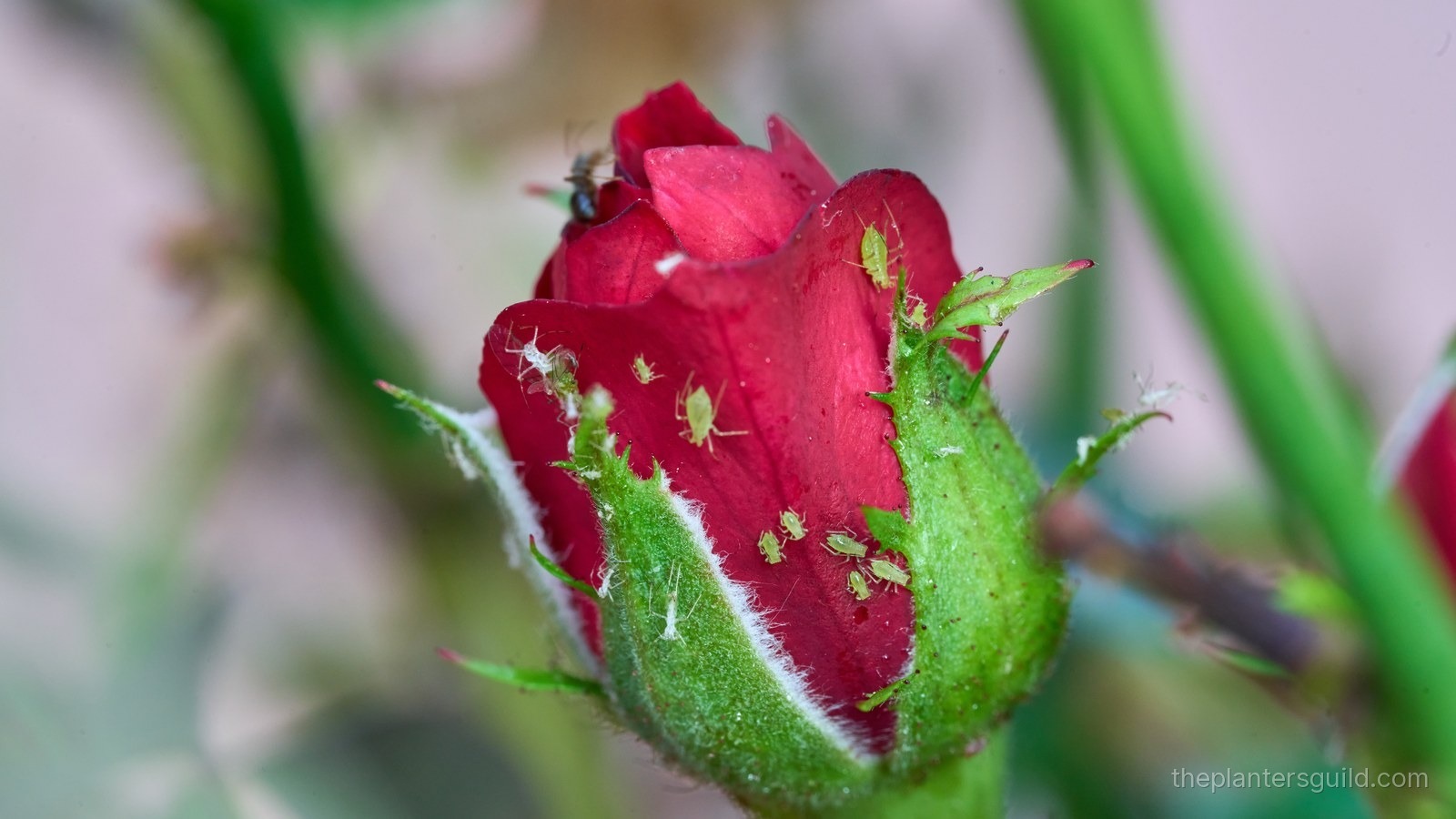
Aphids are soft, pear-shaped, and slow-moving. One to four millimeters, depending on species and age, and they come in just about every color: pale green, near-black, dusty gray, rose-pink, and on milkweed a yellow so bright it looks fake. Color won't ID them. The tell is on the back end.
Look at the rear of the abdomen and you'll see two short tubes sticking up, one on each side. Those are the cornicles (older books call them siphunculi), and nothing else in the garden has them. They're not exhaust pipes for honeydew, which is the common myth. The cornicles fire a fast-setting defensive droplet that gums up a predator's mouthparts, and they release an alarm pheromone, E-beta-farnesene, that tells the rest of the clone to drop off the leaf when something starts eating them (Alfaress et al., 2018). Find the twin cornicles and you've found an aphid. Everything else is detail.
Some of the colony will have wings and most won't. The wingless ones are the factory, sitting and feeding and producing. The winged ones are the dispersers, made when the plant gets crowded or stressed, and they're how a colony on your neighbor's roses becomes a colony on yours.
Common faces you'll meet:
- Green peach aphid (Myzus persicae): pale green to pinkish, the generalist, and a serious virus carrier on vegetables
- Potato aphid (Macrosiphum euphorbiae): larger, green or pink, fond of tomatoes and a long list of garden plants
- Melon/cotton aphid (Aphis gossypii): small, variable, dark green to nearly black, hard on cucurbits (squash, cucumbers, melons)
- Oleander aphid (Aphis nerii): the bright yellow one with black cornicles, the milkweed regular we'll come back to (University of Florida IFAS Extension, 2018)
Why a few become thousands
Here's the part that explains the speed, and it's genuinely strange.
Through spring and summer, your garden aphids are all female, and they don't lay eggs and they don't mate. A female gives birth to live young that are clones of herself (Ogawa & Miura, 2014). No males, no courtship, no waiting on eggs to hatch. She just produces finished daughters, one after another.
Now stack one more fact on top. Those daughters are already developing their own daughters inside them before they're even born. The generations are nested, one inside the next like a set of measuring cups. Entomologists call it telescoping generations, and it means a newborn aphid is effectively pregnant at birth (Bermingham & Wilkinson, 2009). She skips the whole grow-up-find-a-mate stage that slows every other insect down.
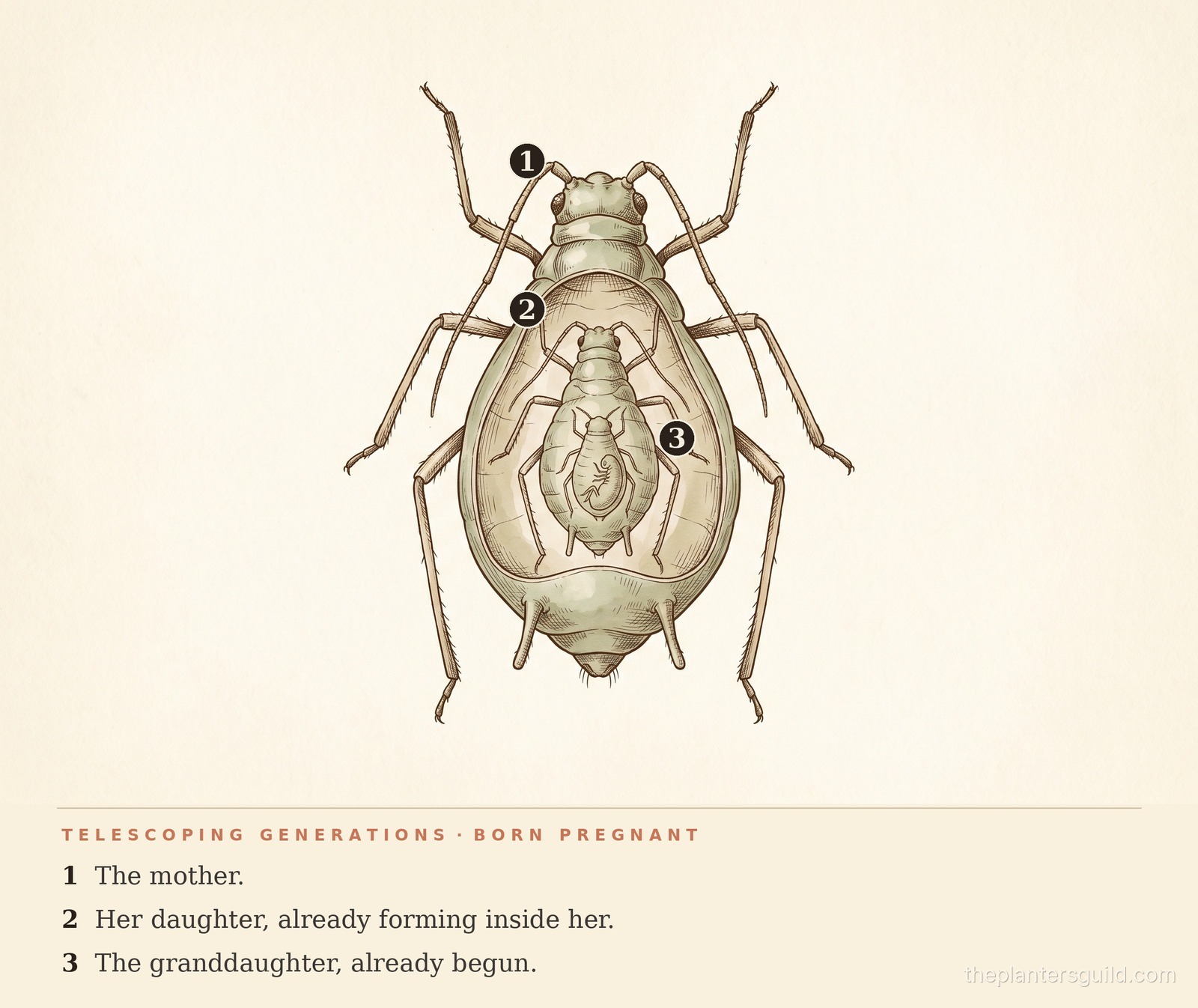
Run that math. A new aphid matures in about a week and starts producing several offspring a day, and each of those is on the same clock. You don't get addition, you get compounding. That's why the count goes from "huh, a few aphids" to "the whole flush is coated" inside a week, and why squashing the dozen you see on Monday doesn't end anything. The reproduction is the pest. The individual bug is almost beside the point.
When days shorten and cold comes on, many species switch to producing males and egg-laying females for one round of sex and overwintering eggs. But that's the offseason. The season you're fighting in is the all-female, all-cloning, no-brakes version.
Where to find them
Aphids want soft tissue and sugar flow, so they crowd the youngest growth. Check these, roughly in order:
The growing tips and new shoots, where the stem is still tender. The undersides of young leaves, near the veins. Flower buds, packed in tight before the bud opens. The stems of known favorites: roses, milkweed, the cabbage family, beans, fruit trees in spring. And the ant highway, because if ants are marching up and down a stem with purpose, they're almost always commuting to an aphid colony you haven't spotted yet.
Indoors and on a shaded patio, the same rule holds. Aphids ride in on a new nursery plant or a bunch of cut greens and head straight for the freshest growth on whatever's nearby. A houseplant pushing a new leaf is exactly the soft target they want, so quarantine new arrivals and check the tips.
How they damage plants
Aphids don't chew. They slide a thread-fine stylet (their needle-like mouthpart) between cells until it taps the phloem, the plumbing that carries sugars around the plant, and then the plant's own internal pressure does the pumping. The aphid barely has to work; it just drinks.
That does three things, and they pile up:
The new growth pays first. Tips that should be expanding instead curl, pucker, and yellow, because the aphids are draining the sugar that growth runs on. Heavy feeding stunts and deforms the flush, and on a young plant under real pressure it stalls growth outright.
Then comes the sticky mess. An aphid takes in far more sap than it can use, mostly to mine the small amount of protein in it, and it dumps the excess sugar straight out the back as honeydew. That clear, sticky film coats the leaves below, and a black fungus called sooty mold colonizes it fast. The mold doesn't feed on the plant, but it cakes the leaf surface and blocks light, so a bad aphid run turns into an aphid-and-mold run.
And some aphids carry disease. Aphids vector a long list of plant viruses as they feed, and the green peach aphid, the commonest species in most gardens, moves them plant to plant on its mouthparts as it samples (Clemson Cooperative Extension, 2019). On vegetables that matters more than the direct feeding, because once a plant is infected, killing the aphid doesn't undo it.
The ant problem nobody mentions
If you only treat the aphids, you'll often lose, and the reason is ants.
Ants farm aphids the way we farm dairy cattle. They stroke the colony with their antennae to draw out honeydew, and in exchange they defend it: they drive off lady beetles, they pull parasitic wasps away, they even carry aphids to better feeding spots and haul off the sick and dead to keep the herd healthy (Stadler & Dixon, 2005). A colony under ant protection is a colony your beneficials literally cannot get into.
So when you find aphids, look for the ant trail, and if it's there, deal with it as part of the job. A sticky band around the trunk or stem, or an ant bait near the base, cuts the supply line. Break the ant guard and the lady beetles and lacewings already cruising your garden will find the colony on their own. Leave the ants and you can spray all week while they tend the survivors.
The Apprehension Protocol
Four tiers. Start at the top, escalate only when the tier below stops keeping up. The whole point is to solve it with the gentlest tool that works, because the heavy tools cost you the predators.
Tier 1: Water and the ants
A sharp jet of water from the hose knocks the colony off the new growth, and most of the aphids you blast off don't make it back. It costs nothing, it's safe on anything, and on roses and sturdy garden plants it's a real control, not a token gesture. Hit the undersides and the growing tips, and repeat every couple of days while the population's high.
At the same time, deal with the ants if they're present (see above). Tier 1 is water plus cutting the ant supply line, together. Done as a pair, on a small-to-medium outbreak, they often end it.
Tier 2: Insecticidal soap or horticultural oil
When water isn't keeping up, go to a contact spray. Insecticidal soap and horticultural oil both kill soft-bodied aphids the same way, by breaking down their outer layer and suffocating them, and neither leaves a toxic residue behind (Clemson Cooperative Extension, 2021). They're cheap, they're about as low-risk as garden sprays get, and most of them are labeled safe on vegetables right up to harvest.
The catch is that they only kill what they touch. There's no lingering effect, so a spray that misses the undersides misses the aphids. Cover the plant thoroughly, leaf backs included, spray to runoff, and plan on a repeat in 5 to 7 days to catch the ones you missed and the newborns that have arrived since. Spray in the cool of morning or evening, not in hot sun, to avoid leaf burn.
Tier 3: Recruit the beneficials
For anything bigger than one plant, or a problem that keeps coming back, your best long-term control isn't a spray at all. It's the predators. The biggest thing you can do for them is stop spraying anything broad-spectrum that kills them along with the aphids.
Lady beetles and their larvae, green lacewing larvae, hoverfly maggots, and tiny Aphidius wasps are all aphid specialists, and in most gardens they show up on their own once you quit interfering and cut the ants out (more on each below). For sustained pressure you can buy and release green lacewing eggs or Aphidius wasps, which establish and keep working between your sprays (Oregon State University Extension Service, n.d.).
Tier 4: Systemic insecticide, almost never
This is the last resort, and for a home garden it's almost always the wrong tool. The systemics that move into plant tissue against aphids are usually neonicotinoids, the same class flagged in our thrips dossier: persistent for months, highly toxic to bees, and increasingly restricted.
A systemic doesn't know the difference between an aphid drinking sap and a bee drinking nectar from the same plant's flowers. So it's off the table for anything flowering, anything you eat, and anything pollinators visit, which rules out most of the garden. And on milkweed it's not a judgment call at all, for a reason that gets its own section.
The allies on your side
You almost never have to import a solution. The aphid is the bottom of a lot of food chains, and your job is mostly to stop killing the things already eating them.
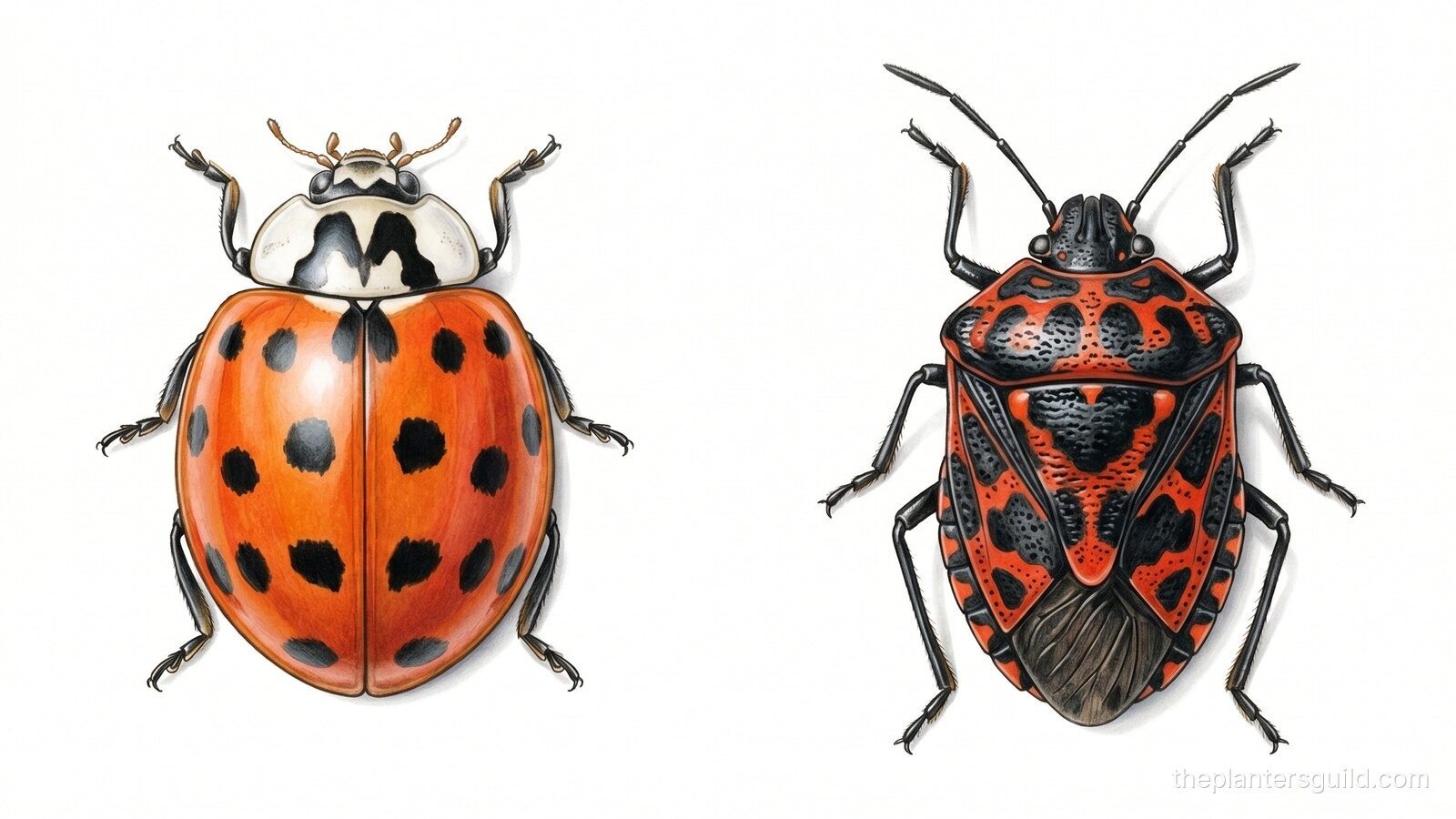
The lady beetle is the famous one, and the larva does more work than the adult: a spiny, black-and-orange "alligator" that looks like a pest and eats hundreds of aphids before it pupates. Our Harlequin vs. Ladybug dossier covers that beetle in full, and it's the larva to leave alone. Green lacewing larvae are pale, fierce, and grab aphids with hooked jaws. Hoverfly adults look like little bees hovering over the flowers, harmless themselves, but their legless maggots are quiet aphid-eating machines down in the colony.
And the strangest ally leaves evidence. A parasitic wasp stings an aphid and lays an egg inside it, and the larva eats the aphid from the inside and pupates in the hollowed-out shell. What's left is an aphid mummy: a swollen, papery, tan or bronze aphid glued to the leaf, often with a neat round exit hole where the next wasp chewed its way out. Mummies are good news. They mean the wasps found your colony and are already working it. Learn to spot them and you'll know when to do nothing.
The milkweed exception
If you grow milkweed for monarchs, the bright yellow oleander aphid will find it, and the usual advice goes out the window.
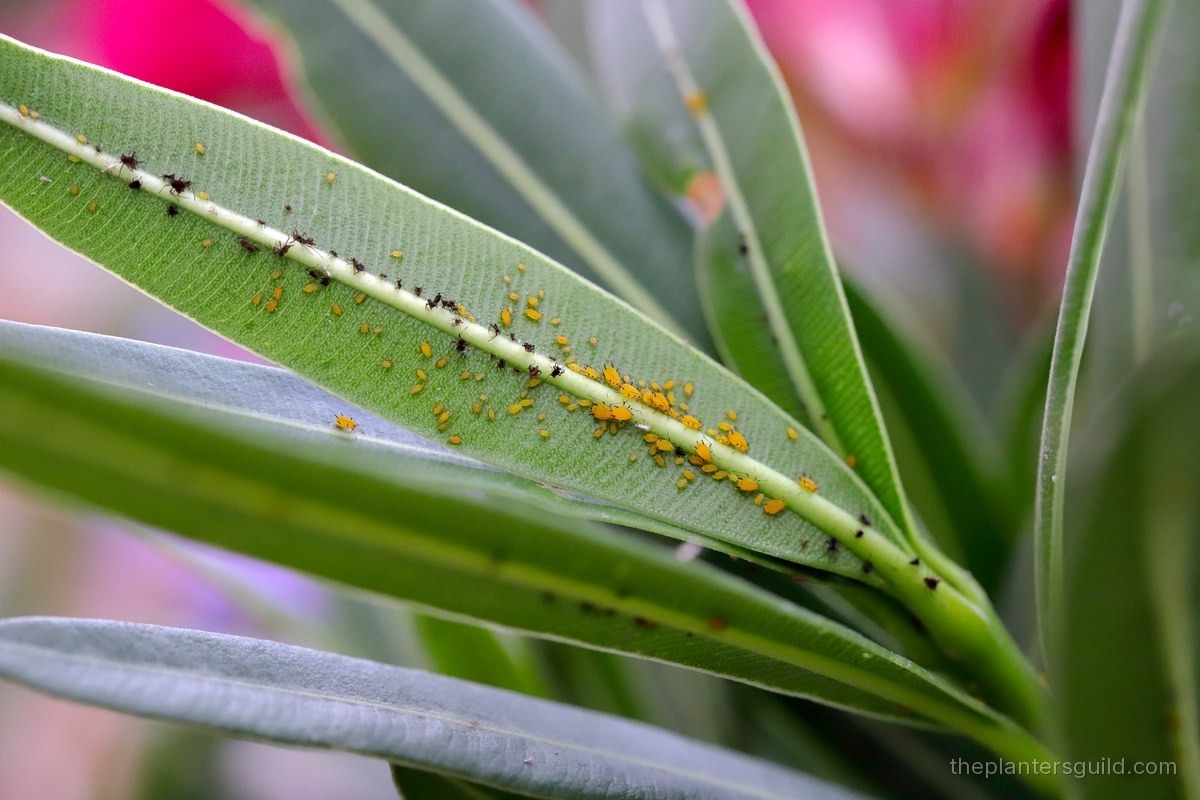
You can't spray your way out of this one. The systemics that would knock the aphids down also poison the monarch caterpillars you planted the milkweed for, and even a contact spray catches eggs and small caterpillars in the crossfire. There's also a real cost to leaving the aphids alone: heavy infestations measurably reduce how many eggs monarchs lay on a plant and how well the caterpillars grow on it (Mach et al., 2023). So you can't ignore them and you can't nuke them.
What works is the gentle, physical approach, done by hand and on a schedule. Wipe the colonies off with a gloved finger or a damp cloth, or aim a careful, low-pressure stream of water at the aphids while checking first for monarch eggs and caterpillars. Hose them into the dirt; they rarely climb back. And then let the lady beetles and lacewings do the rest, because milkweed is exactly the kind of plant where you want the predators thriving, not poisoned. It's slower than a spray. It's the only version that doesn't defeat the purpose.
Predictable mistakes
People squash the visible aphids and call it done. The ones you can see are a fraction of a colony that's reproducing faster than you can pinch, so hand-squashing alone never catches up. Knock them down with water and keep at it.
People spray and ignore the ants. The ants just re-tend the survivors and chase off the predators, and you're back where you started in a week. Cut the ant trail every time.
People reach for a strong broad-spectrum insecticide first. That's the move that backfires hardest, because it clears the lady beetles and lacewings along with the aphids, and the aphids, breeding faster, rebound first into a garden with no predators left. You've made the next outbreak worse.
And people panic over aphids on milkweed and spray. On that plant, the spray is the mistake.
The takeaway
Aphids are a speed problem, not a mystery. They multiply fast because they skip sex and the young are born already pregnant, so the answer is to keep knocking the population down while you let the predators catch up, instead of swinging once with something heavy.
Blast them off with water. Cut the ants out of it. Step up to soap or oil if you need to, and protect the lady beetles, lacewings, and wasps that work for free. Save the milkweed with your hands, not a sprayer. Do that and the same garden that grew a green crust in a week will be holding its own a couple of weeks later, with most of the work done by bugs you never had to buy.
Ogawa, K., & Miura, T. (2014). Aphid polyphenisms: Trans-generational developmental regulation through viviparity. Frontiers in Physiology, 5, 1. [link]
Bermingham, J., & Wilkinson, T. L. (2009). Embryo nutrition in parthenogenetic viviparous aphids. Physiological Entomology, 34(2), 103–109. [link]
Alfaress, S., Brodersen, C. R., Ammar, E.-D., Rogers, M. E., & Killiny, N. (2018). Laser surgery reveals the biomechanical and chemical signaling functions of aphid siphunculi (cornicles). PLOS ONE, 13(10), e0204984. [link]
Stadler, B., & Dixon, A. F. G. (2005). Ecology and evolution of aphid–ant interactions. Annual Review of Ecology, Evolution, and Systematics, 36, 345–372. [link]
Mach, B. M., Long, W., Daniels, J. C., & Dale, A. G. (2023). Aphid infestations reduce monarch butterfly colonization, herbivory, and growth on ornamental milkweed. PLOS ONE, 18(7), e0288407. [link]
Clemson Cooperative Extension. (2019). Integrated pest management (IPM) for aphids. Home & Garden Information Center. [link]
Clemson Cooperative Extension. (2021). Insecticidal soaps for garden pest control. Home & Garden Information Center. [link]
University of Florida IFAS Extension. (2018). The oleander aphid: Arch enemy of milkweed. [link]
Oregon State University Extension Service. (n.d.). Biological pest control. Solve Pest Problems. [link]