A working grower's guide to identifying spider mites, understanding why they take down a houseplant in two weeks instead of two months, and getting them out of your collection without scorching the plant in the process.
You won't see them. You'll see the dust.
Spider mites are 0.4 to 0.5 millimeters long. A 10× hand lens will show you a mite is there; extension guides recommend 15× to 20× for the diagnostic detail, and our Workshop review of five hand lenses covers which ones actually resolve at that scale. By the time you spot a mite with the naked eye, you've had them for at least seven to ten days, and the population has been doubling every three to five.
What you'll see first is the damage. Tiny pale dots scattered across the upper surface of a leaf, like someone dusted it with fine sand. That's stippling. Each dot is one cell that a mite punctured and drained dry. At higher pressure, the dots merge and the leaf takes on a bronzed, silvered, faded look that doesn't come back. By the time webbing shows up on the undersides and at stem joints, you've lost the early window.
Webbing is the late signal. Real spider mite webbing isn't architectural the way an actual spider's is. It's fine drag silk, almost invisible until oblique light catches it. By that point, the population is in the thousands and you're managing damage, not preventing it.
The single most useful diagnostic move costs nothing. Hold a sheet of white paper under a suspicious leaf, tap the leaf firmly. If specks fall onto the paper and move, those are mites. If they sit there, you're looking at frass, dust, or sloughed plant matter. Do this once a week on at-risk plants in the dry months and you'll catch most outbreaks before they bloom. (UC IPM Pest Notes — Spider Mites is the canonical reference for the diagnostic and the rest of what follows.)
The white-paper-tap test is the first move. Run it before you spray anything.
Indoor Pests · Class Arachnida (Acari)
Spider Mites
Tetranychus urticae · T. cinnabarinus · Oligonychus ununguis
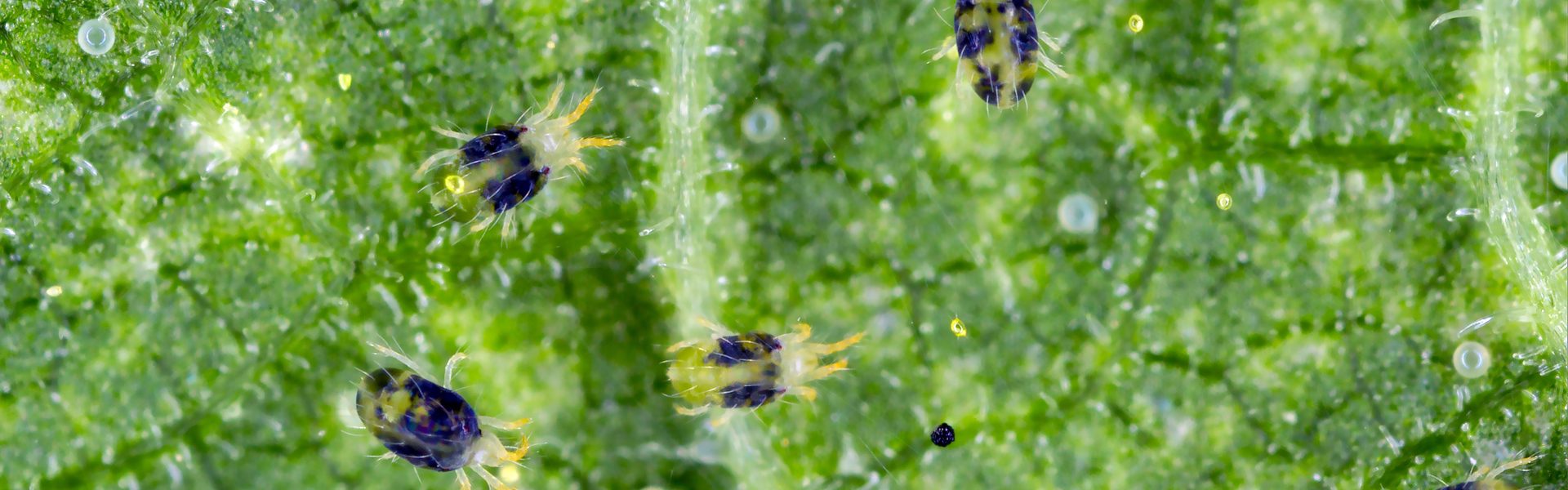
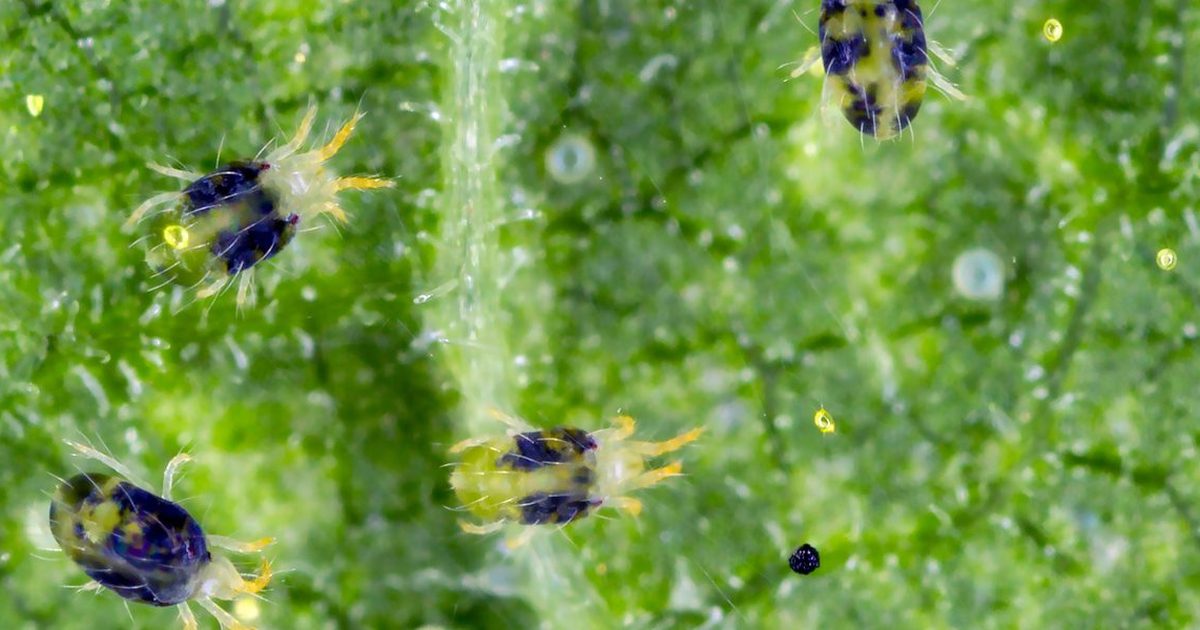 Mug Shot Adult, ~0.45 mm
Vital Statistics
- Class
- Arachnida (Acari) — not insect
- Adult size
- 0.4 to 0.5 mm
- Color
- translucent yellow-green to red-brown, two dark gut spots
- Lifecycle
- 5 to 20 days (temperature-dependent)
- Adult lifespan
- 14 to 30 days
- Eggs per female
- 60 to 100+
Modus Operandi
Pierces individual leaf cells with chelicerae and drains contents, leaving stippled chlorotic dots that merge into bronze patches under population pressure. Established colonies spin fine drag silk on leaf undersides and stem joints. Damage compounds fast: a single female founds a population that doubles every three to five days under warm dry conditions.
Last Seen
Undersides of leaves, leaf axils, stem joints, the youngest growth, and any plant within reach of a heating vent or sunny dry window. Webbing visible only in oblique light at established population levels. Will not appear on yellow sticky cards: they don't fly.
Apprehension Protocol
The Mug Shot
Spider mites are not insects. They're arachnids. Class Arachnida, subclass Acari. Eight legs as adults, no wings, no antennae. This taxonomic fact matters because it changes which chemistries work on them. Most "insecticides" don't.
Two-spotted spider mite (Tetranychus urticae) is the species you're almost certainly dealing with on indoor plants. The "two spots" are dark gut contents visible through the translucent body, not pigmented markings. Body color shifts from yellow-green in summer feeding generations to a brick-red in winter dormancy or under stress. The red form was historically called T. cinnabarinus and treated as a separate species; current taxonomy considers it a color morph of T. urticae. Spruce spider mite (Oligonychus ununguis) is a separate species that shows up on Norfolk Island pine and other needled houseplants, and it follows similar protocols.
Lifecycle: egg, larva (six legs), protonymph, deutonymph, adult. Egg to reproductive adult runs five to twenty days depending on temperature. At 80 to 90°F (27 to 32°C) with low humidity, that's five to seven days. At 60°F (16°C) it stretches closer to twenty. Adult lifespan is fourteen to thirty days, and a single female lays sixty to a hundred-plus eggs across that window. (Helle and Sabelis 1985, Spider Mites: Their Biology, Natural Enemies and Control, remains the standard reference on the lifecycle architecture.)
Sequence the math. One female founds a hundred daughters. Each of those founds another hundred. That's a population doubling every three to five days. A clean plant can carry visible webbing in three weeks, not because mites came in heavy, but because they doubled six times in a row.
The reproductive system is unusual and load-bearing for resistance management. Spider mites are haplodiploid: unfertilized eggs become males, fertilized eggs become females. Combined with the short generation time and high fecundity, that haplodiploidy is one reason the genus develops chemical resistance faster than almost any other arthropod on the planet. Van Leeuwen's lab at Ghent has documented that T. urticae carries the largest detoxification gene family of any sequenced arthropod (Van Leeuwen and Dermauw 2016, Annual Review of Entomology 61: 475–498). Translation: throw the same chemistry at them twice and you've selected for survivors.
We'll come back to this in the protocol section. The takeaway up front: never use the same miticide on the same population twice in a row.
Where to find them
Five places in order of likelihood:
The undersides of leaves, especially along the midrib and at vein junctions. Where two leaves touch or where a leaf rim presses against a pot — sheltered microclimates. Stem joints and leaf axils, where webbing collects with established populations. The youngest expanding growth, which has thinner cuticle and softer cell walls. And any plant within reach of a heating vent, a fan in still warm air, or a sunny dry window. Mites favor warm and dry the way thrips favor warm and humid.
Yellow sticky cards do not catch spider mites. Mites don't fly. They walk, they hitch on hands and pots and watering cans, and at population peak the youngest stages will balloon on a strand of silk to drift to the next plant. Cards are for thrips, fungus gnats, and whiteflies. Save the money.
Run the white-paper-tap test on suspicious plants once a week during dry months. Pair it with flipping ten random leaves over while you water. Two minutes of inspection covers most of a small collection.
How they damage plants
Spider mites have piercing-sucking mouthparts, called chelicerae. They puncture single leaf cells and drain the contents, leaving the empty cell wall and a chlorotic dot. Each dot of stippling is one drained cell. A heavy infestation drains tens of thousands of cells across a leaf in days.
Damage compounds for three reasons.
The cell-feeding kills photosynthesizing tissue. By the time a leaf is heavily stippled, it's lost thirty to fifty percent or more of its working chlorophyll surface area. The plant can't recover that leaf. It can only abscise it and replace it. On a slow-growing plant, that math runs out of leaves before it runs out of mites.
The webbing protects the colony. Drag silk on the undersides of leaves traps dust, shades the surface, and creates a microclimate that buffers mites from sprays and predators. Spray pressure that would dislodge an exposed mite skips off the silk above the colony. Once you see webbing, mechanical control needs more force, more cycles, and more attention to the underside.
Spider mites do not vector indoor plant viruses the way thrips vector tospoviruses (TSWV, INSV). The damage is purely physical and physiological. That's one fewer worry than thrips. It doesn't make mites less destructive — they're faster.
Why heat plus dry air equals explosion: mite metabolism scales with temperature, and reproductive output rises sharply between 80 and 90°F (27 and 32°C). Humidity below 40 percent suppresses fungal pathogens that would otherwise check the population, and predator effectiveness drops in dry air. A condo running HVAC heat all winter is mite paradise. So is a sunny west window behind closed blinds in July. The microclimate around the plant matters as much as the chemistry you spray.
The Apprehension Protocol
Four tiers. Use them in order. Do not skip Tier 1 because the plant is heavy.
Tier 1: Isolate and raise humidity
Move the affected plant out of the room. Different room ideally; if space won't allow it, get a clear plastic tote, drill a few air holes, and quarantine the plant inside.
Then raise the humidity around the plant to at least 60 percent. Spider mites slow their reproduction sharply above that threshold, and the predators you may release in Tier 3 establish faster in humid air. The simple version: bag the plant inside a clear plastic bag with damp paper towels for forty-eight to seventy-two hours after the first water knockdown. Light through the bag, ventilate once a day. Don't seal it airtight at warm temps or you'll cook the foliage.
Inspect every plant within three feet of the affected one, especially anything sharing a fan, a heat vent, or a sunny window. Mites travel by walk and by silk-balloon, and the corner of a room is one continuous habitat from their point of view.
Tier 2: Water knockdown and soap
Strong room-temperature water is the first chemical-free tool. Take the plant to the kitchen sink or the shower. Spray every leaf underside with the strongest stream the foliage will tolerate. The goal is mechanical: dislodge mites, break up webbing, wash the colony off the leaf.
Repeat the water knockdown every three to five days for three full weeks. The cycle timing is keyed to the lifecycle. Mite eggs hatch in three to five days at room temperature, and every knockdown catches the new larvae before they reach reproductive age. Two cycles isn't enough. The third closes the egg-to-adult window the first two opened.
From the second cycle onward, add insecticidal soap (potassium-salt formulation, label rate) or a 1 percent horticultural oil. Soaps work by disrupting the soft cuticle and cell membranes of active mite stages; coverage is everything. Oils work by smothering both eggs and active stages — the only common chemistry in the indoor toolkit that's reliably ovicidal. (NPIC Insecticidal Soap and Horticultural Oil fact sheets cover the mechanisms in detail.)
For most indoor collections, default to insecticidal soap. Oils are more effective on eggs but they're phytotoxic to many aroids and most thin-cuticled foliage if applied at the wrong moment. Two hard rules with oil: don't spray when temps are above 85°F (29°C), and don't spray a drought-stressed plant. Evening application only. Direct sun plus oil plus heat equals leaf burn within hours.
Spray to runoff. Coverage on the undersides matters more than concentration in the bottle. A misted top surface with dry undersides is the same as not spraying.
Tier 3: Predatory mites
For a collection over twenty plants or anyone seeing repeat outbreaks, biological control becomes the cheapest sustainable option. The two species worth knowing:
Phytoseiulus persimilis is the gold standard. It's a specialized predator on Tetranychus urticae, reproduces faster than its prey when conditions are warm (70 to 85°F / 21 to 29°C) and humid (above 60 percent RH), and clears a colony in seven to fourteen days under good conditions.
Neoseiulus californicus is the choice for cooler or drier rooms. More generalist, tolerates lower humidity, slower kill rate but persists in residual presence longer.
Order from a biocontrol supplier. Koppert, Beneficial Insectary, and ARBICO Organics ship to the U.S. Predators arrive in carrier-bran in a small bottle. Sprinkle directly onto foliage at the recommended rate.
Critical timing: release predators after the soap or oil cycles finish. Soaps and oils kill predator mites on contact. Wait seven to ten days after the last spray, then release. If you release predators while you're still spraying, you've paid for sterile carrier.
I haven't run Phytoseiulus in this collection yet. It's the next biocontrol I'm planning to test, partly because the thrips outbreak this month has me thinking harder about what's already on the shelf the day pressure shows up. The literature on this species is unusually clean — Helle and Sabelis 1985 has the canonical chapter — and the operational reports from working growers I trust are consistent.
Tier 4: Targeted miticide
Last resort. For most home growers, you should never reach Tier 4. Water plus soap plus predators handles ninety-five percent of indoor outbreaks if you stay on the cycle.
If escalation is necessary: abamectin (a macrocyclic lactone derived from Streptomyces avermitilis fermentation, acting on glutamate-gated chloride channels) or bifenazate (a hydrazinecarboxylate acting on mitochondrial electron transport). Different modes of action, which is the entire point. Rotate, never repeat. (Van Leeuwen et al. 2010, Insect Biochemistry and Molecular Biology 40(8): 563–572, is the canonical resistance review.)
Avoid systemic neonicotinoids. Imidacloprid and dinotefuran don't translocate efficiently into mite feeding sites and they're highly toxic to bees if the plant ever flowers outdoors (EPA Actions to Protect Pollinators).
And to put it plainly: spinosad does not work on spider mites. The Tier 2 chemistry that runs the Thrips dossier is the wrong tool here. Mites are arachnids; spinosad's mode of action targets insect neurotransmission. If a reader arrives here from the Thrips article, that's the single most important crossover correction.
If you're seriously considering a miticide on a houseplant, the better question is whether the plant is worth saving. A composted plant and a clean restart sometimes pencils out cleaner than a chemistry escalation in a residential setting.
The microclimate connection
Most of what controls spider mites at the home-grower scale isn't chemistry. It's the microclimate around the leaf surface.
Spider mites thrive in dry air. Below 40 percent relative humidity, their reproductive output peaks, the fungal pathogens that would otherwise kill them collapse, and predator effectiveness drops. Above 60 percent, the math reverses on every front. HVAC heat in winter is a mite invitation. So is a sunny west window behind closed blinds in July.
The simplest control move most growers underrate: raise the humidity around at-risk plants to 60 percent for two weeks. Group plants close together. Run a humidifier nearby. Mist the leaf undersides (not the soil) once a day during a recovery window. None of this kills mites by itself. All of it slows reproduction and lets the rest of the protocol do its work.
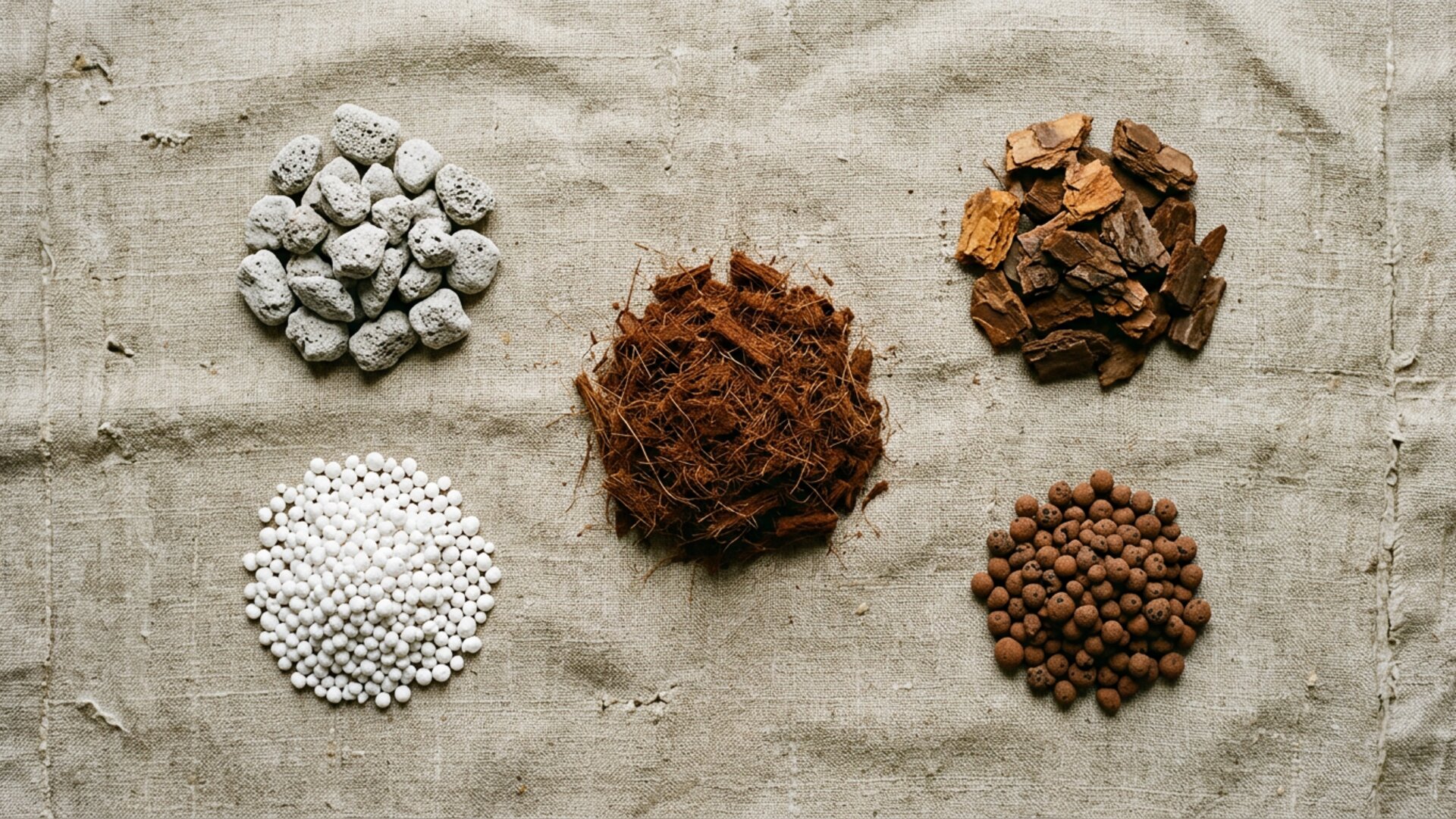
Substrate ties in indirectly. A chunky, airy mix lets a plant transpire freely, which supports the leaf microclimate that suppresses mites. A wet, dense potting mix collapses the root zone, stresses the plant, and stressed plants attract mites the way they attract every other opportunist. UC IPM ties drought stress to mite susceptibility for exactly this reason. If a plant is fighting its substrate, it's fighting the mites with one hand. Our Substrate Primer covers what a chunky aroid mix should actually do.
The single most underrated mite control move is "raise the humidity around the plant for two weeks." It costs nothing and it works.
Predictable mistakes
People stop spraying after one round because the visible mites are gone. The eggs hatch a week later and the population doubles right back. Three cycles minimum, no exceptions.
People mist instead of spraying with pressure. Mist doesn't dislodge mites or wet the underside surfaces where the colony lives. A twelve-dollar pump sprayer fixes this.
People skip the humidity step because it feels passive. It isn't. Humidity is half the protocol.
People spray oil at noon on a hot day and burn their plants. Oils plus heat plus sun equals leaf damage. Evening only.
People use the same miticide twice and select for resistance. The Van Leeuwen literature is unambiguous on this. Rotate or use mechanical and biological control instead.
And one more, specific to the indoor scene: people read the Thrips dossier, see Captain Jack's spinosad, and reach for the same bottle when the next plant shows stippling. Spider mites are arachnids; spinosad is built for insect neurology. It won't touch them.
The takeaway
Spider mites are fast, not mysterious. Catch the stippling early, run the water-and-soap cycle for three weeks straight, raise humidity around the plant, and if you're managing a real collection, keep predator suppliers bookmarked. The mistakes are nearly always shortcut mistakes: stopping early, missing the underside, leaving the air dry. Two weeks of disciplined effort closes most outbreaks. Skip the synthetic miticide unless every other tier has failed.
Catch them early. Run the full cycle. Repot if the plant has been stressed. You'll spend two weeks on this once and never have it bloom into a real problem again.
UC IPM Pest Notes — Spider Mites. University of California Statewide Integrated Pest Management Program. [link]
Van Leeuwen, T., Vontas, J., Tsagkarakou, A., Dermauw, W., & Tirry, L. 2010. Acaricide resistance mechanisms in the two-spotted spider mite Tetranychus urticae and other important Acari: A review. Insect Biochemistry and Molecular Biology 40(8): 563–572.
Van Leeuwen, T., & Dermauw, W. 2016. The molecular evolution of xenobiotic metabolism and resistance in chelicerate mites. Annual Review of Entomology 61: 475–498.
Helle, W., & Sabelis, M. W. (eds.) 1985. Spider Mites: Their Biology, Natural Enemies and Control. Volumes 1A and 1B. Elsevier, Amsterdam.
Fasulo, T. R., & Denmark, H. A. Two-Spotted Spider Mite, Tetranychus urticae Koch (Arachnida: Acari: Tetranychidae). UF/IFAS Featured Creatures EENY-150.
NPIC Insecticidal Soap, Horticultural Oil, and Abamectin Fact Sheets. National Pesticide Information Center, Oregon State University.
EPA Actions to Protect Pollinators. U.S. Environmental Protection Agency.