A working grower's guide to identifying thrips, understanding how they damage indoor plants, and running them out of your collection without poisoning the room they live in.
You won't see them. You'll see the damage.
Thrips are the pest most people miss for a month before they catch on. They're 1 to 2 millimeters long, the color of wet straw, and they live tucked into the curl of new growth or pressed flat against the underside of a leaf. By the time you spot a thrips with the naked eye, you've usually had thrips for weeks.
What you'll see first is the damage. Silver streaks across the leaf surface, like someone dragged a dull pencil across a piece of construction paper. Tiny black specks of frass (that's polite for thrips droppings) scattered around the streaks. New growth coming in pinched, distorted, slightly off-color. Then one day you tap a leaf and a few tan-yellow flecks scatter into the air, and you realize what you've been looking at.
This is when the plant becomes a project.
Indoor Pests · Order Thysanoptera
Thrips
Frankliniella occidentalis · Thrips tabaci · Echinothrips americanus
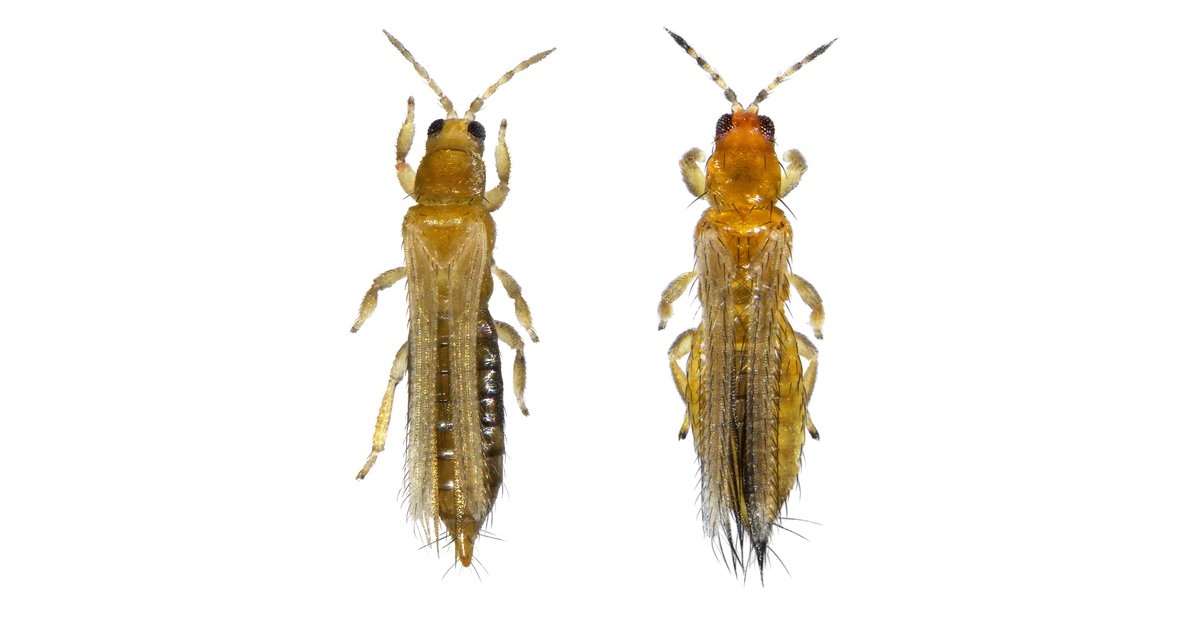 Mug Shot Adult, ~1.5 mm
Vital Statistics
- Order
- Thysanoptera
- Adult size
- 1 to 2 mm
- Color
- yellow / brown / black
- Lifecycle
- 14 to 21 days
- Adult lifespan
- 30 to 45 days
- Eggs per female
- 40 to 80
Modus Operandi
Pierces leaf surfaces with a single mandibular stylet and rasps tissue, leaving silvery streaks where chlorophyll has been drained. Black frass spots accompany the streaks. New growth distorts and discolors. Often unnoticed until population pressure makes the damage unmistakable.
Last Seen
Undersides of leaves, leaf axils, the curl of new growth, the soil surface during pupation. Adults take flight when the plant is disturbed, which is often the first time anyone spots them.
Apprehension Protocol
The Mug Shot
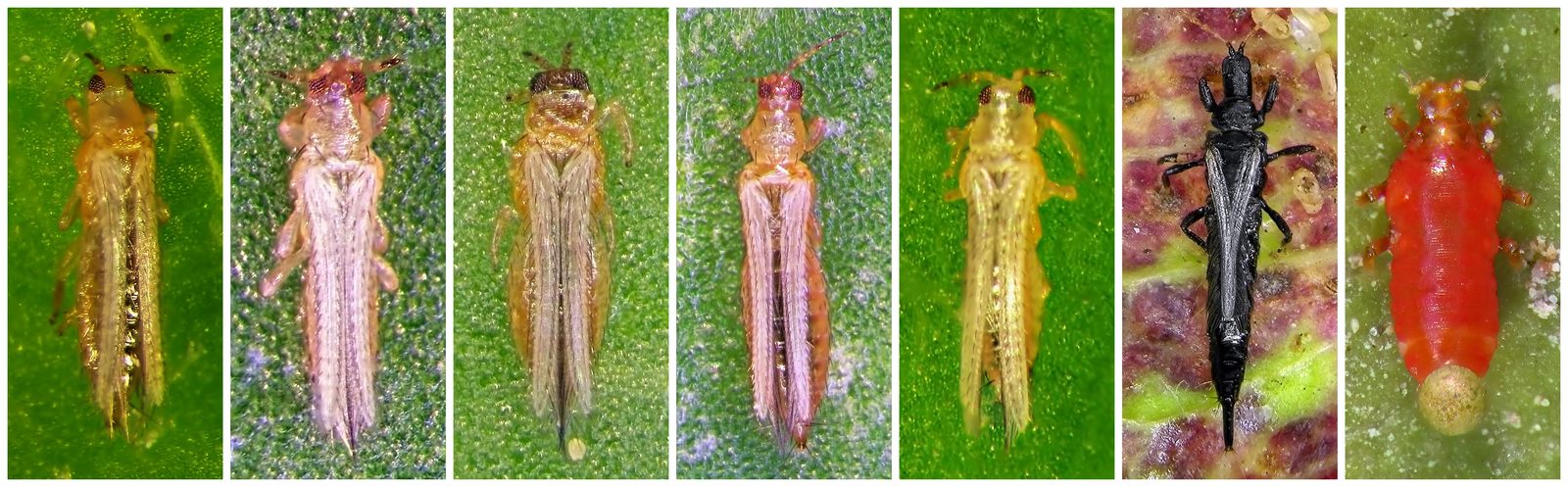
Before we get into protocol, get familiar with what you're hunting. Thrips are members of the order Thysanoptera, which translates from the Greek as "fringe-winged." It's a useful name. Their wings are the diagnostic feature, narrow blades fringed with long hairs that look almost feathery under magnification. A 30× or 60× hand lens shows the fringe cleanly; the Workshop review covers which one to buy. Real thrips wings don't have visible veins. If you find what looks like a thrips but the wings have a clear membrane-vein structure, you're looking at something else.
Common species you'll find on indoor plants:
- Western flower thrips (Frankliniella occidentalis): yellow-tan, the most common species on houseplants and the one that vectors tospoviruses
- Onion thrips (Thrips tabaci): yellow to dark brown, tolerant of cooler conditions
- Echinothrips (Echinothrips americanus): almost black, prefers tropical foliage, very common on aroids
Species IDs and behavior here align with UC IPM Pest Notes — Thrips and Reitz et al. 2020, Annual Review of Entomology 65: 17–37.
Adults are 1 to 2 mm long. Larvae are smaller, wingless, and often a paler yellow or translucent. The full lifecycle (egg, two larval instars, prepupa, pupa, adult) runs 14 to 21 days at room temperature. A single female lays 40 to 80 eggs in her lifetime, often inserting them directly into leaf tissue with a saw-like ovipositor. Adults live another 30 to 45 days after that (UC IPM; Reitz et al. 2020).
That math matters. We'll come back to it.
Where to find them
Six places to check, in order of likelihood:
The undersides of leaves, especially near the midrib. The curl of new, unfurling growth. Leaf axils, where the petiole meets the stem. Flower buds and the inside of any open bloom, where they feed on pollen. The top quarter inch of substrate, where late-instar larvae drop down to pupate. And the air directly above the plant when you disturb it. A few adults will take flight, which is often the first time you actually see one.
Yellow sticky cards work as a monitoring tool, not a control. Hang one near each plant in the affected area. They'll catch flying adults and give you a population trend, which is useful for knowing when you're winning.
How they damage plants
Thrips don't chew. They have a single mandibular stylet (one half of a mouth, essentially) that they use to puncture individual plant cells and rasp the contents loose. They suck the chlorophyll-bearing fluid out of the cell, which is why the damage looks silvery: you're seeing the empty, air-filled wreckage of cells the thrips drained dry.
Thrips damage compounds for three reasons:
Feeding sites cluster, so a heavy population turns a leaf silver in a week. The cell walls collapse and the leaf stops photosynthesizing. You've effectively reduced the plant's working surface area.
The frass that comes with feeding is a fungal buffet. Sooty mold and other fungi colonize thrips droppings in humid environments, so a thrips problem fast-tracks into a thrips-and-mold problem.
Western flower thrips vector plant viruses including tomato spotted wilt virus (TSWV) and impatiens necrotic spot virus (INSV) — both tospoviruses. Transmission is persistent and propagative: only thrips that fed on infected plant tissue as first-instar larvae become competent vectors as adults (He et al. 2020, Insect Science). Once a plant is infected, no amount of pest control reverses it. This is why moving an infested plant through your collection matters.
The Apprehension Protocol
Four tiers. Use them in order, escalate only when the previous tier stops working.
Tier 1: Isolate
Move the affected plant out of the room before you do anything else. Different room ideally; if space won't allow it, get a clear plastic tote, drill air holes, and quarantine the plant inside.
Then inspect every plant within three feet of the affected one. Thrips don't fly far on their own, but they hitch rides on watering cans, sleeves, and plant surfaces. If you've been working with the infested plant on a counter, inspect everything that shared the counter.
Don't skip this step because the plant is heavy. Skipping it is how you treat one plant for six weeks while larvae pupate and emerge in the potting mix of the plant on the next shelf over.
Tier 2: Spinosad
Spinosad is the chemical that actually works on indoor thrips, and it's the one you should reach for first. It's derived from a soil bacterium, breaks down quickly under sunlight, has very low toxicity to mammals and birds, and is approved for organic production. Brand names include Conserve and Captain Jack's Deadbug Brew. Buy it once and you'll use it for years.
Spray to runoff on the undersides of all leaves, the leaf axils, and the soil surface. Late-instar larvae drop into the substrate to pupate, so a foliar spray that skips soil just lets a fresh generation emerge.
Repeat every 7 to 10 days for three full cycles. Most people stop after two because the visible population crashes. Here's why that fails: Spinosad kills active larvae and adults but doesn't penetrate eggs inserted into leaf tissue. The 7 to 10 day window lets the eggs from your last spray hatch into vulnerable larvae before the new generation starts laying. Three cycles closes that window. Two isn't enough.
Spray in the evening, not in direct sun. UV degrades spinosad fast and a noon application loses efficacy by mid-afternoon (NPIC Spinosad General Fact Sheet; Jones et al. 2005, Pest Management Science on spinosad efficacy against F. occidentalis).
Tier 3: Predatory mites
For collections of twenty-plus plants that see thrips more than once, Amblyseius cucumeris and Neoseiulus barkeri are the long game. You sprinkle them from a carrier-material bottle onto the foliage. They're invisible to the naked eye, eat first-instar thrips larvae, and live a few weeks per generation, so you reapply monthly (Funderburk et al. 2009, Florida Entomologist).
Timing matters: release predators after the spinosad cycles finish, not during. Spinosad kills predatory mites too. If you spray while they're establishing, you've paid for sterile carrier. Finish the three-cycle spinosad protocol, wait two weeks, then release predators as maintenance defense.
Skip this tier for small collections. It pencils out only if sustained thrips pressure makes preventive predators cheaper than another full treatment round.
Tier 4: Systemic imidacloprid
This is the last resort, and for indoor plants in residential settings, it's almost always the wrong tool. Imidacloprid is a neonicotinoid: highly persistent in plant tissue for months to years (NPIC Imidacloprid Technical Fact Sheet), highly toxic to bees with oral LD50 values of 1–5 ng per bee (Blacquière et al. 2012, Ecotoxicology), and increasingly restricted by state and federal regulators (EPA Actions to Protect Pollinators).
The use case where it makes sense is outdoor ornamental plants under heavy pressure, where the plant doesn't flower or where bloom can be removed during the active treatment window. For indoor plants, especially anything you keep near food, anything that flowers indoors, or anything in a household with children or pets, the calculus doesn't work. Skip it.
If you're at a point where you're seriously considering imidacloprid, the better question is whether the plant is worth saving. A heavily infested specimen in a residential setting is sometimes more honestly handled by composting it and starting clean.
The substrate connection
Most reinfestations come from the substrate, not the air.
Thrips pupate in the top quarter inch of soil (UC IPM). Foliar sprays that skip the soil leave that layer untouched, and the next generation emerges invisibly. This is why the spinosad protocol includes a soil drench at every cycle.
After the third cycle, when active populations are gone, repot the plant. Bare-root it, rinse the root ball gently with room-temperature water, and repot into fresh substrate. This physically removes remaining pupae. Check the roots while you're in there.
New to substrate building? Our Substrate Primer covers the components and ratios.
Predictable mistakes
People stop after two spray cycles because the plant looks better. The third cycle is what actually closes the egg-to-adult window. Skip it and thrips bounce back hard.
People mist leaves instead of spraying to runoff. Misting wets the top surface and misses the undersides where thrips camp. Buy a $12 pump sprayer.
People don't isolate. They treat the plant in place because it's in "its own corner," which isn't isolation. Thrips walk three feet of countertop like it's a freeway. Move the plant.
The takeaway
Thrips are persistent but not mysterious. The protocol works: spinosad on a calibrated cycle, isolation while you treat, predators afterward if your collection size justifies it. The mistakes are nearly always at the level of impatience or shortcut, not knowledge.
Catch the silver streaks early. Run the full cycle. Repot when it's over. You'll spend two months on this once and never have it bloom into a real problem again.
Reitz, S.R., et al. 2020. Invasion biology, ecology, and management of western flower thrips. Annual Review of Entomology 65: 17–37.
He, Z., Guo, J.-F., Reitz, S. R., Lei, Z.-R., & Wu, S.-Y. (2020). A global invasion by the thrip, Frankliniella occidentalis: Current virus vector status and its management. Insect Science, 27(4), 626–645. [link] [link]
Funderburk, J.E., et al. 2009. Management of flower thrips in blueberries in Florida. Florida Entomologist 92(1): 14–17.
Jones, T., et al. 2005. The efficacy of spinosad against the western flower thrips, Frankliniella occidentalis, and its impact on associated biological control agents on greenhouse cucumbers in southern Ontario. Pest Management Science. [link]
UC IPM Pest Notes — Thrips (Publication 7429). University of California Agriculture and Natural Resources. [link]
Blacquière, T., et al. 2012. Neonicotinoids in bees: a review on concentrations, side-effects and risk assessment. Ecotoxicology 21: 973–992.
NPIC Spinosad General Fact Sheet, Oregon State University. [link]
NPIC Imidacloprid Technical Fact Sheet, Oregon State University. [link]
EPA Actions to Protect Pollinators. U.S. Environmental Protection Agency. [link]