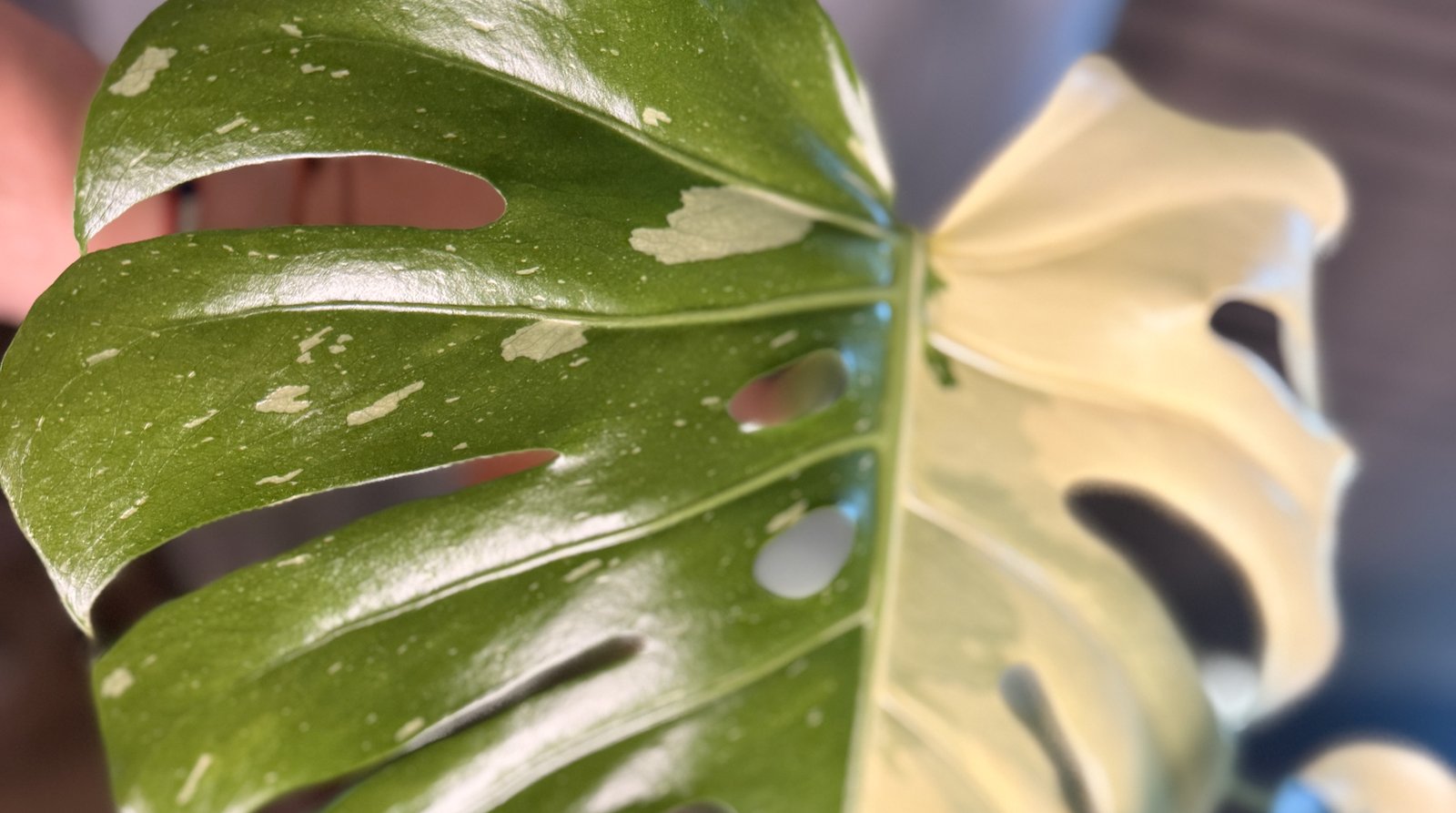
No label can promise that a variegated Monstera will keep its pattern. "Stable," "lab-grown" and "patented" each mean something, but none of them means "can't revert." And for all the confident talk about these plants, I found no published study of why they're variegated in the first place. Here's what the science of chimeras and other variegation does tell you, and what to watch for on the plant in front of you.
What Variegation Is
Variegation is the presence of distinct markings of different colors on a plant part, most often stripes, blotches or streaks, or an edge that differs in color from the middle of the leaf (Marcotrigiano, 1997). That's the whole definition. It says nothing yet about why.
The why is where things get muddy. The horticulturist Michael Marcotrigiano opened his 1997 review of the subject by pointing out that magazines, textbooks and some research journals misuse the words "variegation" and "chimera," calling plants chimeras when they aren't and missing them when they are (Marcotrigiano, 1997).
Genetically controlled variegation falls into two broad kinds (Kirk & Tilney-Bassett, 1978, as cited in Marcotrigiano, 1997):
- Mixed cells. The plant is usually a genetic mosaic, of which a chimera is one type: some of its cells carry different genes, and the pale patches are descended from the mutant cells (Marcotrigiano, 1997).
- Same cells, different switches. Every cell carries the same genes, and the pattern comes from which cells switch their pigment genes on (Marcotrigiano, 1997).
Marcotrigiano calls that second kind the most common cause of variegation, though he says so without citing data. Either way, not every variegated plant is a chimera (Marcotrigiano, 1997).
How a Chimera Works
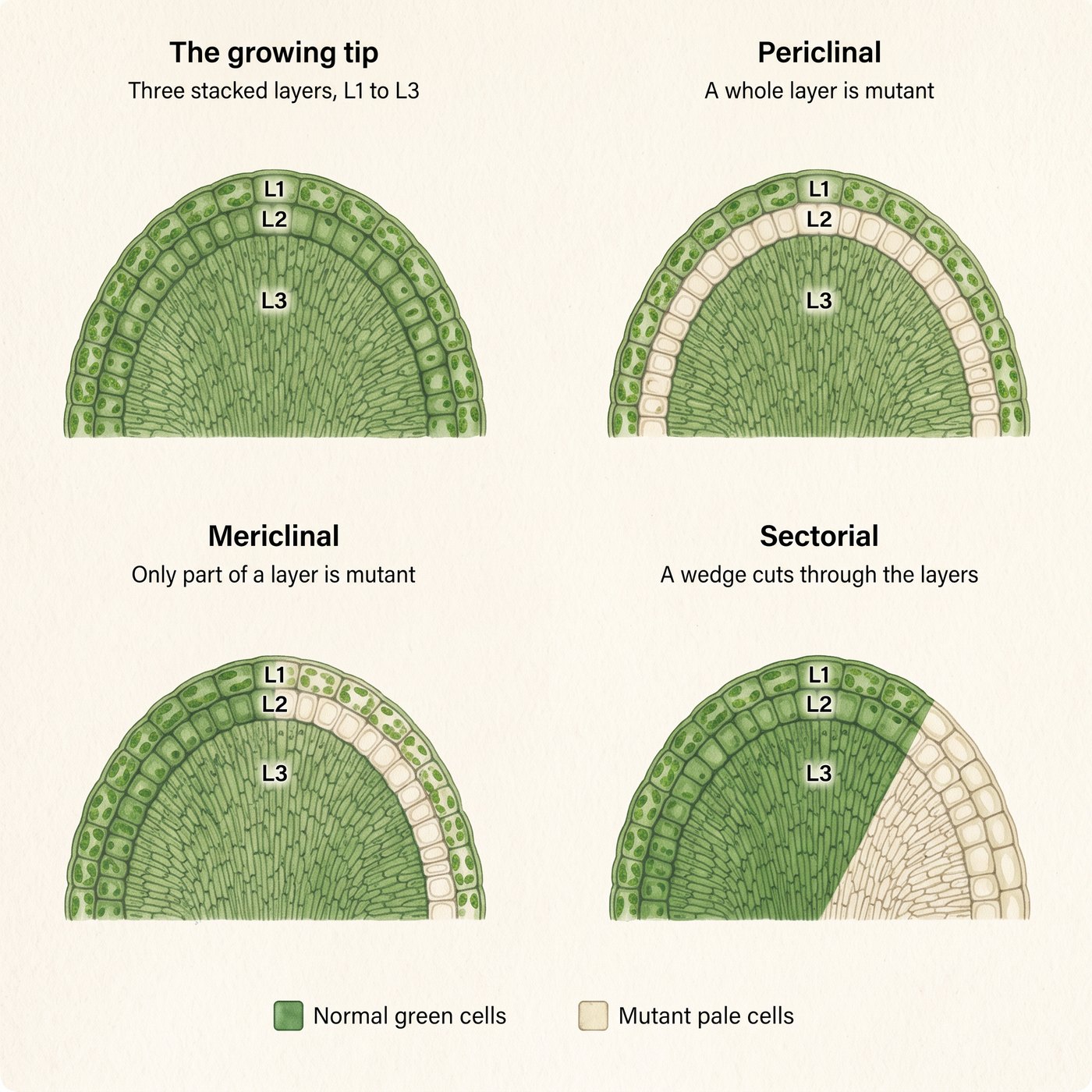
A plant chimera is a genetic mosaic: genetically different cells sit together in the shoot's growing tip, the apical meristem , and keep building the plant from there (Marcotrigiano, 1997). In most flowering plants that tip is organized in stacked cell layers, called L1, L2 and L3 from the outside in, and each layer builds different parts of the leaf (Frank & Chitwood, 2016).
The detailed map of which layer builds which part of the leaf is written for dicots, flowering plants with two seed leaves (Marcotrigiano, 1997). Monstera belongs to the arum family, Araceae, which is a monocot family, meaning flowering plants with one seed leaf (Croat et al., 2024; Lyu et al., 2025). In monocots, growing tips with two layers and with three are both common. In most of them the outer layer builds the whole edge of the leaf blade, and sometimes there's no separate third layer at all (Stewart & Dermen, 1979, as cited in Marcotrigiano, 1997). That means even a two-layered monocot can grow a leaf with a white border on green, or the reverse (Marcotrigiano, 1997).
How the mutant cells are arranged decides how stable the pattern is. There are three cases:
- Periclinal : one or more whole layers are mutant, so the shoot is built like nested sleeves of different cells. These are the most stable, because the layers stay separate. A side bud (the bud tucked where a leaf meets the stem, which grows into a new branch) is built with the same stack of layers as the main growing tip, so the branch it makes carries the same pattern (Marcotrigiano, 1991, as cited in Marcotrigiano, 1997). That's also why periclinal chimeras can be propagated by stem cuttings, division or grafting (Marcotrigiano, 1997).
- Mericlinal : only part of a layer is mutant. These are somewhat unstable, and their side buds tend to give solid (unpatterned) shoots or fully layered ones (Marcotrigiano, 1997).
- Sectorial: a wedge of mutant cells runs through the layers. Tidy sectors rarely last, because cells in one layer drift out of line with the layers beside them as they divide (Marcotrigiano, 1997).
Even the stable kind isn't fixed forever. Cells only rarely cross from one layer into the next, but when they do, a periclinal chimera can switch its pattern, which growers often see as a bud sport, a branch that suddenly grows with a different look from the rest of the plant (Marcotrigiano, 1997). A variegated wintercreeper, Euonymus fortunei 'Moon Shadow', with a green outer layer over a white inner one can throw an all-white shoot when the inner layer takes over, or an all-green one when the outer layer does (Frank & Chitwood, 2016; North Carolina Extension Gardener Plant Toolbox, n.d.). In a chrysanthemum engineered with a fluorescent marker in its outer layer, researchers found the marked cells pushing into the inner layers in 1 of 64 stem cuttings, and then in 11 of 38 cuttings taken from sucker shoots (Aida et al., 2020).
When the mutation sits in the chloroplasts themselves, cells start with a mix of normal and faulty chloroplasts and sort out by chance into all-green or all-mutant lines (Marcotrigiano, 1997). A steady layered pattern forms only once the cells at the tip have finished sorting (Marcotrigiano, 1997).
What We Know About Variegated Monstera
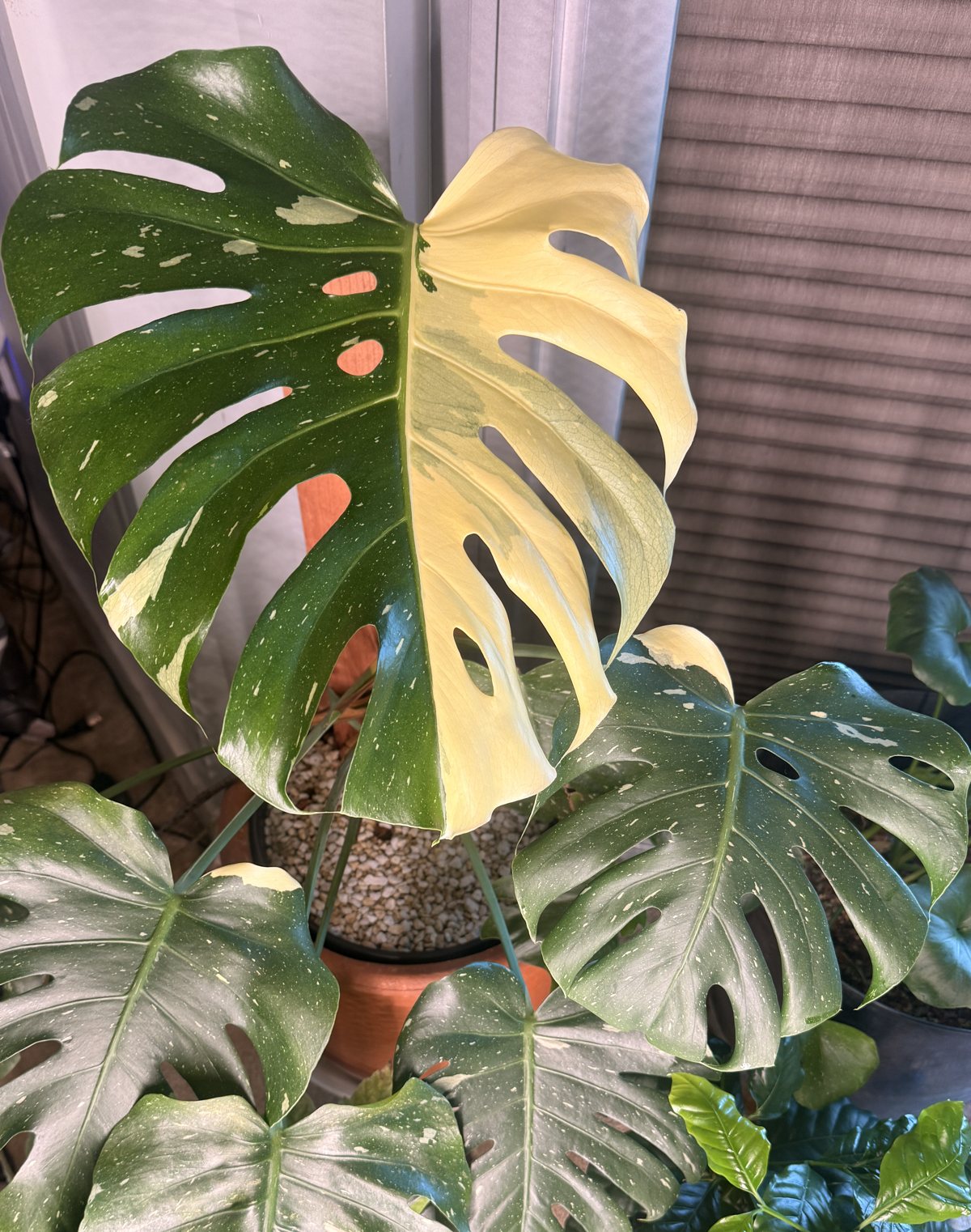
I went looking for a genetic, cell-layer or anatomical study of what makes 'Albo', 'Aurea', 'Thai Constellation' or 'Mint' variegated, and I didn't find one. The closest thing is a single photo caption in a 2016 review of plant chimeras. It uses Monstera deliciosa 'Variegata' as an example of frequent green-and-white sectoring caused by active transposons, mobile stretches of DNA that hop in and out of pigment genes, without citing a study of Monstera or showing data for it (Frank & Chitwood, 2016).
That matters, because elsewhere in the arum family, leaf patterns have been linked to causes other than the obvious guess. When researchers regenerated variegated golden pothos (Epipremnum aureum, another member of the arum family) in tissue culture, the new plants showed no sign of color switching over a year, which the authors took as implying the variegation "was not caused by transposable elements" (Hung & Xie, 2009). In other members of the arum family, leaf patterns have been linked to:
- point mutations in the chloroplast's own DNA, including in an arrowhead vine, Syngonium podophyllum, one of 23 variegated ornamentals studied (Park et al., 2023);
- greatly reduced activity of a nuclear gene (a gene in the cell's nucleus) in the chlorophyll pathway, which the authors' own earlier work had associated with the pale tissue of golden pothos (Guan et al., 2017);
- a single nuclear gene controlling leaf background color in Caladium , tightly linked to the gene for leaf spotting (Cao et al., 2017);
- viruses, which leave mosaic, mottle and spotting symptoms on the leaves of Amorphophallus (Dong et al., 2024).
So the honest answer to "why is my Albo variegated?" is that I found no published study that tests it. It might be a chimera. It might be one of the other routes.
Cultivar names like 'Variegata' or 'Albo-Marginata' describe what the leaf looks like. They don't show that the variegation comes from a genetic mosaic (Marcotrigiano, 1997). We'd read 'Albo', 'Aurea' and 'Thai Constellation' the same way.
"Stable," "Lab-Grown," "Patented": What Those Words Promise
It's tempting to reason that a plant multiplied in a tissue-culture lab, from tiny pieces of tissue on sterile gel, must carry its variegation in every cell and so can't revert. The evidence doesn't support that shortcut.
Lab propagation can split a chimera or preserve it. Adventitious shoots (new shoots that form from tissue other than an existing bud), whether on a leaf cutting or in culture, can start from one cell, one layer or several, depending on the species (Marcotrigiano, 1997). From a periclinal chimera, most of them generally sort into its component genotypes (for a green-and-white chimera, green and white), and the odds of every regenerated plant keeping the same layer arrangement are extremely low (Marcotrigiano, 1997). Results in other plants fit that picture:
- In the variegated snake plant Sansevieria 'Laurentii', leaf cuttings have been reported not to come true, while in a 2025 study every shoot grown directly from single rhizome nodes looked like the variegated mother plant (Bahnamirei et al., 2025).
- In a lab protocol for Philodendron 'White Knight', most shoots at the rooting stage had plain green leaves and only some were variegated (Kang & Sivanesan, 2025).
- In golden pothos, 21 percent of the shoots regenerated in culture came out variegated, and more than half came out green (Hung & Xie, 2009).
Keeping the pattern in plants regenerated from adventitious shoots is evidence that a variegation isn't a chimera, but Marcotrigiano is careful to call it evidence, not proof (Marcotrigiano, 1997). And a lab origin doesn't freeze a plant in place. A tray of tissue-cultured Philodendron 'Birkin' still turned out some plants with purple reversions in part or all of a leaf or shoot, and some with changed leaf shapes (Griffis et al., 2022). A commercial population of 'Thai Constellation' itself threw a spontaneous dwarf, now patented as its own cultivar (Costa Farms, 2025). That change was in size, not variegation, but it shows the cultivar isn't immune to change.
"Relatively genetically stable" does appear in the scientific literature for 'Thai Constellation'. It's in the opening paragraph of a 2023 study on lab-propagating the cultivar, stated without a citation, and the study itself never tests it (Jing et al., 2023).
Patents are a different kind of document. At least two newer Monstera cultivars hold US plant patents whose applicants describe them as "whole-plant" mutations that stayed true to type over several rounds of propagation (Hung & Anh, 2024; Ployphommas, 2024). Those are the applicants' own statements in support of a patent, not independent tests. Three of these patents describe 'Thai Constellation' itself as not patented (Costa Farms, 2025; Hung & Anh, 2024; Ployphommas, 2024).
"Borsigiana" and the Trade Names
If you see "borsigiana" on a label, as in Monstera borsigiana 'Albo', here's what it means on the current botanical books: the same species as M. deliciosa. The World Checklist of Vascular Plants, the global name list kept by the Royal Botanic Gardens, Kew, treats M. borsigiana as a synonym of M. deliciosa, and so does a 2024 revision of the genus in Central America (Croat et al., 2024; Govaerts, 2026). A synonym is an older or alternative name that now points at the same species.
The cultivar names are a looser affair. The International Aroid Society is the official registration authority for cultivated aroid names (International Aroid Society, n.d.). I haven't confirmed whether the names on the variegated shelf are registered there, so on this page they're trade names: labels the trade uses, not names we know have a registered description behind them.
What to Watch For on Your Plant
Two things are worth watching, all-white growth and all-green reversions, plus one common belief about growth rate.
Watch all-white growth. In variegated Pelargonium (zonal geranium), the white leaf tissue acts as a carbon sink, using more sugar than it makes and depending on the green (Milić et al., 2023). Albino golden pothos regenerated in a lab have been kept alive for more than 11 years, but on a sugar-fed medium under very low light (Hung et al., 2021). A chimera with two white inner layers is generally unable to survive on its own unless a green or variegated branch of the same plant supplies it (Marcotrigiano, 1997). A few do get by. The snake plant Sansevieria trifasciata 'Hahnii Solid Gold', a monocot, is one: a slow grower with bright-yellow leaves and a narrow green edge (Chahinian, 1986, as cited in Marcotrigiano, 1997). In dicots, where the outer layer carries chlorophyll only in the guard cells around the leaf pores, such plants would be expected to fail, yet in some species they manage anyway (Marcotrigiano, 1997). I've seen the small version of this on my own Albo: an all-white leaf came in and browned off.
Green reversions. For variegated trees and shrubs, the Royal Horticultural Society says reverted all-green shoots outgrow the variegated ones, and advises removing them entirely, or cutting back to a stem that still carries variegated leaves (Royal Horticultural Society, n.d.). I found no trial of the same practice on Monstera, so treat it as a principle borrowed from woody plants, not a tested Monstera rule.
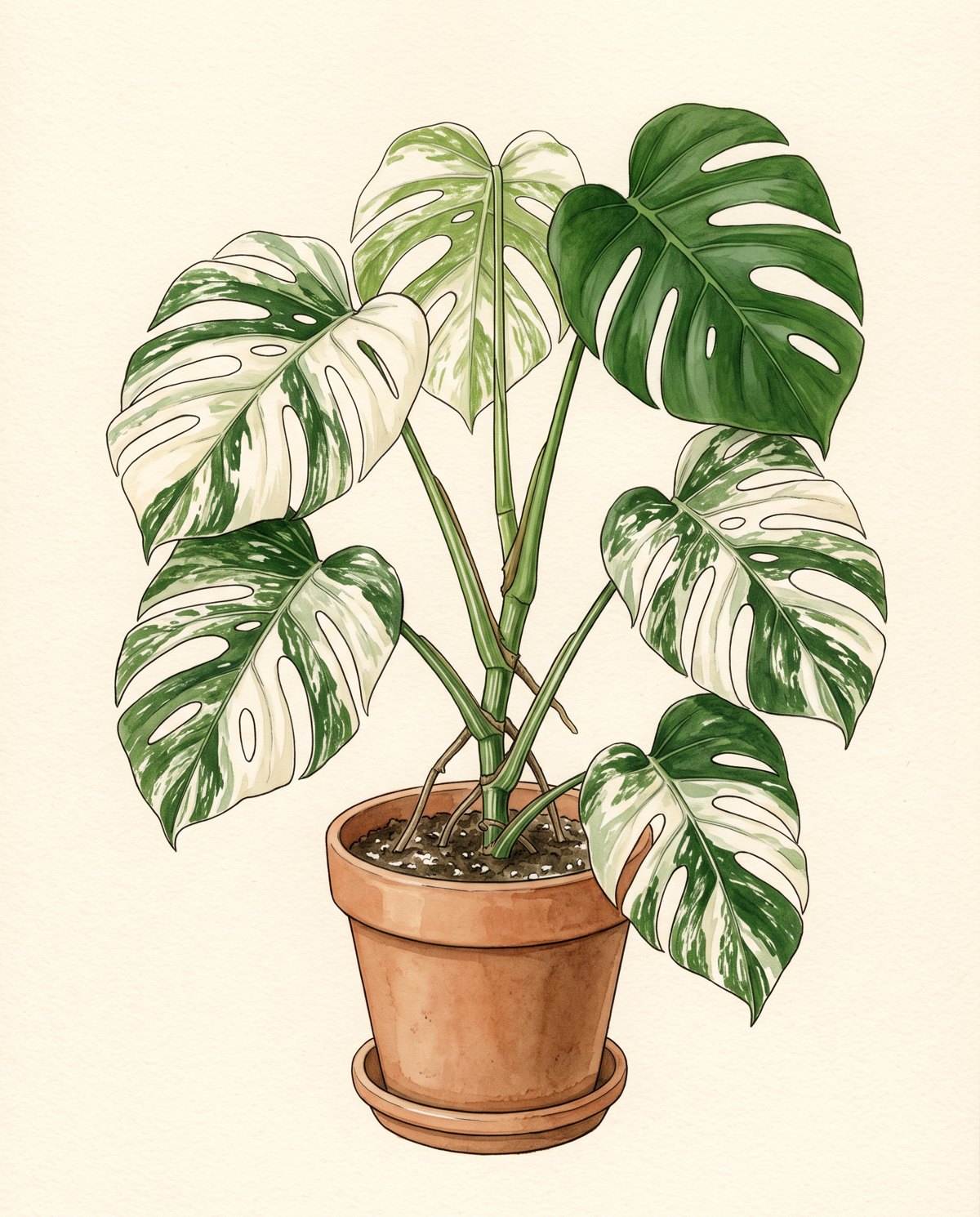
Growth rate. In many green-and-white plants the albino tissue divides less often or stops sooner than the green, and chloroplast-based chimeras may grow more slowly (Marcotrigiano, 1997). Measured comparisons are messier than that sounds. Among three golden pothos cultivars, the green-and-pale-yellow 'Golden' took up the least carbon dioxide, but the uniformly yellow-green 'Neon' took up the most (Falcioni et al., 2026). In milk thistle, whose white patches come from air spaces in the leaf rather than missing chlorophyll, the white patches showed no significant difference from the green in net photosynthesis (Shelef et al., 2019). Slower growth in a variegated Monstera is plausible, but I found no measurement of it.
What This Means When You Propagate
I found no study that tests any of this on Monstera, so treat what follows as reasoning from other plants, not a Monstera rule.
A cutting carries what its bud carries. In a periclinal chimera, each side bud has the same stack of layers as the tip it came from (Marcotrigiano, 1991, as cited in Marcotrigiano, 1997), which is why these chimeras can be propagated by stem cuttings, leaf-bud cuttings, division or grafting (Marcotrigiano, 1997). And once a cell has sorted out to all-normal or all-mutant chloroplasts, every cell that grows from it stays that way (Marcotrigiano, 1997). So a node sitting in an all-green stretch of stem is unlikely to give you a variegated plant.
A shoot that has gone all green is worth watching. On variegated shrubs, reverted green shoots outgrow the variegated ones, which is why the RHS advises removing them (Royal Horticultural Society, n.d.). That's a principle borrowed from woody plants.
An all-white leaf is living off the rest of the plant, as covered above. That's what I saw on my Albo.
The Takeaway
Variegation describes a pattern. It doesn't name a mechanism. For the variegated Monstera people actually grow, I found no published study that works out the mechanism, so treat any confident explanation of it as unproven. "Stable," "lab-grown" and "patented" each mean something, but none of them means "can't revert." Keep an eye on all-white and all-green growth, and enjoy the pattern you have.
Aida, R., Sasaki, K., Yoshioka, S., & Noda, N. (2020). Chimerism of chrysanthemum stems changes at the nodes during vegetative growth. Plant Biotechnology, 37(3), 373–375. https://doi.org/10.5511/plantbiotechnology.20.0519a
Bahnamirei, M. K., Sarmast, M. K., Alizadeh, M., & Dahkaei, M. N. P. (2025). Innovative in vitro shoot regeneration in variegated snake plant (Sansevieria trifasciata cv. Laurentii) through utilization of light exposed single-node rhizome tissue. Scientific Reports, 15, 39505. https://doi.org/10.1038/s41598-025-23247-w
Cao, Z., Sui, S., Yang, Q., & Deng, Z. (2017). A single gene controls leaf background color in caladium (Araceae) and is tightly linked to genes for leaf main vein color, spotting and rugosity. Horticulture Research, 4, 16067. https://doi.org/10.1038/hortres.2016.67
Chahinian, B. J. (1986). The Sansevieria trifasciata varieties. Trans Terra Publishing. (Cited as summarized in Marcotrigiano, 1997; we did not read it directly.)
Costa Farms, LLC (Assignee). (2025). Monstera plant named ‘MKR-MTCM1’ (U.S. Plant Patent No. PP36,561). U.S. Patent and Trademark Office.
Croat, T. B., Cedeño-Fonseca, M., & Ortiz, O. O. (2024). Revision of Monstera (Araceae: Monsteroideae) of Central America. Phytotaxa, 656(1), 1–197. https://doi.org/10.11646/phytotaxa.656.1.1
Dong, J., Zhu, T., Lv, R., Dong, K., Li, Y., Zhang, B., Zhang, L., Chen, Y., Yin, X., Zhang, L., Yin, J., Lu, J., Xi, D., & Wu, K. (2024). Occurrence and characterization of viruses infecting Amorphophallus in Yunnan, China. Scientific Reports, 14, 12948. https://doi.org/10.1038/s41598-024-63477-y
Falcioni, R., Antunes, W. C., Demattê, J. A. M., & Nanni, M. R. (2026). Colored leaves of Epipremnum aureum reveal contrasting dynamic photosynthetic and water-use strategies. ACS Omega, 11(28), 42790–42804. https://doi.org/10.1021/acsomega.6c04515
Frank, M. H., & Chitwood, D. H. (2016). Plant chimeras: The good, the bad, and the ‘Bizzaria’ [Preprint]. bioRxiv. https://doi.org/10.1101/060715
Govaerts, R. (Ed.). (2026). The World Checklist of Vascular Plants (WCVP) [Data set, via GBIF]. Royal Botanic Gardens, Kew. Retrieved October 12, 2026, from https://www.gbif.org/dataset/f382f0ce-323a-4091-bb9f-add557f3a9a2
Griffis, J. L., Jr., Manners, M. M., Bennett, K., & Tuncay, Ö. (2022). Unusual variegation pattern in Philodendron ‘Birkin’ related to leaf chlorophyll content and leaf color. Proceedings of the Florida State Horticultural Society, 135, 187–190. https://doi.org/10.32473/fshs.135.1.136611
Guan, X., Li, Z., Zhang, Z., Wei, X., Xie, J., Chen, J., & Chen, Q. (2017). Overexpression of an EaZIP gene devoid of transit peptide sequence induced leaf variegation in tobacco. PLOS ONE, 12(4), e0175995. https://doi.org/10.1371/journal.pone.0175995
Hung, C.-Y., & Xie, J. (2009). A comparison of plants regenerated from a variegated Epipremnum aureum. Biologia Plantarum, 53(4), 610–616. https://doi.org/10.1007/s10535-009-0112-1
Hung, C.-Y., Zhang, J., Bhattacharya, C., Li, H., Kittur, F. S., Oldham, C. E., Wei, X., Burkey, K. O., Chen, J., & Xie, J. (2021). Transformation of long-lived albino Epipremnum aureum ‘Golden Pothos’ and restoring chloroplast development. Frontiers in Plant Science, 12, 647507. https://doi.org/10.3389/fpls.2021.647507
Hung, P. N., & Anh, L. T. (2024). Monstera plant named ‘HUTAMT41’ (U.S. Plant Patent No. PP36,063). U.S. Patent and Trademark Office.
International Aroid Society. (n.d.). Aroid cultivar registry. Retrieved October 12, 2026, from https://www.aroid.org/cultivarregistry
Jing, Y., Beleski, D. G., & Vendrame, W. A. (2023). Micropropagation and acclimatization of Monstera deliciosa Liebm. ‘Thai Constellation’. Horticulturae, 10(1), 1. https://doi.org/10.3390/horticulturae10010001
Kang, I., & Sivanesan, I. (2025). Micropropagation of Philodendron ‘White Knight’ via shoot regeneration from petiole explants. Plants, 14(11), 1714. https://doi.org/10.3390/plants14111714
Kirk, J. T. O., & Tilney-Bassett, R. A. E. (1978). The plastids: Their chemistry, structure, growth and inheritance. Elsevier/North-Holland Biomedical Press. (Cited as summarized in Marcotrigiano, 1997; we did not read it directly.)
Lyu, H., Sim, S. B., Geib, S. M., Imamura, J. S. L., Corpuz, B. L., Corpuz, R. L., Kauwe, A. N., Simmonds, T. J., Arakawa, C. N., Myers, R. Y., Keith, L. M., Yu, Q., Matsumoto, T. K., Amore, T. D., & Suzuki, J. Y. (2025). Chromosome-level genome assembly and annotation of Anthurium amnicola. Scientific Data, 12, 605. https://doi.org/10.1038/s41597-025-04939-4
Marcotrigiano, M. (1991). Understanding foliar variegation as it relates to propagation. Combined Proceedings, International Plant Propagators’ Society, 41, 410–415. (Cited as summarized in Marcotrigiano, 1997; we did not read it directly.)
Marcotrigiano, M. (1997). Chimeras and variegation: Patterns of deceit. HortScience, 32(5), 773–784. https://doi.org/10.21273/HORTSCI.32.5.773
Milić, D., Pantelić, A., Banović Đeri, B., Samardžić, J., & Vidović, M. (2023). Contrasting metabolisms in green and white leaf sectors of variegated Pelargonium zonale: An integrative transcriptomic and metabolomic study. International Journal of Molecular Sciences, 24(6), 5288. https://doi.org/10.3390/ijms24065288
North Carolina Extension Gardener Plant Toolbox. (n.d.). Euonymus fortunei. NC State Extension. Retrieved October 12, 2026, from https://plants.ces.ncsu.edu/plants/euonymus-fortunei/
Park, H.-S., Jeon, J. H., Cho, W., Lee, Y., Park, J. Y., Kim, J., Park, Y. S., Koo, H. J., Kang, J. H., Lee, T. J., Kim, S. H., Kim, J.-B., Kwon, H.-Y., Kim, S. H., Paek, N.-C., Jang, G., Suh, J.-Y., & Yang, T.-J. (2023). High-throughput discovery of plastid genes causing albino phenotypes in ornamental chimeric plants. Horticulture Research, 10(1), uhac246. https://doi.org/10.1093/hr/uhac246
Ployphommas, P. (2024). Monstera plant named ‘Sumi1’ (U.S. Plant Patent No. PP35,706). U.S. Patent and Trademark Office.
Royal Horticultural Society. (n.d.). Reversion. Retrieved October 12, 2026, from https://www.rhs.org.uk/problems/reversion
Shelef, O., Summerfield, L., Lev-Yadun, S., Villamarin-Cortez, S., Sadeh, R., Herrmann, I., & Rachmilevitch, S. (2019). Thermal benefits from white variegation of Silybum marianum leaves. Frontiers in Plant Science, 10, 688. https://doi.org/10.3389/fpls.2019.00688
Stewart, R. N., & Dermen, H. (1979). Ontogeny in monocotyledons as revealed by studies of the developmental anatomy of periclinal chloroplast chimeras. American Journal of Botany, 66, 47–58. (Cited as summarized in Marcotrigiano, 1997; we did not read it directly.)