Young and old Monstera leaves can look like different plants. The aerial roots come in two kinds. Swollen joints at the ends of the leaf stalk can bend as the leaves reposition. And nobody has settled what the holes are for. Here's what the research says about each part, and what we do with it.
Corrected September 2026: we've revised this essay. See the correction note at the end.
Why Anatomy Helps You Grow It
Most Monstera advice tells you what to do: water when the top of the mix dries, give it bright indirect light, add a moss pole. That advice can work without ever explaining why the plant looks the way it does, or what it's likely to do next.
This essay walks through the parts of a Monstera that people ask us about most: how a seedling finds a tree, why young and old leaves look so different, the swollen joint at the top of each leaf stalk, the holes, the aerial roots, the flower and fruit, and why the plant irritates mouths and skin. For each one we say what the research shows, where it's still an open question, and what we do with it.
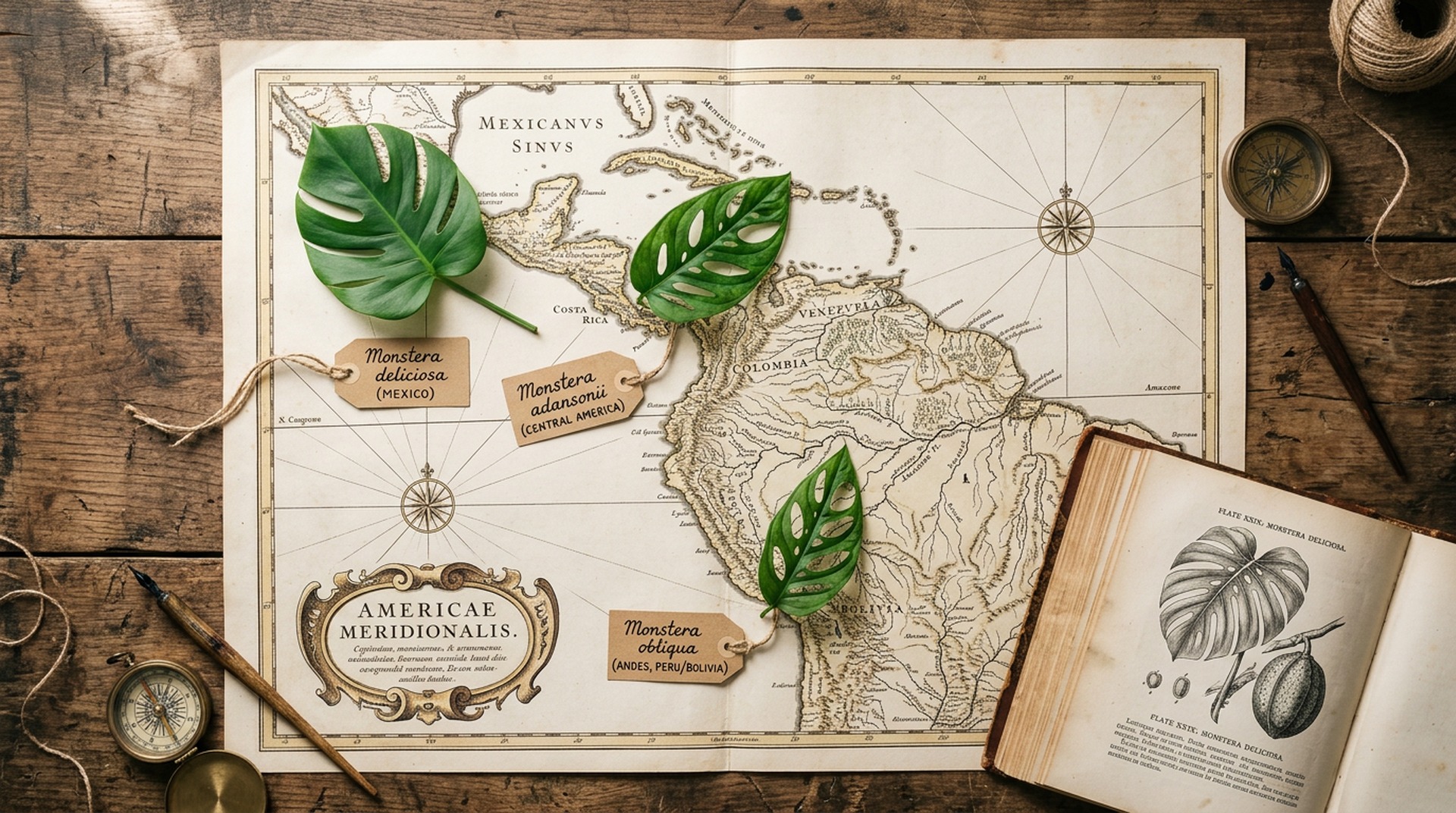
Monstera is a genus of climbing aroids from tropical America. Its range runs from Mexico to Bolivia and southern Brazil (Govaerts, 2026), and Costa Rica and Panama have the greatest number of species (Madison, 1977). The common houseplant, M. deliciosa, is known in the wild from southern Mexico and Guatemala, in foothill (premontane) rain forest and in moist and wet tropical forest (Croat et al., 2024).
Skototropism: How a Seedling Finds a Tree
Monstera seeds germinate on the ground, and the seedlings are skototropic: they grow toward darkness (Croat et al., 2024).
Donald Strong and Thomas Ray, then at Florida State University, showed this in field experiments at La Selva in Costa Rica with a Monstera they called M. gigantea (Strong & Ray, 1975). Their seedlings grew toward the darkest part of the horizon, and in a forest trees provide those dark parts. They named the response skototropism. Madison (1977) thought their plant was probably M. tenuis or M. dubia.
They tested it with targets set on the forest floor: shade-cloth panels of different thicknesses and upright boards of different widths. Wider trunks drew seedlings from farther away. The seedlings grew toward the dark except when the light grew very dim, when they apparently turned toward light instead (Strong & Ray, 1975).
Monstera isn't the only climber that does this. Another aroid, Syngonium triphyllum, shows the same behavior in its creeping shoots (Ray, 1992, citing Strong & Ray, 1975), and in English ivy the same support-finding response works in shade and switches off in full sun (Wyka, 2023).
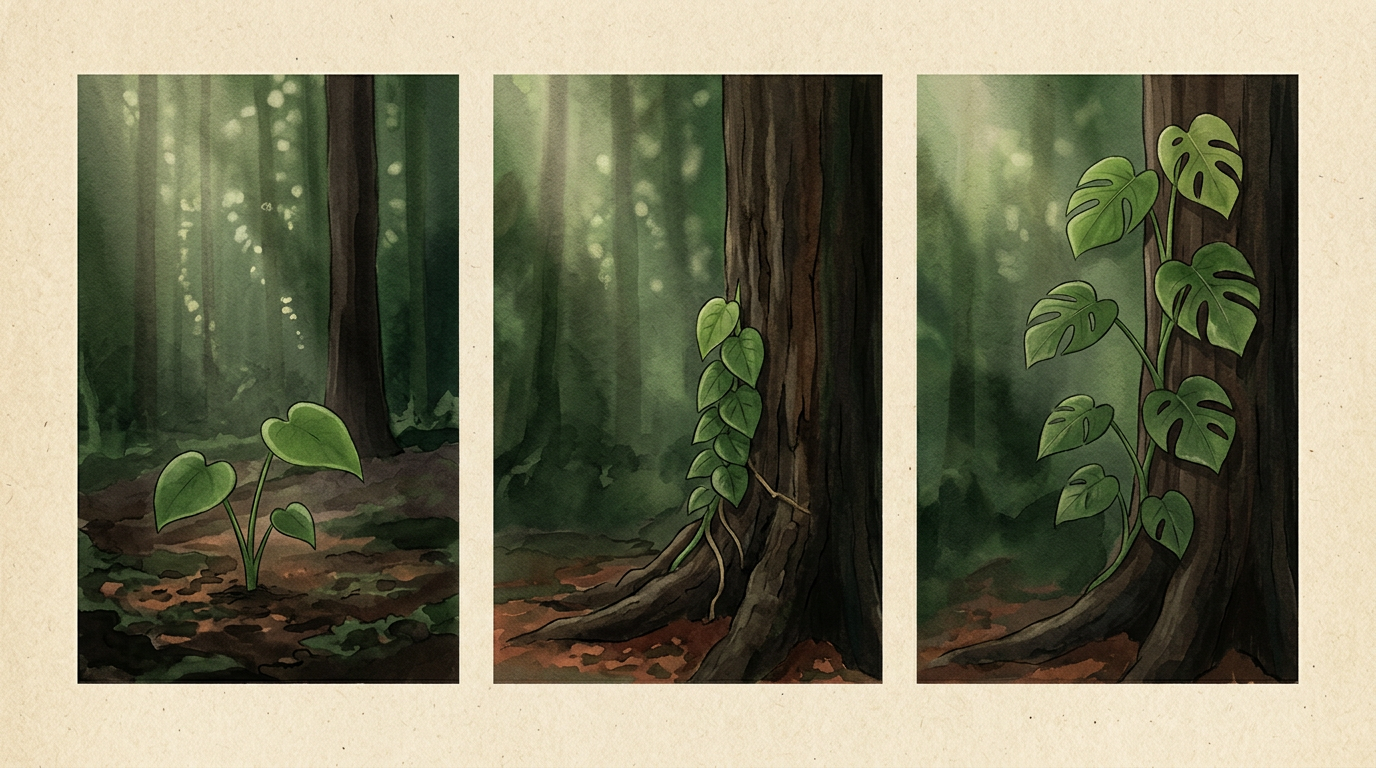
Once a seedling met a tall, upright surface, the skototropism stopped. Within about a month it was growing toward light, and its leaves changed to a round, saucer-like form: the next stage, not yet the adult leaf (Strong & Ray, 1975).
We couldn't find a study that tests skototropism in M. deliciosa. Its seedlings start out with ordinary foliage leaves (Croat et al., 2024), unlike the leafless runners of some wild species. Penn State Extension also notes that a Monstera gets "leggy" in low light (Marquesen, n.d.).
Heteroblasty: Why Young and Old Leaves Differ
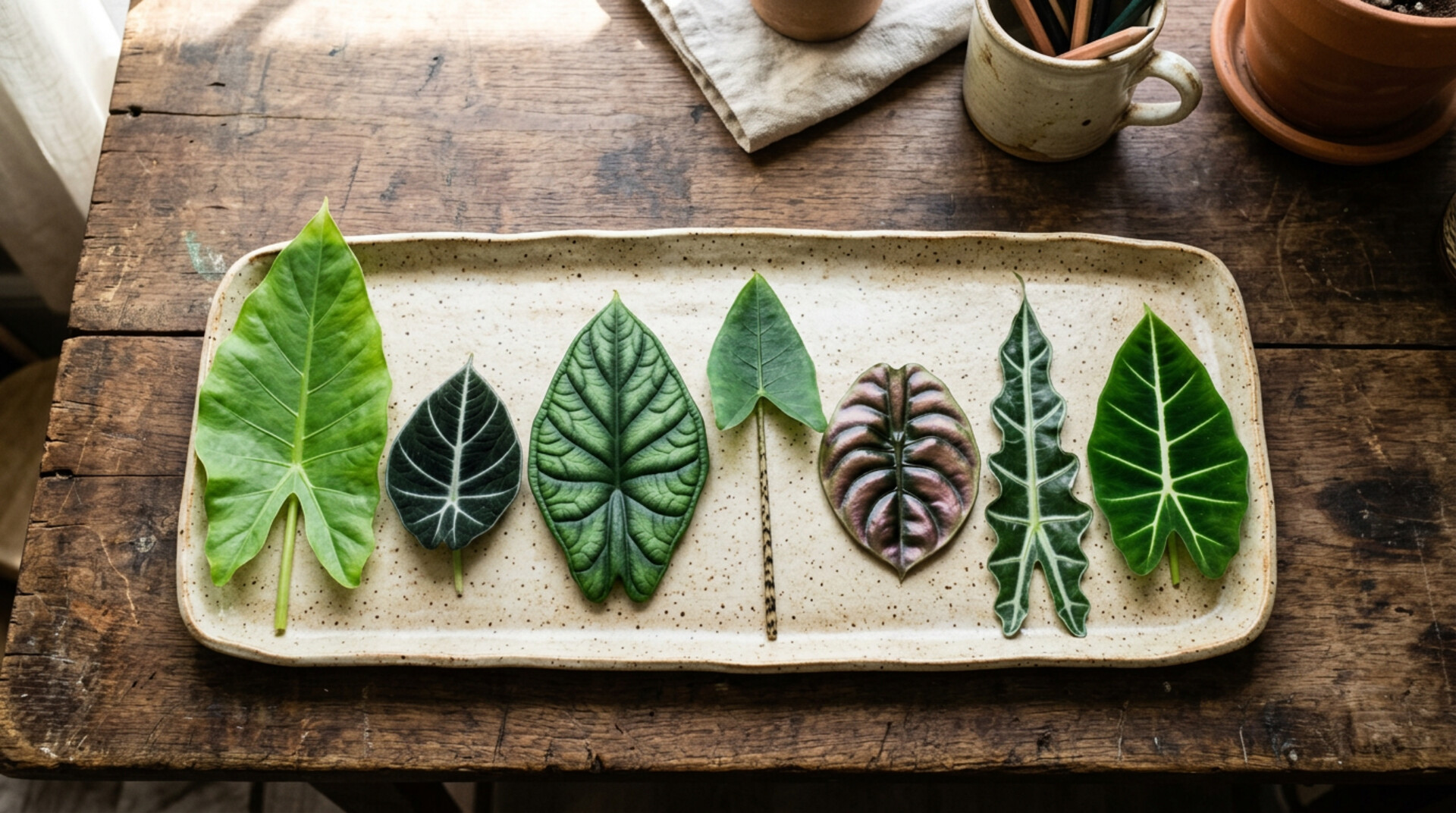
Monstera leaves change a lot between a young plant and a mature one. Botanists call this heteroblasty. The word first meant sharp, distinct changes between juvenile and adult forms, and it has since come to cover gradual change too (Ray, 1990).
Monstera has both kinds. In some species the young plant simply makes bigger leaves on a thicker stem, little by little; in others each stage is clearly different from the last (Madison, 1977).
The dramatic kind happens in species whose climbing juvenile is a shingle plant: small leaves pressed flat against the trunk, overlapping one another. The shingle plant makes larger and larger leaves as it climbs until, over a few nodes, it switches abruptly to the adult form with large leaves (Madison, 1977). M. dubia is one of these shingle species, and Madison names M. acuminata, with four very different kinds of shoot, as an extreme case. In adult M. dubia and M. acuminata, the big leaves hang down parallel to the trunk (Madison, 1977).
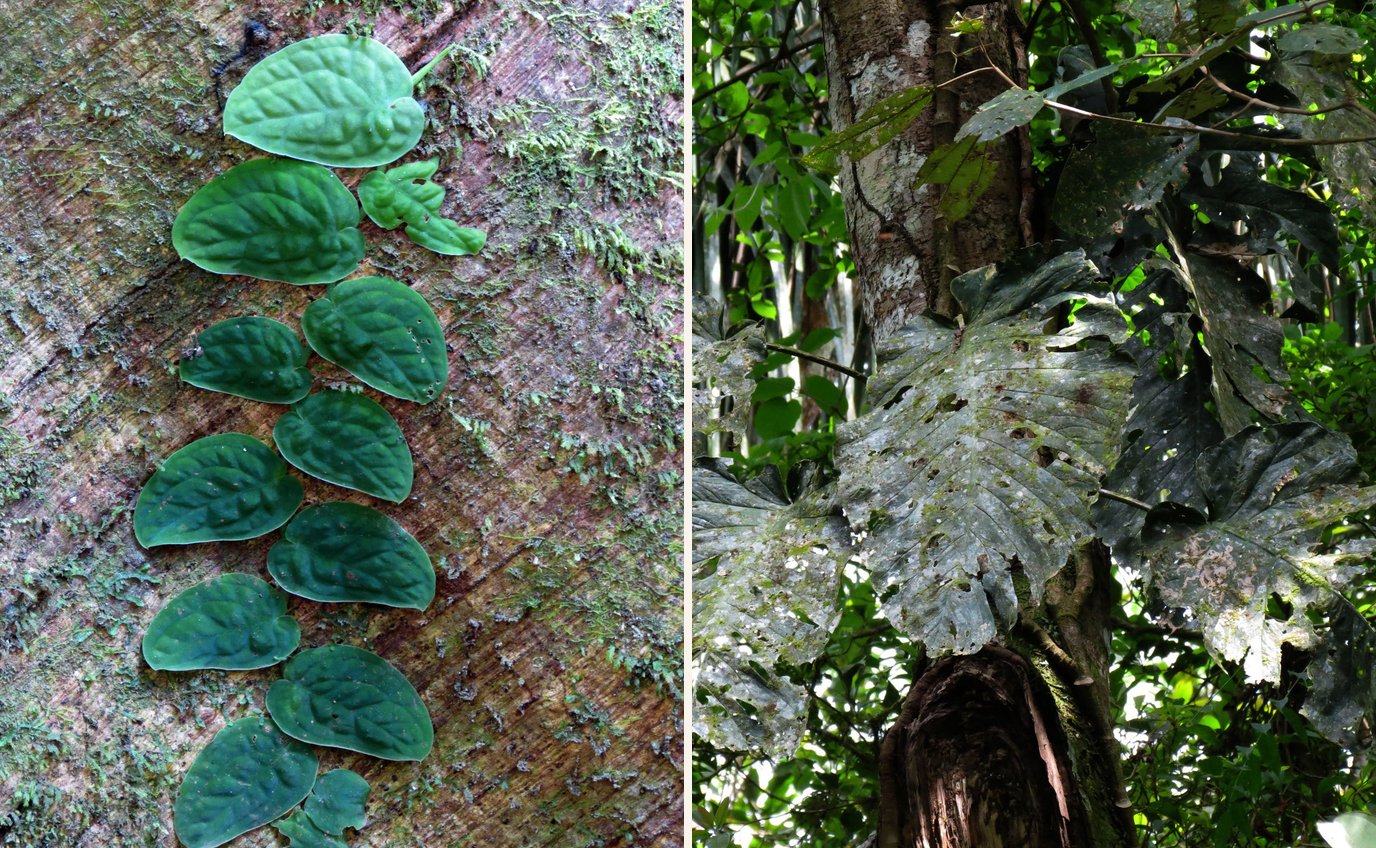
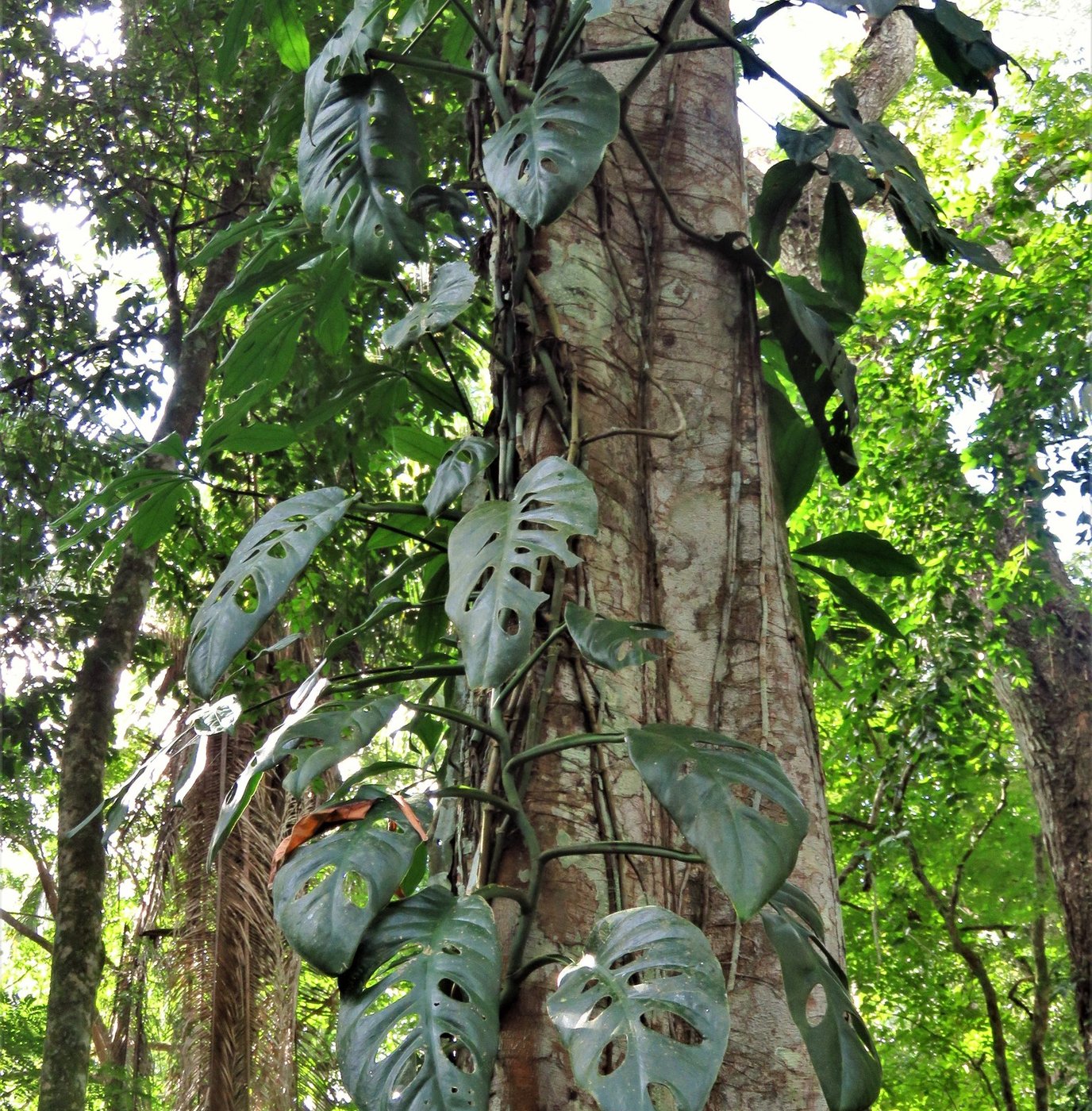
The two common houseplant species, M. deliciosa and M. adansonii, don't go through a shingle stage. Young M. deliciosa leaves sit on stalks 5.5 to 6.7 in (14 to 17 cm) long, aren't pressed to the support and have no holes (Croat et al., 2024). Young M. adansonii leaves aren't pressed flat either, and may already have holes (Croat et al., 2024); that species simply grows larger leaves and a thicker stem as it matures (Madison, 1977).
So what sets off the adult leaves? For wild M. tenuis in Costa Rica, Ray (1983) put the change at the point where successive leaves reach a certain size. He noted that the stem needn't meet brighter light as it climbs, and wrote that light may affect how fast the changes happen but not what they are. In M. skutchii, the change seems to be triggered from within the plant once the climbing stem reaches about 0.4 in (1 cm) across (Ray, 1990). Contact with a support matters too. It turns the creeping seedling into a leafy climber (Ray, 1983). In Monstera and several other aroid genera, a shoot touching a vertical support makes short internodes with well-developed leaves and a stem that thickens node by node, while a shoot that loses contact switches to long internodes with reduced leaves (Ray, 1990).
Light still plays a part, at least in how fast the change comes (Ray, 1983). Strong and Ray (1975) went further and tied the change to the point where the climbing plant reached direct sun, and in golden pothos, a related aroid vine, plants grown upright in high light made leaves 9 to 13 times larger than plants grown under the study's other conditions (Brito et al., 2025).
For M. deliciosa itself, Madison (1977) notes that it often grows to maturity on the ground or on rocks, while the rest of the genus flowers only as epiphytes (plants growing on other plants) or, very rarely, on rocky cliffs. Climbing isn't a requirement for adult leaves in this species.
Supports help in cultivation too. Penn State Extension notes that M. siltepecana, trained upright on a support, makes larger leaves with the typical cuts and holes (Marquesen, n.d.). So we give our Monsteras something to climb and the brightest indirect light we can, and we expect the big leaves to come with size, not on the day the pole goes in.
The Climber's Architecture
Botanists have long called plants like Monstera secondary hemiepiphytes: plants that start as climbers rooted in the ground and later become epiphytic by losing that connection (Putz & Holbrook, 1986). Muir (2013) uses the term for Monstera.
The label is contested. One paper argues that it's hard or impossible to apply in the field and should be dropped (Zotz, 2013), and the recent revision of Central American Monstera describes the genus as "nomadic vines" (Croat et al., 2024).
The "losing that connection" part doesn't fit Monstera well. As the oldest part of the stem decays, the plant may lose touch with the ground through its stem, but it keeps a connection through long roots (Madison, 1977). A survey of climbing aroids in a Panamanian lowland forest found the same: in the species that start on or near the ground, the lower stem withered back but contact with the soil was always kept through roots (Einzmann et al., 2024).
The stem itself changes as the plant grows. Adult M. deliciosa stems are 1.2 to 2.2 in (3.0 to 5.5 cm) thick. The stretches of stem between leaves, the internodes, are longer on juveniles than on adults: 2.8 to 4.7 in (7 to 12 cm) against 0.4 to 3.5 in (1 to 9 cm). Adult leaf stalks reach 16 to 43 in (40 to 110 cm) (Croat et al., 2024).
Size of host matters too. The biggest Monstera species flower only on the biggest trees in the forest; a smaller tree either doesn't have enough clear trunk or can't bear the weight (Madison, 1977). Most of what we give a potted Monstera stands in for that tree: a support to climb and a pot its roots can reach.
The Geniculum: A Joint That Bends
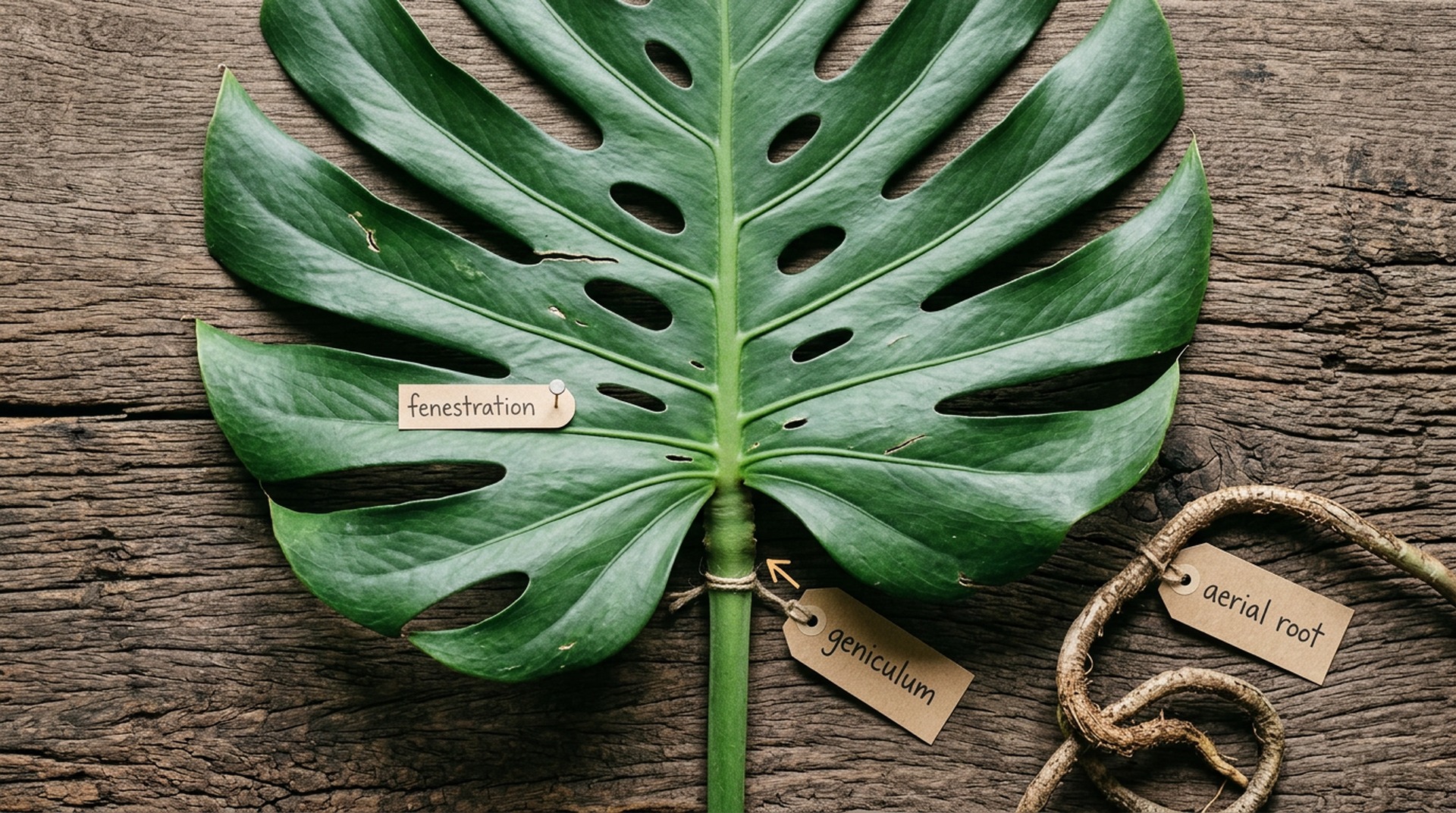
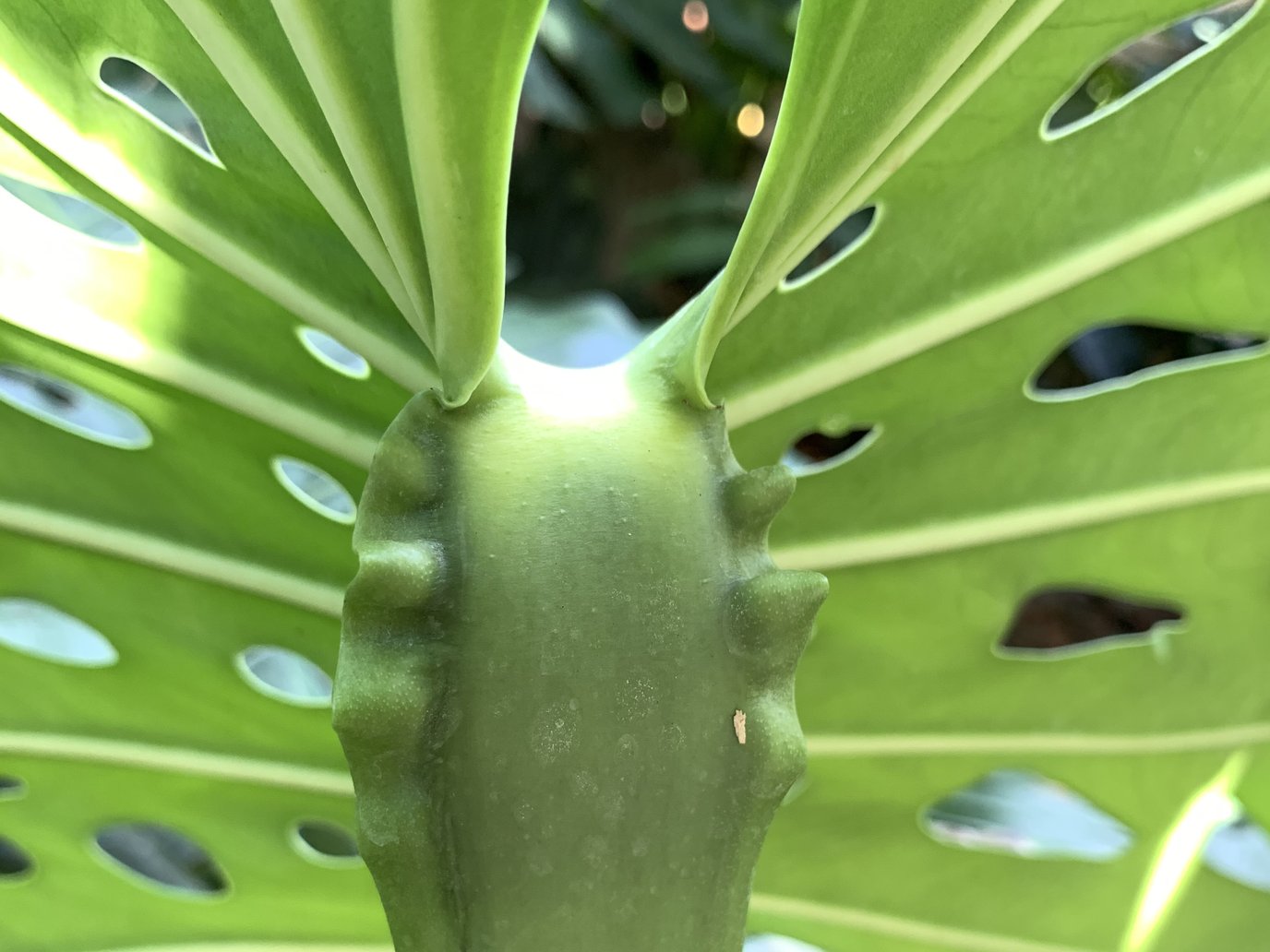
A Monstera leaf stalk has a swollen section, a pulvinus, at each end. The upper one, where the stalk meets the leaf blade, is called the geniculum and is often clearly curved (Madison, 1977). Most Monstera leaf stalks have one (Croat et al., 2024).
It isn't unique to the genus. Madison (1977) treats the geniculum as typical of the Monstereae, the tribe Monstera belongs to. He gives the apparent lack of one as a way Heteropsis differs from that tribe. On M. deliciosa the geniculum is 0.8 to 2 in (2 to 5 cm) long, warty, flattened on top and rounded underneath (Croat et al., 2024).
The joints bend as the leaf moves. Madison (1977) watched a large cultivated M. deliciosa that got its light mostly from one window. After the pot was turned 180 degrees, the leaves rearranged themselves over about two weeks and apparently ended up less shaded. The bending was marked at the pulvini, the swollen ends of the leaf stalks, even in leaves over two years old. He took it as support for the idea that the arrangement of the leaves responds to where the light comes from.
That's one plant, watched once. We couldn't find a study that measures how fast a Monstera leaf repositions or what inside the joint does the work. When we turn a Monstera, we give it a couple of weeks before judging how the leaves sit.
Fenestration: The Holes
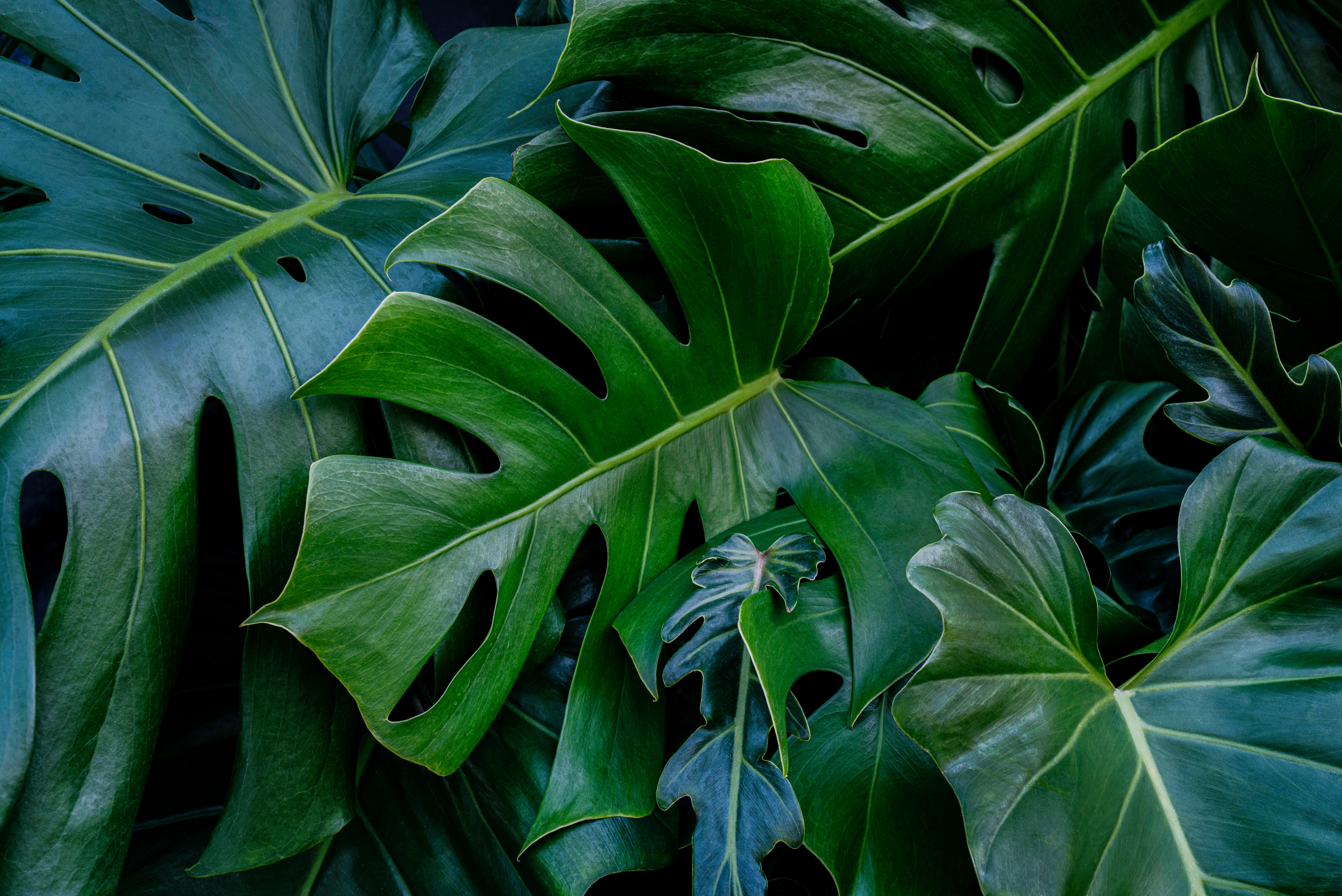
Holes in the leaf blade are one of the most characteristic features of Monstera, though not every species has them (Madison, 1977). They turn up in other climbing aroids too, including Rhaphidophora, Epipremnum and Amydrium, and outside the aroids in Aponogeton fenestralis and in Pentagonia, a genus in the coffee family (Madison, 1977). The splits along the edge of a Monstera leaf start as holes: a hole that forms early enough in the leaf's development can extend to the margin (Madison, 1977).
Nobody has settled what the holes are for. Madison (1977) dismissed an early idea, that the holes let rain drip through to the roots, as "a fanciful interpretation with no basis in reality." He suggested instead that they might break up the still layer of air next to the leaf and keep it from overheating in strong sun.
Muir (2013) offered a different idea, using a model rather than an experiment. In a forest understory, the shaded layer under the canopy, much of a plant's photosynthesis can come from sunflecks, brief and unpredictable spells of direct light. In the model, a leaf with holes spreads the same amount of leaf over more ground, so it meets more sunflecks. But light falls through the holes, so the leaf's average daily photosynthesis comes out the same. What changes is how much it varies from day to day: the holed leaf's supply is steadier, and Muir argues that steadier growth can raise a plant's long-run reproductive success. He called the idea "readily falsifiable" and described how to test it. We couldn't find a test.
Muir also offered a tentative reason why young leaves lack holes: the deepest shade of the understory gets less light and poorer sunflecks, and slow-growing juveniles have less to gain from steadier light (Muir, 2013).
The one recent field measurement on M. deliciosa points somewhere else. On plants growing on a university campus in Costa Rica, leaves growing in sun had more of their area in holes than leaves in shade, and the authors suggest the holes may help the leaf shed heat (Díaz-Valverde et al., 2025). It's a comparison of existing leaves, not an experiment.
For growers, the practical part is simpler. Holes come with size in M. deliciosa, whose juvenile leaves have none (Croat et al., 2024). When a young plant makes solid leaves, we read that as a young plant, not a problem.
The Aerial Root
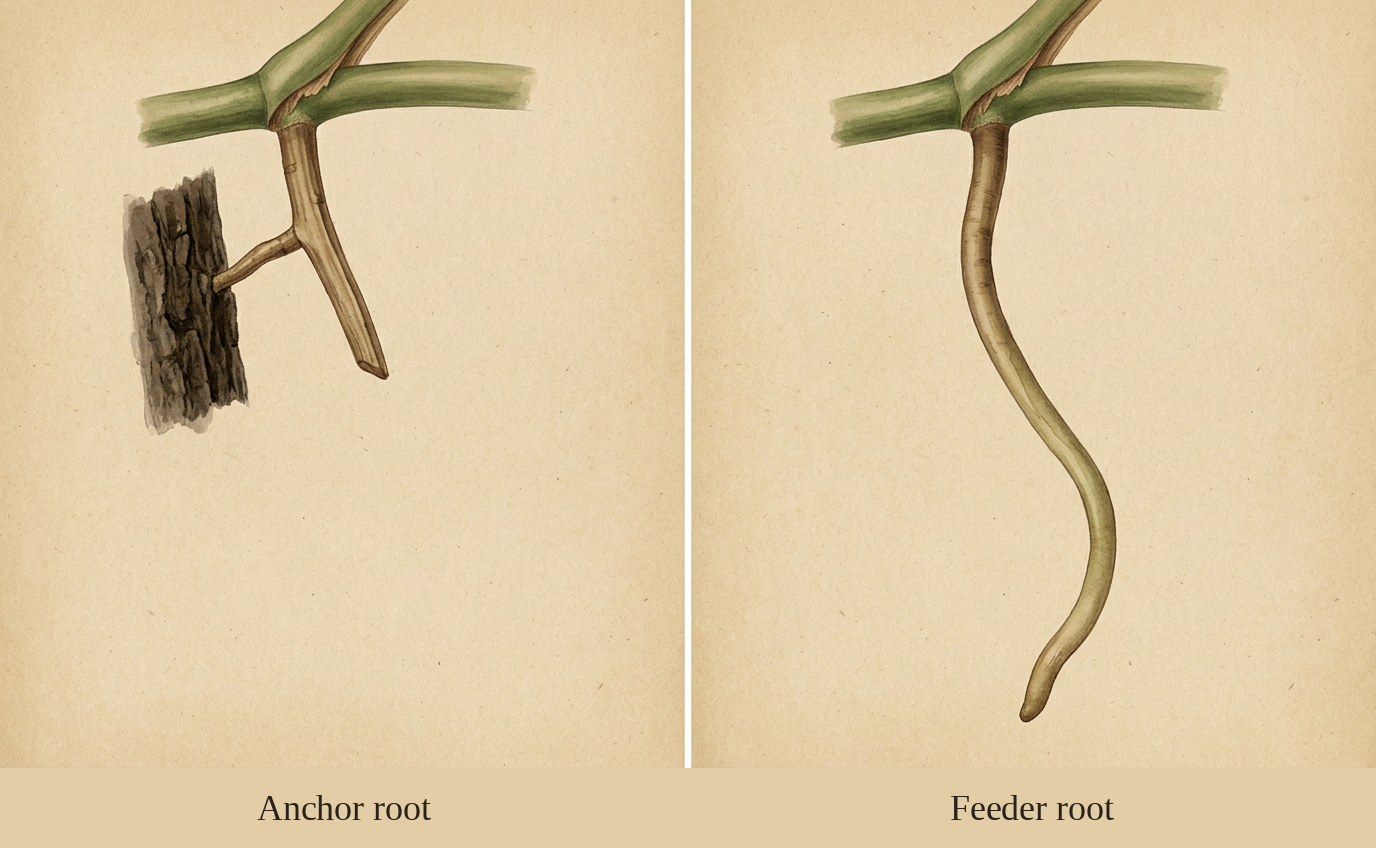
Once a Monstera is climbing, its roots split into two kinds (Madison, 1977; Croat et al., 2024).
Anchor roots attach the plant to its support. They grow from the stem between the nodes and at the nodes, in any direction over the surface, often following a crack, and they stick by root hairs; they're usually 4 to 8 in (10 to 20 cm) long (Madison, 1977). They seem to need contact with a surface to keep growing (Madison, 1977).
Feeder roots grow from the nodes, generally one per node, and grow downward. They may hang free or run along the support, generally without branching until they reach the ground, which can be 66 to 98 ft (20 to 30 m) below; once in the soil they branch heavily (Madison, 1977). Madison (1977) reports an earlier proposal that the feeder roots are the main water carriers, and thought it likely. Outdoors in Florida, the long aerial roots of M. deliciosa take root where they touch the ground (Crane & Balerdi, 2016).
Can they drink from the air? The evidence we found says not much. The aerial roots of M. deliciosa carry a waxy outer layer that the researchers describe as a reasonable barrier against water loss, letting water through at rates close to those measured for isolated plant cuticles (Suresh et al., 2022). In golden pothos, root hairs grow only on the side of an aerial root that touches the host, and a tracer test on two roots showed water entering through them there (Mantovani & Groba, 2026). We don't mist aerial roots, and we couldn't find a study showing that misting helps them.
We also couldn't find research on whether cutting aerial roots sets a Monstera back. Our practice: if an anchor root has gripped the pole or a feeder root has reached the pot, we leave it, and we trim the rest only when they're in the way.
The Thai Constellation in my living room (south-east window with supplemental grow-light) is climbing a cedar plank, but its aerial roots are doing something separate. Two of them have grown roughly 36 inches (91 cm) sideways across the wall in opposite directions, and a third has reached almost 48 inches (122 cm), clearly looking for something else to attach to. I haven't pruned them; they're doing what I imagine they'd do on a tree, except the host is my drywall.
The plant's adult leaves arrived about four months after I gave it the cedar plank. Same plant in the same room, just given vertical attachment, produced its first deeply fenestrated leaf within a single growth cycle. The geniculum on those new leaves is noticeably more developed than on the juvenile growth lower down. One plant can't tell me whether the plank or the plant's own size made the difference; the research above points mostly to size.
The Inflorescence and the Fruit
M. deliciosa rarely flowers or fruits indoors (Khamare & Marble, 2023). Of the many aroids grown as ornamentals, it's the only one also grown for its fruit (Morton, 1987).
Like other aroids, including calla lilies and jack-in-the-pulpit, Monstera flowers in a spadix and spathe (Marquesen, n.d.): a column crowded with many flowers, sheltered at first by a sheath (Madison, 1977; Morton, 1987). Depending on the species, a Monstera spathe may be white, deep yellow or rose (Madison, 1977); in M. deliciosa the spadix is cream and the spathe waxy and white (Morton, 1987). The spadix carries many flowers in spirals, each with both male and female parts, and the ones at the base are usually sterile (Madison, 1977). The spathe falls off two or three days after it opens (Madison, 1977).
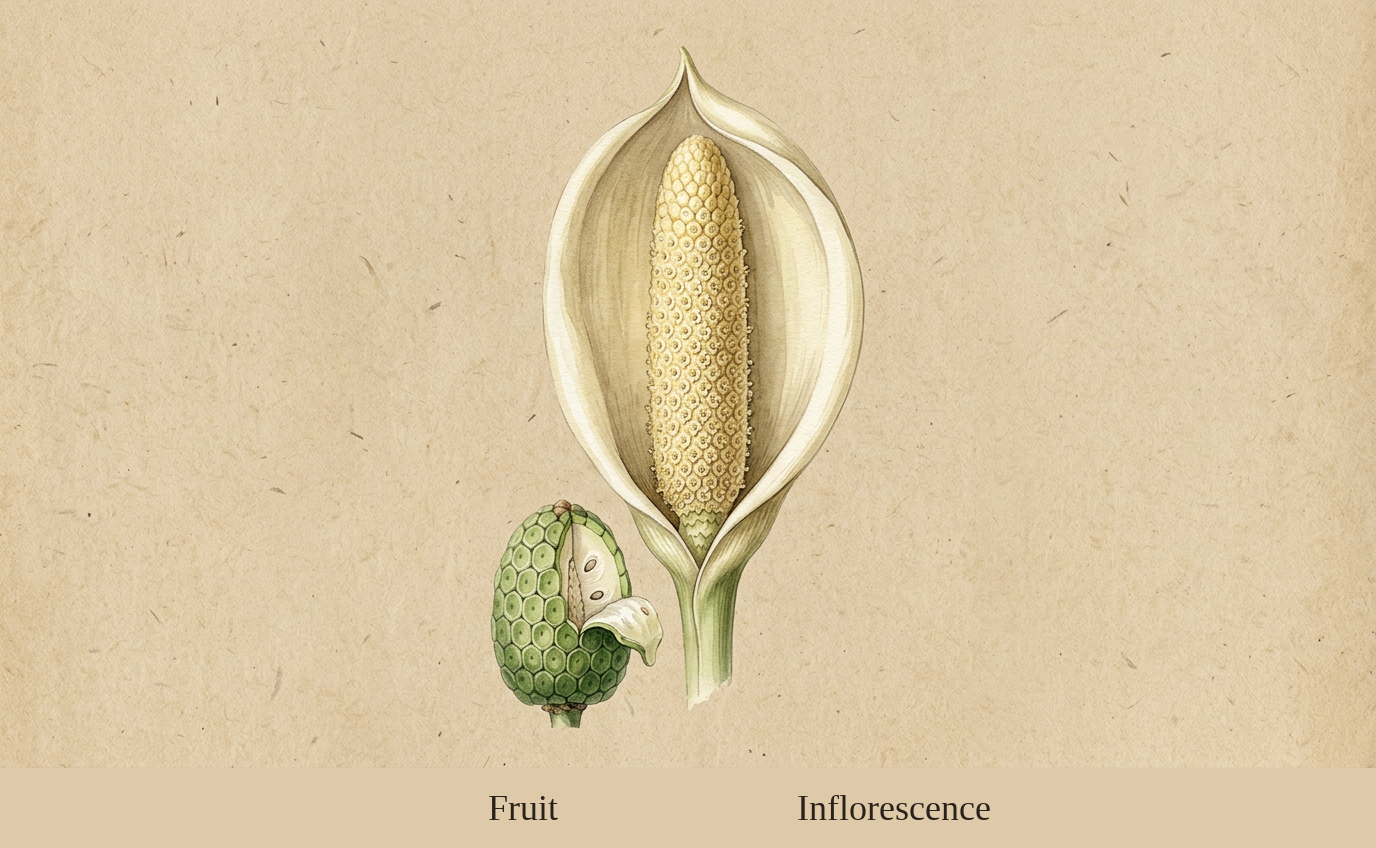
After flowering, the spadix develops into a green fruit covered in hexagonal scales, 8 to 12 in (20 to 30 cm) or more long (Morton, 1987). It takes 12 to 14 months from flowering to maturity (Crane & Balerdi, 2016). Crane and Balerdi advise cutting it when the scales at its base begin to separate slightly. Kept at room temperature for 5 to 6 days, it ripens from the base toward the tip, and only the pulp that falls easily off the core should be eaten.
Fully ripe pulp tastes like a blend of pineapple and banana (Morton, 1987). Even ripe, the fruit is high in oxalic acid, and Crane and Balerdi (2016) advise against eating a lot at once. Ripe fruit may also bring on hives (Queensland Poisons Information Centre, n.d.), and Morton (1987) notes that some people have had hives and anaphylaxis, a severe allergic reaction, after eating it.
Handling and Toxicity
All Monstera species and all their parts are toxic to dogs, cats and people, except that the ripe fruit of M. deliciosa is edible; unripe fruit is toxic (Khamare & Marble, 2023). The main agent is needle-shaped crystals of calcium oxalate, called raphides, bundled in special cells (idioblasts) scattered through the plant (Schmid, 2023). As in most aroids, Monstera's raphides run through all its tissues and are especially plentiful in the fruit and the seed coat (Madison, 1977).
Chewing or crushing the plant releases the raphides, which irritate any tissue they touch (Schmid, 2023). In pets that shows up as irritation and burning of the mouth, tongue and lips, heavy drooling, vomiting and trouble swallowing (ASPCA, n.d.); rarely, severe throat swelling makes breathing difficult (Pet Poison Helpline, n.d.). Most pets that chew insoluble-oxalate plants recover fully, often without veterinary treatment (Schmid, 2023).
In people, eating the plant can cause intense burning of the mouth, tongue and throat, sometimes with nausea, vomiting, drooling and diarrhea; NC State rates the severity as low and lists symptoms "only if eaten in large quantities" (North Carolina Extension Gardener Plant Toolbox, n.d.). Unripe fruit causes severe discomfort when swallowed (Crane & Balerdi, 2016). Queensland's poison center advises urgent medical attention if the lips or tongue swell or breathing or swallowing becomes hard (Queensland Poisons Information Centre, n.d.). Serious cases are uncommon: among 18,621 accidental houseplant exposures reported to poison centers in Germany, Austria and Switzerland, none produced severe symptoms (Pietsch et al., 2025).
Touching matters too. Contact with the sap may irritate skin (North Carolina Extension Gardener Plant Toolbox, n.d.), and Penn State Extension recommends gloves because of the possibility of contact dermatitis (Marquesen, n.d.). Unripe fruit carries needle-like cells called trichosclereids that visibly pierce the skin when the fruit is handled, and Madison (1977) considered it unclear whether the fruit's prickly irritation comes from those or from raphides. Eyes are a risk for the people who care for plants. Eye exposures made up almost 10% of adult cases in the poison-center data, which the authors link to plant care (Pietsch et al., 2025). In one case, sap splashed while a woman was pruning a related aroid, Dieffenbachia, and left crystal deposits in her cornea (Bagatur Vurgun et al., 2022).
What we do: gloves and eye protection when we cut or repot, a wash for any sap that gets on skin, and plants kept out of reach of pets and small children who chew. If a child or pet does chew a Monstera, call a poison center or your vet.
The Takeaway
Monstera is a climbing aroid of tropical American forests. In the species that has been tested, the seedlings find trees by growing toward the dark. Its leaves change as the plant grows, abruptly in some species and gradually in others. In the wild species where the change has been measured, the adult leaves seem to arrive at a certain size, and contact with a support keeps a climber growing toward it. In the one plant on record, the leaves repositioned over about two weeks, bending at the swollen joints of their stalks. Nobody has yet shown what the holes are for. Once it climbs, its roots split into anchors and feeders, and the feeder roots keep it connected to the ground. And every part except the fully ripe fruit is toxic if eaten (Marquesen, n.d.), with sap that can irritate skin and eyes.
None of that makes a Monstera hard to grow. It helps make sense of why a young M. deliciosa has solid leaves, and why a pole helps even though size seems to be what sets off the adult leaves. It's also why we wear gloves when we prune.
We review our essays against the research available at the time, and we correct them when a source doesn't say what we took it to say or when we can't find support for a point. In this review we corrected our safety advice, how Monstera matures, several botanical details and our account of one research team, and we no longer describe an untested model as showing that the leaf holes raise the light a leaf captures. We also removed claims we couldn't source.
ASPCA. (n.d.). Swiss cheese plant. ASPCA Animal Poison Control. https://www.aspca.org/pet-care/aspca-poison-control/toxic-and-non-toxic-plants/swiss-cheese-plant
Bagatur Vurgun, E., Arslan, S. C., Turhan, S. A., & Toker, A. E. (2022). To report a case of crystalline keratopathy induced by Dieffenbachia plant sap and literature review. American Journal of Ophthalmology Case Reports, 25, 101383. https://doi.org/10.1016/j.ajoc.2022.101383
Brito, C., Mantuano, D., De Toni, K. L. G., & Mantovani, A. (2025). Increasing leaf sizes of the vine Epipremnum aureum (Araceae): Photosynthesis and respiration. PeerJ, 13, e19214. https://doi.org/10.7717/peerj.19214
Crane, J. H., & Balerdi, C. F. (2016). Monstera growing in the Florida home landscape (HS1071). UF/IFAS Extension. https://edis.ifas.ufl.edu/publication/HS311
Croat, T. B., Cedeño-Fonseca, M., & Ortiz, O. O. (2024). Revision of Monstera (Araceae: Monsteroideae) of Central America. Phytotaxa, 656(1), 1–197. https://doi.org/10.11646/phytotaxa.656.1.1
Díaz-Valverde, V., Avalos, G., & Quesada-Fonseca, J. (2025). Phenotypic differences in sun and shade leaves of Monstera deliciosa (Araceae). Revista de Biología Tropical, 73, e56794. https://doi.org/10.15517/rev.biol.trop..v73i1.56794
Einzmann, H. J. R., Weichgrebe, L., Kohlstruck, J., & Zotz, G. (2024). Climbing aroids in a Panamanian lowland forest: We should reconsider our categories. Journal of Vegetation Science, 35(2), e13246. https://doi.org/10.1111/jvs.13246
Govaerts, R. (Ed.). (2026). The World Checklist of Vascular Plants (WCVP): Monstera Adans. [Checklist dataset]. Royal Botanic Gardens, Kew, via GBIF. https://api.gbif.org/v1/species/206561590
Khamare, Y., & Marble, C. (2023). Common poisonous houseplant species in Florida (ENH1375). UF/IFAS Extension. https://doi.org/10.32473/edis-EP639-2023
Madison, M. (1977). A revision of Monstera (Araceae). Contributions from the Gray Herbarium of Harvard University, 207, 3–100.
Mantovani, A., & Groba, Y. C. (2026). Sclerified cork outperforms the exodermis: Root water permeability decreases in the soil-to-canopy transition of the aroid vine Epipremnum aureum. Physiologia Plantarum, 178(2), e70779. https://doi.org/10.1111/ppl.70779
Marquesen, S. (n.d.). Monstera as a houseplant. Penn State Extension. https://extension.psu.edu/monstera-as-a-houseplant
Morton, J. F. (1987). Ceriman. In Fruits of warm climates (pp. 15–17). Julia F. Morton. https://hort.purdue.edu/newcrop/morton/ceriman.html
Muir, C. D. (2013). How did the Swiss cheese plant get its holes? The American Naturalist, 181(2), 273–281. https://doi.org/10.1086/668819
North Carolina Extension Gardener Plant Toolbox. (n.d.). Monstera deliciosa. NC State Extension. https://plants.ces.ncsu.edu/plants/monstera-deliciosa/
Pet Poison Helpline. (n.d.). Oxalates (insoluble). https://www.petpoisonhelpline.com/poison/insoluble-oxalates/
Pietsch, J., Acquarone, D., Holzer, A., Arif, T., Fuchs, J., Deters, M., Begemann, K., & Hermanns-Clausen, M. (2025). Accidental exposure to poisonous houseplants: An analysis of cases reported to poison information centers. Deutsches Ärzteblatt International, 122, 676–677. https://doi.org/10.3238/arztebl.m2025.0143
Putz, F. E., & Holbrook, N. M. (1986). Notes on the natural history of hemiepiphytes. Selbyana, 9(1), 61–69.
Queensland Poisons Information Centre. (n.d.). Fruit salad plant (Monstera deliciosa). Queensland Health. https://www.poisonsinfo.health.qld.gov.au/plants-and-mushrooms/fruit-salad-plant-monstera-deliciosa
Ray, T. S. (1983). Monstera tenuis (chirravaca, mano de tigre). In D. H. Janzen (Ed.), Costa Rican natural history (pp. 278–280). University of Chicago Press.
Ray, T. S. (1990). Metamorphosis in the Araceae. American Journal of Botany, 77(12), 1599–1609. https://doi.org/10.1002/j.1537-2197.1990.tb11400.x
Ray, T. S. (1992). Foraging behaviour in tropical herbaceous climbers (Araceae). Journal of Ecology, 80(2), 189–203. https://doi.org/10.2307/2261006
Schmid, R. D. (2023). Houseplants and ornamentals toxic to animals. In Merck Veterinary Manual (professional version). Merck & Co. https://www.merckvetmanual.com/toxicology/poisonous-plants/houseplants-and-ornamentals-toxic-to-animals
Strong, D. R., Jr., & Ray, T. S., Jr. (1975). Host tree location behavior of a tropical vine (Monstera gigantea) by skototropism. Science, 190(4216), 804–806. https://doi.org/10.1126/science.190.4216.804
Suresh, K., Zeisler-Diehl, V. V., Wojciechowski, T., & Schreiber, L. (2022). Comparing anatomy, chemical composition, and water permeability of suberized organs in five plant species: Wax makes the difference. Planta, 256(3), 60. https://doi.org/10.1007/s00425-022-03975-3
Wyka, T. P. (2023). Negative phototropism of the shoots helps temperate liana Hedera helix L. to locate host trees under habitat conditions. Tree Physiology, 43(11), 1874–1885. https://doi.org/10.1093/treephys/tpad077
Zotz, G. (2013). ‘Hemiepiphyte’: A confusing term and its history. Annals of Botany, 111(6), 1015–1020. https://doi.org/10.1093/aob/mct085