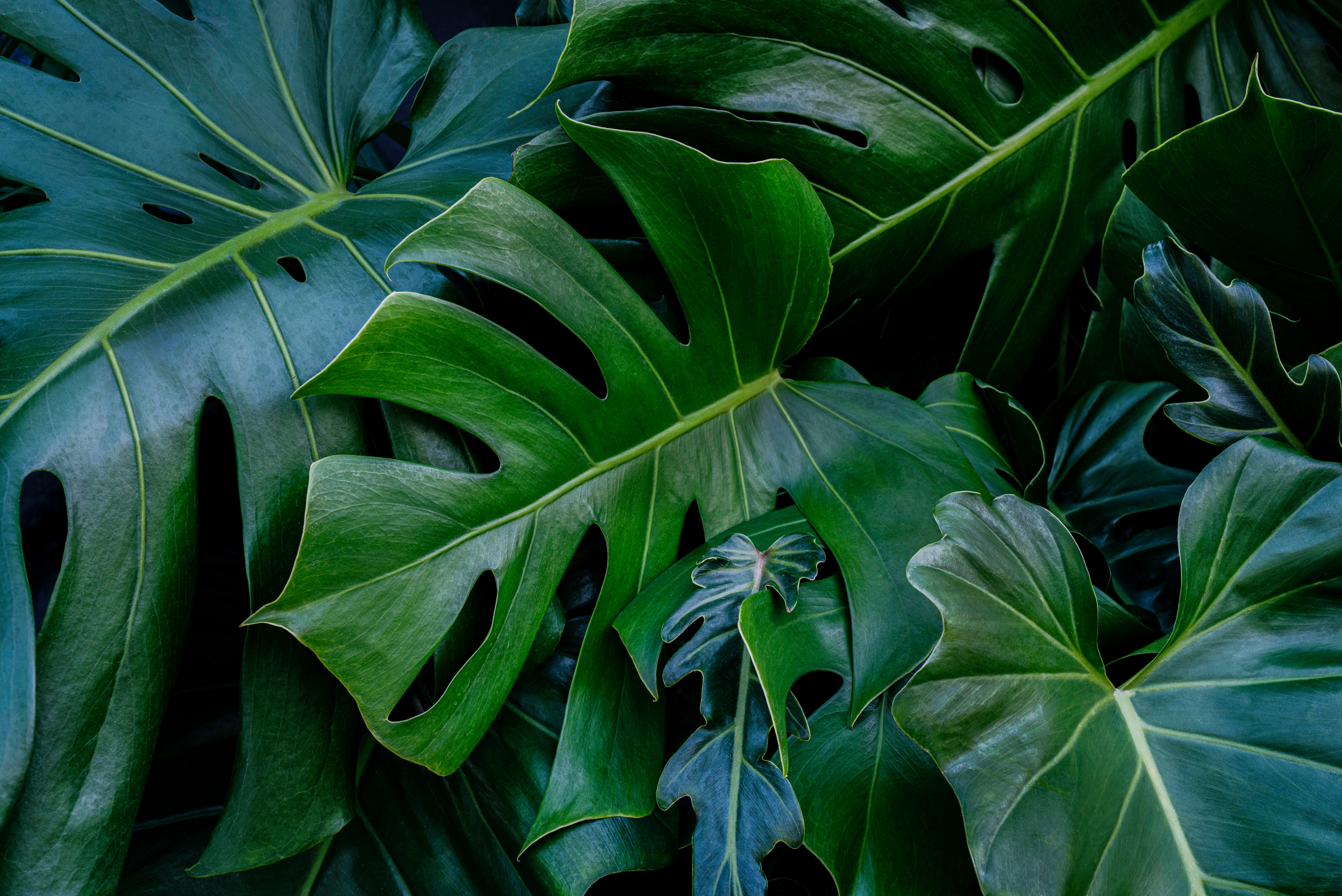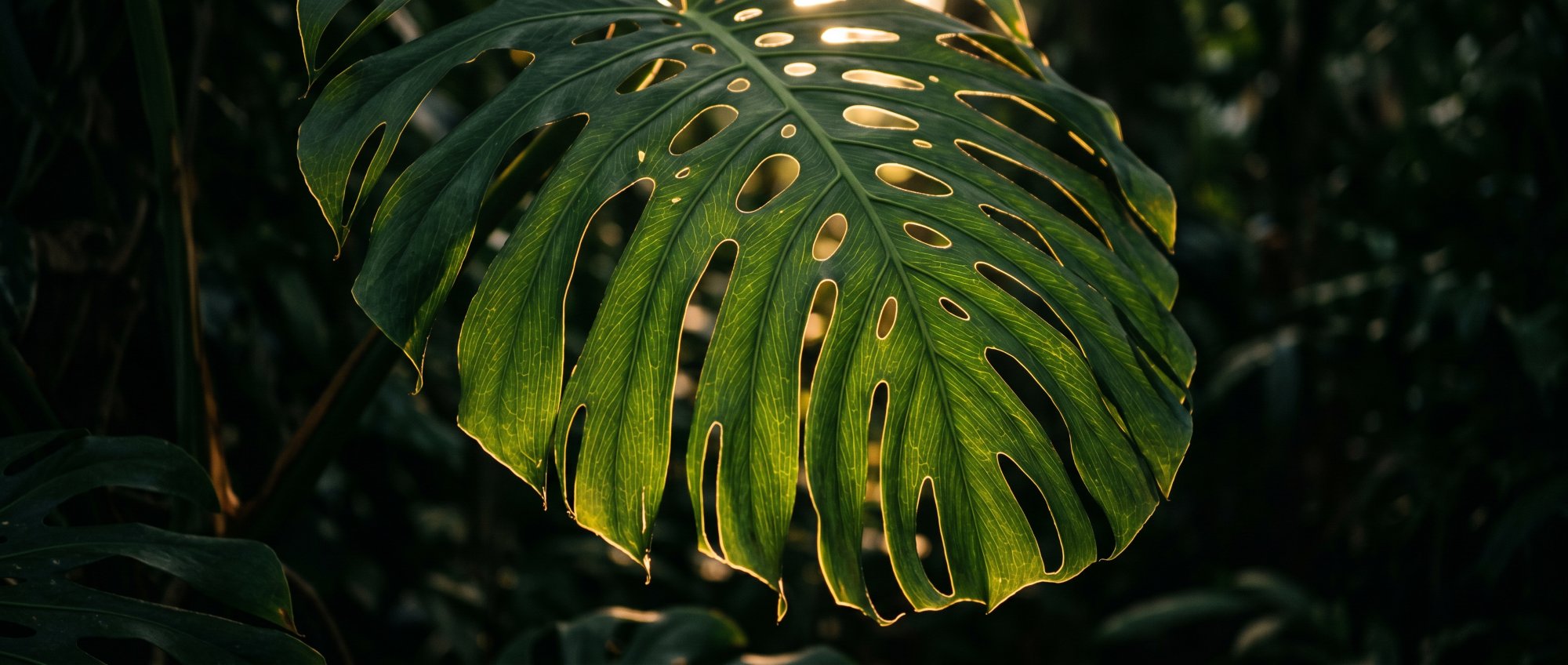
The holes aren't damage, and they aren't there to look good on a tote bag. They're built on purpose, by cells that are programmed to die, and the best explanation for why is one of the more elegant bits of plant science you'll run into. Here's what's actually going on, and what it means for the plant on your shelf.
First, There Are Two Kinds of "Cut"
Most popular writing lumps all of it together as "fenestration." That muddles two different things that happen by two different mechanisms (Madison, 1977; Melville & Wrigley, 1969).
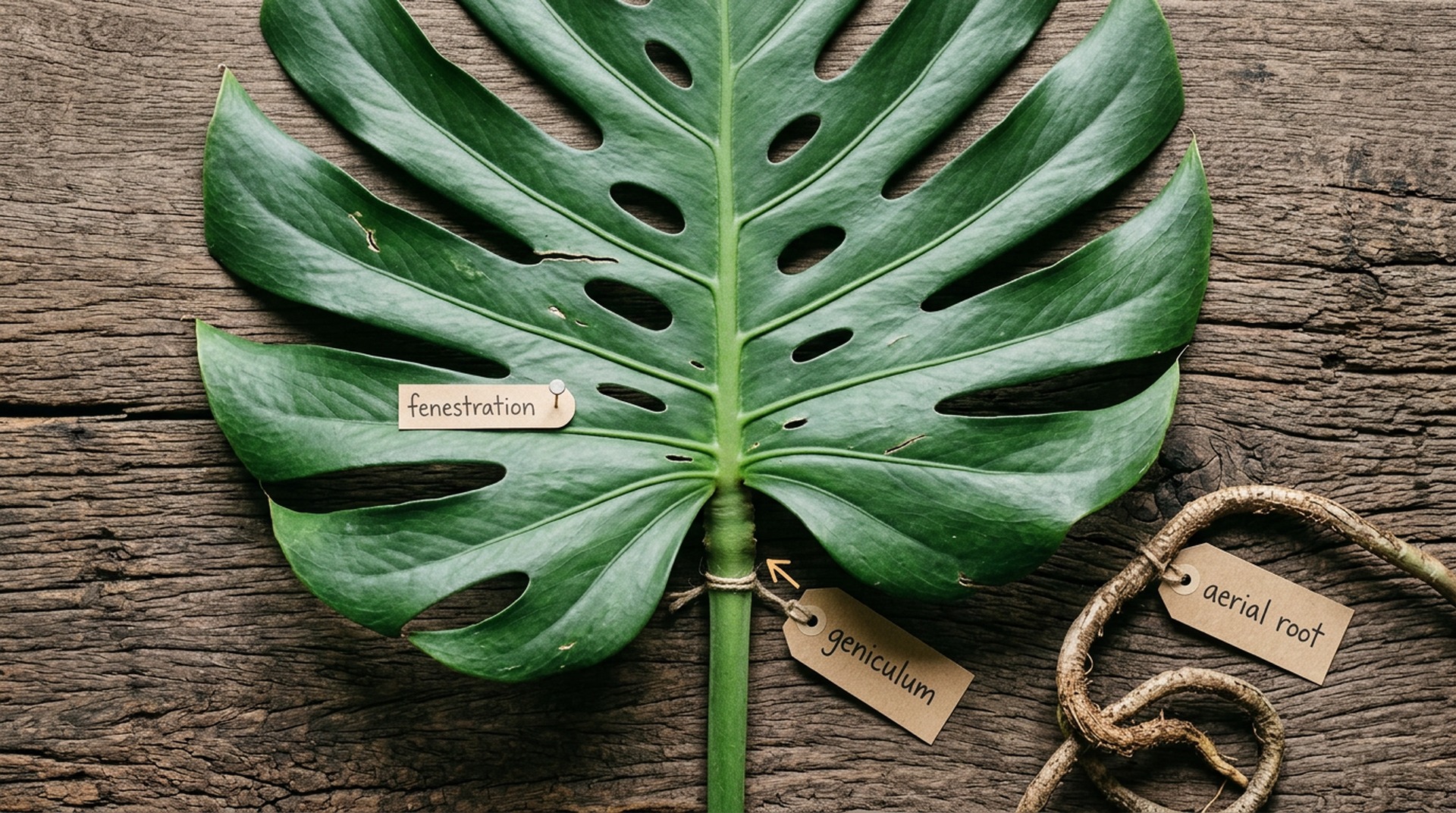
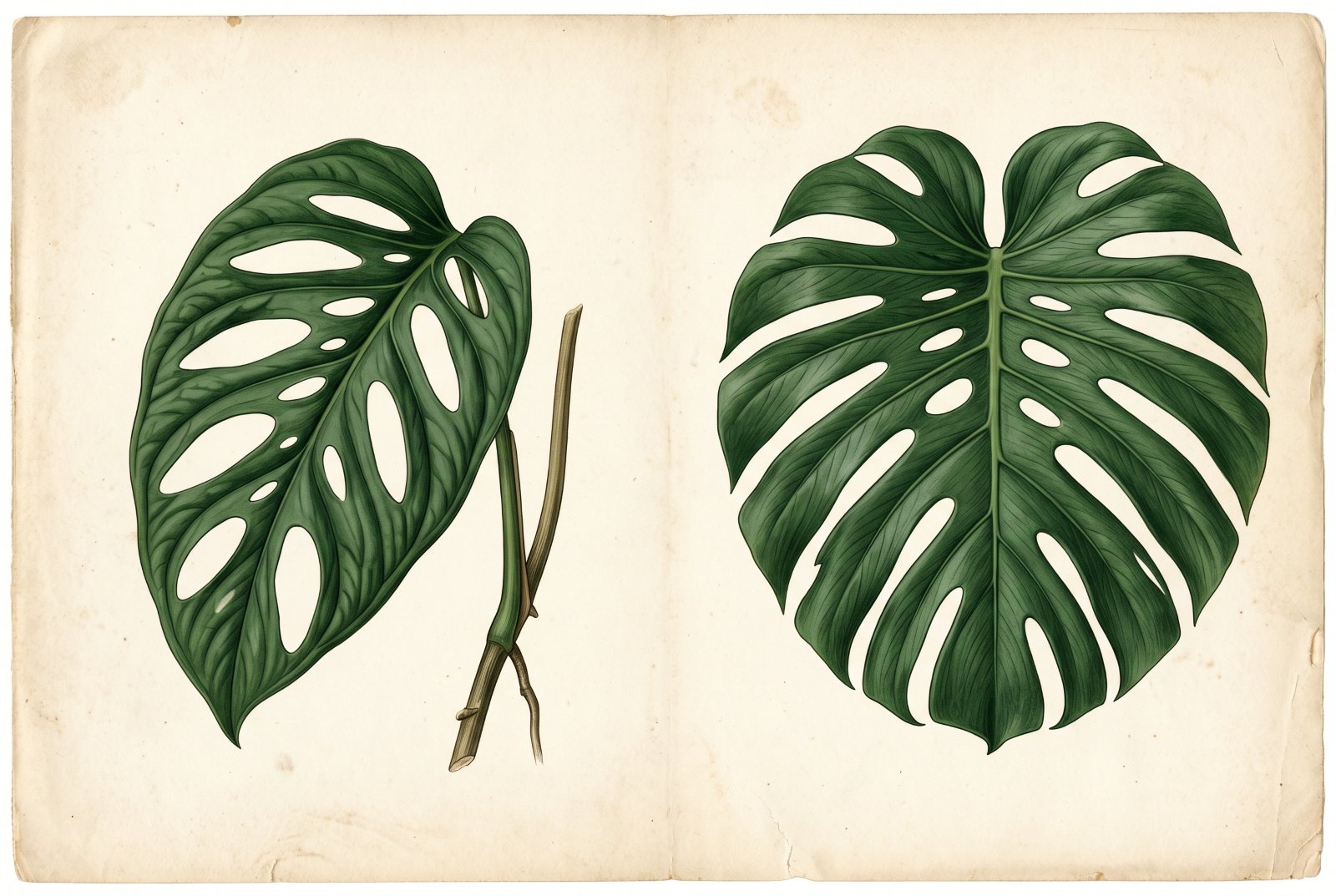
Fenestration (from the Latin fenestra, "window") means the true holes that open inside the leaf blade, with intact leaf tissue all the way around them. Look at the closed, oval holes of M. adansonii and M. obliqua. That's pure fenestration.
Lobing (or pinnate dissection) is a different animal. Those are the deep splits that cut in from the edge, dividing the blade into fingers. When an adult M. deliciosa shows those dramatic margin-to-midrib splits, that's mostly lobing, not holes.
Plenty of adult Monsteras do both. Deliciosa carries the marginal splits plus a row or two of genuine holes near the midrib. Adansonii goes the other way, mostly holes with a smooth edge. Why does the distinction matter beyond pedantry? Because the two cuts form in completely different ways, and the famous one, the holes, is the stranger of the two.
How the Holes Actually Form

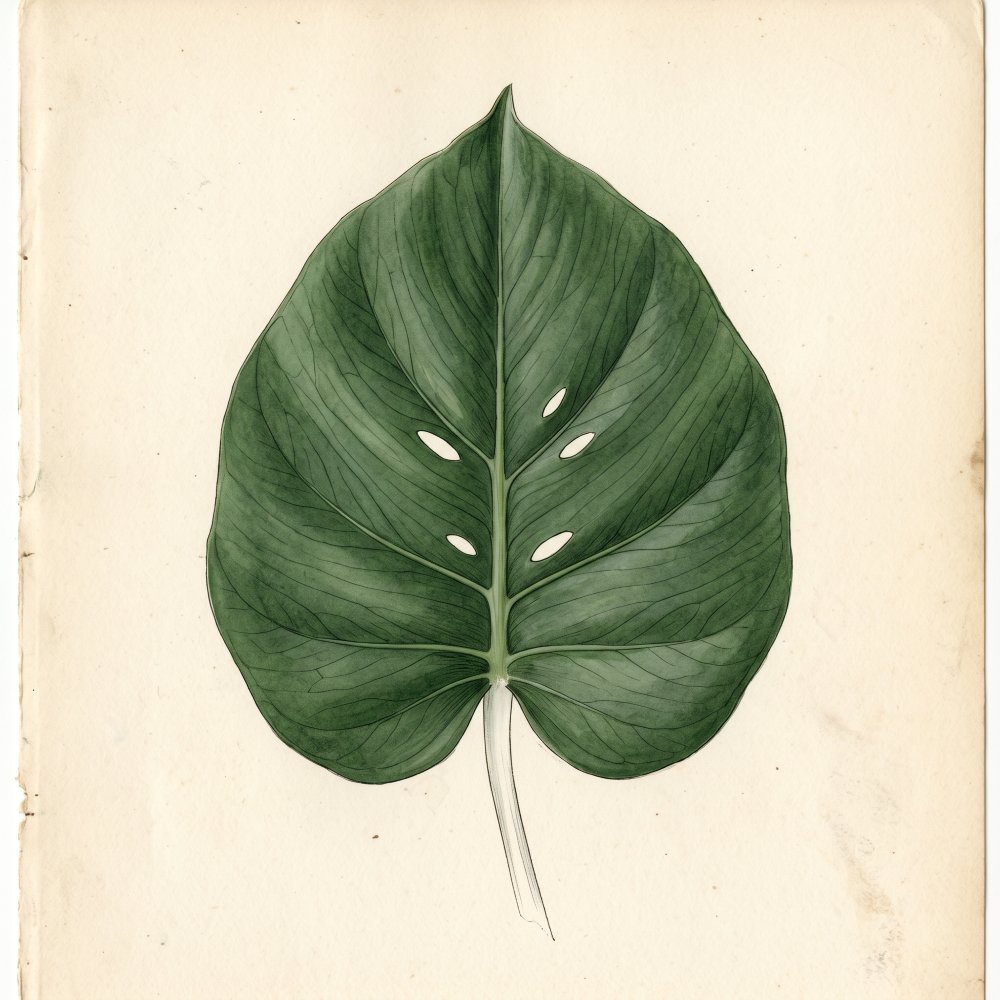
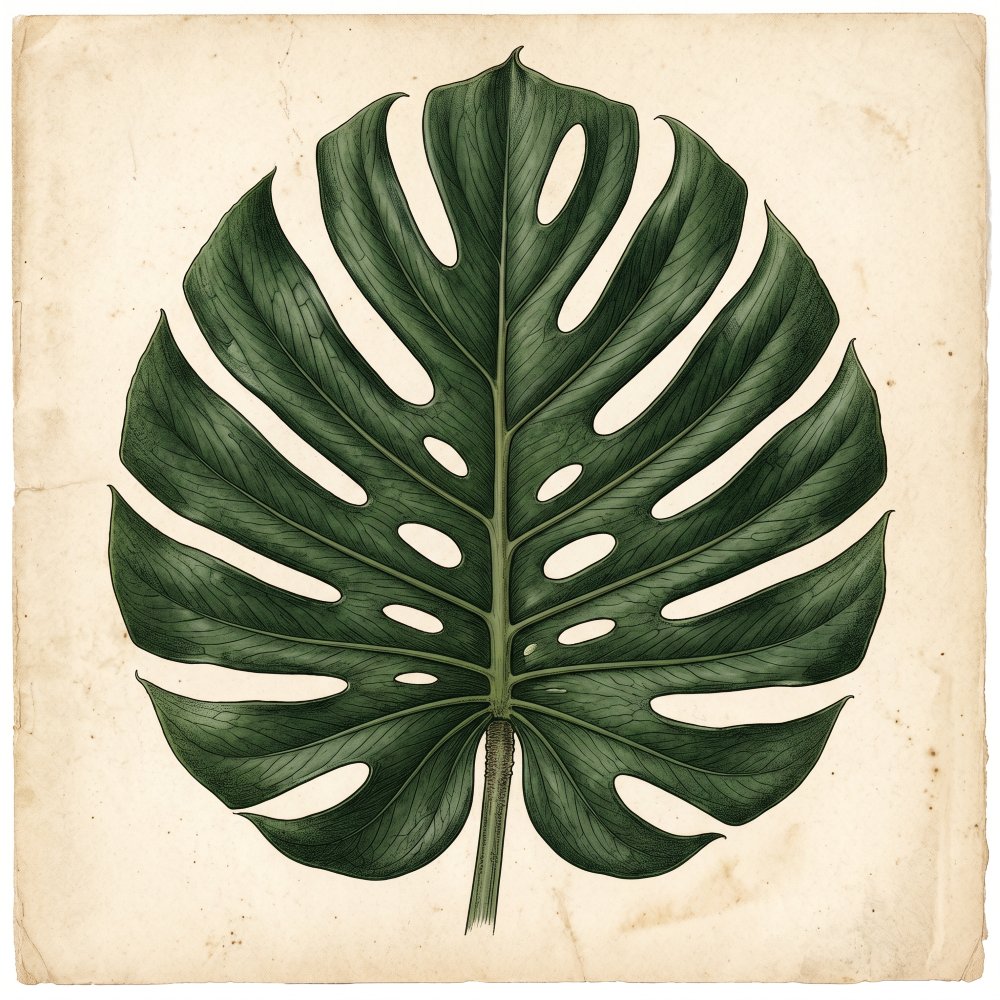
Here's the part that surprises people. A Monstera hole isn't torn open, eaten by an insect, or split by growth pressure. It's planned.
The clearest account comes from a study of Monstera obliqua (Gunawardena et al., 2005). Very early in a leaf's development, long before you'd recognize it as a leaf, a discrete patch of cells at each future hole site is fated to die. The cells right next to those patches carry on growing normally. The doomed cells go through programmed cell death (PCD, an orderly self-destruct sequence that cells run on purpose, as opposed to dying messily from injury). Under the microscope, the dying cells show the textbook signs. Their DNA fragments early, the nuclei distort, the contents condense. None of that is random decay. It's an organized shutdown (Gunawardena et al., 2005).
What happens next is the elegant bit. Those holes start as pinprick gaps in a leaf that's still tiny. Then the leaf expands toward full size, and each hole expands right along with it, opening up roughly ten-thousand-fold in area (Gunawardena et al., 2005). So the plant sketches the windows in miniature, kills the cells standing in the way, and blows the whole leaf up like a balloon until those little gaps become the big, clean holes you see. That's a good part of why Monstera became a textbook case of cells being killed on schedule to sculpt a plant's shape.
The descriptive groundwork goes back decades. An earlier study mapped the geometry of where the holes sit relative to the leaf's veins and how the pattern gets laid down (Melville & Wrigley, 1969). The 2005 work later supplied the cellular machinery behind that pattern.
How the Splits Form (a Different Trick)
The marginal splits, the deliciosa "fingers," don't come from killing internal cells at all. They come from differential growth at the leaf edge during development, where notches get established between the growing lobes (Gunawardena et al., 2005). So the plant keeps two separate tools in the drawer. One kills internal patches to punch holes. The other steers edge growth to carve splits. Most plants with divided leaves get by with just one of those tricks. Monstera runs both, which is a big reason its adult foliage looks the way it does.
So Why Bother Making a Leaf With Holes In It?
This is the genuinely interesting evolutionary question, and it's worth being honest that the field has narrowed it without fully closing it. Several explanations have been floated. One is well modeled and leads the pack. The others are plausible and less tested. So if anyone tells you flatly "it's for the rain" or "it's for the wind," they're skipping past where the science actually stands.
The Leading Explanation: Betting on Sunflecks
The understory of a tropical forest is mostly deep shade, broken up by brief, shifting patches of sun called sunflecks (beams that slip through gaps in the canopy above and sweep across the floor as the sun and the leaves move). For a plant living down there, those flecks are most of the usable light it will ever get, and they're unpredictable in both place and time.
The leading explanation builds a model around exactly that situation (Muir, 2013). The argument goes like this. A small, solid leaf is a gamble. Either a sunfleck lands on it (jackpot) or it doesn't (nothing). Now take that same amount of leaf tissue and spread it over a larger area with holes punched through. Sure, some light falls through the holes and gets "wasted." But the wider footprint means the leaf is more likely to catch some sun at any given moment, and far less likely to catch none at all.
That trade matters more than it sounds, because long-term growth in a flickering environment isn't governed by your average good day. It's dragged down by the bad days, the stretches where a solid leaf would have caught nothing. Spread the tissue out, lower the odds of a zero, and a holed leaf evens out how much carbon it captures over time. That steadier return wins over the long run, even when it gives up a little peak performance (Muir, 2013). In plain terms, it's a bet-hedging strategy. Trade a bit of best-case for a lot less worst-case.
This is the most cited current explanation, and it fits what we actually see. Fenestration turns up in understory climbers that live on sunflecks, and it turns up in the adult, higher-climbing, big-leaved phase rather than the deeply shaded juvenile. The plant builds holes precisely when and where the model says they'd pay off.
The Other Ideas (Proposed, Not Proven)
A holed leaf could do several useful things at once, so these aren't really rivals to be voted on. Think of them as candidate side benefits, each with a different amount of evidence behind it. A graduate study tested some of them directly (Lubenow, 2011), and the older revision of the genus discussed several more (Madison, 1977).
- Letting wind through. A big solid leaf on a slim climbing stem catches wind like a sail. Holes let air pass through instead, which would cut tearing and ease the strain on the leaf stalk. Plausible, with some support, and usually treated as a secondary function.
- Letting rain through. Holes let rainfall pass down to the plant's own roots and the host tree below rather than pooling on the blade. The USF study reported support for a water-related benefit while specifically not backing the damage-avoidance and herbivory ideas as primary drivers (Lubenow, 2011).
- Discouraging herbivores. The idea here is that a hole-riddled leaf looks pre-chewed, or is just harder for some insects to work on. It's weakly supported, and the USF work argued against it as a main reason (Lubenow, 2011).
- Staying cooler. Holes might lower leaf temperature by breaking up the still layer of air at the surface. Proposed, and the least tested of the bunch.
So here's the honest summary. Sunfleck bet-hedging (Muir, 2013) is the leading, formally modeled explanation, with wind and rain as credible secondary functions and herbivory poorly supported. The deep marginal splits of deliciosa probably ride along on the same logic, though lobing has had less dedicated study than the holes have.
What This Means for Your Plant
Here's where the science and the care advice turn out to be the same story. The most common Monstera question, by far, is "why won't mine make holes?" The answer falls straight out of the biology above. Fenestration is an adult trait, gated by maturity and light (Madison, 1977; Muir, 2013).
A young plant makes solid, entire, heart-shaped juvenile leaves. That's not a failure or a deficiency. It's the correct leaf for that stage. A mature plant sitting in low light with nothing to climb will also keep making juvenile-type leaves, because it's reading its conditions as "still down in the shade, not time yet."
What flips the switch is light and climbing height, not extra feeding. In the wild, the plant fenestrates as it climbs into brighter air. Indoors, you reproduce that by giving it a bright indirect spot and a moss pole or board to climb. As it gains height and light, the new leaves start showing the splits and holes. The older solid leaves won't retroactively change, but everything coming after will.
So if your Monstera's newest leaves are coming in solid, you don't really have a problem to fix. You have a stage to move it through. More light, something to climb, patience. The holes are waiting in the program.
The Takeaway
The holes are the most photographed thing about this plant and the least understood. They aren't damage and they aren't decoration. They're sketched into the leaf in miniature by cells that are scheduled to die, then enlarged as the leaf grows, and the best current science reads them as a clever way to keep catching light where light is scarce and unreliable. You can't talk a young plant into making them. What you can do is give it the light and the height it's actually asking for, and let the program run.
Gunawardena, A. H. L. A. N., Sault, K., Donnelly, P., Greenwood, J. S., & Dengler, N. G. (2005). Programmed cell death and leaf morphogenesis in Monstera obliqua (Araceae). Planta, 221(5), 607–618. https://doi.org/10.1007/s00425-005-1545-1
Madison, M. (1977). A revision of Monstera (Araceae). Contributions from the Gray Herbarium of Harvard University, 207, 3–100.
Melville, R., & Wrigley, F. A. (1969). Fenestration in the leaves of Monstera and its bearing on the morphogenesis and colour patterns of leaves. Botanical Journal of the Linnean Society, 62(1), 1–16.
Muir, C. D. (2013). How did the Swiss cheese plant get its holes? The American Naturalist, 181(2), 273–281.
Lubenow, C. (2011). The adaptive function of leaf fenestrations in Monstera spp. (Araceae): A look at water, wind, and herbivory [Undergraduate research report]. Monteverde Institute: Tropical Ecology and Conservation, Digital Commons @ University of South Florida. https://digitalcommons.usf.edu/tropical_ecology/79