Before you can grow one well, it helps to know what it actually is. Here's the genus behind the silhouette: who named it and why, how botanists have mapped it, how many species there really are, and the family of cousins it keeps getting mixed up with.
The Name on the Tag Is Bigger Than the Plant
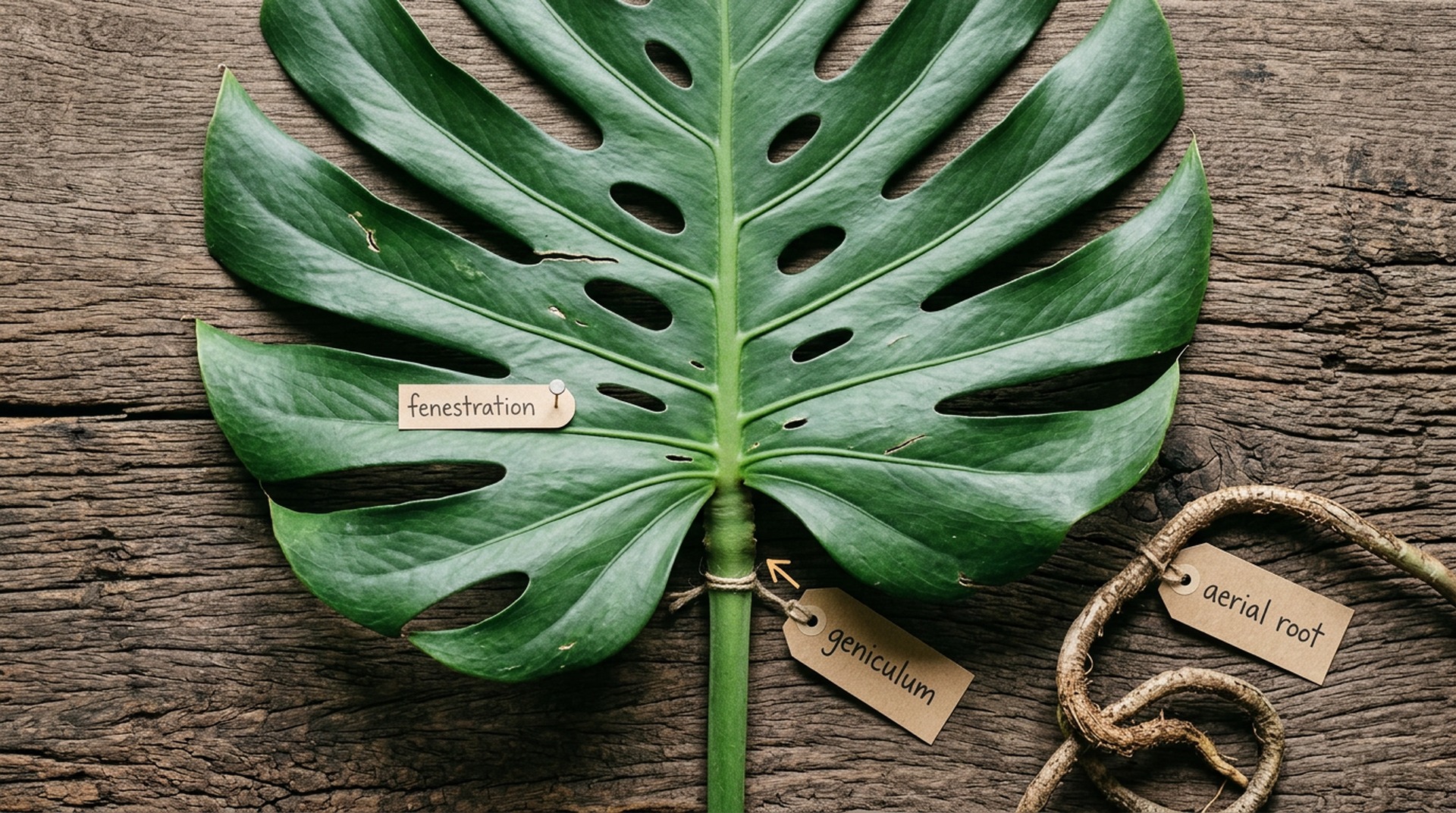
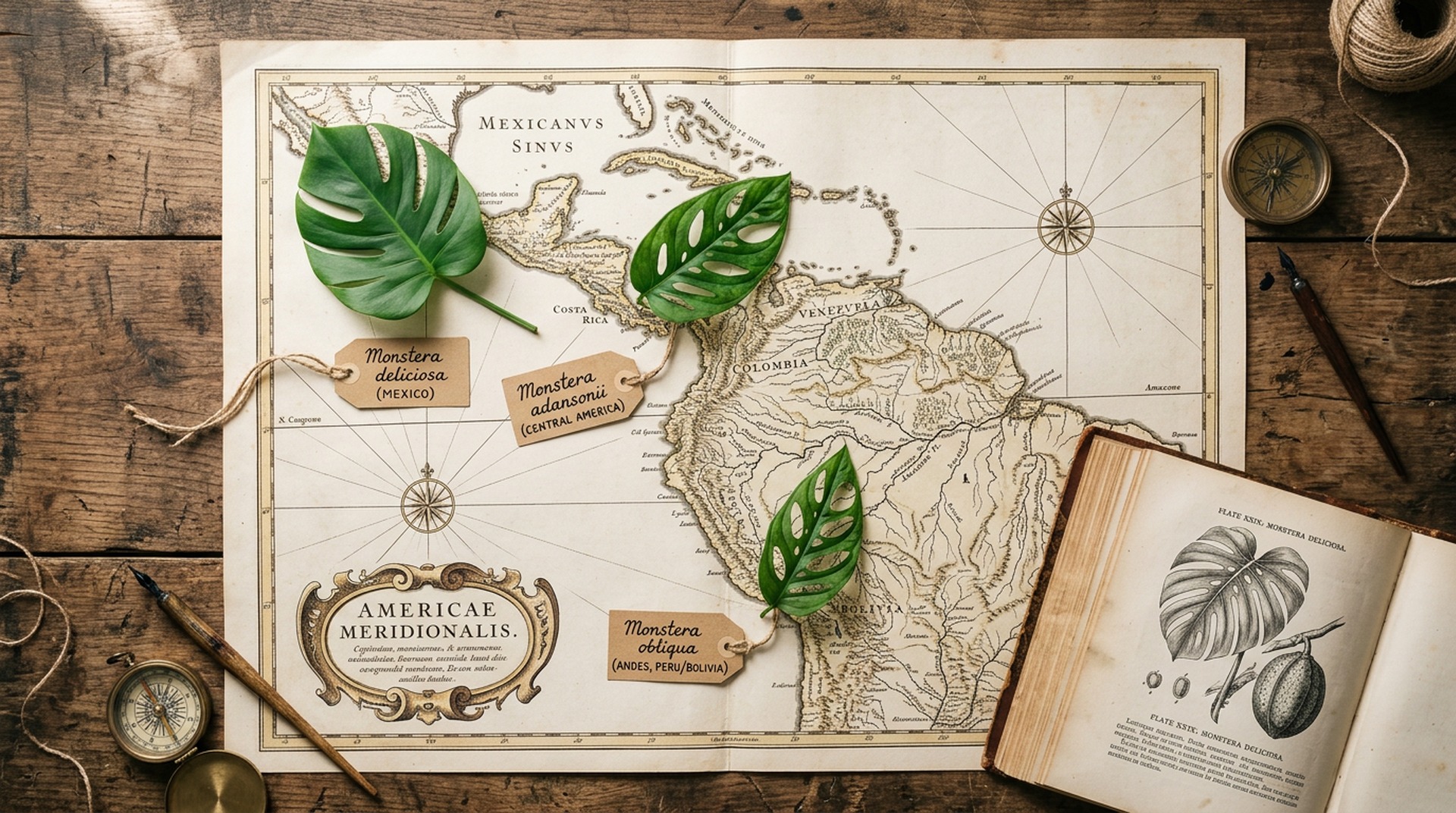
Say "I have a Monstera" and you almost certainly mean one plant: Monstera deliciosa, the big split-leaf one. But "Monstera" isn't a plant. It's the name of a whole genus (a group of closely related species that share a scientific name), and deliciosa just happens to be the famous member. There are dozens of others. You've probably met one without realizing it, like the small-holed Monstera adansonii that gets sold as the "Swiss cheese vine." Most of the rest you'll never spot in a shop, because they live high up in Central American cloud forests and only got described by science in the last few years.
So there's a gap between the one plant everybody pictures and the genus standing behind it, and it's worth closing. Close it and you stop buying plants by their label and start knowing what you actually own. This piece is about the genus: where the name came from, how people have organized it, how big it really is, and the family it belongs to. The care details for the famous species live in their own profiles.
Where the Name Came From (1763)
The French naturalist Michel Adanson published the name Monstera in 1763, in a two-volume work called Familles des Plantes (Adanson, 1763). Adanson had a habit of coining names without bothering to explain them, so the etymology isn't airtight. The usual reading: Monstera traces to the Latin monstrum, "monster" or "marvel," a nod to the strange, hole-riddled, deeply cut leaves that look downright abnormal sitting next to an ordinary whole leaf (Madison, 1977). That "Adans." you'll see hanging off the genus name? That's him.
One wrinkle, in case you ever go poking around the databases. Adanson's book sits awkwardly against the official starting line for plant naming, so the genus in its modern, working form usually gets credited to the Austrian botanist Heinrich Wilhelm Schott in the early 1800s. He's the one who placed it properly inside the arum family and moved species into it (Madison, 1977). The big reference indexes still list it as Monstera Adans., though, because everyone who came after Adanson picked up his name and kept it.
There's a nice loop in all this. The type species of the genus (the single species that anchors what the name officially means) is Monstera adansonii Schott, named in Adanson's honor. So the genus name and its anchor species both point back to the same eighteenth-century naturalist, one straight on and one as a tribute.
Madison's Map (1977) and What Came After
For most of its history this genus was miserable to work with. The features that actually separate one Monstera from another sit in the flower spike, the fruit, and the seed, and those parts are short-lived, hard to collect, and fall apart the moment you press them onto a herbarium sheet (Madison, 1977). A dried, leafless climbing stem, which is what most museum specimens amount to, frequently can't be identified at all. And the leaves won't bail you out: a young plant and an adult of the same species can look like two entirely different organisms.
The person who finally imposed some order was Michael Madison. His 1977 work, A Revision of Monstera (Araceae), is still the foundation everyone builds on (Madison, 1977). He recognized 22 species, wrote the first real keys and descriptions, and split the genus into four sections (a section is a formal subdivision of a genus, ranked just below the genus itself). Two of those sections come up constantly if you read about the popular plants. There's section Tornelia, the large-fruited group that holds M. deliciosa, and section Marcgraviopsis, which covers species whose juveniles flatten themselves against a tree trunk in overlapping "shingles" before they grow up.
Now for the part where Madison's map starts to show its age. Once researchers got around to comparing Monstera species by DNA instead of by looks, the four sections stopped holding up cleanly. A 2019 study of the broader subfamily found that species Madison had filed into the same section didn't always turn out to be relatives, which tells you at least some of those groups are artificial (Zuluaga et al., 2019). Here's the catch: nobody has yet built a DNA family tree dense enough to draw better groups in their place. So botanists do the pragmatic thing. They keep using Madison's section names as handy shorthand while openly admitting the names will get redrawn eventually. When a 2023 paper describes a new species and parks it "in section Marcgraviopsis," that's the system at work, a placeholder everyone agrees is temporary (Cedeño-Fonseca et al., 2023).
So How Many Species Are There?
Madison's 22 species have roughly tripled. Plants of the World Online, the global name database run by the Royal Botanic Gardens, Kew, currently lists somewhere around 70 accepted Monstera species, and the count keeps climbing (POWO, n.d.). I'm giving a round number on purpose. This is a genus under active revision, and any precise integer goes stale almost yearly, so "around 70, and rising" is the honest version.
That growth isn't a bookkeeping artifact. It's the payoff from real fieldwork in one small slice of the world. Since about 2010, a tight cluster of botanists working in Costa Rica and Panama has been describing new species at a steady clip, often pulled from the cloud forests of the Talamanca mountains and the Panamanian highlands (Cedeño-Fonseca et al., 2021). Several of those new species arrived with a warning attached. The forests they live in are being cleared for coffee and other crops, so some Monstera species got formally named and flagged as threatened in the very same paper (Cedeño-Fonseca et al., 2020).
Why did a plant this famous stay so badly counted for so long? Same reasons that made the genus hard to map in the first place. The diagnostic parts are fragile and rarely collected. The juveniles and adults look so unalike they sometimes got named as separate species. And the adults flower high in the canopy on their host trees, well out of reach. What changed, mostly, was better tree-canopy access and a lot of patient collecting in those isthmian forests (Madison, 1977; Zuluaga et al., 2019).
The Family It Belongs To
Monstera lives in Araceae, the arum family, one of the largest and oldest groups of flowering plants that grow from a single point per stem (Cusimano et al., 2011). Grown a peace lily, a pothos, a philodendron, or a calla? Then you've grown an aroid (a member of the arum family). They all run the same basic flower design: a fleshy spike of tiny flowers called a spadix, wrapped in a single modified leaf called a spathe. The "flower" on a peace lily is really just that spathe doing the showing off.
Drill down a level and Monstera sits in the subfamily Monsteroideae, which is overwhelmingly made of climbers that start life on the ground and then haul themselves up a tree (Zuluaga et al., 2019). One level deeper is the tribe Monstereae (a tribe ranks between subfamily and genus), the root-climbing group that includes Monstera itself. The full address reads like this:
- Family: Araceae (the arum family)
- Subfamily: Monsteroideae (mostly tree-climbers)
- Tribe: Monstereae (the root-climbers)
- Genus: Monstera (around 70 species, New World only)
One line in that address explains a lot. Monstera is the only large genus in its tribe that lives exclusively in the Americas (Zuluaga et al., 2019). Its closest relatives in the tribe are all Old World plants, scattered across Asia, Australasia, and the Pacific. That split, one New World genus ringed by Old World cousins, is thought to go back to the deep breakup of the ancient southern supercontinent, with later ocean-crossing dispersal filling in the rest (Zuluaga et al., 2019; Nauheimer et al., 2012). It's a model-based inference, not a settled fact, but the short version holds: Monstera and pothos are old cousins that wound up on opposite sides of the planet.
The Cousins It Gets Confused With
This is where the family tree starts earning its keep at the plant shop. The Old World relatives in tribe Monstereae are Rhaphidophora, Epipremnum, Scindapsus, and Amydrium (Zuluaga et al., 2019). Every one of them climbs, every one can throw holed or split leaves, and as young plants they look an awful lot like Monstera. That resemblance isn't some coincidence of fashion. They look alike because they really are related, all descended from the same climbing-aroid stock.
And the trade leans right into the confusion. Rhaphidophora tetrasperma gets sold as "mini monstera" or "Monstera Ginny," even though it isn't a Monstera at all. Epipremnum pinnatum 'Cebu Blue' gets mistaken for one. Plain pothos, which is also an Epipremnum, sits on the same shelf under a dozen different names. None of this is exactly a scam. The seller's job is to move a recognizable plant, and "mini monstera" sells a lot better than the correct Latin mouthful.
A botanist's name has one job: point at exactly one species and nothing else, so a researcher in Panama and a grower in California mean the same plant. A seller's name has a different job: be recognizable, and move the plant off the bench. The fix isn't to memorize Latin. It's to keep both names in mind. Learn the botanical name of anything you actually care about getting right (a pricey variegated plant, say), and treat the shop name as a friendly nickname that might be wrong.
How to Keep the Genus Straight
You don't need a botany degree for any of this. A handful of working rules cover almost everything that comes up:
- "Monstera" is a last name, not a first name. It tells you the family the plant married into, not which individual you're holding. Pair it with a species word (deliciosa, adansonii) whenever it matters.
- If a label says only "Monstera," assume deliciosa until proven otherwise. That's the default the trade means, but check the leaf before you commit, because adansonii and a few cousins wear the same name.
- "Mini monstera" is not a Monstera. It's Rhaphidophora tetrasperma, a cousin. Lovely plant, different genus.
- The section names are shorthand, not gospel. If you read that a plant is in section Tornelia or Marcgraviopsis, take it as a useful hint about its relatives, but know it's a system botanists fully expect to revise.
- When in doubt, the database wins. Plants of the World Online is the free, public place to check whether a name is currently accepted. For anything expensive, look it up before you buy.
The Takeaway
A Monstera isn't really a plant. It's a small, growing crowd of them: an American genus of climbing vines that picked up its "monster" name in 1763 for those strange leaves, got its first real map from Madison in 1977, and has nearly tripled in size as botanists keep turning up new species in Central American forests. The one on your shelf is a single famous member of that crowd. Know the genus behind it and a label turns into actual understanding, which is also what lets you spot the cousins wearing borrowed names on the shelf right next to it.
Adanson, M. (1763). Familles des plantes (Vol. 2). Paris: Vincent.
Cedeño-Fonseca, M., Ortiz, O. O., Zuluaga, A., Grayum, M. H., & Croat, T. B. (2021). Four new species of Monstera (Araceae) from Panama, including one with the largest leaves and another with the largest inflorescences in the genus. Webbia: Journal of Plant Taxonomy and Geography, 76(2), 265–279.
Cedeño-Fonseca, M., Ortiz, O. O., Zuluaga, A., Grayum, M. H., & Croat, T. B. (2020). Three new species of Monstera (Araceae: Monsteroideae: Monstereae) from the Cordillera de Talamanca in Costa Rica, threatened by the expansion of coffee plantations. Nordic Journal of Botany. https://doi.org/10.1111/njb.02970
Cedeño-Fonseca, M., Ortiz, O. O., Hay, A., & Blanco, M. A. (2023). Three new species and a new record of Monstera Adans. sect. Marcgraviopsis Madison (Araceae: Monsteroideae: Monstereae) from the Caribbean watershed in Costa Rica and Panama. Webbia: Journal of Plant Taxonomy and Geography, 78(2), 107–116. https://doi.org/10.36253/jopt-14904
Cusimano, N., Bogner, J., Mayo, S. J., Boyce, P. C., Wong, S. Y., Hesse, M., Hetterscheid, W. L. A., Keating, R. C., & French, J. C. (2011). Relationships within the Araceae: comparison of morphological patterns with molecular phylogenies. American Journal of Botany, 98(4), 654–668. https://doi.org/10.3732/ajb.1000158
Madison, M. (1977). A revision of Monstera (Araceae). Contributions from the Gray Herbarium of Harvard University, 207, 3–100.
Nauheimer, L., Metzler, D., & Renner, S. S. (2012). Global history of the ancient monocot family Araceae inferred with models accounting for past continental positions and previous ranges based on fossils. New Phytologist, 195(4), 938–950. https://doi.org/10.1111/j.1469-8137.2012.04220.x
Plants of the World Online. (n.d.). Monstera Adans. Royal Botanic Gardens, Kew. https://powo.science.kew.org/
Zuluaga, A., Llano, M., & Cameron, K. M. (2019). Systematics, biogeography, and morphological character evolution of the hemiepiphytic subfamily Monsteroideae (Araceae). Annals of the Missouri Botanical Garden, 104(1), 33–48. https://doi.org/10.3417/2018269