What looks like one Monstera flower is really a spike of many small flowers inside a single hood. In the species studied, it warms itself and takes pollen before it sheds its own, and the pollinators recorded in the field are mainly small beetles. Here's what the field studies and the botanists who have revised the genus show, from flower to fruit, and where they disagree.
Corrected October 2026: we've revised this essay. See the correction note at the end.
What a Monstera Flower Actually Is
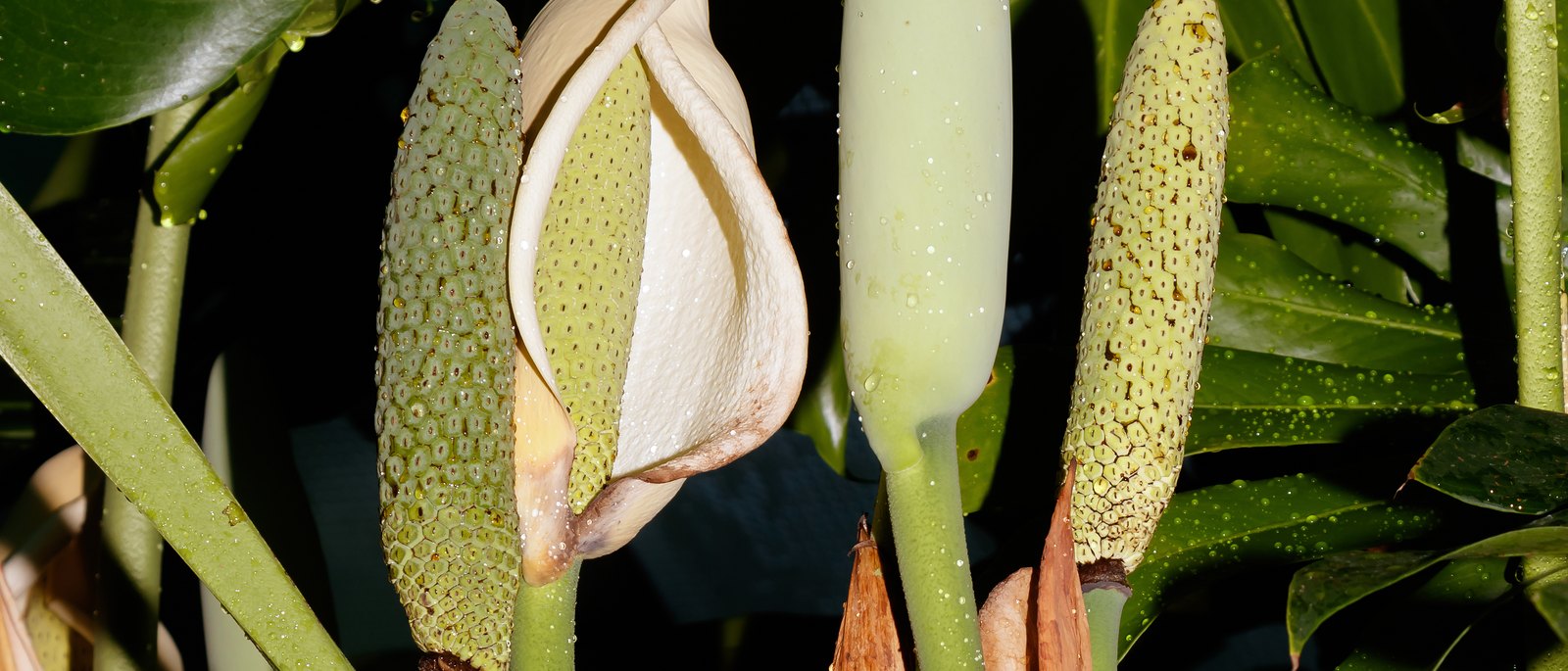
Start by setting aside the picture of petals. Monstera belongs to the arum family (Araceae), whose flowers are small and numerous and are packed into spikes. In most of the family, often spectacularly, the spike comes with a hood (Watson & Dallwitz, 1992 onwards). Botanists call the spike a spadix and the hood a spathe, and the two together make up an inflorescence, one structure carrying many flowers. So in this essay, "the flower" means the whole inflorescence.
On a Monstera, the spadix carries numerous flowers arranged in spirals, and none of them has a perianth, the petals and sepals (Madison, 1977). Most of those flowers are perfect, meaning each has both male and female parts: Madison counts four stamens, the pollen-making parts, per flower. Those at the bottom of the spike are usually sterile (Madison, 1977). In Monstera deliciosa, those sterile basal flowers carry a yellow secretion on their stigmas, the tips that receive pollen (Croat, Cedeño-Fonseca, & Ortiz, 2024).
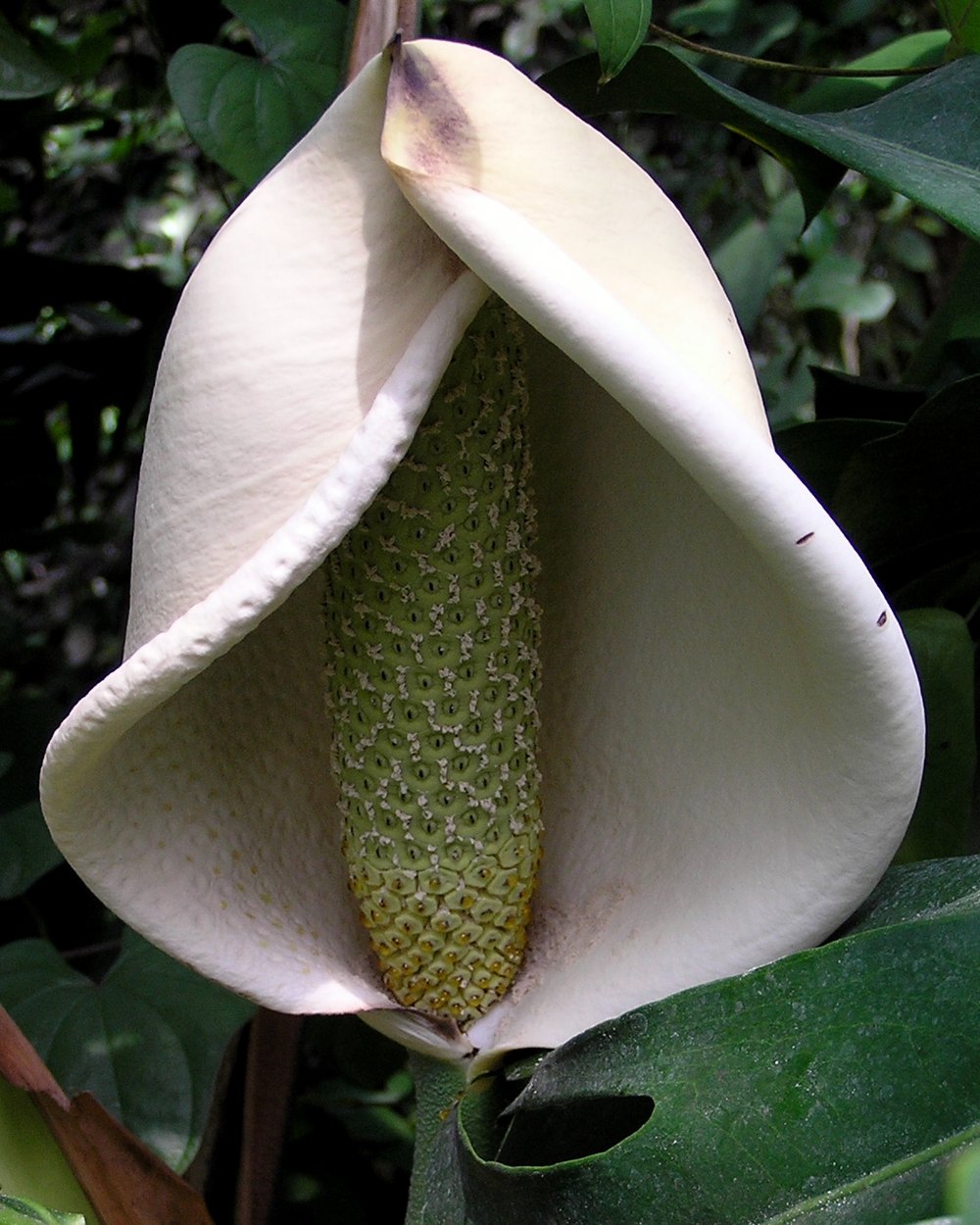
In bud, the spathe is green and wrapped tightly around the spadix. At flowering it unfurls and takes on color, from white to deep yellow to rose depending on the species (Madison, 1977). On M. deliciosa the open spathe is yellowish outside and cream inside (Croat et al., 2024).
How long the hood lasts varies. Madison (1977) describes it lasting two or three days once open before it drops. A 2024 revision of the Central American species describes the spathe more broadly, as either falling or withering in place after flowering (Croat et al., 2024). And in M. lentii, studied in a mountain forest in Costa Rica, the dried spathe stayed attached for three to four weeks after the male phase (Prieto & Cascante-Marín, 2017).
Here’s why the two-sexed flowers matter. In monoecious aroids, members of the arum family that carry separate male and female flowers on the same plant, the male flowers sit above the female ones (Watson & Dallwitz, 1992 onwards). Position keeps the sexes apart there. A Monstera flower has both sexes in one place, and the plant separates them in time.
Female First, Then Male
Monstera flowers are protogynous: the female phase, when the stigmas can take pollen, comes before the male phase, when the anthers (the pollen-bearing tips of the stamens) shed it. Madison (1977) put the gap at one or two days. A 2019 review of aroids with bisexual flowers covers several Monstera species, and in those the female phase runs 28 to 72 hours and the male phase 2 to 48 hours, depending on the species (Díaz Jiménez et al., 2019).
The same review describes a flowering sequence of about five days in M. adansonii, M. deliciosa and M. lentii. M. obliqua is quicker: its sequence lasts only 48 hours but is spread over three days, with a dormant phase of up to 14 hours in the middle (Díaz Jiménez et al., 2019). In the Costa Rican study, the female phase of M. lentii lasted three days, and the researchers saw no apparent overlap between the female and male phases (Prieto & Cascante-Marín, 2017).
The gap likely has a job. The Costa Rican researchers describe protogyny in M. lentii as a mechanism likely to prevent self-pollination (Prieto & Cascante-Marín, 2017). Madison (1977) went further, concluding that self-fertilization within one inflorescence is not possible. The M. lentii fieldwork complicates that. When the researchers bagged 11 inflorescences to keep insects out, six still set some fruit, an average fruit set (the share of flowers that went on to form fruit) of 10 percent. Inflorescences left open to insects reached a mean fruit set of 61.4 percent (Prieto & Cascante-Marín, 2017). The authors say further studies are needed to confirm self-pollination in Monstera, so we’d read the bagged result as a possibility, not a settled finding.
The Spike That Warms Itself
Heat production is common in Monstera: the inflorescences of the species studied are thermogenic, meaning they make heat of their own (Díaz Jiménez et al., 2019). The shape of it, as the 2019 review summarizes it, is a spike that stays slightly warm through the female phase and warms further while the anthers release pollen (Díaz Jiménez et al., 2019). In numbers, the spadix runs 0.9 to 4.5°F (0.5 to 2.5°C) above the surrounding air from the start of the female phase to the start of the male phase (Díaz Jiménez et al., 2019). It then climbs to 3.6 to 9°F (2 to 5°C) above the air during pollen release (Díaz Jiménez et al., 2019).
There’s a catch. The same review notes that by day the spadix was almost the same temperature as the air, and that significant differences were measured only at night or in the early morning (Díaz Jiménez et al., 2019).
M. lentii doesn’t fit that summary neatly. The Costa Rican team put a probe inside the floral chamber, the pocket the spathe forms around the spadix, and recorded peaks of 3.2 to 7.7°F (1.8 to 4.3°C) above the outside air (Prieto & Cascante-Marín, 2017). The heating rose in the morning hours and around noon, and the peaks were similar in the female and male phases, with no clearly higher peak at pollen release (Prieto & Cascante-Marín, 2017). That sets it apart from the pollen-release peak found in other Monstera species by Chouteau and colleagues, whose studies include M. adansonii and M. deliciosa cultivated ex situ, outside their natural habitat (Chouteau et al., 2007, 2009, as cited in Prieto & Cascante-Marín, 2017).
Why make heat at all? Heat production is often tied to the release of scent that attracts pollinators, a point the Costa Rican authors take from Endress (1994). They suggest the longer heating in M. lentii might stretch out the time the flower draws insects during the female phase (Prieto & Cascante-Marín, 2017). The 2019 review proposes that, across Monstera, the warmth might serve pollinators as an energy reward, an idea Chouteau et al. (2007) had proposed for M. obliqua (Díaz Jiménez et al., 2019). The scent itself is described as sweet or bittersweet in every Monstera species studied (Díaz Jiménez et al., 2019). In M. lentii the scent rose each day around noon and faded by dusk during the female phase (Prieto & Cascante-Marín, 2017).
Beetles, Flies and Bees
The Costa Rican study of M. lentii describes itself as only the second to document how Monstera is pollinated (Prieto & Cascante-Marín, 2017). The first, Chouteau and colleagues’ work on M. obliqua in French Guiana, is the only earlier report of a nitidulid beetle in Monstera, Colopterus amputatus (Chouteau et al., 2007, as cited in Prieto & Cascante-Marín, 2017). Nitidulids are a family of small beetles, Nitidulidae, and the Costa Rican authors describe the species they found as sap-feeding.
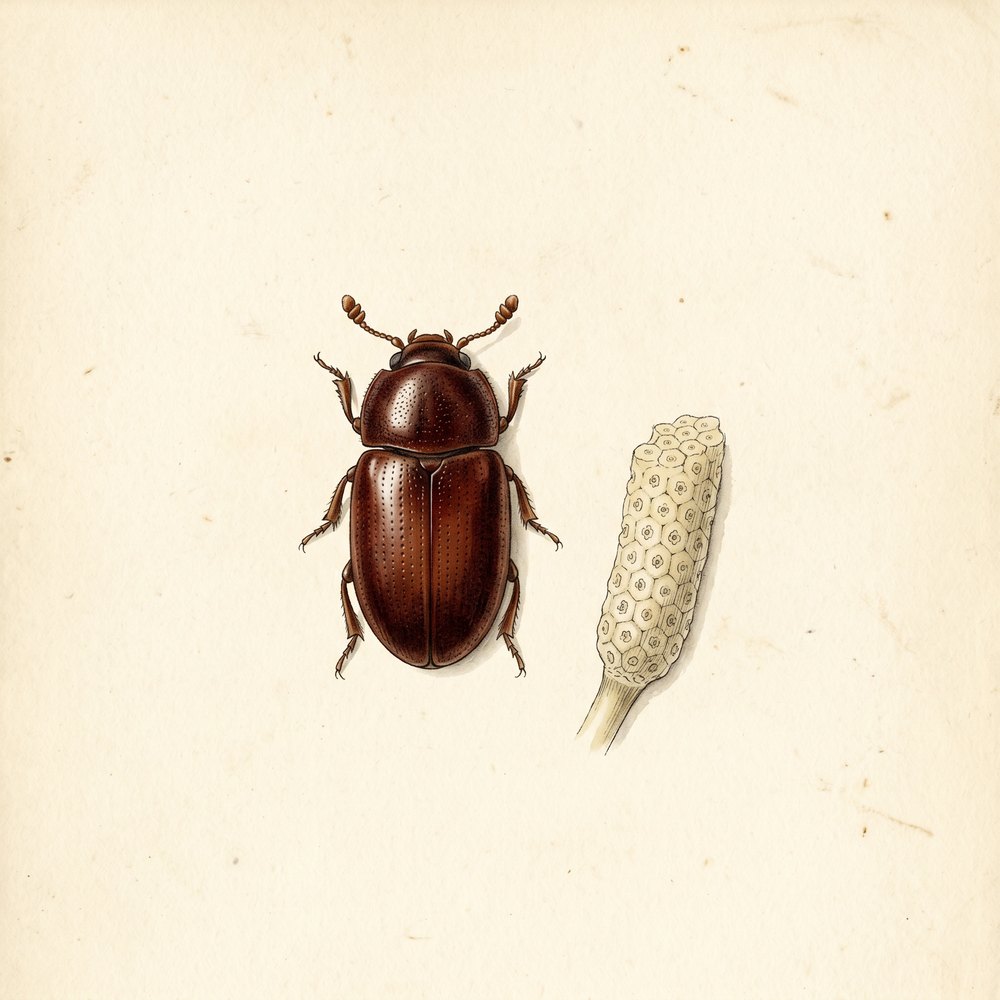
In M. lentii, the most frequent visitor was Cychrocephalus corvinus, a nitidulid about 0.2 inch (5 mm) long (Prieto & Cascante-Marín, 2017). The beetles arrived mainly in the morning hours and entered the floral chamber through a slit in the spathe (Prieto & Cascante-Marín, 2017). Once inside, the authors write, the beetles use the chamber "as a shelter and a place for aggregation and mating." The researchers couldn’t establish whether the beetles eat the pollen, and they note that the beetles’ jaws suggest a predatory habit instead (Prieto & Cascante-Marín, 2017). The beetles moved around on the spadix and departed once the male phase ended, carrying pollen, which is what makes them, in the authors’ words, a suitable pollinator (Prieto & Cascante-Marín, 2017).
They weren’t alone. Drosophilid flies, the family that includes the small fruit flies, also entered the chamber, and the authors conclude that M. lentii is likely to have a mixed pollination system, since the flies may also be important pollinators (Prieto & Cascante-Marín, 2017). For the beetle-pollinated Monstera species it covers, the 2019 review reports that beetles turn up at different times of day, from early morning to afternoon depending on the species, while the scent is being released (Díaz Jiménez et al., 2019).
Bees are where the record gets tangled. On a single inflorescence, Madison (1977) saw several species of beetles, hemipterans (true bugs), flies and bees, and he thought the bees, as the most mobile visitors, were "perhaps the effective pollinators." He also passed on an unpublished account from C. H. Dodson, who had watched trigonid bees (stingless bees of the Trigona group) in Ecuador serve as the main pollinators of M. lechleriana and M. dilacerata (Madison, 1977). A year later came a report of large numbers of Trigona corvina bees collecting nectar from the stigmas of M. deliciosa, along with pollen (Ramírez & Gómez, 1978, as cited in Hawai‘i-Pacific Weed Risk Assessment, 2023).
The later field work reads those bees differently. In M. lentii, stingless bees turned up for pollen once the spathe had opened fully in the male phase, so the authors regard them as pollen robbers, visitors that take pollen without pollinating (Prieto & Cascante-Marín, 2017). The 2019 review goes further: because the inflorescences stay nearly shut through the female phase, and bees have been seen only at open ones late in flowering, its authors set bees aside as pollinators, at least in the better-studied cases (Díaz Jiménez et al., 2019). Where we land: the beetle account is the one with field studies behind it, and the bee reports for M. lechleriana and M. dilacerata rest on an observation passed on in 1977.
One more comparison helps place Monstera. Its pollination system resembles that of the neotropical (American tropical) Philodendron, except that Philodendron relies on scarab beetles rather than nitidulids (Prieto & Cascante-Marín, 2017).
From Spike to Fruit
After pollination, Madison (1977) writes, the spathe drops away and the spadix turns green. He takes the green as a sign that the spike is apparently photosynthetic, making food from light, and as camouflage that protects the developing seeds. The berries are grouped into a syncarp, a single fruit built from many berries, and each berry holds one to four seeds under a cap that falls away at maturity (Croat et al., 2024). In M. deliciosa, the fruit is made up of numerous berries stuck together under a thick, hard peel of hexagonal plates (Crane & Balerdi, 2016).
It takes a while, and how long depends on the species: 2 to 15 months across the genus (Madison, 1977). M. deliciosa in Florida takes 12 to 14 months from flowering to ripe fruit (Crane & Balerdi, 2016). In M. lentii, the whole cycle from inflorescence development to seed dispersal took nearly 36 weeks, about nine months (Prieto & Cascante-Marín, 2017). The 2024 revision records M. deliciosa flowering in March, April and May, with fruit present all year (Croat et al., 2024).
When an M. deliciosa fruit is ready to cut, its skin pales to a lighter shade and the tile-like plates at its base start to loosen a little (Crane & Balerdi, 2016). After it is cut, it ripens from the base toward the top, and only the pulp that falls easily off the core should be eaten, because, in the fact sheet’s words, immature sections "contain oxalic acid crystals that cause severe discomfort when swallowed" (Crane & Balerdi, 2016). The eating and the safety side deserve their own essay; here we’re following the biology that gets the fruit made.
The seeds matter to botanists as well. Madison (1977) found seed shape and size variable enough across the genus to be useful for telling species apart. He also reports that M. deliciosa has berries roughly twice as wide as other species’ and seeds roughly twice as heavy (Madison, 1977). That cap on each berry is the protective top of the pistil, the female part of each small flower. When a fruit matures, it is shed and the seeds are revealed in a sweet pulp, which Madison (1977) describes as usually gray.
Who carries the seeds off is less settled. Madison (1977) thought birds were the apparent dispersers, based on observations recorded on herbarium specimens, and he wrote that he had not seen birds at ripe fruit himself. In studies from French Guiana, Monstera was one of five plant genera whose fruits were eaten only by opossums, and other Neotropical studies record the genus being eaten by bats, primates or procyonids, the raccoon family (Voss & Jansa, 2021, a book on opossums quoted in Hawai‘i-Pacific Weed Risk Assessment, 2023).
What It Takes to Flower
When a Monstera does flower, several inflorescences usually follow one after another (Madison, 1977). Getting to that point takes an adult plant. Madison (1977) describes seedling, juvenile and adult phases. The juvenile phase runs from after the seedling stage until adult foliage appears, and covers the first stages of climbing. The adult phase has the leaves typical of flowering individuals.
Where the adult phase happens varies. Madison (1977) describes the genus as hemi-epiphytes, plants that start on the ground and later climb trees, growing on the lower and middle parts of tree trunks, beneath the canopy: seeds germinate on the ground, and the young plants creep along it until they reach a tree and begin to climb.
M. deliciosa is the exception. It often grows to maturity on the ground or on rocks, while the genus’s other species flower only as epiphytes (plants growing on trees) or, very rarely, on rocky cliffs (Madison, 1977). Madison describes one large population at the type locality of its variety sierrana, the place the variety was first described from, growing almost entirely sprawled on the ground, rarely climbing the lower 3 to 6½ feet (1 to 2 m) of tree trunks (Madison, 1977).
Flowering in cultivation has been recorded. The heating studies mentioned above include cultivated M. adansonii and M. deliciosa (Chouteau et al., 2009, as cited in Prieto & Cascante-Marín, 2017). In Florida home landscapes, the University of Florida’s extension service (UF/IFAS) says M. deliciosa grown from cuttings may start bearing fruit in 4 to 6 years, and suckers, new shoots from the base of the plant, begin fruiting in 2 to 4 years (Crane & Balerdi, 2016). The IFAS assessment printed on the same fact sheet rates the plant a high invasion risk in Florida and does not recommend planting it there (Crane & Balerdi, 2016).
Seed is a separate hurdle. Madison (1977) notes that seed set fails in isolated plants and in several species in cultivation, which he took as showing that a proper pollinator is needed. M. lentii is the caveat: some of its bagged inflorescences set fruit, as described above, though self-pollination there still needs confirming (Prieto & Cascante-Marín, 2017).
Flower and fruit both belong to an adult plant. The fruit then takes months to mature, and seed, in Madison’s reading, also needs the right pollinator.
We review our essays against the research available at the time, and we correct them when a source doesn't say what we took it to say or when we can't find support for a point. In this review we corrected our account of which insects pollinate Monstera and when they arrive, how its flowers are built and change phase, whether a plant can pollinate itself, how the spike warms, where in the forest the plant flowers and how long the fruit takes to ripen. We had also credited the Costa Rican study of M. lentii and other sources with points they don't make, and removed claims we couldn't source, including how often Monstera flowers and fruits indoors.
Hero photograph by H. Zell via Wikimedia Commons (CC BY-SA 3.0). Inflorescence photograph credited in caption above.
Chouteau, M., Barabé, D., & Gibernau, M. (2009). Flowering and thermogenetic cycles in two species of Monstera (Araceae). Bulletin de la Société d'Histoire Naturelle de Toulouse, 145, 5–10.
Chouteau, M., McClure, M., & Gibernau, M. (2007). Pollination ecology of Monstera obliqua (Araceae) in French Guiana. Journal of Tropical Ecology, 23(5), 607–610. https://doi.org/10.1017/S0266467407004427
Crane, J. H., & Balerdi, C. F. (2016). Monstera growing in the Florida home landscape (HS1071). University of Florida IFAS Extension. https://edis.ifas.ufl.edu/publication/HS311
Croat, T. B., Cedeño-Fonseca, M., & Ortiz, O. O. (2024). Revision of Monstera (Araceae: Monsteroideae) of Central America. Phytotaxa, 656(1), 1–197. https://doi.org/10.11646/phytotaxa.656.1.1
Díaz Jiménez, P., Hentrich, H., Aguilar-Rodríguez, P. A., Krömer, T., Chartier, M., MacSwiney G., M. C., & Gibernau, M. (2019). A review on the pollination of aroids with bisexual flowers. Annals of the Missouri Botanical Garden, 104(1), 83–104. https://doi.org/10.3417/2018219
Hawai‘i-Pacific Weed Risk Assessment. (2023). Monstera deliciosa Liebm. Plant Pono. https://plantpono.org/wp-content/uploads/Monstera-deliciosa.pdf
Madison, M. (1977). A revision of Monstera (Araceae). Contributions from the Gray Herbarium of Harvard University, 207, 3–100. https://doi.org/10.5962/p.336443
Prieto, D., & Cascante-Marín, A. (2017). Pollination by nitidulid beetles in the hemi-epiphytic aroid Monstera lentii (Araceae: Monsteroideae). Flora, 231, 57–64. https://doi.org/10.1016/j.flora.2017.04.010
Ramírez B., W., & Gómez P., L. D. (1978). Production of nectar and gums by flowers of Monstera deliciosa (Araceae) and of some species of Clusia (Guttiferae) collected by New World Trigona bees. Brenesia, 14/15, 407–412.
Voss, R. S., & Jansa, S. A. (2021). Opossums: An adaptive radiation of New World marsupials. Johns Hopkins University Press.
Watson, L., & Dallwitz, M. J. (1992 onwards). The families of flowering plants: Descriptions, illustrations, identification, and information retrieval: Araceae. https://delta-intkey.com/angio/www/araceae.htm