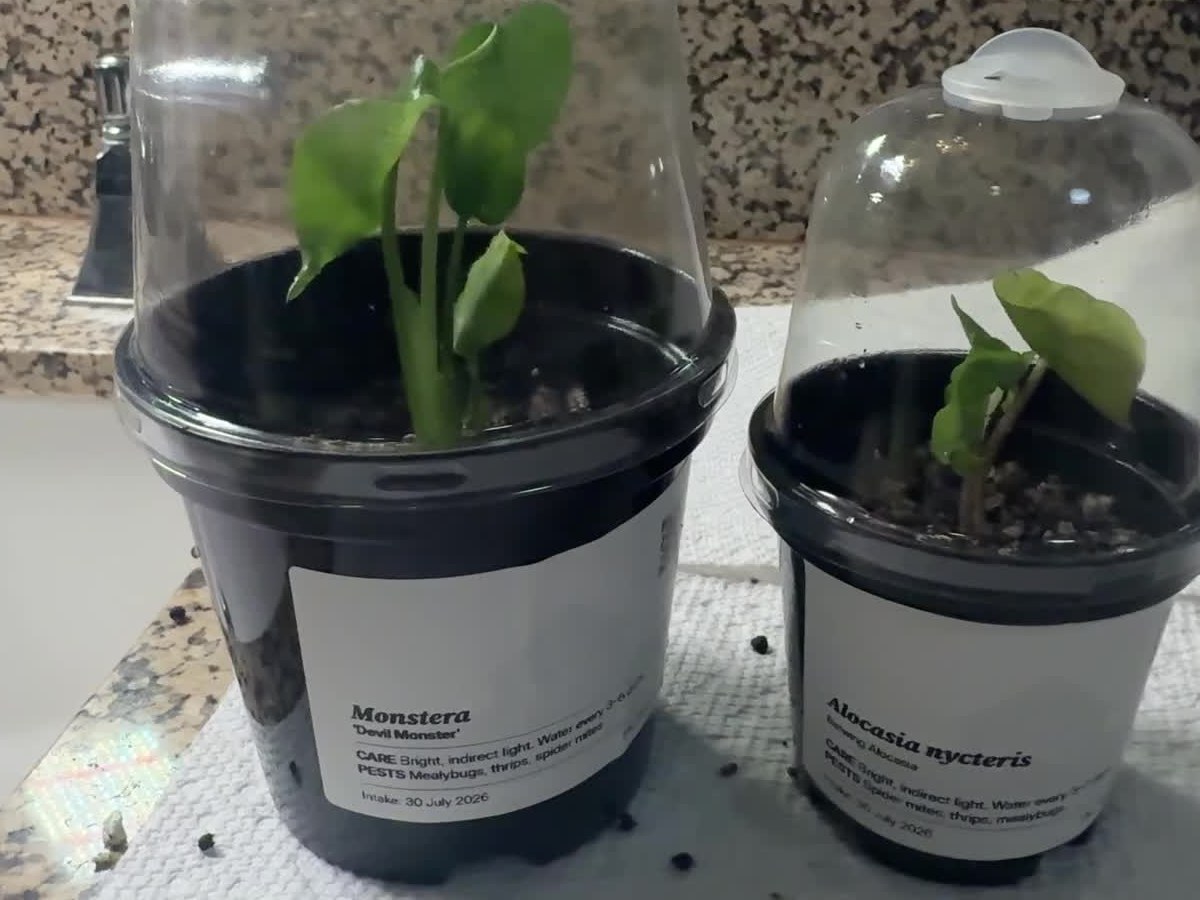
This is the version we ran before we standardized on iodine: a two-minute GrowSafe bath, and a pot filled, soaked, and shaken out before the plant ever went in. It worked, and every plantlet from that batch is still alive. Here's exactly what we did, and why we've since refined it.
Same protocol, an earlier version
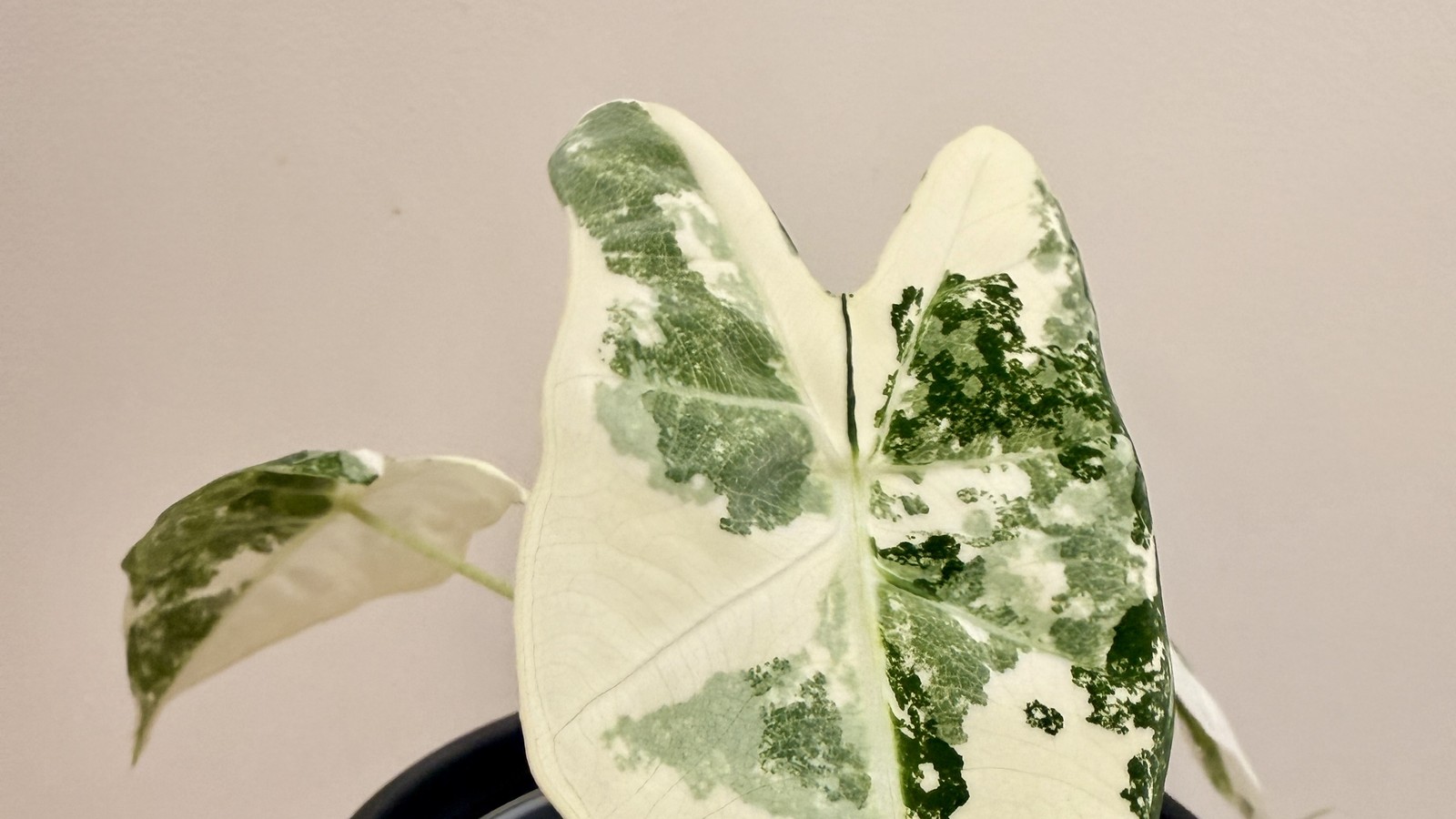
Protocol No. 01 covered deflasking (getting a tissue-cultured plant, one grown from a few cells in a sealed sterile flask, out of that flask and into soil) the way we do it now. This one looks backward. The plants in these photos, a tray of variegated Alocasia micholitziana 'Frydek', came out of the flask on an earlier version of the same protocol, and two things were different: the disinfecting dip and how we prepped the pots. Everything else was the same.
We're writing it up for two reasons. It's a clean record of a method that worked, and it's an honest account of why we changed it. If you've been deflasking with a botanical dip and a presoaked pot, there's nothing here to worry about. The Frydeks prove it holds up.
Watch: the full acclimation
The written protocol runs alongside the video from here.
The specimen
Alocasia micholitziana 'Frydek' is a velvet-leaved aroid (a member of the arum family, Araceae) from the Philippines, and this one is the variegated form, with the cream-and-green sectors you can see in the photos. That makes it a hard test case. The velvets are already fussier than the glossy Alocasias about humidity and rot, and a variegated one has less chlorophyll to run on while it re-roots. If a protocol carries a variegated Frydek through cleanly, that isn't luck.
The dip: a GrowSafe bath
Before potting, the rinsed plantlets got a two-minute bath in a mild dilution of GrowSafe, a botanical biopesticide labelled as an organic miticide, fungicide, and insecticide. The dip does one thing: knock back the fungi, bacteria, and stray pests riding on the tissue before it lands in a warm, humid pot where anything alive gets a running start (Chandra et al., 2010). Inside the flask everything is sterile. The second you open it, the plant is exposed, and the surface it's presenting is soft, sugar-coated, and has no defenses of its own.
GrowSafe handled it. We ran a mild dilution, kept the bath short, and saw no burn, no stalling, and nothing lost.
Why we run iodine now
Now every plant that comes out of a flask here gets a dilute povidone-iodine dip instead (the amber antiseptic sold as Betadine): two or three drops per cup of distilled water, a minute or two, and out (Capriotti et al., 2018). We didn't switch to fix a problem. We never lost a plantlet to GrowSafe, and the Frydeks from this batch are all still alive and pushing new leaves. Iodine just turned out to be gentler across a wider spread of species and cultivars, including the touchy ones, so it became the standard. If a method works but a gentler one works on more plants, that's the one we'd rather run.
The pot: soaked first, then planted
The other difference was how we built the pots. This run, we filled each one with the mix first, Fluval Stratum cut with #2 perlite, then soaked it through with a squirt bottle. We shook the pots up and down so gravity pulled the excess out, leaving the substrate damp and heavy but not dripping. Only then did we open a hole in the middle, set the plantlet in, and firm the mix around the roots to stand it up.
The point is that the roots meet moisture that's already settled evenly through the pot, with no dry pockets and no watering-in from the top afterward. A presoaked, shaken-out mix also won't slump the way dry substrate does when it first gets wet, so the plant stays put.
The way we do it now flips the order. Pot into the airy mix dry, seat the plant, then water in lightly to settle everything (see Protocol No. 01). Both land in the same spot, a plantlet standing in damp, breathable substrate. The presoak version just does the watering up front.
What didn't change
The rest is the deflasking protocol, start to finish. Rinse every trace of gel off the roots under gentle water, since that leftover sugar feeds microbes faster than it feeds the plant. Treat the flask-grown roots as an anchor rather than a water supply, because the working roots grow in after potting. Keep the new pot in bright, indirect light under a closed humidity dome, then crack the dome a little wider each day for about two weeks while the leaves rebuild the waxy cuticle (the plant's protective outer layer) and working pores they never needed in the flask (Mohammed et al., 2023; Sharma et al., 2023). Protocol No. 01 covers all of it.
The steps, in order
- Get the plantlets out of the flask. Work the whole clump of gel and roots loose in one piece so nothing tears.
- Wash all the gel away. Hold the roots under a soft, room-temperature stream and tease the medium out of the crown and off every root until the runoff is clear.
- Divide and tidy up. Ease clustered plantlets apart at the base, snip away only the tissue that's clearly browned or collapsed, and leave the healthy roots be.
- Give them a GrowSafe bath. Dip the rinsed plantlets in a mild dilution of GrowSafe for two minutes, then lift them out. (These days we use a dilute povidone-iodine dip here instead.)
- Build the pot wet. Fill each pot with Fluval Stratum and #2 perlite, soak it through with a squirt bottle, then shake the pot up and down so gravity carries the excess out.
- Open a hole and snug the plant in. Make a hole in the center, set the plantlet in, and firm the mix just enough to stand it up. No watering-in needed.
- Cover, then wean over about two weeks. Bright but indirect light, never direct sun. Start with the dome shut and vent it a little wider each day, until the plant is out in open room air and pushing new leaves.
Where people slip up
Leave gel on the roots and you hand fungi a lead you can't claw back. Rush the humidity weaning and you're asking a leaf with no cuticle to cope with air it was never built for. Two more worth naming: soaking the pot but forgetting to shake it out leaves the roots sitting in water instead of damp air, and pulling the dome too early wilts the plant faster than its roots can keep up.
The takeaway
If you're deflasking with a botanical dip and a presoaked pot, keep at it. It works, and the Frydeks prove it. We moved to an iodine dip because it's gentler on a wider range of plants, and that was the only reason. Pick the disinfectant that's kindest to the species in front of you, get the gel off, and don't rush the dome.
Capriotti, K., Pelletier, J., Barone, S., & Capriotti, J. (2018). Efficacy of dilute povidone-iodine against multi-drug resistant bacterial biofilms, fungal biofilms and fungal spores. Clinical Research in Dermatology: Open Access, 5(1), 1–5. [link]
Chandra, S., Bandopadhyay, R., Kumar, V., & Chandra, R. (2010). Acclimatization of tissue cultured plantlets: From laboratory to land. Biotechnology Letters, 32(9), 1199–1205. [link]
Mohammed, M., Munir, M., & Ghazzawy, H. S. (2023). Design and evaluation of a smart ex vitro acclimatization system for tissue culture plantlets. Agronomy, 13(1), 78. [link]
Sharma, N., Kumar, N., James, J., Kalia, S., & Joshi, S. (2023). Strategies for successful acclimatization and hardening of in vitro regenerated plants: Challenges and innovations in micropropagation techniques. Plant Science Today, 10(sp2), 90–97. [link]